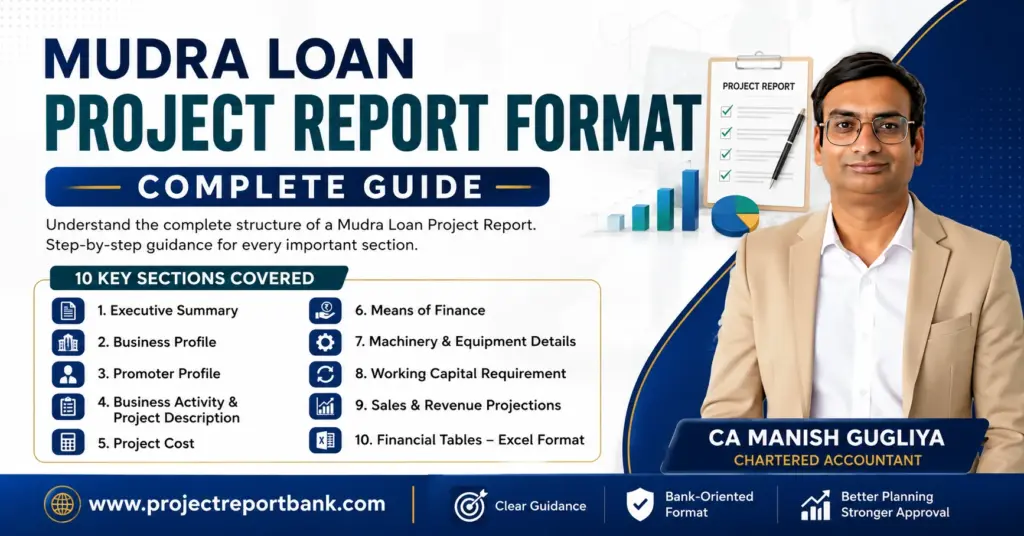
When you sit down to prepare a mudra loan project report, one of the first sections you need to write is the business profile. This is not a marketing brochure or a company advertisement. It is a precise, factual description that tells the banker what your business does, who runs it, where it operates, whether it is new or existing, and what the mudra loan will be used for. A project report is required to apply for a mudra loan, and the business profile is where the story of your enterprise begins for the lender. Mudra loans support Micro, Small, and Medium Enterprises (MSMEs) and are a significant instrument of financial inclusion, providing small loans to micro enterprises that often struggle to access formal bank loan facilities. Getting this section right can make the difference between a smooth appraisal and weeks of follow-up queries.
Key Takeaways
- The business profile in a mudra loan project report is a factual snapshot of the enterprise – not a sales pitch. It should clearly communicate what the business does, who promotes it, where it operates, and what the loan will finance.
- Bankers use this section to quickly assess the nature of activity, business model, promoter involvement, and proposed use of funds before examining detailed financials.
- Strong business details in a mudra loan project report must be internally consistent with project cost, sales assumptions, and financial projections elsewhere in the report.
- The format is flexible, but it should always cover name, constitution, nature of business, products or services, location, target customers, promoter background, and proposed project.
- In my experience as CA Manish Gugliya (ProjectReportBank.com), clear and specific business descriptions for mudra loan applications make appraisal smoother, though they do not guarantee sanction.
What Is a Business Profile in a Mudra Loan Project Report?
The business profile is the business overview section of your mudra loan project report that presents the company’s background and core facts about the enterprise. A mudra loan project report outlines business plans and financial needs, and the business profile is where you lay the foundation by describing your enterprise as a separate entity – its identity, activity, location, scale, and purpose. It answers who the enterprise is, what it does, where it operates, whom it serves, and what part of the business is being financed under pradhan mantri mudra yojana.
This section is different from the promoter profile, which focuses on the individual owners’ education, experience, and personal credentials. It is also distinct from the executive summary, which provides a compact overview of the business model, project cost, and loan requirement in condensed form. Financial projections – the numeric estimates of income, expenses, and profitability – belong in their own section. And unlike a general company marketing profile, the project company profile in a loan project report is written for credit appraisal, not customer perception.
A project report includes business description and market analysis. Banks treat the business profile as a concise snapshot that supports quick understanding of the mudra loan project, especially for loans under Shishu (up to ₹50,000), Kishore (₹50,001–₹5,00,000), and Tarun (₹5,00,001–₹10,00,000) categories. Mudra loan schemes are categorized into Shishu, Kishore, and Tarun, and mudra loans offer up to ₹10 lakh without collateral, which makes the quality of your project report even more critical.
Table of Contents
Why Is the Business Profile Important in a Mudra Loan Project Report?
From a banker’s appraisal perspective, many branch managers first scan the business profile in a mudra loan project report before they examine detailed financials. Banks require project reports to evaluate loan viability, and this section gives the credit officer a quick mental picture of the enterprise.
The business profile helps the lender understand the nature of business – whether it is manufacturing, trading, or service – the scale of operations, the customer base, and the linkage between the loan amount and the business model. Business reports should contain operational details to validate plans to lenders. A clear project report can speed up loan processing times because it reduces the need for repeated clarifications during the loan process. Key financial ratios assess repayment capacity and viability, but those ratios are meaningful only when the underlying business activity is clearly understood.
A clear business description for mudra loan reduces follow-up queries, avoids confusion about activity (for example, distinguishing between retail readymade garments and tailoring services), and supports risk assessment. Mudra loan project reports help banks assess repayment ability, and a well-described business profile is a strong starting point.
However, a strong business profile does not by itself guarantee approval. Other factors – financials, credit history, repayment capacity – matter equally. You can read more about this in the article on whether a project report guarantees Mudra Loan approval. Lenders cross-check this section with KYC, financial documents, stock levels, and projected sales to assess internal consistency of the loan project report.

What Information Should Be Included in the Business Profile?
A practical business profile format for mudra loan should cover the following elements. The business profile should include basic enterprise details and promoter backgrounds, and each sub-point is usually 2–5 lines, written in simple English or local language as accepted by the bank. The same basic structure works for Shishu, Kishore, and Tarun categories, with the level of detail increasing as loan size increases. Use consistent dates and legal names exactly as appearing in registrations like Udyam, GST, or shop act.
Name of the Business
The business name should match your bank account, GST registration, Udyam certificate, or local licence. For example, “M/s Shree Balaji Readymade Garments” – not a slogan or informal name. Where the trade name is different from the applicant’s personal name (common in proprietorships), both should be mentioned, such as “Proprietor: Mr. Rajesh Kumar, trading as M/s Shree Balaji Readymade Garments.” Keep this to 2–3 short lines.
Constitution of the Business
State clearly whether the entity is a proprietorship concern, partnership firm, LLP, or private limited company as on the date of the report. Mention registration status where relevant: “Proprietorship, registered under Udyam since April 2023.” No detailed legal comparison is needed – just enough information so the banker knows whose liability is involved in the business loan.
New or Existing Business
Include a clear statement such as “Proposed new business to be started in November 2026” or “Existing business since FY 2019–20.” For existing businesses, indicate years in operation and a broad turnover range without giving full financial projections. For expansion cases, state both current activity and what will change after the mudra loan – for example, adding a second machine or a new product line.
Nature of Business
Business activities should be classified as manufacturing, trading, or services. Specify precisely: “retail trade in mobile accessories” instead of vague “electronics business.” This description should match the activity code used in your Udyam registration.
Weak: “Garments business.” Better: “Retail trading of ladies’ kurtis and kids’ wear through a 250 sq. ft. shop in Kota, serving students and local households.”
The project commercial aspects of the business become much clearer with specific descriptions.
Products or Services
List all the products or services that generate revenue, focusing on primary items. For manufacturing, include product type and basic specification (e.g., “mild steel window grills and gates for residential buildings”). For services, mention how the service is delivered – shop-based, on-site, or online. Avoid over-promotion; keep statements modest and factual. The report should include market analysis and funding needs, but this subsection is about describing what you sell, not claiming market dominance.
Business Location
The location of the business affects its market reach and operational success. Mention full address or at least area and city, whether premises are owned or rented, and approximate size: “200 sq. ft. rented shop in main market, Bhilwara, Rajasthan.” Connect location to business logic – “shop located near coaching institutes to attract student customers.” For manufacturing units, indicating the industrial area name helps bankers understand infrastructure and zoning. Include the space or land requirement for the proposed project where relevant.
Target Customers and Market Area
The target market description should include customer segments and competitive landscape. Describe target customers in simple terms: college students, local households, small retailers, contractors, or online buyers. Clarify whether the business is B2B, B2C, or mixed, and whether the market area is local, district-level, state-level, or pan-India. Claims about demand should be realistic – reference nearby housing societies, schools, or industrial units rather than making unsupported national-level claims. Customer perception of your products can be mentioned briefly if supported by facts.
Promoter Background and Experience
Keep this concise – 4–6 lines – because a detailed promoter profile will generally appear separately. Mention education qualification (e.g., “B.Com, 2017, University of Rajasthan”), technical training, and years of industry experience. Earlier self-employment, family business involvement, or specific skills (like repairing smartphones or operating CNC machines) should be highlighted. Any background in business administration or related management roles adds credibility.
Existing Business Performance
This subsection applies only if you run an existing business. Mention year of starting, general sales trend, and an approximate turnover band: “annual turnover in the range of ₹18–22 lakh during FY 2023–24, based on GST and sales records.” No unaudited or inflated figures – this must align with tax returns and financial documents submitted to the bank. Note any achievements export orders or significant milestones, if any.
Proposed Project or Expansion
Loan report profiles should specify the purpose of the loan and expected outcomes. Describe what the mudra loan project covers: new setup, specific machinery, increase in stock, renovation, or working capital facility. Connect the proposal to expected business impact – increased capacity, anticipated revenue growth, or improved customer reach. For example, the project might involve a term loan for machinery and partial fulfilment of working capital needs. Mention broad project cost components in words, leaving detailed numbers for the project cost table. Include project logistics details such as installation timeline or supplier arrangements.
Employment and Manpower
Employment information should describe current jobs and expected new hires after funding. Mention existing and proposed manpower: “promoter plus 1 salesman and 1 helper” or “2 machine operators.” Highlighting employees working locally strengthens the profile. Wages and salary costs must agree with staff numbers assumed in the expense estimates and financial projections later in the report.
Business Profile Format for Mudra Loan Project Report
A simple structured table helps present business details in a mudra loan project report clearly for bankers. A standard project report format is accepted by most banks, though minor variations are common.
| Particular | Information to Mention |
|---|---|
| Business Name | Registered name of enterprise |
| Constitution | Proprietorship / Partnership / LLP / Company |
| Promoter | Name and relevant background |
| Business Status | New / Existing / Expansion |
| Nature of Activity | Manufacturing / Trading / Service |
| Products/Services | Main offerings |
| Business Location | Address, owned/rented, approximate size |
| Target Market | Main customer groups and market area |
| Experience | Relevant promoter or business experience |
| Project Purpose | New setup / expansion / working capital |
| Employment | Existing and proposed manpower |
Banks do not prescribe a single compulsory format. Minor customisation is acceptable as long as the content remains complete, factual, and internally consistent with the rest of the report.
Sample Business Profile for a New Business
The following is an illustrative business profile example for mudra loan only. Actual details must be based on the reader’s own business.
M/s Shree Sai Mobile Accessories & Repair Centre is a proposed proprietorship enterprise to be established by Mr. Anil Sharma in Vaishali Nagar, Jaipur, Rajasthan. The business idea involves retail trading of mobile accessories (covers, chargers, earphones, tempered glass) along with basic mobile phone repair services from a 180 sq. ft. rented shop. The target customers are students, working professionals, and local residents in a market area near three coaching institutes and two colleges. Mr. Sharma holds a diploma in electronics and has 4 years of experience working as a technician in a mobile repair shop. The business is proposed to commence in January 2027. Under the current mudra loan project, a Kishore category loan of ₹3,50,000 is sought for shop fitting, furniture, repair tools, initial stock of accessories, signboard, and working capital for the first three months. Approximate project cost is ₹4,20,000 including promoter’s own contribution of ₹70,000.
This business profile works because it is specific, avoids jargon, shows relevant experience, and clearly connects the proposed loan to business activity. It gives the banker enough to visualise the enterprise and cross-check with project cost and revenue assumptions.
Sample Business Profile for an Existing Business
This is another illustrative business profile format for mudra loan, this time for an existing micro enterprise seeking expansion.
M/s Krishna Masala Udyog is a proprietorship concern promoted by Mr. Dinesh Patel, operating since September 2021 from a 400 sq. ft. rented unit in Rajendra Nagar Industrial Area, Indore, Madhya Pradesh. The enterprise is engaged in manufacturing of ground spices including turmeric powder, chilli powder, and coriander powder. Current annual turnover is in the range of ₹18–22 lakh (FY 2024–25), based on GST returns. The unit supplies to approximately 60 local kirana shops and 5 small wholesalers in Indore and Dewas districts. Mr. Patel has 8 years of experience in the food products trading business, including 3 years of managing his own commercial manufacturing processes at this unit. The enterprise holds FSSAI licence and Udyam registration. Under the proposed mudra loan project, a Tarun category loan of ₹8,00,000 is sought for procurement of an additional pulveriser machine, a semi-automatic packing machine, and money for increased stock of raw spices during peak season. The expansion is expected to increase production capacity by approximately 40% and enable supply to additional retail outlets in nearby districts.
This profile clearly separates present business performance from the proposed project – important when the banker compares it with past financials and projected increase in sales.
How to Write a Strong Business Description for Mudra Loan
A strong business description for mudra loan should quickly answer eight questions: what the business does, what it sells, who its customers are, where it operates, who manages it, what experience supports it, what is being proposed, and why finance is needed.
Here is a simple formula you can adapt:
“M/s [Name] is a [constitution] engaged in [manufacturing/trading/service] of
at [location], catering mainly to [customers] in [market area]. The business is promoted by [name] who has [experience]. Under the current mudra loan project, the unit proposes to [project description], for which a bank loan of ₹[amount] is sought under [Shishu/Kishore/Tarun] category.”
Project Report eBook Zinc Sulphate
₹1,499 Buy NowSmall Business Project Report
₹14,999 Buy NoweBook Myths About GST Search
₹499 Buy NoweBook AI Manufacturing Ideas
₹500 Buy NoweBook White Label Business
₹500 Buy NoweBook Indian Jewellery Business
₹500 Buy NoweBook Imitation Jewellery Business
₹500 Buy NoweBook Diamond Gemstone Jewellery
₹500 Buy NoweBook Jewellery Franchise
₹500 Buy NoweBook Jewellery Export
₹500 Buy NoweBook Lab Grown Diamond
₹500 Buy NoweBook Medical Devices Manufacturing
₹500 Buy NoweBook Ayurvedic Cosmetic
₹500 Buy NoweBook 3D Printing Business
₹500 Buy NoweBook Rare Earth Magnet Recycling
₹500 Buy NoweBook Gold Refining Business
₹500 Buy NoweBook Drone Parts Manufacturing
₹500 Buy NoweBook Moduler Funiture
₹500 Buy NoweBook on Future of Agribusiness
₹500 Buy NoweBook on Smart Tips for Bootstrapping a stratup
₹500 Buy NoweBook on Green Tech Startup
₹500 Buy NowBasic eBook Hydrogen
₹500 Buy NowBasic eBook PLI Scheme
₹500 Buy NowInvestor Plan 20% Advance Project Report
₹25,000 Buy NowBankable Project Report 20% Advance
₹7,000 Buy NoweBook EV Battery Recycle
₹1,000 Buy NowHow to Start an Ice Manufacturing Plant in India: A Complete Guide
₹500 Buy NowSaree Reselling Business: A Step-by-Step Guide for Beginners
₹500 Buy NowComprehensive Foam Mattress Making Project Report: Steps, Costs, and Market Trends
₹500 Buy NowBest Mini Oil Mill Project Report PDF for Efficient Oil Extraction
₹500 Buy NowThe Art of Cricket Bat Manufacturing: A Comprehensive Guide
₹500 Buy NowPineapple Processing Project Report
₹500 Buy NowSoldering Wire Manufacturing Project Report
₹500 Buy NowHerbs Processing Project Report
₹500 Buy NowComputer And Laptop Repairing Service Project Report
₹500 Buy NowStrawberry Jam Project Report
₹500 Buy NowLemon Processing Project Report
₹500 Buy NowOrange Processing Project Report
₹500 Buy NowCashew Nut Processing Unit Project Report
₹500 Buy NowLarge Cardamom Processing Project Report
₹500 Buy NowBetel Nut Mouth Freshener Project Report
₹500 Buy NowSpring Manufacturing Project Report
₹500 Buy NowBucket Mop Manufacturing Project Report
₹500 Buy NowPrimary School Project Report
₹500 Buy NowWater Tap Project Report
₹500 Buy NowHard Trolley Bag Project Report
₹500 Buy NowBicycle Manufacturing Project Report
₹500 Buy NowSugarcane Bagasse Particle Board Project Report
₹500 Buy NowBagasse Paper Project Report
₹500 Buy NowSabudana Factory Project Report
₹500 Buy NowElectric Weighing Machine Project Report
₹500 Buy NowAutomobile Rubber Beading Project Report
₹500 Buy NowBAMBOO PLY BOARD PROJECT REPORT
₹500 Buy NowSolar Light Assembling Project Report
₹500 Buy NowCookies Biscuit Making Project Report
₹500 Buy NowAAC Blocks Project Report
₹500 Buy NowMayonnaise Making Unit Project Report
₹500 Buy NowBindi Making Project Report
₹500 Buy NowFootball Manufacturing Project Report
₹500 Buy NowCustard Powder Project Report
₹500 Buy NowHair Oil Project Report
₹500 Buy NowProject Report On Maize Starch
₹500 Buy NowEvent Management Business Project Report
₹500 Buy NowSunflower Oil Project Report
₹500 Buy NowApricot Oil Project Report
₹500 Buy NowMango Juice Project Report
₹500 Buy NowEyeglass Frame Manufacturing Project Report
₹500 Buy NowElectric Vehicle Spare Parts Project Report
₹500 Buy NowProjector Assembly Unit Project Report
₹500 Buy NowLiquid Dish Wash Making Unit Project Report
₹500 Buy NowWaste Textile Fabric Recycling Project Report: Boost Sustainability with Comprehensive Guide
₹500 Buy NowMirror Glass Project Report
₹500 Buy NowThermowaste Recycling Project Report
₹500 Buy NowBiomass Briquettes Project Report
₹500 Buy NowMushroom Cultivation Project Report
₹500 Buy NowWooden Toys Project Report
₹500 Buy NowBetel Vine Oil Project Report
₹500 Buy NowHoney Processing Plant Project Report
₹500 Buy NowA4 Paper Project Report
₹500 Buy NowLithium Ion Battery Project Report
₹500 Buy NowWire Nail Manufacturing Project Report
₹500 Buy NowFloor Heating Mats Project Report
₹500 Buy NowIce Cream Cone Project Report
₹500 Buy NowPlastic Injection Molding Project Report
₹500 Buy NowPaint Manufacturing Project Report
₹500 Buy NowPhenyl Project Report
₹500 Buy NowLock Manufacturing Project Report
₹500 Buy NowClub And Bar Project Report
₹500 Buy NowOats Making Project Report
₹500 Buy NowHomestay Project Report
₹500 Buy NowPlastic Molded Toys Project Report
₹500 Buy NowPackers and Movers Service Project Report
₹500 Buy NowCorn Puff Project Report
₹500 Buy NowCraft Beer Project Report
₹500 Buy NowProject Report For Color Capsicum In Polyhouse
₹500 Buy NowJeera Biscuit Project Report
₹500 Buy NowBajra Flour Project Report
₹500 Buy NowAnchor Hook Project Report
₹500 Buy NowEssential Guidelines for Developing an E-Waste Recycling Project Report
₹500 Buy NowUtensil Cleaning Powder Project Report
₹500 Buy NowHandmade Paper Project Report
₹500 Buy NowMango Pulp Processing Project Report
₹500 Buy NowCotton Buds Project Report
₹500 Buy NowFrozen French Fry Project Report
₹500 Buy NowLED Bulb Project Report
₹500 Buy NowCoaching Institute Project Report
₹500 Buy NowDog Grooming Center Project Report
₹500 Buy NowRabri Making Unit Project Report
₹500 Buy NowHing Processing Project Report
₹500 Buy NowKing Chilli Processing Project Report
₹500 Buy NowJuice Corner Project Report
₹500 Buy NowAir Bubble Sheet Project Report
₹500 Buy NowHand Made Jewelry Project Report
₹500 Buy NowFruit and Vegetable Store Project Report
₹500 Buy NowInterior Designing Services Project Report
₹500 Buy NowElectric Fan Manufacturing Plant Project Report
₹500 Buy NowSoya Milk Plant Project Report
₹500 Buy NowBanana Paper Project Report
₹500 Buy NowFashion Design School Project Report
₹500 Buy NowChikki Making Unit Project Report
₹500 Buy NowHR Consultancy Project Report
₹500 Buy NowWood Recycling Project Report: Essential Strategies & Trends
₹500 Buy NowEngine Flushing Oil Manufacturing Project Report
₹500 Buy NowBamboo Sticks Project Report
₹500 Buy NowBanana Powder Manufacturing Project Report
₹500 Buy NowDisposable Plastic Syringes Project Report
₹500 Buy NowGrease Manufacturing Project Report
₹500 Buy NowGinger Garlic Paste Project Report
₹500 Buy NowCopper Powder Project Report
₹500 Buy NowEnvelope Project Report
₹500 Buy NowCoriander Seeds Processing Project Report
₹500 Buy NowMushroom Processing Project Report
₹500 Buy NowClay Bricks Project Report
₹500 Buy NowPeda Processing Unit Project Report
₹500 Buy NowHostel Business Plan & PG in India – Project Report Guide
₹500 Buy NowMobile Phone Store Project Report
₹500 Buy NowPasta Making Project Report
₹500 Buy NowDaycare Centre Project Report
₹500 Buy NowCourier Services Business Project Report
₹500 Buy NowGreen Chili Sauce Project Report
₹500 Buy NowMatchbox Manufacturing Project Report
₹500 Buy NowMosquito Repellent Agarbatti Business Project Report
₹500 Buy NowCCTV Camera Assembly Unit Project Report
₹500 Buy NowSoya Paneer Project Report
₹500 Buy NowSolar Charkha Yarn Project Report
₹500 Buy NowMouth Freshener Making Unit Project Report
₹500 Buy NowGerbera Cultivation Project Report
₹500 Buy NowPopcorn Processing Project Report
₹500 Buy NowDrumstick Farming Project Report
₹500 Buy NowKurkure Project Report
₹500 Buy NowRusk Biscuit Project Report
₹500 Buy NowFood Tiffin Delivery Business Project Report
₹500 Buy NowGas Lighter Project Report
₹500 Buy NowOld Age Homes Project Report Comprehensive Guide: Planning and Impact
₹500 Buy NowMultigrain Flour Mill Project Report
₹500 Buy NowBiodiesel Project Report
₹500 Buy NowAluminium Extrusion Plant Project Report
₹500 Buy NowPlastic Bucket Project Report
₹500 Buy NowSuper Market Project Report
₹500 Buy NowMenthol Mint Oil Project Report
₹500 Buy NowBathroom Fittings Project Report
₹500 Buy NowChapati Making Business Project Report
₹500 Buy NowGajak Processing Unit Project Report
₹500 Buy NowBlood Bags Project Report
₹500 Buy NowAgro Service Centre Project Report
₹500 Buy NowCNG Pump Project Report
₹500 Buy NowOnline Tutorial Project Report
₹500 Buy NowReady Made Ghee Diya Project Report
₹500 Buy NowYarn Dyeing Project Report
₹500 Buy NowWooden furniture Project Report
₹500 Buy NowGalvanized Roofing Sheets Project Report
₹500 Buy NowSoya Chunks Project Report
₹500 Buy NowScrew Manufacturing Project Report
₹500 Buy NowKids Play School Project Report
₹500 Buy NowPlastic Waste To Fuel Project Report
₹500 Buy NowSlipper Manufacturing Project Report
₹500 Buy NowYoga Mat Project Report
₹500 Buy NowNoodles Project Report
₹500 Buy NowLiquid Soap Project Report
₹500 Buy NowLubricant Oil Project Report
₹500 Buy NowTwo Wheeler Repairing Service Project Report
₹500 Buy NowToughened Glass Project Report
₹500 Buy NowJam Jelly Sauce And Pickles Project Report
₹500 Buy NowSolid Shoe Polish Project Report
₹500 Buy NowGinger Processing Project Report
₹500 Buy NowClay Kulhar Making Unit Project Report
₹500 Buy NowWedding Planner Project Report
₹500 Buy NowChilli Powder Processing Project Report
₹500 Buy NowAmla Processing Project Report
₹500 Buy NowAreca Cutlery Palm Leaf Plate Project Report
₹500 Buy NowCeramic Mugs Project Report
₹500 Buy NowSoya Oil Refinery Plant Cost in India: Soybean Oil Project Report Manufacturing Process Download PDF
₹500 Buy NowDesiccated Coconut Powder Project Report
₹500 Buy NowJackfruit Processing Project Report
₹500 Buy NowPetha Making Unit Project Report
₹500 Buy NowAluminium Foil Container Project Report
₹500 Buy NowJaggery Making Unit Project Report
₹500 Buy NowPottery Products Project Report
₹500 Buy NowFruit Juice And Squash Project Report
₹500 Buy NowHydroponics Project Proposal PDF: Essential Report Overview and Business Plan
₹500 Buy NowGummed Paper Tape Project Report
₹500 Buy NowGypsum Board Project Report
₹500 Buy NowRose Water Project Report
₹500 Buy NowExtension Board Project Report
₹500 Buy NowSugarcane Juice Bar Project Report
₹500 Buy NowPeanut Butter Project Report
₹500 Buy NowWaste Glass Recycling Plant Project Report
₹500 Buy NowPackaged Drinking Water Plant Project Report
₹500 Buy NowKhoya Manufacturing Project Report
₹500 Buy NowPeppermint Oil Project Report
₹500 Buy NowWall Putty Project Report
₹500 Buy NowAluminium Utensils Project Report
₹500 Buy NowMassage Oil Project Report
₹500 Buy NowAluminium Fabrication Project Report
₹500 Buy NowPet Jar Project Report
₹500 Buy NowEV Charging Station Project Report
₹500 Buy NowPetroleum Jelly Project Report
₹500 Buy NowPanipuri Business Project Report
₹500 Buy NowMelamine Crockery Project Report
₹500 Buy NowCeramic Crockery Project Report
₹500 Buy NowBaby Cereal Project Report
₹500 Buy NowAluminium Casting Project Report
₹500 Buy NowTomato Ketchup Project Report
₹500 Buy NowWheel Balancing Alignment
₹500 Buy NowRaisin (Kishmish) Project Report
₹500 Buy NowCotton Wicks Project Report
₹500 Buy NowFloor Cleaner Project Report
₹500 Buy NowStaple Pins Project Report
₹500 Buy NowBronze Bushes Project Report
₹500 Buy NowPET Preform Project Report
₹500 Buy NowGalvanised MS Wire Project Report
₹500 Buy NowBrass Utensil Project Report
₹500 Buy NowLiquid Detergent Project Report
₹500 Buy NowComprehensive Perfume Manufacturing Project Report: Costs, Setup, and Market Analysis
₹500 Buy NowCharcoal Facewash Project Report
₹500 Buy NowTalcum Powder Project Report
₹500 Buy NowUPVC Doors Windows Project Report
₹500 Buy NowDetergent Cake Project Report
₹500 Buy NowPVC Pipe Manufacturing Plant Project Report
₹500 Buy NowBiogas Plant Project Report Manufacturing Process Business Plan
₹500 Buy NowBio CNG Plant Project Report PDF for Effective Renewable Energy Solutions
₹500 Buy NowBath Soap Project Report
₹500 Buy NowDhupbatti Manufacturing Project Report
₹500 Buy NowPaneer Production Project Report
₹500 Buy NowOffset Printing Project Report
₹500 Buy NowNamkeen Manufacturing Project Report
₹500 Buy NowSchool Bag Project Report
₹500 Buy NowPencil Manufacturing Project Report
₹500 Buy NowChalk Manufacturing Project Report
₹500 Buy NowCattle Feed Project Report
₹500 Buy NowPen Manufacturing Project Report
₹500 Buy NowCar Wash Project Report
₹500 Buy NowTea Processing Project Report
₹500 Buy NowDehydrated Onion Project Report
₹500 Buy NowCucumber Farming Project Report
₹500 Buy NowDehydrated Fruits And Vegetables Project Report
₹500 Buy NowDehydrated Garlic Project Report
₹500 Buy NowHarra Oil Project Report
₹500 Buy NowOrganic Waste Compost Project Report
₹500 Buy NowCompostable Bag Project Report
₹500 Buy NowAluminium Recycling Project Report
₹500 Buy NowCastor Oil Project Report
₹500 Buy NowBroom Manufacturing Project Report
₹500 Buy NowConcertina Wire Project Report
₹500 Buy NowAllen Screws Project Report
₹500 Buy NowWire Mesh Fencing Project Report
₹500 Buy NowSurgical Gloves Project Report
₹500 Buy NowBamboo Shoot Pickle Canned Project Report
₹500 Buy NowIV Bottles Project Report
₹500 Buy NowPlywood Manufacturing Project Report
₹500 Buy NowWheat Dalia Project Report
₹500 Buy NowPlastic IV Bags Project Report
₹500 Buy NowMaize Flour Mill Project Report
₹500 Buy NowSurgical Adhesive Plasters Project Report
₹500 Buy NowWood Carving Project Report
₹500 Buy NowSurgical 3 Ply Mask Project Report
₹500 Buy NowPulse Dal Mill Project Report
₹500 Buy NowSoya Flour Project Report
₹500 Buy NowBaheda Oil Project Report
₹500 Buy NowNeem Oil Project Report
₹500 Buy NowCitronella Oil Project Report
₹500 Buy NowGeranium Oil Project Report
₹500 Buy NowSurgical Adhesive Tapes Project Report
₹500 Buy NowComprehensive Paver Block Project Report PDF
₹500 Buy NowCLC Blocks Project Report
₹500 Buy NowCoir Brushes Manufacturing Project Report
₹500 Buy NowAbsorbent Cotton Project Report
₹500 Buy NowSchool Uniform Project Report
₹500 Buy NowPlaster of Paris Project Report
₹500 Buy NowCold Storage 5000 MT Project Report
₹500 Buy NowCello Tape Project Report
₹500 Buy NowDetergent Powder Project Report
₹500 Buy NowBesan Mill Project Report
₹500 Buy NowComprehensive Notebook Manufacturing Plant Project Report: Costs & Setup
₹500 Buy NowHealthcare Oxygen Project Report
₹500 Buy NowJute Shopping Bag
₹500 Buy NowSafety Pin Manufacturing
₹500 Buy NowPaper Clip Project Report
₹500 Buy NowAutomobile Workshop Project Report
₹500 Buy NowBanana Wafer Project Report
₹500 Buy NowCorrugated Box Project Report
₹500 Buy NowCement Pipe Manufacturing Project Report
₹500 Buy NowNaphthalene Balls Project Report
₹500 Buy NowNuts And Bolts Project Report
₹500 Buy NowBread Making Project Report
₹500 Buy NowSoft Toys Project Report
₹500 Buy NowRubber Eraser Project Report
₹500 Buy NowLemongrass Oil Project Report
₹500 Buy NowRubber Band Project Report
₹500 Buy NowSanitary Napkins Project Report
₹500 Buy NowVirgin Coconut Oil Project Report
₹500 Buy NowSurgical Bandage Manufacturing Project Report
₹500 Buy NowComprehensive Paper Plate Making Project Report for Success and Profit
₹500 Buy NowPaper Cup Project Report
₹500 Buy NowHollow Bricks Project Report
₹500 Buy NowTyre Retreading Project Report
₹500 Buy NowNail Polish Project Report
₹500 Buy NowElectronic Repair Project Report
₹500 Buy NowSteel Scrubbers Project Report
₹500 Buy NowHow to Start Cloud Kitchen: Best Tips for 2025
₹500 Buy NowFlex Printing Project Report
₹500 Buy NowWedding Banquet Hall Project Report
₹500 Buy NowGinger Oil Project Report
₹500 Buy NowFood Truck Project Report
₹500 Buy NowFast Food Restaurant Project Report
₹500 Buy NowComprehensive Ceramic Tiles Project Report: Manufacturing Cost and Industry Trends
₹500 Buy NowSoft Drinks Project Report
₹500 Buy NowBiodegradable Plastic Bags Project Report
₹500 Buy NowPet Bottle Project Report
₹500 Buy NowPet Bottle Recycling Project Report Comprehensive Guide
₹500 Buy NowPVC Tape Project Report
₹500 Buy NowPotato Powder Manufacturing Project Report
₹500 Buy NowHand Sanitizer Project Report
₹500 Buy Now1000MT Cold Storage Project Report
₹500 Buy NowTissue Paper Napkin Project Report
₹500 Buy NowPlastic Recycling Project Report
₹500 Buy NowPaper Bag Project Report
₹500 Buy NowNon Woven Bags Project Report
₹500 Buy NowJute Gunny Bags Project Report
₹500 Buy NowIce Cream Parlour Project Report
₹500 Buy NowTop Tips for Crafting the Perfect Petrol Pump Project Report
₹500 Buy NowPapad Udyog Project Report
₹500 Buy NowMasala Udyog Project Report
₹500 Buy NowGYM Project Report
₹500 Buy NowCandle Making Project Report
₹500 Buy NowStone Crusher Project Report
₹500 Buy NowComprehensive Potato Chips Project Report: Setup, Costs, and Machinery
₹500 Buy NowLaundry Project Report
₹500 Buy NowAgarbatti Business Project Report
₹500 Buy NowMedical Shop Project Report for Bank Loan PDF Download: Pharmacy Startup Business Plan
₹500 Buy NowGarment Shop Project Report
₹500 Buy NowDental Clinic Project Report
₹500 Buy NowFly Ash Bricks Project Report
₹500 Buy NowBarbed Wire Manufacturing Project Report
₹500 Buy NowComputer Institute Project Report
₹500 Buy NowMustard Oil Mill Project Report
₹500 Buy NowMastering the Essentials of a Groundnut Oil Mill: Costs and Process Explained
₹500 Buy NowCoconut Oil Project Report
₹500 Buy NowCoffee Cafe Shop Project Report
₹500 Buy NowTent House Project Report
₹500 Buy NowRestaurant Project Report
₹500 Buy NowPhotography Studio Project Report
₹500 Buy NowStationery Shop Project Report
₹500 Buy NowBakery Project Report
₹500 Buy NowBoutique Project Report
₹500 Buy NowGrocery Shop Project Report
₹500 Buy NowRO Drinking Water Plant Project Report Complete Guide with eBook Download
₹500 Buy NowBeauty Parlour Project Report eBook – Cost, Profit & Download Guide
₹500 Buy Now































































































































































Use short sentences, local place names, and real activities rather than generic phrases like “huge demand.” The language should be understandable for a branch manager reading dozens of loan project reports every month.
Weak vs Strong Business Profile Example
Many mudra loan applications fail to communicate the business properly because the business overview in the mudra loan project report is written in vague language.
| Weak Description | Better Description |
|---|---|
| “Applicant wants to start a garment business.” | “Retail trading of ladies’ kurtis and kids’ wear through a 250 sq. ft. shop in Kota main market, targeting students from nearby coaching institutes and local households.” |
| “We provide electronic services.” | “Mobile phone and charger repair service with walk-in and on-site options, operating from a shop in Vaishali Nagar, Jaipur, serving students and working professionals.” |
| “Manufacturing unit for food items.” | “Manufacturing of ground turmeric and chilli powder in a 400 sq. ft. unit in Indore, supplying to local kirana shops and wholesalers in Indore and Dewas districts.” |
| “Trading business of general items.” | “Wholesale trading of stationery and office supplies to schools, coaching centres, and small offices in Udaipur, similar in format to how large retailers like Big Bazaar serve general consumer needs but at a local wholesale level.” |
The stronger versions help the banker visualise the business and link it with project cost, working capital requirement, and sales projections. Vague descriptions force the credit officer to guess, which delays the process or leads to constructive criticism during appraisal.
Common Mistakes While Writing Business Profile
In my experience as a practising CA, many business profile sections in mudra loan reports are questioned because of recurring issues.
- Vague activity description: Writing “electronics” or “manufacturing” without specifying what product. Fix: use precise descriptions matching your Udyam or GST registration.
- Copying another project report: Banks notice when the same generic text appears across different applicants. Fix: write details specific to your own business.
- Inconsistent business name: Trade name in the profile doesn’t match bank account or registration documents. Fix: use the exact registered name.
- Mismatched dates: Start year in the profile contradicts financial statements. Fix: cross-check all dates before submission.
- Unsupported turnover claims: Stating turnover figures not backed by GST returns or bank statements. Fix: mention only verifiable figures.
- Heavy promotional language: Using “world-class” or “best quality” without evidence. Fix: keep descriptions factual.
- Mismatch with financial projections: Describing a purely service business while projecting large raw material consumption. Fix: ensure the nature of business matches expense line items.
- Not distinguishing existing vs proposed: Mixing current operations with future plans. Fix: clearly separate what exists today from what the loan will finance.
Cross-check the business profile with financial documents and the project cost statement before finalising.
Business Profile for Manufacturing vs Trading vs Service Business
While the overall business profile format for mudra loan remains similar, the emphasis changes depending on the type of enterprise.
Manufacturing
Focus on what is being manufactured, scale or capacity (e.g., 100 kg per day), basic machinery names, key raw materials, and main customers. Mention whether production follows specific manufacturing processes – job work, own-brand, or both. If regulatory approvals like FSSAI are obtained, mention them. Note any export orders or achievements export orders if applicable.
Trading
Mention product range, whether trading is wholesale or retail, typical purchase sources, and approximate stock-holding pattern. Clarify the sales channel – shop-front, door-to-door, online marketplaces, or B2B supply. Describe how advertising strategies help reach customers, if relevant. Connecting stock requirement with working capital finance is important in the profile.
Service
Describe the type of service – beauty parlour, coaching centre, repair workshop – the key equipment required, and whether service is location-based or provided at customer premises. Mention qualifications or licences where applicable. In service businesses, manpower skills and customer relationships are often more important than inventory, so highlight them accordingly.
Information to Collect Before Writing the Business Profile
Collecting correct data in advance avoids corrections and inconsistencies later. Gather the following details information before drafting:
- Exact business name as per bank records
- Constitution documents (partnership deed, if any)
- Promoter PAN and Aadhaar details
- Licences: shop act, Udyam, GST registration
- Address proof of business location and land requirement details
- Brief work experience summary
- Notes on main products and services
- Existing sales and approximate monthly expenses
- Staffing pattern
- Required third party details such as key customers, suppliers, or third party details like contractor arrangements
This is not an exhaustive list. For a broader checklist, refer to the guide on information required before preparing a Mudra Loan project report.
Can You Write the Business Profile Yourself?
Most entrepreneurs can draft the business profile in a mudra loan project report themselves because it is largely factual information about their own activity. You know your business better than anyone else.
However, you may still take help from a CA or consultant to refine language and ensure the description matches project cost, financial projections, and bank expectations. Self-drafted profiles should be checked carefully for spelling of names, addresses, dates, and figures – these must be consistent with KYC and financial documents you submit to the bank. Private sector banks, public sector lenders, and institutions involved in retail banking all review the same basic elements.
For guidance on preparing the entire report yourself, read the article on whether you can prepare your own Mudra Loan project report.
How the Business Profile Connects With the Rest of the Project Report
Bankers read the business profile together with sections on project cost, means of finance, sales projections, expenses, and repayment schedule. Project reports must include financial projections and business plans, and the business profile must logically feed into them.
Key connection points:
- Number of employees in profile must match salary expenses in projections
- Nature of business must align with machinery or inventory listed in project cost
- Location (owned/rented) must match rental expense, if any
- Product range must correspond to raw material or stock estimates
- Market area description must support projected sales volumes
- Financial projections cover 5-year P&L, balance sheet, and cash flow statement – all these must be consistent with the business described
The report must include a repayment plan and repayment schedule for the loan. Financial analysis including break even analysis and complete financial information flows from the business description. Any loss statements in initial years should be explainable through the business model described in the profile. Financial projections should cover 3 to 5 years in the report, and the cash flow assumptions must align with what the business profile describes.
For readers who want to understand how all sections fit together, refer to the Mudra Loan project report format guide.
Where Does the Business Profile Appear in the Project Report?
In most mudra loan report formats, the business profile appears soon after the executive summary and before detailed project cost and financial projections. Some formats place it under “Business Overview” while others use a separate heading like “Business Profile” or “Business Details.”
The business profile supports, but does not replace, the executive summary. An executive summary provides a compact overview of the business model, key numbers, and loan requirement – it is a condensed version of the entire report. For structuring the executive summary specifically, refer to the guide on how to write the executive summary of a Mudra Loan project report.
Business Profile Example Template
The following is a simple fill-in-the-blank template that applicants can adapt:
Business Name: [Registered name of enterprise] Constitution: [Proprietorship / Partnership / LLP / Private Limited] Promoter: [Full name of promoter(s)] Business Status: [New / Existing since (year)] Nature of Business: [Manufacturing / Trading / Service – with specific description] Products/Services: [List main items] Location: [Full address, city, state – owned/rented, approx. size] Target Customers: [Customer segment and market area] Promoter Experience: [Education, training, years of relevant experience] Project Proposal: [What is proposed – new setup / expansion / additional equipment] Purpose of Finance: [Machinery / working capital / shop setup / stock – loan amount sought under Shishu/Kishore/Tarun]
Replace bracketed placeholders with specific facts. This is not a bank-prescribed mandatory format but a practical starting point that can be customised for the mudra scheme requirements of the specific lender – whether it is Axis Bank, HDFC Bank, ICICI Bank, Union Bank, or any other participating institution.
CA Manish Gugliya’s Practical Tips for Writing the Business Profile
In my experience while preparing project reports and CMA data for MSME clients, the following simple practices make a difference to the quality of the mudra loan project report business profile:
- Keep it factual and verifiable. Every statement should be supportable with documents. Do not write what you cannot prove.
- Avoid exaggeration. “Best quality” and “huge demand” are empty phrases. Let the facts of your business speak.
- Ensure names and addresses match. Spelling differences between profile and registration documents create unnecessary doubt.
- Keep sentences short. A branch manager should understand your business in one quick reading.
- Mention relevant experience clearly. Even 2 years of relevant project work in a similar enterprise matters.
- Separate existing and proposed activities. Never mix what you already do with what you plan to do.
- Align with financial assumptions. If your profile mentions 3 employees, your salary projection should reflect 3 employees.
- Get a second opinion. Request another person – a CA, advisor, or trusted friend – to read the profile and check if they understand the business idea and the money required.
A well structured project report shows professionalism and seriousness to the banker. The project report should be concise and easy to understand, and the business profile sets that tone from the very beginning. A well-structured project report increases approval chances by ensuring the lender sees a coherent, credible application through public finance channels available under the mudra yojana.
Frequently Asked Questions
The following FAQs address common queries related to writing the business profile section of a mudra loan project report.
How long should the business profile section be in a Mudra Loan project report?
For most mudra loans up to ₹10 lakh, the business profile can usually be covered in about half to one page. Focus on clarity rather than length. Very short one-line profiles are typically inadequate, while multi-page narratives may distract from the key areas of financial analysis. A business profile in a PMMY project report establishes business credibility and viability – aim for completeness within a concise format.
What should I write if my business has not started yet?
Describe the proposed activity, tentative start date (for example, January 2027), planned location, target customers, and how your past job or family experience supports the new venture. Avoid claiming past turnover. Focus on how the planned business will operate once the mudra loan is sanctioned and funds are deployed.
Should I include turnover figures in the business profile?
For existing businesses, mentioning an approximate annual turnover range is acceptable. Detailed year-wise figures should remain in the financial statements section. Any turnover mentioned must be consistent with GST returns, income tax returns, or bank statements submitted to the lender.
Can I use the same business profile for different banks?
The core business description can remain the same. However, minor adjustments may be needed for each bank’s specific report format and language preference. Ensure that the loan amount, project cost, and dates are updated correctly before you submit to a different lender. Whether you approach a public sector bank, a private sector bank, or any institution participating in the mudra scheme, the fundamentals remain consistent.
Is the business profile different from promoter profile and executive summary?
Yes. The business profile focuses on the enterprise and its activities. The promoter profile focuses on the individual owners’ education qualification, experience, and personal credentials. The executive summary gives a top-level snapshot of the entire mudra loan project including key numbers like project cost, loan amount, and projected income. All three sections should be consistent with each other but should not repeat the same text.
Conclusion
A well-prepared business profile in a mudra loan project report gives the banker a clear, factual picture of what the business is, what it does, who runs it, whom it serves, and what is being proposed under mudra yojana. It should be specific, internally consistent, and aligned with financial projections, project cost, and other sections of the loan project report.
No business profile or project report can guarantee mudra loan approval. But a clear and honest description significantly improves the quality of your application, strengthens your approval chances, and supports smoother appraisal. In my practice, I have consistently seen that entrepreneurs who invest time in writing a specific and factual business profile – rather than copying generic templates – experience fewer queries and faster processing from banks.
- How to Present Sales & Revenue Projections in a Mudra Loan Project Report

- How to Present Working Capital Requirement in a Mudra Loan Project Report
- How to Present Machinery Details in Mudra Loan Project Report
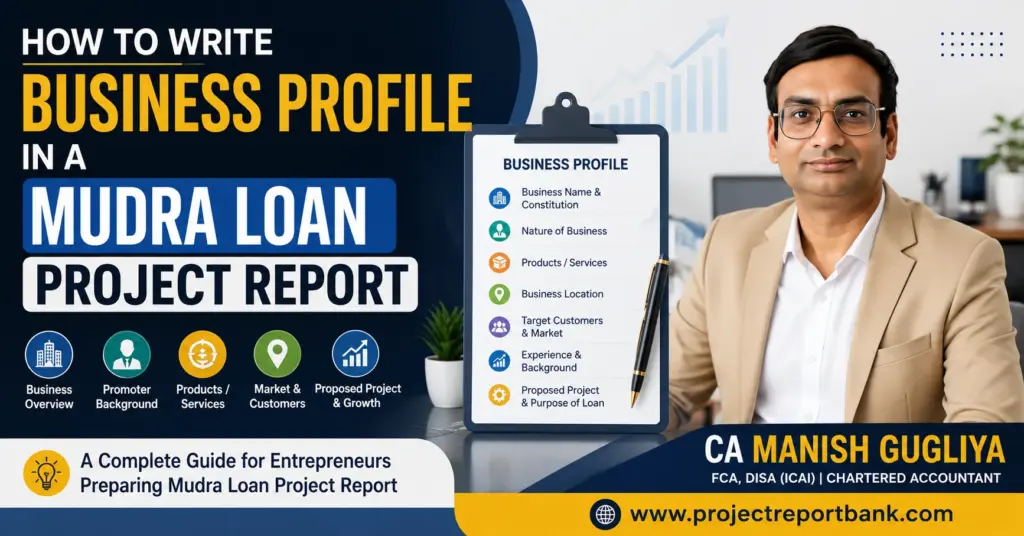
- How to Write Business Profile in a Mudra Loan Project Report
- Mudra Loan Project Report Format: Complete Guide