Key Takeaways
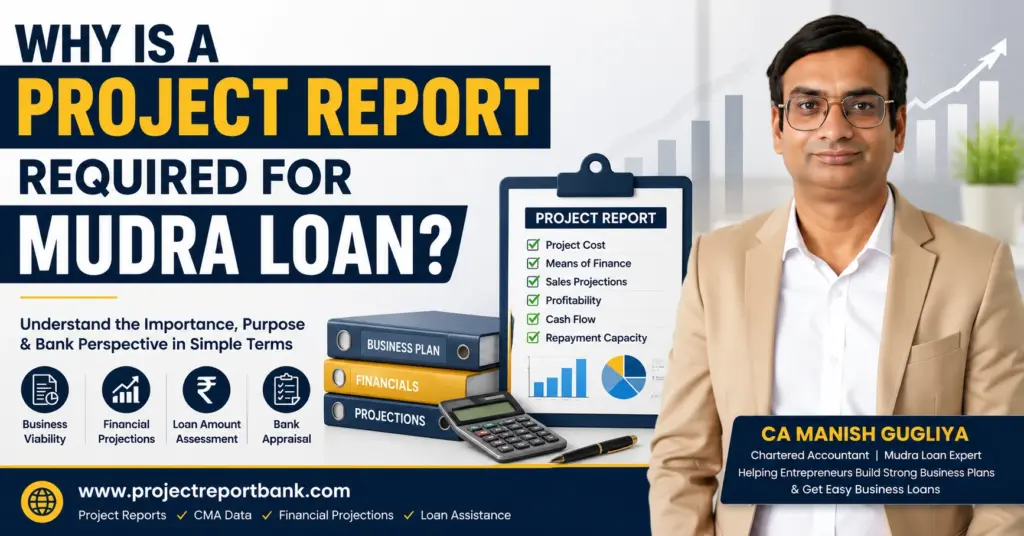
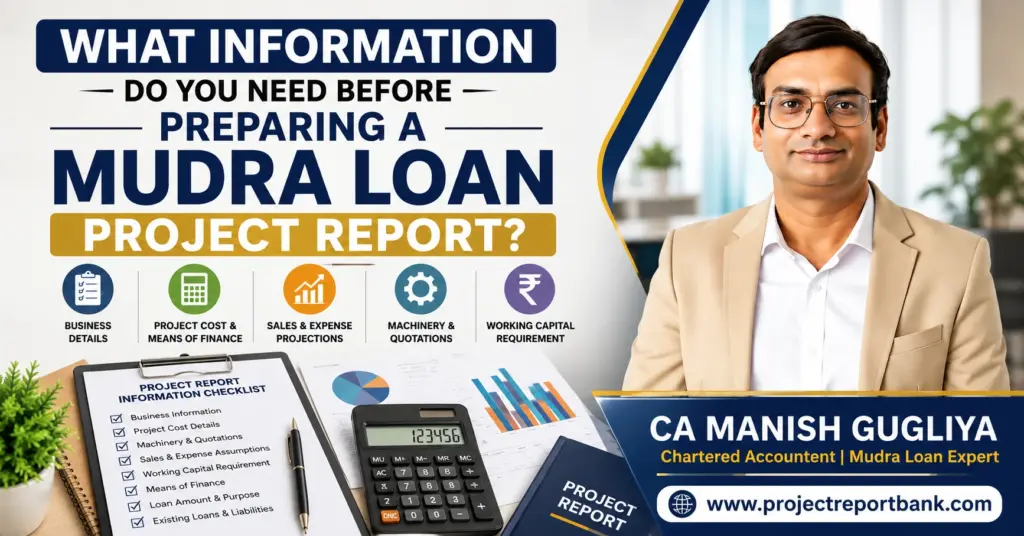
- Before drafting any mudra loan project report, collect concrete data on applicant background, business model, project cost, machinery, expected monthly sales, operating expenses, working capital cycle, loan amount and existing liabilities.
- Wrong or incomplete inputs lead to unrealistic financial projections, weak debt service coverage ratio and confusion during bank appraisal-whether the loan is from SBI, HDFC Bank, ICICI Bank, Union Bank or any private sector banks.
- The exact information required differs for new vs existing businesses and for manufacturing, trading and service enterprises. This article gives separate guidance for each.
- The article is written from the perspective of CA Manish Gugliya, Chartered Accountant, focusing on practical project report preparation for mudra loan applications.
- You will find a master checklist, a new-vs-existing comparison table and an FAQ so you can actually start collecting information before meeting a CA or consultant.
Why Collecting the Right Information Matters Before Preparing the Project Report
Every figure in a project report-project cost, profitability, cash flow, repayment schedule-comes from basic information the entrepreneur provides. Errors at this stage spoil the entire report. Key sections of a project report include executive summary, market analysis, and financial projections, and all of them depend on your inputs.
The key areas built on this information include:
- Total project cost and means of finance structure
- Projected sales figure and revenue projections
- Raw material and operating expenses
- Working capital cycle and balance sheet assumptions
- Repayment schedule and debt service coverage ratio (DSCR above 1.5 is preferred by banks for loan approval)
- Cash flow statement and break even point
Wrong assumptions → wrong projections → weaker project report. Even a perfectly formatted report cannot guarantee mudra loan approval because banks also check CIBIL, security, conduct of existing accounts and policy norms. Banks require a project report to assess mudra loan viability, and readers unfamiliar with the basic concept can first understand what a Mudra Loan project report is.
Mudra Loan Project Report Preparation Checklist
This is a master, high-level checklist of information required for mudra loan project report preparation, applicable across Shishu, Kishore and Tarun categories. Mudra loans are categorized into Shishu, Kishore, and Tarun schemes, and a standard project report format includes business, finances, and repayment plans. A mudra loan project report outlines business plans and financial needs.
- Applicant/promoter details: PAN, Aadhaar, education qualification, experience, company’s background
- Business constitution: proprietorship, partnership, private limited company
- Business name, address, nature of activity, business overview
- Whether the unit is new or existing
- Location and premises details: owned/rented, size, space or land requirement, rent agreement details, city or village
- Product/service description with selling prices
- Proposed machinery/equipment/furniture/vehicles with estimated costs and suppliers
- Project cost break-up covering all key areas
- Means of finance: own contribution (margin money) vs mudra term loan vs any working capital or cc limit
- Expected monthly sales, major operating expenses, manpower requirements and estimated salaries
- Working capital details: stock levels, credit period to customers and from suppliers
- Existing loans/EMIs and basic financial statements of existing business if any
- Availability of quotations and supporting documents
Later sections explain each heading so an entrepreneur can systematically collect data required for a bank loan project report.

Table of Contents
Applicant and Promoter Information Required
Banks assess both the project and the person behind it. The promoter profile should detail the entrepreneur’s qualifications and business experience-this is not a formality but directly affects approval chances.
- Full name, date of birth, PAN, Aadhaar, address, mobile, email
- Proposed business constitution: individual, partnership, private limited
- Education qualification, technical skills, business administration background
- Years in same line of activity (e.g., “running a tailoring unit since 2019”)
- Whether promoter will work full time, key responsibilities
- Family members or partners actively involved, if any
- Promoter contribution amount: e.g., ₹2.50 lakh from savings and family support, and timing of this investment
This project company profile section helps a CA prepare realistic means of finance and DSCR calculations.
Business Activity and Business Model Information
The report must clearly state whether the proposal is manufacturing (e.g., flour mill with commercial manufacturing processes), trading (e.g., hardware shop) or service (e.g., mobile repair centre). The business model determines what information is required and how cost structures differ.
- Main products or related services, target customers (retail public, wholesalers, institutions)
- How revenue will be generated: cash sales, orders, contracts, and typical ticket size
- Location: town/city, locality type (market area, industrial area), approximate footfall or demand drivers
- Premises: owned, rented or leased, with monthly rent, lease period, and land requirement
- Whether this is a completely new business idea, expansion of an existing unit, or diversification
For instance, a small printing unit needs different project logistics details than a grocery trader-one requires heavy machinery investment, the other needs higher working capital for stock.
Product or Service Information
Realistic sales projections depend on basic product/service data, not just one big turnover number. The project report must establish that the market exists for the proposed product or service, and market analysis must include insights into local demand and pricing strategies.
- Product/service name, unit of sale (kg, piece, service ticket), expected selling price in ₹
- Expected monthly quantity or number of service tickets
- Installed production capacity per day/month, expected capacity utilisation in Year 1 (40–50% is realistic for new units)
- Seasonal demand variations (festive season, wedding season)
- Customer perception and channels: walk-in, wholesale, online; cash vs credit sales ratio
Example: A paper plate unit producing 1,500 plates per day at ₹2.50 per plate over 25 working days projects monthly sales of ₹93,750. This is how simple product assumptions become projected turnover.
Machinery and Equipment Details
For manufacturing and some service units, machinery and equipment details form the backbone of project cost and technical feasibility. Technical feasibility should include details on location and infrastructure requirements.
- Item name (e.g., atta chakki, laminating machine, refrigerator), quantity, basic specs/capacity, approximate cost per unit
- Preferred supplier name or city, whether quotation is received, prices inclusive of GST, transport and installation
- Indirect fixed costs: electrical wiring, civil modifications, delivery charges, license or registration fees linked to machinery
- Keep at least one recent quotation for each major item so the project cost in the report roughly matches real market rates
Supporting annexures should include relevant quotations and business registration documents. Even a WhatsApp screenshot from the supplier is better than no reference at all.

Project Cost Information Required
Project cost means total investment in fixed assets plus margin for working capital-not just the loan amount. A precise project cost breakdown is essential for mudra loan applications. Different banks usually expect this reconciliation.
Major project cost heads:
- Land/building (if applicable), interior/renovation
- Plant and machinery, equipment, furniture and fixtures, computers, vehicles
- Electrical installation, initial deposits (electricity, rent advance, security deposit)
- Working capital margin: initial stock, first 1–2 months’ operating expenses, cash buffer
- Contingency provision (5–10%)
Hypothetical example: Total project cost of ₹8.00 lakh for a tailoring unit-₹3.00 lakh machinery, ₹1.00 lakh furniture and interiors, ₹4.00 lakh working capital margin. The report should include a break-even analysis to demonstrate financial stability at this scale.
Means of Finance and Promoter Contribution
Project Cost = Means of Finance. The project report should outline the means of finance clearly separating personal contribution and loan amount. Means of finance typically combines promoter’s own contribution and bank finance under the mudra scheme.
- Own contribution available in ₹, whether already invested or to be brought in
- Any other verifiable sources: family support, internal accruals
- Proposed mudra term loan amount and any separate working capital facility or cc limit
- For Tarun Plus category, promoter margin is approximately 20% on assets
Avoid inflating own contribution on paper or underestimating working capital limit just to make ratio analysis look attractive. For a deeper understanding of financing structure, see the Mudra Loan Project Report Basics guide.
Proposed Mudra Loan Amount and Purpose
Banks expect a clear link between requested loan amount, project cost and business requirement-not a random figure like “₹10 lakh because that is the maximum.” Mudra loans can provide up to ₹10 lakhs for business funding under standard categories, and a project report must detail repayment schedules for loans.
- Purpose-wise split: machinery, furniture, working capital, renovation
- Timing: lump sum vs phased disbursement
- Loan category: Shishu, Kishore or Tarun; loan types (term loan for assets, working capital loans for operations)
- Specific description: “purchase of 2 flour mill machines and initial stock of wheat” rather than “for business expansion”
- Whether a separate CC/OD or working capital limit is planned later
- Whether the same report may be adapted for other loan project applications at different banks
A repayment schedule is essential in the project report for banks, showing adequate repayment capacity over the loan tenure.
Sales and Turnover Information
Realistic sales projections require data on expected selling price, units sold, capacity utilisation, working days and growth. These inputs drive turnover, gross profit and DSCR calculations in the mudra loan project report. Financial projections typically cover three to five years.
- Expected customers per day or orders per month, average bill value
- Working days per month (typically 25–26), initial utilisation percentage
- Year 1 monthly turnover, Year 2–3 growth assumptions (5–15%)
- Seasonal peaks and troughs, price increase assumptions
- Whether advertising strategies will influence customer acquisition timing
Example: A mobile repair shop expecting 10 jobs per day at ₹400 each over 26 days gives monthly sales of ₹1,04,000. Banks prefer project reports in a correct format where such assumptions are traceable.
From a project appraisal perspective, overstated sales with no basis reduce credibility. Banks assess financial projections for potential risks and opportunities.
Raw Material or Purchase Information
For manufacturing processes and trading units, raw material or purchase cost is usually the largest expense and directly affects gross margin and working capital requirement.
- Main items: name, unit of purchase (kg, metre, carton), current purchase price per unit
- Expected monthly consumption and standard input–output ratio
- Wastage percentage and whether by-products have sale value
- Supplier terms: number of suppliers, credit period in days, cash vs credit, price volatility
- Required third party details for key suppliers
These inputs influence both the projected Profit & Loss and the working capital assessment (stock levels, creditor period) that financial institutions review.
Operating Expense Information
Underestimating expenses is a common mistake. The report should estimate all recurring costs based on realistic, location-specific data. Project reports should be clear, concise, and easy to understand in presenting these figures.
- Rent (exact monthly amount and deposit), electricity, fuel, water
- Telephone/internet, repairs and maintenance, packaging
- Salaries and wages, employer PF/ESI where applicable
- Marketing, advertising strategies, local transport, delivery, commissions
- Insurance, professional fees, accounting and GST compliance, bank charges
- Miscellaneous provision
Collect real quotes where possible-a rent agreement offer, electricity tariff slab, or third party details on transport rates.
Employee and Salary Information
Manpower planning must match scale of operations. Banks often check if proposed staff strength is adequate for projected output without being excessive.
- Number of employees working by role: skilled worker, helper, supervisor, sales staff, accountant
- Monthly salary for each category; whether family members work without salary
- Shift pattern, working hours, and dependence of output on staff strength
- EPF/ESI where applicable, bonus/gratuity for larger units, annual increment provision
Salary information feeds into both monthly expense estimates and DSCR calculations in the full report.
Working Capital Information Required
Working capital is money blocked in stock, credit given to customers and day-to-day expenses until sales collections come in. Even a profitable business on paper can struggle without adequate working capital. A project report includes cash flow and profit & loss statements that reflect this reality.
- Average stock of raw materials and finished goods (in days or months)
- Credit period allowed to customers vs credit received from suppliers
- Percentage of cash vs credit sales, monthly cash expenses
- Seasonal spikes needing higher stock and cash cushion
- Whether a working capital facility (cc limit or overdraft) is being sought now or planned later, since this affects CMA data if required
Existing Loan and Liability Information
Banks evaluate total repayment obligations, so existing EMIs and limits must be captured honestly. This is part of the complete financial information expected by lenders.
- Type of existing loan: home, vehicle, personal, business loan, credit card, CC/OD
- Lender name, current outstanding, EMI, remaining tenure
- Whether borrowing is for personal or business purposes
- Existing guarantees given for others’ loans, if any
- Any achievements export orders or receivables pledged elsewhere
This information does not automatically disqualify an applicant but helps assess realistic cash flow and DSCR for the new mudra loan.
Additional Information Required for an Existing Business
Existing businesses seeking mudra or other bank loans must provide historical financial information so projections can be compared with past performance. Details of statutory registrations and licenses needed for the business should be documented.
- Last 1–3 years’ turnover, gross profit, net profit (even if financial statements are unaudited)
- Basic balance sheet details: major assets and liabilities, any past losses
- Last 6–12 months’ bank statements, current account turnover, cheque returns
- Conduct of existing CC limits, if any
- Current installed capacity vs actual utilisation, existing machinery list, employees working today
- How the proposed loan will change capacity, product mix or branch network
- GST summary figures help create more accurate financial projections data for the mudra loan project report
Information Required for a New Business
New enterprises have no historical numbers, so the mudra loan project report must rely on realistic assumptions. Proposals should address potential risks and include a mitigation strategy.
- Expected selling prices based on local market visits, not guesswork
- Probable daily sales quantity, competitive landscape (number of competitors in area)
- Realistic initial capacity utilisation ramp-up: 40–50% in Year 1, gradually increasing
- Market rent quotations, electricity tariffs for similar units, current local wage levels
- Latest quotations for machinery and raw materials from GST-registered vendors
- Reference similar existing businesses (friends, relatives, local units) to cross-check whether projected turnover and expense levels look reasonable
For a new business, the important point is not just to give a number, but to understand and be able to explain the basis of that number during bank discussions. Market analysis must include insights into local demand and pricing strategies, and the report must establish that the market exists for the proposed product or service.
Supporting Documents and Quotations
The focus of this article is information and assumptions, but some inputs are naturally supported by documents. Supporting documents required for mudra loans should include identity proofs and financial statements.
- Machinery/vehicle/furniture quotations dated in current financial year
- Rent or lease offers, written estimates for interior or electrical work
- Last 1–3 years’ financial statements, GST returns summary, bank statements
- Registrations: Udyam/MSME, shop licence, FSSAI, if any
- Supporting annexures should include relevant quotations and business registration documents
Documentation requirements vary by bank and scheme. Readers needing an exhaustive list should refer to guides in the Mudra Loan Project Report Basics cluster.
What If Exact Figures Are Not Available?
Where exact figures are unavailable, borrowers can use reasonable estimates based on supplier quotations, market rates, comparable businesses and local wage levels. Avoid random numbers without any basis-banks and CAs are comfortable with well-explained estimates but uncomfortable with obviously unrealistic numbers.
- Use at least two supplier quotations for machinery cost benchmarking
- Check rent for similar shops in the same market, collect actual electricity bills from comparable units
- For new ventures: short market surveys, informal discussions with existing shop owners
- Trial operations or pilot batches where possible
- Never copy standard project reports or generic templates without adapting to actual location, size and capacity-this leads to inconsistencies noticed by bank officers
In practice, a reasonable estimate with a clear explanation is far more credible than a precise-looking number with no basis.
Common Mistakes While Providing Information for a Mudra Loan Project Report
As a CA reviewing many files, common patterns of errors in borrower-provided data are easy to spot and can delay or weaken loan proposals. Reports generated from faulty inputs waste everyone’s time.
- Overstating sales without considering capacity or local demand
- Understating rent, salaries or other expenses to inflate projected profit
- Ignoring working capital needs-especially for trading businesses
- Giving machinery costs without any quotation or vendor reference
- Mismatch between total project cost and requested loan amount
- Unrealistic capacity utilisation in Year 1 (assuming 90–100% from day one)
- Not disclosing existing EMIs, credit card dues or personal loans
- Figures in the report not matching GST returns or bank statements
- Copying a projection from another business without adapting
- Providing approximate sales figure or expense numbers without understanding their basis
Each of these weakens financial analysis and reduces the bank’s confidence in the entrepreneur plans.

Information to Give Your CA or Project Report Consultant
Whether you engage a CA, a consultant or prepare your own Mudra Loan project report, the same core information is required. Professional help mainly converts raw data into bank ready project reports with proper financial statements. Readers wanting to know more about who can prepare a Mudra Loan project report can refer to the dedicated article.
Applicant Details
- PAN, Aadhaar, photographs, address proof, basic KYC documents
- Brief write-up on experience and skills relevant to the proposed mudra project
Business Details
- Proposed business name, constitution, address, nature of activity
- Whether unit is new or existing; short note describing business model and target customers
Project Cost Details
- Rough project cost sheet: land/building (if any), machinery, furniture, interior work, vehicle, deposits, working capital margin with estimated amounts in ₹
Machinery and Asset Details
- Available quotations (PDF, image or email) including item name, capacity, quantity and all-inclusive price
- Information on interior work, computers, vehicles to be financed
Sales Assumptions
- Expected customers per day, average billing value, working days per month
- Seasonal trends and expected Year 1 monthly sales for top 3–5 products or services
Expense Assumptions
- Present market rent offers, typical electricity bills for similar premises
- Planned salaries for each employee; bullet estimates for marketing, transport, maintenance
Working Capital Details
- Expected stock levels in days or months, credit period to customers and from suppliers
- Whether a cc limit or OD is envisaged alongside the mudra term loan
Loan Requirement
- Required loan amount, purpose-wise split (machinery vs working capital), preferred repayment tenure
- Information on any parallel bank loan applications at different banks, if planned
Existing Business Information
- Last 1–3 years’ financials, GST returns summary, bank statements
- Current asset and machinery list; short note on why additional finance is required
New Business vs Existing Business – Information Requirement
While many information categories overlap, the depth and source of data differ. This affects how financial analysis and DSCR calculations are prepared.
| Information | New Business | Existing Business |
|---|---|---|
| Historical sales | Not available; assumption-based | Last 1–3 years’ turnover available |
| Financial statements | Projected only | Actual + projected |
| Machinery | Fresh quotations only | Existing asset list + new additions |
| Working capital | Assumption-based cycle | Actual cycle + incremental requirement |
| Liabilities | Fresh borrowing only | Existing EMIs and CC limits included |
| Promoter contribution | Fresh investment | Partly from accumulated profits |
| GST / bank statements | Not available | Available for verification |
| Customer perception data | Market survey / estimates | Actual customer base and sales records |
Not every item is mandatory in every mudra case. Specific requirements depend on loan size, bank policy and scheme guidelines. Mudra loans support Micro, Small, and Medium Enterprises (MSMEs) and banks require details information appropriate to the proposal. A project report is essential for mudra loan applications, whether from Axis Bank, ICICI Bank or any other lender, and the interest rate and appraisal norms may differ. This also applies to a pmegp project report or pmegp loan proposal at the same bank.
Quick Final Checklist Before Starting the Project Report
Before preparing or ordering a mudra loan project report, confirm these items:
- ☑ Applicant KYC documents and basic profile note ready
- ☑ Clear description of business activity and business overview prepared
- ☑ Product/service list with expected prices and quantities drafted
- ☑ Draft project cost sheet with all heads listed
- ☑ At least indicative machinery quotations collected
- ☑ Rent and premises information documented
- ☑ Salary and manpower plan finalised
- ☑ Estimated monthly operating expenses noted
- ☑ Working capital assumptions: stock levels, credit terms decided
- ☑ Existing loans and EMI details declared honestly
- ☑ Requested mudra loan amount and tenure logically linked to project cost
- ☑ Information on promoter contribution amount and timing available
- ☑ Financial documents for existing business collected (if applicable)
Do not start drafting numbers until this checklist is substantially complete. Consult the broader Mudra Loan Project Report Basics resources if you need guidance on report structure or project commercial aspects before proceeding.
Frequently Asked Questions
What information is required for a Mudra Loan project report?
Banks typically expect applicant KYC and background, clear business activity details, project cost break-up, means of finance, proposed mudra loan amount and purpose, expected sales, operating expenses, working capital requirement, existing liabilities and supporting information like quotations and basic financials for existing units. A project report must include business description and funding needs along with a repayment schedule. The exact depth varies by loan category and whether banks require simple or detailed financial projections.
How often should I update my estimates before submitting to the bank?
Key assumptions like machinery cost, rent and major raw materials should be reviewed just before finalising the project report, especially if more than 2–3 months have passed since initial data collection. Supplier quotations have validity periods, and market conditions change. Keeping a current information file ensures the project report matches what the bank asks for during appraisal and avoids discrepancies in the details information.
Do I need detailed CMA data for a Mudra Loan?
Full CMA data is usually needed for larger working capital limits and higher-value bank loans. Most mudra proposals under ₹10 lakh rely on a simpler loan project report format. However, having clear working capital details, cash flow assumptions and a projected balance sheet still helps if the bank later upgrades facilities, offers a working capital limit, or considers financial inclusion products. Being prepared for this saves time and builds credibility as a serious business owner.
What if there are multiple partners or directors in the business?
Information is required for each key promoter: KYC, background, experience, shareholding or profit-sharing ratio and individual contribution to project cost. The report should show combined strength, clear responsibilities and how each partner’s skills support the small business. This is especially relevant where one partner handles manufacturing processes and another manages sales-the combined profile strengthens the proposal.
Can I reuse the same information for different banks?
Core business and financial information remains the same across different banks, but format and some details may need adjustment per lender. For example, one bank may want a detailed ratio analysis while another may focus on cash flow. Keeping a well-organised information file makes it easier to customise reports for multiple submissions-whether it is a mudra loan project, a business loan from private sector banks, or a pmegp loan application. A project report vs business plan distinction also matters here, as some financial institutions may request both.
- Mudra Loan Project Report Online – Can It Really Be Done?
- Does a Project Report Guarantee Mudra Loan Approval? (Expert Guide by CA Manish Gugliya)

- Does Mudra Loan Amount Affect Project Report Requirements?
- When Does a Bank Ask for a Project Report for Mudra Loan?

- What Information Do You Need Before Preparing a Mudra Loan Project Report?
- Project Report vs Business Plan for Mudra Loan: Which Is Better for Your Application?
- Can I Prepare My Own Project Report for Mudra Loan?
- Who Can Prepare a Project Report for Mudra Loan?

- Why Is a Project Report Required for Mudra Loan?