Key Takeaways
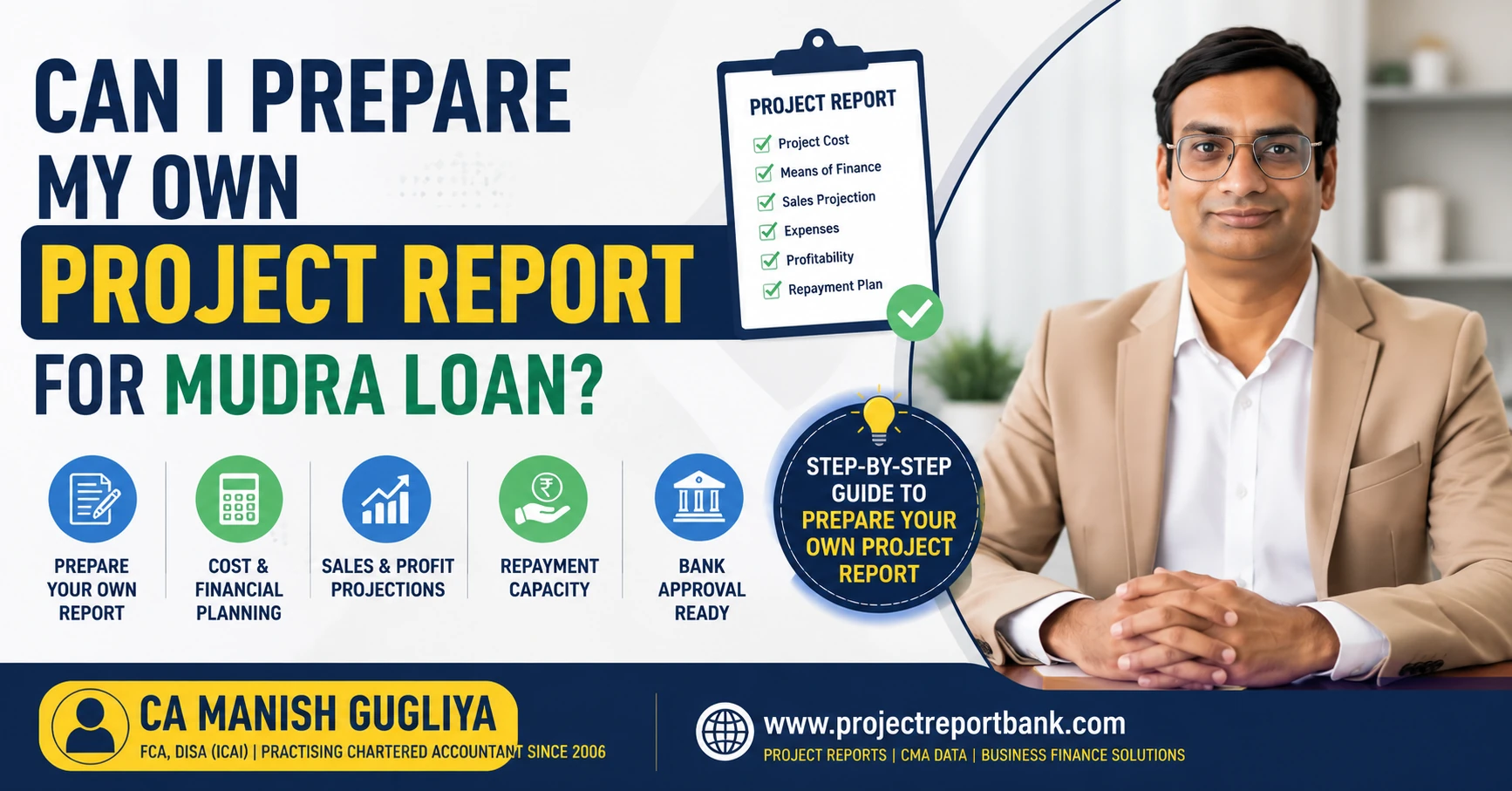
- You can generally prepare your own project report for Mudra Loan, provided your numbers, assumptions, and explanations are realistic, internally consistent, and properly presented.
- A CA is not automatically mandatory for every mudra loan project report, but some banks or specific cases may require professional certification or detailed cma data.
- DIY preparation works best for smaller, simpler proposals (Shishu or lower Kishore) where the business owner understands project cost, monthly sales potential, expenses, working capital, and repayment capacity.
- Even a self-made report must cover project cost, means of finance, financial projections, debt service coverage ratio, and basic market analysis in a structured project report format.
- Professional review becomes important when projects are larger, involve commercial manufacturing processes, or when you are not comfortable preparing financial statements.
Can You Prepare Your Own Project Report for Mudra Loan?
Yes, you can prepare your own project report for Mudra Loan. The critical question is not who typed the document but whether it accurately explains your business idea, project cost, loan requirement, profitability, and repayment plan. A comprehensive project report is essential for securing loans under the Pradhan Mantri Mudra Yojana (PMMY), which supports micro enterprises in manufacturing, trading, and services with collateral free credit up to ₹10 lakh.
If you are new to the concept, start with this beginner guide to Mudra Loan project reports before diving into self-preparation. In brief, a project report outlines business plans and financial needs. Lenders use project reports to assess business viability and repayment capacity – they care about the quality of your numbers, not whether a CA or the applicant prepared the document.
There are four practical approaches: (a) fully self-prepared reports, (b) reports using a template, (c) professionally prepared reports, and (d) self-prepared reports later reviewed by a professional. Copying another person’s numbers or an old project report from the internet is far riskier than honestly preparing your own realistic projections.

Table of Contents
Is a CA Required to Prepare a Mudra Loan Project Report?
For many small Mudra Loan proposals, banks accept self-prepared project reports without compulsory CA certification. No RBI or MUDRA guideline states that every project report must be prepared or signed by a CA. However, internal policies at different banks and branches vary – some may insist on CA-certified financials for higher ticket or composite limits.
For a detailed discussion on whether a CA or professional should prepare the project report, refer to our dedicated article. The key takeaway: if you prepare the report yourself, you can always get a CA’s help later to review projections, correct financial calculations, or reformat the report to match lender norms.
When Can You Prepare the Mudra Loan Project Report Yourself?
DIY preparation is practical for straightforward, smaller proposals – typically Shishu (up to ₹50,000) or lower Kishore (₹50,001 to ₹5 lakh) categories – where the business model and cost structure are simple to explain. About 83% of all Mudra loans sanctioned fall in the Shishu category, confirming that a large majority of proposals are small and relatively simple.
Before starting, honestly assess your comfort with numbers and your ability to justify assumptions when the bank asks questions. Even a self-prepared report must align with your KYC documents, application form, and financial documents like existing bank statements.
Small and Simple Business Proposal
Simple businesses are ideal for self-preparation: a Kirana store needing one display counter, a fridge, and initial stock; a salon with two chairs, mirrors, and basic equipment; a tiffin service requiring utensils and a delivery vehicle. These involve one location, a few fixed assets, and predictable monthly expenses, making projections straightforward. For a loan amount up to ₹2–5 lakh with few line items, most disciplined applicants can prepare a usable full report themselves.
You Understand Your Business Costs
Self-preparation works when you already know approximate prices for machinery, furniture, computers, renovation, deposits, and initial stock. Key cost heads include plant and machinery, furniture and fixtures, interior work, shop deposit, licenses, opening stock, and margin money for working capital. These figures should be supported by recent quotations from local vendors – not guesswork copied from internet samples.
You Can Prepare Reasonable Sales Estimates
Reasonable sales projections should be based on capacity, daily footfall, average order size, or service calls per day. For example, a small café estimating 40 customers per day with an average bill of ₹250 arrives at roughly ₹3 lakh in monthly sales – far more credible than writing a random round sales figure. Start with 50–60% capacity utilisation in Year 1, gradually increasing to 70–80% by Year 2. Realistic revenue projections improve loan approval chances significantly. Inflated sales figures in project reports can lead to red flags for bank managers.
You Understand Basic Financial Statements
DIY is comfortable when you understand that a Profit and Loss account is your annual income minus expenses, a balance sheet is a snapshot of assets and liabilities on a specific date, and a cash flow statement shows when money actually comes in and goes out. Financial projections typically cover 3 to 5 years. If you cannot link EMI payments, interest, and principal reduction with these statements, professional assistance may be better.
When Should You Consider Professional Help?
The decision depends on accuracy, completeness, and what is at stake. Consider professional help when:
- Project cost approaches the ₹10 lakh Tarun limit or above
- The project involves complex manufacturing processes or multiple machinery items
- The bank asks for detailed cma data, ratio analysis, or separate working capital assessment
- You are expanding an existing business where past financials, GST returns, and bank statements must be linked with future projections
- You are unfamiliar with break even analysis, DSCR, or financial analysis
Financial viability is crucial for the bank’s assessment, and a professional can ensure technical soundness in interest, EMIs, depreciation, and cash flow linkages. This applies equally to a Mudra Loan, business loan, pmegp loan, or any other loan types requiring a detailed project report.
What Should a Self-Prepared Mudra Loan Project Report Contain?
Essential sections of a project report include an executive summary and business description, along with financial projections and supporting schedules. The report should outline estimated costs including fixed and working capital. Internal consistency is crucial – project cost, means of finance, sales, expenses, profit, and repayment schedule must use the same base assumptions. For a broader reference, see the Mudra Loan Project Report Basics page.
Understanding why a project report is required for a Mudra Loan helps you appreciate what each section must accomplish.
Applicant and Promoter Details
Include name, age, address, education qualification, relevant experience, and the project company profile. Mention past work history, years in the line of activity, licenses (FSSAI, trade license), the company’s background, and existing banking relationships. This section covers what some formats call the promoter’s details information.
Business Overview
Describe the nature of business, products or services offered, target customer profile, location (city and locality), shop size showing space or land requirement, type of premises (owned/rented), and planned start date. This business overview helps bankers quickly understand your entrepreneur plans. For existing units, note current status and expansion plan. Include any required third party details such as key suppliers or third party details of service providers.
Market and Demand Analysis
Keep market analysis practical: mention nearby schools, offices, hospitals, or residential colonies that generate demand. Note competitors within your area and why customers will choose your business. Cover project commercial aspects like pricing strategy, advertising strategies, and competitive advantages. Identify target customers and articulate your competitive edge clearly.
Project Cost
Banks require a detailed project cost breakdown. Create a table listing machinery, equipment, furniture, computers, renovation, deposits, licenses, pre-operative expenses, initial inventory, and working capital margin. Clarify whether costs include GST. All figures should match quotations attached as annexures.
Means of Finance
Show how total project cost will be funded: promoter contribution (margin money), proposed Mudra Loan (term loan and/or working capital loans), and any other sources. The total must exactly equal total project cost. Project reports should match the total project cost with the loan category applied for – Shishu loans provide up to ₹50,000 for small businesses, Kishore loans range from ₹50,000 to ₹5 lakh for business expansion, and Tarun loans offer between ₹5 lakh and ₹10 lakh for larger projects. All Mudra loans are collateral free under the PMMY scheme.
Sales Projections
Prepare year-wise sales projections based on capacity, expected utilisation, and realistic pricing. Document assumptions (working days, average bill, production capacity) below the sales table. Each sales figure should be defensible. Showing expected revenue with a gradual ramp-up is more credible than sudden jumps.
Expense Projections
Cover raw material, salaries for employees working in the business, rent, electricity, internet, transport, packaging, maintenance, administrative costs, marketing, and insurance. Include interest on loan and depreciation on fixed assets. Banks also look at project logistics details like transport and distribution costs. Avoid unrealistically low expenses that make margins look impossibly high.
Projected Profitability
Create a projected Profit and Loss statement showing sales, cost of goods sold, gross profit, operating expenses, interest, depreciation, and net profit for 3–5 years. Detailed financial statements must include profit and loss statements and cash flow projections. Highlight the break even point – the year when cumulative profits turn positive. Mention gross and net profit margins in percentage terms.
Cash Flow
A cash flow statement shows yearly cash inflow from operations and outflows for purchases, expenses, loan instalments, and capital expenditure. A detailed project report includes repayment schedules and cash flow. This is where bankers verify whether you have enough cash to pay EMIs even in tight months.
Projected Balance Sheet
Include a projected balance sheet for Year 1, Year 2, and Year 3 minimum, showing fixed assets, current assets (stock, receivables, cash), and liabilities (loan outstanding, creditors, capital). Mismatched balance sheets – where assets and liabilities do not tally – are a common red flag.
Working Capital Requirement
Quantify inventory, debtors, and daily expenses to determine the working capital cycle. Banks may provide a working capital limit via cash credit. Even for term loan proposals, working capital requirement must be clearly understood and stated.
Loan Repayment
A repayment schedule shows how the loan will be repaid – include month-wise or year-wise EMI, principal, interest, and outstanding balance. Ensure consistency with the interest expense in Profit and Loss and outstanding loan in the balance sheet. Banks prefer DSCR above 1.5 for loan applications; a debt service coverage ratio below this threshold often triggers scrutiny. MudraReady’s analysis confirms that many bank officers close files when DSCR falls below acceptable levels.
How to Prepare Your Own Project Report for Mudra Loan – Step by Step
This chronological guide helps any business owner prepare their own project report at home with a notebook, calculator, and optionally Excel. Cross-check every figure at the end – totals, subtotals, and linked numbers must match across all sections.

Step 1 – Define Your Business Activity
Write a crisp description: what product or service, at which location, for which customers, from which date. Note whether this is a new business or expansion, and the legal form (proprietorship/partnership). Include your past experience and technical feasibility assessment of the business model.
Step 2 – Determine the Total Project Cost
List every item needing funding: machinery, tools, furniture, interior, computers, licenses, deposits, initial stock, and cash for initial months. Add up for a single total. Round amounts to the nearest ₹1,000 for clarity.
Step 3 – Collect Machinery and Equipment Quotations
Collect at least 1–2 written quotations for major equipment, dated in the current financial year, with GST and installation charges clearly mentioned. Use actual quotation amounts in your cost table. Recent quotations help bankers trust your estimates. Whether you apply at axis bank, hdfc bank, icici bank, or any other lender, current quotations strengthen credibility.
Step 4 – Estimate Working Capital
Calculate average stock value, credit given to customers, and daily cash expenses (wages, electricity, small purchases). Estimate total working capital for one month or 45 days. This margin becomes part of project cost.
Step 5 – Estimate Production or Service Capacity
Manufacturing units: calculate daily/monthly production based on machine capacity, shifts, and working days. Service businesses: estimate customers or jobs per day given staff strength. Document these assumptions – they form the foundation of your sales projections.
Step 6 – Estimate Realistic Sales
Multiply practical capacity utilisation (50–60% initially) by selling price for monthly and yearly sales. Gradually increase over 2–3 years. Cross-check that projected sales are sensible for local market size and competition. Inflated sales figures can lead to project report rejection.
Step 7 – Calculate Operating Expenses
List all recurring monthly expenses including purchase cost, salaries, rent, electricity, internet, transport, repair, packaging, and administrative costs. Use current bills where available and adjust for annual increases. Include related services costs if applicable.
Step 8 – Prepare Profit Projections
Create a projected P&L showing sales minus cost of goods, operating expenses, interest, and depreciation. Check whether net profit seems realistic. Note the year the business crosses the break even point and explain why.
Step 9 – Estimate Loan Repayment
Use an EMI calculator to compute monthly EMI based on the proposed loan amount, tentative interest rate range, and repayment period. Draw a schedule showing instalments, interest, principal, and outstanding balance. Verify that projected cash profits comfortably exceed yearly instalments, indicating a healthy DSCR. A Mudra Loan project report must demonstrate repayment capacity to lenders.
Step 10 – Prepare Financial Statements
Summarise into structured projected Profit and Loss, Balance Sheet, and Cash Flow for at least 3 years. Provide complete financial information with internal consistency: opening balances, depreciation, loan disbursement, and repayments must match across statements.
Step 11 – Review All Assumptions
Go through each assumption for sales, pricing, expenses, and interest rate. Stress-test: what if sales are 10% lower or expenses 5% higher? Can you still service EMIs? Note key assumptions explicitly.
Step 12 – Match the Report With Supporting Documents
Cross-check figures against quotations, rent agreements, and KYC documents. Document preparation should include KYC, identity documents, and financial information. Ensure names, addresses, and activity descriptions match across the project report, application form, and registrations like Udyam or GST. Attach an index page listing all annexures.
Example of Self-Preparing a Mudra Loan Project Report
Consider a hypothetical mobile repair shop (all figures are illustrative only):
| Item | Amount (₹) |
|---|---|
| Repair tools & equipment | 80,000 |
| Furniture & fixtures | 30,000 |
| Computer & billing system | 25,000 |
| Shop deposit & renovation | 40,000 |
| Initial spare parts stock | 50,000 |
| Working capital (2 months) | 75,000 |
| Total Project Cost | 3,00,000 |
| Promoter Contribution (20%) | 60,000 |
| Proposed Mudra Loan (Kishore) | 2,40,000 |
Estimated monthly sales: ₹80,000. Monthly expenses: ₹52,000. Monthly net profit: ~₹18,000. EMI at ~10% interest rate for 3 years: ~₹7,750. DSCR = (Net Profit + Depreciation + Interest) ÷ (Principal + Interest) ≈ 1.6 – above the preferred 1.5 threshold.
This kind of bank ready report, with clear numbers and supporting quotations, is what banks require to assess loan viability.
Common Mistakes When Preparing Your Own Project Report
- Copying another business’s report without changing assumptions
- Overstating sales or profitability with no market basis
- Underestimating essential expenses like rent, electricity, or salaries
- Mismatched totals between project cost and means of finance
- Incorrect links between repayment schedule and interest in P&L
- Balance sheet that does not tally
- Missing or outdated quotations
- Vague business descriptions that do not explain the business plan clearly
- Not showing promoter margin money contribution
- Ignoring working capital entirely
- Mathematical errors in financial calculations
Such issues cause repeated queries, delayed processing, and loss of confidence in the borrower’s understanding. The MUDRA loan program supports micro enterprises, and banks expect even small businesses to present coherent numbers.
Can I Use a Project Report Template for Mudra Loan?
Yes. Banks prefer project reports in a standard format for Mudra Loans, and a template helps ensure all sections are covered. However, never copy someone else’s financial figures. Every business has different cost drivers, loan size, and risks. Customise each figure for your own location, business model, and capacity. Unlike a pmegp project report which may follow a different structure, Mudra templates should align with your specific bank requirements. Use the template headings and layout as a guide in the correct format, not as a source of numbers.
Can I Prepare a Mudra Loan Project Report in Excel?
Excel is excellent for financial calculations, linked schedules, and scenario testing. Change sales or interest rate assumptions and immediately see the effect on profitability and repayment capacity. However, export the final report as a clean PDF with headings and page numbers. Watch for broken formulas – incorrect links can produce wrong DSCR, cash flow, or balance sheet figures. Reports generated in Excel should be carefully verified before printing.
Can I Prepare a Mudra Loan Project Report Without Accounting Knowledge?
A person without formal training can usually prepare narrative portions (business description, market analysis, project cost) but may struggle with profit, cash flow, and DSCR calculations. Focus on documenting your assumptions clearly, then seek limited help for financial analysis and formatting. You must still understand the final figures – bankers often ask about margins, break even analysis, and repayment during appraisal. Familiarise yourself with terms like gross profit, net profit, working capital, and DSCR using simple resources. This helps whether you apply for a bank loan at any branch.
Self-Prepared vs Professionally Prepared Mudra Loan Project Report
| Factor | Self-Prepared | Professionally Prepared |
|---|---|---|
| Cost | Minimal | ₹2,000–₹5,000+ |
| Business understanding | Strong (your own knowledge) | Depends on input provided |
| Financial accuracy | Risk of errors in ratios/statements | Generally higher |
| Time required | More (learning curve) | Less (expert handles) |
| Customisation | Full control | May need iterations |
| Suitable for simple projects | Yes | Yes, but may be overkill |
| Suitable for complex projects | Risky without review | Recommended |
| Bank acceptance | Accepted if accurate | Accepted if accurate |
The choice depends on project complexity, loan amount, your comfort with financial calculations, and the bank’s documentation requirements. Some key areas like technical feasibility assessment and achievements export orders documentation (for manufacturing units) may specifically benefit from professional input.
Does a Self-Prepared Project Report Reduce Mudra Loan Approval Chances?
Banks do not reject a Mudra Loan simply because the applicant prepared the project report. Approval depends on eligibility under PMMY, credit profile, quality of projections, DSCR, documentation, and internal bank policies. What reduces approval chances is a weak, inconsistent report that does not show how the loan will be repaid. If unsure about projections, getting them reviewed before submission is a sensible middle approach. A project report is essential for Mudra loan applications regardless of who prepares it, and bank ready project reports focus on substance over authorship.
How to Make a Self-Prepared Project Report Look Professional
- Use clear headings, numbered pages, and consistent fonts
- Start with a 1–2 page executive summary: business name, activity, location, total project cost, loan amount, and DSCR highlights
- Check language for clarity; avoid slang
- Write all rupee amounts with proper commas (₹2,50,000 not 250000)
- Include a contents page and annexure list with properly labeled attachments
Checklist Before Submitting Your Self-Prepared Project Report
- ✅ Correct spelling of names; matching addresses across all documents
- ✅ Accurate loan amount and clear mention of Mudra category (Shishu, Kishore, or Tarun)
- ✅ Project cost totals match means of finance totals
- ✅ EMI and interest figures align across schedules and P&L
- ✅ Balance sheet tallies
- ✅ All KYC, business registrations, quotations, rent agreements, and bank statements attached
- ✅ Print one complete set for the bank, keep one for personal reference
When Should You Get Your Project Report Reviewed?
Consider professional review when project cost is high relative to savings, when you are unfamiliar with DSCR and ratio analysis, or when the bank has raised queries about mismatched figures. Review is especially useful for composite proposals involving term loan plus working capital limit, or when cma data is specifically requested. The goal is not to change your business idea but to present numbers aligned with banking expectations per lender norms. Different banks may apply varying scrutiny levels.
CA Manish Gugliya’s Practical View
In my experience since 2006, most small entrepreneurs understand their business better than any outsider. The real problem is rarely who prepared the report – it is whether the promoter can confidently explain each assumption when the bank asks questions. I have seen applicants with perfectly formatted CA-prepared reports who could not explain their own sales figure or working capital cycle. That is a bigger red flag than a simple, honest, self-prepared report.
A project report is not only for bank compliance. It is a planning tool – your opportunity to test whether the business can comfortably carry the proposed debt before you commit. Treat the process of preparing your own mudra loan project report as a way to clarify your own thinking about costs, margins, and cash flow.
Frequently Asked Questions
How many years of projections should I include in a self-prepared Mudra project report?
Most banks are comfortable with at least 3 years for smaller Mudra Loans, but some officers ask for up to 5 years, especially for Tarun category amounts. Preparing 5-year projections where practical avoids rework if a detail-oriented branch requests them.
Do I need to calculate DSCR myself if the bank has its own software?
Banks run their own DSCR calculations internally, but including a basic DSCR working in your report demonstrates that you have considered repayment capacity seriously. DSCR above 1.5 is preferred by banks for loan applications. Use simple EMI calculators to estimate, even if final numbers differ slightly from the bank’s computation.
If the bank asks for changes, can I edit my self-prepared report later?
Yes. Applicants regularly revise reports after initial discussion – adjusting sales, expenses, or project cost based on banker feedback. Keep an editable version in Word or Excel so changes can be made quickly and cleanly.
What if my actual sales differ from the projections given in the project report?
Projections are estimates based on current assumptions. Actual performance may vary. The key is to prepare realistic, honest projections and manage the business responsibly so EMIs can be serviced even if growth is slower. A project report is not a guarantee – it is an informed plan.
Can I submit the same self-prepared Mudra project report to different banks?
The core business plan and projections can remain the same, but different banks may prefer slightly different formats or additional data fields. Adapt the cover page and any bank-specific schedules while keeping underlying numbers consistent. Whether you approach a nationalised bank or a private lender, the substance of your bank ready report matters more than cosmetic differences.
Final Conclusion
Yes, in most practical cases, you can prepare your own project report for Mudra Loan. For small, simple proposals, a carefully self-prepared report with realistic assumptions, consistent financial statements, and proper supporting documents can be fully adequate. For larger or more complex projects, professional preparation or at least a technical review helps reduce errors and improve the quality of financial presentation.
The strength of your mudra loan project report lies in realistic assumptions, internally consistent numbers, and your own ability to explain every figure during bank appraisal. A project report is essential for Mudra loan applications – invest the effort to get it right. Readers who want to deepen their understanding of overall structure and evaluation criteria should explore the Mudra Loan Project Report Basics resource before finalising their own report.
- Mudra Loan Project Report Online – Can It Really Be Done?
- Does a Project Report Guarantee Mudra Loan Approval? (Expert Guide by CA Manish Gugliya)
- Does Mudra Loan Amount Affect Project Report Requirements?
- When Does a Bank Ask for a Project Report for Mudra Loan?
- What Information Do You Need Before Preparing a Mudra Loan Project Report?
- Project Report vs Business Plan for Mudra Loan: Which Is Better for Your Application?
- Can I Prepare My Own Project Report for Mudra Loan?
- Who Can Prepare a Project Report for Mudra Loan?
- Why Is a Project Report Required for Mudra Loan?