India produces over 350 million tonnes of food grains annually, yet an estimated 10% to 15% is lost after harvest due to inadequate storage infrastructure. For entrepreneurs, agro-infrastructure investors and project promoters, this gap represents both a national challenge and a significant investment opportunity. This article serves as a comprehensive hub for understanding grain storage projects in India – covering project types, cost structures, business models, financial projections, government schemes, compliance requirements and the process of preparing a bankable Detailed Project Report.
Key Takeaways
- A grain storage project report in India must address the specific project concept (silo, warehouse, integrated plant or logistics terminal), storage capacity planning, complete investment and cost heads, revenue and occupancy assumptions, bank finance structure and regulatory compliance – not merely present generic financial statements.
- Modern grain storage using steel grain silos and scientific warehouses is central to India’s food security strategy and to cutting post-harvest losses, which currently reach 10% to 15% in traditional storage. Properly designed silos reduce post-harvest losses to less than 1%.
- Project viability depends more on location, handling throughput, realistic storage occupancy and demand contracts than on mere static storage capacity in metric tonnes.
- Banks and investors focus on defensible financial projections, DSCR analysis, IRR, sensitivity testing and compliance with WDRA, FCI norms and environmental approvals – not on template-based documents with optimistic assumptions.
- Project Report Bank, led by CA Manish Gugliya, FCA, DISA (ICAI), provides customised grain storage DPRs, CMA Data and project finance advisory for serious promoters across India.
Grain Storage, Silos & Logistics Projects in India – Investment Overview
Efficient grain storage is critical for food security and economic stability in India. The country’s food grain production reached 353.96 million tonnes in 2024-25, yet India faces a storage deficit of approximately 166 million metric tonnes. India faces an estimated 10% to 15% annual post-harvest loss – losses that translate directly into reduced farmer income, wasted resources and pressure on the public distribution system. Grain storage represents a critical node in ensuring the efficiency of food distribution networks in India, and the shift to scientific storage is vital for preventing grain spoilage and ensuring food quality.
The Food Corporation of India, state food agencies, Central Warehousing Corporation, State Warehousing Corporations and Primary Agricultural Credit Societies (PACS) have historically created storage capacity for wheat, rice, pulses and oilseeds. However, traditional storage systems often rely on Cover and Plinth (CAP) facilities, which are vulnerable to weather, pests and moisture damage. The evolution from these open-air and kutcha godowns to scientific grain storage silos and modern warehouses with mechanised grain handling marks a structural shift in how the country approaches foodgrain storage.
For investors, this shift creates distinct avenues: commercial grain storage facilities rented to FCI or traders, captive storage for mills and feed manufacturers, logistics-linked terminals serving inter-state or export movement, and Public-Private Partnership concessions with long-term revenue visibility. Regional disparities exist in grain storage capacity, impacting overall food security efforts and creating location-specific investment opportunities.
Key Points for Investors:
- Project viability depends on proximity to mandis, railheads or consuming centres – not just low land cost
- Assured demand through contracts or institutional hiring is more important than total installed capacity
- Technology selection (grain storage silos versus conventional godowns) must align with business model and customer requirements
- Access to bank finance requires realistic tariff assumptions, demonstrated demand risk mitigation and professional financial projections
If you are planning a grain storage facility and want to discuss your proposed capacity, location and approximate budget, reach out via WhatsApp for an initial conversation.
The rest of this article acts as a comprehensive hub covering different project types, cost components, machinery and technology, business models, financial projections, government schemes, compliance and the step-by-step process of preparing a bankable DPR for grain storage projects in India.
Explore Grain Storage Projects – Quick Navigation
This navigation section helps you jump directly to the topics most relevant to your investment planning – whether you are evaluating project types, understanding cost structures, preparing financial projections or navigating government schemes and compliance.
Project Types & DPR Guides: The article covers eight distinct project formats below, from steel grain silo plants and modern food grain warehouses to rail-linked terminals, hub and spoke models, road-fed silo facilities, PACS and FPO warehouses, integrated cleaning-drying-storage plants and bulk handling logistics terminals.
Cost & Technical Planning: Separate detailed guides cover grain silo and warehouse setup cost, silo machinery and equipment, process flow and bulk handling systems, capacity planning from 5,000 to 50,000 MT and land, building and plant layout requirements.
- Later sections cover finance and feasibility resources including project cost and means of finance, financial projections, feasibility studies, ROI and IRR analysis
- Government schemes, FCI PPP models and WDRA compliance are addressed with links to dedicated guides
- Technology comparison between silos and warehouses is covered toward the end of this article
Types of Grain Storage, Silos & Logistics Projects in India
Grain storage infrastructure in India now spans eight major project formats, each with different capex requirements, technology, risk profiles and target customers. This section provides a high-level comparison; promoters needing a full grain storage project report in India for a particular model should use the linked dedicated DPR articles.
Typical stored commodities include wheat, rice, paddy, maize, barley, corn, pulses and oilseeds. Design must be tailored to grain type, moisture content and required storage duration. Demand comes from FCI depots and state agencies, processors (flour mills, rice mills, feed mills), grain traders, exporters, PACS, FPOs and institutional buyers. These project categories often combine with logistics components like rail sidings, truck terminals and bulk handling systems for complete supply-chain solutions.
Steel Grain Silo Plants
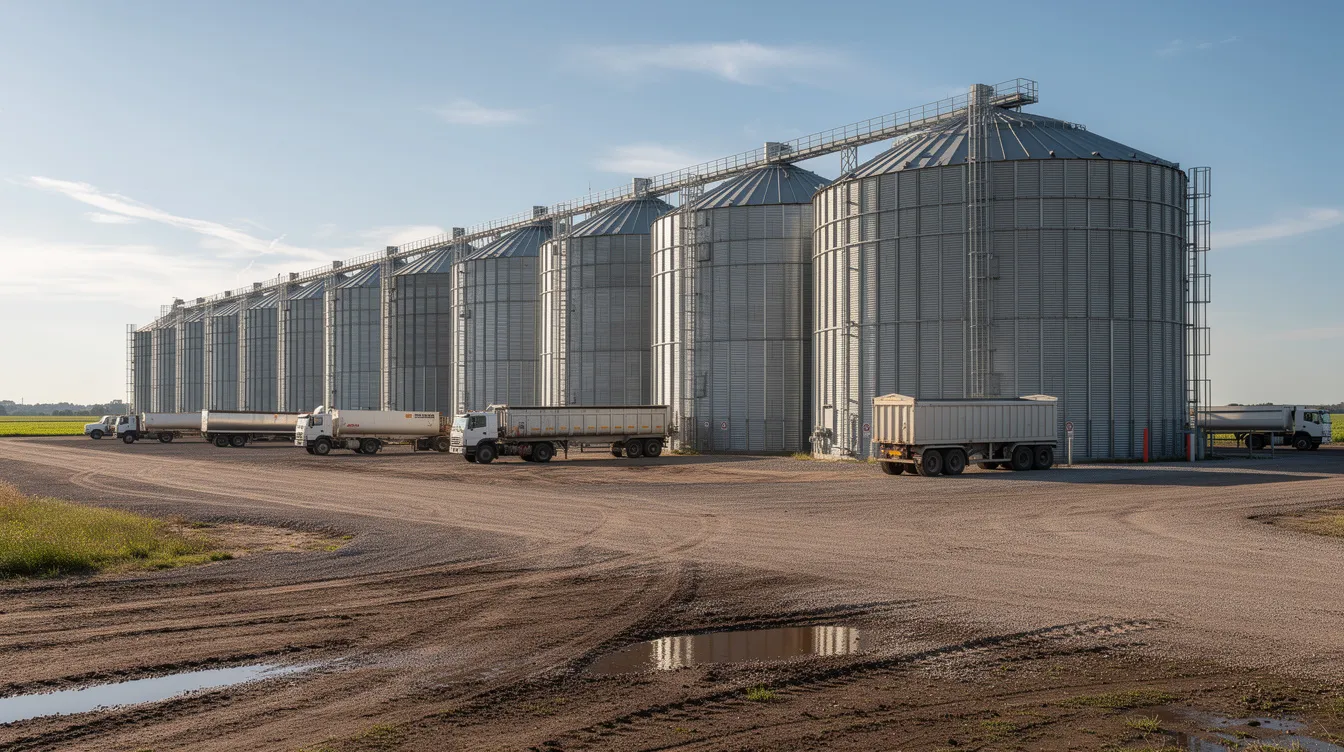
Steel grain silo plants use vertical corrugated galvanized steel structures designed for long-term bulk storage with aeration systems, temperature monitoring cables and mechanised loading and unloading. Commercial grain silos can store over 20,000 tons of grain, with typical cluster capacities ranging from 5,000 to 50,000 MT and above. Steel silos provide significant advantages over traditional jute-bag storage methods, including better preservation, lower storage loss and scientific control of moisture and pests. Properly designed silos reduce post-harvest losses to less than 1%, compared to 10% to 15% in traditional storage.
Steel silos are preferred for their corrosion resistance and lower maintenance compared to concrete alternatives. Key advantages include FIFO (first-in, first-out) management and suitability for PPP projects with FCI or state agencies. However, they involve higher initial capex, need skilled O&M, dependence on reliable power and careful structural design based on geotechnical data. For in-depth assumptions, layouts and techno-financial planning, refer to the Steel Grain Silo Plant Project Report & DPR in India.
Modern Food Grain Warehouses and Godowns
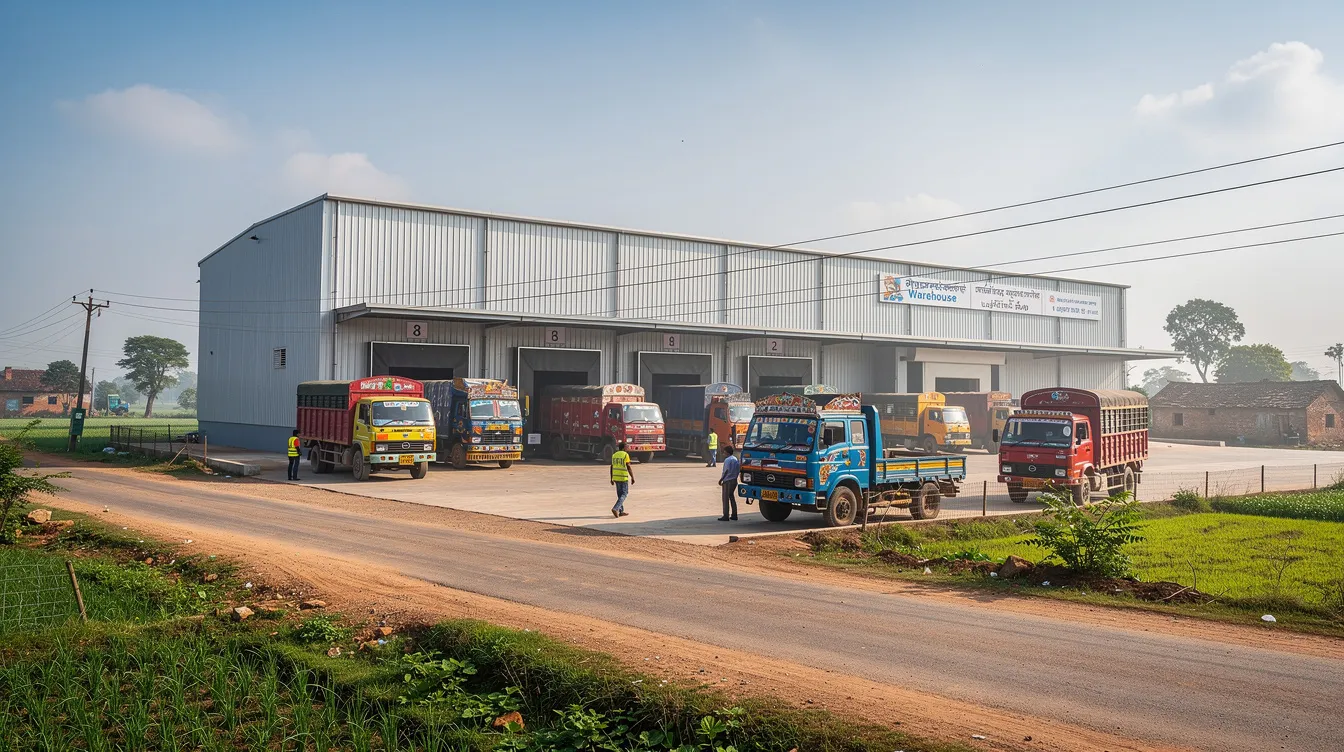
Modern warehouses are RCC or PEB steel structures with scientific ventilation, rat-guarded platforms, palletisation and pest management systems, replacing traditional godowns and CAP storage. These storage facilities are more flexible than silos for handling multiple commodity types and bagged storage, and are suitable for FCI hiring, state agencies, grain traders and food processing industries.
Investment drivers include lower unit capex than silos, familiar operating model, WDRA registration potential and easier scalability on moderate land parcels. Limitations include comparatively higher labour requirement, manual handling risk and slightly higher storage losses if not well managed. For detailed warehouse project planning, see the Modern Food Grain Warehouse & Godown Project Report & DPR in India.
Rail-Linked Grain Silo Terminals
Rail-linked terminals are large steel grain silo complexes connected to railway sidings, designed for high-throughput bulk movement from producing to consuming regions. These often form part of FCI or state PPP frameworks, acting as primary procurement or evacuation hubs with capacities typically 25,000 to 50,000 MT and above. Private players have completed silos with capacities of 25,000 to 50,000 MT each at locations like Darbhanga, Samastipur and Sahnewal.
Advantages include lower long-distance logistics cost, strong institutional demand and potential long-term concession revenue. Key risks include dependence on railway connectivity, rigorous tender conditions, high capex and strict performance obligations. For deeper technical, legal and financial aspects, see the Rail-Linked Grain Silo Terminal Project Report & DPR in India.
Hub & Spoke Grain Silo Projects
Hub and spoke models feature a larger central hub silo (often rail-linked) supported by smaller spoke silos closer to mandis or production clusters. The Government of India plans 100 Lakh Metric Tonnes of silo capacity under programmes including FCI’s Hub & Spoke model across 249 locations. As of September 2024, 23.25 LMT of silo capacity was completed nationally.
Revenue potential exists through long-term concession agreements, handling charges and integrated logistics services. Complexity includes multi-location land acquisition, coordinated construction, operational integration and tender-driven timelines. For detailed hub and spoke DPR resources, see the Hub & Spoke Grain Silo Project Report & DPR in India.
Road-Fed Grain Silo Storage Facilities
Road-fed silos receive and dispatch grain entirely by trucks, focusing on locations with strong road connectivity to mandis, mills and local markets. Typical capacity ranges span 10,000 to 25,000 MT for regional facilities, using bucket elevators, chain and belt conveyor systems and a mix of hopper silos and flat bottom silos. Hopper silos improve unloading speed and reduce material accumulation, while flat bottom silos are designed for long-term bulk storage and support very high storage capacities for grain.
The investor profile includes private grain traders, feed manufacturers, agro-logistics operators and cooperatives. Demand must be demonstrated through contracts or credible market assessment. Refer to the Road-Fed Grain Silo Storage Facility Project Report & DPR in India for detailed design and economics.
PACS & FPO Rural Grain Storage Warehouses
Decentralized storage facilities promoted at Primary Agricultural Credit Societies and Farmer Producer Organisations serve local procurement, fair price shops and input distribution, with capacities often between 500 and 5,000 MT. Decentralising storage to the village level can empower farmers to store food grains closer to the produce source, while decentralized storage can also reduce distress selling among farmers by enabling better market timing.
Transitional support for cooperative societies can strengthen local food distribution and farmer income. These projects may be eligible for Agriculture Infrastructure Fund support and NABARD refinance, subject to scheme conditions. For detailed PACS and FPO DPR guidance, see the PACS & FPO Rural Grain Storage Warehouse Project Report & DPR in India.
Integrated Grain Cleaning, Grading, Drying & Storage Plants
Integrated plants combine pre-cleaning, fine cleaning, grading, drying, bagging and storage for value-added services. Key customers include seed processors, premium grain brands, exporters and flour or feed mills requiring consistent grain quality parameters. Revenue streams come from cleaning, grading and drying charges in addition to storage rental and handling fees.
These projects involve higher technology intensity and machinery capex but deliver stronger margins where quality-linked contracts are available. For the dedicated DPR article, see Integrated Grain Cleaning, Grading, Drying & Storage Plant Project Report & DPR in India.
Bulk Grain Handling & Logistics Terminals
Large logistics terminals at ports, railheads or inland waterways focus on fast intake, transfer and evacuation of grain in bulk form. Infrastructure includes high-capacity loading bays, rapid conveying systems and buffer silos or warehouses. The investor profile includes logistics companies, port operators, trading houses and large processing industries involved in import, export or inter-state movement.
Integrated warehousing solutions at these terminals can enhance logistics and reduce transportation costs. Revenue comes from handling charges, throughput-based fees, storage and blending services. For the specialist DPR resource, see the Bulk Grain Handling & Logistics Terminal Project Report & DPR in India.
Grain Storage Business Models and Revenue Opportunities
The same physical grain storage infrastructure can support multiple business models. A well-prepared detailed project report must clarify whether the project is storage-only, integrated with processing, or combined with trading and logistics.
- Commercial storage rental billed per MT per month for bagged or bulk storage
- Long-term lease of entire warehouse or silo blocks to FCI, state agencies, processors or grain traders
- Institutional storage contracts under PPP or FCI tenders where fixed and variable charges are defined in concession agreements
- Captive storage for flour mills, rice mills, feed manufacturers or ethanol units, where benefits come from quality control and logistics savings rather than external rent
- Cleaning, grading, drying, bagging and handling charges as ancillary revenue at integrated plants
- PACS and FPO member storage models where societies charge members concessional rates and may also earn from institutional hiring
Warehouse receipt-enabled services under the WDRA framework allow registered warehouses to issue electronic Negotiable Warehouse Receipts (e-NWR), enabling farmers and traders to obtain working-capital finance against stored stock.
It is important to distinguish storage rental income from commodity trading margins. Similarly, project term-loan finance (for construction and machinery) is fundamentally different from working-capital finance used for stocking or trading under e-NWR or direct purchase models. For deeper rental income and profitability calculations, consult the Grain Warehouse Revenue Model, Rental Income & Profitability in India.
Grain Silo & Warehouse Setup Cost in India
Project cost varies widely with storage capacity, technology, land cost, soil conditions, level of mechanisation and location. Modern storage solutions require substantial initial investment but offer economic preservation benefits over the project life. Project costs for silos can reach Rs 46 to 48 crores depending on capacity and specifications in India.
A grain storage project report in India should break down the following cost components:
| Cost Component | Typical Description |
|---|---|
| Land and site development | Acquisition or lease, levelling, boundary walls, drainage |
| Civil works | Warehouse sheds, RCC plinths, admin block, internal roads |
| Steel structures and silos | Corrugated steel bins, catwalks, aeration, temperature cables |
| Foundations | Based on geotechnical investigation; heavier for silos |
| Grain handling machinery | Bucket elevators, conveyors, hoppers, gates and valves |
| Cleaning, grading, drying | Equipment as per project scope |
| Electrical systems | HT/LT panels, transformers, DG sets, cabling, lighting |
| Automation and control | PLC/SCADA, sensors, monitoring software |
| Weighbridge and lab | Sampling, quality control, fumigation systems |
| Utilities | Water supply, fire-fighting, compressed air |
| Pre-operative expenses | Design, consultancy, statutory approvals |
| Interest during construction | Based on implementation schedule |
| Contingencies and working capital margin | Buffer for cost variations and initial operations |
For capacity-wise cost structures, refer to Grain Silo & Warehouse Setup Cost in India. Professional project cost assessment considers vendor quotations, soil reports, local construction norms and realistic implementation schedules.
Grain Storage Machinery, Technology & Process Flow
Machinery selection must match planned throughput in tonnes per hour, storage technology and the mix of services offered. Moisture control, pest management and regular inspections are essential for effective grain storage, and automated systems improve grain inventory monitoring and quality management.
Key machinery and systems include:
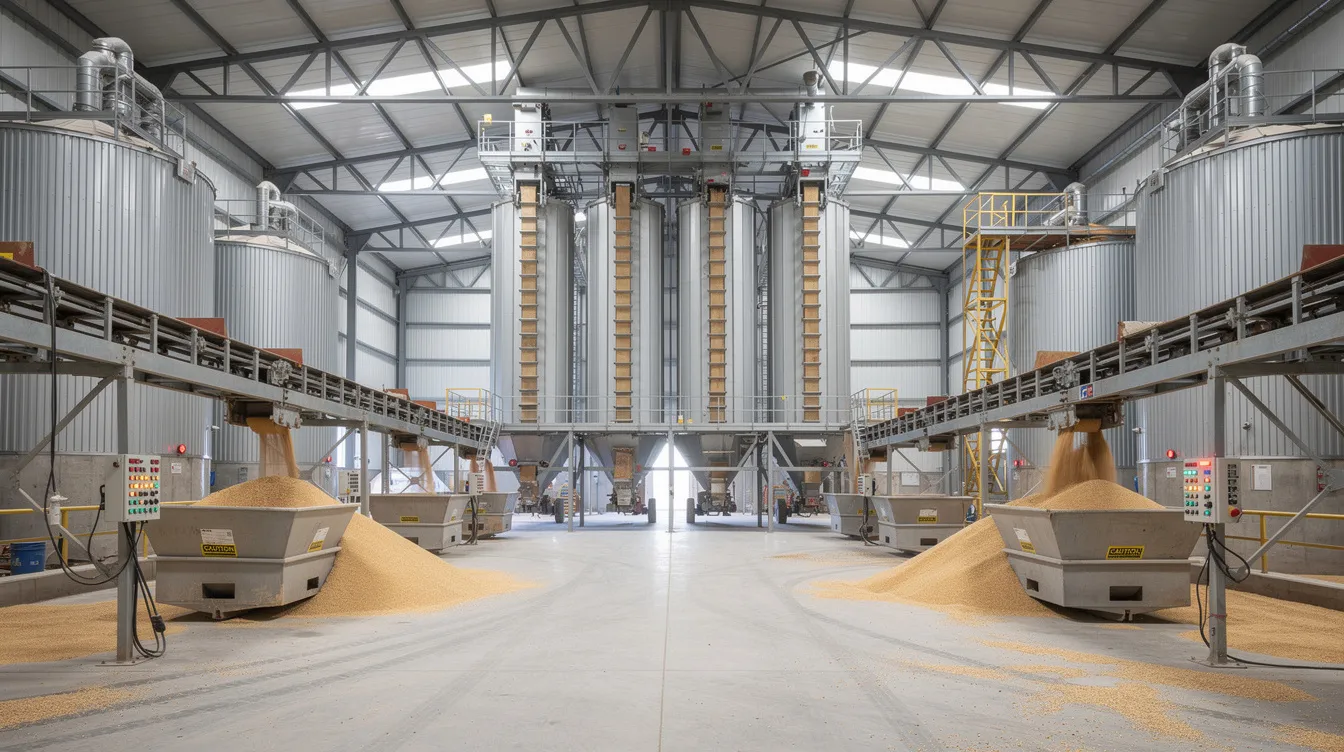
- Receiving equipment: truck tippers, underground pits, intake hoppers
- Pre-cleaners, fine cleaners, destoners and aspiration channels
- Dryers (continuous or batch) where moisture reduction is required
- Conveyor systems: bucket elevators, belt conveyors, chain conveyors, screw conveyors and diverter valves
- Storage systems: steel grain silos (flat-bottom or hopper-bottom) with aeration fans, vents and temperature monitoring, or scientific warehouses with pallets
- Advanced automation: PLC/SCADA controls, level sensors, temperature monitoring cables, aeration control panels
- Dust control: cyclones, filters and aspiration systems
Mechanised steel grain silo facilities offer greater operational efficiency through automation and are better suited to bulk grain handling and large throughput. Conventional warehouses are more manual and flexible for bags and multiple commodities but can be upgraded with conveyor systems and bag handling equipment.
Process Flow: Grain receiving → weighing → sampling and quality check → pre-cleaning → drying (if required) → conveying to silos or warehouse → storage with periodic monitoring → fumigation and aeration → dispatch by truck or rail.
For detailed machinery listings, see Grain Silo Machinery, Equipment & Cost in India and Grain Storage Process Flow Chart & Bulk Handling System.
Grain Silo Capacity Planning, Land & Plant Layout
Key capacity concepts that are often confused in DPRs:
- Static storage capacity in metric tonnes based on silo volume and grain bulk density
- Handling throughput in tonnes per hour for receiving and dispatch
- Annual throughput and storage turnovers per year – a 25,000 MT complex can handle 75,000 to 100,000 MT per year with multiple turnovers
- Average storage occupancy as a percentage of designed capacity actually utilised
- Seasonal peak utilisation during harvest peaks and procurement months
Indicative planning considerations by scale:
- 5,000 MT: Suitable for PACS, FPOs or small traders; emphasis on flexibility, low capex and local coverage
- 10,000 MT: Common starting point for regional warehouses or silos serving local mandis and mills
- 25,000 MT: Suitable for larger traders, processors or PPP projects, usually justifying higher mechanisation
- 50,000 MT and above: Typically institutional or PPP and rail-linked projects requiring robust engineering and financing
Site selection must consider proximity to mandis, highways or railway sidings. Geotechnical investigation is essential to design foundations. The layout must accommodate truck movement, parking, turning radius, weighbridge, office, lab, utilities, fire access, green belts and future expansion. Precise land requirement cannot be generalised without engineering layout; it depends on silo diameter, number of bins, warehouse bays, setbacks and local building regulations.
For detailed planning, see Grain Silo Capacity Planning – 5,000 to 50,000 MT in India and Grain Storage Warehouse Land, Building & Plant Layout Requirements in India.
Grain Storage Project Cost & Means of Finance
A bankable detailed project report must clearly state both the total project cost broken into major heads and the means of finance – how the investment will be funded.
Lenders generally expect to see:
- Promoter contribution (own funds) as a specified percentage of project cost
- Term loan from banks aligned to eligible project cost heads
- Working capital limits (CC/OD, BG, LC, e-NWR-backed limits) for operations
- Treatment of capital subsidy or interest subvention clearly separated from term-loan assumptions
| Illustrative Means of Finance | Percentage |
|---|---|
| Promoter Contribution | 25–30% |
| Term Loan | 60–70% |
| Unsecured Loans / Other Sources | 0–10% |
| Total Project Cost | 100% |
This table is illustrative. Actual structure depends on project specifics, lender requirements and promoter resources.
Banks examine debt-equity ratio, promoter skin in the game, repayment tenor, moratorium period and interest rates relative to projected cash flows. For comprehensive coverage, see Grain Storage Project Cost & Means of Finance in India. Promoters may also explore Project Finance Advisory & Loan Structuring Services for customised capital structure planning.
Grain Storage Financial Projections, Working Capital & DSCR
Lenders and investors rely on forward-looking financial projections to evaluate whether cash flows from the grain storage project can service term-loan obligations sustainably. Financial projections should cover 5 to 7 years for viability assessment.
A robust financial model should contain:
- Projected Profit & Loss Statements, Balance Sheets and Cash Flow Statements
- Storage occupancy assumptions by customer type (FCI, processors, traders, PACS members) and by year
- Rental tariff assumptions and escalation clauses
- Ancillary income from handling, cleaning, drying and grading
- Operating costs: salary, power, repairs, fumigation, insurance, administrative overheads
- Interest, depreciation and loan repayment schedules
Working capital needs are lower for pure rental and fee-based service models where no grain ownership is involved. They are substantially higher if the operator owns stock for trading or processing.
DSCR analysis is central to assessing project financial viability. Banks assess debt service coverage ratio for loan approval, and DSCR is calculated as cash available for debt service divided by total debt obligations (interest plus principal) for each year. Banks generally look for satisfactory average and minimum DSCR benchmarks and examine downside scenarios. Loan tenors for grain silo projects are usually 7 to 10 years.
For in-depth financial modelling discussion, see Grain Storage Financial Projections, Working Capital & DSCR. Promoters needing professional financial modelling and CMA Data can use Financial Projections & Financial Modelling Services and CMA Data Preparation Services.
Grain Silo Project Feasibility, ROI, IRR & Payback
Feasibility analysis has multiple dimensions, all of which must be reasonably favourable:
- Market feasibility: Demand for storage and handling services in the catchment area, competing facilities, institutional procurement volumes and tariffs
- Technical feasibility: Suitability of storage technology, capacity, machinery and site conditions
- Financial feasibility: Profitability, DSCR, IRR, payback and sensitivity to key variables
- Commercial and legal feasibility: Land title, concession terms, regulatory clearances and contractual framework
Project feasibility and viability assessments should adapt to local contexts and agricultural conditions. Key investment metrics include:
- Project IRR versus equity IRR and what each tells investors
- ROI on capital employed compared with alternative investments
- Payback period as an indicator of how many years it takes to recover original investment from net cash flows
- DSCR as the primary banking metric for debt repayment capacity
Sensitivity analysis should test lower occupancy (for example 60% instead of 85%), lower storage tariffs due to competition, higher capex from steel price increases or civil cost overruns, delayed commissioning, and changes in interest rates or concession conditions. DPR examples are illustrative and cannot be used as guaranteed outcomes.
For detailed feasibility resources, see Grain Storage & Silo Project Feasibility Study in India and Grain Silo ROI, IRR, Payback & Sensitivity Analysis in India. Project Report Bank’s Project Feasibility Study Services assist promoters in stress-testing projections before committing large capital.
Government Subsidies, Bank Loans & FCI PPP Opportunities
While bank term loans remain the primary funding source, several government schemes and PPP models support grain storage creation, subject to evolving guidelines and strict eligibility. The Agriculture Infrastructure Fund (AIF) supports post-harvest infrastructure projects in India, and the Agricultural Infrastructure Fund and similar schemes are vital for bridging the storage capacity gap. Financial constraints hinder private sector participation in rural agriculture storage solutions, making such schemes important.
Key frameworks include:
- Agriculture Infrastructure Fund: Interest subvention of 3% per annum for eligible post-harvest infrastructure including warehouses and silos, with credit guarantee support for smaller loans
- NABARD refinance and special credit lines for rural storage infrastructure, PACS godowns and cooperative projects
- State-level schemes providing capital subsidy, interest incentives or viability-gap funding
- PACS and FPO storage initiatives under decentralised capacity plans with hiring assurance
- AMI scheme under ISAM providing capital subsidy of 25% in plain areas and 33.33% for special categories
Public-private partnerships can help expand modern grain storage infrastructures in India. FCI’s steel silo modernisation programme uses DBFOO (Design, Build, Finance, Own & Operate) and DBFOT (Design, Build, Finance, Operate & Transfer) models with long-term concession agreements, often spanning 30 years. These involve competitive bidding, prequalification criteria and performance guarantees with no automatic allocation.
Promoters must check latest scheme details on official portals and treat subsidies as potential upsides, not guaranteed inflows. For detailed coverage, see FCI Grain Silo PPP Projects – DBFOO, DBFOT & Investment Models in India and Grain Warehouse & Silo Subsidy, Bank Loan & Government Schemes in India.
No consultant can guarantee bank loan sanction or subsidy approval; decisions rest solely with lenders and authorities.
WDRA Registration, e-NWR & Regulatory Compliance
The Warehousing Development and Regulatory Authority (WDRA), established under the Warehousing Act, 2007, regulates scientific warehousing and electronic Negotiable Warehouse Receipts in India.
- WDRA registration is required for warehouses that want to issue negotiable warehouse receipts under the WDRA ecosystem
- Not every small private godown is automatically mandated to obtain WDRA registration; the decision depends on business model, customers and financing plans
- e-NWR enables farmers, traders and processors to obtain credit against stored commodities, improving liquidity – all registered warehouses have been mandated to issue only electronic NWRs since August 2019
Other regulatory aspects include land-use permissions, building plan sanctions, environmental clearances, fire NOC, compliance with relevant BIS/IS codes for steel structures, quality standards, labour registrations and tax registrations (GST, PAN, TAN). DPRs should include a concise regulatory and approval roadmap.
For stepwise WDRA and e-NWR guidance, see WDRA Warehouse Registration, e-NWR & Compliance Requirements in India.
Scientific Grain Storage & Warehouse Technology Comparison
Scientific grain storage goes beyond having walls and a roof. It involves continuous control of moisture, temperature, pests and inventory to preserve grain quality and minimise losses.
Key practices include aeration to maintain safe grain temperatures and prevent condensation, moisture management using drying systems, regular sampling and testing, scheduled fumigation with approved chemicals, and proper maintenance of stacking, palletisation, sanitation and record-keeping.
| Parameter | Steel Grain Silos | Modern Warehouses |
|---|---|---|
| Initial investment | Higher capex per MT | Lower capex per MT |
| Automation | Higher; suited to bulk operations | Lower; more manual flexibility |
| Commodities | Best for uniform bulk lots | Flexible for mixed commodities and bags |
| Operational efficiency | Better with advanced automation and process control | Depends on housekeeping and labour quality |
| Maintenance | Steel structures, coatings, aeration, sensors | Structural upkeep plus pest control |
| Risk concentration | Higher if structural or operational failure occurs | Distributed; depends on operating practices |
Technology choice should be driven by business model, capacity, land constraints, demand pattern and financing ability – not merely by trend or subsidy availability. For detailed comparison, see Scientific Grain Storage – Aeration, Moisture Control & Fumigation and Steel Grain Silos vs Conventional Grain Warehouses – Cost & Viability in India.
How to Prepare a Bankable Grain Storage DPR in India
A bankable Detailed Project Report is a structured document that converts a project idea into a technically and financially evaluated proposal. A DPR is essential for securing bank financing for projects. A DPR consolidates engineering inputs and vendor quotations into a coherent investment case, and DPRs assess market demand and site suitability for projects.
Step-by-step action plan:
- Define proposed project type (silo, warehouse, integrated plant, logistics terminal) and business model
- Identify location, catchment area, expected demand and target customers
- Assess site suitability: land size, title status, soil conditions, zoning and connectivity
- Decide preliminary storage capacity and handling throughput based on demand analysis
- Finalise technical configuration: number and type of silos or warehouse bays, machinery and automation level
- Obtain technical and civil quotations from credible vendors
- Prepare project cost estimation and means of finance plan
- Develop revenue assumptions and detailed financial projections
- Conduct sensitivity analysis for occupancy, tariff, cost overruns and delays
- Map regulatory and environmental requirements with timelines
- Compile comprehensive DPR with technical drawings, quotations, licences and promoter credentials
Typical documents examined by lenders:
- KYC and financial statements of promoters and existing businesses
- Land documents (sale deed or lease deed, mutation, property tax receipts) – banks prefer clear land title before sanctioning loans
- Layout plan, project cost break-up and vendor quotations
- CMA Data and projected financial statements
- Net worth statement and details of existing borrowings
Banks typically require detailed project reports for loan proposals. Project reports emphasise that effective inventory management prevents stock accumulation and inefficiency. Promoters wanting structured assistance for bank submissions can explore Bank Finance DPR & Loan Proposal Assistance and CMA Data Preparation Services.
Common Mistakes Investors Should Avoid
- Overestimating storage occupancy and assuming 85% to 95% utilisation from year one without firm contracts – occupancy of 50% to 70% in initial years is more realistic for new facilities
- Selecting land solely on low price without considering connectivity, soil conditions and approval challenges
- Confusing throughput (TPH) with storage capacity (MT), leading to under-designed handling systems that cannot manage peak-season inflows during harvest peaks
- Under-budgeting proper maintenance, fumigation, power and skilled technical staff, which directly affects grain quality and customer confidence
- Assuming subsidies and PPP contracts as guaranteed cash flows before formal sanction or award, ignoring demand risk
- Ignoring WDRA and e-NWR potential where the target customer segment depends on warehouse receipt financing
- Preparing optimistic projections without sensitivity analysis, resulting in weak DSCR under realistic conditions
Rectifying these mistakes at DPR stage is far easier and cheaper than after project implementation. Serious promoters should engage professional feasibility and project finance advisory services early.
Professional Grain Storage DPR Preparation & Project Finance Advisory
CA Manish Gugliya, FCA, DISA (ICAI), is a practising Chartered Accountant with over 20 years of experience in project finance, DPR preparation, CMA Data and financial modelling for manufacturing, agriculture, agro-processing and infrastructure projects across India.
Project Report Bank is a professional advisory platform – not a template marketplace – specialising in:
- Customised Detailed Project Reports for grain storage, grain silos, warehouses and logistics terminals
- Bank finance DPR and loan proposal assistance tailored to specific lenders
- CMA Data preparation, term-loan structuring and working-capital assessment
- Financial projections, DSCR analysis, IRR and payback calculations and sensitivity analysis
- Project feasibility studies before major land or machinery commitments
Advisory is delivered online across the country, based on client inputs on land, proposed capacity, business model, target customers and funding plan. No consultancy can guarantee loan sanction or subsidy; quality DPRs improve preparedness and lender comfort but final decisions rest with banks and authorities.
If you are a serious entrepreneur, warehouse developer, agro-logistics operator, PACS or FPO planning a grain storage project, share your proposed project details – location, capacity, approximate investment and target timeline – via WhatsApp for a customised scope and fee proposal.
The global grain storage market is projected to reach USD 14.2 billion by 2034, and India’s push to build storage infrastructure makes this a significant window of opportunity for well-prepared promoters. India aims to construct 100 Lakh Metric Tonnes of steel silo capacity, and the essential cookies of success in this space are sound planning, realistic projections and professional execution.
Frequently Asked Questions
These FAQs address common queries from new investors that may not be fully covered in the main sections above.
What is the minimum practical size for a grain storage project for a first-time investor?
There is no fixed minimum, but many first-time private promoters consider 5,000 to 10,000 MT warehouses or silos to balance capex and market demand. Smaller PACS or FPO projects may be viable with institutional hiring support. Capacity should always be based on demand assessment and financing ability rather than arbitrary numbers.
Can the same silo or warehouse be used for different grains during the year?
Both silos and warehouses can usually store different commodities in different seasons, provided proper cleaning, fumigation and segregation practices are followed. However, long-term contracts with FCI or processors may specify dedicated space for particular grains or quality grades, which DPRs must reflect.
How long does it typically take to implement a grain storage project after DPR approval?
Implementation time depends on capacity and complexity. Small godowns may take 6 to 9 months from sanction to commissioning, whereas large steel silo or rail-linked projects can take 18 to 24 months. Realistic project schedules in DPRs should include time for detailed design, approvals, construction, machinery fabrication and trial runs.
How should I decide between steel grain silos and a conventional warehouse model?
Promoters should compare expected grain volumes, customer requirements, land availability, budget, desired automation and potential PPP or scheme eligibility. Silos suit high-volume, bulk, long-duration storage and institutional contracts, while warehouses offer more flexibility for mixed commodities and smaller catchment markets.
When should I start preparing my DPR and financial projections?
Start DPR preparation soon after shortlisting land and broad capacity, ideally before finalising civil or machinery orders. Early financial projections help refine project scope, avoid over-investment and prepare for timely bank discussions and scheme applications.
Conclusion – Planning a Profitable and Bankable Grain Storage Project
Successful grain storage, silo and logistics projects in India require a sound understanding of local demand, realistic occupancy potential and careful selection between silos, warehouses or integrated models. Accurate estimation of project cost, capacity and technology – supported by evidence-based financial projections with prudent DSCR, IRR and sensitivity analysis – separates viable projects from those that struggle after implementation.
A well-prepared grain storage project report in India, backed by professional financial modelling and risk assessment, helps promoters take informed decisions and present credible proposals to banks and investors. The action plan should be clear, the production assumptions should be defensible, and the material financial risks should be acknowledged and tested.
If you are planning a grain storage project, share brief details of your planned capacity, location, business model and financing requirement via WhatsApp so that Project Report Bank, under the guidance of CA Manish Gugliya, can evaluate the scope for a customised DPR and project finance advisory engagement.