Key Takeaways
- Grain storage project cost in India varies widely by technology (conventional warehouse vs steel grain storage silos), installed storage capacity (5,000–50,000 MT) and geographic location, with cost per MT typically lower for large, efficiently designed projects that capture economies of scale in land, civil works and machinery.
- Major public agencies like the Food Corporation of India, Central Warehousing Corporation and State Warehousing Corporations dominate food grain storage today, but significant private, FPO and cooperative sector investment is needed to close India’s storage gap of approximately 166 million tonnes and reduce post-harvest losses that cost the country an estimated 15 million tonnes of grain annually.
- Project cost is driven by land, civil construction, steel silos or warehouse superstructure, bulk handling systems, utilities, safety systems and working capital, and the cost per MT for a modern steel grain silo project is usually higher than for a conventional warehouse but delivers much lower storage losses and better grain quality preservation.
- Typical means of finance combines promoter equity with bank term loans (for example, a 70:30 debt-equity structure as an illustration), sometimes supported by the Agriculture Infrastructure Fund or other government-linked facilities, and assessed by lenders through DSCR analysis, projected cash flows and a bankable DPR.
- Project Report Bank, led by CA Manish Gugliya, prepares customised DPRs, financial projections, CMA Data and bank finance proposals for grain storage warehouses, grain silos and integrated grain handling projects across India.
Introduction – Understanding Grain Storage Project Investment in India
India’s food grain production reached over 330 million tonnes in 2023-24, crossing a milestone that few countries in the world can match. Yet this achievement sits alongside a persistent and troubling reality: only 47% of India’s food grain production is stored effectively, and the country loses approximately 15 million tonnes of grain annually due to improper storage. The storage gap is estimated at around 166 million tonnes, a figure that represents both a national food security challenge and a substantial investment opportunity for private entrepreneurs, cooperatives, FPOs and logistics companies.
The institutional backbone of grain storage in India rests on the Food Corporation of India (FCI), which procures 85 million tonnes of foodgrains annually, the Central Warehousing Corporation (CWC) established in 1957 under the Warehousing Corporations Act, and the State Warehousing Corporations (SWCs) that operate hundreds of warehouses across the country. India’s agricultural warehousing capacity was over 166 million tonnes in 2020, yet FCI’s buffer stocks frequently exceed prescribed norms, straining existing storage capacity and forcing reliance on temporary arrangements.
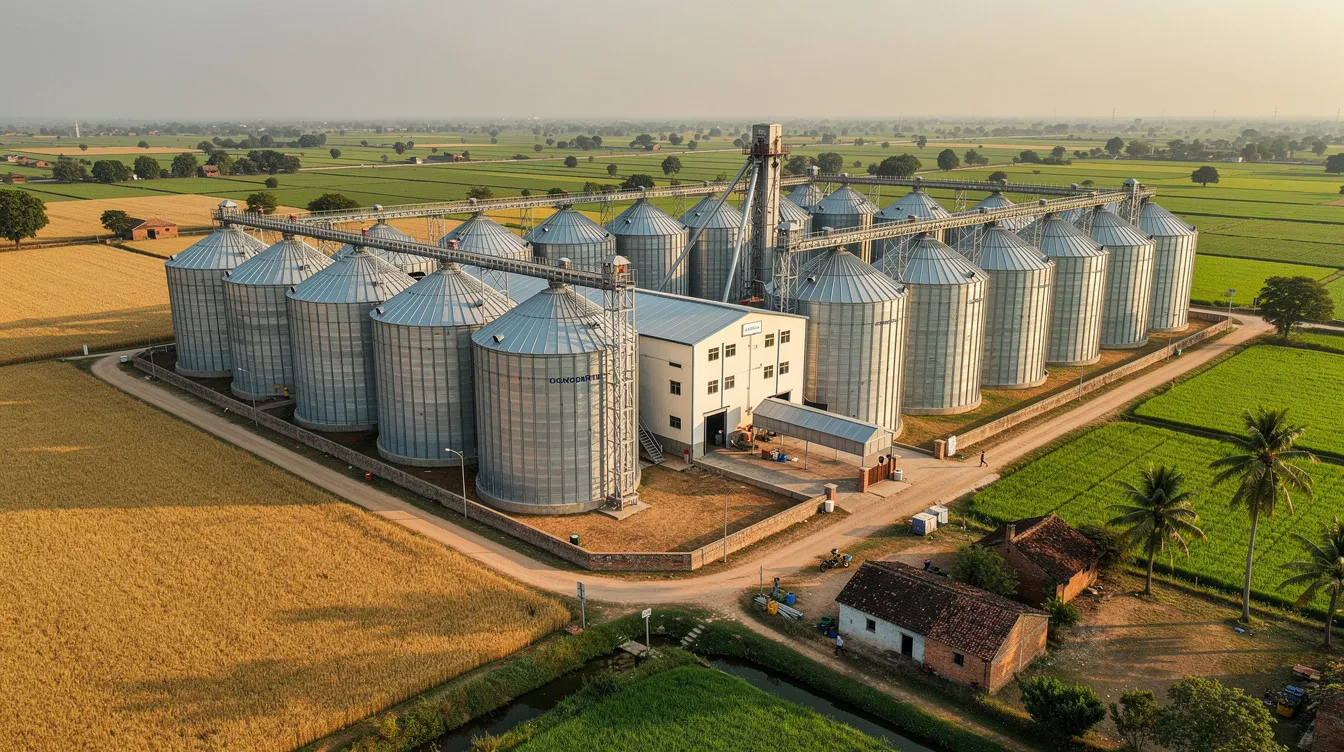
India’s grain storage infrastructure includes CAP (Cover and Plinth) storage, conventional godowns and modern steel silos. About 30 million tonnes of grain are still stored in CAP storage, which offers minimal protection from moisture, dust, insects and rodents. Conventional covered godowns provide better shelter but often lack adequate temperature control and scientific pest management. Modern steel grain silos, by contrast, reduce storage losses to below 0.5% and require roughly one-third the land of equivalent conventional warehouses.
This article examines grain storage project cost in India and the means of finance available to project promoters. It is written from the perspective of entrepreneurs, FPOs, primary agricultural credit societies, logistics operators and warehouse developers who need to understand the real investment, financing structure and financial feasibility before committing capital.
The government has taken a major step through the World’s Largest Grain Storage Plan, which envisions 63,000 PACS with 70 million tonnes of combined storage capacity. The government aims for 100% storage capacity by 2027 through PACS, and the pilot project phase has already seen 11 godowns constructed. This hub and spoke model of decentralised storage at village level creates fresh investment opportunities for cooperatives and their financing partners.
For a separate detailed discussion of setup benchmarks across different technologies, readers may refer to the guide on Grain Silo & Warehouse Setup Cost in India.
Grain Storage Project Cost in India – Investment Overview
Understanding grain storage project cost begins with defining what “project cost” includes. In any Detailed Project Report, total project cost encompasses land and site development, building and civil works, plant and machinery, bulk handling equipment, electrical infrastructure and utilities, preliminary and preoperative expenses, interest during construction, contingency provisions and working capital margin. Actual numbers change with site conditions, design specifications, commodity prices and technology choices-no single figure applies universally.
The per MT investment differs substantially across facility types:
- A conventional food grain warehouse or godown, with basic plinth, bagged storage and limited mechanisation, typically carries the lowest capital cost per MT but incurs higher post-harvest losses and labour expenses over its lifetime.
- A modern scientific grain warehouse with RCC flooring, proper ventilation, insulated roofing and fumigation systems costs more per MT but earns better rental rates and meets the quality standards expected by agencies operating under the public distribution system.
- A steel grain silo storage facility requires significantly higher upfront capital per MT due to steel superstructure, aeration, temperature monitoring and automated handling, but the efficiency gains and loss reduction often justify the premium for large volumes.
- An integrated grain cleaning, drying and storage project adds processing equipment to the base storage investment, increasing total cost but also diversifying revenue streams.
- A bulk grain handling and logistics terminal with rail connectivity involves the highest total investment but serves as a distribution hub, reducing transportation costs across the network.
FCI plans to build 111.12 lakh tonnes of steel silos across 12 states, signalling a clear policy shift toward modern bulk storage. Construction costs for grain storage facilities vary significantly by location and market conditions-a project in Punjab faces different land and labour economics than one in Madhya Pradesh, Telangana or Uttar Pradesh.
| Facility Type | Capacity Band | Indicative Cost per MT (₹) |
|---|---|---|
| Conventional Godown/Warehouse | 10,000–50,000 MT | 4,000–6,000 |
| Modern Scientific Warehouse | 10,000–50,000 MT | 4,900–6,500 |
| Steel Grain Silo System | 10,000–50,000 MT | 8,000–12,000 |
| Integrated Cleaning-Drying-Storage | 10,000–25,000 MT | 10,000–15,000 |
| Bulk Grain Terminal (with rail siding) | 25,000–50,000 MT | 10,000–16,000 |
Amounts are illustrative and depend on site, design, automation level and current material prices. Modern steel silos require significant upfront technology costs compared to conventional godowns.
For projects modelled on conventional and modern warehouse formats, a detailed treatment is available in the Modern Food Grain Warehouse & Godown Project Report. Promoters evaluating silo-based investment can review the Steel Grain Silo Plant Project Report & DPR. Those planning at terminal scale may find the Bulk Grain Handling & Logistics Terminal Project Report relevant.
Detailed Grain Storage Project Cost Breakdown
Any grain storage DPR should break the total project cost into clearly defined heads, each supported by quotations, technical specifications and stated assumptions. The following subsections describe the major cost components, their typical share of total investment, and how they differ between warehouse and silo projects.
Land Purchase, Development and Site Preparation
Land requirements vary sharply between warehouse and silo formats. A 10,000 MT conventional warehouse may need 4–5 acres, while a 10,000 MT steel silo system can often be built on 1.5–2 acres because modern silos require one-third the land of conventional warehouses. For a 50,000 MT silo complex, approximately 7 acres may suffice, compared to 18–20 acres for equivalent bagged storage.
Cost elements include land acquisition or lease premium, conversion charges, site levelling, soil testing and geotechnical investigations, boundary wall construction, internal roads and basic site development. Regional land prices in states like Punjab or Haryana can be several times higher than in Madhya Pradesh or parts of Telangana, making location one of the most significant variables in total project cost.
| Component | 10,000 MT Warehouse | 10,000 MT Steel Silo |
|---|---|---|
| Land Area (approx.) | 4–5 acres | 1.5–2 acres |
| Illustrative Land + Development Cost | ₹80–150 lakh | ₹50–100 lakh |
Site selection should consider proximity to mandis, railheads, highways and procurement centres of FCI or state agencies. Detailed guidance is available in the article on Grain Storage Warehouse Land, Building & Layout Requirements.
Warehouse or Silo Civil Construction
Civil and foundation works are critical for grain storage structures to support heavy loads. For a conventional godown, the focus is on plinth height (typically 80 cm or more), RCC flooring, ventilation, roofing (galvanised sheets or PEB structures) and loading dock design. A modern scientific warehouse adds insulated roofing, higher floor specifications and scientific pest control provisions.
For steel grain silos, civil works include RCC ring beam foundations, tunnel structures for reclaim systems, elevator pits, control room buildings and equipment platforms. Wind and seismic load calculations for tall structures add engineering complexity.
| Aspect | Warehouse Project | Silo Project |
|---|---|---|
| Civil Cost as % of Total Fixed Capital | 40–55% | 20–30% |
| Key Cost Drivers | Plinth, roofing, floor area | Foundations, tunnels, ring beams |
Grain Storage Equipment and Machinery
For steel grain silos, major machinery includes silo shells and roof panels, aeration systems, sweep augers, temperature monitoring sensors, level sensors, ventilation fans, ladders, platforms and safety systems. For warehouses, the equipment list typically covers stackers, bagging and unbagging machinery, fumigation systems and basic mechanisation.
Investment in grain handling and mechanization affects the overall project budget substantially. Automation can reduce long-term operational costs despite increasing initial capital expenditures. Readers planning silo-based projects can refer to the detailed guide on Grain Silo Machinery, Equipment & Cost.
Bulk Handling, Conveying and Loading Systems
Bulk handling systems-bucket elevators, belt conveyors, chain conveyors, screw conveyors, intake pits, truck unloading hoppers and loading spouts-are essential for modern grain silos and large-scale terminals. These systems handle wheat, rice, maize and other grains with minimal spillage and manual intervention. For conventional warehouses, a mix of mechanised and manual handling is common depending on scale.
Typical conveying capacities range from 60 to 200 TPH for commercial storage projects. A detailed process flow and material handling design is discussed in the article on Grain Storage Process Flow Chart & Bulk Handling System.
Electrical Infrastructure, Utilities and Fire Safety
Key components include HT/LT panels, transformers, internal electrification, power cabling for motors and MCCs, lighting, DG sets, earthing, lightning arrestors and PLC/SCADA systems for automated operations. Utility planning covers sanctioned power load, backup power, water supply for cleaning and fire hydrant systems, and storm water drainage.
Statutory requirements for grain storage include firefighting and environmental compliance-fire hydrants, sprinklers where prescribed, fire alarms and smoke detectors must comply with local fire authority norms. Electrical, utilities and fire safety systems together can account for 8–15% of total fixed capital depending on automation level.
Weighbridge, Laboratory and Quality Control Equipment
An electronic weighbridge (40–60 MT capacity) is essential for accurate weight recording, billing and compliance with FCI and CWC standards. An in-house quality control lab with moisture meters, grain probes, insect detection tools and sample dividers supports grading and food safety. Indicative cost for a standard weighbridge plus lab setup may range from ₹15–30 lakh depending on specifications.
Roads, Drainage, Boundary Walls and Auxiliary Facilities
Internal roads for truck circulation, parking bays, turning radius, rainwater drainage, storm water channels and proper site grading prevent waterlogging near storage structures. Auxiliary facilities include a gate complex, guard room, administrative building, staff amenities and security systems. Inadequate drainage or low plinth design remains a major cause of moisture ingress and grain damage-a classic case where modest incremental spending during construction avoids substantial operating losses for years.
Preliminary and Preoperative Expenditure
This head covers company formation, legal charges, design and engineering consultancy, DPR preparation, architectural consulting, statutory approvals and implementation-period expenses including staff salaries, travel and trial runs. Preliminary and preoperative expenses typically range within 3–5% of total fixed assets and must be separately capitalised for accurate project cost estimation.
Interest During Construction (IDC)
Interest during construction is computed on the drawn portion of the term loan until the project achieves commercial operations. For a mid-sized storage project with a 12–18 month implementation period, IDC can add 3–6% to the base project cost. Delays in steel supply, fabrication or civil works directly inflate IDC and disturb debt-equity ratios and DSCR assumptions submitted to banks. IDC is treated by banks as part of project cost for term loan appraisal.
Contingency Provisions
Contingency of 5–10% over civil works, steel structures and machinery absorbs price escalation and minor design changes. It should not be applied on land, IDC or working capital. In periods of steel and cement price volatility, under-provisioning contingency leads to mid-project funding gaps.
Working Capital Margin
Even a pure rental warehouse needs working capital for salaries, utilities, regular maintenance, insurance and initial operating float. In trading or integrated grain procurement models, working capital for inventory and receivables can be substantial-grain stored for own account may be held for several months before being sold, tying up significant funds.
Grain storage project costs can include utilities, maintenance and staff management as recurring working capital components. CMA Data preparation for bank working capital limits should reconcile with the DPR’s project cost assumptions. For professional CMA Data preparation, promoters may refer to CMA Data Preparation Services for Bank Loans.
Illustrative Project Cost Statement – 10,000 MT Modern Warehouse
| Cost Head | Amount (₹ Lakh) |
|---|---|
| Land & Site Development | 120 |
| Building & Civil Construction | 250 |
| Plant & Machinery (incl. handling) | 100 |
| Electrical, Utilities & Fire Safety | 55 |
| Weighbridge, Lab & QC Equipment | 20 |
| Roads, Drainage & Auxiliary | 35 |
| Preliminary & Preoperative Expenses | 25 |
| Interest During Construction | 30 |
| Contingency | 30 |
| Working Capital Margin | 35 |
| Total Project Cost | 700 |
All amounts are illustrative and must be customised through site-specific quotations, current material prices and professional assessment.
Grain Storage Project Cost by Storage Capacity
Grain storage project cost does not rise linearly with capacity. Larger projects capture economies of scale in land utilisation, civil works and machinery, lowering cost per MT. A 50,000 MT silo complex will have a materially lower per-MT investment than five separate 10,000 MT units.
| Capacity | Technology | Approx. Land | Indicative Fixed Capital (₹ Crore) | Approx. Cost/MT (₹) |
|---|---|---|---|---|
| 5,000 MT | Steel Grain Silo | 1–1.5 acres | 4–5 | 8,000–10,000 |
| 10,000 MT | Modern Warehouse | 4–5 acres | 5–7 | 5,000–7,000 |
| 25,000 MT | Steel Silo (semi-automated) | 3–4 acres | 18–25 | 7,200–10,000 |
| 50,000 MT | Steel Silo Complex (with rail) | 6–8 acres | 50–60 | 10,000–12,000 |
All figures are illustrative projections, excluding land cost variations across states.
At capacities of 25,000 MT and above, incremental automation such as high-speed conveyors, automated sampling, SCADA control systems and real-time monitoring enters the design, increasing total project cost but improving throughput and manpower productivity. FCI’s online depot system enables real-time tracking of grain, and large-scale facilities are expected to integrate similar systems.
Rural PACS-based storage units of 1,000–2,000 MT have a fundamentally different cost structure from 50,000 MT logistics terminals near railheads or ports. The government aims to create 150–200 lakh MT of additional storage capacity through a mix of these formats. For guidance on choosing optimal storage capacity, readers can refer to Grain Silo Capacity Planning – 5,000 to 50,000 MT.
Means of Finance for Grain Storage Projects
The means of finance for a grain storage project must align the debt-equity structure with the project’s risk profile, revenue stability and cash flow pattern. An over-leveraged project with uncertain occupancy creates repayment stress regardless of how attractive the projected numbers may appear.
The principal sources of finance include:
- Promoter equity (own funds, unsecured loans from family or associates)
- Bank term loans from commercial banks, cooperative banks or regional rural banks
- Working capital limits (cash credit, warehouse receipt finance)
- NBFC or project finance from specialised infrastructure lenders
- Equity participation from strategic partners or investors
- Government-supported facilities such as the Agriculture Infrastructure Fund, which offers interest subvention and credit guarantee support for eligible projects
A 70:30 debt-equity ratio is a commonly used illustration, where 70% of project cost is funded through a term loan and 30% through promoter equity. However, actual ratios vary with project size, collateral strength, promoter track record and lender policy.
Illustrative Means of Finance – 10,000 MT Modern Warehouse (₹700 Lakh Project)
| Source | Amount (₹ Lakh) | % of Project Cost |
|---|---|---|
| Promoter’s Equity | 210 | 30% |
| Bank Term Loan | 455 | 65% |
| Working Capital (Bank) | 35 | 5% |
| Total | 700 | 100% |
Interest subvention under schemes like the Agriculture Infrastructure Fund reduces the effective interest rate on eligible loans without changing the base project cost. Promoters must verify the latest guidelines from official portals before finalising assumptions in the DPR. Government schemes can provide financial assistance for agricultural marketing infrastructure projects in India, but benefits are not universally available across all categories and states.
Rural warehousing and PACS or FPO grain storage projects may combine equity contribution from members with bank finance and government support. A detailed discussion is available in the PACS & FPO Rural Grain Storage Warehouse Project Report.
Serious promoters planning grain storage, silo or integrated handling projects can connect with Project Report Bank via WhatsApp for customised DPR preparation, means of finance planning and bank loan structuring assistance.
Bank Loan Financing for Grain Storage Warehouse and Silo Projects
Banks treat grain storage infrastructure as long-term assets and focus their appraisal on the strength of underlying contracts, realistic utilisation assumptions and the promoter’s ability to service debt through the project’s cash flows.
Key parameters lenders examine include:
- Promoter’s financial strength, experience in warehousing or agriculture, and net worth adequacy
- Clarity of land title or acceptable lease arrangements suitable for mortgage
- Reasonableness of total project cost supported by quotations from approved suppliers
- Technology choice and alignment with end-user requirements (FCI specifications, CWC norms, private standards)
- Revenue visibility through long-term storage contracts, capacity booking or guaranteed offtake
- Projected occupancy rates and sensitivity of DSCR to lower-than-planned utilisation
- Collateral and security: primary charge over project assets, equitable mortgage of land and building, possible additional collateral and personal guarantees of promoters
Documentation expectations include a bankable DPR, detailed financial projections, CMA Data for working capital assessment, project implementation schedule and clear cost breakup. Detailed Project Reports are essential for banks when applying for finance in grain storage projects. A professionally prepared proposal improves the quality of appraisal discussion, though no documentation can by itself guarantee loan sanction-banks also consider regulatory norms, risk appetite and overall exposure limits.
For professional Bank Finance DPR & Loan Proposal Assistance, promoters can engage Project Report Bank’s advisory services.
Government Schemes and Financial Assistance for Grain Storage Infrastructure
Government support for grain storage infrastructure aims to close the storage gap, reduce post-harvest losses and encourage private and cooperative investment across the country. However, scheme availability, eligibility and conditions must always be verified from current official notifications before building them into project assumptions.
The Agriculture Infrastructure Fund (AIF), a central sector scheme with a ₹1 lakh crore outlay operational through 2032-33, supports warehouses, silos and cold chains with interest subvention of 3% and credit guarantee benefits for eligible entities including FPOs, PACS and agri-entrepreneurs. NABARD-linked refinance programmes and state-level warehousing promotion schemes can support term loans through participating banks and cooperative institutions.
It is important to distinguish between capital subsidy (where applicable under specific sub-schemes), interest subvention (reduction in effective interest rate on eligible loans) and ordinary commercial term loans without any subsidy component. Not all grain storage projects qualify for financial assistance, and promoters should not assume universal subsidies across all project types or states.
The cooperative sector grain storage plan through PACS uses convergence of the AIF with other central and state programmes, and the prime minister’s vision of decentralised storage creates specific opportunities for cooperatives. Micro food processing enterprises and similar small-scale ventures under PM Formalization of such initiatives can also benefit from convergence, subject to eligibility. Project Report Bank can structure financial projections to reflect verified scheme benefits where applicable.
Working Capital Requirements for Grain Storage Projects
Working capital patterns differ substantially between business models. A pure storage-service model generates rental income and needs working capital primarily for 1–3 months of operating expenses-staff salaries, power for aeration systems, fumigation materials, repairs, insurance and modest receivables. Farmers and traders using the facility pay storage charges, and the operator’s cash cycle is relatively short.
In a grain procurement and trading model, working capital needs are dominated by inventory financing. Grain may be stored for own account, held for several months to sell at better prices and avoid distress sales, with the value of stocks requiring substantial bank funding through cash credit or warehouse receipt finance. The margin for this inventory is funded by the promoter.
An integrated grain cleaning, drying, grading and storage model falls between these extremes, with slightly higher receivables and consumable stocks. Further details on such projects are available in the Integrated Grain Cleaning, Grading, Drying & Storage Plant DPR.
| Working Capital Component | Storage-Service Model (₹ Lakh) | Trading Model (₹ Lakh) |
|---|---|---|
| Operating Expenses (2 months) | 10–15 | 10–15 |
| Inventory (grain stock) | – | 150–300 |
| Receivables | 5–10 | 15–25 |
| Less: Creditors | (3–5) | (5–10) |
| Net Working Capital | 12–20 | 170–330 |
Underestimating working capital leads to cash flow strain even if the fixed capital portion was accurately planned. Reconciling working capital estimates with CMA Data is essential for a coherent bank finance proposal.
Grain Storage Project Revenue Model and Financial Projections
Revenue in grain storage projects is typically built on storage charges per MT per month, handling charges for loading and unloading operations, and value-added services such as drying, cleaning and grading. Ancillary income from logistics contracts and warehousing services linked to the broader supply chain can supplement the core storage business.
Average occupancy is the single most important revenue driver. A 10,000 MT facility operating at 60% occupancy in Year 1, 75% in Year 2 and 85% in Year 3 will generate substantially different cash flows than one assuming 90% from the start. Seasonal harvest patterns also affect when the facility fills and when it empties, creating natural cash flow variability.
Key financial statements in a grain storage DPR include projected income statement, cash flow statement and balance sheet, along with profitability indicators such as EBITDA margin and return on capital employed. Break-even analysis identifies the utilisation level at which the project covers all fixed and variable costs.
Illustrative Financial Snapshot – 10,000 MT Modern Warehouse
| Indicator | Year 1 | Year 2 | Year 3 |
|---|---|---|---|
| Capacity Utilisation | 60% | 75% | 85% |
| Gross Revenue (₹ Lakh) | 90 | 112 | 128 |
| Operating Expenses (₹ Lakh) | 55 | 60 | 65 |
| EBITDA (₹ Lakh) | 35 | 52 | 63 |
| Indicative DSCR | 1.15 | 1.55 | 1.85 |
Assumed storage tariff of ₹125/MT/month, handling charges additional. All figures illustrative.
Sensitivity analysis-testing outcomes under lower utilisation, lower tariffs or higher interest rates-helps identify the point at which DSCR falls below comfortable levels. The efficiency of the control and monitoring systems implemented during construction directly affects both grain quality and long-term operating expenses.
For a practical understanding of DSCR methodology in project appraisal, readers may also refer to the DSCR & Loan Repayment Capacity analysis framework discussed in the context of food processing projects.
Sample Grain Storage Project Cost and Means of Finance
The following example presents an illustrative 10,000 MT modern grain warehouse with partial mechanisation. This is not a silo project-it represents a scientific warehouse suitable for bagged storage of wheat, rice, maize and other food grains with modern ventilation, pest control and basic bulk handling.
Table 1: Detailed Project Cost Statement
| Cost Head | Amount (₹ Lakh) |
|---|---|
| Land (3.5 acres) & Site Development | 120 |
| Building & Civil Construction | 260 |
| Plant & Machinery (handling, fumigation) | 90 |
| Bulk Handling & Conveying Systems | 45 |
| Electrical, Utilities & Fire Safety | 55 |
| Weighbridge, Lab & QC Equipment | 20 |
| Roads, Drainage & Auxiliary Facilities | 35 |
| Preliminary & Preoperative Expenses | 22 |
| Interest During Construction (12 months) | 28 |
| Contingency (5% on civil + machinery) | 25 |
| Working Capital Margin | 30 |
| Total Project Cost | 730 |
Table 2: Means of Finance Statement
| Source | Amount (₹ Lakh) | Share |
|---|---|---|
| Promoter’s Equity | 220 | 30.1% |
| Bank Term Loan | 480 | 65.8% |
| Working Capital (Bank Funded) | 30 | 4.1% |
| Total | 730 | 100% |
Table 3: Key Financial Appraisal Assumptions
| Parameter | Assumption |
|---|---|
| Installed Capacity | 10,000 MT |
| Utilisation (Yr 1 / Yr 3) | 60% / 85% |
| Storage Tariff | ₹120–130/MT/month |
| Operating Margin (stabilised) | 45–50% at EBITDA level |
| Term Loan Interest Rate | 9.5% p.a. (before any subvention) |
| Loan Tenure | 10 years (incl. 1 year moratorium) |
| Expected DSCR Range (Yr 2 onwards) | 1.40–1.90 |
| Indicative Project IRR | 14–18% |
All amounts are illustrative and must be customised through site-specific quotations, updated material prices and lender-specific appraisal. Project cost total equals means of finance total.
At ₹730 lakh for 10,000 MT, the cost works out to approximately ₹7,300 per MT-reasonable for a well-specified modern warehouse with handling systems. Annual revenue potential at stabilised occupancy could reach ₹125–130 lakh, supporting an indicative DSCR band of 1.4–1.9 depending on interest rate and operating cost growth. Small changes in utilisation, tariff or interest rate can materially alter viability, reinforcing why sensitivity analysis is essential.
Project Report Bank can adapt this framework to prepare investor-ready DPRs and bank finance reports for different capacities and technologies, including steel grain silos or integrated drying-storage plants.
Key Factors Affecting Grain Storage Project Investment
- Geographic location determines land cost, labour rates, transportation costs and proximity to production catchments. States like Punjab and Haryana have higher land prices but higher grain production density.
- Steel and cement price cycles directly impact silo and warehouse construction cost-galvanised steel sheet prices have ranged between ₹55,000–75,000 per MT in recent years.
- Level of automation and technology choice (flat-bottom vs hopper-bottom silos, PEB roofing, SCADA systems) can swing the per-MT cost by 20–40%.
- Compliance with FSSAI norms, local building bye-laws, fire safety regulations and pollution control clearances adds both cost and implementation time. Regulatory compliance and obtaining local approvals add costs to grain storage projects.
- Projects aligned with long-term contracts from FCI, CWC, state agencies or corporate buyers justify higher capital intensity because of improved revenue visibility.
- Design elements that influence lifetime cost-roof insulation, drainage, pest-proofing, energy-efficient fans-represent modest incremental investment during construction but reduce operating expenses for 20–25 years.
- The macro-policy environment, including stock limits under the Essential Commodities Act and changes in procurement policy, shapes long-term occupancy risk and hence financing appetite.
Common Mistakes in Grain Storage Project Cost Estimation
Promoters frequently underestimate civil and structural costs, particularly plinth, flooring, drainage and soil improvement requirements. Taxes, duties and statutory fees are sometimes omitted from the initial budget.
Preoperative expenses, IDC and contingency are often inadequately provisioned, leading to mid-project funding gaps that delay implementation and escalate the final cost. Project costs for grain storage can vary considerably based on local factors and market conditions, and generic per-square-foot or per-MT thumb rules without site-specific adjustment create unreliable estimates.
Working capital miscalculations are common-assuming full advance payments from customers, ignoring credit terms, or failing to budget for the initial months of low utilisation when cash flows are tight. Unrealistic utilisation assumptions (100% occupancy from Year 1 at premium rates) artificially inflate IRR and DSCR, creating stress when actual operations begin.
The most reliable approach combines validated quotations, professional DPR preparation and conservative but defensible assumptions. Growth in occupancy should be projected realistically, not aspirationally.
Why a Bankable DPR Is Important for Grain Storage Project Financing
Grain storage projects are capital intensive, have long payback periods and are sensitive to utilisation rates. A bankable DPR is therefore not just a formality-it is the foundation on which both the promoter’s investment decision and the lender’s appraisal process rest.
From a Chartered Accountant’s project-finance perspective, a bankable DPR should contain a clear technical description, capacity and layout plan, detailed cost estimates with supporting quotations, means of finance, projected financial statements, risk analysis and sensitivity scenarios. Well-structured financial modelling-including projected cash flows, DSCR analysis, break-even calculation and IRR assessment-helps both promoters and lenders understand the risk-return profile and repayment capacity of the project.
CMA Data must align with the DPR in terms of working capital cycles, current assets and liabilities, and projected bank borrowing. Discrepancies between CMA Data and DPR projections during bank appraisal can delay or weaken the financing proposal.
For customised, bank-ready DPRs and allied documentation for grain storage, grain silos and logistics terminal projects, promoters can engage Bank Finance DPR & Loan Proposal Assistance from Project Report Bank. Quality documentation strengthens the proposal-though no one can guarantee loan sanction, a professionally prepared DPR ensures the project is presented in the most complete and credible manner possible.
Serious promoters are welcome to connect via WhatsApp for project-specific DPR, financial modelling and bank-lender discussion support.
Frequently Asked Questions
The following questions address common queries on grain storage project cost, financing and DPR preparation that are not fully covered in the preceding sections.
What is the approximate cost of setting up a grain storage warehouse in India?
The cost depends on capacity, specification and location. A modern 10,000 MT warehouse with scientific storage features typically requires ₹5–7 crore in total project cost (approximately ₹5,000–7,000 per MT), while a basic godown of similar capacity may cost ₹4,000–5,500 per MT. These are indicative ranges-actual DPR estimates must be based on site-specific data, current material prices and validated quotations from contractors and suppliers.
How much does a 10,000 MT steel grain silo project typically cost?
A bare silo installation with civil works and aeration for 10,000 MT may cost approximately ₹8–10 crore. A fully integrated facility with grain cleaning, drying, automated bulk handling and metal silos can push total investment to ₹12–15 crore or more. Steel price volatility and the level of automation are key cost drivers. Costs at farms or remote locations may be higher due to transport and erection logistics.
What is the usual project cost per MT of grain storage capacity?
Conventional warehouses often fall in the ₹4,000–6,500 per MT range, while steel grain silos typically range from ₹8,000–12,000 per MT at medium to large scale. Silos cost more per MT upfront but reduce losses, need less land and can be more efficient over their productive life. Per MT cost also falls as capacity increases, reflecting economies of scale in civil works and shared machinery.
What level of promoter contribution do banks expect for grain storage projects?
Most banks expect 25–35% of total project cost as promoter’s equity for new storage projects, though the exact requirement varies with collateral offered, project risk and the borrower’s financial strength. A 70:30 debt-equity ratio is a common but not universal benchmark. Banks place emphasis on demonstrating that the equity contribution is from genuine own funds rather than borrowed sources. Approved project cost and land value contribute to the collateral assessment.
What financial projections and ratios are essential in a grain storage DPR?
A comprehensive DPR should include projected income statement, cash flow statement and balance sheet for the loan tenure plus two to three years. Key ratios include DSCR (annual net cash accrual plus interest, divided by loan instalment plus interest), project IRR, payback period and break-even occupancy. Banks pay particular attention to DSCR trends across the loan tenure and its robustness under sensitivity scenarios testing lower utilisation, lower tariffs and higher interest rates. The production and storage capacity assumptions underlying revenue must be clearly documented and defensible.
Conclusion – Planning a Financially Viable Grain Storage Project
Establishing a grain storage project in India-whether a conventional warehouse, a steel silo system or an integrated handling facility-requires careful cost estimation, appropriate technology selection and a well-structured means of finance. The storage infrastructure gap across the country is real, and projects that are implemented with realistic assumptions, credible demand visibility and balanced financing have a strong foundation for stable, long-term returns.
High-quality storage reduces post-harvest losses, supports national food security and generates stable rental or service income when aligned with long-term contracts from agencies like FCI, CWC, cooperatives and private agribusinesses. The network of storage facilities across the country must grow, and the opportunity for private and cooperative sector investment has never been larger.
A detailed, bankable DPR, robust financial modelling and accurate CMA Data remain the most effective tools for securing bank term loans and working capital on reasonable terms-particularly for first-time warehouse or silo promoters who need to demonstrate financial viability to lenders.
Entrepreneurs, FPOs, primary agricultural credit societies, MSMEs and logistics firms planning grain storage, grain silos or integrated handling terminals are welcome to contact Project Report Bank via WhatsApp for professional DPR preparation, project finance advisory and investor-ready documentation tailored to their specific project requirements.
CA Manish Gugliya FCA, DISA (ICAI) More than 20 years of professional experience in project reports, financial projections, CMA Data, project finance and business advisory.