A PACS grain storage warehouse project report is the foundational document that determines whether a proposed rural grain warehouse is technically feasible, financially viable and bankable. Whether a Primary Agricultural Credit Society or a Farmer Producer Organisation is planning the investment, the detailed project report must address capacity, location, construction design, project cost, means of finance, revenue assumptions, operating expenses and debt-servicing capacity before any meaningful financing discussion can begin.
This article provides a practical advisory guide covering how PACS and FPO warehouse projects work, what they cost, how they are financed, which government schemes may apply and what a professional DPR should contain.
Key Takeaways
- A PACS grain storage warehouse project report is a bank-oriented document covering proposed capacity, technical design, project cost, means of finance, five-to-seven-year financial projections, DSCR and risk analysis, essential for accessing term loans, subsidies and infrastructure fund assistance.
- Under the World’s Largest Grain Storage Plan in Cooperative Sector (approved 31 May 2023), PACS-led village warehouses can access convergent benefits through AIF interest subvention, AMI capital subsidy and NABARD refinance support, but eligibility criteria and subsidy rates differ between PACS and FPOs.
- Typical rural grain warehouse capacities range from 500 to 5,000 MT; key cost heads include land, civil construction, warehouse equipment, professional fees and initial working capital, with exact project cost requiring current local quotations rather than universal per-MT estimates.
- Project viability depends on realistic demand assessment, achievable storage tariffs, adequate occupancy assumptions and sustained DSCR over the loan tenure – not merely on the availability of subsidy.
- A Detailed Project Report (DPR) is essential for seeking funding from banks, cooperative institutions and government schemes. Project Report Bank, led by CA Manish Gugliya, FCA, DISA (ICAI), prepares customised bankable DPRs, CMA Data and financial models tailored to specific PACS or FPO projects, locations and financing plans.
PACS & FPO Rural Grain Storage Warehouse Project Overview in India
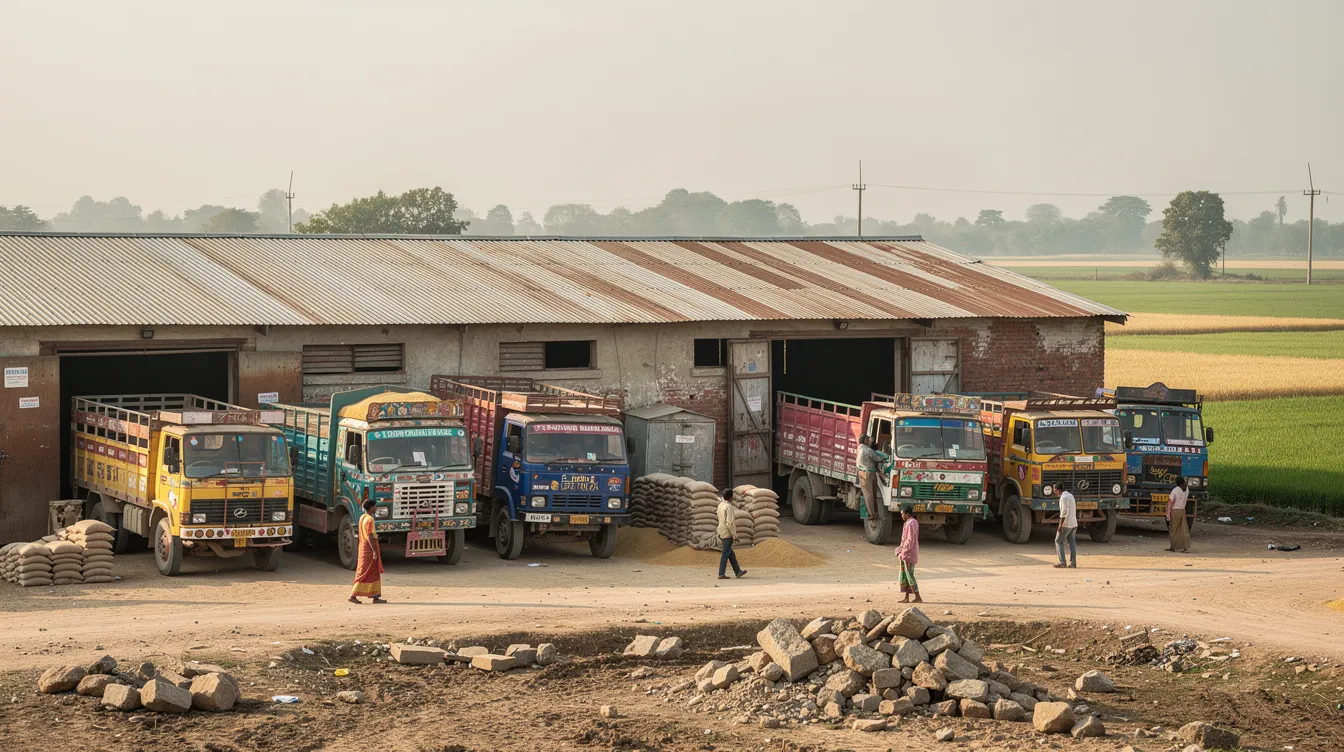
A Primary Agricultural Credit Society is a village-level cooperative society registered under state cooperative laws, with a defined membership base of local farmers. PACS typically operate under the supervision of District Central Cooperative Banks and state cooperative structures. When a PACS constructs a grain storage warehouse, the facility serves its members for harvest aggregation, short-to-medium-term scientific storage and, where applicable, government procurement operations.
A Farmer Producer Organisation, on the other hand, is typically a producer company registered under the Companies Act or a cooperative formed specifically for aggregation, marketing and value addition. FPO-owned warehouses serve similar functional purposes but operate under different governance, borrowing and scheme eligibility conditions.
The project concept involves constructing a scientific warehouse or godown at rural or village level for storing bagged food grains such as wheat, paddy, pulses, maize and oilseeds. Unlike a traditional village godown with basic construction and limited protection, a properly designed warehouse includes elevated plinth, moisture-resistant flooring capable of bearing stack loads, ventilation provisions, pest control systems, fire safety arrangements, internal circulation for vehicles, weighment facilities and an office or sampling area. Scientific storage godowns are supported under schemes like the Gramin Bhandaran Yojana and the cooperative grain storage plan, enabling warehouses to meet technical standards required by lenders and government agencies.
The warehouse serves multiple functions: aggregation of agricultural produce during harvesting season, reduction of post harvest losses through scientific storage, enabling warehouse receipt financing for depositors, and potentially serving as a procurement centre for FCI, NAFED or state agencies where contracted. The DPR should cover technical feasibility, financial viability and operational sustainability to convince both the PACS governing body and the lending institution.
PACS and FPOs are distinct institutional forms – a cooperative society versus a producer company or cooperative – and their projects may access different government schemes, eligibility criteria and financing channels even when the physical infrastructure is similar.
If you are a PACS management committee member or FPO director considering a grain warehouse project, you may contact Project Report Bank via WhatsApp with details of your proposed capacity, land availability and approximate project size for an initial professional review of DPR and bank loan requirements.
Why Rural Grain Storage Infrastructure Is Important in India
India’s foodgrain production stands at approximately 311 million metric tonnes (MMT) against a total storage capacity of about 145 MMT, implying a storage shortfall of roughly 166 MMT, according to FAO-cited data referenced on the Ministry of Cooperation’s World’s Largest Grain Storage Plan page. This gap is most acute at the village and block level, where farmers lack access to nearby scientific storage infrastructure.
Seasonal harvesting creates market gluts. Without village-level storage, farmers are compelled to sell immediately at depressed prices rather than storing produce and timing the market. Scientific PACS and FPO warehouses reduce both quantitative and quality losses caused by moisture, pests and repeated handling during open-yard or unscientific storage. The project should demonstrate how it benefits local farmers and the local rural development economy through reduced wastage, better price realisation and aggregation efficiency.
Locally available storage also reduces multiple transport trips to distant mandis, lowering handling costs and enabling bulk aggregation for more efficient movement. Well-planned PACS and FPO warehouses form a core part of post harvest management infrastructure, complementing larger regional warehouses, cold storage facilities, silos and FCI buffer stock operations.
The Government of India’s World’s Largest Grain Storage Plan in Cooperative Sector, approved on 31 May 2023, aims to create decentralised storage at the PACS level through convergence of schemes such as AIF and AMI, covering more than one lakh PACS across 24 States and UTs. The scheme aims to reduce wastage, strengthen food security and improve farmer incomes. As of mid-2026, 313 PACS godowns had been completed with approximately 1.80 lakh metric tonnes of agricultural storage capacity created under this plan.
PACS vs FPO Grain Warehouse Projects – Ownership and Business Model
Ownership structure directly affects land title, borrowing capacity, governance, risk allocation and scheme eligibility. A PACS warehouse is owned by a cooperative society with statutory linkage to cooperative banking structures, while an FPO warehouse may be owned by a producer company or a cooperative of farmers, with different legal and financial implications.
| Aspect | PACS Warehouse | FPO Warehouse |
|---|---|---|
| Legal Form | Cooperative society under state cooperative law | Producer company (Companies Act) or cooperative |
| Promoter Base | Village-level farmer members, often long-standing | Farmer shareholders or cooperative members |
| Land Ownership | Often owns land; long-term lease may be acceptable | Must own or hold valid long-term lease |
| Typical Project Size | 500–2,000 MT village-level | 500–5,000 MT, sometimes larger |
| Main Beneficiaries | Member farmers of the PACS | Farmer-members of the FPO |
| Decision-Making | Managing committee, general body | Board of directors, shareholder meetings |
| Borrowing Powers | Through DCCB/State Cooperative Bank | Commercial banks, regional rural banks, cooperative banks |
| Likely Scheme Support | Cooperative grain storage plan, AMI (cooperative slab), AIF | AIF, AMI (general or special category), state programmes |
| Revenue Model | Storage fees, handling, procurement contracts | Storage fees, aggregation services, value addition |
| Governance Risk | Potential political interference; distributed member accountability | Board-level risk; financial liability borne by promoters |
PACS warehouses may be integrated into state cooperative structures and can sometimes access special cooperative-sector support, including assured hiring arrangements with FCI or NAFED in eligible cases. FPO warehouse models may involve own-built facilities on leased or owned land, or operation of leased warehouses from private companies or cooperatives, or functioning as aggregation centres connected to larger scientific warehouses.
Lenders scrutinise society resolutions, borrowing limits, board composition, member commitment, offtake contracts and cash-flow allocation for loan repayment. Ownership and business model therefore directly influence bankability and the structure of any bank loan proposal.
Types of Rural Grain Storage Warehouse Projects
One size does not fit all. Capacity, design and mechanisation depend on crop pattern, catchment area, distance to markets and the financial strength of the PACS or FPO. Eligible storage types include silos and bulk storage systems alongside conventional warehouses. Onion and potato storage structures also qualify for government subsidies under certain programmes. Typical configurations include:
- PACS-owned village grain godown (500–2,000 MT) – serves local members, manual handling, basic scientific design. For detailed godown planning, see the Modern Food Grain Warehouse & Godown Project Report & DPR in India.
- FPO-owned aggregation and storage centre – medium capacity near primary mandi, may include cleaning and grading services.
- Cooperative scientific warehouse serving multiple PACS or FPOs – higher capacity (2,000–5,000 MT), better infrastructure, semi-mechanisation.
- Procurement-cum-storage facility – built where agency contracts exist for FCI or NAFED hiring.
- Rural bulk storage and handling centre – larger truck volumes, mechanised loading, possible rail access.
- Multi-commodity warehouse – accommodates grains, pulses, oilseeds with segmented storage.
- Hub-and-spoke network – village spokes feeding a central warehouse hub. This configuration is explored in detail in the Hub & Spoke Grain Silo Project Report & DPR in India.
Many PACS and FPO projects initially start with improved godowns rather than full silo complexes. Over-mechanisation without corresponding volume can significantly reduce financial viability.
PACS & FPO Grain Warehouse Capacity Planning
Static storage capacity refers to the maximum tonnes that can be stored at one time when the warehouse is fully occupied. Annual throughput is the total tonnage handled over a full year through multiple in-and-out cycles. Warehouse capacity planning must match local agricultural production and storage needs through catchment analysis.
| Parameter | 500 MT | 1,000 MT | 2,000 MT | 5,000 MT |
|---|---|---|---|---|
| Typical Role | Village-level | Block-level | Cluster-level | District-level |
| User Base | Few dozen PACS members | Wider PACS or small FPO | Multiple PACS/FPOs | Large cooperative or FPO |
| Turnover Cycles/Year | 2–3 | 2–4 | 2–4 | 3–4 |
| Equipment Complexity | Basic manual | Basic + semi-mechanised | Semi-mechanised | Mechanised options viable |
| Management | Part-time manager | Dedicated manager + clerk | Full-time staff team | Professional management |
Practical design considerations include bag size assumptions (50 or 75 kg), safe stack height (typically 1.8–2.5 m depending on bag type), aisle widths for labour or forklift movement, circulation paths for trucks and tractors, and fire access around stacks.
Land area cannot be estimated using a single universal MT-per-sq.ft factor. The correct method starts with net covered storage floor area, adds proportions for internal circulation, platforms, office, utilities and future expansion, then adjusts for site-specific constraints with engineer or architect input. Capacity decisions directly influence project cost per MT, tariff strategy and DSCR – under-sized warehouses may miss demand while over-sized ones can suffer chronically low occupancy.
Land, Building and Infrastructure Requirements
Site selection should favour locations within or near the PACS or FPO’s operational villages, with all-weather road access for trucks and tractor-trolleys, minimal flooding risk and compliance with local land-use rules. Land ownership and site suitability are critical for project feasibility – clear title in the name of the PACS or FPO is preferred, and an acceptable long-term lease may be permitted by some schemes and lenders.
Technical specifications include structural design, pest control and safety features. Building design fundamentals cover suitable plinth height above the highest known water level, appropriate floor load-bearing capacity for stacked bags, RCC or structural steel framing, adequate clear height for stacking and ventilation, and proper roof treatment to minimise leakage and condensation. The project’s design should maximise protection against pests and moisture to preserve grain quality throughout the storage period.
Key infrastructure elements include boundary wall or fencing, gated entry, internal circulation roads, loading-unloading platforms, ramps, drainage, water and electrical connections, firefighting provisions (extinguishers, hydrants as per design), security cabin with CCTV, and an office or control room with basic record-keeping, sampling and testing facilities.
Regulatory approvals such as local building permissions are necessary for construction. Detailed civil drawings, structural design, soil testing where necessary and local approvals must be obtained before or alongside DPR finalisation.
Machinery, Equipment and Warehouse Technology
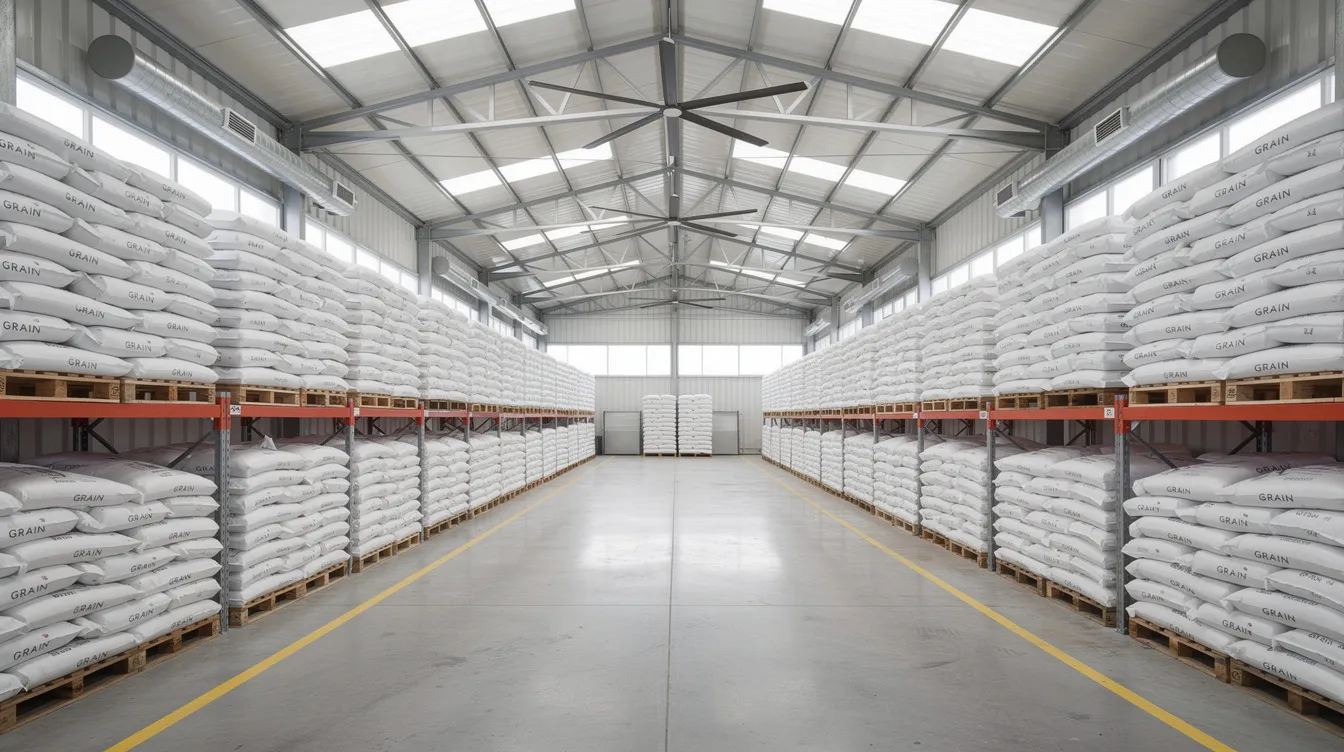
The typical flow of grain in a rural warehouse involves arrival in gunny bags or loose on tractors and trucks, unloading, cleaning or grading where offered, weighing, stacking, periodic inspection and monitoring, fumigation, and eventual outward movement.
| Category | Basic Essential | Optional / Semi-Mechanised |
|---|---|---|
| Weighing | Platform scales, sample triers | Electronic weighbridge |
| Handling | Hand trolleys, pallets, dunnage, ladders | Belt conveyors, bag elevators, forklifts |
| Quality Control | Moisture meters, tarpaulins | Grain cleaners, graders, temperature monitors |
| Pest Management | Rodent-proofing materials, fumigation sheets | Motorised blowers, integrated monitoring |
| Safety | Fire extinguishers, basic lighting | CCTV, automated gates, warehouse management software |
Manual handling has lower capital cost but higher labour dependence. Semi-mechanised systems offer a balanced trade-off for the 1,000–5,000 MT range. Highly mechanised installations with automated intake and conveyor systems, as used in road-fed grain silo storage facilities, may not be financially optimal for every village-level PACS or FPO warehouse.
Technology choice should be aligned with projected throughput, local labour availability, power reliability and long-term maintenance capacity. Vendor quotations must inform DPR preparation.
PACS & FPO Rural Grain Warehouse Project Cost in India
Project cost depends on location, soil conditions, civil specification, technology level and land cost. This section provides a structured framework rather than a single universal figure.
Principal cost components include:
- Land purchase or development
- Site formation, boundary wall and approach roads
- Warehouse civil construction including platforms and internal roads
- Office, weighbridge room and utility blocks
- Machinery and warehouse equipment
- Electrical installation and lighting
- Fire safety and security systems
- Professional fees (architect, structural engineer, DPR preparation, legal)
- Statutory approvals and registration costs
- Preliminary and pre-operative expenses
- Interest during construction
- Contingency (typically 5–10%)
- Initial working capital margin
Under the cooperative grain storage plan, AMI construction cost norms have been revised from approximately ₹3,000–3,500 per MT to about ₹7,000 per MT for plain areas and ₹8,000 per MT for north eastern states. However, a government-approved subsidy cost norm is not the same as actual commercial construction cost. Promoters should obtain updated local civil and equipment quotations and allow for inflation and contingency.
Very small warehouses show higher per-MT cost due to minimum fixed costs (office, basic equipment, boundary wall), whereas mid-sized warehouses benefit from economies of scale. The difference between pure construction cost, total fixed asset cost and total project cost (including pre-operative expenses, interest during construction and initial working capital margin) must be clearly understood and reflected in the DPR.
Project Cost and Means of Finance
Means of finance comprises promoter contribution (equity or share capital), term loan from a bank or cooperative institution, and where sanctioned, back-ended subsidy or capital assistance. Borrowers must contribute at least 20% of the project cost as margin money, though under the cooperative grain storage plan, this requirement has been reduced to approximately 10% for eligible PACS.
Loan tenure for warehouse financing can range from 9 to 15 years depending on lender norms and project size. Subsidy under schemes like Gramin Bhandaran Yojana or AMI is released after project completion and inspection verification – it is not available as upfront cash during construction. Banks usually disburse loans as per construction progress milestones.
| Component | Illustrative Share |
|---|---|
| Promoter Contribution (Equity/Share Capital) | 25–30% |
| Bank Term Loan | 55–65% |
| Back-Ended Subsidy (if sanctioned) | 10–15% |
| Total Project Cost | 100% |
These ratios are illustrative. Exact proportions depend on lender requirements, scheme guidelines and promoter capacity.
Mis-interpreting subsidy as upfront cash can create liquidity gaps during implementation. An effective project implementation schedule is necessary for timely completion, and a professional DPR must map month-wise fund requirements, loan drawdown schedules and expected subsidy receipt dates.
Government Schemes, Subsidies and Bank Finance
Scheme features, eligibility criteria and subsidy rates change over time. The information below is based on official sources available up to late 2026, and readers should reconfirm before making commitments.
World’s Largest Grain Storage Plan in Cooperative Sector – This plan aims to expand PACS-level storage and allied agri infrastructure through convergence of schemes including AIF, AMI and other cooperative-sector programmes. Governance involves an Inter-Ministerial Committee. Many PACS projects involve credit-linked assistance rather than pure grants.
Agriculture Infrastructure Fund (AIF) – A central sector scheme with a total corpus of ₹1 lakh crore, providing interest subvention of 3% per annum on loans up to ₹2 crore for up to 7 years and credit guarantee through CGTMSE. The Agriculture Infrastructure Fund provides financial support for storage projects including warehouses. PACS, farmer producer organisations, cooperatives and private companies may be eligible subject to rules.
Agricultural Marketing Infrastructure (AMI) Scheme – Provides back-ended capital subsidy for rural warehouses. The minimum capacity for eligible warehouses is 50 MT. Subsidy rates are 25% for general-category applicants and 33.33% for special categories (SC/ST, women, cooperatives, north eastern states and hilly areas). The maximum subsidy for general-category applicants is capped at INR 37.5 lakh. Eligible projects must comply with NABARD’s technical standards and scheme norms.
Gramin Bhandaran Yojana – This scheme supports rural storage infrastructure development including scientific storage godowns. Eligible applicants can receive up to 33.33% subsidy under Gramin Bhandaran Yojana for special categories, with a maximum subsidy of INR 45 lakh. Cold storage facilities are also included under the NABARD subsidy scheme. NABARD supports loans for new agricultural storage facilities only.
NABARD’s Role – NABARD’s Warehouse Infrastructure Fund has a corpus of Rs. 5,000 crore. The minimum capacity for NABARD’s subsidy eligibility is 5,000 metric tonnes for certain programmes. NABARD provides NABARD refinance to eligible cooperative banks, regional rural banks and other financial institutions that lend for agricultural storage projects. Individual PACS or FPO borrowers receive loans from their banks, which may in turn obtain refinance support from the national bank.
| Scheme | Implementing Institution | Type of Assistance | Eligible Applicants | Key Conditions |
|---|---|---|---|---|
| Cooperative Grain Storage Plan / AMI | Ministry of Cooperation / NABARD | Capital subsidy, interest subvention | PACS, cooperatives | Credit-linked, technical compliance, capacity norms |
| Agriculture Infrastructure Fund | DoA&FW / lending banks | Interest subvention (3%), credit guarantee | PACS, FPOs, cooperatives, private entities | Loan up to ₹2 crore, eligible infrastructure |
| Gramin Bhandaran Yojana | NABARD | Capital subsidy up to 33.33% | Cooperatives, individuals, FPOs | Min. capacity, NABARD technical standards, new facilities |
| AMI (General Rural Godown) | NABARD / DMI | Back-ended capital subsidy | Cooperatives, FPOs, private entities | 50–5,000 MT, credit assessment and financial appraisal required |
Combining multiple subsidies or interest subvention benefits on the same component of project cost is often restricted. Each project must be structured in line with scheme-wise rules. Special concessions designed for PACS under the cooperative-sector grain storage plan are not automatically available to all FPOs. State governments may offer additional support in certain regions.
PACS & FPO Grain Warehouse Revenue Model
Principal revenue sources include storage rental charges per MT per month, handling charges for inward and outward movement, cleaning and grading service fees, weighment charges and documentation or service charges for warehouse receipts.
Business models differ in risk and capital requirement:
- Own-account storage – PACS buys grain for later sale. Higher working capital requirement, exposure to price fluctuation.
- Third-party storage – Charges farmers, traders or government agencies for storage. Lower inventory risk but revenue depends on occupancy.
- Hybrid – Combination of own procurement and third-party rental, adjusting by season.
Tariffs depend on competition, location, services offered, duration and risk allocation. The DPR should benchmark local market tariffs rather than assume over-optimistic rates. Projected revenue streams should be included in the financial analysis with clearly stated assumptions.
Potential additional income includes leasing space during lean season, storing agri-inputs, value addition services like pre-packing or sorting for select commodities, and integrating small cleaning or processing units where permitted.
Guaranteed contracts with FCI, NAFED or state agencies cannot be assumed without actual selection, agreement or hiring assurance through official processes.
Operating Expenses and Working Capital Requirements
Typical operating cost heads include salaries and wages (manager, clerk, watchmen, loaders), outsourced handling charges, electricity and fuel, repairs and maintenance, pest control and fumigation, insurance, stationery and communication, security and CCTV maintenance, and general administration.
Periodic maintenance activities include roof and floor upkeep, whitewashing, fumigation cycles, repairing doors and ventilators, pest-proofing perimeters and maintaining firefighting equipment. These costs must be budgeted realistically in the DPR.
Working capital requirements arise even in a primarily storage-rental business because expenses occur monthly while storage charges may be billed and collected at intervals. Where PACS or FPOs buy grain on own account, additional working capital is required to finance inventory until sale. The DPR should assess working capital needs, cost of short-term borrowing and sensitivity to delays in collection.
Financial Projections for PACS & FPO Grain Storage Warehouse
A professional five-to-seven-year financial model for a PACS grain storage warehouse project report should contain year-wise projected income statements, balance sheets and cash-flow statements, detailed revenue build-up by capacity and tariff, operating cost schedules, depreciation, interest and tax calculations, and a term-loan repayment schedule.
| Assumption | Illustrative Value (1,000 MT Warehouse) |
|---|---|
| Static Capacity | 1,000 MT |
| Year 1 Utilisation | 55–60% |
| Year 3 Utilisation | 75–80% |
| Year 5 Utilisation | 85–90% |
| Storage Cycles per Year | 2–3 |
| Average Storage Duration | 3 months per lot |
| Staffing | Manager, clerk, 2 watchmen, contract loaders |
| Salary Escalation | 5–7% per annum |
| Maintenance Cost Growth | 5% per annum |
These assumptions are illustrative and must be adjusted for each project based on location, crop pattern and market conditions.
Banks assess loan proposals based on consistent positive cash flow and adequate DSCR over the full loan tenure rather than headline profit in a single year. Project Report Bank develops detailed, Excel-based financial models with scenario analysis and sensitivity checks through its Financial Projections & Financial Modelling Services.
DSCR, ROI, IRR and Project Viability
DSCR (Debt Service Coverage Ratio) measures cash available for servicing term-loan principal and interest divided by total debt service for the period. Sustained DSCR above the lender’s comfort range indicates better repayment capacity. Financial metrics like DSCR and IRR are used to gauge project viability across the entire loan tenure.
ROI measures annual profit relative to total investment. Project IRR captures the return on total project cash flows, while equity IRR measures returns to promoters after debt servicing. The project must show adequate returns on investment and profitability for both lender comfort and promoter interest.
Break-even analysis identifies the minimum average occupancy and tariff combination at which the project covers all fixed and variable operating costs. A qualitative three-scenario approach is essential:
- Downside – Lower occupancy (50% in early years), tariff pressure, higher maintenance costs. DSCR may fall below comfort levels.
- Base case – Realistic utilisation ramp-up and costs. DSCR adequate, positive equity IRR.
- Upside – Better occupancy, ancillary service revenue. Improved DSCR and faster payback.
Common risks affecting viability include construction cost overruns, delayed commissioning, slower demand build-up, inability to achieve planned tariffs and higher interest rates. These must be tested through sensitivity analysis during DPR preparation. Project Report Bank conducts independent feasibility assessments and stress-testing before promoters commit major capital.
PACS & FPO Rural Grain Warehouse Bank Loan and DPR Requirements
Banks and cooperative financial institutions generally evaluate legal status and registration, bye-laws permitting borrowing, governing-body resolution, land title or lease documentation, project cost estimates with quotations, technical feasibility and projected financials. The DPR must assess the agricultural profile and demand for storage in the catchment area.
A structured, bank-oriented detailed project report DPR should include project description, promoter profile, catchment and demand study, technical design summary, detailed cost estimates, means-of-finance plan, year-wise projections, DSCR analysis and risk-mitigation measures. A well-structured business plan is crucial for presenting to potential investors or lenders. Project completion requires thorough documentation and annexures to support claims.
| Due-Diligence Area | Typical Evidence Required |
|---|---|
| Legal & Governance | Registration certificate, bye-laws, board resolution, PAN, GST |
| Land & Collateral | Title deed or registered lease, encumbrance certificate, land records |
| Technical Design | Approved building drawings, structural design, soil test report |
| Financial Viability | CMA Data, projected P&L, balance sheet, cash flow, DSCR |
| Scheme Eligibility | Category certificates, scheme application, sanction letter |
| Environmental & Safety | Building permission, fire NOC, insurance |
CMA Data (Credit Monitoring Arrangement statements) must be internally consistent with the DPR – projected profit and loss, balance sheet, cash flow and loan repayment schedule must align. Project Report Bank supports PACS and FPOs in preparing lender-ready documentation through its Bank Finance DPR & Loan Proposal Assistance and CMA Data Preparation Services.
Approvals, Registrations and Compliance
Key compliance areas include society or producer-company incorporation with updated registration, PAN, GST registration if applicable, and board or society resolutions authorising the project and borrowing. Local statutory approvals cover land-use permission or conversion where required, building plan approval from local authority, fire safety clearance and electricity connection or load sanction.
WDRA (Warehousing Development and Regulatory Authority) registration is relevant when a warehouse intends to issue negotiable warehouse receipts meeting WDRA standards – not all smaller godowns are mandated to register unless they seek these specific services. Commodity-specific compliances such as fumigation regulations, labour law registrations and insurance for building, stocks and third-party liability should be addressed.
Promoters should ensure compliance with state-level schemes and regulations, which may impose additional technical standards or offer extra incentives. Including a compliance checklist within the DPR supports smoother credit assessment and implementation.
Rural Grain Warehousing vs Steel Silo Storage
| Aspect | Rural Grain Warehouse | Steel Silo Storage |
|---|---|---|
| Minimum Viable Capacity | 50–500 MT | 1,000–5,000 MT+ |
| Investment per MT | Lower | Higher |
| Automation Level | Manual or semi-mechanised | Mechanised with conveyors, aeration |
| Land Footprint | Larger base area (horizontal) | Smaller footprint (vertical) |
| Commodity Flexibility | Multi-commodity, bagged storage | Best for bulk homogeneous grains |
| Staffing Skill | General labour, basic supervision | Specialised technical operators |
| Maintenance | Simpler, periodic civil upkeep | Mechanical systems, corrosion prevention |
| PACS/FPO Suitability | Highly suitable for village-level | Better for district-level hubs |
For many village-level PACS and small FPOs, well-designed godowns offer more flexibility and lower capital intensity. Steel silos become attractive at higher throughput levels with bulk procurement, mechanised handling and proximity to transport corridors. Promoters evaluating larger installations can review the Steel Grain Silo Plant Project Report & DPR in India or the Rail-Linked Grain Silo Terminal Project Report & DPR for logistics-intensive, rail-connected configurations.
Some regions may ultimately require a mix – PACS-level warehouses feeding larger bulk storage at district or railhead level. Project planning should consider regional grain flows rather than isolated facilities.
Key Risks and Challenges in PACS & FPO Warehouse Projects
Demand-side risks – Over-estimation of storage demand, competition from existing private or cooperative warehouses, policy shifts in government procurement patterns, and farmer reluctance to pay storage charges.
Implementation risks – Land disputes or title defects discovered late, delays in building permissions, contractor-related cost overruns and quality issues, and slippage from planned construction schedules affecting loan disbursement and interest during construction.
Operational and governance risks – Weak record-keeping, inadequate pest or fumigation practices leading to quality loss, poor internal controls, potential pilferage, and gaps in board oversight impacting financial discipline.
Financial risks – Lower-than-projected occupancy, delayed recovery of storage charges, inability to raise member contributions on time, costlier-than-anticipated bank finance and delayed release of back-ended subsidy impacting cash flow.
Mitigation strategies include conservative demand estimates, phased capacity creation, pre-construction title and approval checks, use of standard designs, robust contractor agreements, insurance coverage, internal audit mechanisms and sensitivity analysis in the DPR to understand tolerance for lower occupancy or higher cost.
How CA Manish Gugliya Assists with PACS & FPO Warehouse DPR Preparation
CA Manish Gugliya, FCA, DISA (ICAI), is a practising Chartered Accountant with over 20 years of professional experience in DPR preparation, bank finance advisory, CMA Data and financial modelling, and founder of Project Report Bank (Manish Gugliya & Company, Chartered Accountants).
Services relevant to PACS and FPO warehouse projects include:
- Customised bankable detailed project report preparation
- Project cost and means-of-finance analysis
- Five-to-seven-year financial projections with DSCR and loan repayment analysis
- CMA Data preparation aligned with DPR assumptions
- Break-even and sensitivity analysis for occupancy and tariff variations
- Assistance with bank loan proposal documentation and responses to bank queries
- Project finance advisory and loan structuring covering optimal loan tenure, moratorium, repayment profile and mix of term loan, working capital and promoter contribution
No guaranteed sanctions, subsidies or project returns are promised. The objective is to prepare defensible projections based on reasonable assumptions.
Serious PACS committees, cooperative federations and FPO boards may share basic project details – location, proposed capacity, land status, estimated project cost and required loan amount – via WhatsApp for an initial professional discussion.
Frequently Asked Questions About PACS & FPO Rural Grain Warehouses
What is a PACS grain storage warehouse project report and why is it important?
A PACS grain storage warehouse project report is a bank-oriented detailed project report covering proposed warehouse capacity, design, project cost, means of finance, revenue model, operating costs and five-to-seven-year financial projections for a specific PACS. It also addresses governance structure, land details, scheme eligibility, DSCR and risk analysis. Without a robust DPR, accessing subsidies, NABARD-refinanced bank loans or infrastructure fund assistance becomes difficult. The report helps both the PACS management and the lender assess viability and structure the loan appropriately.
Can an FPO establish its own rural grain warehouse in India?
Yes. An FPO – whether a producer company or cooperative – can set up its own warehouse if it has suitable land (owned or long-term leased), a viable demand base, adequate promoter contribution and a bankable DPR. FPO warehouses typically rely on term loans from commercial or cooperative banks and may access schemes like AIF or AMI subject to eligibility criteria. However, special concessions designed for PACS under the cooperative-sector grain storage plan are not automatically available to all FPOs, and each FPO must verify its own eligibility.
How can promoters estimate the project cost for a 1,000 MT PACS grain godown?
Start by determining approximate covered area with a technical consultant, then obtain current local civil construction rates for similar warehouses. Add cost of platforms, internal roads, boundary wall and office block. Collect equipment quotations for weighing systems, pallets, moisture meters, fire safety and basic handling tools. Then add pre-operative expenses, professional fees, interest during construction and initial working capital margin. Professional DPR preparation helps refine estimates using realistic assumptions and actual vendor quotes rather than flat per-MT numbers.
What role does NABARD refinance play in PACS and FPO warehouse financing?
NABARD generally does not lend directly to individual PACS or FPOs. Instead, it provides refinance to eligible banks and cooperative institutions that lend for agricultural infrastructure projects. When a bank receives NABARD refinance for a warehouse portfolio, it may be more willing to fund viable PACS or FPO proposals. However, each project must still meet the bank’s credit norms, DSCR expectations and security requirements. Refinance availability does not replace the need for a solid DPR with proper financial appraisal and demand assessment.
Is a bankable DPR mandatory to apply for PACS and FPO warehouse subsidies?
Most credit-linked subsidy and infrastructure fund schemes, including those implemented through NABARD, require an approved bank loan and a technically and financially appraised project. In practice, this means a structured DPR is essential. Scheme application formats typically ask for detailed cost, capacity, financial projections and implementation planning. A generic estimate or simple contractor quotation is usually insufficient. Businesses and cooperatives applying under these programmes benefit from professionally prepared DPRs that align with both bank appraisal requirements and scheme documentation standards.
Conclusion – Planning a Bankable PACS & FPO Rural Grain Storage Warehouse
Successful PACS and FPO rural grain warehouses require the right location, realistic assessment of local storage demand, technically sound design, accurate costing, balanced means of finance, clear understanding of applicable schemes and robust cash-flow capacity for term-loan repayment. The investment in agriculture storage infrastructure must be guided by catchment-level demand rather than assumptions about subsidies alone.
A customised, project-specific DPR with five-to-seven-year projections, DSCR and sensitivity analysis is critical for convincing banks, aligning with government infrastructure fund requirements and guiding the management committee’s investment decisions. Every aspect – from capacity planning and construction cost to revenue assumptions and working capital – must be internally consistent and defensible.
PACS boards, cooperative federations and FPO directors who are serious about setting up grain storage infrastructure are encouraged to share their project concept, land details and tentative capacity requirements with Project Report Bank via WhatsApp for professional DPR and project-finance advisory support.
CA Manish Gugliya FCA, DISA (ICAI) Manish Gugliya & Company, Chartered Accountants www.projectreportbank.com