
Key Takeaways
- A hub and spoke grain silo project report must address both technical infrastructure design and detailed financial feasibility, covering capacity planning, land requirements, machinery, project cost, revenue model, DSCR, IRR and risk assessment for a bankable DPR.
- The hub and spoke model silos modernize food grain storage infrastructure in India by connecting centralized, rail-linked hub silos with decentralized, road-fed spoke silos across agricultural production zones, enabling bulk intake, scientific storage and efficient long-distance movement of wheat, rice and other food grains.
- Grain silos are expensive, capital-intensive assets with concession periods often exceeding 20–30 years; investment decisions require careful analysis of PPP contract terms (DBFOT or DBFOO), financing structure, operating costs and sensitivity to utilisation and policy risks.
- The Government of India, through FCI and DFPD, has planned steel silos of 111.125 LMT capacity at 249 locations under the hub and spoke model, with Phase-I covering 34.875 LMT at 80 locations and Phase-II tenders for 25.125 LMT at 54 locations already floated.
- Project Report Bank, led by CA Manish Gugliya, FCA, DISA (ICAI), prepares customised, bankable DPRs, CMA Data, financial projections and feasibility studies for grain storage and infrastructure projects, tailored to specific tender conditions and financing requirements.
Introduction – Hub & Spoke Grain Silo Projects in India
India procures, stores and distributes tens of millions of tonnes of wheat, rice and other food grains every year through the public distribution system. Yet a significant proportion of this grain has historically been stored in conventional godowns using bagged storage methods that are labour-intensive, prone to pest and moisture damage and difficult to integrate with modern bulk logistics. The model reduces post-harvest grain spoilage and losses caused by inadequate storage, and the economic cost of these inefficiencies runs into thousands of crores annually.
The hub and spoke grain silo project has emerged as a solution to this problem. Under this approach, supply chain optimization aggregates grain from smallholder farms to high-capacity facilities, connecting procurement-area spoke silos with large, rail-linked hub silos for centralised storage and long-distance bulk movement. The Hub & Spoke Model Silos modernize grain storage infrastructure by replacing manual, bag-based handling with mechanised, scientifically controlled steel silo systems. It enhances logistical efficiency by centralizing processing while using regional nodes for collection. The project enhances food security by retaining marketable grain volumes that would otherwise be lost.
The Food Corporation of India and the Department of Food and Public Distribution have approved an Action Plan to construct steel silos of 111.125 LMT capacity at 249 locations under the hub and spoke model across India. This is a large-scale national programme, and private developers are being invited to participate through PPP concessions. However, these projects demand substantial capital investment, careful engineering, robust financial structuring and a professionally prepared Detailed Project Report.
This article, written from a project-finance and banker’s perspective, covers the technical design, project cost structure, revenue model, financial projections, key ratios, risk assessment and documentation required for a bankable hub and spoke grain silo project report. At Project Report Bank, CA Manish Gugliya assists promoters in preparing customised DPRs, CMA Data, financial models and feasibility studies for grain storage and other infrastructure projects.
What Is a Hub & Spoke Grain Silo Project?
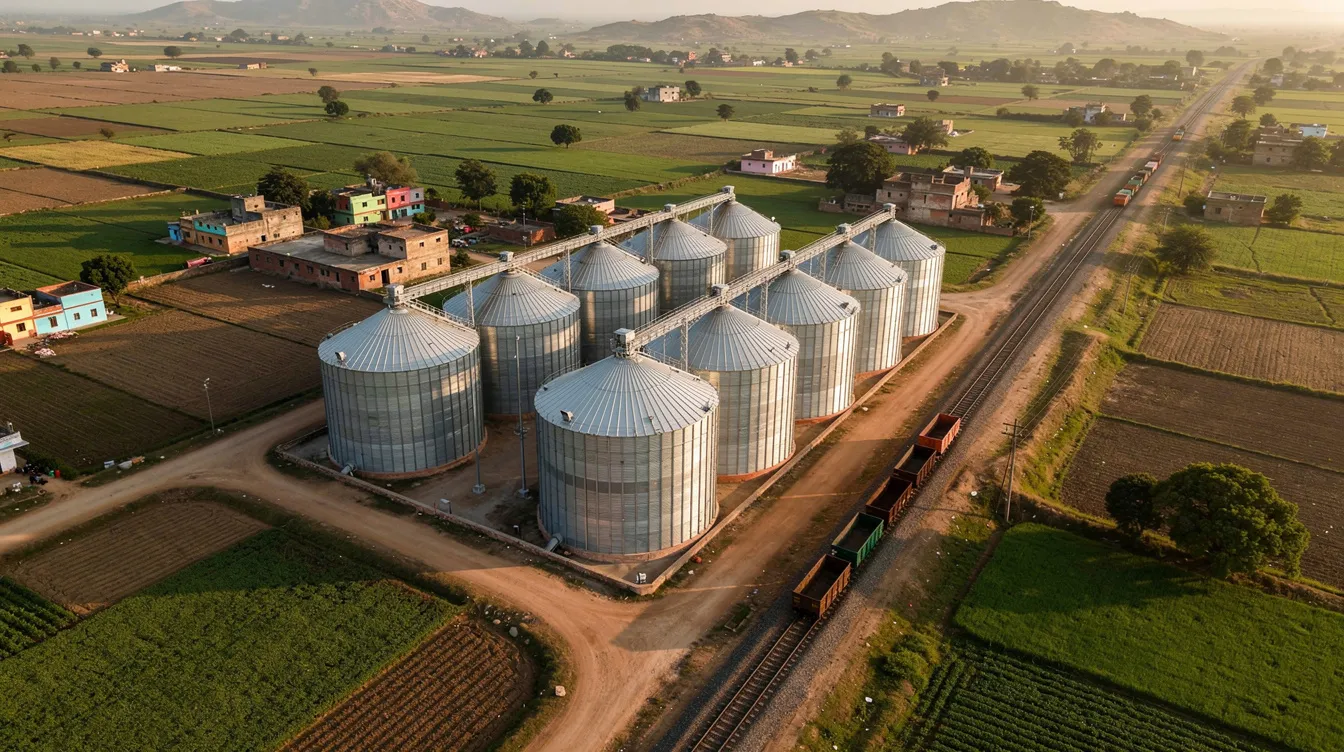
A hub and spoke grain silo project is a network of grain storage facilities structured around one or more large, rail-linked hub silos connected to multiple smaller, road-fed spoke silos serving procurement and consumption zones. The hub facility serves as the primary aggregation point for large-scale distribution, while spoke facilities are smaller storage units positioned across agricultural production zones. The project architecture consists of centralized hubs connected to decentralized spokes via multimodal transport systems.
The hub silo is typically a high-capacity facility with a dedicated railway siding, designed for centralised bulk storage and redistribution. It handles rake-level loading and unloading, connects to the national rail movement network for wheat, rice and other food grains, and often includes container depot infrastructure. The central hub connects to regional spokes, reducing logistical costs and optimizing grain distribution across deficit and surplus regions.
The spoke silo is a smaller steel silo complex located near mandis and procurement centres. It is road-connected, designed for farmers and local aggregators to deliver grain, and provides bulk intake and short-haul shuttle movement to the hub. Market stability is promoted by empowering farmers with localized drop-off points, and it reduces turnaround times during harvest season for farmers.
A typical grain movement cycle works as follows: procurement happens at the spoke, where grain is bulk-unloaded into steel silos after cleaning and weighing. From the spoke, grain moves in bulk carriers by road to the hub. At the hub, grain is transferred to rail wagons for long-distance movement, and then dispatched to consumption centres or PDS networks. This is fundamentally different from a standalone grain storage project because it involves integrated logistics planning, coordinated capacity utilisation across locations and performance obligations under concession agreements.
The operational arrangements – who owns the grain, who bears storage losses, what tariff structure applies – depend entirely on the specific PPP contract, state government MoU or purely private commercial model. No two concession agreements are identical.
Hub Silo vs Spoke Silo – Infrastructure and Operations
A DPR for a hub and spoke project must clearly differentiate the design, capacity, machinery and costing for hubs and spokes because their functions, risk profiles and capital requirements are materially different. For detailed information on railway-connected silo infrastructure, the Rail-Linked Grain Silo Terminal Project Report & DPR covers terminal-specific engineering and financial requirements.
| Parameter | Hub Silo | Spoke Silo |
|---|---|---|
| Primary function | Centralised aggregation, bulk storage, rail dispatch | Local procurement intake, short-term storage, road dispatch |
| Road connectivity | Required for truck access | Primary connectivity mode |
| Railway connectivity | Dedicated siding essential | Generally not required |
| Typical capacity range (indicative) | 50,000–1,50,000 MT | 10,000–50,000 MT |
| Land requirement | Larger (siding, yard, container depot) | Comparatively smaller |
| Major machinery | Rail wagon loaders/unloaders, large conveying networks, container handling | Truck receiving pits, basic conveyors, local dispatch |
| Automation level | Higher (PLC/SCADA, digital tracking) | Moderate |
| Capex intensity | Significantly higher | Lower per location |
| Opex profile | Higher (rail operations, power, larger team) | Lower per location |
| Logistics role | Strategic node in national grain movement | Localised intake and feeder point |
| Major infrastructure risk | Railway approvals, siding construction delays, land near rail | Road access, land acquisition, local permits |
Hub silos generally require railway siding infrastructure, wagon tipplers or bulk loading systems, more complex conveying networks and higher electrical demand compared to simpler road-fed spoke silos. The hub plays a strategic logistics role in the food grain supply chain, connecting procurement areas to deficit regions, while spokes are localised intake and short-haul dispatch points. Infrastructure risks – particularly land availability near railway lines and railway approval timelines – are substantially higher at hub locations, and these must be captured in the project report’s risk matrix.
FCI Hub & Spoke Grain Silo PPP Model in India
The Food Corporation of India, established under the Food Corporations Act 1964, is responsible for procurement, storage, movement and distribution of food grains for the public distribution system. The Department of Food and Public Distribution has focused on creating modern grain storage under central schemes and PPP models to move from bagged storage in godowns to bulk storage in steel silos.
In India, hub-and-spoke silo projects are proposed under public-private partnership frameworks. The FCI hub and spoke programme aims to reduce storage losses, improve hygiene and optimise rail logistics for wheat and rice. Under this framework, FCI or state agencies act as counterparties, and private developers set up hub and spoke model silos on DBFOT or DBFOO basis under long-term concession agreements. As of September 2024, Phase-I of the Hub & Spoke model covered 34.875 LMT capacity at 80 locations, with 14 locations under DBFOT (10.125 LMT) and 66 locations under DBFOO (24.75 LMT). Phase-II tenders for 25.125 LMT at 54 locations under DBFOO mode in 17 bundles were floated in September 2024.
Project sites are identified based on procurement-rich districts for spokes and rail junctions or consumption centres for hubs, and are often tendered as bundled packages combining multiple sites in a state or corridor. Key concessionaire responsibilities include designing and constructing silos and associated infrastructure, arranging project finance, maintaining prescribed storage and handling standards, ensuring availability, complying with safety and statutory norms and meeting performance benchmarks.
It is essential that promoters carefully read tender documents, model concession agreements, technical schedules and payment mechanisms. The DPR must reflect actual tender conditions, not generic assumptions.
DBFOT Model for Grain Silo Projects
DBFOT – Design, Build, Finance, Operate, Transfer – is a PPP structure where the developer designs and constructs grain silos, finances the construction, operates the facility for the concession period and transfers the asset back to the contracting authority at the end. Land is often provided or facilitated by FCI. For example, in Phase-I, 14 locations (10.125 LMT) were structured under DBFOT with FCI land.
The developer recovers investment through annuity-like payments, storage charges or availability-based payments defined in the PPP contract, subject to deductions and penalties for non-performance. For the DPR, the focus must be on construction-period cash flows, concession tenure modelling, residual value assumptions and terminal transfer conditions, all of which directly impact DSCR and IRR calculations.
DBFOO Model for Grain Silo Projects
DBFOO – Design, Build, Finance, Own, Operate – places greater responsibility on the developer. Here, the developer arranges land (purchase or long-term lease), finances, owns and operates the facility. Ownership remains with the developer, and there is no mandated transfer back to the authority. All Phase-II tenders (25.125 LMT at 54 locations) have been structured under DBFOO mode.
DBFOO grain storage projects may serve FCI contracts, state agencies, processors or private grain traders, often with more flexibility in tariffs and third-party usage. The financial consequence is clear: higher land investment, longer payback expectation and potentially diversified revenue streams, but also correspondingly higher exposure to market and utilisation risks. The DPR must separately model land acquisition cost, property taxes and exit scenarios.
DBFOT vs DBFOO – Investor Comparison
| Parameter | DBFOT | DBFOO |
|---|---|---|
| Land risk | Low (authority provides) | High (developer acquires) |
| Ownership during concession | Developer holds structures; land with authority | Developer owns land and structures |
| Typical concession tenure | 25–35 years | 25–35 years or longer |
| Regulatory interface | Authority manages land-related approvals | Developer handles all approvals |
| Pricing flexibility | Fixed by concession agreement | Some flexibility for third-party services |
| Capital recovery risk | Lower (contracted payments) | Higher (market and utilisation dependent) |
| Residual asset value | Asset transfers to authority | Developer retains asset |
| Bankability | Generally stronger contracted cash flows | Requires robust off-take documentation |
DBFOT offers clearer visibility on contracted payments but less flexibility, while DBFOO offers asset ownership and operational flexibility but exposes the promoter more directly to market and utilisation risks. Investors must align their choice of model with risk appetite, balance sheet strength and strategic goals – whether seeking an infrastructure annuity or building an integrated agribusiness platform. For advisory on structuring the most suitable financing approach, Project Finance Advisory & Loan Structuring Services can help align debt-equity structures with projected contractual cash flows.
Capacity Planning in a Hub & Spoke Grain Silo Network
Correct capacity planning is central to both technical feasibility and financial viability. Over-sizing silos leads to poor utilisation and weak returns; under-sizing creates operational bottlenecks and missed throughput. The project should analyze grain production forecasts and local consumption patterns before finalising capacity at each location.
It is important to distinguish between static storage capacity (the total MT that can be stored at a given time) and annual throughput (total MT handled during a year considering turnover of stock). For example, a hub with 50,000 MT static capacity handling three full turnovers per year could process 150,000 MT annually. A modular framework allows operators to add new spoke units as production expands, making phased development possible.
The DPR should analyse crop patterns in the catchment area, FCI procurement volumes, historical arrivals at mandis, peak season intake rates, dispatch obligations and buffer stock requirements. Hub capacity and spoke capacity must be balanced: spokes should be sized for local procurement peaks and first-stage storage, while hubs should be designed around rake size, number of rakes per day and long-distance movement schedules.
Key systems must be sized accordingly: truck unloading capacity (MT/hour), bulk intake pits, chain conveyor capacities, bucket elevator ratings and rail loading/unloading capacities at the hub. Inadequate sizing of any one system creates bottlenecks that affect the entire network.
Illustrative example (not an official standard): A cluster with 2 spoke silos of 25,000 MT each and one 75,000 MT hub could have an annual throughput of approximately 2,50,000–3,75,000 MT depending on turnover, assuming 3–5 stock rotations per year. Seasonal utilisation would peak during rabi and kharif procurement phases, with lower utilisation during off-seasons.
Land, Site Selection and Infrastructure Requirements
Land is a critical risk area in grain storage DPRs. Location affects not only cost but also operational efficiency and the ability to obtain bank finance. Poor site selection can delay projects by years.
For spoke sites, key criteria include proximity to major mandis or procurement centres, strong road connectivity for tractors and trucks, access to reliable power supply, safe distance from habitations and suitability for heavy foundations that support large steel silos.
For hub sites, the requirements are more demanding: feasible railway siding location, adequate distance from the existing or proposed station, sufficient land for rail loops or sidings, connectivity to national or state highways and scope for future expansion. States like Punjab, Haryana, Uttar Pradesh, Madhya Pradesh, Gujarat, Maharashtra and West Bengal are common locations for such projects given their grain procurement volumes.
The project report should specify land size in acres or square metres for each hub and spoke, land use classification (industrial, warehousing, agricultural), title or lease status and any conversion or CLU requirements. On-site infrastructure must include internal roads with adequate turning radius for bulk trucks, weighbridge placement, drainage network, storm-water management, firefighting water storage, office block and control room locations.
Necessary approvals typically include local body building permissions, fire NOCs, pollution control consents, electrical connections, railway approvals for siding drawings at hubs and any state-specific warehouse or food grain storage registrations. Land and rail connectivity can materially affect capital expenditure and project execution risk.
Hub & Spoke Grain Silo Machinery and Equipment
The DPR should provide a clear list of major machinery for both hub and spoke silos, differentiating basic storage systems from rail-linked terminal equipment. For a detailed discussion on silo plant technology and construction, the Steel Grain Silo Plant Project Report & DPR covers plant-level engineering and machinery selection.
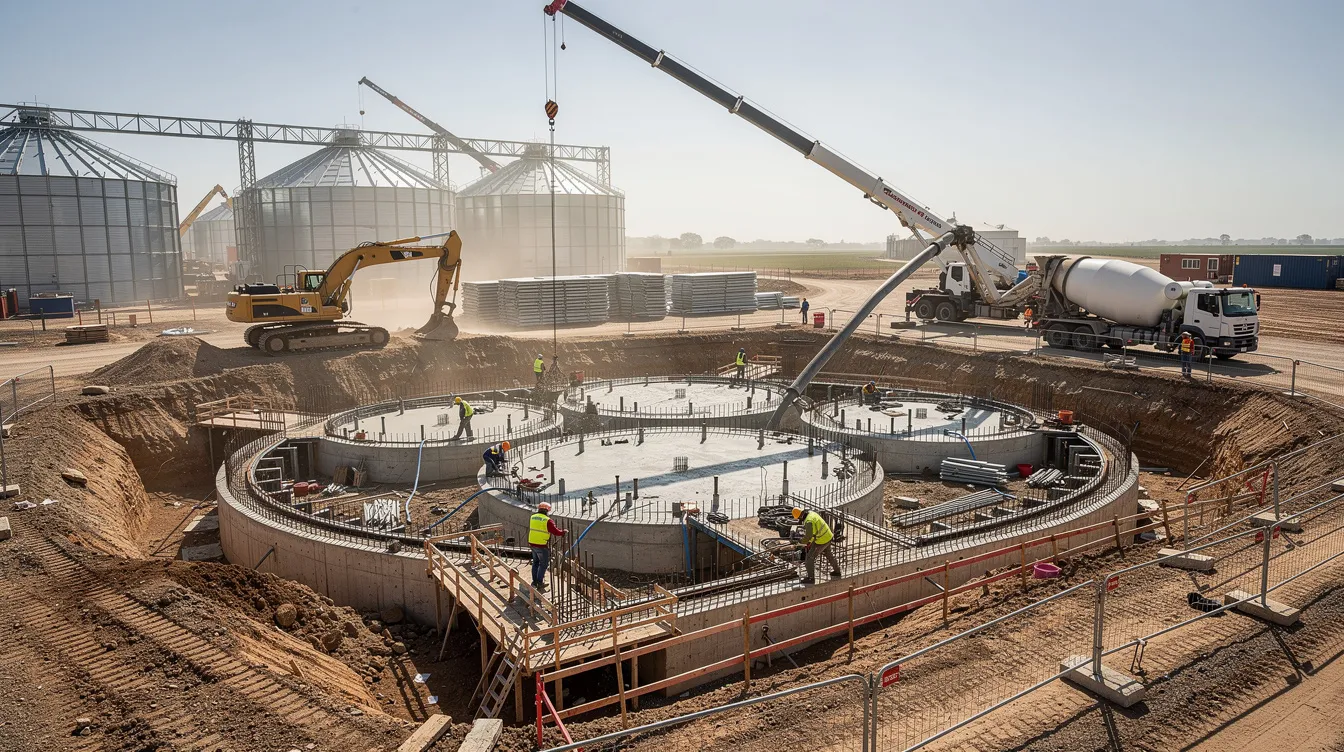
Core storage equipment: Galvanized steel silos – flat bottom or hopper bottom – are preferred for medium and small-scale projects due to their lower initial cost compared to concrete silos. Concrete silos can last over 50 years with low maintenance costs and offer superior insulation compared to galvanized steel, making them suitable for long-term, large-scale storage. Concrete silos are also more resistant to physical damage than steel silos. However, steel silos have a lower initial cost than concrete silos and are commonly used across most FCI PPP projects currently being constructed at 249 locations. Galvanized steel silos are ideal for temporary storage solutions and medium silos serving spoke locations.
Silo walls must withstand lateral pressure from stored grain, and wall thickness and structural design must account for grain type, bulk density, wind loads and seismic conditions. Each silo includes aeration systems that prevent moisture migration and mold growth, roof vents, sweep augers, access ladders and safety cages.
Intake and conveying machinery: Grain receiving pits, truck tipplers (where applicable), belt or chain conveyors, bucket elevators, flow diverters and spouting form the material handling backbone. These systems must be rated for the peak intake capacity required during procurement season.
Cleaning and conditioning systems: Pre-cleaners, scalpers and aspiration systems reduce foreign matter and moisture-related storage risk. Optional dryers may be included depending on the grain type and moisture content at intake.
Monitoring and automation: Temperature monitoring systems provide real-time grain condition data through temperature monitoring cables that deliver continuous information on grain condition within each silo. Level indicators, PLC or SCADA systems, control panels, safety interlocks and dust extraction systems are essential for ensuring grain quality and complying with occupational health standards. Digital inventory tracking systems manage transport corridors connecting spokes to the hub, while automated condition monitoring systems maintain grain quality during storage. A project report should include interventions for pest management, moisture control and temperature monitoring.
Discharge systems: The center discharge plus bottom sweep auger configuration achieves residual rates below 0.5%, ensuring near-complete grain extraction and minimising wastage.
Hub-specific equipment: Rail wagon loading and unloading systems, bulk loading spouts, silo reclaim systems sized to match rake turnaround times and integration with railway signalling or yard arrangements. These systems represent a substantial portion of hub capex and engineering complexity.
Additional silo material considerations: While most current FCI projects use galvanized steel, some large silos may use concrete construction. Concrete silos can exceed a lifespan of 50 years with minimal maintenance. Fiberglass silos exist for niche applications but are not common in large-scale Indian grain storage infrastructure. The selection between materials depends on specific needs including capacity, durability, climate, and whether the storage is permanent or temporary.
Project Cost Structure for a Hub & Spoke Grain Silo Network
Grain silos are expensive, long-life infrastructure assets. The DPR should break down capex separately for each hub and spoke site plus common project development costs, rather than quoting a single per-tonne figure. The cost of grain silos varies by size, material and features, and a universal cost figure would be misleading.
Major cost heads include:
- Land purchase or lease premium
- Land development, boundary walls and site grading
- Foundations (heavily influenced by soil conditions)
- Civil structures for intake pits, tunnels, control rooms, internal roads and drains
- Steel silos and accessories
- Mechanical conveying systems (conveyors, elevators, cleaners)
- Grain cleaning and conditioning equipment
- Electrical systems and power supply infrastructure
- Automation, PLC/SCADA, monitoring systems
- Fire protection and safety systems
- Weighbridges and site utilities
- Railway siding cost at hubs: Track works, yard development, signalling charges, safety equipment and associated civil works – often among the largest single components of hub capex
- Pre-operative expenses, design and consultancy
- Statutory fees and approvals
- Interest during construction
- Contingency provision
- Initial working capital margin
To provide a sense of scale: small grain silos can cost around $68,421, while large industrial silos may require tens of millions of dollars to build. Earlier reports estimated that constructing 111 LMT capacity at 249 locations under the Hub & Spoke model required approximately ₹9,236 crore across 12 states. Individual tender values vary – for instance, the Bathinda DBFOO tender (Phase-II, Project-7, Punjab-1) had an estimated tender value of approximately ₹215.34 crore for certain hub and spoke complexes.
The total cost depends on capacity, site conditions, land arrangements, railway requirements, equipment specifications, project scope and contractual obligations. Any illustrative cost figures in a DPR must be clearly labelled with their assumptions regarding year, location type and size.
Cost variation drivers that must be discussed include soil conditions, distance to railway connection, local material and labour rates, level of automation, imported versus domestic equipment and the scope required under any FCI or state tender.
Means of Finance and Funding Structure
Hub and spoke silo projects are usually financed through a mix of promoter equity and long-term term loans, sometimes supplemented by infrastructure funds or institutional investors. For example, Leap India Food & Logistics secured IFC debt financing for a 1.725 MMT capacity network under a 32.25-year concession with FCI.
A typical DPR should present:
- Proposed debt-equity ratio (commonly 70:30 or 75:25 for infrastructure PPP)
- Sources of equity: promoter funds, internal accruals, strategic investors
- Bank term loans with proposed tenure, moratorium and repayment structure
- Possible infrastructure lending schemes or development finance
- Working capital limits for operations
- Construction-period funding: moratorium structure, capitalisation of interest during construction, drawdown schedule aligned with EPC progress
- Debt service reserve account for initial operating years
For PPP projects with annuity or availability-based payments, cash flows from the concession must be thoroughly mapped to loan repayment schedules and DSCR covenants. For DBFOO projects, lenders will examine off-take contracts, minimum guaranteed storage or handling commitments and the promoter’s ability to bear market and volume risk.
The financing structure must be aligned with projected contractual cash flows. A project may appear profitable on paper but experience liquidity stress if the repayment structure is too aggressive relative to the revenue ramp-up.
Revenue Model and Cash Flow Streams
Revenue arrangements differ depending on whether the project is under FCI PPP, state agency contract or private commercial model silos serving millers, traders and processors. Transportation costs are lowered by consolidating shipments to the primary hub, and the model improves shelf life and reduces costs of food grains through scientific storage.
Possible revenue streams include:
- Fixed capacity charges or storage annuity (common in PPP structures)
- Variable grain handling charges per MT actually handled
- Loading and unloading fees
- In-plant movement charges
- Possible transport services between spokes and hubs
- Ancillary income such as weighing or fumigation services
The DPR must clearly distinguish between guaranteed or availability-based payments and utilisation-linked income, as this critically affects risk profile and DSCR stability. For reference, in the Punjab Grain Silos Project at Amritsar, the fixed storage service charge was initially approximately ₹1,400 per MT, later renegotiated to approximately ₹1,100 per MT, with variable handling charges at about 7.5% of the fixed charge over a 30-year concession period.
The DPR should also capture deductions and penalties: non-availability, quality lapses, delayed rake handling and other performance-linked adjustments that materially affect net realisation. Revenue from speculative open-market storage or trading (if any) should be modelled conservatively and clearly separated from contracted cash flows in the financial model.
Operating Expenses of a Hub & Spoke Silo System
Operating costs are a mix of fixed and variable components, and both must be carefully projected for each hub and spoke in the network.
Key expenditure heads include:
- Electricity for conveyors, aeration systems and lighting
- Manpower costs (operations, maintenance, security, administration)
- Repairs and maintenance
- Annual maintenance contracts with equipment suppliers
- Insurance
- Security and housekeeping
- Statutory inspections and licence renewals
- IT, SCADA and monitoring system costs
Additional items for hubs include rail-yard maintenance, higher energy consumption for rake handling systems, potential demurrage charges and rail-related safety and compliance costs.
Annual maintenance for steel silos can be as low as $0.0137 per ton, making them cost-efficient over their operational life when properly maintained. However, periodic major maintenance and equipment replacement reserves must be set aside for long-life components like conveyors, bucket elevators, drive motors and automation hardware.
Expenses should be categorised into fixed (minimum staff, base power, insurance) and variable (per MT handling costs, wear-and-tear proportional to throughput) for proper break-even and sensitivity analysis. Energy-efficient machinery, preventive maintenance and optimised rake scheduling can materially improve operating margins over the concession life.
Financial Projections and Key Ratios
A robust financial model within the DPR should typically cover at least 7–10 years in detail and extend to cover the full concession period or expected project life for IRR calculations. For detailed financial projections and financial modelling services, professional assistance ensures that assumptions are internally consistent and bankable.
Standard projection statements that must be included:
- Projected Profit & Loss account
- Projected Balance Sheet
- Projected Cash Flow statement
These must be clearly linked to capacity, utilisation and tariff assumptions for each hub and spoke. Revenue, operating costs, maintenance reserves, administrative overheads, tax rates, depreciation policies and interest rates must all be explicitly documented and justified.
Calculations of EBITDA, profit after tax, cash accruals, loan repayment profile and Cash Available for Debt Service (CADS) should be derived year by year. The projections should be scenario-tested for conservative, base-case and optimistic utilisation levels, particularly for DBFOO or partially market-linked projects. Projects typically aim to maximize efficiency, reduce costs and enhance food security, but the financial model must demonstrate this through defensible numbers rather than assertions.
DSCR, IRR, ROI, Payback and Sensitivity Analysis
Banks and investors in grain silo infrastructure rely heavily on quantitative indicators such as DSCR, IRR, ROI and payback period, but these must always be interpreted alongside qualitative risks.
Debt Service Coverage Ratio (DSCR)
DSCR measures cash available for servicing debt divided by scheduled principal plus interest payments. Lenders look for adequate headroom over minimum covenants throughout the loan tenure. For infrastructure projects, a minimum DSCR of 1.20–1.30x is generally expected, though specific lender requirements vary. Yearly DSCR as well as average and minimum DSCR across the loan tenure should be presented with clear commentary. Understanding DSCR and loan repayment capacity in practical terms helps promoters present stronger proposals.
Internal Rate of Return (IRR)
Project IRR measures the return on total project investment, while equity IRR measures the return on promoter’s own funds. Contracted cash flows, concession length, residual or transfer value and reinvestment assumptions all influence these returns. The distinction matters because a project with moderate project IRR can still deliver attractive equity IRR if leverage is structured efficiently.
Return on Investment (ROI)
ROI provides a supplementary decision tool for promoters, measuring net returns against the total investment. However, for long-term infrastructure with 25–35 year concessions, ROI alone does not replace full discounted-cash-flow analysis.
Payback Period
The period required to recover the initial investment from project cash flows. For grain silo projects with long concession tenures, payback periods of 8–15 years are common depending on utilisation and tariff levels.
Sensitivity Analysis
A dedicated sensitivity analysis should test the impact on DSCR and IRR of:
- 10–20% capex escalation
- 6–12 month commissioning delay
- Lower-than-expected utilisation (say 70–80% of base case)
- Higher power tariffs
- Interest rate increase of 100–200 basis points
- Delayed payment from counterparties
The DPR should present these results transparently, underscoring that silo projects are capital-intensive but can be stable when structured with realistic assumptions. For a practical illustration of how ROI, IRR, payback and sensitivity analysis work together in project evaluation, similar analytical frameworks apply across infrastructure projects.
Working Capital Assessment and CMA Data
A grain storage infrastructure operator – who usually does not own the grain – has fundamentally different working capital needs from a trading or processing business that owns large grain inventories. Typical hub and spoke PPP silo operators require working capital mainly for operating expenses, receivables from the authority or customers, statutory payments and maintenance obligations, not for funding grain stock.
Elements to estimate include average receivable period, payment milestones under the concession, credit terms from vendors, minimum cash balance and timing of major maintenance outflows across the year. Post-harvest loss reduction minimizes spoilage caused by moisture and pests, which also reduces the operational burden on the storage operator.
CMA Data for bank loans should summarise projected working capital requirements year by year, supported by projected income statement and balance sheet figures. For professional CMA Data preparation for bank loans, the analysis must be tailored to the specific operating model and concession terms.
Conservative provisioning for delays in receivables is important, particularly when payments depend on performance certification or government budget cycles. Working capital limits and terms must be aligned with the main term-loan structure to avoid liquidity stress even when the project is viable on paper.
Feasibility Study and Risk Assessment
Before investing in grain silos, promoters should undertake a structured feasibility study covering market, technical, financial, legal and environmental aspects. Project feasibility assessments must consider regional grain supply, existing infrastructure and stakeholder analysis.
Key feasibility components include evaluation of procurement and distribution patterns in the region, overlap with existing FCI and state storage, assessment of rail and road infrastructure, soil and site investigations and review of policy developments around food security. The feasibility study should validate whether proposed capacities, number of hubs and spokes and technology choices are aligned with realistic utilisation and projected revenues.
Risk management plans in project reports address grain spoilage and transport disruptions. A practical risk register should cover:
| Risk Category | Description | Mitigation Strategy |
|---|---|---|
| Land acquisition | Delays or title disputes, especially for DBFOO | Early due diligence, staged acquisition, legal title work |
| Railway approvals | Siding approval and construction delays | Early engagement with Indian Railways, contingency budgeting |
| EPC execution | Construction delays, quality issues | Milestone-based contracts, performance securities |
| Cost overruns | Steel, cement, labour escalation | Escalation clauses, contingency funds, fixed-price EPC |
| Counterparty credit risk | Delayed payments by FCI or state agency | Escrow accounts, clear payment milestones, penalty provisions |
| Utilisation risk | Lower procurement or dispatch volumes | Conservative throughput assumptions, bundling locations |
| Policy changes | Changes in procurement policy, buffer norms | Scenario analysis, revenue diversification |
| Technology and O&M | Equipment failure, maintenance gaps | Preventive maintenance, OEM AMCs, insurance |
| Financing risk | Interest rate changes, refinancing risk | Fixed-rate options, debt service reserves |
| Environmental and safety | Fire, dust, pesticide compliance | Fire NOCs, dust extraction, FSS Act compliance |
For each risk, the DPR should suggest specific mitigation strategies. Lenders and investors view a well-documented risk analysis as a positive sign of promoter preparedness and governance.
Hub & Spoke Silos vs Conventional Grain Warehouses
Many entrepreneurs compare modern steel silos with conventional godowns for grain storage. A DPR should transparently present both options where relevant. For a detailed comparison with conventional storage, the Modern Food Grain Warehouse & Godown Project Report & DPR provides a warehouse-focused perspective.
| Parameter | Hub & Spoke Steel Silos | Conventional Warehouses |
|---|---|---|
| Storage method | Bulk, sealed, upright structures | Bagged grain on floors or racks |
| Handling | Mechanised bulk intake and dispatch | Labour-intensive manual handling |
| Labour intensity | Low | High |
| Automation | PLC/SCADA, temperature, level monitoring | Minimal |
| Quality monitoring | Continuous automated monitoring | Periodic manual inspection |
| Capital investment | Higher | Lower |
| Space utilisation | Efficient (vertical storage) | Larger footprint required |
| Logistics integration | Easy with rail and road networks | Limited to road |
| Storage losses | Lower (scientific storage) | Higher (pest, moisture, pilferage) |
| Suitable for | High-throughput, rail-linked, long-term | Smaller, local, short-term |
Integration with rail and road logistics is significantly easier with hub silos, especially where high-throughput rail-linked terminals are required. Warehouses may suit smaller, local storage requirements. The selection between silos and warehouses should be based on capacity requirement, throughput, location, access to rail connectivity and financing capability, not on technology preference alone.
How to Structure a Bankable Hub & Spoke Grain Silo DPR
Lenders expect a silo project DPR to be detailed, internally consistent and tailored to the specific concession or commercial arrangement, not a generic template. A comprehensive project report covers strategic, engineering, financial and operational frameworks.
Recommended DPR chapters:
- Executive summary
- Promoter profile and company background
- Industry and policy background
- Project concept – hub and spoke layout and logistics design
- Selection of locations with site analysis
- Technical design and capacity planning
- Land and civil works specifications
- Machinery and equipment
- Implementation schedule and project management
- Project cost estimates by site
- Means of finance
- Revenue model and tariff assumptions
- Operating cost estimates
- Detailed financial projections (P&L, Balance Sheet, Cash Flow)
- DSCR and financial ratio analysis
- IRR and return analysis
- Sensitivity analysis
- Risk assessment
- Conclusions regarding feasibility and bankability
Annexures should include layout drawings, tentative equipment lists, vendor quotations or budgetary offers, tender extracts or concession terms (if applicable) and supporting market and traffic studies. For assistance in preparing bankable documentation, Bank Finance DPR & Loan Proposal Assistance supports promoters through the entire process aligned with Indian banking norms and infrastructure-financing expectations.
Documents and Data Required from Promoters
The quality of a hub and spoke grain silo project report depends on the accuracy and completeness of inputs received from promoters and technical partners.
Promoter-related documents:
- Company incorporation details, PAN, GST registration
- Shareholding pattern
- Audited financial statements for the last 3 years
- Brief profiles of key promoters and management team
Project-specific documents:
- Proposed hub and spoke locations
- Land ownership or lease documents
- Basic site sketches, topography or soil investigation reports
- Correspondence with railways or local authorities
Technical inputs:
- Target storage capacities and configuration of grain silos
- Preliminary machinery quotations or EPC budgetary offers
- Technology partner proposals (if any)
Contract-related information:
- Copies of FCI or state tenders, letters of award
- Draft concession agreements or MOUs with offtakers
- Payment mechanism details
Financial inputs:
- Promoter contribution plan
- Preferred funding structure
- Estimated implementation timeline
- Any prior term sheets or discussions with lenders or investors
The documents required depend on whether the project is at conceptual, tender, awarded or implementation stage.
Why Professional Financial Advisory Matters
CA Manish Gugliya assists project promoters in preparing customised Detailed Project Reports, CMA Data, financial projections, project feasibility analysis, bank finance documentation, debt structuring analysis and banker presentations for hub and spoke grain silo and other infrastructure projects. Each project report is tailored to the specific financing requirements, project size, concession terms and technical configuration.
Professional input is particularly important for ensuring realistic assumptions, proper treatment of tax and depreciation, and a clear explanation of how loan repayment capacity has been evaluated. However, no advisory service can guarantee bank sanction, investor funding or project profitability – the objective is to present a transparent, defensible financial case.
Need a Professional Hub & Spoke Grain Silo Project Report or Bankable DPR?
CA Manish Gugliya provides assistance with customised Detailed Project Reports, CMA Data, project feasibility studies, financial projections and bank finance documentation for industrial and infrastructure projects. For a project-specific discussion, connect through WhatsApp via ProjectReportBank.com.
Website: www.projectreportbank.com
Frequently Asked Questions
Can a hub and spoke grain silo project be developed without an FCI or government contract?
Yes. While most current projects are structured around FCI or state agency PPP contracts, a purely private hub and spoke silo network can serve millers, food processors, commodity traders and private logistics companies on a commercial storage and handling basis. However, revenue visibility and bankability are generally stronger when backed by a government off-take arrangement. The DPR for a private project should model market-based tariffs, utilisation scenarios and counterparty creditworthiness with particular care.
How long does it typically take to implement a hub and spoke silo cluster from DPR stage to commissioning?
Timelines vary significantly depending on land availability, railway approvals, EPC contractor performance and statutory clearances. A typical timeline from tender award to commissioning may range from 18 to 36 months per location, though delays of 6–12 months beyond initial estimates are common, particularly at hub locations requiring railway siding construction. The implementation schedule in the DPR should account for these dependencies with a realistic contingency buffer.
Can existing conventional warehouses be upgraded into a hub and spoke system with steel silos?
Partial integration is possible – for instance, an existing warehouse site with adequate land and road access could be redeveloped as a spoke location with new steel silo structures. However, full conversion is rarely practical because the engineering requirements for mechanised bulk handling, foundation design, conveyor systems and rail connectivity are fundamentally different from bag-storage godowns. The feasibility of upgrading must be assessed on a site-by-site basis.
What environmental and safety norms apply to large steel grain silos?
Large grain silo facilities typically require pollution control consent (for dust emissions), fire NOCs, compliance with the Food Safety and Standards Act for grain handling, electrical safety certifications and building approvals. Dust extraction and control systems are mandatory for occupational health compliance. At hub locations with railway sidings, additional railway safety clearances may apply. The DPR should list all applicable clearances and estimated timelines for obtaining them.
How often should a silo project’s financial model be revisited after commissioning?
A financial model should be revisited at least annually after commissioning, and more frequently during the initial 2–3 operating years when actual utilisation, operating costs and revenue realisation can be compared against DPR assumptions. Any material deviation in throughput, tariff, power costs or receivable cycles should trigger a model update. Periodic recalibration helps in managing lender covenants, planning maintenance expenditure and making informed decisions about capacity expansion or operational adjustments.
Conclusion – Planning a Viable Hub & Spoke Grain Silo Project
Hub and spoke grain silos are a key component of India’s strategy for modernising food grain storage and logistics infrastructure. The model integrates procurement-area spoke silos with rail-linked hub silos to enable efficient bulk handling, scientific storage and cost-effective long-distance movement. However, these are capital-intensive projects with concession horizons of 20–30 years or longer, and they demand rigorous planning of capacity, technology, land, connectivity and finances.
Investors must assess project cost drivers, revenue visibility, DSCR, IRR and key risks before committing substantial funds. The selection of DBFOT or DBFOO structure, the quality of off-take arrangements, the reliability of railway and land approvals and the robustness of engineering design all affect whether a project delivers stable, long-term returns.
A professionally prepared DPR – incorporating realistic technical assumptions, transparent financial modelling and project-specific risk analysis – remains essential for bank finance, FCI or state PPP participation and sound internal investment decisions. Financial projections should tell a logical business story, supported by defensible assumptions rather than optimistic assertions.
Serious promoters considering hub and spoke grain silo investments are encouraged to evaluate technical requirements, financing structures and commercial viability before making commitments. For customised DPRs, CMA Data, feasibility analysis and financial modelling tailored to your specific project, connect with Project Report Bank through WhatsApp via the website.
CA Manish Gugliya FCA, DISA (ICAI) More than 20 years of professional experience in project reports, financial projections, CMA Data, project finance and business advisory.
Website: www.projectreportbank.com