Setting up a grain silo or modern grain warehouse in India requires careful assessment of land, construction technology, handling machinery, automation, and financing. Whether you are a grain trader evaluating bulk storage, a food processing company planning captive capacity, or a cooperative building a rural godown, the total project cost depends on several interconnected decisions. This article provides a structured investment breakdown based on secondary data and professional project-finance experience.
Key Takeaways
- The grain silo setup cost in India typically ranges from a few crore rupees for a 5,000 MT facility to ₹60–100+ crore for a 50,000 MT integrated bulk storage project, depending on technology, automation level, and location. Storage capacity significantly affects total investment.
- Conventional grain warehouses (RCC or PEB godowns with bagged grain storage) usually have lower upfront construction cost per MT than steel grain silos, but higher storage losses, labour dependence, and long-term operational costs.
- Major project cost heads include land, civil foundations, warehouse or bolted steel silos, grain handling machinery, utilities, aeration systems, temperature monitoring, interest during construction, and initial working capital.
- All rupee figures in this article are indicative, based on 2025–26 market conditions and secondary data. Actual quotations from silo manufacturers, civil contractors, and equipment suppliers are essential before final investment decisions.
- Project Report Bank, led by CA Manish Gugliya (FCA, DISA), prepares customised DPRs, financial projections, and CMA Data for grain storage projects across India. For professional project-finance assistance, connect through the website’s enquiry facility.
Grain Silo & Warehouse Setup Cost in India – Investment Overview
The approximate grain silo cost in India, excluding land, falls in a broad band of ₹50–90 lakh per 1,000 MT of installed capacity for steel grain silos, depending on silo design, automation, and site conditions. For conventional PEB or RCC grain warehouses, the equivalent figure is typically ₹35–60 lakh per 1,000 MT of storage capacity. These are illustrative ranges; actual costs must be validated through a Detailed Project Report.
Grain storage infrastructure in India broadly includes modern steel grain silos for bulk storage, conventional RCC godowns, pre-engineered building (PEB) grain warehouses, and hybrid facilities combining silos with bagged flat storage. The choice between these storage structures depends on the required storage capacity, grain type, level of automation, logistics costs, and the promoter’s commercial model.
Factors impacting project cost include planned silo capacity (5,000 to 50,000 MT and above), choice between flat bottom silos and hopper bottom silos, land cost and local construction costs, provision for advanced automation systems, whether the facility is road-fed or rail-linked, and construction material specifications.
| Project Type | Indicative Cost per MT (Excl. Land) | Typical Storage Density |
|---|---|---|
| Steel Grain Silo (Flat Bottom) | ₹5,000–₹9,000 per MT | Higher (vertical bulk storage) |
| PEB Warehouse (Bagged) | ₹3,500–₹5,500 per MT | Moderate |
| RCC Godown (Conventional) | ₹4,500–₹6,500 per MT | Lower |
Figures are illustrative and must be refined with current supplier quotations in a project-specific DPR.
Establishing a grain silo in India involves technical specifications and regulatory guidelines that differ from conventional warehouse construction. Location impacts silo costs due to transportation and labour expenses, making early site evaluation critical.
Grain Silo vs Grain Warehouse – Understanding the Investment Difference
A grain silo stores grain in bulk inside sealed steel bins, while a grain warehouse stores bagged grain in covered structures. The engineering, space utilisation, and capital intensity differ considerably.
The initial investment for a steel silo storage system is typically higher per MT than a basic warehouse, primarily due to the silo structure itself, mechanical handling systems, and specialised foundations. However, grain silos reduce storage losses significantly-studies indicate warehouses experience approximately 8% annual grain loss versus around 4% for silos with one turnover per year, according to World Bank research. Proper storage improves grain quality and profitability over time.
| Parameter | Steel Grain Silo | Grain Warehouse (Bagged) |
|---|---|---|
| CAPEX per MT | Higher | Lower |
| Land for Same Capacity | Less (vertical bulk storage) | More (horizontal layout) |
| Automation & Machinery | High | Low to Moderate |
| Storage Losses | ~4% annually | ~8% annually |
| Labour Requirement | Lower | Higher |
| Typical Users | FCI, large traders, processors | PACS, FPOs, small traders |
| Expansion | Modular silo addition | Additional bays/sheds |
Investing in silos enhances operational efficiency in grain management. Silos allow for bulk storage and organised grain management, improve inventory management, and reduce fumigation and handling costs. The lowest grain silo price or warehouse construction cost is not always the best financial option once DSCR, ROI, and lifetime storage efficiency are considered.
Capacity-Wise Grain Silo & Warehouse Setup Cost in India
Capacity steps of 5,000, 10,000, 25,000, and 50,000 MT are commonly used benchmarks in Indian grain storage planning, aligned with FCI contracts, PACS hubs, and food processing industries requirements.
5,000 MT Capacity: A small to medium grain storage project, typically road-fed and serving local mandis. Small grain silos typically store 100–1,000 tons, while medium grain silos usually have a capacity of 3,000 tons-a 5,000 MT project falls between medium and the lower end of larger silos. Estimated CAPEX for steel grain silos: ₹3–5 crore (excluding land). A PEB warehouse alternative may cost ₹2–3.5 crore. Land requirement: approximately 1–2 acres for silos, 2–4 acres for a warehouse.
10,000 MT Capacity: Economies of scale start improving per MT costs. High-capacity grain silos typically involve lower per-unit capital costs compared to smaller units. Illustrative CAPEX for a steel grain silo plant: ₹5–8 crore excluding land. Working capital and interest during construction would add 5–10% to total project cost.
25,000 MT Capacity: Projects at this scale often need multiple silos, more advanced handling capacity, and may integrate cleaning, grading, and drying lines similar to an Integrated Grain Cleaning, Grading, Drying & Storage Plant. Integration of advanced handling features increases the project budget. Illustrative CAPEX: ₹15–25 crore excluding land. Percentage allocation might broadly be: civil 20–30%, mechanical/electrical 30–40%, pre-operative and financial costs 10–15%.
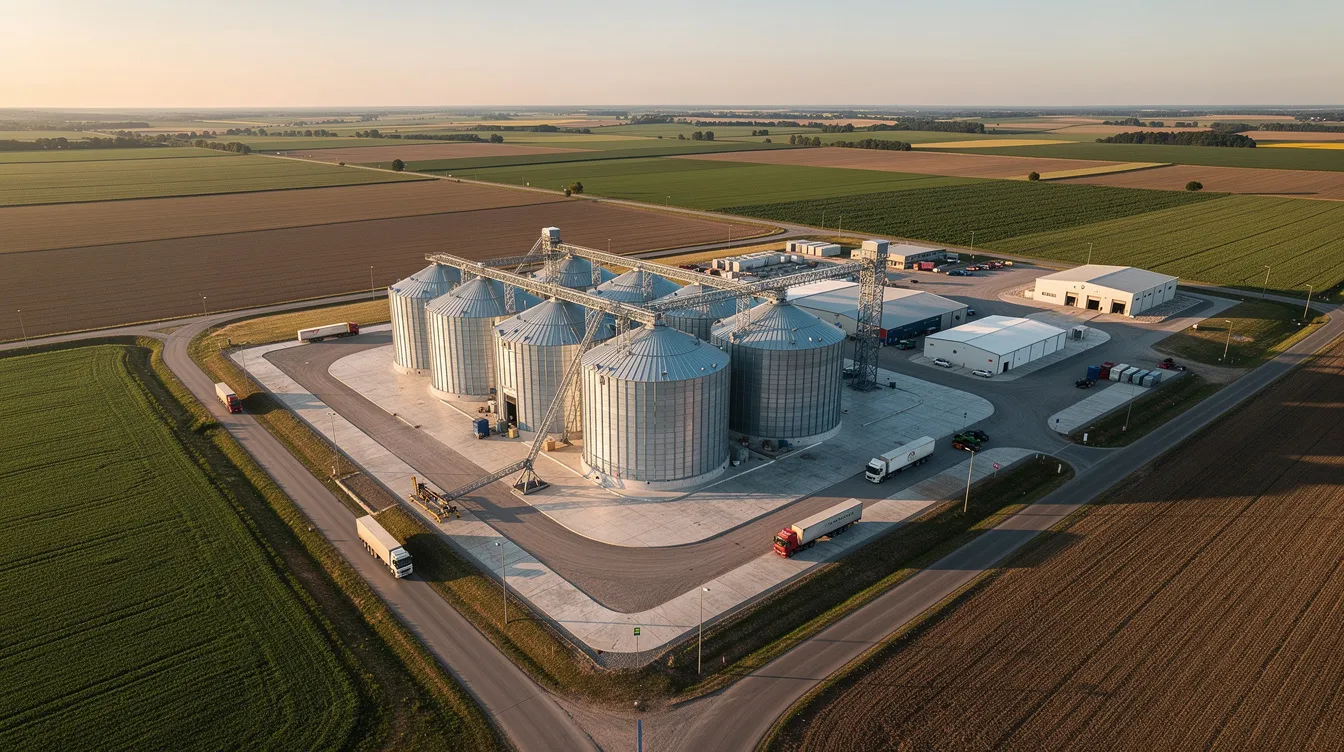
50,000 MT Capacity: Large industrial silos can store tens of thousands of tons and are often rail-linked terminals or hub silos under PPP models. The NCML Sonipat project-four flat bottom silos of 12,500 MT each-had a total CAPEX of approximately ₹80 crore, or about ₹6,400 per MT excluding land and rail siding. Including land, rail infrastructure, and heavy handling systems, total investment for such projects can exceed ₹100 crore.
All figures above are illustrative and must be refined in a project-specific DPR with current supplier quotations.
Land Requirement and Site Development Cost
Land cost frequently changes project economics more than the grain silo cost or warehouse construction itself, especially near major mandis and railheads. Approximate land requirements:
| Capacity | Steel Silos | Warehouse (Bagged) |
|---|---|---|
| 5,000 MT | 1–2 acres | 2–4 acres |
| 10,000 MT | 2–3 acres | 4–7 acres |
| 25,000 MT | 4–6 acres | 8–12 acres |
| 50,000 MT | 6–10 acres | 12–20+ acres |
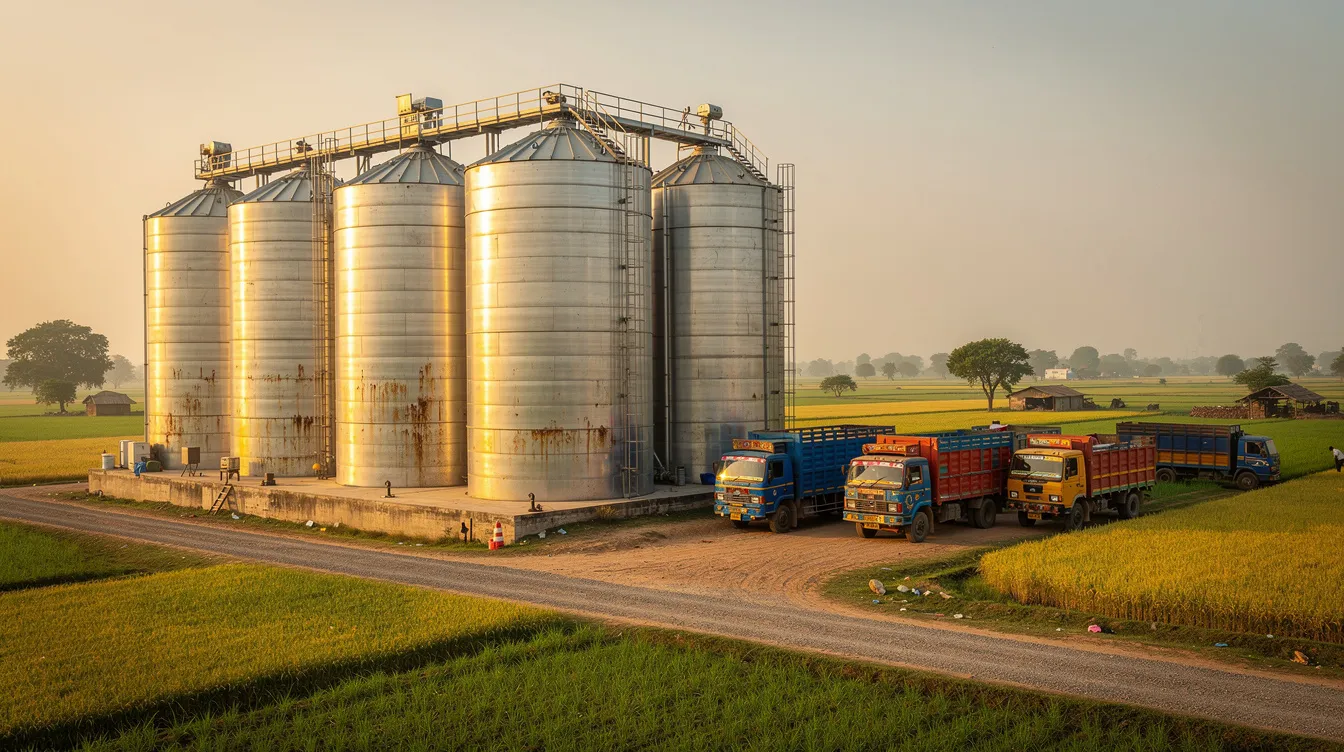
Site selection for grain silos should consider access to transportation networks, proximity to procurement centres, and soil bearing capacity. Soil testing is an important step when planning silo foundations, since foundation requirements are influenced by soil bearing capacity at the site. According to industry sources, foundation costs constitute 8–15% of total installed cost on competent soil, rising to 20–25% if piling is required.
Site development components include boundary walls, internal roads, drains, weighbridge placement, gate complex, and greenbelt where required. Logistics and proximity to manufacturing hubs influence overall project expenses. For road-fed grain silo facilities, truck circulation space is critical. Larger locations suitable for a Hub & Spoke Grain Silo Project should account for future capacity expansion.
Grain Warehouse Construction Cost in India
Grain warehouse construction cost in India depends on whether the project uses conventional RCC godowns, modern PEB steel warehouses, or hybrid layouts with covered platforms and loading docks.
Key civil and structural cost components include foundations and plinth (designed for high grain loads), superstructure, roofing with insulation where required, and flooring with appropriate load-bearing capacity. Local municipal guidelines and fire safety clearances are necessary for establishment. Regulatory compliance is needed for civil works and operations across Indian states.
Indicative construction cost per square foot:
- PEB Warehouses: ₹1,200–₹1,600/sq ft for standard specifications; up to ₹2,600/sq ft for insulated, fully equipped facilities
- RCC Godowns: ₹1,800–₹3,200/sq ft depending on location and design, as reported by AAA Infra Corp
Usable storage area versus total built-up area is an important distinction. Corridors, office blocks, and utility rooms reduce the net area available for bagged grain stacks. Effective storage capacity in MT depends on stacking norms, eave height, and aisle widths. Promoters should refer to a Modern Food Grain Warehouse Project Report for detailed layouts and civil-cost benchmarking.
Steel Grain Silo Construction and Installation Cost
Steel grain silos are high-density storage structures typically made from galvanised steel-the most commonly used construction material for modern grain storage silos in India. Vertical silos are the most common type for grain storage. The silo design chosen-flat bottom silos for large-volume long-term grain storage or hopper bottom silos designed for frequent grain discharge-directly impacts cost. Hopper-bottom silos allow self-discharge under gravity and are suited for short-term storage, while flat bottom silos are ideal for larger silos requiring maximum durability and corrosion resistance.
Core cost elements include the silo shell, roof structure, stiffeners, and bolted joints; RCC ring beam foundations; internal accessories such as aeration ducts and sweep augers; and access ladders, platforms, and safety cages. High-quality materials increase initial silo investment but reduce maintenance costs substantially. High-quality silos can last for decades with minimal maintenance. Selecting appropriate silo types can minimise construction expenses.
Grain silo construction cost in India is heavily affected by steel prices, galvanisation thickness, fabrication method, wind and seismic design loads, and whether the project is EPC turnkey or supply-only. As per MoFPI approved cost norms, silo cost inclusive of civil, electrical, and machinery is pegged at ₹5,900 per MT-though current market rates are higher after inflation adjustment.
A detailed Steel Grain Silo Plant Project Report & DPR will normally include civil foundation drawings, silo mechanical BOQ, electrical cost estimates, and phased investment options.
Grain Handling Machinery and Equipment Cost
The grain silo or warehouse structure alone is not sufficient for efficient grain storage. Grain handling and grain preservation systems are critical cost components affecting both CAPEX and OPEX.
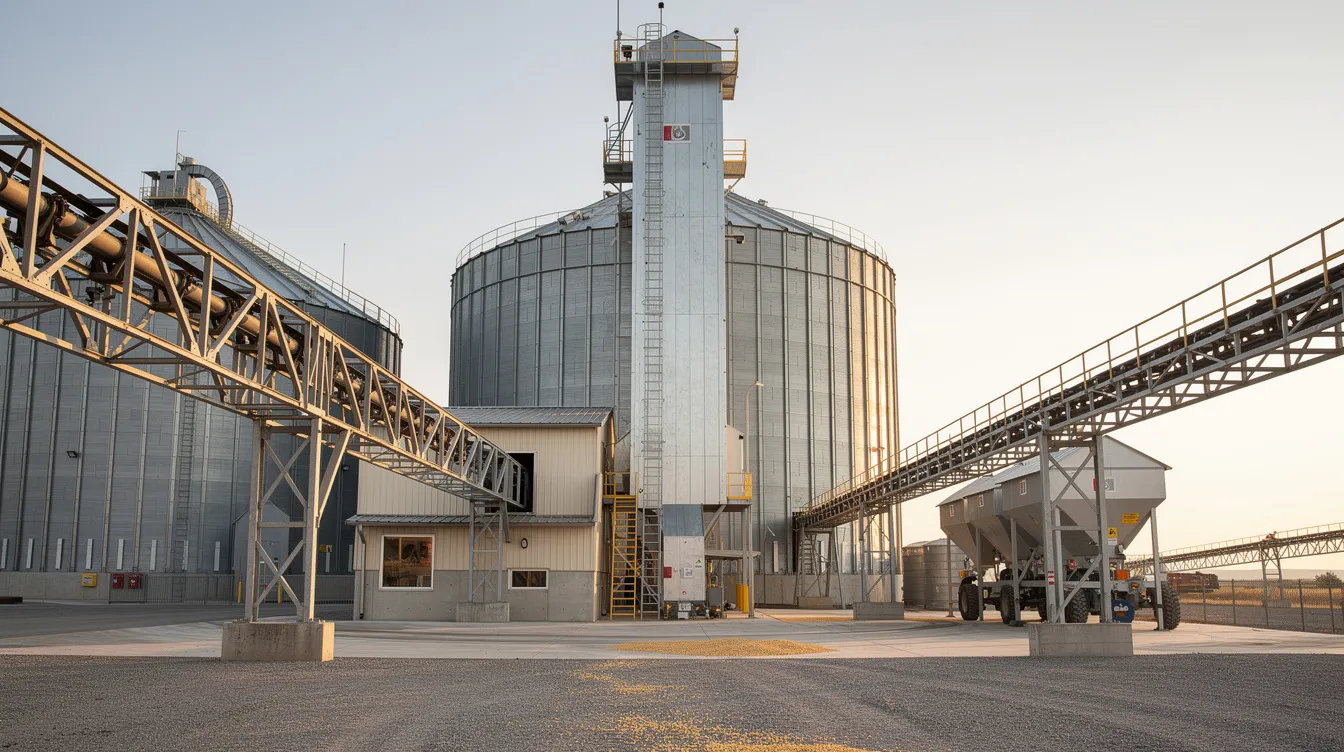
Essential mechanical handling equipment includes bucket elevators for vertical lifting, belt or chain conveyors for horizontal transfer, truck receiving pits with grain storage hopper arrangements, and discharge spouts. For grain quality preservation, cleaners, graders, and pre-cleaning systems remove impurities. Dryers are essential for maize and paddy in humid climates. Aeration systems with blowers and ducts are essential for maintaining grain quality during storage, and temperature monitoring systems are crucial to prevent spoilage in grain silos.
Grain preservation technology is necessary to manage moisture and prevent spoilage. Automation systems in silos improve operational efficiency but raise costs-silo costs can vary significantly depending on automation levels. Promoters should avoid unnecessary automation to control initial costs, especially in the early project phase.
For larger projects, it may be economical to integrate cleaning, grading, and drying lines, or to incorporate Bulk Grain Handling & Logistics Terminal arrangements for high-volume flows. The mechanical, handling, and electrical portion typically constitutes 25–35% of total CAPEX in modern grain silo projects.
Complete Project Cost Breakdown and Capital Investment
A consolidated view of total grain storage project CAPEX for an illustrative 10,000 MT steel grain silo project:
| Cost Head | Approximate % of Total CAPEX |
|---|---|
| Land Purchase & Registration | 10–20% (varies by state) |
| Site Development | 3–5% |
| Civil Foundations & Utility Buildings | 15–25% |
| Steel Grain Silos | 20–30% |
| Grain Handling Machinery | 15–25% |
| Electrical, DG Set, Transformer | 5–8% |
| Weighbridge, Office, Lab, Ancillary | 3–5% |
| Pre-operative & Consultancy | 3–5% |
| Interest During Construction | 3–5% |
| Contingency | 3–5% |
| Working Capital Margin | 3–5% |
Foundation work is crucial and affects overall silo construction costs. Proper project planning optimises installation and operational costs-an underestimated civil budget or insufficient contingency can create funding gaps during implementation.
A bankable DPR must align the project cost with means of finance, expected cash flows, DSCR, and repayment schedules. Serious promoters should consider professional support from Project Report Bank for customised financial projections and modelling based on vendor quotations and site-specific data.
Operating Expenses of Grain Silo and Warehouse Projects
While investors focus on grain silo cost or warehouse construction cost, long-term viability depends equally on OPEX and capacity utilisation.
Key operating cost components include manpower, power consumption (elevators, conveyors, aeration blowers), fumigation chemicals, pest control, repairs and maintenance costs, insurance, and statutory compliance. Mechanised steel silo systems require lower handling labour per MT but higher power use. Conventional warehouses require more manual handling and bagging labour but lower mechanisation.
Fixed operating expenses (salaries, insurance, minimum power) continue regardless of occupancy. Variable costs (power for grain movement, fumigation proportional to occupancy) scale with utilisation. Any serious feasibility study must project OPEX year-wise and incorporate it into DSCR analysis.
Revenue Models and Storage Business Opportunities
Grain storage assets can generate cash flows through multiple models: storage rent (₹ per MT per month), handling charges, integrated logistics services including inventory management, and captive storage cost savings for flour mills, rice mills, feed mills, and food industries.
Large hub silos may enter long-duration storage agreements with government agencies or food processing companies, often with fixed storage fees. Revenue potential depends on location, competition from existing commercial grain storage facilities, seasonal arrival patterns, and average annual occupancy rates. Grain trading and grain processing businesses often find captive storage more economical than renting third-party space.
Promoters should test multiple revenue scenarios-optimistic, base, conservative-in their projections to understand risk to cash flow and loan repayment.
Bank Loan, Project Finance and Means of Finance
Typical funding structures for grain silo and warehouse projects include promoter’s equity (25–35% of project cost), term loan (65–75%), and possible interest subvention under eligible schemes. Working capital limits cover grain inventory and receivables.
Lenders evaluate projects through a professionally prepared DPR covering technical, financial, and market aspects; realistic project cost estimates; DSCR and cash flow coverage over loan tenure; and promoter contribution planning. Government subsidies may help reduce the effective investment for silo construction in India through schemes like the Agriculture Infrastructure Fund.
For a hypothetical ₹8 crore project: promoter equity of ₹2.5 crore (31%), term loan of ₹5.5 crore (69%), with subsidy or interest subvention treated separately. Professional Bank Finance DPR & Loan Proposal Assistance and CMA Data Preparation Services ensure that projected balance sheets, P&L, and cash flow statements are structured for lender appraisal.
Government Schemes, Subsidies and Incentives
The Government of India promotes scientific grain storage through several programmes. Under the Agricultural Marketing Infrastructure (AMI) sub-scheme, capital subsidy of 25% in plain areas and 33⅓% for NER, hilly areas, women, SC/ST, and FPOs is available for storage projects of 50–10,000 MT capacity.
The Agriculture Infrastructure Fund (AIF) provides interest subvention of approximately 3% per annum on term loans up to ₹2 crore for eligible post-harvest infrastructure, including warehouses and silos.
Scheme guidelines, subsidy rates, and eligible costs change periodically. Promoters must verify latest notifications before incorporating benefits into project cost. Not every grain storage project will qualify-eligibility depends on project type, promoter category, location, and compliance with scheme conditions. PACS & FPO Rural Grain Storage Warehouse projects have specific scheme alignment requirements.
Grain Storage Project Financial Feasibility, ROI and Payback
A grain silo or warehouse should be evaluated as a long-term infrastructure investment. Key financial indicators include projected P&L over 7–10 years, cash flow and DSCR profile, ROI, IRR, payback period, and break-even occupancy utilisation.
From the North MP steel silo PPP case study, a 50,000 MT project generated revenue of approximately ₹4.2 crore/year against expenses of ₹1.2 crore/year, yielding an implied payback of approximately 10 years. Sensitivity analysis should test scenarios where construction costs increase 10–15%, occupancy falls below planned levels, or power tariffs rise faster than inflation.
Professional Project Feasibility Study & Viability Services can assist promoters in deciding whether to proceed, scale down, or phase the investment. Each project’s viability is location- and contract-specific-no guaranteed ROI should be assumed.
Common Mistakes That Increase Grain Silo and Warehouse Setup Costs
Practical planning errors frequently observed in Indian grain storage projects include:
- Underestimating civil foundation cost, especially on weak soil requiring piling
- Choosing capacity without considering truck movement and future expansion
- Focusing only on the lowest grain silo price without assessing total cost of ownership-selecting a grain silo manufacturer by price alone without evaluating the right grain silo manufacturer for quality and support
- Inadequate provision for aeration and moisture control, leading to grain spoilage
- Undersized grain handling equipment creating bottlenecks during peak season
- Ignoring local seismic and wind-load requirements for bolted steel silo designs
- Preparing budgets without contingencies, IDC, and pre-operative expenses
- Over-optimistic revenue assumptions in DPRs submitted to banks
Comparing quotes from multiple suppliers helps find cost-effective options. Choosing the right manufacturer ensures quality construction-reliable manufacturers provide long-term support for silos, and experienced manufacturers ensure efficient silo performance over years. Selecting a manufacturer impacts the overall silo investment value. Customised grain silo solutions from reputable silo manufacturers deliver better results than generic specifications.
Promoters should view investment in proper design, DPR preparation, and technical supervision as protection against costly mid-course corrections.
How to Plan a Bankable Grain Silo or Warehouse Project
A systematic planning sequence reduces risk and improves bankability:
- Define project concept: Determine silo capacity, target users (own processing unit, FCI, grain traders, PACS), grain types, and right storage capacity for the market
- Market demand assessment: Evaluate local production volumes, current storage gap, competing facilities, and customised storage solutions needed
- Technology decision: Choose between flat bottom steel grain silos, hopper silos, bagged-grain warehouse, or a combination-selecting the storage system that delivers efficient grain storage and can improve grain quality and improve storage efficiency
- Technical planning: Preliminary land identification, site layout, equipment lists, and civil BOQs for the silo structure
- Financial planning: CAPEX and OPEX estimation, funding strategy, projected income, profitability, and DSCR analysis
- Documentation: Detailed Project Report, CMA Data aligned with bank formats, and loan structuring using Project Finance Advisory & Loan Structuring Services
Professionally prepared DPRs and projections reduce back-and-forth with banks and improve the chances of timely project-finance sanction. Technology modern grain silos use today allows better grain protection and can improve operational efficiency across the storage chain.
Frequently Asked Questions
What is the approximate cost of setting up a 10,000 MT grain silo project in India?
For a 10,000 MT steel grain silo system, the total project cost-including civil foundations, silos, basic grain handling equipment, and supporting infrastructure but excluding land-can range from approximately ₹5 to ₹8 crore at 2025–26 indicative prices. The actual figure depends on automation level, grain type, soil conditions, and silo design. Precise costing needs quotations from silo manufacturers, civil contractors, and electrical vendors, consolidated in a customised DPR. A small farm silo of 100–500 MT will have a much higher per-MT cost due to fixed overheads.
How does the cost to build a 10,000 MT grain warehouse compare with a steel silo system?
A bagged-grain warehouse of equivalent capacity requires more land and built-up area but lower specialised mechanical equipment, so the initial investment may be lower per MT. However, over 15–20 years, higher handling labour, fumigation, and storage losses in warehouses-along with greater bulk materials consumption for bagging-may narrow the gap or make silos more economical when total cost of ownership is evaluated. Larger silos benefit from economies of scale that warehouses cannot easily match.
What documents should be included in a grain storage project DPR for bank finance?
A bankable DPR should include an executive summary, promoter profile, technical details of silos or warehouses and handling equipment, land and civil layout drawings, detailed project cost and means-of-finance statement, 7–10 year financial projections, DSCR analysis, break-even and sensitivity analysis, and risk mitigation strategies. Working with a professional advisory like Project Report Bank ensures these elements are properly structured for bank appraisal and linked to accurate CMA Data.
How much does it cost to build a grain warehouse per square foot in India?
Indicative construction cost ranges from ₹1,200–₹1,600/sq ft for PEB grain warehouses to ₹1,800–₹3,200/sq ft for RCC structures, depending on location, structural design, eave height, and finish specifications. These figures are for initial budgeting only-final rates must be obtained from contractors against approved drawings and specifications specific to the project site.
Is grain warehousing a profitable business in India?
Profitability depends on location, storage tariffs, occupancy rates, operating costs, and financing structure. Case studies from PPP silo projects in India indicate payback periods of approximately 8–12 years when occupancy is maintained above 70–80%. However, each project is location-specific. High-quality materials, proper silo construction, and efficient handling systems that improve storage efficiency and maintain grain quality are essential for long-term profitability.
Planning a Grain Silo or Warehouse Project in India?
A grain storage investment requires careful assessment of land, construction technology, grain handling machinery, operating costs, revenue potential, and financing requirements. CA Manish Gugliya, with over 20 years of professional experience, assists entrepreneurs and investors with Detailed Project Reports, financial projections, CMA Data, project feasibility studies, and bank finance documentation.
For professional assistance with your proposed grain silo or warehouse project, connect through WhatsApp using the website’s existing enquiry facility.