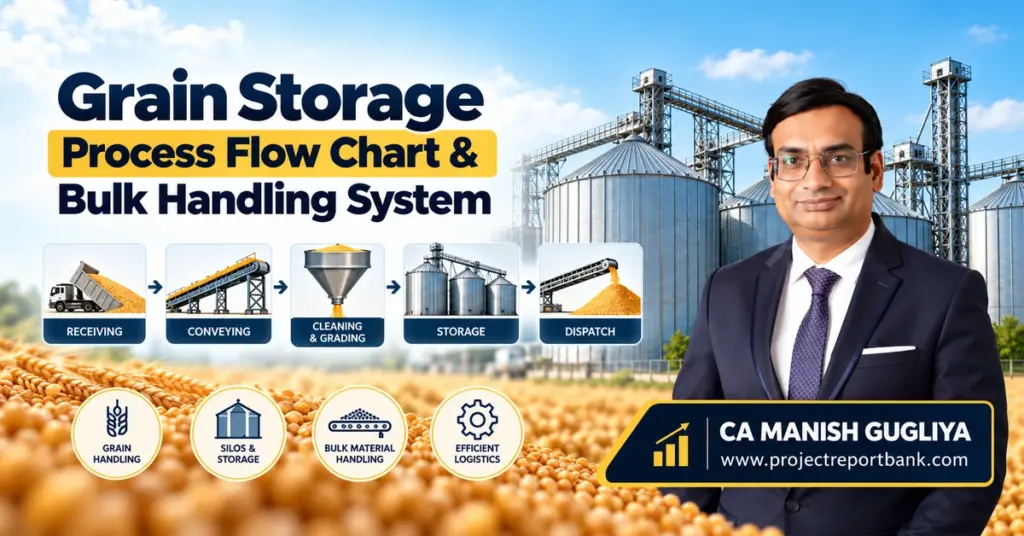
Key Takeaways
- A grain storage process flow chart maps every step from grain arrival, weighing, and sampling through cleaning, drying, storage in grain silos, aeration, monitoring, and final dispatch, forming the technical backbone of any DPR for a grain storage project.
- An efficient grain storage and bulk handling system reduces grain losses, helps maintain grain quality, and directly influences project cost, plant layout, machinery selection, and bankability.
- Commercial grain storage projects in India typically use flat bottom silos for long term bulk storage and hopper bottom silos for frequent turnover, integrated with bucket elevators, belt and chain conveyors, and automated monitoring systems.
- From a DPR and project finance perspective, the process flow chart drives capacity planning, power load estimation, operating cost assumptions, and revenue projections – all of which lenders and investors scrutinise closely.
- Project Report Bank, led by CA Manish Gugliya (FCA, DISA), prepares customised DPRs, CMA Data, and feasibility studies for grain storage and grain silo projects across India.
Introduction – Understanding the Grain Storage Process Flow Chart
A grain storage process flow chart is a step-by-step schematic describing how bulk grains move from truck or rail arrival, through material handling and conditioning, into grain storage silos, and finally to dispatch. It helps visualize operational steps before detailed engineering drawings are prepared, allowing promoters to discuss concepts with silo OEMs, EPC contractors, bankers, and investors with clarity.
For Indian grain storage projects planned during 2026–2030, this flow chart is becoming increasingly important. FCI procurement operations, expansion of private warehousing, growth of agro-processing clusters, and stricter food safety norms under FSSAI all demand systematic documentation of how harvested grains are received, cleaned, dried, stored, and dispatched. Grain silos reduce post harvest losses significantly compared to traditional storage methods, and a well-planned grain storage and handling process protects grain quality while lowering per-ton handling costs.
The flow chart is not merely a diagram for an engineering wall. It precedes machinery selection, capacity planning, electrical load estimation, and financial projection – all essential inputs for a bankable Detailed Project Report.
If you are planning a commercial grain storage facility, steel grain silo project, or bulk handling terminal, Project Report Bank can prepare a customised technical-financial DPR for your project. Reach out via WhatsApp or call to discuss your requirements.
What Is a Grain Storage and Bulk Handling System?
An integrated grain storage and bulk handling system is the complete set of civil structures, grain silos, grain storage silos, mechanical conveying equipment, cleaning and drying machinery, automation, and utilities required to handle bulk materials from intake to dispatch. It allows operators to safely store large quantities of grain while preserving grain quality and ensuring traceability.
Typical components include:
- Bulk grain receiving infrastructure (receiving pit, truck tippler)
- Bucket elevators and belt or chain conveyors for material handling
- Pre-cleaners and grain cleaner equipment
- Grain dryers for moisture management
- Steel silos – both flat bottom silos for long term grain storage and hopper bottom silos for frequent discharge
- Aeration systems and temperature monitoring cables
- Dust collection and ventilation systems
- Weighbridges and truck or rail loading systems
- PLC/SCADA automation and control systems
Modern grain silos use corrugated galvanized steel panels, offering modularity and faster erection compared to concrete silos or riveted steel structures. Modern silos include automated aeration systems for temperature control and integrated monitoring systems for grain management.
The configuration varies by commodity – wheat, paddy, maize, or soybean each have different moisture requirements, bulk density, and storage needs. Site connectivity (road-fed, rail-linked, or port-adjacent) also shapes the system design.
Compared to conventional bagged storage in godowns, mechanised bulk storage in grain silos offers clear advantages in labour efficiency, food safety compliance, space utilisation, and reduced storage losses. Grain silos protect crops from moisture and pests far more effectively than traditional storage methods, and silos help ensure a steady supply of grains throughout the year.
Project Report Bank focuses on conceptual process definition, DPR preparation, and financial modelling. Detailed structural and mechanical engineering is performed by qualified OEMs and engineering consultants.
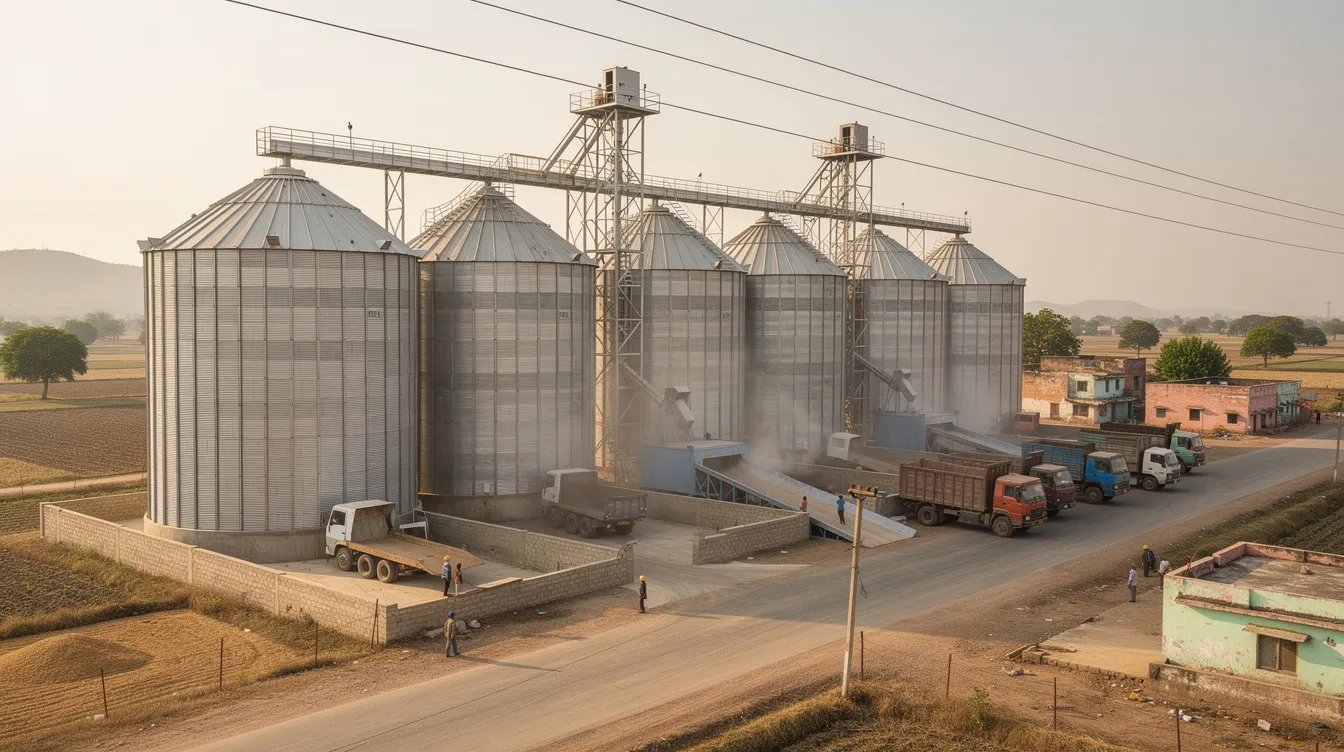
Complete Grain Storage Process Flow Chart
A grain storage process flow chart helps visualize operational steps and forms the basis for plant design, equipment procurement, and financial planning. The grain storage process flow involves receiving, cleaning, drying, and dispatching as its core stages.
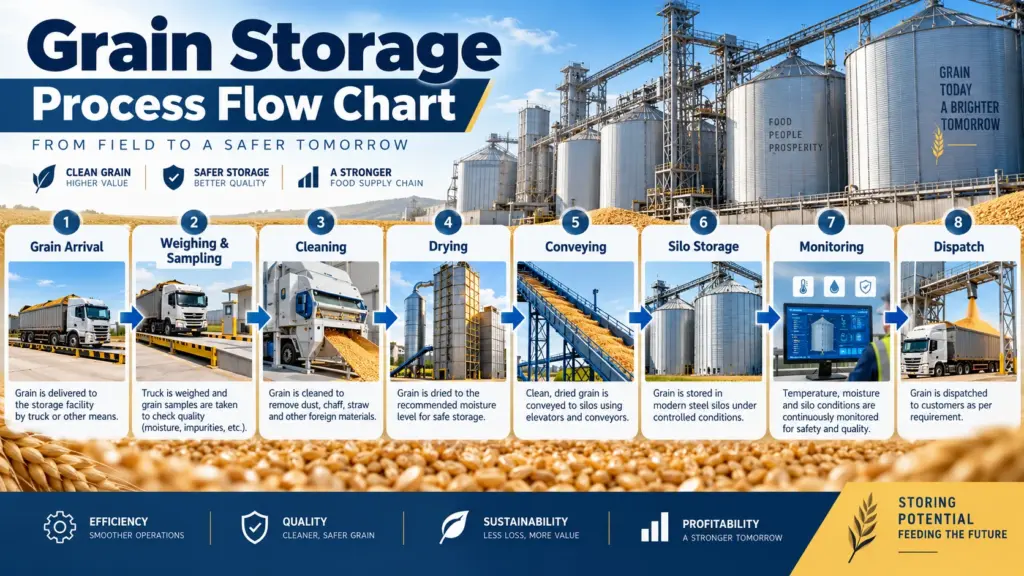
Main Conceptual Flow Chart:
Grain Arrival by Truck/Rail ↓ Weighbridge and Documentation ↓ Sampling and Quality Inspection ↓ Grain Receiving Pit / Intake Hopper ↓ Pre-Cleaning and Impurity Removal ↓ Magnetic Separation (where specified) ↓ Grain Cleaning and Grading ↓ Moisture Testing ↓ Grain Drying (if required) / Dryer Bypass ↓ Bucket Elevator and Conveyor System ↓ Distribution and Silo Filling ↓ Bulk Grain Storage in Flat Bottom or Hopper Bottom Silos ↓ Aeration, Temperature and Condition Monitoring ↓ Silo Discharge and Grain Reclaim ↓ Grain Transfer and Final Quality Checks ↓ Weighing and Loading ↓ Truck/Rail Dispatch
Simplified Flow for Already Clean and Dry Grain:
Arrival → Weighing → Sampling → Intake Hopper → Limited Pre-cleaning → Conveyor/Elevator → Silo Filling → Storage and Monitoring → Discharge and Final Weighment → Dispatch
The grain silo process flow diagram directly affects machinery selection – the number and capacity of bucket elevators, conveyors, pre-cleaners, and dryers all follow from this chart. It also determines power consumption and MCC sizing, labour requirement and automation scope, and capital expenditure on grain storage silos and auxiliary equipment.
Actual routing in an engineered plant includes bypass lines, interlocks, and safety systems designed by OEMs in compliance with BIS and relevant safety standards. The conceptual flow chart presented here serves as the planning foundation, not a substitute for detailed engineering.
Step-by-Step Grain Receiving, Cleaning, Storage and Dispatch Process
This section breaks the flow chart into ten operational steps, each relevant for plant operations and DPR preparation. Examples reference wheat or maize in North Indian states with realistic intake rates of 120–200 TPH.
Step 1 – Grain Arrival, Weighing and Sampling
Grain arriving from farms is weighed and tested for moisture content at the facility gate. Trucks of 16–28 tonnes use a dual-purpose weighbridge (inward and outward weighment), with data integrated into ERP systems for batch traceability.
Incoming grain is evaluated for quality before storage through representative sampling using grain probes. Composite samples are tested for moisture, foreign matter, damaged or weevilled grains, and broken kernels. These quality control checkpoints are critical at each phase of grain handling – acceptance decisions and price deductions depend on this data, which also feeds directly into DPR revenue calculations.
Step 2 – Grain Receiving Hopper and Intake Pit
The receiving pit is typically a concrete structure with steel gratings where trucks unload grain by manual tipping, hydraulic tippler, or gravity. Slide gates and feeders regulate grain flow to bucket elevators, preventing choking and spillage.
Dust suppression and aspiration points near the intake reduce grain dust emissions and improve worker safety. The number of pits and hopper volume determine how many trucks per hour can be processed during peak procurement – a critical capacity planning parameter for seasonal operations.
Step 3 – Grain Pre-Cleaning and Impurity Separation
Pre-cleaners remove large impurities – straw, husk, chaff, stones, and oversized or undersized particles – that would otherwise cause blockages or affect storage conditions. Common equipment includes rotary drum pre-cleaners or vibrating screens sized for 60–200 TPH.
Mechanical separators and sieves remove foreign materials from grain at this stage. This reduces wear on downstream conveyors, improves aeration effectiveness in silos, and lowers the risk of insect infestation and mold growth during storage. In DPRs, pre-cleaning capacity usually equals or slightly exceeds maximum intake capacity to avoid bottlenecks.
Step 4 – Grain Cleaning and Grading
Secondary cleaning uses multi-deck cleaners, destoners, and graders when the facility supplies food processing units, feed mills, or export markets requiring tighter grain quality specifications. This stage may produce multiple output streams – main grade, downgraded grain, and screenings – each with separate storage or bagging arrangements.
The higher capital cost of advanced cleaning equipment must be justified through better pricing, service charges, or export premiums in the project feasibility study. Basic cleaning for FCI-specification storage differs substantially from premium sorting for flour mills or exporters.
Step 5 – Grain Drying and Moisture Management
Moisture management is critical to preventing post harvest losses. Grain moisture levels should typically be around 12% to 14% for safe storage, though the exact limit depends on grain type and intended duration. For wheat, FSSAI standards specify moisture content not exceeding 14% by weight. Maize is often stored at 13–14% for long term storage.
Grain is dried to safe moisture levels to prevent spoilage during storage using continuous-flow or batch dryers with hot air from diesel, biomass, or thermic fluid heaters. Typical moisture reduction is 2–6 percentage points per pass. Grain should not be stored if moisture exceeds safe thresholds.
Dryer capacity in TPH must match the intake rate. Under-sized dryers create queues and may force storage of wet grain, increasing grain spoilage risk and financial losses. Physical grain damage should be minimized during transportation to storage – aggressive drying can cause stress cracks, reducing nutritional quality.
Step 6 – Grain Transportation Using Conveyors and Bucket Elevators
Grain is moved into storage using bucket elevators and belt conveyors. Bucket elevators handle vertical lifting from pits to cleaners and silos, while belt or chain conveyors manage horizontal transfers. Screw conveyors serve smaller, precise transfer applications.
Gentle handling limits grain breakage and fines generation. Belt speeds, elevator cup design, and impact reduction at transfer points all matter. Conveyor throughput – whether 120 TPH or 300 TPH – must align with intake, cleaning, drying, and dispatch requirements, not merely with silo storage capacity. Routing flexibility through multiple conveyor lines supports segregation by grain quality, lot, and season.
Step 7 – Grain Distribution and Silo Filling
Distribution systems such as chain conveyors on silo roofs, spouts, diverter valves, and rotating distributors route grain into selected storage silos. Level switches, load cells, or radar level sensors protect against overfilling and improve inventory accuracy.
Silo utilisation and bin management influence revenue from storage contracts and reduce unnecessary truck rehandling – a factor that directly affects project economics in DPR projections.
Step 8 – Grain Storage, Aeration and Quality Monitoring
Flat bottom silos are designed for long term bulk storage, with aeration ducts, perforated floors, roof vents, and temperature monitoring cables that stabilize internal conditions. Aeration systems control moisture and temperature in grain silos, preventing hotspots and moisture migration that lead to spoilage. Modern silos include aeration systems and temperature monitoring integrated into automated control platforms.
Grain undergoes periodic inspection and control measures for pests. Effective pest management practices are vital for grain storage integrity. Stored grain should be routinely checked for signs of spoilage and pest activity, with fumigation carried out under expert supervision. Grain monitoring integrates pest control and temperature management to maintain quality. Regular inspections help ensure grain quality during the storage period.
Proper grain storage maintains nutritional quality over time, and grain silos can store thousands of tons of grain when properly managed. Silos, bins, and warehouses are used for long term grain storage depending on project requirements and various types of commodities handled.
Step 9 – Grain Discharge and Reclaim Systems
Hopper bottom silos allow 100% gravity-assisted discharge through cone outlets with hopper angles typically between 45° and 60°. Flat bottom silos require sweep augers or screw conveyors for complete reclaim via under-floor conveyors.
Common flow issues include bridging, rat-holing, and non-uniform discharge when outlet design or operating procedures are inadequate. Reliable reclaim is essential to meet time-bound dispatch schedules under warehousing or logistics contracts.
Step 10 – Grain Weighing, Loading and Dispatch
Outgoing grain is inspected and weighed before dispatch to ensure quality. Final verification includes moisture checks and visual inspection before loading into trucks or rail cars via telescopic chutes, spouts, or automated loading stations.
Outward weighment on the weighbridge generates invoices, delivery challans, e-way bills, and inventory reconciliation in ERP. Dispatch throughput and number of loading points influence truck turnaround time and overall terminal efficiency – a critical parameter in DPR viability analysis.
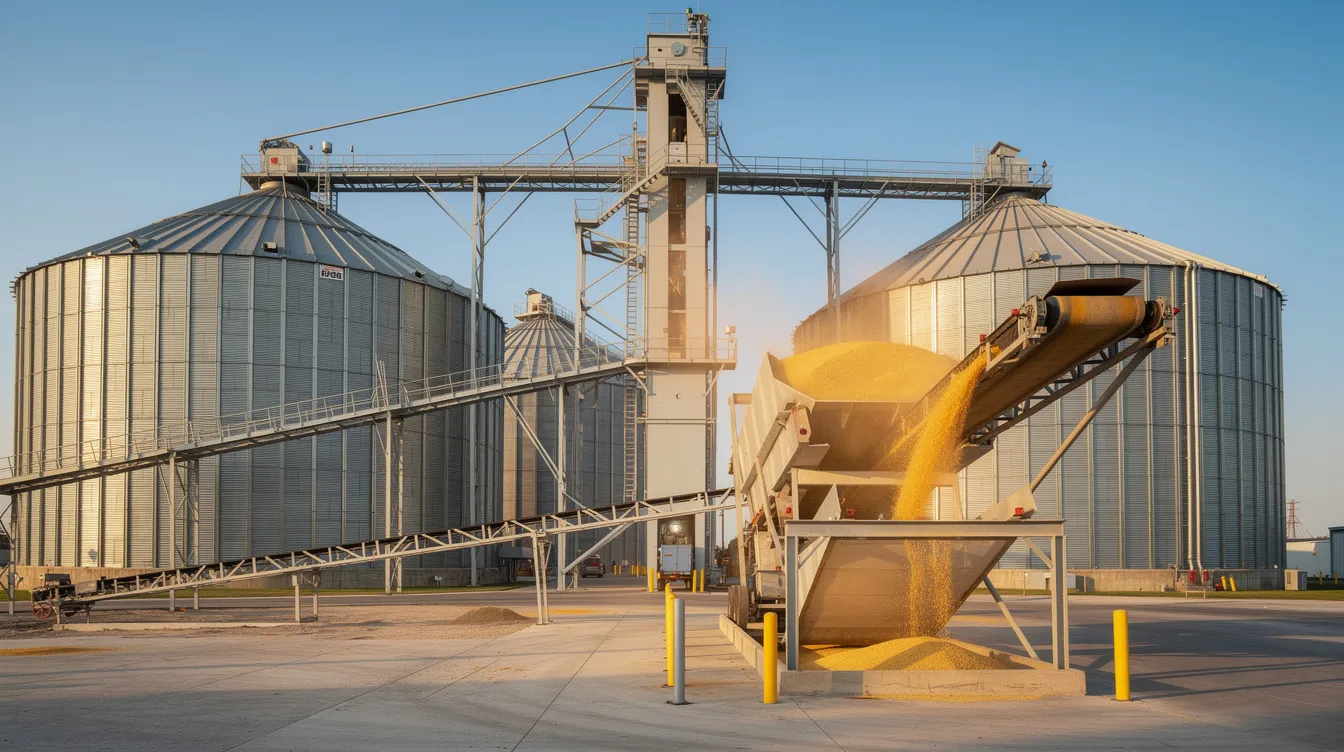
Major Equipment Used in a Bulk Grain Handling System
The table below summarises each major equipment item, its function in the grain storage process flow chart, and key selection factors.
| Equipment | Main Function | Process Stage | Important Selection Considerations |
|---|---|---|---|
| Weighbridge | Inward/outward grain weighment | Arrival and Dispatch | Capacity matching truck/rake sizes; dual operation; ERP integration |
| Grain Receiving Hopper | Receiving bulk grain from trucks | Intake | Volume sized for peak truck flow; dust suppression |
| Intake Pit and Feeder | Regulated feed to elevators | Intake | Slide gates, vibrating feeders; spill containment |
| Bucket Elevator | Vertical grain lifting | Multiple stages | Capacity 60–350 TPH; lift height; gentle handling |
| Belt Conveyor | Horizontal grain transfer | Multiple stages | 15–350 TPH; belt speed; weather protection |
| Chain Conveyor | Horizontal/inclined transfer | Distribution, reclaim | Up to 350 TPH; enclosed; low dust |
| Screw Conveyor | Short-distance precise transfer | Various | 3–150 TPH; diameter and speed matched to grain |
| Pre-cleaner | Remove large impurities | Pre-cleaning | Throughput matching intake; screen sizing |
| Grain Cleaner and Grader | Fine cleaning and grading | Cleaning | Multi-deck; commodity-specific screens |
| Magnetic Separator | Remove iron contamination | Cleaning | Placement before silos; self-cleaning type |
| Grain Dryer | Reduce moisture to safe levels | Drying | TPH matched to intake; fuel source; cooling zone |
| Grain Distributor | Route grain to selected silos | Silo filling | Diverter valves; chain distributors; automation |
| Steel Grain Silo | Bulk grain storage | Storage | Flat bottom or hopper bottom; diameter; structural loads |
| Aeration Fan | Temperature and moisture control | Storage | Airflow per tonne; ducting design |
| Temperature Monitoring System | Detect hotspots in stored grain | Storage | Cable or wireless sensors; alarm integration |
| Dust Collection System | Control grain dust emissions | Multiple stages | Bag filters; aspiration at transfer points; explosion protection |
| Discharge and Reclaim Equipment | Extract grain from silos | Dispatch | Sweep augers; gravity outlets; conveyor integration |
| Automatic Weighing and Loading | Bulk loading into trucks/wagons | Dispatch | Accuracy; throughput; integration with ERP |
| PLC/SCADA Controls | Automated operation and monitoring | Plant-wide | Interlocks; route selection; alarms; data logging |
Equipment selection must be based on throughput, grain characteristics, operating cycles, and required automation – not merely on storage capacity. For a detailed discussion of machinery configuration and costing, refer to Grain Silo Machinery, Equipment and Cost in India.
Types of Bulk Grain Handling Systems
Bulk grain handling systems in India are configured differently depending on transport connectivity, commodity, scale, and commercial purpose. Each configuration has distinct infrastructure requirements and investment implications.
Road-Fed Bulk Grain Handling Systems
Road-fed facilities receive and dispatch grain entirely by truck. These include rural procurement centres, district-level storage, and private grain silo complexes near state highways. The process centres on truck-based intake, weighbridge operations, cleaning and drying where required, grain silo storage, and truck dispatch. Operational focus is on managing seasonal truck peaks during harvest and flexible contracts with local mills or government agencies. A detailed feasibility analysis for this model is covered in the Road-Fed Grain Silo Storage Facility Project Report and DPR.
Rail-Linked Grain Terminal Handling Systems
Terminals connected to railway sidings handle full rakes for inter-state movement or port evacuation. Additional infrastructure includes wagon tipplers or rail unloading pits, longer conveyor runs, and high-capacity bucket elevators sized for rapid rake turnaround. Capital cost is higher, but economies of scale and strategic positioning in the national grain logistics network improve commercial viability. The Rail-Linked Grain Silo Terminal Project Report and DPR examines this model in detail.
Centralised Grain Storage Facilities
Large central grain storage complexes with multiple flat bottom silos – typically 50,000 to 200,000 MT – serve state procurement and buffer stock operations. These may be road-fed, rail-linked, or both, with advanced automation, quality labs, and integrated bulk handling systems. DPRs for such projects must carefully examine contract terms, escalation clauses, DSCR, and long-horizon IRR.
Hub-and-Spoke Grain Storage Networks
Hub-and-spoke models use a central hub silo terminal receiving grain from multiple smaller rural spokes. The hub handles high-spec cleaning, drying, and long term storage, while spokes focus on consolidation. This structure improves utilisation of expensive dryers and cleaning lines and enhances marketing flexibility. Details are available in the Hub and Spoke Grain Silo Project Report and DPR in India.
Integrated Grain Cleaning, Grading, Drying and Storage Facilities
Plants integrating high-spec cleaning, grading, and drying with storage serve flour mills, animal feed plants, or exporters requiring consistent quality. The grain storage process flow chart in such plants includes additional loops and by-product streams – bran, broken grain, screenings – with separate handling. Capital cost is higher but revenue potential improves through quality-linked pricing. The Integrated Grain Cleaning, Grading, Drying and Storage Plant Project Report and DPR covers this configuration.
Mechanised Grain Warehouse Systems
Semi-mechanised systems store grain in warehouses or flat sheds but use conveyors and bucket elevators for intake and dispatch. Such projects bridge the gap for promoters not yet ready for full steel silo infrastructure, and may connect to larger Bulk Grain Handling and Logistics Terminal operations.
Grain Silo Loading and Unloading Process
The silo loading and unloading process is one point where poor design creates the most operational disruption.
During loading, grain is elevated via bucket elevators, distributed through roof conveyors or distributors, and directed into selected silos through spouts and diverter valves. OEM-specified maximum loading rates must be respected to avoid structural stress on silo roofs.
Bin allocation requires segregating by grain type, moisture band, quality grade, origin, and contract – all documented in inventory systems for traceability.
During unloading, hopper bottom silos use gravity discharge through multiple outlet gates, while flat bottom silos require sweep augers and under-floor conveyors for complete reclaim. Incomplete reclaim, bridging, and flow problems from inadequate outlet design increase truck waiting times, demurrage on rail rakes, and can weaken commercial viability. These risks must be recognised in DPR risk analysis.
Grain Storage Plant Capacity Planning and Material Flow Design
Storage capacity in MT is fundamentally different from bulk handling throughput in TPH. Many first-time promoters confuse these metrics, which creates problems in both plant design and financial projections.
Consider a hypothetical 20,000 MT wheat storage facility:
- Scenario A (Slow Turnover): Limited to 400 MT/day intake, 10 hours operation. Required conveyor capacity approximately 40–50 TPH. Moderate elevator and cleaning equipment. Lower capex but the facility fills slowly.
- Scenario B (Aggressive Seasonality): Peak intake of 2,000 MT/day over 10 hours during harvest. Required intake line handling approximately 200 TPH. Dryers, conveyors, and elevators must all match this throughput. Significantly higher capex and power demand.
Buffer capacity in dryers and cleaning units must handle peak flows even when annual average throughput is lower. Bottlenecks at intake pits, dryers, or load-out stations cause queueing, increased demurrage, and loss of handling revenue – directly affecting DSCR and payback calculations.
Plant Layout and Material Flow Optimisation
Conceptual plant layout must integrate process flow, traffic movement, safety, and future expansion – not just place silos randomly on a plot. Key components include:
- Entry/exit gates with internal roads allowing smooth truck circulation
- Weighbridge near the gate with adequate parking queue space
- Receiving pit aligned for easy truck manoeuvring
- Cleaning and drying section adjacent to intake and elevator tower
- Vertical elevator towers central to silo blocks
- Storage silos arranged in logical rows with service access
- Truck loading area with sufficient turning radius
- Electrical substation and control room in accessible, low-dust locations
- Open areas reserved for additional silos in future expansion
Minimising unnecessary transfer points and rehandling reduces grain damage and power consumption. Layout must also consider wind direction for dust control, stormwater drainage, fire access, and separation distances as per local regulations.
Automation, PLC and SCADA in Modern Grain Handling Systems
In modern agriculture and grain storage, automation serves as a tool for safer, more consistent, and traceable operations. Functions typically automated in an automated grain handling system include:
- Route selection for conveyors and bucket elevators
- Sequenced start/stop with interlocks to prevent overloading
- Silo level monitoring, grain temperature, and aeration fan status
- Integration of weighbridge and loading scales with ERP
- Logging run-hours, alarms, and stoppages for maintenance planning
PLC panels and SCADA/HMI systems give operators graphical views of the grain storage process flow chart in real time, with alarms for overfill, high temperature, and motor overload. Essential protections – emergency stops, pull-cord switches, level sensors – should be distinguished from optional features like advanced analytics, with cost-benefit evaluation reflected in DPRs.
Automation specifications must be coordinated between silo OEMs, conveyor suppliers, and electrical contractors to avoid interface gaps and unforeseen costs.
Grain Handling Losses, Operational Risks and Safety
Food safety, worker safety, and minimising grain losses are central to sustainable grain storage projects. Major risks include:
- Grain spillage and grain dust during intake and transfer, creating safety issues
- Excess grain breakage from high-speed conveying
- Grain spoilage from high moisture pockets, poor aeration, or insect activity
- Conveyor blockages and equipment downtime
- Inventory discrepancies from measurement errors
- Dust explosions where combustible dust concentrations are unmanaged
- Confined space risks in silos and working-at-height risks on roofs
Design measures include dust collection systems, aspiration points, explosion vents where specified, access platforms, guard rails, and lock-out/tag-out procedures. Fumigation must be performed only by certified agencies. DPR risk analysis should identify these operational risks, propose mitigation, and account for maintenance, insurance, and compliance costs. Harvested crops require careful handling from farm gate to silo to prevent spoilage.
Grain Storage System Setup Cost and Investment Considerations in India
Total project cost for a grain storage plant includes substantially more than grain silos and conveyors. Key cost heads include:
- Land and site development
- Civil works for intake pits, tunnels, silo foundations, roads, and drainage
- Silo structures (flat bottom and hopper bottom silos) and accessories
- Bulk grain handling equipment – bucket elevators, conveyors, distributors
- Cleaning and drying machinery
- Weighbridges and loading systems
- Electrical infrastructure, DG sets, transformers, and cabling
- Automation, PLC/SCADA, and instrumentation
- Dust control and fire protection
- Pre-operative and engineering expenses
- Contingencies and initial working capital
Costs vary with location, soil conditions, power availability, commodity mix, and level of automation. Generic per-ton cost claims should be treated cautiously. A deeper cost-component discussion is available in the Grain Silo and Warehouse Setup Cost in India guide.
Promoters planning grain storage investments can engage Project Report Bank to prepare customised cost estimates, financial models, and DPRs based on site-specific inputs. Contact via WhatsApp or call to discuss your project.
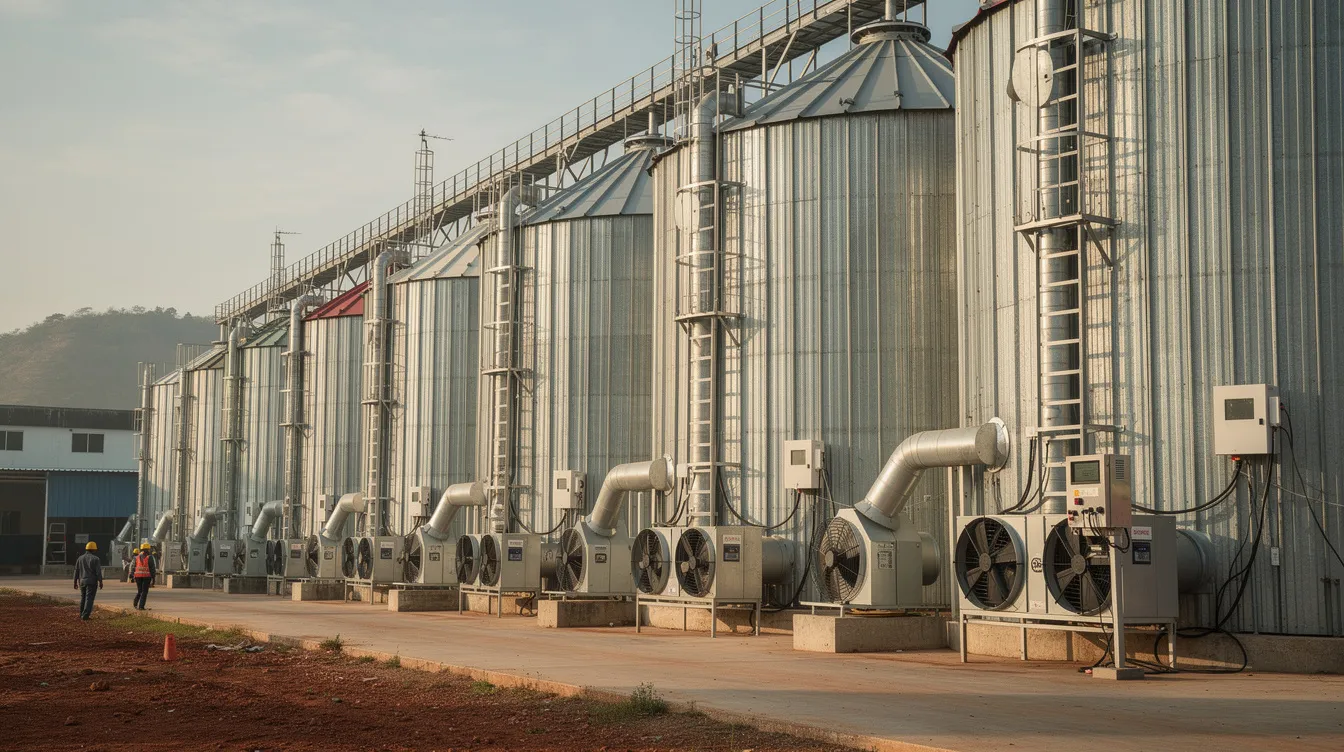
Industrial Grain Storage Models and Project Feasibility
Grain storage investments serve various types of business models, each with distinct revenue patterns:
- Captive storage for flour mills, animal feed plants, or starch units secures raw material supply and reduces price volatility, with savings rather than storage fees driving returns.
- Commercial warehousing earns storage rental per MT per month plus handling charges, with sensitivity to occupancy levels and contract tenures.
- Procurement-linked storage for FCI or state agencies operates under fixed and variable fee structures with performance obligations.
- Bulk trading and logistics terminals earn margins from trading, blending, arbitrage, and logistics – higher risk but potentially higher returns.
Project feasibility must combine technical grain storage and handling design with realistic assumptions on tariffs, utilisation, electricity, repairs, interest, and tax. Readers evaluating a silo design can refer to the Steel Grain Silo Plant Project Report and DPR in India or the Modern Food Grain Warehouse and Godown Project Report and DPR for model-specific analysis. Weather conditions, seasonal demand, and structural integrity requirements all influence which model is appropriate.
Bank Finance, DPR and Financial Planning for Grain Storage Projects
From practical experience in preparing DPRs for grain storage projects, lenders expect a coherent link between the grain storage process flow chart, machinery list, capacity assumptions, and financial projections. Inconsistencies between silo capacity, intake/dispatch throughput, and projected revenue per MT raise immediate questions during credit appraisal.
A bankable DPR should cover:
- Detailed project cost with vendor quotations
- Means of finance – promoter contribution, term loan, applicable subsidies
- Working capital assessment based on operating cycle
- Capacity utilisation build-up over initial years
- Expected tariffs and handling charges supported by market data
- Operating costs – power, labour, maintenance, fumigation, insurance
- Profitability and cash flow projections for at least 7–10 years
- DSCR analysis, break-even analysis, ROI, IRR, and sensitivity tests
Banks often question proposals where storage capacity and handling capacity are confused, or where revenue assumptions bear no relationship to the technical design. Realistic financial projections based on defensible assumptions are more valuable than optimistic numbers.
Project Report Bank offers Bank Finance DPR and Loan Proposal Assistance and CMA Data Preparation Services for Bank Loans. For promoters requiring independent evaluation, Project Feasibility Study and Viability Services are also available. Project Report Bank prepares DPRs and projections based on available information but does not guarantee future performance or bank sanction – actual approval depends on lenders’ independent appraisal.
Grain Storage Systems for PACS, FPOs and Rural Warehouses
Primary Agricultural Credit Societies, Farmer Producer Organisations, and small cooperatives typically operate at lower volumes with limited capital. Such projects may prioritise smaller grain storage silos, low-height hopper bottom silos, or improved rural warehouses with basic mechanisation – a single bucket elevator, pre-cleaner, and low-capacity silo.
A modular expansion philosophy works well: starting with 5,000 MT storage capacity and provisions in the layout to expand to 10,000–15,000 MT as procurement grows. Simple, robust equipment and clear operating procedures matched to local skill levels play a crucial role in making these projects sustainable. The PACS and FPO Rural Grain Storage Warehouse Project Report and DPR provides a framework for such projects.
Common Mistakes in Grain Storage Process and Handling System Design
Several frequent mistakes affect Indian grain storage projects:
- Sizing conveyors on silo capacity alone. Selecting bucket elevators based on 25,000 MT total storage instead of peak daily intake needs leads to chronic bottlenecks during procurement season.
- Underestimating intake pit requirements. Too few or undersized receiving pits cause truck queues during harvest, delaying procurement and creating poor farmer experience.
- Ignoring moisture variability. Harvested grains often arrive above 18–20% moisture. Without adequate dryer capacity or bypass lines, wet grain enters silos, causing spoilage and financial losses.
- Excessive transfer points. Too many conveyor transfer points and sharp bends increase grain breakage, dust generation, maintenance burden, and power consumption.
- Inadequate dust management. Poor aspiration and dust collection lead to housekeeping problems, pollution complaints, and fire or dust explosion hazards.
- Poor discharge arrangements. Bottom silos without proper hopper angles, aeration, and reclaim equipment suffer bridging and incomplete emptying.
- No maintenance access planning. Missing walkways, platforms, and safe ladder systems make routine inspection difficult, increasing downtime risk.
- Ignoring future expansion. Not reserving space or electrical capacity for additional silos or conveyors forces expensive redesign later.
- Optimistic projections without defined process flow. Preparing financial projections without a properly defined grain storage process flow chart and machinery scope produces unrealistic cost and revenue estimates that bankers will question.
Frequently Asked Questions
What is the grain storage process flow chart?
A grain storage process flow chart is a step-wise representation showing every stage from grain receiving, weighing, and sampling through pre-cleaning, cleaning, drying if needed, conveying into grain silos, bulk storage with aeration and monitoring, reclaim, final quality checks, and dispatch. It is essential before selecting machinery, designing the plant layout, and preparing a DPR because it defines the scope of equipment, power requirements, and capacity assumptions for the entire project.
How does a bulk grain handling system work in a silo plant?
Grain is unloaded into intake pits, lifted by bucket elevators, passed through cleaners and dryers, then routed via belt or chain conveyors to selected silos. During dispatch, grain is reclaimed through silo outlets and conveyors to truck or rail loading points. The entire sequence is often coordinated by PLC/SCADA systems that manage route selection, interlocks, and real-time monitoring to minimise grain losses and labour requirements.
Is grain drying always compulsory before silo storage?
Drying is compulsory when incoming moisture exceeds safe storage levels for that grain and intended duration. For long term wheat storage, moisture is often targeted around 12–13%. However, naturally dry grain within acceptable moisture limits can proceed to safe storage without mechanical drying. Actual limits depend on commodity, ambient temperature, and storage duration, and should be determined with technical guidance from experienced grain management specialists.
What is the difference between storage capacity and handling capacity?
Storage capacity is the maximum tonnes of grain the silos or warehouses can hold at one point in time – for example, 20,000 MT. Handling capacity is the tonnes per hour or per day the system can receive and dispatch – for example, 100 TPH or 300 TPH. A 20,000 MT plant with only 50 TPH conveyors will take far longer to fill than one with 200 TPH equipment. Lenders scrutinise both metrics to ensure they align with projected revenue.
What inputs are needed to prepare a DPR for a grain storage project?
Key inputs include project location and land size, proposed storage capacity, silo types (flat bottom or hopper bottom), grain types to be handled, peak and average intake and dispatch volumes, road or rail connectivity, tentative customer contracts, and the promoter’s equity contribution plan. These details allow preparation of realistic project cost, means of finance, working capital assessment, and profitability projections. Share these details with Project Report Bank via WhatsApp for customised DPR and financial modelling.
Conclusion – Planning an Efficient Grain Storage and Bulk Handling System
A well-designed grain storage process flow chart is the foundation for preserving grain quality, minimising grain losses, and ensuring efficient movement through grain silos, conveyors, and handling equipment. It translates operational requirements into machinery specifications, power loads, and capital investment – all essential for a bankable project.
Material flow design, capacity planning, plant layout, automation, and safety must align with commercial contracts and realistic financial projections. Successful grain storage infrastructure requires coordination between grain silo OEMs, civil and structural engineers, automation specialists, and project finance advisors – no single discipline can address every aspect in isolation.
Entrepreneurs, FPOs, PACS, logistics companies, and agro-processors planning grain storage and bulk handling projects in India can contact Project Report Bank for customised DPRs, CMA Data, feasibility studies, and financial projections. Reach out via WhatsApp or call to discuss your project with CA Manish Gugliya.