Planning a grain based ethanol plant in India requires more than enthusiasm about biofuels. It demands a structured investment evaluation backed by defensible assumptions, realistic financial projections and a thorough understanding of feedstock economics, regulatory requirements and debt-servicing capacity.
This guide explains how to plan, cost and finance a grain based ethanol manufacturing plant, with a focus on preparing a detailed project report that banks and investors can appraise with confidence.
Key Takeaways
This article covers the essential planning, costing and financing considerations for a grain based ethanol plant project report PDF in India. Before committing capital, promoters should understand:
- Ethanol production from maize and broken rice serves India’s E20 blending programme, but procurement is not guaranteed for every plant. A feasibility-based approach is essential.
- Plant configuration choices range from 30 to 200 KLPD. Capital costs for grain-based plants range from INR 100 to 600 crore depending on capacity, technology, environmental systems and location.
- Feedstock typically accounts for 60% to 70% of variable operating costs, making raw material availability and price sensitivity the most important variables in any financial model.
- A bankable detailed project report must include technical specifications, project cost, means of finance, 5–7 year financial projections, DSCR, IRR, sensitivity analysis and a realistic risk assessment.
- Project Report Bank, led by CA Manish Gugliya, prepares customised grain based ethanol plant DPRs, CMA Data and financial modelling for bank loans – not generic templates downloaded from the internet.
- Key decisions covered here include feedstock strategy, plant capacity selection, government support assessment and major investment risks that affect project viability.
- The full grain based ethanol plant project report PDF should compile all these elements into one bankable document tailored to project-specific assumptions.
Grain Based Ethanol Plant Project Report PDF – Introduction
India’s ethanol demand has grown rapidly under the Ethanol Blended Petrol Programme. The country achieved E10 blending in petrol by June 2022, and the E20 target was advanced to 2025–26. This has created significant investment interest in grain based ethanol production from maize, broken rice and other permitted foodgrains.
However, successful ethanol projects require a detailed operational and financial blueprint – not a vague sense of policy tailwinds. Ethanol plants require 30 to 48 months from concept to commissioning, meaning that investment decisions taken today must account for capacity competition, feedstock economics and procurement realities several years into the future.
A grain based ethanol plant project report PDF typically covers:
- Ethanol production concept, technology and process configuration
- Plant capacity, machinery and infrastructure requirements
- Project cost estimation and means of finance
- Financial projections including profitability, DSCR, IRR and payback
- Feedstock availability, by-product revenue and risk analysis
- Regulatory approvals and implementation schedule
For bank appraisal, a professionally prepared DPR is needed – not a generic downloaded sample from 2016 with outdated cost and policy assumptions. A Detailed Project Report is essential for ethanol plants because DPRs help secure funding from banks and investors through transparent, defensible financial analysis.
Project Report Bank is a CA-led advisory that prepares customised ethanol plant DPRs, CMA Data and feasibility studies for entrepreneurs and MSMEs across India.
Understanding Grain Based Ethanol Plants and Project Types
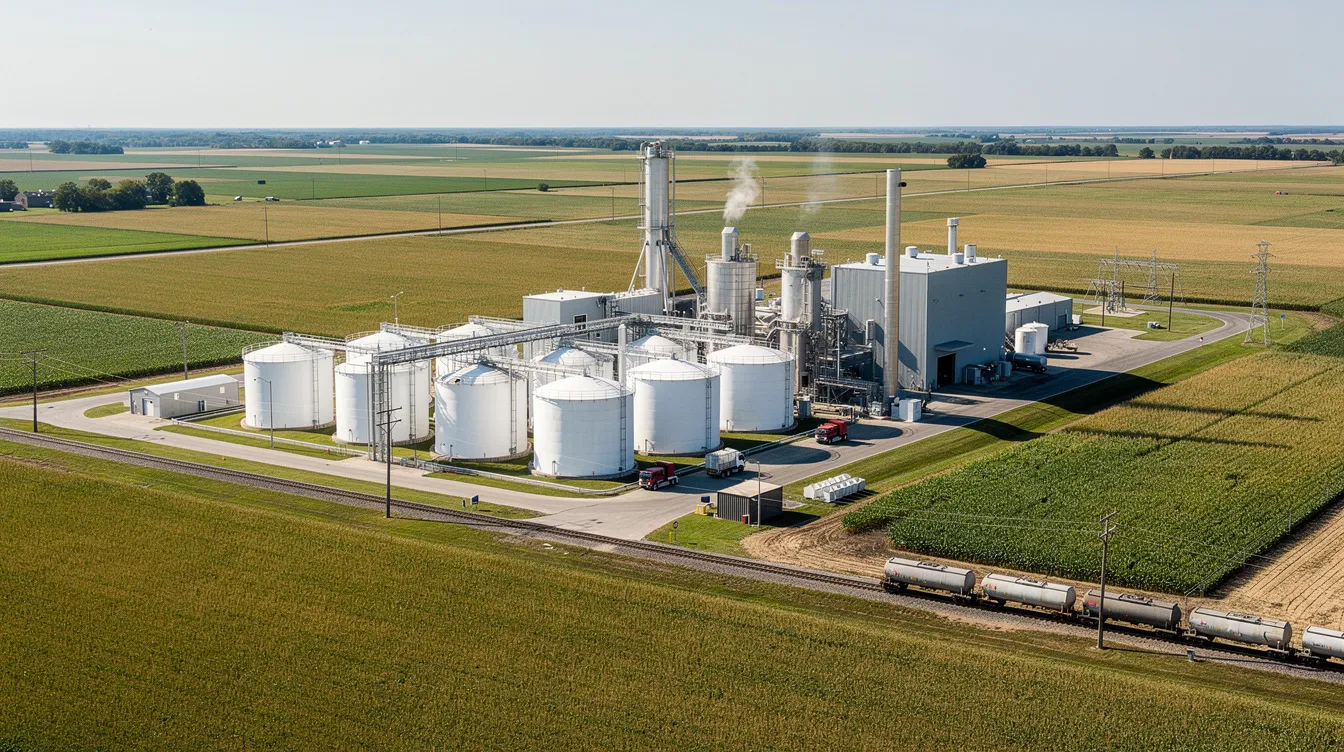
A grain based ethanol plant converts starchy grains into fuel-grade ethanol through a series of biochemical and distillation processes. The focus here is on first-generation fuel ethanol from grains like maize and broken rice, not second-generation cellulosic biofuels.
An ethanol manufacturing plant can be designed as maize-based, broken rice-based, damaged foodgrain-based or multi-grain. This choice drives plant configuration, ethanol yield and by-product mix. Grain-based distilleries can process damaged foodgrains and maize, providing feedstock flexibility. Ethanol can also be produced from sugarcane juice and B heavy molasses, but the capital cost structure, by-products and feedstock supply dynamics differ substantially from grain based ethanol production. For a detailed comparison, see our guide on Grain-Based vs Molasses-Based Ethanol.
The grain handling and ethanol production chain follows a standard sequence: grain receiving, cleaning, milling, slurry preparation, liquefaction, saccharification, fermentation, distillation, dehydration and ethanol storage. Dual feed configurations that allow switching between molasses and grain feedstocks exist but increase process complexity and capital cost.
Industry Overview and Ethanol Demand Outlook in India
India’s dependence on crude oil imports – above 85% – and emission-reduction commitments are driving ethanol demand. Under the amended National Policy on Biofuels, the E20 target was advanced to 2025–26. Ethanol production capacity is supported by government procurement plans, with overall capacity rising to approximately 2,000 crore litres including both grain and molasses routes.
Key considerations for investors:
- Oil marketing companies (Indian Oil, BPCL, HPCL) procure ethanol through tender-based allocation. Blending in petrol is policy-driven but does not legally guarantee procurement for every individual plant.
- Ethanol plants create 200 to 300 jobs per 100 KLPD capacity, contributing to rural employment.
- Installed grain based ethanol capacity has increased rapidly across the country. States like Madhya Pradesh, Gujarat and major maize-producing regions are seeing new project proposals, creating competition among distilleries.
- Ethanol production reduces India’s crude oil import dependency, which currently stands around 85%.
The DPR should summarise realistic ethanol procurement assumptions for the project’s state and region, rather than simply citing national blending targets.
Grain Feedstock Options – Maize, Broken Rice and Multi-Feedstock
Feedstock selection is central to any grain based ethanol manufacturing project and must be analysed in depth within the project report.
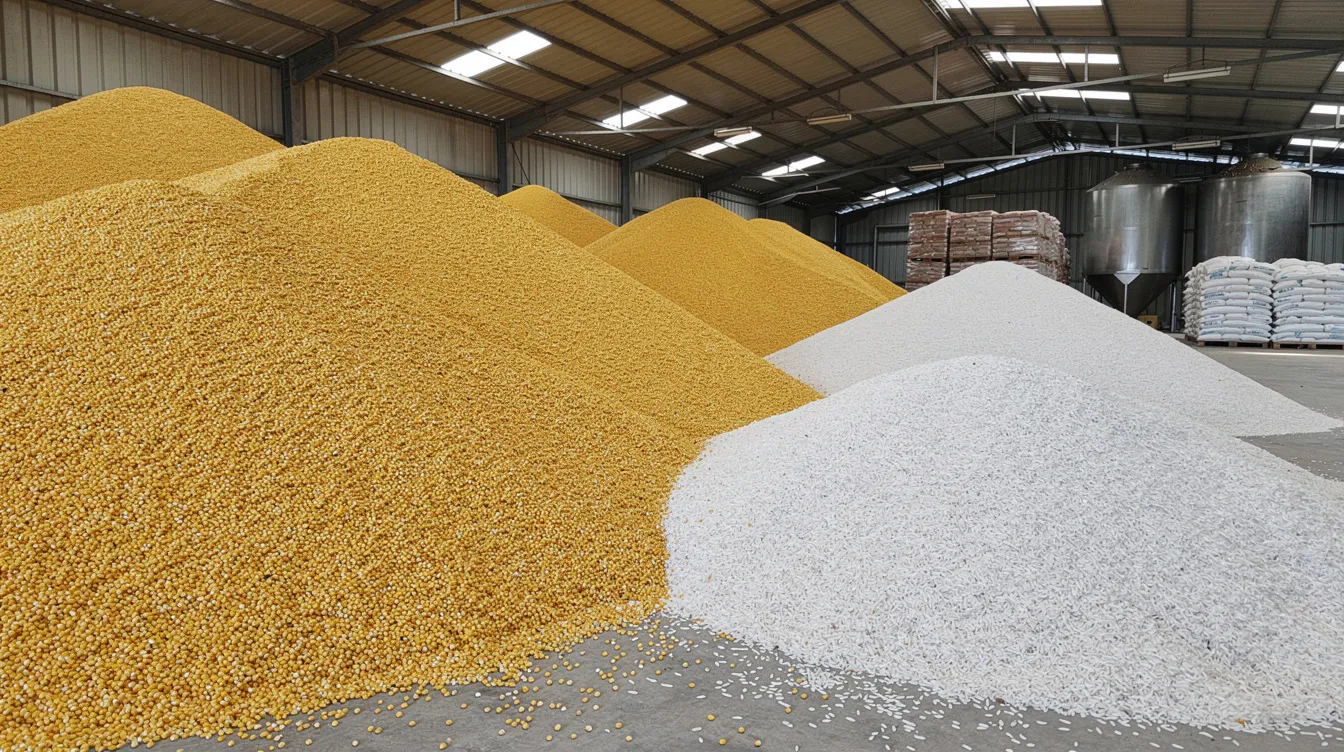
Maize offers approximately 380–400 litres of ethanol per tonne. Landed maize cost in favourable locations ranges from ₹26,000 to ₹30,000 per MT. DDGS from maize yields around 300 kg per tonne. Grain prices fluctuate seasonally, impacting project economics. For detailed maize economics, refer to our Maize-Based Ethanol Plant Project Report.
Broken rice is suitable for ethanol production due to its high starch content and lower human-consumption value. It yields approximately 410–450 litres per tonne, with DDGS commanding higher prices due to protein characteristics. Our Broken Rice Ethanol Plant Project Report covers this configuration in detail.
A multi-feedstock ethanol distillery can process maize, broken rice, sorghum and other grains. This provides feedstock flexibility but increases capital cost and process complexity. Understanding local grain availability – through a raw material availability study covering at least 50–100 km procurement radius – aids in project feasibility for ethanol production. A comparison of Maize vs Broken Rice for Ethanol economics helps promoters evaluate the right feedstock strategy.
Plant Capacity and Configuration – 30 to 200 KLPD Ethanol Plants
Capacity planning is a critical early decision in project planning. Common ethanol plant capacities in India include 30, 60, 100, 150 and 200 KLPD.
| Capacity (KLPD) | Annual Output (KL)* | Approx. Feedstock (MT/year)** | Indicative Project Cost |
|---|---|---|---|
| 30 | ~9,900 | ~25,000 | ₹50–60 crore |
| 60 | ~19,800 | ~50,000 | ₹130–180 crore |
| 100 | ~33,000 | ~82,500 | ₹230–310 crore |
| 150 | ~49,500 | ~124,000 | ₹300–400 crore |
| 200 | ~66,000 | ~165,000 | ₹360–480 crore |
Assuming 330 operating days, ~95% capacity utilisation at full ramp-up. *Based on ~400 L/MT maize yield.
Higher capacity improves economies of scale but demands assured grain supply, higher working capital and greater scrutiny from lenders. For bank loan discussions, DPRs frequently evaluate at least two capacity options and compare DSCR, IRR and payback period under different capacity utilisation scenarios. Whether you need a 30 KLPD ethanol plant project report or a 100 KLPD DPR, the structure remains similar – only the scale and assumptions change.
Raw Material Requirements, Yield and Cost Analysis
Raw material planning dominates ethanol production cost. For a 100 KLPD plant operating 330 days at 400 L/MT maize yield, daily grain consumption is approximately 250 MT, with annual consumption around 82,500 MT and approximate raw material cost of ₹214.5 crore per year.
The DPR should analyse:
- Seasonal availability and procurement radius
- Transportation costs and grain storage (silos vs godowns)
- Procurement strategies: long-term contracts vs spot purchase
- Mass balance calculations linking grain input to ethanol and DDGS output
Sensitivity analysis on feedstock price (±10–20% maize cost) should be directly linked to ethanol plant profitability and DSCR in the financial projections. Financial modeling is essential for evaluating the impact of input costs on profitability.
Grain Based Ethanol Manufacturing Process and Technology Overview
The standard process for grain based ethanol manufacturing follows these steps:
- Grain receiving and cleaning – removal of foreign matter, stones and dust
- Milling – hammer mills reduce grain to flour for slurry preparation
- Liquefaction – alpha-amylase converts starch to dextrin at elevated temperatures. Modern ethanol plants utilize continuous cooking for improved energy efficiency.
- Saccharification – glucoamylase breaks dextrin into fermentable sugars
- Fermentation – yeast converts sugars to alcohol and CO₂ (batch or continuous)
- Distillation – beer column and rectification produce rectified spirit
- Dehydration – molecular sieve technology produces fuel-grade ethanol
- Storage and dispatch – ethanol stored in approved tanks for supply to petroleum depots
The DPR should describe the selected process route, expected process efficiencies and specific utility consumption per litre of ethanol. For a step-by-step process description, see our guide on Grain-Based Ethanol Manufacturing Process.
Ethanol Plant Machinery, Equipment and Infrastructure
Machinery selection is a major component of ethanol plant project cost. In a 120 KLPD maize plant, machinery accounted for approximately ₹157.56 crore of the total project cost.
Major equipment groups include:
- Grain handling and storage (silos, conveyors, classifiers)
- Milling equipment (hammer mills)
- Liquefaction and saccharification vessels
- Fermentation tanks (batch or continuous)
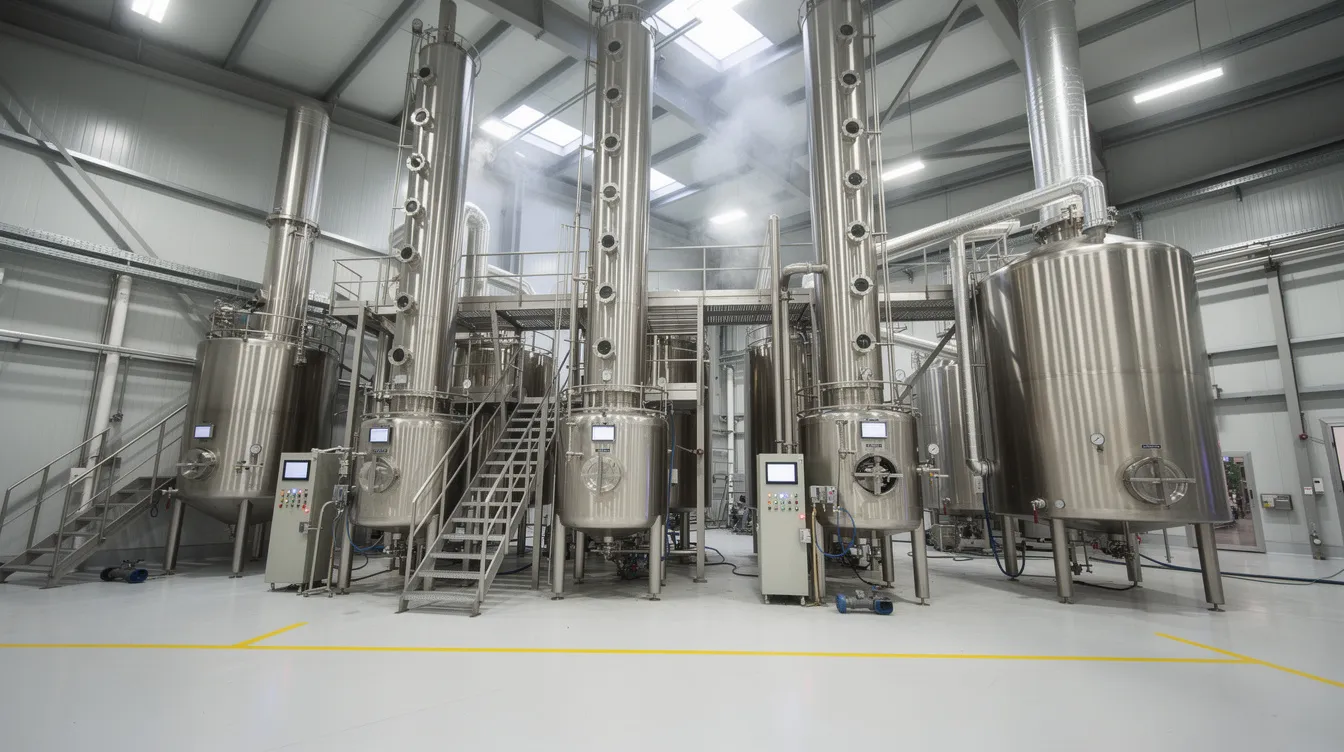
- Distillation columns and molecular sieve dehydration
- DDGS dryer and handling systems
- Boilers (AFBC type, 45 TPH for larger plants) and captive power systems
- Cooling towers, water treatment and laboratory equipment
- Effluent treatment plant and ZLD facilities
- CO₂ recovery system if planned
Infrastructure includes land development, civil structures, internal roads, fire-fighting systems and automation (DCS/PLC). The choice between imported and indigenous equipment affects both capital cost and long-term energy efficiency. Detailed specifications and costs are covered in our Ethanol Distillery Machinery and Equipment Cost guide.
Land, Building, Utilities and Environmental Management
A 60–100 KLPD grain based ethanol plant typically requires 15–25 acres, with provision for future expansion and regulatory buffer zones. Key built-up structures include process building, grain silos, boiler house, cooling tower area, ETP/ZLD area, administrative block, laboratory, weighbridge and boundary wall.
Ethanol plants require substantial steam and water for processing and operations. Utility requirements include:
- Water: 8–10 KL per KL of ethanol produced
- Boiler fuel: coal, rice husk, bagasse, briquettes or gas
- Electricity: captive generation or grid supply for motors, cooling, lighting and process systems
Environmental compliance is non-negotiable. Zero Liquid Discharge is mandatory for ethanol plants in India, as per CPCB directives. Ethanol production requires effective wastewater treatment systems, and pollution control systems are essential in ethanol manufacturing plants. Plants must comply with environmental regulations for emissions, and ethanol production generates solid waste requiring proper hazardous waste management. For comprehensive details, refer to our guide on Ethanol Plant Water Consumption and ZLD.
By-Products: DDGS, CO₂ and Protein Recovery
By-products are important for ethanol plant economics but should be treated as additional revenue, not the primary driver of viability. Using high-value co-products can significantly buffer against ethanol pricing fluctuations.
DDGS is the main by-product, used as protein-rich animal feed. Maize-based DDGS yields approximately 300 kg per tonne of grain, with market prices of ₹12,500–₹15,500 per MT. Rice-based DDGS can command ₹22,000–₹29,000 per MT due to higher protein content. Ethanol production from broken rice can yield over 80% protein purity in extracted co-products. By-product credits typically reduce net production cost by ₹8–₹15 per litre. For detailed analysis, see our guide on DDGS Production and Profitability.
Ethanol production often relies on capturing CO₂ for additional revenue. Optional CO₂ recovery plants can capture fermentation CO₂ for industrial or food-grade use, contributing approximately ₹0.20–₹0.40 per litre equivalent – but only if local offtake is reasonably assured.
Project Cost Estimation for Grain Based Ethanol Plants
Project costs should account for land, machinery, and operational expenses comprehensively. A grain-based ethanol plant typically costs INR 100 to 200 crore for mid-range capacities, while ethanol plant setup costs range from INR 50 to 600 crore depending on capacity, technology and environmental compliance.
Fixed capital is divided into:
- Land and site development
- Buildings and civil works
- Plant and machinery (process equipment)
- Boiler and power plant
- Storage tanks, electrical and instrumentation
- ETP/ZLD and pollution control
- Engineering, supervision and installation
Pre-operative expenses, interest during construction, contingency and working capital margin typically add 15–30% on top of fixed capital. The difference between fixed capital cost, total project cost and total funding requirement must be clearly presented in the DPR. For capacity-wise cost benchmarks, see our detailed guide on Grain-Based Ethanol Plant Setup Cost.
Means of Finance, Bank Loans and Working Capital
A grain based ethanol plant project report for bank loan must include a clear means-of-finance plan. Term loan financing typically follows a 70:30 debt-equity ratio, though the final structure depends on bank policy and promoter financial strength.
An illustrative means of finance for a 100 KLPD plant (₹270 crore total project cost):
| Component | Amount (₹ Crore) | Percentage |
|---|---|---|
| Promoter Equity | ~95 | ~35% |
| Term Loan | ~148 | ~55% |
| Working Capital Margin | ~27 | ~10% |
Term loan tenures usually run 7–10 years with a moratorium of 12–18 months during commissioning and ramp-up. State Bank of India and Punjab National Bank frequently lead consortiums for financing ethanol projects. Banks require CMA Data, projected balance sheets and working capital assessment alongside the DPR – this is where CA-led advisory like Project Report Bank provides expertise and support.
Financial Projections, Profitability, DSCR, ROI and IRR
A core part of any grain based ethanol plant feasibility study is a 5–7 year financial model showing profitability, cash flows and debt-servicing capacity. Financial projections should include internal rate of return (IRR) and net present value (NPV).
The DPR PDF must contain:
- Projected Profit and Loss, Balance Sheet and Cash Flow Statement
- Detailed schedules for capacity utilisation, production and raw material consumption
- Ethanol revenue plus by-product revenue, with major cost heads clearly separated
- EBITDA margin, break-even capacity utilisation, DSCR, IRR, ROI and payback period
Ethanol projects typically target an IRR of 15 to 20 percent. Standard payback periods for ethanol projects range from 3 to 5 years under favourable assumptions. Banks expect DSCR of 1.25–1.5x in initial years.
Scenario analysis should cover base case, optimistic case (higher utilisation, better DDGS prices) and stressed case (higher grain cost, lower capacity utilisation). These are estimates, not guaranteed outcomes. For detailed financial methodology, refer to Ethanol Plant Financial Projections and DSCR.
Government Support, Subsidies and Ethanol Policy Environment
Government support for alcohol production and ethanol manufacturing includes interest subvention schemes that reduce effective borrowing costs for ethanol projects. The National Policy on Biofuels, Ethanol Blended Petrol Programme and Ministry of Petroleum and Natural Gas notifications provide the policy framework.
However, not all subsidies will be sanctioned for every project. Eligibility depends on capacity, feedstock, commissioning timelines and state-level policies. The project report should clarify which schemes are currently active, and benefits should be conservatively factored into financial projections. A professional advisor can help verify latest scheme notifications and integration into the project finance structure.
Licences, Environmental Clearance and Statutory Approvals
Grain based ethanol plants in India require multiple approvals at central, state and local levels. Project implementation schedules should include milestones for financial closure and regulatory clearances.
Major approvals include:
- Environmental Clearance, which takes 12 to 18 months under EIA Notification 2006
- State Pollution Control Board Consent to Establish, required before construction begins
- Distillery licence, which varies by state and requires detailed understanding of local regulations
- PESO approval, mandatory for ethanol storage and handling
- Factory licence, boiler and pressure vessel certifications, fire NOC
- Water extraction and wastewater discharge permissions
Regulatory compliance for ethanol projects often involves environmental assessments, and DPR preparation can take 12 to 18 months when accounting for all approvals. Different states may have specific ethanol-related policies or single-window clearances. Approval timelines directly affect interest during construction. For a comprehensive overview, see Ethanol Plant Licences and Environmental Approvals.
Risk Analysis and Sensitivity for Grain Based Ethanol Projects
Comprehensive risk assessments are integral for project planning in ethanol production. A serious feasibility study cannot ignore risks.
Major risk categories include:
- Raw material risk: Maize and broken rice price volatility, seasonal supply constraints
- Market and offtake risk: OMC procurement changes, new capacities creating oversupply
- Regulatory risk: Policy revisions, tightening environmental norms
- Technical risk: Lower-than-expected ethanol yield, higher utility consumption
- Financial risk: Interest rate changes, DSCR shortfall, working capital stress
The DPR should include sensitivity analysis showing how ±10–20% variations in grain price, ethanol price and capacity utilisation affect EBITDA, DSCR, IRR and payback. Lenders value projects where promoters have realistically evaluated risks – through multi-feedstock capability, conservative gearing and diversified by-product markets. For a deeper exploration, see Ethanol Plant Investment Risks in India.
Structure and Contents of a Bankable Grain Based Ethanol Plant DPR (PDF)
A well-structured DPR enhances project viability and reduces risks. A DPR typically includes technical, financial, and regulatory assessments. A comprehensive DPR also includes market analysis and demand-supply dynamics.
The bankable grain based ethanol plant project report PDF should contain:
- Executive Summary and Promoter Background
- Project Concept, Capacity and Location
- Industry and Ethanol Demand Analysis
- Feedstock Availability Study
- Technical Process and Plant Configuration
- Machinery, Equipment and Utilities
- Land, Civil Works and Infrastructure
- Project Cost Estimates
- Means of Finance
- Working Capital Assessment
- Financial Projections (5–7 years)
- Profitability, IRR, DSCR and Payback
- Risk and Sensitivity Analysis
- Government Schemes and Subsidies
- Statutory Approvals Roadmap
- Implementation Schedule with Gantt Chart
- Supporting Annexures (vendor quotations, CMA Data, land documents)
Each chapter must be supported by transparent assumptions and current market data, not generic or outdated numbers.
How Project Report Bank Supports Ethanol Plant Promoters
Project Report Bank is a CA-led project finance and DPR advisory – not a machinery vendor or EPC contractor. Led by CA Manish Gugliya with over 20 years of expertise in preparing project reports, financial projections and bank finance documentation, the firm supports ethanol plant promoters with:
- Customised grain based ethanol plant DPR preparation
- CMA Data preparation for bank loans
- Financial projections and modelling
- DSCR, working capital and loan-structuring analysis
- Feasibility studies and investment viability assessment
Bank Finance DPR and Loan Proposal Assistance starts from ₹25,000, with final scope and fees depending on plant capacity and project requirements. Project Report Bank does not guarantee bank sanctions, subsidies or investment returns.
To discuss your ethanol project, share brief details – proposed capacity, feedstock, location and timeline – via WhatsApp or call for a customised scope and quote.
Frequently Asked Questions – Grain Based Ethanol Plant Project Report PDF
What minimum details are required to start a customised grain based ethanol plant DPR?
You should provide your promoter profile, proposed capacity (e.g., 60 or 100 KLPD), preferred feedstock (maize, broken rice or multi-feed), tentative project location, expected project start date and whether a bank term loan is targeted. This enables the advisory team to scope the DPR accurately from the outset.
Can one standard DPR PDF be used for multiple banks and investors?
The core DPR can serve as the base document, but different lenders may require specific annexures, CMA Data formats or additional clarifications. An investor-facing document may need a different emphasis than a bank loan proposal. A professionally prepared base DPR is typically adapted for each institution.
How long does it typically take to prepare a professional grain based ethanol plant DPR?
For a standard capacity plant where promoters share data and vendor quotations promptly, a professional DPR typically takes 2–4 weeks. Complex multi-feedstock or integrated projects with co-generation and protein recovery may take longer, depending on technical inputs and the depth of financial modelling required.
Do banks in India insist on CMA Data along with the ethanol plant project report?
Most banks require CMA Data for working capital assessment. A grain based ethanol DPR for term loan should be complemented by CMA statements when applying for both term loan and cash-credit limits. Producing these as an integrated set improves consistency and credibility during bank appraisal.
Is it necessary to include stress-test or downside scenarios in the ethanol DPR financials?
While not always formally mandatory, including sensitivity and downside scenarios – such as higher grain cost or lower capacity utilisation – is strongly recommended. Credit committees appreciate insights into how the project performs under adverse conditions. It demonstrates realistic risk understanding and strengthens the overall quality of the DPR.