Key Takeaways
- A modern grain-based ethanol plant typically targets 2.5–4.0 KL of freshwater per KL of ethanol produced, with best-in-class designs achieving closer to 2.5–3.0 KL/KL through internal recycling and condensate recovery.
- For 30–200 KLPD capacities, total freshwater requirement ranges roughly from 100–120 KLD to 600–800 KLD depending on process configuration, cooling-water system and zero liquid discharge design.
- Effluent treatment plant, condensate polishing unit, multiple effect evaporator, reverse osmosis and other ZLD elements can together account for 10–20% of total project cost and materially influence operating costs and DSCR.
- CPCB and State Pollution Control Boards increasingly insist on zero liquid discharge ethanol plant configurations, especially for new grain-based distilleries in water-stressed regions across India.
- Detailed water balance, realistic ethanol plant ETP cost and ZLD operating-cost assumptions are essential inputs in a bankable Detailed Project Report and project finance appraisal – underestimating these can compromise the entire investment case.
Introduction – Water Management in Grain-Based Ethanol Project Planning
Ethanol plant water consumption has become one of the most scrutinised aspects of distillery project planning in India. As the country continues to expand its ethanol production capacity – currently estimated at 1,822 crore litres – the demand for freshwater at new grain-based distilleries is drawing attention from regulators, bankers and communities alike. India’s ethanol blending programme requires large quantities of fuel-grade ethanol to be blended with petrol, and the rapid addition of new plants across water-stressed regions makes water management a project-defining issue, not a secondary compliance formality.
It is important to distinguish between two very different categories of water use. The total water footprint of ethanol production includes both agricultural water (for growing grain feedstock) and industrial process water used at the plant. Producing one litre of ethanol from rice requires approximately 10,790 litres of water when the entire lifecycle – including irrigation for growing crops – is considered. Growing 1 kg of rice alone needs about 3,000–5,000 litres of water. Similarly, sugarcane requires around 3,636 litres of water per litre of ethanol, and maize needs about 4,670 litres per litre of ethanol on a full lifecycle basis. These figures reflect the water consumed by farmers in growing feedstock, not what the manufacturing facility itself uses. This article focuses exclusively on the industrial water requirement – the water consumed within the ethanol plant boundary for processing, utilities and effluent treatment.
Typical project sizes in India today range from 30 to 200 KLPD. Investors, bankers and regulators increasingly ask two pointed questions: “How many litres of freshwater does one litre of ethanol actually need at the plant?” and “How will zero liquid discharge be achieved?” The Grain Ethanol Manufacturers Association (GEMA) has publicly clarified that modern grain-based plants use approximately 3–5 litres of industrial water per litre of ethanol, not the 10,000-litre figure that has circulated in public debate. Modern ethanol distilleries are designed for very low or zero liquid discharge, combining ETP, biological treatment, reverse osmosis, MEE and condensate recovery to recycle most water internally.
This discussion is presented from a project-finance and DPR perspective – focusing on the grain based ethanol plant water requirement, treatment systems, capital cost, operating costs and the impact on overall project feasibility. The grain-based ethanol manufacturing process involves multiple stages – from grain cleaning and slurry preparation to fermentation, distillation and dehydration – each consuming water in different forms and quantities.
Understanding Water Consumption in Grain-Based Ethanol Plants
Before examining specific numbers, it is essential to understand the difference between gross water circulation and net freshwater intake. A plant’s cooling towers may circulate tens of thousands of KLD internally, but the freshwater make-up – water drawn from an external source to replace evaporation, drift and blowdown losses – is only a fraction of that volume. Ethanol production requires significant water for various processes, and the total consumption figure that matters for project planning is net freshwater intake after accounting for all internal recycling.
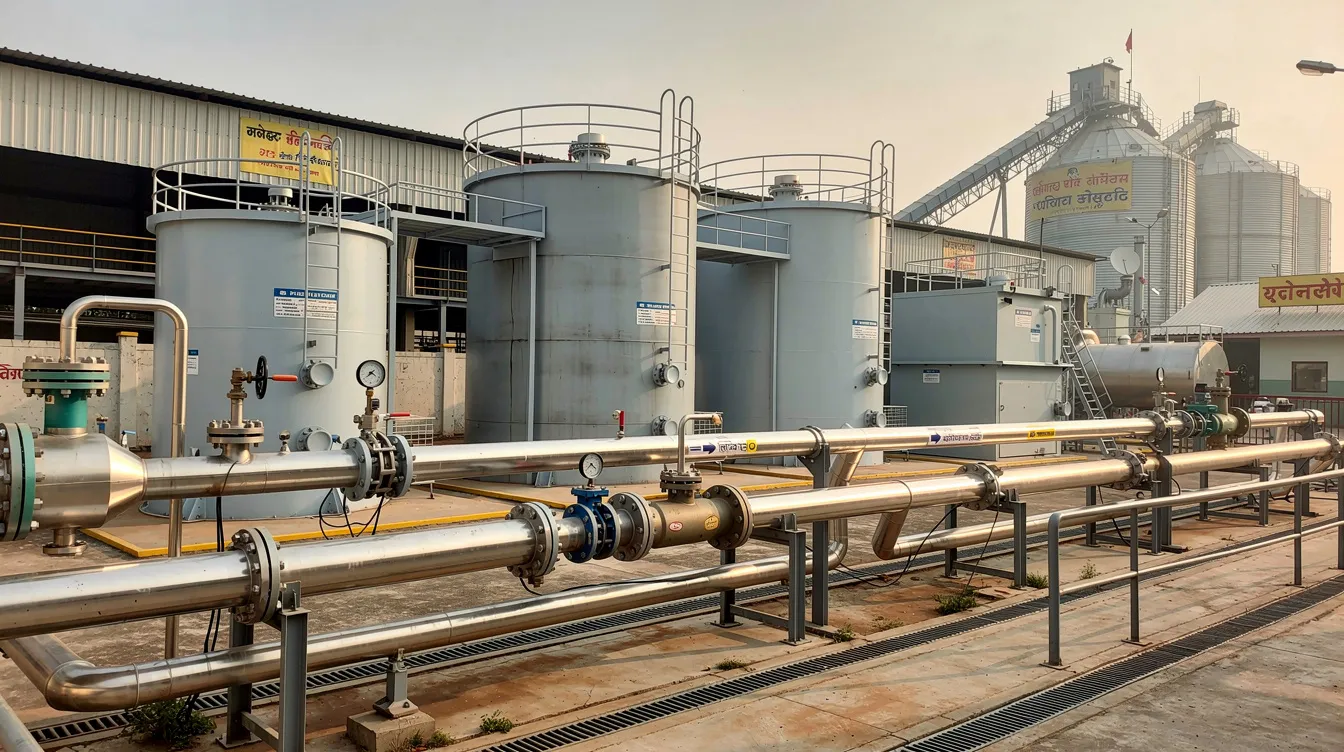
Water is essential in mashing and fermentation processes, where grain is converted to a slurry using process water and microorganisms break down sugars into ethanol. The major water-use areas in a grain-based ethanol plant include:
- Grain cleaning and slurry preparation (using wheat, rice, broken rice or maize as raw material)
- Liquefaction and saccharification
- Fermentation
- Distillation and dehydration
- DDGS handling, including wet cake washing and drying
- Cooling-tower make-up – cooling towers are a major consumer of water in ethanol plants, often accounting for over 40–50% of total use
- Boiler feed water and steam generation
- Cleaning-in-place (CIP) and floor/equipment washing
- ETP, CPU and utility systems
- Domestic and service water
A proper ethanol distillery water balance differentiates between process water, utility water (cooling and boiler), service water (domestic, gardening, fire-fighting reserve) and ETP/ZLD water. Together, these determine total ethanol plant water consumption.
Modern dry-grind ethanol plants consume about 3 to 4 litres of water per litre of ethanol produced at the industrial level. Freshwater requirement in older ethanol plants could be 4 to 6 gallons per gallon of ethanol produced – significantly higher than current norms. Water consumption varies significantly depending on the technology and efficiency of the ethanol plant, and promoters should obtain vendor-backed guarantees rather than relying solely on generic benchmarks.
The boiler, steam, power and utilities requirements of the plant directly influence water demand. Similarly, grain quality and feedstock characteristics – discussed in detail under ethanol plant raw material requirements and yield – affect process efficiency and, consequently, water use per litre of ethanol produced.
Grain-Based Ethanol Plant Water Requirement for 30–200 KLPD Capacities
The exact grain based ethanol plant water requirement depends on the technology supplier, cooling-system choice (closed-circuit versus conventional cooling tower), condensate recovery efficiency, and whether the plant operates as true zero liquid discharge. The following table presents indicative freshwater requirement ranges for different plant capacities, derived from published environmental clearance documents and project reports.
| Plant Capacity (KLPD) | Indicative Freshwater Requirement (KLD) | Specific Freshwater Consumption (KL/KL Ethanol) | Key Assumptions |
|---|---|---|---|
| 30 | 100–130 | 3.3–4.0 | ZLD with condensate recovery; closed-loop cooling; 330 days/year; ~90% avg capacity utilisation |
| 60 | 200–260 | 3.2–4.0 | Similar configuration; moderate condensate recovery |
| 100 | 300–400 | 3.0–4.0 | Based on Assam DPR (700–900 KLD gross, 300–400 net after high recycling); ZLD mandatory |
| 150 | 450–620 | 3.0–4.0 | Consistent with Maharashtra project data (~596 KLD); EC-compliant ZLD |
| 200 | 600–800 | 3.0–4.0 | Economies of scale in cooling and treatment; vendor-specific guarantees expected |
These are indicative ranges, not universal norms. The methodology is straightforward: multiply the specific freshwater consumption (KL/KL) by the daily ethanol production capacity at assumed utilisation. For instance, a 100 KLPD plant operating at 90% utilisation produces 90 KL/day of ethanol; at 3.5 KL/KL, it requires approximately 315 KLD of freshwater. Environmental clearance documents for 120 and 300 KLPD plants in India have capped freshwater at 4 KL per KL of ethanol production.
Bankers and appraisers increasingly treat “litres of freshwater per litre of ethanol” as a sustainability and risk metric. A plant unable to demonstrate that its water consumption stays within 3.5–4.0 KL/KL may face questions during loan appraisal. Reading this alongside ethanol plant capacity planning for 30 to 200 KLPD helps promoters integrate capacity selection with water-availability and environmental-infrastructure planning.
Ethanol Distillery Water Balance and Recycling Strategy
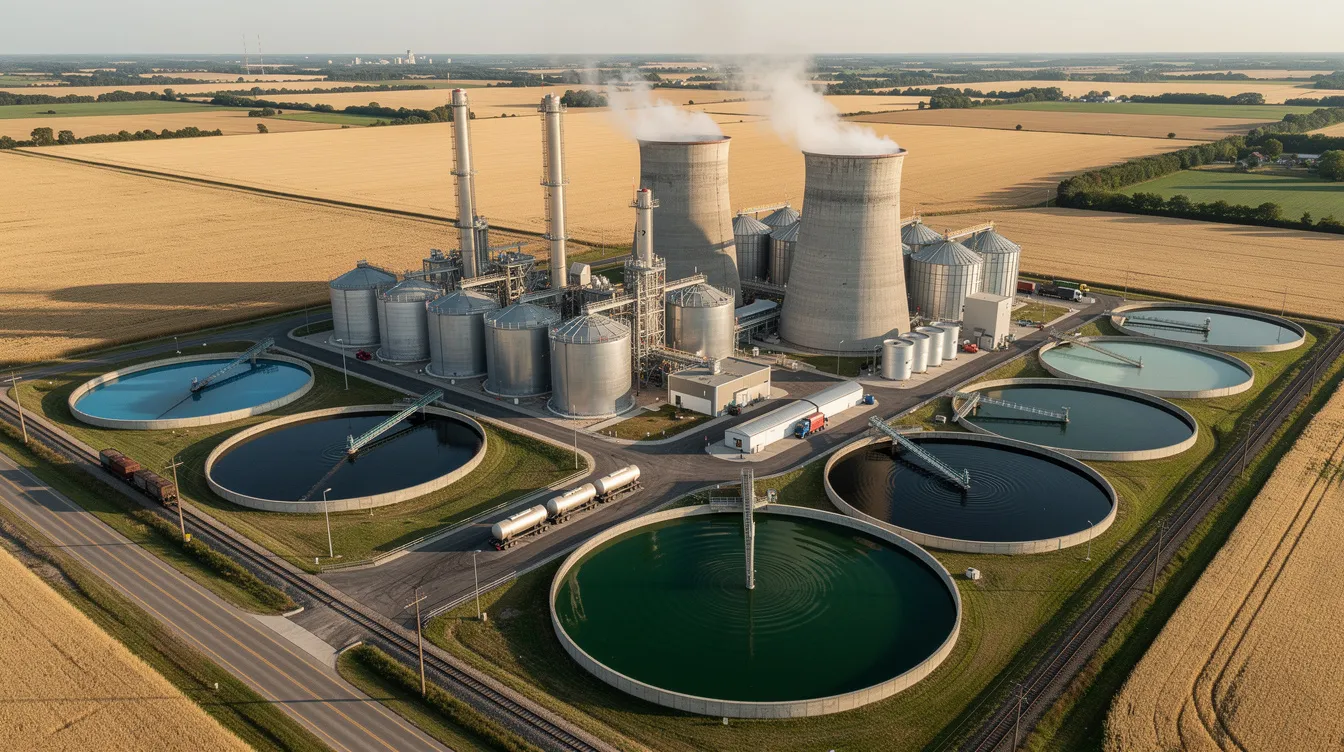
A water balance is a quantitative reconciliation of all water inflows, outflows, evaporation losses, storage and recycling streams within the ethanol plant and associated utilities. Without a properly reconciled water balance, a DPR’s water-related assumptions remain unverifiable.
Consider an illustrative 100 KLPD grain-based plant. Based on project data from an Assam DPR, gross water demand before recycling may be 1,150–1,310 KLD, comprising process water for mashing and liquefaction (~600–650 KLD), cooling-tower make-up (~280–320 KLD), boiler feed water (~180–220 KLD), CIP and washing (~60–80 KLD), and domestic/service water (~30–40 KLD). However, with condensate recovery of approximately 400–500 KLD from distillation and MEE systems, and with treated effluent reuse, the net freshwater intake drops to approximately 700–900 KLD – and with aggressive recycling, can approach 300–400 KLD net.
A water-balance flowchart for such a plant would show raw-water intake flowing into process, cooling and boiler circuits; wastewater streams routed to ETP and CPU; MEE condensate returned to CPU for polishing; CPU permeate recycled to cooling towers, boiler feed or utility use; and concentrated MEE syrup directed to DDGS drying. High-TDS and high-COD streams would be clearly marked as requiring concentration or biological treatment before reuse.
Water recycling in ethanol plants allows for the reuse of high-strength process water after treatment. Segregating clean, moderately polluted and highly polluted streams at source reduces the overall ethanol plant water treatment load and improves reverse osmosis membrane performance, lowering both capex and operating costs. Improving condensate recycling from 70% to 90% can reduce freshwater intake by 15–25%, making it a financially significant lever.
Wastewater Generation in Grain-Based Ethanol Production
Grain-based ethanol distillery wastewater characteristics differ significantly from molasses-based spent wash, especially in terms of colour, dissolved solids and organic-loading profile. A detailed comparison is available in the discussion on grain-based vs molasses-based ethanol cost and viability.
Ethanol mills generate large volumes of wastewater called vinasse. For molasses-based production, for every litre of alcohol, 12–15 litres of spent wash are produced. Spent wash has high biological oxygen demand and is highly acidic, making it one of the most challenging industrial effluents. Grain-based plants, however, produce a different profile of effluent – primarily thin stillage, process condensate and spent lees – with lower colour and different organic load characteristics.
The main wastewater streams in a grain-based ethanol plant include:
- Thin stillage (centrate after decanter separation) – high in organic load and suspended solids; typically concentrated via MEE
- Wet cake washings from DDGS handling
- Spent lees from distillation columns
- Process condensate from MEE and evaporation systems – relatively cleaner
- Cooling-tower blowdown and boiler blowdown
- Floor and equipment wash water
- Domestic sewage from plant staff facilities
In the Mathura 100 KLPD project, total raw stillage from distillation was approximately 558 KLD, with thin slops from the decanter at around 470 KLD – these are large quantities requiring dedicated treatment infrastructure. Unlike older molasses distilleries, modern grain-based ethanol plants with DDGS integration and ZLD convert much of the organic load into a valuable by-product, significantly reducing the volume of liquid effluent requiring external disposal.
Effluent Treatment Plant (ETP) Requirements in Ethanol Distilleries
The ethanol distillery ETP serves to treat process effluents to standards suitable either for recycling within the plant or for further concentration in ZLD systems, ensuring compliance with CPCB and State Pollution Control Board norms. Promoters should understand that an ETP alone does not ensure a zero liquid discharge ethanol plant – for grain-based distilleries, ETP is integrated with CPU, RO, MEE and sometimes crystallisers or ATFDs to eliminate liquid discharge.
Effluent characterisation is the starting point. Expected parameters – COD, BOD, TSS, TDS, pH and temperature – must be established for each wastewater stream through vendor-supplied design data or pilot testing, not assumed from generic values.
A typical ethanol distillery ETP includes the following stages:
- Collection and equalisation tanks for flow and load balancing
- pH correction and neutralisation
- Oil and grease removal (where relevant)
- Primary clarification
- Biological treatment (aerobic or anaerobic depending on configuration) – central to reducing organic load and a key determinant of operating cost
- Secondary clarification
- Filtration and tertiary treatment (sand/carbon filters, disinfection)
- Membrane steps (UF/RO) before recycle, where required
Design factors such as hydraulic retention time, nutrient balance, sludge handling and aeration energy must be considered. Instrumentation for online monitoring of pH, flow, COD and other key parameters, along with skilled operators, is expected – and these costs must be included in both capex and opex in the DPR.
Condensate Polishing Unit (CPU) and Water Recycling Opportunities
A CPU is a dedicated treatment block for process condensate generated from evaporation systems, MEE and sometimes distillation. Its purpose is to remove residual COD, ammonia, traces of organics and odour so that the recovered water can be reused. An efficient CPU plays a critical role in making a zero liquid discharge ethanol plant financially viable, because every additional percentage of condensate recycled reduces raw-water procurement cost and ETP/ZLD operating loads.
Common CPU treatment steps include equalisation, stripping or degassing for ammonia and volatile compounds, aerobic treatment or biological polishing, filtration, activated carbon adsorption, and in some cases reverse osmosis to meet boiler-feed or high-purity reuse requirements.
Recovered condensate is usually reused for cooling-tower make-up, floor washing and general utilities, and sometimes as boiler feed water after further demineralisation. Water quality management is critical for preventing scaling and corrosion in ethanol production processes – conductivity, hardness, silica, COD and microbiological quality must be monitored against OEM recommendations for boilers and cooling systems.
Zero Liquid Discharge (ZLD) Systems for Ethanol Plants
An ethanol plant ZLD system is a configuration of treatment technologies that ensures no continuous liquid discharge leaves the plant boundary. Water is recovered for reuse, and remaining dissolved solids are converted to dry or semi-dry solid waste. Many ethanol facilities implement water recycling and zero liquid discharge systems to minimise freshwater intake and meet increasingly stringent regulatory conditions.
The typical ZLD process blocks in a grain-based ethanol distillery include:
- Segregation of wastewater streams at source
- Primary and biological treatment in ETP
- Membrane treatment (UF/RO) for suitable streams
- Multiple Effect Evaporator (MEE) for concentrating high-TDS effluents
- Drying systems (DDGS dryer, ATFD) for solidification of concentrates
- Condensate polishing unit for recovered condensate reuse
ZLD does not mean “no wastewater generated” – wastewater is still produced but is treated, evaporated and reused within the ethanol plant water management system. In a simplified flowchart: raw stillage flows from distillation to a decanter; thin slop goes to MEE; MEE condensate routes to CPU; CPU permeate returns to cooling tower and boiler circuits; MEE syrup feeds into the DDGS dryer or solidification system; and ETP-treated water is reused for general utilities.
While zero liquid discharge significantly reduces regulatory risk, it increases both capital investment and energy consumption – a trade-off that requires careful financial modelling and sensitivity analysis in the DPR. This is a point where some promoters draw parallels with chemical industries that have long operated under ZLD mandates, though the specific technology configuration for ethanol distilleries differs.
ETP, CPU, MEE and ZLD Equipment – Configuration and Investment Implications
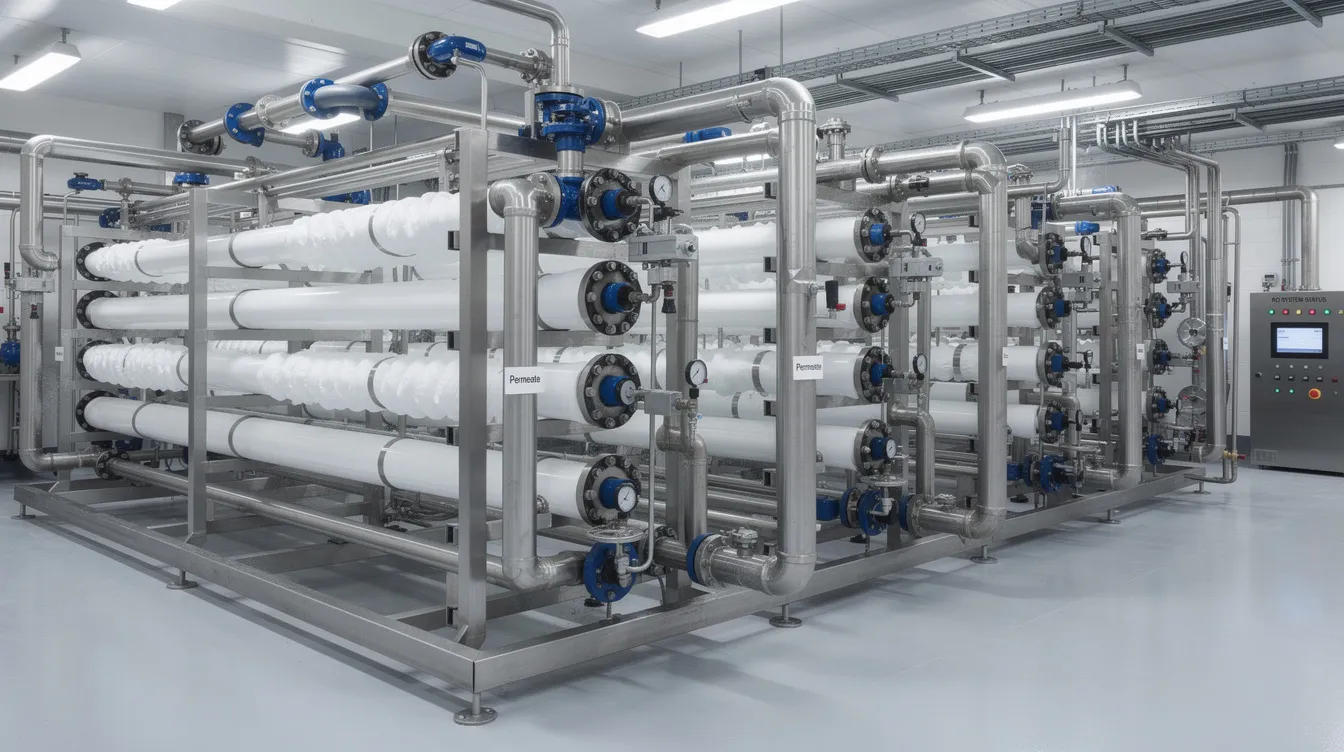
Actual machinery selection and sizing must be carried out by qualified process and environmental engineers. However, promoters should understand the main equipment blocks, approximate scale and how they influence ethanol plant ETP cost. The following table summarises major equipment for ethanol distillery wastewater treatment.
| Equipment | Primary Function | Key Sizing Driver | Main Utility Requirements | Typical Inclusion |
|---|---|---|---|---|
| Equalisation Tank | Flow and load balancing | KLD throughput | Minimal power | ETP |
| Aeration Tank / Bioreactor | Aerobic biological treatment | COD load, retention time | Blower power, nutrients | ETP |
| Anaerobic Digester | High-strength organic removal | COD load | Minimal (generates biogas) | ETP (optional) |
| Clarifier | Solids separation | KLD throughput | Minimal | ETP |
| UF Skid | Pre-treatment for RO | KLD, TSS | Power | ZLD |
| RO Skid | TDS reduction, water recovery | TDS, KLD | Power, antiscalants | ZLD |
| MEE | Concentration of high-TDS streams | KLD, TDS | Steam (major) | ZLD |
| CPU | Condensate polishing for reuse | KLD, COD | Power, chemicals | CPU |
| ATFD / Dryer | Solidification of concentrates | TPD solids | Steam, power | ZLD |
| Sludge Dewatering | Sludge volume reduction | TPD sludge | Power | ETP |
| Pumps, Blowers, Instrumentation | Fluid handling, monitoring, automation | Plant-wide | Power | All blocks |
Steam consumption for MEE and power requirements for large blowers should be cross-checked with the main process and boiler sizing – as discussed under ethanol distillery boiler, steam, power and utilities requirements – to avoid underestimating auxiliary loads.
When promoters receive turnkey quotations for grain-based ethanol plants and DDGS systems, some water-treatment equipment such as CPU and basic effluent handling may already be included in the process package. It is important to verify inclusions carefully and avoid double counting or omitting costs in the DPR. A broader perspective on total plant machinery investment relative to water-treatment infrastructure is available in the discussion on ethanol distillery machinery, equipment and cost.
Ethanol Plant ETP & ZLD Project Cost in India
Cost figures discussed here are indicative ranges based on recent Indian distillery project clearances, published documents and industry references. Actual ethanol plant ETP cost and ZLD cost must be obtained from vendor quotations at the time of project planning.
According to published data, the share of machinery and plant cost attributable to effluent and environmental blocks – ETP, ZLD systems, bio-methanation and related equipment – typically ranges from 8–15% of the total machinery cost. When civil works, piping, electrical, automation, erection, commissioning and contingencies are included, the overall share of water-treatment infrastructure in total project cost can reach 10–20%.
| Cost Component | Indicative Share of Total ETP/ZLD Investment |
|---|---|
| ETP (biological and primary treatment) | 20–30% |
| CPU and condensate treatment | 10–15% |
| MEE / evaporation and ZLD equipment | 25–35% |
| Piping, tanks and interconnections | 8–12% |
| Electrical, instrumentation and automation | 8–12% |
| Civil works and foundations | 8–12% |
| Engineering, erection, commissioning, contingencies | 10–15% of equipment cost |
For smaller plants like 30 KLPD, ZLD-related capex can appear disproportionately high compared to core process machinery, as minimum equipment sizes must be met regardless of throughput. For 100–200 KLPD projects, economies of scale make per-KLPD ZLD investment more reasonable. Location, raw-water quality (groundwater vs surface water), regulatory stringency and chosen technology suppliers can shift costs significantly. Promoters should obtain multiple techno-commercial bids before finalising DPR estimates.
The overall context of how ETP and ZLD capex fits into the total investment is well illustrated in the discussion on grain-based ethanol plant setup cost in India.
Operating Costs of ETP, CPU, MEE and ZLD Systems
ZLD operating cost – not just capital cost – has a recurring impact on EBITDA, cash flows and DSCR. Underestimating these costs is a common error in ethanol project financial projections.
The main operating-cost heads include:
- Electricity for blowers, pumps, agitators, membrane skids and instrumentation
- Steam for MEE and thermal drying units – often the largest single component
- Chemicals (pH control, coagulants, flocculants, antiscalants, biocides, membrane cleaning agents)
- Labour – skilled operators for ETP and ZLD are essential
- Laboratory testing and environmental monitoring
- Membrane replacement and MEE maintenance schedules
- Sludge handling, dewatering, transport and disposal
Combining electricity, steam and chemicals may add several paise per litre of ethanol to operating costs. For a plant producing 100 KL/day, even a small per-litre cost adds up to a material annual expense. Efficient water management in ethanol plants helps reduce operational costs and environmental impact, but higher water-recovery efficiency can paradoxically increase energy consumption in MEE and RO – the trade-off between low ethanol plant water consumption and higher operating costs must be modelled through sensitivity analysis under different energy-tariff scenarios.
CPCB Guidelines, Environmental Clearance and Pollution-Control Compliance
The regulatory framework for ethanol distillery wastewater treatment involves three tiers: MoEFCC (New Delhi) for Environmental Clearance where applicable, Central Pollution Control Board (CPCB) guidelines, and State Pollution Control Boards for Consent to Establish and Consent to Operate.
CPCB has issued guidelines for distilleries – historically focused on molasses-based spent wash – and recent directions and EC conditions for grain-based ethanol distilleries commonly stipulate no untreated discharge, progressive movement towards zero liquid discharge, and specific norms for BOD, COD, TSS and TDS in treated water reused within premises. Under the Namami Gange programme, CPCB has set targets for distilleries in the Ganga basin to reduce freshwater use to 5 KL/KL or below, with inspections confirming that many plants currently operate in the 5–7 KL/KL range.
Environmental clearance documents for 120 KLPD and 300 KLPD plants explicitly include conditions that freshwater consumption shall not exceed 4 KL/KL of ethanol production and that no liquid discharge shall leave the plant premises.
Promoters must follow several steps: obtain site-specific hydrogeological and water-availability assessments, include detailed water balance and effluent-treatment plans in EC applications, secure permissions for freshwater withdrawal from the relevant authority (irrigation department, groundwater authority), and install online monitoring and flow meters as per SPCB directions. Requirements differ between grain-based and molasses-based distilleries, between inland and coastal sites, and across different regions of the country. Promoters should check latest CPCB/SPCB notifications and EC conditions as of their project’s approval date, and budget time and professional fees for environmental-impact assessment, public hearing (where applicable) and compliance reporting.
Water-Treatment Cost and Overall Ethanol Project Financial Feasibility
From a project-finance perspective, water treatment and ZLD decisions affect not only environmental compliance but also capex structure, operating margins, DSCR and the bankability of the ethanol project. Setting up an ethanol plant is a highly profitable opportunity, but profitability depends on feedstock prices, ethanol yield and the realistic estimation of all operating costs – including water treatment. For global context, ethanol prices in North America were 0.72 USD/kg in October 2025, underscoring that margins are sensitive to cost structures.
ETP and ZLD capex feeds directly into total project cost, means of finance, term-loan requirement, debt-equity ratio and promoter contribution planning. Interest during construction is also affected since ZLD equipment is often on the critical path for commissioning.
On the operating side, ETP/ZLD costs affect EBITDA margins through higher utility and chemical expenses, increase working-capital requirements (for chemicals inventory, spare membranes and utility bill credit periods), and reduce cash flows available for debt servicing. A professional financial analysis must incorporate depreciation on ETP and ZLD assets, repair and maintenance reserves, contingency and escalation for energy tariffs and chemical prices, and sensitivity analysis where freshwater cost, ZLD operating cost or plant downtime due to environmental non-compliance are stress-tested.
Promoters preparing bankable DPRs should ensure their financial model accurately captures ethanol plant water consumption, ETP and ZLD investment, and utility costs. If you are planning a grain-based ethanol project and need a customised DPR, CMA Data or financial model that accounts for these infrastructure costs realistically, consider engaging Project Report Bank for professional advisory. WhatsApp-based initial enquiries are convenient for sharing project details and documents.
Practical Water-Conservation and Cost-Optimisation Strategies
Beyond mandatory ZLD infrastructure, practical water conservation measures can reduce both ethanol plant water consumption per litre and operating costs, supporting long-term sustainability. These measures should be integrated into the water balance and financial model so that projected savings are measurable and bankable.
Technically grounded conservation measures include:
- Maximising condensate recovery from MEE, evaporators and distillation to solve for the highest possible recycling rate
- Optimising cooling-tower cycles of concentration to reduce blowdown and make-up water
- Using closed-circuit cooling or hybrid cooling where feasible and justified by the financial analysis
- Installing variable-frequency drives on major pumps and blowers to match real-time load
- Segregating relatively clean streams for direct or minimal-treatment reuse
- Implementing leak-detection and water-metering at key nodes across the facility
- Scheduling CIP and wash-water use efficiently to avoid unnecessary consumption
Good housekeeping, operator training and preventive maintenance of water-treatment equipment prevent performance deterioration that leads to higher liquid discharge or higher energy use. Each measure should be backed by measured data (m³/day saved, kWh consumption change) so that the DPR reflects achievable savings rather than aspirational targets.
Common Mistakes Made by Ethanol Plant Promoters Regarding Water and ZLD
Even experienced industrialists sometimes underestimate water and effluent aspects when focusing on core ethanol production capacity and feedstock tie-ups. The following mistakes are observed frequently:
- Assuming a generic single number for ethanol plant water consumption without checking technology-specific guarantees from vendors
- Ignoring source-water availability and seasonal variation before locking in plant capacity – particularly relevant in regions dependent on groundwater
- Treating ZLD as an optional add-on rather than integrating it from the concept stage and land layout planning
- Under-sizing ETP, CPU or MEE capacity, leading to bottlenecks and non-compliance during peak operations
- Underestimating power and steam requirements for ZLD, which later strain boiler and turbine sizing
- Budgeting insufficient opex for chemicals, membrane replacement and skilled manpower
- Overlooking the land and layout requirements for ETP and ZLD blocks – discussed further under ethanol plant land, building and layout requirements – which can later complicate expansions
- Not engaging financial and technical advisers jointly, leading to inconsistencies between DPR assumptions and actual engineering design
Early-stage multidisciplinary planning, structured vendor consultations and professional DPR preparation can help promoters avoid these issues and build a project that is both compliant and financially resilient.
Frequently Asked Questions on Ethanol Plant Water Consumption, ETP and ZLD
The following questions address common queries from ethanol project promoters, bankers and investors that are not fully elaborated in the main sections above.
How much water is required for a 100 KLPD grain-based ethanol plant?
A 100 KLPD grain-based ethanol plant with ZLD and good condensate recovery typically requires approximately 300–400 KLD of net freshwater, translating to a specific consumption of about 3.0–4.0 KL per KL of ethanol. This assumes 330 operating days per year, approximately 90% average capacity utilisation and effective condensate recycling. Gross water circulation before recycling may be 1,100–1,300 KLD, but most of this is recovered and reused internally.
What is the difference between an ethanol plant ETP and a condensate polishing unit?
An ETP treats mixed process effluents – including floor washings, cooling-tower blowdown and medium-strength wastewater – through biological treatment, clarification and filtration to reduce COD, BOD and suspended solids. A CPU specifically treats process condensate from MEE and evaporation systems, focusing on removing residual organics, ammonia and odour to make the water suitable for reuse in cooling towers or boiler feed. Both are integral parts of a zero liquid discharge ethanol plant, but they serve different wastewater streams.
Is ZLD mandatory for all ethanol plants in India?
ZLD is not uniformly mandated by a single national rule for every ethanol plant. However, environmental clearance conditions for new grain-based ethanol distilleries increasingly require zero liquid discharge, particularly in water-stressed regions and sensitive river basins. CPCB and State Pollution Control Board requirements vary by location, plant capacity and feedstock. Promoters must check the specific EC conditions, CTE and CTO requirements applicable to their project site and capacity – what applies in Maharashtra may differ from requirements in other states.
How much does ETP and ZLD operating cost affect ethanol plant profitability?
While the per-litre impact of ETP and ZLD operating costs may appear modest – typically a few paise per litre of ethanol – the aggregate annual impact on a 100 or 200 KLPD plant is substantial. Steam for MEE, electricity for RO and blowers, chemicals and membrane replacement can collectively reduce EBITDA margins and affect DSCR under stress scenarios. These costs must be modelled correctly in DPR and CMA Data submissions, not estimated as round-number percentages.
What should be included in an ethanol plant DPR regarding water treatment?
A bankable DPR for an ethanol project should include a detailed and reconciled water balance showing freshwater intake, internal recycling, evaporation losses and wastewater generation; a technology description for ETP, CPU, MEE and ZLD systems; itemised capex estimates based on vendor quotations; realistic operating-cost projections for steam, power, chemicals and manpower; regulatory assumptions including EC conditions and SPCB requirements; and sensitivity analysis covering scenarios where water costs increase or ZLD performance falls short of design expectations.
Conclusion – Integrating Water Management into Ethanol Project Strategy
Ethanol plant water consumption, distillery wastewater treatment and zero liquid discharge design are not merely statutory compliance requirements – they are core elements of technical and financial feasibility for any grain-based ethanol project in India. A DPR that treats water-treatment infrastructure as a secondary budget item, rather than a project-defining investment, is unlikely to withstand serious bank scrutiny or deliver stable operations over the long term.
Careful planning of freshwater requirements, ETP and ZLD capex, operating costs and regulatory compliance improves bankability, supports sustainable operations and protects promoters against environmental penalties and legal risks. The numbers should tell a logical financial story – one where water-treatment investment and its recurring costs are explicitly modelled, sensitivity-tested and clearly presented to lenders and investors.
If you are planning a grain-based ethanol plant and need professional support with DPR preparation, financial projections, CMA Data for bank loans or investment-feasibility analysis that properly accounts for water-treatment infrastructure and costs, contact Project Report Bank. WhatsApp is the most convenient way to share your project details and begin a discussion.
CA Manish Gugliya FCA, DISA (ICAI) Practising Chartered Accountant | 20+ Years of Professional Experience Project Finance, DPR & Industrial Feasibility Advisory www.projectreportbank.com.