A rice mill is not a machinery purchase. It is an integrated agro-processing project where paddy sourcing, storage, milling recovery, product mix, working capital and debt servicing must work together for the venture to sustain itself financially. This hub guide covers the complete landscape of planning, structuring and financing an integrated rice milling and rice processing plant project in India – written from the perspective of a practising Chartered Accountant who prepares bankable DPRs for such projects.
Key Takeaways
- An Integrated Rice Milling & Rice Processing Plant Project Report & DPR is a structured blueprint covering technical design, capital investment, capacity selection, paddy procurement, revenue model, profitability, working capital, DSCR and bank-finance assessment for a modern or automatic rice mill plant in India.
- This hub article is authored by CA Manish Gugliya (ProjectReportBank.com), focusing on bankable DPRs, financial projections, CMA Data and feasibility assessment for integrated rice mill projects across capacity ranges.
- Project economics – including total project cost, working capital, ROI, IRR and payback – vary significantly with capacity (e.g., 2–8 TPH), technology, automation level, location, paddy variety and product mix, so all figures in this guide are illustrative and must be customised for any specific project.
- A proper Rice Mill Detailed Project Report is essential for bank loans, term loan assessment and investor discussions; generic downloadable PDFs or template DPRs are insufficient for serious project finance.
- This page acts as the central hub connecting readers to 19 specialised guides covering setup cost, machinery, process flow, capacity planning, paddy storage, revenue model, financial projections, working capital, DSCR, bank finance, feasibility, ROI/IRR analysis and parboiled rice processing DPR.
1. Integrated Rice Milling & Rice Processing Projects – An Overview
An integrated rice milling and rice processing plant goes far beyond purchasing a single milling machine and placing it in a shed. It is an end-to-end agro-processing project covering paddy reception, cleaning, storage, drying, milling, grading, colour sorting, packaging, by-product handling and dispatch – often with parboiling capabilities. The total capital investment for a rice mill of meaningful commercial scale can reach ₹10.96 crore or more, depending on configuration.
India produced 137 million tonnes of paddy in 2024-25 and exported 17.7 million tonnes of rice in the same period. The global rice market was valued at USD 316.58 billion in 2025 and is expected to reach USD 384.74 billion by 2034. Rice processing operations are growing due to rising global consumption, and the shift from small hullers to modern rice mill plants – with integrated cleaning, sorting, packaging and sometimes parboiling – is accelerating across Indian states.
A well-prepared Integrated Rice Milling & Rice Processing Plant Project Report typically answers:
- How much land is required and what plant layout suits the proposed capacity
- What the plant capacity should be (TPH and annual MT) based on paddy availability and market demand
- What the total project cost is, including machinery, civil works, utilities and working capital
- What profit margins, break-even capacity and DSCR can be expected
- Whether the project is feasible for bank loan or project finance
As a practising Chartered Accountant, my focus at ProjectReportBank.com is on financial structuring, feasibility study and bankable DPR preparation – not on selling machinery or civil construction services. Each major aspect introduced here – from integrated rice mill plant setup cost in India to operating cost, profitability and DSCR – is covered in detail in dedicated supporting guides linked throughout this article.
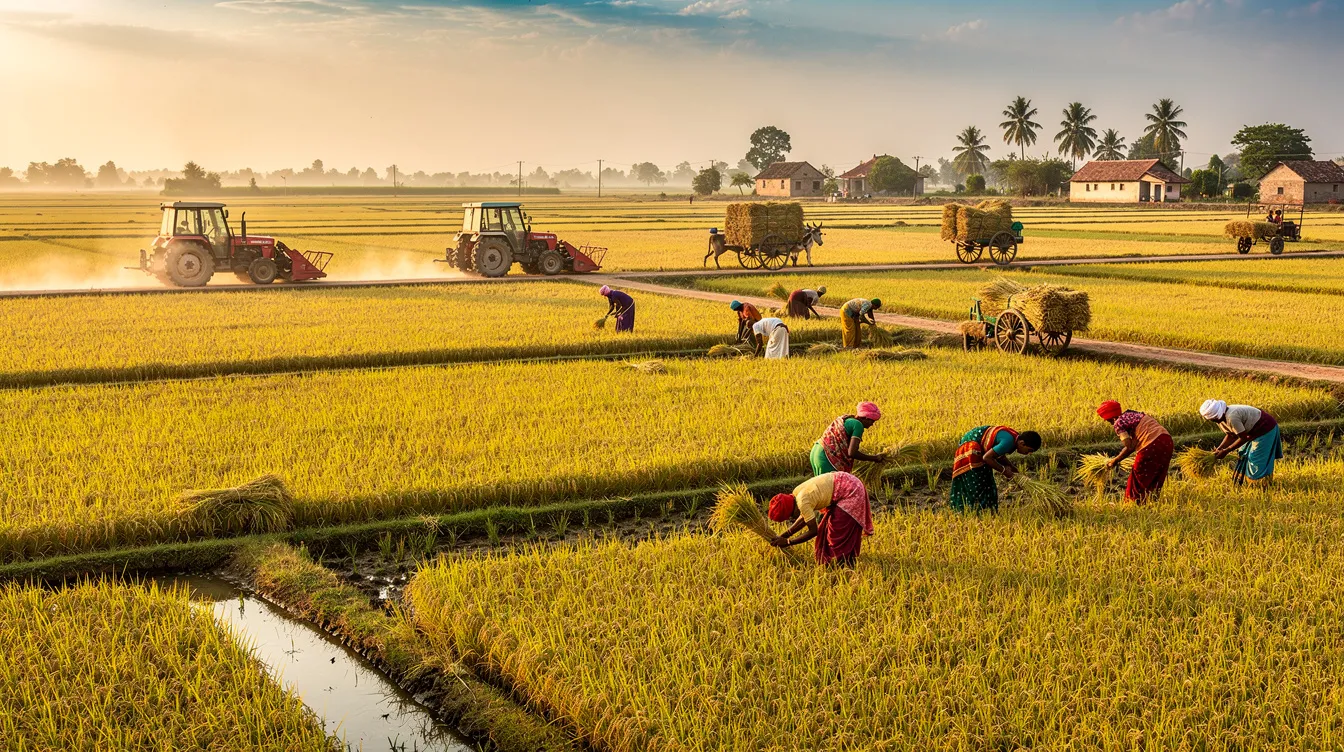
2. What Is an Integrated Rice Milling & Rice Processing Plant?
An integrated rice mill plant is a facility handling the full processing chain: buying paddy, pre-cleaning, de-stoning, husking, paddy separation, whitening, polishing, grading, sorting, blending, packaging, storage and by-product management. An integrated rice processing plant incorporates cleaning, de-stoning, parboiling, milling, sorting, grading, and packaging within a single facility. Key components include raw material receiving, drying and milling sections.
Core process stages in a modern integrated rice processing unit include:
- Paddy reception and weighing
- Pre cleaning and de-stoning
- Husking (shelling) to produce brown rice
- Paddy separation (separating unhulled paddy from brown rice)
- Whitening and polishing to produce polished rice or white rice
- Length and width grading for head rice and broken rice separation
- Colour sorting using optical color sorters
- Blending and packaging (bulk and retail)
- Warehousing for finished milled rice and by-products
- Husk and bran handling, collection and disposal or utilisation
A simple traditional rice mill – with a basic huller, low recovery, limited dust control and manual material handling – differs substantially from a modern rice mill plant that achieves higher efficiency through conveyors, aspiration systems, automated packing and quality rice processing. Modern rice milling systems are designed to minimize grain stress and breakage during processing, which directly improves head rice recovery.
Integrated rice processing lines can be configured for raw rice, parboiled rice or both. The rice milling process may include parboiling, which requires specific equipment and adjustments in processing strategy. This choice directly affects machinery, utilities, total cost and the structure of the DPR.
3. Why Prepare a Detailed Project Report (DPR) for a Rice Mill?
A Rice Mill Detailed Project Report is the primary document lenders and investors use to understand technical configuration, project cost, financial projections, cash flows and loan repayment capacity. It is not simply a business overview or a narrative about rice production. A Detailed Project Report must cover market analysis, financial projections, and compliance details. Forecasting financial projections is vital in assessing the viability of a rice processing plant project. Market research is essential before starting a rice mill, and a rice mill business plan should include financial predictions.
Key functions of a rice mill project report and DPR include:
- Defining the project concept and integrated rice processing plant layout
- Selecting appropriate capacity and product mix
- Listing machinery with specifications and quotations
- Presenting project cost break-up and means of finance
- Establishing sales volume and price assumptions
- Projecting rice mill cost of production, profit and loss, and cash flow
- Calculating DSCR and demonstrating loan repayment capacity
- Identifying risks and presenting sensitivity analysis
- Covering statutory requirements (factory license, trade license, FSSAI, pollution-control consents)
A DPR prepared for a rice mill bank loan must be project-specific – based on actual location, land cost, quotations for milling machinery, regional paddy availability, market realisations and proposed debt-equity mix. A rice mill DPR for project finance should align technical feasibility with realistic financial feasibility, showing sustainable DSCR and reasonable ROI and IRR over the term-loan period.
4. Integrated Rice Mill Plant Setup & Investment Planning
Integrated rice mill plant setup begins from land selection and continues through civil works, machinery procurement, utility installation, paddy storage construction, working capital arrangement and project-implementation scheduling.
Typical capital investment heads in a rice milling plant investment include:
- Land and land development (for a 4 TPH rice mill, land alone may cost ₹15–30 lakh depending on state and location)
- Civil works – mill building, paddy godown, finished rice warehouse, office, laboratory
- Plant and machinery – the largest component by value
- Electrical installations, transformer and internal wiring
- Utilities – boiler, compressor, DG set, water supply system
- Material handling – conveyors, elevators, internal roads
- Storage infrastructure for paddy, finished rice and by-products
Pre-operative expenses (interest during construction, consultancy fees, statutory approvals), contingencies and margin for working capital complete the total project cost picture. Promoters often underestimate costs such as weighbridge, husk-handling system, laboratory equipment and fire-safety installations – all of which must appear in the Integrated Rice Mill Project Report.
As a benchmark, a 2 TPH mini rice mill costs approximately ₹35–60 lakh in 2026, while a typical 4 TPH rice mill costs ₹1.2–2.5 crore to set up. Larger modern integrated units with parboiling capability can range substantially higher. Detailed capacity-wise cost ranges and component breakdowns are discussed in the guide on integrated rice mill plant setup cost in India.
Final project cost depends strongly on the desired automation level – manual, semi-automatic or automatic rice mill plant – and product mix (raw rice only versus raw plus parboiled rice).
5. Rice Mill Machinery & Equipment in a Modern Rice Mill
Rice mill machinery and equipment form the heart of the integrated rice processing line and typically account for 50–65% of total plant-and-machinery cost in a rice milling project. For a 4 TPH plant, rice mill machinery costs approximately ₹65 lakh to ₹1.4 crore depending on brand, technology and configuration.
Key equipment groups in a modern rice mill include:
- Pre-cleaner and de-stoner for removing impurities and stones from paddy rice
- Paddy husker (rubber-roll or centrifugal type)
- Paddy separator to separate unhulled paddy from brown rice
- Rice whitener and polisher for producing polished rice
- Length and width graders for separating head rice from broken rice and medium grain fragments
- Colour sorters (optical) for removing discoloured rice kernels and foreign matter
- Aspiration and dust-collection systems for environmental compliance
- Elevators, conveyors and bulk bins for material handling
- Automatic bagging and packing machines
The choice between Indian and imported milling machinery lines affects recovery, operating cost, energy consumption and required skilled manpower – all of which must be captured in the rice milling plant DPR in India. Machinery layout, rated TPH and number of parallel lines drive both plant capacity and the feasibility of future expansion.
A separate guide covers capital ranges and brand-wise considerations for rice mill machinery and equipment cost. Machinery selection should follow – not precede – understanding of paddy varieties, target markets (domestic vs international markets) and desired product mix.
6. Rice Milling Process & Production Flow
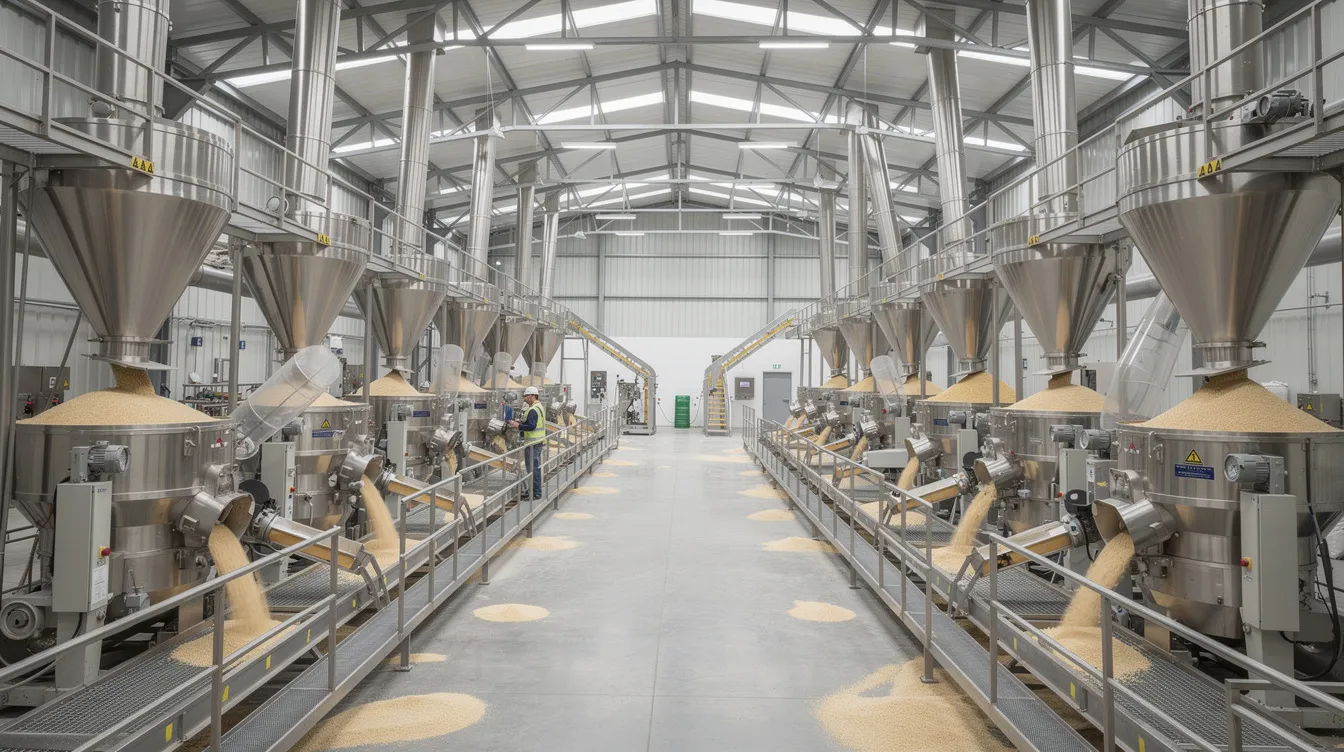
The milling process in an integrated rice processing plant runs from paddy intake to packed rice, following a structured production process flow. Paddy intake and pre-cleaning are crucial for optimizing milling performance and product quality. Quality control is integral throughout the rice processing chain from intake to final packaging.
Key stages in the rice milling process flow:
- Paddy reception, weighing and sampling
- Pre cleaning to remove dust, straw and light impurities
- De-stoning to separate stones and heavy foreign matter
- Husking to produce brown rice
- Paddy separation – returning unhulled paddy for re-husking
- Whitening and polishing to produce white rice or polished rice
- Length grading to separate head rice, broken rice and rice kernels of different sizes
- Colour sorting to remove discoloured or defective grains
- Blending (if multiple varieties or grades are mixed)
- Packaging – bulk bags for wholesale, retail packs for consumer markets
- Palletisation, storage and dispatch
Process-control variables critical for DPR analysis include paddy moisture level, expected rice processing yield, target rice milling recovery percentage (modern rice mills can achieve 67–70% head rice yield), acceptable broken rice percentage and quality-control checkpoints for moisture, foreign matter and whiteness. Continuous-flow dryers maintain safe moisture levels in raw or parboiled paddy to prevent spoilage.
Material handling choices – bucket elevators versus pneumatic systems, covered conveyors, aspiration – affect energy use, dust emissions and labour requirement. The detailed rice milling process flow chart and production process guide provides step-wise process diagrams and SOPs. The DPR should describe the chosen production process clearly so bank officials unfamiliar with milling technology can follow plant operations.
7. Rice Mill Capacity Planning & Production Capacity
Plant capacity planning for an integrated rice mill should start from paddy availability, target markets and working-capital capability – not from machinery vendor catalogues alone. Operational planning for rice processing includes evaluating raw material logistics and machinery efficiency.
Core capacity-planning factors include:
- Local paddy availability in MT per season and procurement radius
- Expected operating days per year (typically 250–300 days)
- Number of shifts per day (often 16–20 hours of operation)
- Achievable TPH per line and realistic uptime percentage
- Annual production capacity – for a rice processing facility, this can range from 50,000 to 100,000 MT of paddy depending on scale
- Installed capacity versus expected capacity utilization in early years
- Planned expansion over the next 5–7 years
Mini rice mills typically process 1 ton per hour, while commercial plants operate at 4–10 TPH. The relationship between TPH, daily throughput and annual production capacity in MT must be calculated using assumed conversion ratios (paddy to rice recovery).
Excessive capacity relative to assured paddy supply or market demand lowers utilisation and DSCR. Under-sized plants miss economies of scale. The rice milling project report must justify the capacity choice numerically. The dedicated guide on rice mill plant capacity planning and production capacity contains sample scenarios and methods for ideal sizing. Chosen capacity directly influences project cost, working capital requirement and term-loan sizing.
8. Land, Building & Rice Mill Plant Layout
Land and building decisions should be made with process flow, truck movement, safety and future expansion in mind – not merely the minimum square footage required to place machinery.
Key planning elements include:
- Land requirement in acres, based on capacity and storage needs (how much land is often underestimated by first-time promoters)
- Zoning, industrial-area approvals and access-road availability
- Paddy unloading area and weighbridge placement
- Paddy storage warehouse or silo location adjacent to the milling hall
- Milling hall sized for current and future expansion
- Finished-goods godown, husk and bran storage areas
- Boiler section and utility block positioned for safety and emissions compliance
- Office, laboratory and staff amenities
- Adequate truck-turning radius and forklift movement space
Layout should ensure unidirectional material flow to avoid cross-contamination and minimise reverse movement of paddy and finished rice. Structural choices between PEB (pre-engineered building) and RCC affect rice mill construction cost and implementation schedule.
Readers seeking sample layouts and capacity-wise land norms can refer to the guide on rice mill land, building and plant layout requirements. A clear block plan and brief layout description should be part of every integrated rice milling plant detailed project report prepared for bank appraisal.
9. Paddy Procurement & Raw Material Planning
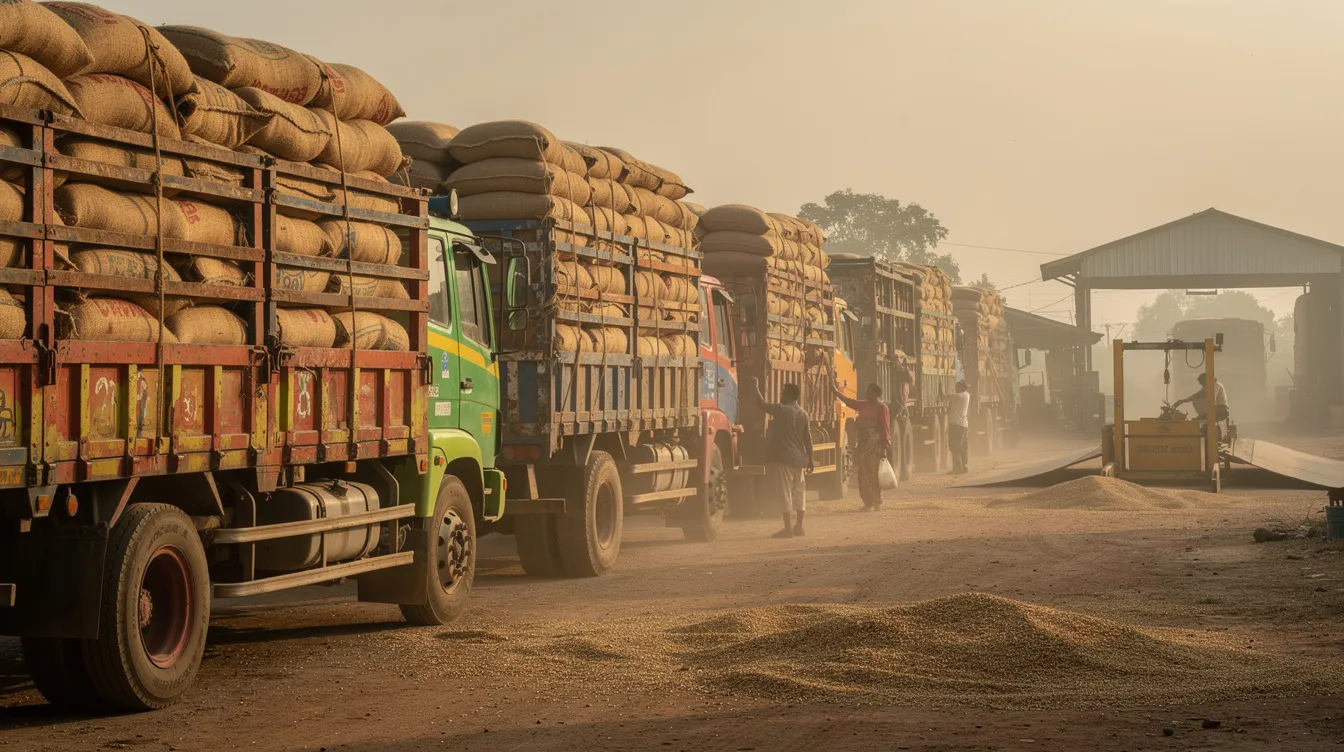
Paddy procurement strategy is often the single most important factor in rice mill profitability. It affects raw materials cost, rice quality, recovery and the working-capital cycle. Sourcing strategies for paddy include contracts with farmers or procurement through markets (mandis). Effective logistics planning is essential for the procurement, storage, and distribution of paddy and finished rice.
Key points a DPR should analyse:
- Sourcing from farmers directly versus buying paddy through mandis
- Government MSP dynamics and their impact on procurement pricing
- Seasonal versus staggered procurement approaches
- Moisture control at the point of purchase
- Shrinkage, handling loss and transport-cost assumptions
- Procurement radius in km and local competition from other mills
- Price-adjustment formulas for moisture and impurity deviations
- Three-year paddy price trend data to support realistic DPR assumptions
Clear norms around accepted moisture, impurities and pricing are crucial for maintaining planned rice processing yield and head rice recovery. For bankable DPRs, paddy price assumptions must be realistic and supported by verifiable trend data – not optimistic single-season prices.
The specialised guide on paddy procurement and raw material planning for rice mill provides structured procurement-planning frameworks and illustrative cost build-ups.
10. Paddy Storage, Warehouse & Silo Planning
Paddy storage design – warehouses versus silos – directly influences production continuity, quality preservation, moisture management and working-capital lock-in. Proper paddy storage systems should include aeration, temperature, and moisture monitoring.
Storage options and considerations:
- Conventional godowns with stackable bags – lower capital cost, higher labour demand
- Bulk paddy silos – higher capital cost, better moisture control, lower handling losses
- Aerated bins and covered drying yards for pre-treatment before milling
- Moisture and temperature control to prevent quality deterioration, fungus and infestation
- DPRs typically assume certain storage-loss percentages and fumigation costs in operating-cost projections
- Cold storage may be considered for specialised finished-rice products
Choice of storage capacity (measured in days or months of paddy consumption) links directly to procurement strategy and working-capital sizing, especially for mills that buy heavily during harvest and store for year-round milling operation.
Capacity-wise storage-planning guidelines are discussed in the guide on paddy storage, warehouse and silo requirements for rice mill. Warehouse and silo capacity, layout and cost estimates must appear in both project-cost and working-capital sections of the rice processing plant project report.
11. Rice Mill Project Cost & Means of Finance
A rice mill project cost summary in the DPR brings together all fixed-asset and pre-operative components along with margin for working capital, presenting a complete capital-requirement picture. The total capital investment for a 40 TON/day mill is approximately ₹10.96 crore as a benchmark, though actual figures vary significantly.
Typical cost heads in a rice mill project report in India:
- Land and site development
- Civil construction (mill building, godowns, warehouse, office, lab)
- Plant and machinery (typically 50–65% of fixed-asset investment)
- Electricals and instrumentation
- Utilities – boiler, compressor, DG set, water system
- Paddy storage and finished-rice storage
- Vehicles where required for logistics
- Pre-operative expenses – interest during construction, consultancy, statutory fees
- Contingency provision (typically 5–10% of fixed assets)
- Margin for working capital
Means of finance typically include promoter’s capital (equity contribution, often 15–25%), term loan from bank or financial institution, and eligible support under government schemes or subsidies where applicable – without treating prospective subsidies as guaranteed receipts.
A dedicated guide on rice mill project cost and means of finance walks through cost heads and financing patterns in depth. A well-structured rice mill project finance DPR should show a balanced debt-equity mix and a realistic implementation schedule aligned with drawdown of the term loan.
12. Revenue Model, Product Mix & By-Products
Integrated rice mill revenue does not come only from sale of head rice. The DPR must capture value from broken rice, bran and husk as well, since these can materially support debt servicing. By-product management can create additional revenue streams and improve overall plant profitability. Rice husk and bran are significant by-products that can be utilized for energy generation or as animal feed.
Key revenue components in the rice mill revenue model:
- Sale of raw rice or white rice (primary revenue driver)
- Sale of parboiled rice where the plant is configured for it
- Sale of broken rice (for animal feed, flour or industrial use)
- Sale of rice bran (for oil extraction – a valuable by-product)
- Sale of rice husk (for boiler fuel, brick kilns or briquettes)
- Value-added packaging – branded consumer packs, fortified rice, etc.
- Revenue from cooking quality variants and premium varieties
Paddy to rice conversion ratios and rice milling recovery percentage for each product influence topline revenue and gross margin assumptions. Modern rice mills can achieve 67–70% head rice recovery, but this varies with paddy variety, moisture and machinery capability. Recovery and product-mix assumptions in the DPR should align with machinery specifications and benchmark data discussed with technical suppliers.
The guide on rice mill revenue model and product mix walks through sample recovery scenarios and revenue compositions. A clear revenue model helps both promoter and banker understand how the rice mill business intends to generate cash for covering operating costs, interest and loan instalments.
13. Rice Mill Operating Cost, Profitability & Break-Even
The DPR must move from gross revenue to profit by analysing operating costs, contribution margin and break-even capacity – not by simply showing attractive net-profit figures. Operating costs for rice processing plants are 80–85% raw material expenses, making paddy price the dominant variable.
Major operating-cost items include:
- Paddy consumption (the single largest cost head)
- Electricity and fuel (for dryers, boilers, motors)
- Labour, supervision and manpower requirement
- Repairs and maintenance of milling machinery
- Packaging materials
- Inward and outward logistics
- Quality-control and lab expenses
- Administrative overheads and selling expenses
Rice mill cost of production is usually presented per MT of paddy processed or per kg of rice, showing how cost behaves with capacity utilization – separating fixed from variable costs for break-even analysis. At the break-even point, contribution per MT of rice covers all fixed costs and the milling operation reaches EBIT-positive territory.
Healthy profit margins for rice processing range between 15–25% at the gross level, though net margins depend on leverage, scale and efficiency. Whether a rice mill business is profitable depends on several factors including procurement discipline, recovery rates and market realisations.
Detailed worked-out examples are available in the guides on rice mill operating cost and cost of production and rice mill profitability and break-even analysis. Lenders look for realistic gross margin and profit margins, not inflated projections.
14. Financial Projections, Working Capital & DSCR Analysis
The financial section of an integrated rice mill DPR typically covers 5–8 years of projections, including profit and loss, balance sheet, cash flow and ratio analysis. In my experience, this section receives the most scrutiny from bank appraisal teams.
Rice Mill Financial Projections
- Sales build-up based on capacity utilization ramp (often 60–70% in year one, rising thereafter)
- Production-cost schedules, overhead projections, depreciation and interest
- Projected profit and loss, balance sheet and cash-flow statements
- Key financial ratios – current ratio, debt-equity ratio, return on capital
The detailed guide on rice mill financial projections for DPR covers projection methodology comprehensively.
Working Capital Assessment
- Inventory levels: paddy stock (potentially several months), finished rice, consumables
- Receivables and payables cycles
- Working-capital gap and margin money requirement
- Working capital for a 4 TPH rice mill typically ranges ₹40–80 lakh, though seasonal procurement can push peak requirements higher
- Seasonal paddy procurement creates significant working-capital pressure that is unique to rice milling versus many other manufacturing units
The dedicated guide on working capital requirement for rice mill provides detailed calculation methods.
DSCR and Loan Repayment Capacity
- DSCR (Debt Service Coverage Ratio) measures whether cash accruals adequately cover principal and interest obligations
- Bank norms typically require minimum average DSCR of 1.25–1.30 for rice mill projects
- Unrealistic revenue assumptions with understated operating costs create misleading DSCR comfort
- Capacity-utilization ramp-up must be realistic, not optimistic
The specialised guide on DSCR and loan repayment capacity for rice mill project provides more detailed DSCR analysis frameworks. I typically develop these financial projections and working-capital assessments based on project-specific inputs, without claiming to certify future performance.
15. Bank Loan, Term Loan Assessment & Project Finance for Rice Mills
Most integrated rice milling projects in India are funded through a mix of promoter’s capital and term loan from banks or financial institutions, sometimes supplemented by working-capital limits and government schemes.
What lenders broadly evaluate in a rice mill bankable project report:
- Promoter profile, experience and management capability
- Total project cost and means of finance (debt-equity ratio typically 3:1 to 4:1)
- Technical configuration and machinery adequacy
- Raw-material availability within procurement radius
- Market potential and rising demand for target products
- Projected profitability, cash-flow projections and DSCR
- Collateral, security and insurance
- Implementation plan and project-commissioning timeline
While a strong rice mill DPR for bank loan is essential, actual sanction is always subject to the lender’s independent appraisal, internal policies and regulatory norms. No DPR can guarantee sanction.
Licenses required include FSSAI registration and Pollution Control Board consent. Statutory compliance includes obtaining licenses from local authorities and food safety agencies. Term loan assessment is based on eligible fixed assets, acceptable debt-equity ratio, repayment period and moratorium aligned with project gestation – covered in depth in the guide on term loan assessment for rice milling project.
Broader bank loan and project-finance considerations for rice mill plant are addressed in a separate detailed guide. A professionally structured rice mill loan project report, CMA Data and projections can significantly improve discussion quality with banks, even though final decisions rest with the lender.
16. Feasibility, ROI, IRR, Payback & Sensitivity Analysis
Feasibility analysis for a rice mill project goes beyond simple profit-and-loss forecasts. It considers technical, raw-material, market, financial and operational feasibility – as well as implementation risk and management capability.
Feasibility Study
- Assessment of local paddy availability, competition mapping and market access (both domestic and international markets)
- Logistics feasibility, regulatory environment and Andhra Pradesh or West Bengal state-specific conditions where applicable
- Management capability and promoter’s business requirements
The focused article on rice mill feasibility study and project viability examines these dimensions in detail.
ROI, IRR and Payback
- Expected ROI for a rice processing plant is 18–25%, depending on scale and efficiency
- IRR compares project return against cost of capital – viable projects should show IRR meaningfully above borrowing cost
- A 4 TPH rice mill can achieve a payback period of 3–4 years under favourable conditions
- These metrics should be interpreted jointly, not in isolation
The guide on ROI, IRR, payback and sensitivity analysis of rice mill provides worked-out explanations.
Sensitivity Analysis
DPRs should test base-case projections against adverse but plausible scenarios:
- Higher paddy prices or market fluctuations in procurement cost
- Lower selling-price realisation
- Reduced capacity utilisation
- Higher interest rates
- Lower milling recovery
In my practice, feasibility and sensitivity analysis are key tools to assess rice mill project viability before promoters commit large capital investment or sign high-value term-loan documents.
17. Parboiled Rice Processing Plant within an Integrated Rice Mill
Parboiled rice processing is an additional process line that many integrated rice mills choose to install, especially where consumer preference or export demand for parboiled rice is strong. Parboiling units introduce pre-treatment steps that fundamentally alter the plant’s utility and environmental requirements.
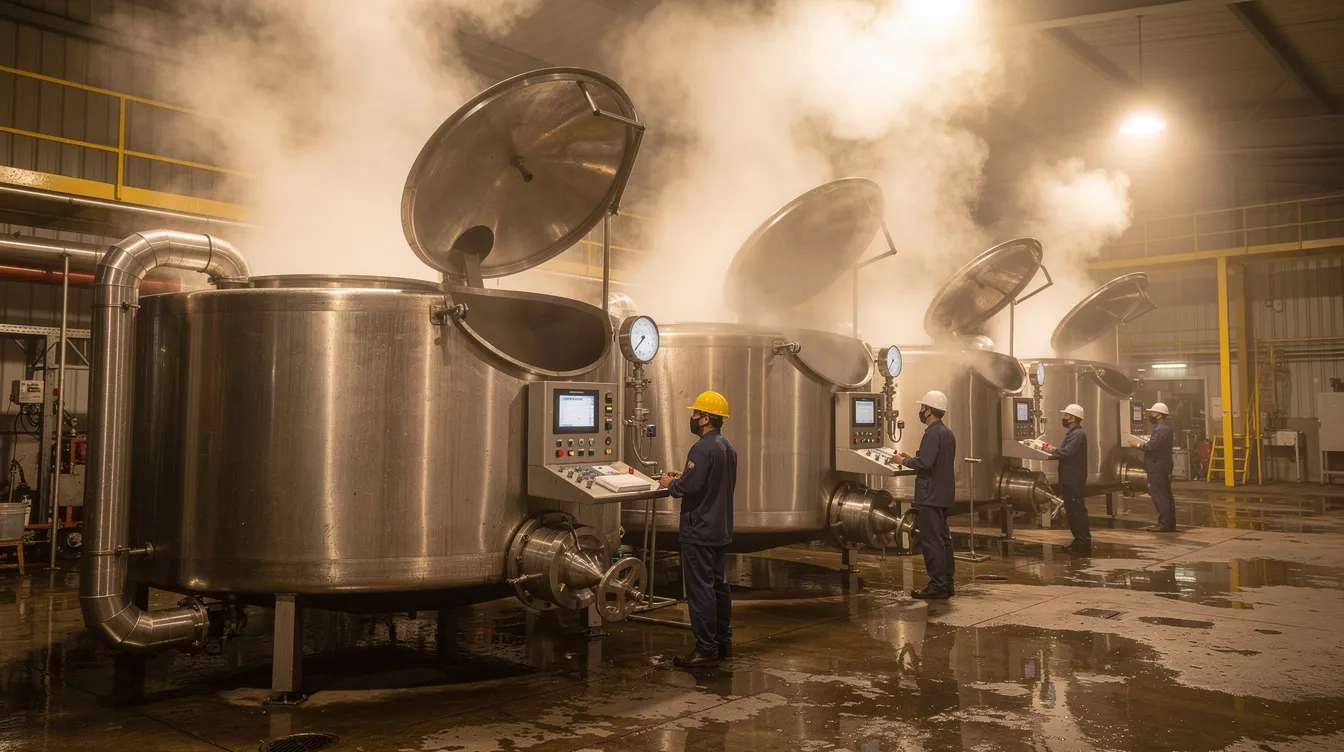
Main parboiling steps include:
- Soaking or steeping of paddy in hot water for a defined duration
- Steaming under controlled pressure to gelatinise the starch within rice grains
- Drying – mechanical (continuous-flow dryers) or yard-based – to bring moisture to safe milling levels
- Tempering before the paddy enters conventional milling stages
- Standard milling: husking, whitening, polishing, grading and sorting
Additional requirements of a parboiled rice processing plant include higher water usage, boiler and steam network, specialised dryers, and effluent management. Effluent treatment plants are necessary for managing wastewater to comply with environmental regulations. Environmental compliance is essential for processing plants to manage waste and emissions.
Parboiling improves head rice recovery and alters the colour, texture and nutritional value of the final product, with implications for cooking quality, market pricing and the rice mill revenue model. The dedicated guide on parboiled rice processing plant project report and DPR covers parboiled-specific DPR issues in greater detail.
Promoters must decide early in the planning stage whether to include parboiling, since it significantly alters land requirement, utilities, environmental approvals and project-cost structure.
18. Key Drivers of Rice Mill Project Profitability & Risk
Profitability in integrated rice milling is multi-factorial. Strong technology alone cannot compensate for weak paddy procurement, poor working-capital planning or weak market linkages.
Profitability Drivers
- Paddy procurement price and timing – the dominant cost variable
- Paddy quality, moisture level and varietal characteristics
- Milling recovery and broken percentage – directly affecting head rice and by-product revenue
- Capacity utilisation – higher throughput spreads fixed costs
- Sales realisation for different rice varieties and target markets
- Value obtained from by-products (bran for oil extraction, husk for energy)
- Energy efficiency and cost of finance
- Higher efficiency in logistics and production reduces cost per kg
Key Project Risks
- Raw-material price and availability volatility across seasons
- Competitive pressure on selling price in both domestic and international markets
- Inventory-loss risk in paddy storage from moisture, pests or infestation
- Under-utilisation of plant due to supply or demand shortfalls
- Delayed commissioning increasing interest during construction
- Working-capital strain from seasonal procurement
- Rice milling generates substantial air pollution from fugitive emissions; coal or husk-fired boilers produce fly ash and suspended particulate matter
- Handling and disposal of rice husk ash causes health impacts to humans and plants – the Punjab Pollution Control Board has studied rice husk storage practices for pollution control, and courts have mandated air-tight enclosures for rice husk handling to reduce pollution
- Changes in regulatory or environmental norms
Planning should address potential operational risks and create contingency strategies for supply chain disruptions. DPRs should reflect risk-mitigation strategies: diversified procurement sources, conservative utilisation ramp-up, prudent leverage, adequate contingencies and realistic product-mix assumptions.
19. What Should an Integrated Rice Mill DPR Contain?
While formats vary between institutions, a comprehensive rice processing plant detailed project report tends to include certain essential sections. The project report for an integrated rice milling plant must include an executive summary and technical specifications.
Technical and Planning Sections
- Executive summary and business overview
- Promoter background and management team
- Project concept and objectives
- Location and site details
- Industry and market overview (including analysis of rising demand)
- Selected capacity and product mix (raw and/or parboiled rice)
- Detailed manufacturing process description
- List of rice mill machinery and equipment with specifications
- Land, building and plant layout
- Utilities and infrastructure plan
- Raw materials – paddy procurement plan
- Storage plan – warehouse, silo, cold storage where relevant
Financial and Implementation Sections
- Project cost estimate and means of finance
- Revenue and pricing assumptions
- Operating-cost assumptions
- Projected profit and loss
- Projected balance sheet
- Projected cash-flow statement
- Term-loan repayment schedule
- Working-capital assessment
- Break-even analysis
- DSCR analysis
- ROI, IRR and payback period
- Sensitivity and risk analysis
- Implementation schedule
Statutory and regulatory sections – covering factory license, trade license, FSSAI, pollution-control consents and food processing approvals – should be covered at an overview level and updated for the specific state and year of implementation.
20. Generic DPRs vs Customised Rice Mill DPRs
Many entrepreneurs first download generic rice mill DPR samples for orientation. These documents provide a useful business overview and general understanding, but are rarely sufficient as final submissions for a rice mill DPR for bank loan.
Limitations of Generic Reports
- Assume standardised paddy prices, uniform recovery and approximate machinery costs
- Reflect a “typical” location rather than actual land prices or regional conditions
- Do not incorporate actual financing terms, quotations or project-specific product mix
- Often contain outdated cost data and recovery assumptions
- Cannot demonstrate that the specific promoter’s project is viable
What a Customised DPR Should Capture
- Chosen capacity and automation level (manual, semi-automatic or automatic)
- Specific machinery brands and actual quotations
- Exact site details – land cost, distance from paddy-growing areas
- Local paddy procurement realities and target markets
- Promoter’s contribution and proposed debt terms
- Project-specific financial projections with realistic assumptions
From a bank-appraisal perspective, credibility improves substantially when all assumptions are clearly sourced and aligned with real quotations. Serious promoters should treat generic DPRs as learning tools and invest in a project-specific, professionally prepared rice mill detailed project report before approaching banks or investors.
21. How CA Manish Gugliya & ProjectReportBank.com Can Assist
CA Manish Gugliya is a practising Chartered Accountant who works extensively on Detailed Project Reports, financial projections, CMA Data and bank-finance documentation for industrial and MSME projects – including integrated rice milling and rice processing plants across India. Chartered accountants bring structured financial analysis and professional rigour to the DPR process.
Services offered in the rice milling domain include:
- Preparation of Integrated Rice Mill Project Report and DPR
- Assistance in preparing rice processing plant DPR for bank loan and for investors
- Development of rice mill financial projections and cash-flow models
- Preparation or review of rice mill CMA Data for working-capital proposals
- Analysis of DSCR and repayment capacity
- Structuring project cost and means of finance
- Estimating working-capital requirement based on seasonal procurement patterns
- Conducting break-even, ROI, IRR and payback analysis
- Performing sensitivity analysis around key variables such as paddy price and selling price
While high-quality DPRs and projections help improve the bank-appraisal process, no guarantee of sanction, subsidy approval or investment can or should be given.
If you are planning an integrated rice milling or rice processing plant and require a project-specific DPR, financial projections, CMA Data or bank-finance analysis, you may contact CA Manish Gugliya through ProjectReportBank.com. Assignments can be handled online for projects located anywhere in India.
22. Conclusion – Integrating Technical Design & Financial Planning
- The success of an integrated rice mill project depends on alignment between technical design (capacity, machinery, plant layout, paddy storage, process flow), commercial strategy (paddy procurement, product mix, market positioning) and financial planning (project cost, working capital, DSCR, ROI, IRR and payback).
- An Integrated Rice Milling & Rice Processing Plant Project Report translates all these interlinked factors into a coherent plan that can be evaluated by promoters, lenders and investors.
- Properly prepared DPRs reduce the risk of under-budgeting, over-estimating profitability or overlooking key working-capital and repayment pressures which frequently cause stress in operational rice mills.
- Each major topic introduced in this hub – from setup cost, machinery, process and capacity to land layout, raw-material planning, storage, revenue model, operating cost, profitability, projections, working capital, DSCR, bank finance, feasibility, ROI/IRR and parboiled rice processing – has a dedicated supporting article accessible through contextual links on ProjectReportBank.com.
- If you are at the decision or bank-discussion stage, consider commissioning a customised, bankable integrated rice milling plant detailed project report tailored to your proposed capacity, location and financing structure.
Frequently Asked Questions (FAQ)
What is the difference between an Integrated Rice Mill Project Report and a basic rice mill project profile?
A basic rice mill project profile provides a generic overview of machinery, process steps and rough cost estimates, often with outdated assumptions and no project-specific financial modelling. An Integrated Rice Milling & Rice Processing Plant Project Report & DPR is far more detailed: it includes location-specific land and building costs, actual machinery quotations, realistic paddy prices, product-mix and recovery assumptions, complete financial projections, working-capital assessment, DSCR analysis and sensitivity scenarios. Banks prefer DPRs clearly tailored to the promoter’s exact project rather than photocopied profiles that do not match the proposed capacity or site.
Is a DPR mandatory for getting a bank loan for a rice mill in India?
For micro-enterprises or very small loans, some lenders may accept simplified formats. However, for most commercial rice mill plants – particularly projects involving term loans of substantial size – a structured rice mill DPR for bank loan or similar techno-economic appraisal report is practically required. Each bank has its own internal documentation standards, but almost all demand detailed project cost, means of finance, revenue and cost assumptions, projected financial statements, working-capital requirement and DSCR estimates. Having a professionally prepared DPR, even when not legally mandatory, significantly reduces back-and-forth queries and improves project credibility.
How do government schemes and subsidies affect the DPR for a rice mill project?
Central and State government schemes for food processing, agro-processing or MSME investment can improve project viability by lowering effective project cost or borrowing cost. In a rice mill detailed project report, such schemes are reflected either as part of the means-of-finance structure (capital subsidy) or as adjustments in interest and cash-flow projections (interest subvention), always with clear mention that actual eligibility depends on scheme rules at the time of application. Promoters should verify the latest scheme guidelines and timelines – DPRs should avoid treating prospective subsidies as guaranteed receipts.
How is working capital for a rice mill different from other manufacturing units?
Rice milling faces strong seasonality in paddy procurement. Many mills purchase a large share of annual paddy requirements during harvest, locking significant funds into inventory for months. This contrasts with industries where raw materials can be procured more evenly, resulting in smoother inventory cycles and lower working-capital peaks. A rice mill working capital assessment must therefore account for seasonal stocking, repayment of short-term limits from sale proceeds and coordination with term-loan instalments – which is why a specialised working-capital study forms a critical part of the DPR.
Can the same DPR be used if I change location or capacity later?
Significant changes in location, land cost, capacity, machinery configuration or paddy-procurement geography alter the financials enough that a DPR should be updated rather than reused unchanged. Lenders generally expect the rice mill project report to reflect the actual proposed site, capacity, machinery quotations and financial structure. Using a DPR prepared for a different scenario can create confusion or credibility issues. When capacity is scaled up or the plant is shifted to another state, the promoter should get the DPR and financial projections revised to reflect new assumptions and obtain an updated view of project viability and DSCR.