
Key Takeaways
- Paddy storage requirements for rice mill projects drive both technical design (warehouse, silo, handling systems) and financials (CAPEX, working capital, DSCR, bankability).
- Required storage capacity is calculated from rice mill TPH capacity, operating hours, inventory days, procurement seasonality and variety segregation – not just annual tonnage.
- Warehouse versus silo choice depends on project size, land cost, automation level, quality risk and long-term economics; many integrated rice mills adopt a hybrid storage model combining both.
- Storage planning directly affects working capital limits, margin money, interest cost and debt service coverage in a bankable Rice Mill DPR.
- CA Manish Gugliya and ProjectReportBank.com integrate storage design, capacity planning and finance into professional Rice Mill Project Reports and DPRs.
Introduction: Why Paddy Storage Is Critical in a Rice Mill DPR
In India, paddy procurement is highly seasonal. The Kharif Marketing Season runs from October to January in most states, with some Rabi procurement between March and May. A commercial rice mill, however, is normally planned to run 250–300 days per year. This mismatch between seasonal supply and continuous milling is the fundamental reason paddy storage exists.
Paddy storage requirements for rice mill projects are not simply a civil construction question. They form a core part of both technical feasibility (continuous grain flow into the mill) and financial feasibility (inventory value, bank credit limits, DSCR). Inadequate storage leads to production stoppages, forced high-price purchases in the off-season, excess moisture content at intake, pest infestation, quality deterioration, reduced head rice recovery and storage losses that erode profit margins. Proper storage extends the shelf life of rice products significantly and protects margins.
A modern rice mill paddy storage system may combine warehouses for bag storage with silos for bulk grain storage, supported by a paddy handling system, aeration, fumigation and moisture management. CA Manish Gugliya, a Chartered Accountant and project finance consultant at ProjectReportBank.com, plans paddy storage facility requirements, rice mill capacity and storage infrastructure cost together in bankable Rice Mill DPRs.
Importance of Paddy Storage in a Rice Mill Project
The storage section bridges seasonal procurement and year-round milling. Material flows from paddy receiving to testing, pre-cleaning, storage and finally into the rice milling process. Without adequate buffer stock, a rice mill cannot sustain production beyond the procurement window.
Rice is best stored in paddy form for protection. The husk provides a natural barrier against moisture ingress, insects and rancidity – a key advantage over storing brown rice or milled rice. Buffer stock planning protects the mill from mandi price fluctuations, transportation disruptions and supply shocks.
In any serious Rice Mill Project Report, assumptions on paddy warehouse requirements, silo capacity, storage period, safe moisture levels and expected storage losses must be explicitly stated and justified. Detailed paddy procurement planning is tightly connected with storage planning and should be addressed in parallel.
Key Factors Determining Paddy Storage Requirement
Two rice mills with identical TPH capacities can require very different paddy storage capacities. The major determinants include:
- Capacity factors: Installed TPH, planned operating hours per day (typically 16–20 hours), operating days per year, and expected capacity utilisation during the initial ramp-up years.
- Procurement factors: Number and duration of procurement seasons, seasonal paddy procurement model (bulk harvest purchase vs staggered lots), local raw material availability and procurement channels (FCI/state agencies, farmers, traders).
- Product-mix factors: Number of paddy varieties (basmati, non-basmati, parboiling grade, organic), need for segregation across warehouse compartments or separate silos.
- Financial and risk factors: Promoter’s working capital strength, bank cash-credit limit expectations, appetite for holding 30/60/90+ days of inventory, seasonal price advantage, acceptable storage losses and buffer stock for emergencies.
- Future expansion plans: Whether the layout should accommodate additional silos or warehouse bays within 3–5 years.
How Is Paddy Storage Capacity Calculated?
The base formula is straightforward:
Daily Paddy Requirement (TPD) = Rice Mill Capacity (TPH) × Operating Hours per Day
Annual Paddy Requirement = Daily Requirement × Operating Days × Capacity Utilisation Factor
Paddy Storage Requirement (tonnes) = Daily Paddy Requirement × Desired Inventory Days
Adjustments are needed for safety stock, seasonal availability, handling losses and moisture shrinkage. For high-moisture freshly harvested paddy, either on-site drying capacity or shorter storage days must be factored in.
Illustrative Example (10 TPH Mill): A 10 TPH mill operating 16 hours/day requires 160 tonnes of paddy daily. For 30 days of storage, roughly 4,800 tonnes of capacity is needed; for 60 days, approximately 9,600 tonnes; and for 90 days, around 14,400 tonnes. These figures are illustrative – actual requirements depend on capacity utilisation, variety mix and procurement pattern. For how rice mill capacity planning determines these inputs, refer to our detailed guide.
Paddy Storage Requirement for Different Rice Mill Capacities
The following table provides indicative planning estimates assuming 16 operating hours per day:
| Rice Mill (TPH) | Daily Paddy (TPD) | 30-Day Stock (T) | 60-Day Stock (T) | 90-Day Stock (T) |
|---|---|---|---|---|
| 2 | 32 | 960 | 1,920 | 2,880 |
| 4 | 64 | 1,920 | 3,840 | 5,760 |
| 5 | 80 | 2,400 | 4,800 | 7,200 |
| 8 | 128 | 3,840 | 7,680 | 11,520 |
| 10 | 160 | 4,800 | 9,600 | 14,400 |
| 15 | 240 | 7,200 | 14,400 | 21,600 |
| 20 | 320 | 9,600 | 19,200 | 28,800 |
| 30 | 480 | 14,400 | 28,800 | 43,200 |
Local procurement conditions, capacity utilisation, variety segregation and moisture levels can change these values significantly. Each DPR must rework storage requirements project-specifically.
Paddy Warehouse Storage System – Godown-Based Grain Storage
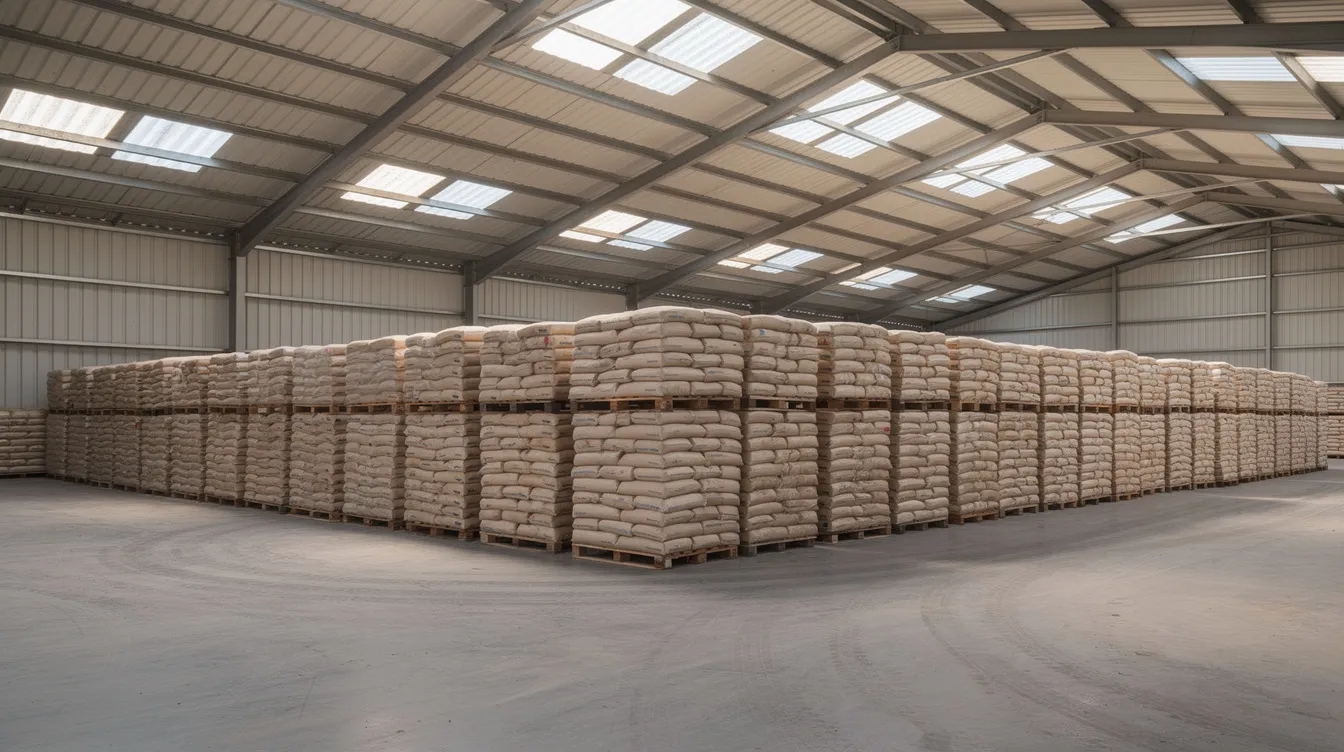
Conventional paddy godown design involves an RCC or PEB structure with concrete flooring, ventilated walls and bag storage. A proper storage facility should be dry, clean, and weatherproof to protect against moisture and pests.
Key technical considerations include:
- Stack height of approximately 5.5 m for 50 kg bags, with gangways of 0.75–1.2 m from walls and central aisles for movement.
- Use of pallets or dunnage is recommended to keep stored bags off the floor to prevent moisture absorption.
- Paddy warehouse ventilation requirements: cross-ventilation through wall vents, ridge ventilators, and roof insulation to limit condensation.
- Implement FIFO (First-In, First-Out) management protocols to minimize storage issues and ensure older stock is milled first.
- Separate stack zones for different varieties, procurement batches and moisture bands.
Warehouses are generally preferable for small and medium rice mills (up to ~5–8 TPH) where automation needs are lower and paddy warehouse setup cost in India is a primary concern. For how warehouse location integrates into the overall plant, see Rice Mill Land, Building & Plant Layout Requirements.
Paddy Silo Storage System – Bulk Grain Storage for Large Rice Mills
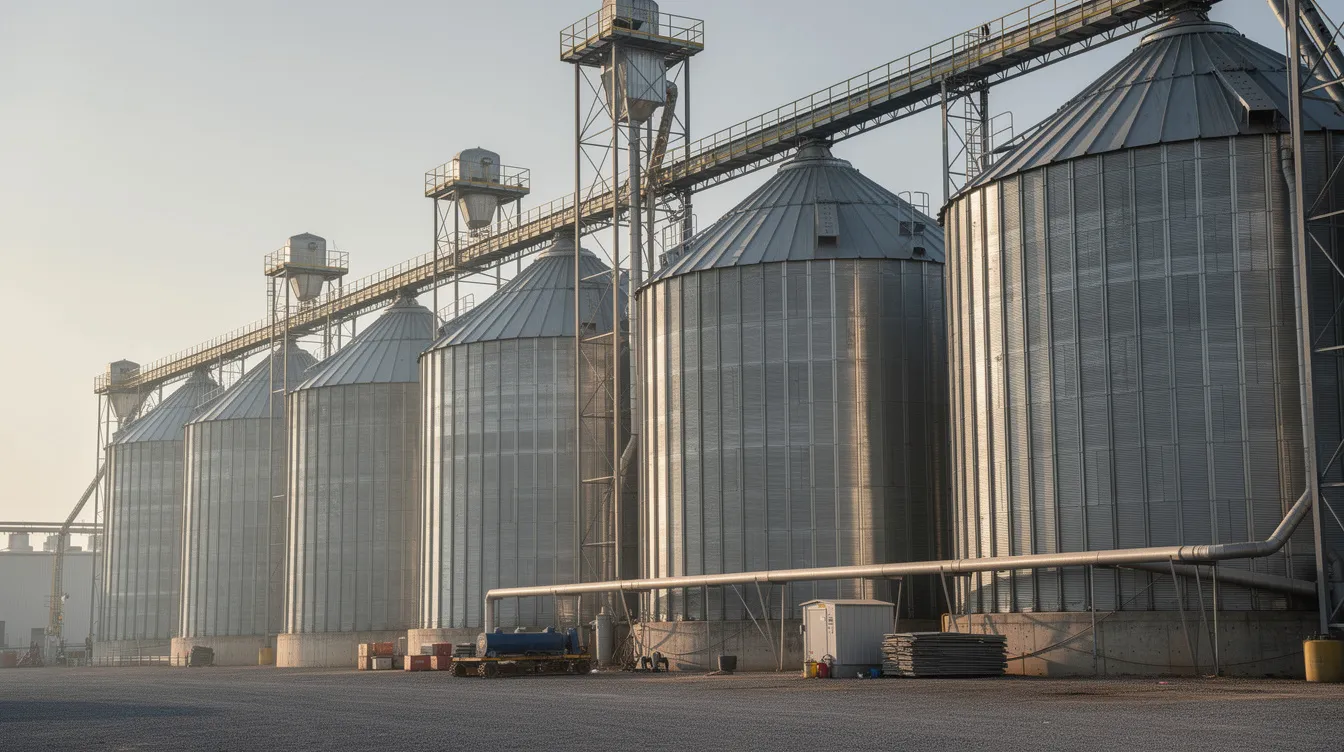
Storage silos protect rice from moisture and pests through sealed construction and controlled environments. Silos maintain controlled temperature and humidity levels, which extends shelf life and maintains the structural integrity of rice kernels. Modern silos reduce spoilage and improve inventory management through automated filling, discharge and monitoring.
Main elements of a silo-based system include a paddy receiving hopper, paddy conveyor system (belt or chain), paddy bucket elevator, pre-cleaner, distribution conveyors, aeration fans, temperature monitoring cables, and level sensors. Discharge conveyors feed buffer bins or day bins near the processing line, enabling continuous automated grain flow.
The paddy silo project cost is higher upfront – MOFPI cost norms indicate approximately Rs 5,900/MT for silos with civil and P&M versus Rs 4,900–7,000/MT for warehouses – but long-term labour, land and quality loss savings often justify the investment for mills of 10 TPH and above.
Types of Silos Suitable for Paddy Storage
- Flat bottom silo: Large cylindrical silo with flat floor; economical per tonne for long-term bulk storage. Requires sweep augers for discharge. Best suited for large-volume, longer-duration paddy storage.
- Hopper bottom silo: Conical bottom allows gravity discharge; higher cost per tonne but excellent for fast turnover, frequent batch changes and smaller capacities.
- Buffer silos and day bins: Small paddy storage bins located close to the milling line. They receive paddy from main silos or warehouse and feed continuous milling operations, managing short-term fluctuations.
Selection depends on mill capacity, procurement pattern, number of paddy varieties and land constraints. No single design is universally superior.
Warehouse vs Silo for Paddy Storage – Which Is Better for a Rice Mill?
| Parameter | Warehouse (Bag Storage) | Silo (Bulk Storage) |
|---|---|---|
| Initial CAPEX/tonne | Lower (~Rs 4,900–7,000) | Higher (~Rs 6,000–12,000) |
| Land per 1,000 T | ~0.5 acres | ~0.06 acres |
| Labour requirement | High (manual stacking) | Low (mechanised) |
| Storage losses/year | ~8% | ~4% or less |
| Pest control | Manual fumigation | Better sealed environment |
| Automation | Limited | High |
| Quality monitoring | Manual inspection | Sensors and aeration |
| Suitable capacity | Small-medium mills | Medium-large mills |
Modern silos protect rice from moisture and pest contamination far more effectively than open godowns. Many integrated rice mills combine both systems for flexibility.
Hybrid Paddy Storage Model for Modern Rice Mills
A hybrid paddy storage facility uses warehouses for seasonal overflow (jute bags or woven plastic bags), main silos for bulk long-term storage, and day bins near the processing line. The flow runs: trucks → weighbridge → sampling → pre-cleaning → warehouse or silo → buffer silo/day bins → milling.
This model allows staged investment – start with warehouses and limited silos, then add silo capacity as the mill and brand scale up over 3–5 years. It also handles multiple varieties, different moisture levels and procurement batches efficiently.
How Much Warehouse Area Is Required for Paddy?
Paddy storage area calculation involves: determine required tonnage → convert to number of bags (e.g., 50 kg each) → decide stack height and footprint → add gangways, fire clearances and loading zones. Generic thumb rules (fixed sq ft per tonne) can mislead because actual requirements change with building height, stacking system, handling equipment and ventilation strategy. Each DPR must produce a project-specific warehouse layout.
Paddy Silo Capacity Calculation and Configuration
Paddy silo capacity calculation starts from total tonnes to be stored in bulk, converted to cubic volume using paddy bulk density (~750–780 kg/m³), then distributed across multiple silos. Multiple silos are preferred for variety segregation, isolating problem lots, maintenance flexibility and managing different moisture levels. A 20 TPH mill might illustratively use 4–6 flat bottom silos plus 2–4 hopper-bottom buffer silos and day bins.
Paddy Receiving and Unloading Infrastructure
The paddy intake system includes truck circulation roads, weighbridge, sampling platform, laboratory for quality and moisture testing, unloading pits, receiving hoppers, pre-cleaners and paddy conveyor systems linking to warehouse or silo. Unloading capacity must handle peak-season arrivals; otherwise truck delays degrade quality and procurement efficiency.
Pre-Cleaning Before Paddy Storage
Paddy pre-cleaning and storage system design is essential for scientific grain storage. Pre-cleaning removes dust, chaff, straw, stones and foreign material before storage. Clean storage areas before new grain intake to minimize infestation risks. Equipment includes pre-cleaners, de-stoners and aspirators – part of overall rice mill machinery and equipment cost.
Paddy Moisture Management for Safe Storage
Moisture control is crucial for maintaining rice quality. Paddy is hygroscopic and can reabsorb moisture from atmospheric conditions above 70% relative humidity. Ambient relative humidity in storage should be kept around 60% to 65% to prevent moisture absorption.
Critical moisture benchmarks:
- Paddy should be dried to a moisture content of 12% to 13% for medium-to-long term storage.
- For short-term storage, moisture content of 14% is acceptable for 2 to 3 weeks.
- Long-term storage of paddy should aim for moisture content around 12% or lower.
In tropical countries like India, high relative humidity requires active moisture management – aeration in silos, controlled ventilation in warehouses, and avoiding storage of wet paddy in poorly ventilated pockets. Inappropriate moisture management leads to caking, fungal growth, off-odours and quantitative losses.
Aeration, Temperature Monitoring and Scientific Grain Storage
Aeration systems in storage prevent moisture migration and help control temperature. In silos, temperature monitoring cables and aeration fans detect and eliminate hot spots. Storage temperatures ideally should be maintained between 20°C and 28°C to prevent grain heating. Maintaining grain at temperatures below 20°C slows insect activity and prevents deterioration.
In warehouses, temperature control relies on building design – roof insulation, ridge ventilation, wall vents and orientation. Early temperature anomaly detection prevents large-scale spoilage, reinforcing why monitoring justifies part of the additional silo investment.
Pest Control, Fumigation and Hygiene in Paddy Storage
Storage pests can spoil both paddy and milled grain, causing quantity loss and quality downgrading. Strict sanitation practices prevent insect infestations during paddy storage in a rice mill. Routine inspection of stored paddy is essential for detecting insects and monitoring grain conditions. Inspection logs should be maintained to track moisture levels and conditions during storage.
Proper pest control measures include sealing entry points and using traps around storage areas. Protection against rodents and birds requires mesh screens, sealed doors and perimeter weed control. Paddy fumigation must be performed by trained, licensed operators using approved chemicals – fumigation should not replace moisture control and sanitation practices in pest management.
Hermetic storage solutions like IRRI Super Bag or similar super bag systems serve farmers and seed producers well at farm level but are generally impractical as the main storage system for large integrated mills. Mills may use hermetic bags for small high-value seed lots while primary bulk storage is managed through warehouses or silos.
Fire and Operational Safety in Paddy Storage Facilities
Fire risks in paddy storage involve large quantities of combustible material, dust, electrical equipment and vehicle movement. Key provisions include fire alarm systems, hydrants, electrical panel segregation, lightning protection for tall silos, and access roads for fire tenders. Operational safety covers guarding of conveyors and bucket elevators, safe silo access, confined space entry procedures and worker training.
Paddy Warehouse Layout and Integration with Rice Mill Plant Layout
Storage layout must align with overall rice mill plant layout. Material flow should run: external truck entry → weighbridge → sampling → unloading → pre-cleaning → storage → cleaning → milling → finished rice warehouse → dispatch, with minimal backtracking. Raw paddy zones, finished rice zones and by-product storage must be clearly separated.
Land Requirement for Paddy Storage
World Bank comparative data shows godown-based storage requires approximately 0.5 acres per 1,000 tonnes versus roughly 0.06 acres per 1,000 tonnes for silo systems. In high land-cost locations, silos may become more attractive despite higher CAPEX because of dramatically smaller footprint.
Paddy Storage Infrastructure Cost in India
Major cost heads in a paddy storage DPR include:
- Civil: Site development, compound wall, warehouse building, flooring, drainage, internal roads
- Silos: Supply and erection of flat bottom and hopper bottom silos, foundations, catwalks, discharge systems
- Mechanical: Receiving hoppers, conveyors, bucket elevators, pre-cleaners, dust extraction
- Utilities: Electrical works, aeration equipment, temperature sensors, fire-fighting, weighbridge, CCTV
Paddy storage project cost can form a substantial proportion of total integrated rice mill project cost, especially with advanced silos and bulk handling. Construction cost norms under government schemes range from Rs 4,900 to Rs 7,000/MT for warehouses and Rs 5,900 to Rs 12,000/MT for silos depending on features and connectivity.
Warehouse vs Silo Investment Decision
Rice mill owners must compare not only initial CAPEX but long-term impact. A costlier silo system may deliver better IRR when land is expensive, labour scarce, storage volumes high and quality-linked price differentials are significant. Studies indicate silo payback periods of 2–4 years under high utilisation. Lenders examine both storage CAPEX and quality loss assumptions; an under-designed or over-designed system can both hurt DSCR.
Impact of Paddy Storage on Working Capital and Bank Finance
Raw Material Inventory Value = Daily Paddy Consumption × Inventory Days × Procurement Price per Tonne
Increasing inventory from 30 to 90 days triples working capital. Bank cash credit limits and margin money must correspond. Rice millers must weigh the benefit of capturing lower harvest prices against interest cost, storage losses and operational risk. This trade-off must be quantified in financial projections and CMA data.
ProjectReportBank.com, through CA Manish Gugliya, integrates paddy storage capacity, procurement planning and working capital assessment in unified Rice Mill DPRs.
Paddy Procurement and Storage Strategy
Procurement and storage strategy are inseparable. A mill buying almost all paddy during harvest needs large storage and strong working capital, while staggered monthly purchases allow smaller facilities. Quality variability among sources – direct farmers, mandi purchases, government agencies and traders – affects segregation requirements. The DPR should derive storage from rice mill capacity and procurement strategy, not arbitrary assumptions. For in-depth discussion, see paddy procurement and raw material planning.
Storage Losses and Their Financial Impact
Even small losses (0.5–2%) on large annual tonnages materially reduce margins. Rice milling processes require managing paddy storage to optimize head rice recovery – stored grain that deteriorates produces more broken rice and lower market value. Studies comparing storage systems show approximately 8% annual losses in bag warehouses versus about 4% or less in silos. Better pest control, moisture management and handling increase CAPEX slightly but improve net margins, IRR and DSCR.
Paddy Storage and Rice Recovery/Quality
Poor storage conditions increase broken percentage, cause off-odours, fungal spots and colour variation. Prolonged storage at high moisture and temperature generally increases internal stress and chalkiness, translating into lower head rice recovery. Paddy quality preservation during storage has a direct commercial impact on revenue per tonne and must influence warehouse design and silo configuration decisions.
Storage Planning for Raw Paddy vs Parboiled Rice Mills
Parboiled rice mills require integrated soaking, steaming and drying sections. Some paddy may need storage both before and after parboiling, with different moisture and temperature histories. Brown rice requires 20% less storage capacity than paddy rice, but most mills store in paddy form for better protection. Integrated plants (raw plus parboiled) need more complex segregation and additional silos or warehouse compartments.
Storage Planning for Multiple Paddy Varieties
Mills handling basmati, non-basmati, parboiling varieties and speciality or organic paddy must design separate silos or clearly segregated warehouse zones. Moisture and harvest timing differ by variety, requiring separate storage bins to avoid contamination and maintain traceability. Variety-wise segregation directly affects the number of silos, total warehouse area and overall paddy storage investment for the rice mill.
Future Expansion Planning in Paddy Storage Infrastructure
Serious promoters should plan storage not only for present capacity but for anticipated growth – for example, from 4 TPH to 8 TPH to 12 TPH over 5–7 years. The DPR should keep space and structural provision for additional silos, extended warehouses and scaled-up receiving sections. Forward-looking storage planning improves long-term return on investment and produces a more bankable Rice Mill DPR.
Paddy Storage in a Rice Mill DPR and Bank Appraisal
A professional Rice Mill DPR covers installed capacity, annual paddy requirement, procurement calendar, inventory days, rice mill storage capacity requirement, warehouse area, silo configuration and paddy handling systems. Financial elements include storage project cost, machinery cost, utilities, manpower, incremental working capital, storage loss assumptions and their impact on profitability, DSCR, IRR and break-even.
Bankers evaluate adequacy of storage infrastructure, realism of procurement plans, inventory norms and whether projected cash flows can service both term loan and working capital. CA Manish Gugliya and ProjectReportBank.com combine detailed cost estimation, storage design review and financial modelling for bankable rice mill storage DPRs.
Common Mistakes in Planning Paddy Storage for Rice Mills
- Calculating storage only from annual consumption instead of procurement season and inventory days
- Ignoring seasonality, buffer stock needs and variety segregation
- Inadequate paddy warehouse ventilation, poor drainage, insufficient unloading capacity
- Missing pre-cleaning before storage and ignoring incoming moisture content
- Holding very high inventory without arranging adequate working capital
- Underestimating interest cost and ignoring storage losses in financial projections
- Not reserving space for future expansion in the plant layout
Practical Checklist for Paddy Storage Planning
- ☑ Confirmed rice mill capacity (TPH) and operating hours
- ☑ Daily and annual paddy requirement calculated
- ☑ Procurement period and inventory days defined
- ☑ Storage quantity computed for warehouse, silo or hybrid model
- ☑ Provision for multiple variety segregation
- ☑ Receiving section and pre-cleaning capacity matched to peak intake
- ☑ Moisture management and pest control strategy documented
- ☑ Fire and operational safety provisions included
- ☑ Storage CAPEX estimated within total project cost
- ☑ Working capital requirement aligned with planned inventory days
- ☑ Impact on DSCR tested through sensitivity analysis
Conclusion – Integrating Paddy Storage into Overall Rice Mill Feasibility
Paddy storage is a strategic decision affecting technical design, land and building, machinery selection, procurement, working capital and long-term profitability. Determining correct paddy storage capacity, warehouse area and silo configuration requires careful rice mill capacity planning, scientific grain storage principles and rigorous financial analysis – not ad-hoc thumb rules.
A coordinated, bankable Rice Mill Project Report must integrate storage planning with procurement strategy, plant layout, machinery selection and finance structure. CA Manish Gugliya and ProjectReportBank.com support promoters, investors and MSMEs with professional DPR preparation, financial projections, CMA data and paddy storage DPRs for warehouses and silos. Approach storage planning systematically – it determines how efficiently your rice mill can produce, how well it preserves value, and how confidently a lender will back the project.
FAQ – Paddy Storage Requirements for Rice Mill
How many days of paddy storage should a commercial rice mill normally plan?
Many Indian commercial mills work with 30–60 days of paddy inventory as a starting range. Actual storage period depends on local crop season, price volatility, working capital strength and bank norms. Mills in remote areas or export-focused basmati units may plan 90 days or more, which must be properly financed and justified in the DPR.
Can a new 4–5 TPH rice mill start without silos and add them later?
Yes. Many small and mid-sized mills initially work with only warehouse-based storage to limit initial CAPEX, provided they have sufficient godown capacity and proper ventilation. If future silo upgradation is envisioned, the plant layout should reserve space and alignment for conveyors and bucket elevators from day one.
Is hermetic storage like IRRI Super Bag practical for large rice mills?
IRRI Super Bag and similar hermetic solutions are excellent for farmers, seed producers and small traders at the farm level, but are not used as the main storage system for large quantities in integrated mills. Large mills may use hermetic bags for small high-value lots while primary storage is managed through warehouses or silos.
How do I quickly estimate warehouse size before a detailed DPR?
Estimate daily paddy requirement from TPH and operating hours. Multiply by tentative inventory days (e.g., 45–60). Convert tonnes to bags, assume a realistic stack height and packing density, then add 30–40% extra area for gangways and handling. This is only for early bank discussions – a proper DPR should refine the figure with detailed stacking layout and safety clearances.
Does higher paddy moisture always mean I need mechanical dryers?
Not always. It depends on typical harvest moisture in the project region, planned storage period and available natural drying options. However, if local paddy routinely arrives above safe storage moisture and longer periods of storage are planned, including mechanical dryers and their CAPEX in the project report becomes commercially advisable.