Key Takeaways
- A parboiled rice processing plant project report (DPR) is a bankable, data-driven document that covers the technical, financial, and commercial feasibility of a proposed parboiled rice mill in India – including plant capacity, manufacturing process, machinery, project cost, means of finance, working capital, profitability, DSCR, and risk analysis.
- Parboiling involves soaking, steaming, and drying paddy rice before milling. This process improves grain quality and milling performance, retains more water-soluble vitamins, and enhances storage stability – making it commercially superior to raw rice milling in many markets.
- Project viability depends heavily on paddy procurement pricing, milling recovery, by-product realization (broken rice, rice bran, rice husk), and efficient plant utilization – not merely on installed capacity or machinery specification.
- The DPR must include sensitivity analysis, break-even assessment, DSCR projections, and risk evaluation to serve as a genuine decision-making tool for promoters and a credible appraisal document for lenders.
- CA Manish Gugliya, through www.projectreportbank.com, assists promoters with detailed project reports, financial projections, CMA Data preparation, feasibility analysis, and bank finance documentation – without promising loan sanctions or guaranteed profitability.
Introduction to Parboiled Rice Processing Plant & DPR
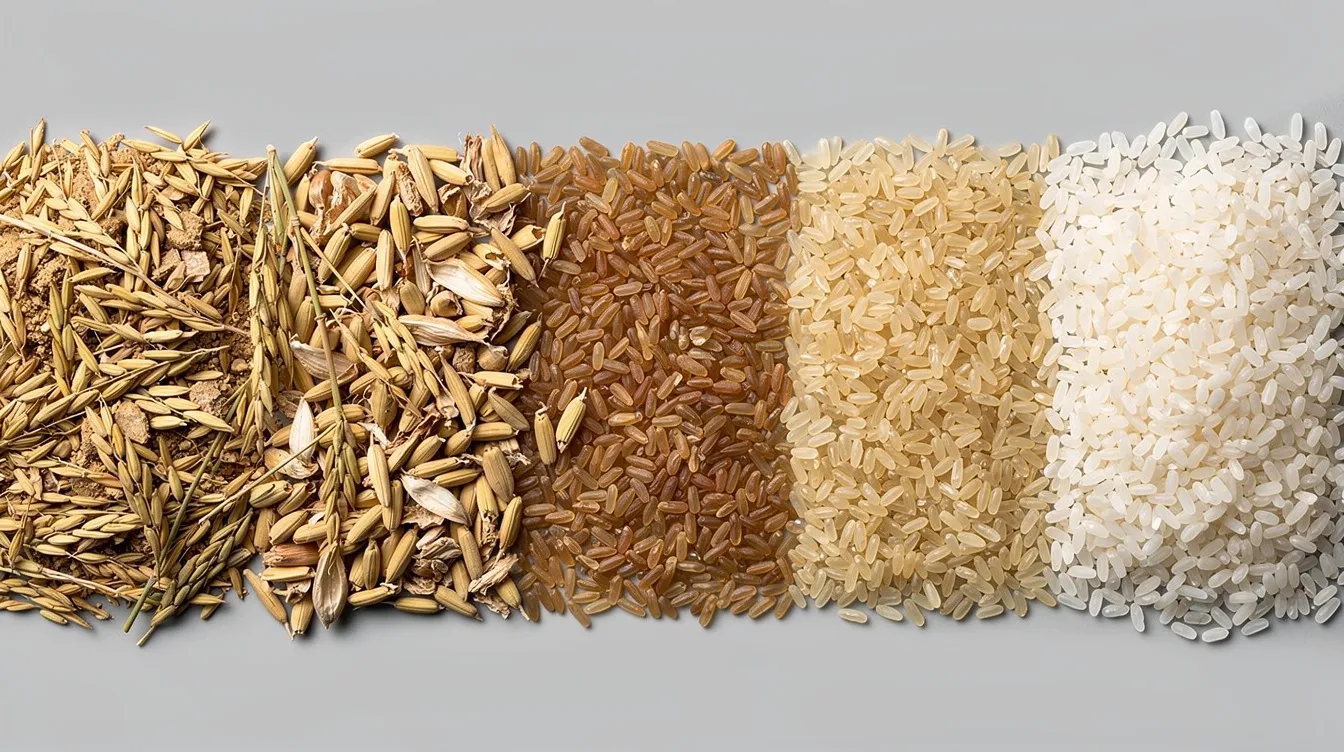
A parboiled rice processing plant integrates two distinct but connected operations: paddy parboiling (soaking, steaming, drying) and rice milling (dehusking, whitening, polishing, grading, packing). The result is parboiled rice – paddy that has been hydrothermally treated before the husk is removed. This process drives water-soluble vitamins deeper into the grain, so parboiled rice retains more water-soluble vitamins than white rice. It also improves gut health and lowers blood sugar impact compared to regular polished rice, which is why the market for parboiled rice is driven in part by its nutritional value.
Parboiled rice differs from raw white rice in several practical ways. It has a firmer texture and is less sticky when cooked, a slightly yellowish tint, and improved milling yield compared to regular rice. Because parboiling gelatinizes starch within the kernel, grains become harder and more resistant to breakage during milling – meaning more head rice and less grain breakage. The grain is also more resistant to insect infestation, making parboiled rice economically advantageous for storage and distribution.
For any entrepreneur considering this rice mill project – whether setting up a new unit, expanding an existing rice mill, or adding a parboiling section – a properly prepared detailed project report is essential before committing capital or approaching banks. I am CA Manish Gugliya (FCA, DISA (ICAI)), a practising Chartered Accountant since 2006, and through my work at www.projectreportbank.com, I have assisted numerous MSME promoters and industrial investors in preparing DPRs, financial projections, and CMA Data for rice processing and agro-processing projects across India.
Parboiled Rice Processing Plant Project Report – Scope & Contents
A professional parboiled rice processing plant project report must be bank-oriented, data-backed, and tailored to the specific capacity and location of the proposed mill. A robust project report must cover executive summaries, market assessments, engineering details and financial metrics. Here is what it typically includes:
Project Background & Market Sections:
- Promoter profile, experience, and financial strength
- Project concept: new unit, expansion, or adding parboiling to an existing rice mill
- Product profile covering parboiled rice grades, non basmati rice, and by-products
- Market assessment including demand-supply analysis and competitor profiling for rice and parboiled varieties
Technical Sections:
- Proposed capacity (TPH, TPD, TPA) and location analysis
- Detailed manufacturing process and process flow chart
- Plant layout, machinery list, utilities (power, water, steam, fuel)
- Quality control and laboratory setup
Resource & Compliance:
- Paddy procurement plan and raw material availability
- Storage, warehousing, and manpower requirements
- Key statutory approvals at a high level
Financial Sections:
- Item-wise project cost and means of finance
- Working capital assessment and cash credit requirement
- Projected profit and loss, balance sheet, cash flow, DSCR, break-even, ROI, IRR, payback period
- Sensitivity analysis and risk assessment
A detailed project report evaluates technical feasibility and operational requirements of processing plants – and a project report should demonstrate technical feasibility, market demand and environmental compliance. Banks and term-lending institutions examine these parameters to judge whether a parboiled rice mill project report is bankable.
Industry Overview and Market Potential for Parboiled Rice
India stands among the major rice producing countries globally. India rice production and export volumes are substantial – the country is the world’s largest exporter of parboiled rice, with Sub-Saharan Africa absorbing roughly 70% of Indian parboiled rice exports. Rice was the largest cereal crop with 700 million metric tons in global production back in 2005, and milled production has only grown since. Across south asia and southeast asia, rice remains a staple food and among the most important food crops.
The global parboiled rice market includes numerous millers and exporters, and the competitive landscape features both large integrated plants and smaller regional units. Industry trends show parboiled rice exports from India to African nations rising from USD 1,740.44 million in 2021-22 to USD 2,052.52 million in 2022-23. Sector growth highlights include a growing middle class in developing economies overview markets, rise rising income levels, and consumption existing gaps in price-sensitive regions that prefer firmer, non-sticky grains.
Key demand drivers include health-conscious consumers, institutional procurement, suitability for processed food and ready-to-eat products, and processed food favourable policies at both central and state levels. A parboiled rice processing plant DPR for India should present market growth trends, competition mapping (including private players strategies), pricing behaviour, and the demand-supply balance for the proposed location. The industry overview section should also reference government policies affecting rice exports, MSP-linked paddy pricing, and any state-specific incentives – the union budget periodically announces support for food processing and agro-industry infrastructure.
Parboiled Rice Manufacturing Process & Process Flow
The manufacturing process for parboiled rice includes cleaning, soaking, steaming, drying, milling and packaging – integrated into a continuous or semi-continuous production line. Choosing technology involves selecting between traditional batch systems and modern automation, depending on capacity, budget, and desired product quality.
Here is the typical process sequence:
- Paddy procurement and receiving – weighment, initial quality check
- Pre-cleaning and destoning – removal of impurities, stones, foreign matter
- Soaking – paddy immersed in tanks at controlled temperature to absorb moisture
- Steaming / parboiling – steam application to gelatinize starch
- Drying – mechanical or multi-stage drying to reduce moisture
- Tempering – resting to equilibrate internal moisture and reduce fissures
- Dehusking – rubber roll sheller removes husk
- Paddy separation – separates unhusked paddy for re-processing
- Whitening and polishing – produces milled parboiled white rice
- Grading – length and thickness classification
- Colour sorting – optical sorting to remove discoloured grains
- Packaging and storage
- By-product handling – rice husk, rice bran, broken rice collection
Parboiling improves grain quality and milling performance. The actual configuration (batch vs. continuous parboiling, dryer type, colour sorter inclusion) varies by project. Quality control measures for rice milling include moisture content and broken rice percentage checks at multiple stages. For a detailed breakdown of each stage, refer to the rice milling process flow chart and production process.
Soaking, Steaming and Drying Section – Technical Considerations
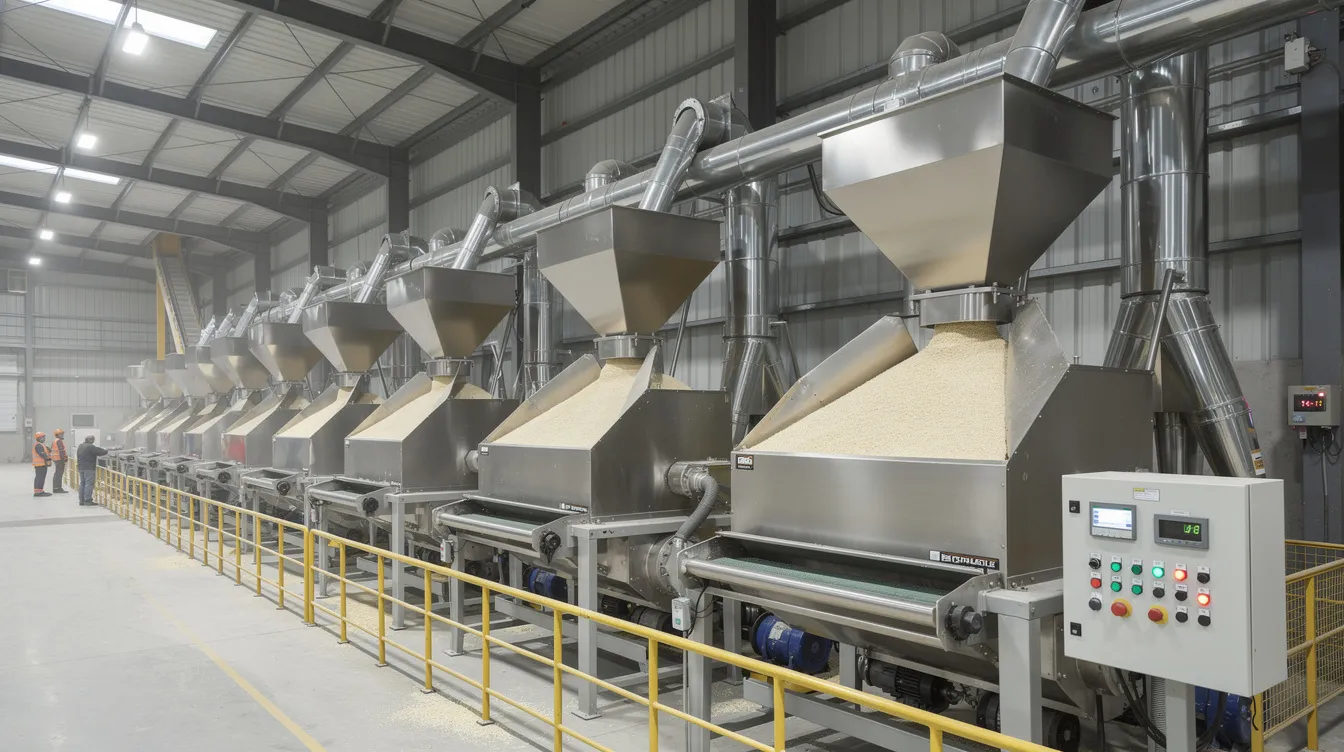
Soaking, steaming, and drying are the heart of parboiled rice processing and directly influence head rice recovery, grain colour, and fuel consumption.
Soaking:
- Soaking tanks are designed for the required paddy throughput and controlled water temperature
- Controlled soaking temperature is crucial for starch gelatinization in parboiling – typically maintained at 50–65°C, below the gelatinization point of ~70–75°C, to avoid husk splitting
- Soaking duration ranges from 2 to 6 hours depending on paddy variety and soil fertility characteristics of the growing region
- Soaked paddy usually reaches 30–35% moisture before steaming
Steaming:
- Steam from the boiler is applied – either atmospheric or under pressure
- Rice husk is used as boiler fuel and biomass in most Indian parboiled mills, reducing fuel cost
- Gelatinization of starch is the key objective: it hardens the kernel, reduces fissures, and improves head rice recovery
Drying:
- After steaming, paddy must be dried to 12–14% moisture for safe milling and storage
- Over-drying causes cracks; under-drying leads to mould and milling problems
- Energy efficiency matters: parboiled rice mills consume approximately 48.75 kWh per tonne vs ~25.32 kWh for raw rice mills
- Instrumentation (moisture meters, temperature gauges, control panels) helps maintain consistent parboiled rice processing quality
Plant Capacity Planning for Parboiled Rice Mill
Correct capacity selection – 3 TPH, 4 TPH, 6 TPH, or 8 TPH – is among the most critical strategic decisions in a parboiled rice mill project. Capacity is expressed in tonnes per hour (TPH) of paddy input, tonnes per day (TPD) based on operating hours, and tonnes per annum (TPA) based on working days.
Capacity planning influences:
- Size and cost of parboiling vessels, boiler, dryer, and milling section
- Storage capacity for paddy and finished goods
- Paddy procurement volume and working capital requirement
- Connected electricity load and manpower planning
- The sized term loan in the parboiled rice plant DPR
The DPR should present multiple utilisation scenarios – for example, 60%, 70%, 80% capacity utilisation in initial years – to test financial resilience. For detailed guidance on expressing and planning capacity, see rice mill capacity planning and production capacity. Expansion options (additional parboiling tanks, a second dryer line) should also be considered when finalizing the plant layout and building design.
Machinery and Equipment for Parboiled Rice Processing Plant
Machinery selection directly impacts product quality, energy consumption, uptime, and total parboiled rice plant machinery cost. Modern rice mills may use PLCs and SCADA for automation systems, which improve consistency but increase capital outlay.
Key equipment sections:
- Paddy receiving and pre-cleaning: paddy cleaner, destoner, magnet separator
- Parboiling section: soaking tanks, parboiling vessels, steam lines, valves, husk-fired boiler and fuel handling
- Drying: paddy dryer (LSU type, column dryer, or other), bucket elevators and conveyors
- Milling: rubber roll sheller, paddy separator, rice whitener, polisher, silky polisher, grader, length grader
- Sorting and packing: colour sorter, packaging machine, weighing and stitching system
- Support systems: dust collection, air compressors, electrical panels, laboratory instruments, fire-fighting equipment
For a 4-TPH plant with parboiling, machinery cost ranges from approximately ₹65 lakh to ₹1.4 crore depending on brand, automation level, and inclusion of colour sorters. A fully automatic 4-TPH parboiled plant (excluding land and civil works) may reach ~₹4 crore. The DPR should present an item-wise machinery and equipment cost table supported by recent quotations. For detailed cost breakdowns, see rice mill machinery and equipment cost.
Land, Building and Plant Layout Planning
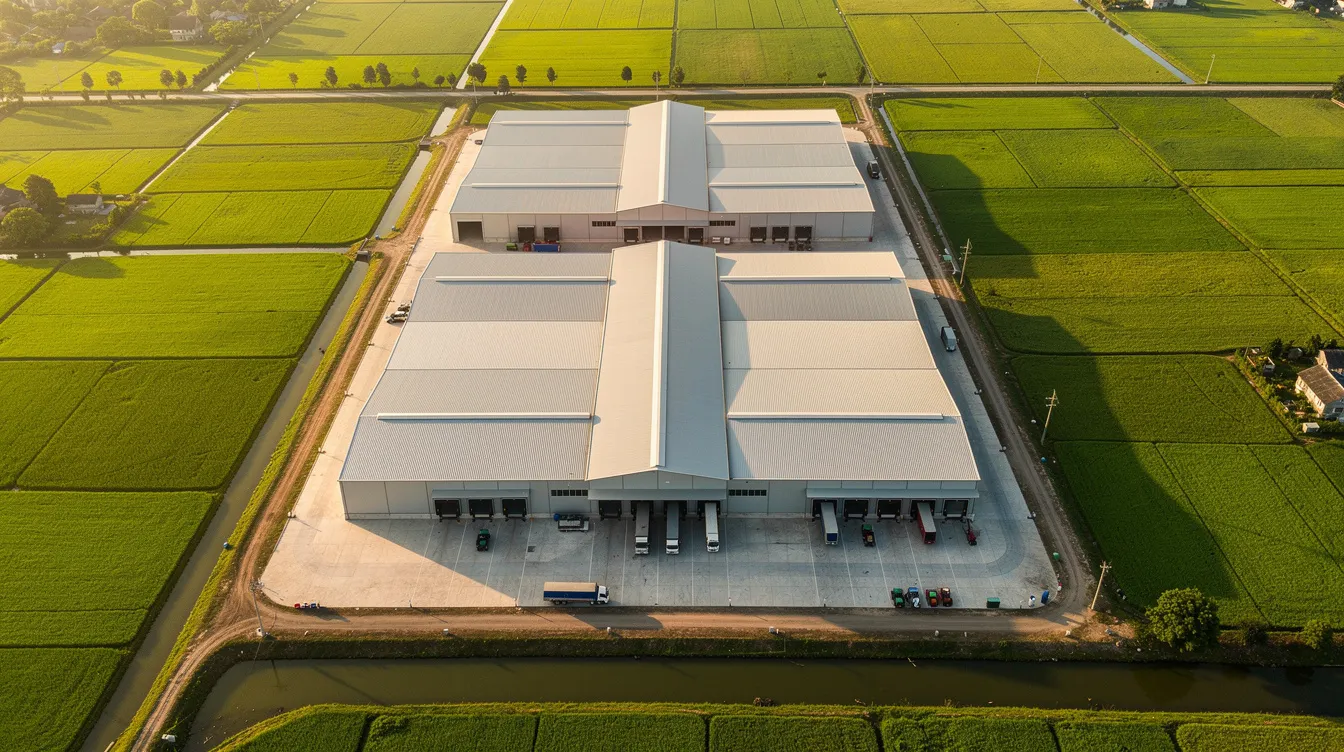
Land and building requirements for a parboiled rice mill are higher than for a raw rice mill, due to the soaking tanks, parboiling area, boiler section, fuel yard, and drying infrastructure. Typical land requirement for a 4-TPH commercial rice mill is 1.5–2 acres, with 25–30% extra recommended for expansion.
Functional zones include:
- Paddy receiving, weighbridge, and raw paddy storage (warehouses or silos)
- Soaking and parboiling section, boiler and fuel yard
- Dryer section and intermediate storage
- Milling block, finished rice warehouse, bran and husk storage
- Packaging area, laboratory, administrative block, staff facilities
The plant layout should follow a logical workflow from paddy intake to finished goods storage, with minimal cross-movement and safe separation between boiler areas and food-grade zones. Parboiling plant design should ensure proximity to paddy supply to minimize transportation costs. Internal roads, drainage, effluent paths, fire-safety access, and water storage must all be planned. For layout planning guidance, see rice mill land, building and plant layout requirements.
Paddy Procurement, Storage and Raw Material Planning
Paddy is the dominant cost component in any parboiled rice processing plant – often 70–80% of total operating cost – so the procurement strategy in the DPR must be carefully designed. Rice paddy cultivation varies by region, and variety and soil fertility affect grain quality and milling recovery.
Key procurement factors:
- Varieties selected (local and high-yielding), moisture content at purchase, foreign matter limits
- Sourcing channels: direct farmer purchase, APMC mandis, commission agents, traders
- Seasonal procurement peaks (Kharif and Rabi), off-season buying, price volatility management
- Procurement radius and logistics cost directly affect raw materials cost
Storage planning covers godowns, covered sheds, and silos with proper aeration, fumigation, pest control, and stock rotation. Poor storage leads to quality deterioration, moisture changes, and increased grain breakage during milling. For more on procurement and storage, refer to paddy procurement and raw material planning for rice mill and paddy storage, warehouse and silo requirements.
Parboiled Rice Plant Project Cost and Means of Finance
The parboiled rice plant project cost must capture all capital expenditure and margin for working capital, based on realistic quotations and civil estimates. Total capital investment is crucial for project financials and must be prepared with care. CAPEX for a parboiled rice facility includes specialized equipment beyond what a raw rice mill requires.
Major CAPEX heads:
| Cost Head | Description |
|---|---|
| Land | Purchase or lease (if applicable) |
| Site development | Leveling, compound wall, internal roads |
| Building & civil works | PEB sheds, RCC structures, storage godowns |
| Parboiling equipment | Soaking tanks, parboiling vessels, steam lines |
| Milling machinery | Sheller, separator, whitener, polisher, sorter |
| Boiler & fuel handling | Husk-fired boiler, fuel conveying |
| Dryer | Paddy dryer system |
| Electrical installation | Transformer, panels, cabling |
| Laboratory & QC | Moisture analyzers, grain testing equipment |
| Pre-operative expenses | Registration, consultancy, trial runs |
| Contingency | Typically 5–10% of hard costs |
| Margin for working capital | Initial paddy purchase, operating expenses |
Means of finance typically includes promoter’s equity contribution, term loan from a bank, unsecured loans from promoters/relatives where acceptable, and eligible capital subsidy where applicable (without guaranteed availability). The DPR should include a sources-and-uses statement. For more detail, see rice mill project cost and means of finance.
Revenue Model, Operating Cost and Profitability Analysis
Profitability in a parboiled rice plant depends on milling recovery, product mix, by-product realization, operating efficiency, and the paddy-rice price spread. The primary product of rice mills is milled rice, but by-products contribute meaningfully to margins.
Revenue streams:
- Parboiled rice (different grades) – primary revenue source
- Broken rice – used in food processing, animal feed, and broiler farming feed mixes
- Rice bran – sold to solvent extraction plants or as animal feed
- Rice husk – used as boiler fuel internally or sold externally
For product mix planning, see rice mill revenue model and product mix.
Major operating costs (OPEX): OPEX includes raw paddy procurement and utilities costs as the dominant items. Cost per metric ton is a standard measure for expenses. Other heads include labour, packing material, repairs and maintenance, administrative overheads, selling and distribution, and finance costs. For detailed cost analysis, refer to rice mill operating cost and cost of production.
Break-even analysis identifies the capacity utilisation or sales level at which the plant covers all fixed costs. Even a technically efficient mill can face profitability pressure if paddy prices rise sharply without proportional movement in rice selling prices. See rice mill profitability and break-even analysis for further discussion.
Financial Projections, Working Capital and DSCR in DPR
A bankable parboiled rice plant DPR must include detailed financial projections supported by realistic assumptions and CMA-style data formats. Financial projections in a project report should include capital investment and operating costs, while financial analysis should include revenue projections, operating expenses and profitability metrics.
Key projection statements:
- Projected profit and loss account, domestic balance sheet, and cash flow statement
- Depreciation chart, interest calculation, and term loan repayment schedule
- Working capital assessment and cash credit computation
Refer to rice mill financial projections for DPR for structural guidance.
Working capital is driven by paddy inventory holding (often the largest component), finished goods stock, packing materials, trade receivables, less trade creditors. The working capital cycle for rice mills is influenced by seasonal procurement and payment terms. See working capital requirement for rice mill.
DSCR (Debt Service Coverage Ratio) measures whether projected cash accruals are sufficient to meet principal and interest obligations. Lenders evaluate DSCR across the entire repayment tenure. Acceptable levels depend on the lender, project risk, and repayment structure. See DSCR and loan repayment capacity for rice mill.
I assist promoters in preparation of financial projections and CMA Data for parboiled rice mill projects, ensuring assumptions are aligned with ground realities – though projected CMA Data is not “certified.”
Bank Loan, Term Loan Assessment and Project Feasibility
A parboiled rice mill bank loan project report supports both term loan and working capital proposals submitted under Indian banking norms. Banks assess:
- Promoter background, experience, and net worth
- Technical configuration and project cost
- Raw material availability and market potential
- Projected profitability and DSCR
- Security/collateral where applicable
- Compliance with bank and RBI guidelines
For details, see bank loan and project finance for rice mill plant. Term loan typically finances building, plant and machinery, boiler, dryer, electricals, and other fixed assets, with expected promoter margin of around 25%. Repayment periods commonly range from 7–10 years including moratorium. See term loan assessment for rice milling project.
Project feasibility is evaluated across four pillars:
- Technical: technology, machinery, water, power, fuel, paddy availability
- Market: demand, competition, buyer segments, average price realization
- Financial: profitability, DSCR, cash flow, break-even, ROI, IRR
- Operational: manpower, procurement logistics, maintenance capacity
Lenders also examine risk factors and mitigation strategies – not just optimistic projections. See rice mill feasibility study and project viability.
ROI, IRR, Payback and Sensitivity Analysis for Parboiled Rice Plant
Investors and bankers look beyond basic profitability to return on investment, internal rate of return, payback period, and sensitivity analysis for plant economics.
- ROI indicates average annual net profit after tax relative to total capital employed
- IRR is the discount rate at which NPV of project cash flows equals zero
- Payback period for a well-managed 4-TPH parboiled plant is often estimated around 3–4 years under favourable conditions
- Sensitivity analysis in financial modeling assesses impacts of market fluctuations on profitability – testing variables like paddy price, rice selling price, fuel cost, electricity cost, milling recovery, and capacity utilisation
For methodology guidance, see rice mill ROI, IRR, payback and sensitivity analysis. All numerical examples in the DPR should be clearly marked as illustrative with transparent assumptions.
Illustrative Financial Model for a Parboiled Rice Processing Plant
Disclaimer: All figures below are purely illustrative for understanding the structure of a parboiled rice processing unit project report. They do not represent current market prices, guaranteed outcomes, or specific project economics.
Illustrative assumptions (hypothetical 4 TPH plant):
| Parameter | Assumption |
|---|---|
| Installed capacity | 4 TPH paddy input |
| Operating hours/day | 16 hours |
| Operating days/year | 300 days |
| Year 1 capacity utilisation | 60% |
| Year 3 onward utilisation | 80% |
| Approximate paddy processing (Year 3) | ~15,360 tonnes/year |
| Rice recovery | ~65% of paddy |
| Broken rice recovery | ~5% |
| Bran recovery | ~6–8% |
| Husk recovery | ~20–22% |
At stabilised capacity, illustrative annual revenue would depend on prevailing rice and by-product prices. Operating margin (EBITDA) for well-run parboiled mills typically falls in a range influenced by paddy-rice spread and fuel costs. After interest and depreciation, the resulting cash accrual determines DSCR and payback.
Under base-case assumptions, illustrative DSCR may fall in the range of 1.4–2.0x (depending on leverage and margins), with payback in the 3–5 year range, and IRR varying by project-specific factors. These numbers shift materially with changes in paddy price, rice realization, or capacity utilisation – which is exactly why sensitivity analysis is essential.
In practice, the DPR and CMA Data prepared with my assistance use current local quotations, realistic power and fuel costs, and site-specific assumptions.
Key Risks and Differences vs. Raw Rice Mill
Parboiled rice projects carry all generic agro-processing risks plus process-specific ones. Risk analysis must be a dedicated section of any parboiled rice mill DPR.
Major risks include:
- Paddy price volatility and rice price fluctuations
- Seasonal shortages and moisture/quality variation in paddy
- Higher energy consumption in parboiling (about 70–75% of energy cost comes from fuel)
- Machinery downtime and low initial capacity utilisation
- Working capital constraints, especially during procurement season
- Regulatory changes including export restrictions
- Environmental compliance related to boiler emissions and effluent handling
Mitigation strategies: diversified procurement base, conservative purchase policies, proper drying and storage, preventive maintenance, adequate working capital lines, and risk-conscious capacity planning.
Raw rice mill vs. parboiled rice mill: The core difference is process complexity. A raw rice mill dehusks and polishes paddy directly. A parboiled rice mill adds soaking, steaming, and drying before milling. This means higher capital investment, higher utility consumption, more complex plant layout, and different product characteristics (parboiled rice is firmer, less sticky, more nutritious). However, parboiled milling yields better head rice recovery and lower grain breakage. Neither system is universally superior – suitability depends on regional preference, export demand, and promoter strategy.
Approvals, Regulatory Considerations and Compliance
Actual approvals vary by state, location, and project size. Promoters must verify current requirements with competent authorities.
Business-level registrations:
- Entity constitution (proprietorship, LLP, company), PAN, TAN, GST registration, Udyam Registration for eligible MSMEs
Factory and plant compliances:
- Industrial land-use permission, building plan approval, Factory Act registration
- Electricity connection under the electricity act with adequate contract demand
- Fire-safety NOC where required
Food safety and environmental:
- FSSAI registration/licence for food safety compliance
- Statutory approvals for a rice processing plant include food safety registrations and pollution-control consents from the State Pollution Control Board
- Boiler approvals under the indian boilers act and indian boiler regulations (boilers act and boilers regulations)
- Effluent treatment plants are mandatory for processing plants due to wastewater generation from soaking operations
Labour and safety:
- Compliance under the employees state insurance act and EPF where threshold is met
- Adherence to the industrial relations code and employment related laws
- Packaged commodities labelling under the legal metrology act
Other applicable frameworks may include tax related laws, industry related laws, and for projects involving foreign capital, regulations overseas direct investment and foreign investment related laws should be examined for overseas direct investment compliance. India’s low labour costs and rice cultivation infrastructure support the manufacturing plant economics, but regulatory compliance must not be overlooked. A SWOT analysis in the DPR should capture these regulatory dimensions alongside market and operational factors.
Why a Professional DPR Matters & How CA Manish Gugliya Can Help
Many parboiled rice projects struggle due to under-estimated project cost, over-estimated margins, or inadequate working capital planning. A thorough DPR addresses these issues upfront before capital is committed.
A professional parboiled rice processing plant project report provides:
- Clear visibility of total capital investment and financing requirement
- Realistic capacity planning and project financials
- Transparent cost of production and projected profitability
- DSCR and repayment capacity analysis
- Structured risk identification and sensitivity testing
The DPR should function as a decision-making tool – helping promoters decide whether to proceed, scale down, or phase the investment – not merely as a loan-application document.
How I can assist:
- Preparation of detailed project report for parboiled rice mills (new units, expansions, modernisation)
- Assistance in financial projections and CMA Data preparation
- Working capital and DSCR analysis, term-loan repayment modelling
- Break-even, ROI, and IRR analysis
- Bank-finance documentation and presentations
I do not promise loan sanction or guaranteed profitability. Final decisions rest with lenders and market conditions.
Entrepreneurs, MSMEs, and existing rice mill owners planning a new parboiled rice processing plant or expansion may share details of proposed capacity, location, machinery quotations, and funding plan for a customised DPR and feasibility assessment through www.projectreportbank.com.

Frequently Asked Questions (FAQ)
What is the typical setup cost of a parboiled rice processing plant in India?
The parboiled rice plant setup cost in India depends primarily on plant capacity (3–8 TPH), degree of automation, land and building cost, boiler and dryer size, and whether colour sorters and advanced packing lines are included. A 4-TPH plant machinery line alone may cost ₹65 lakh to ₹1.4 crore, while a fully automatic plant (excluding land and civil) can reach approximately ₹4 crore. Small-to-medium projects can run into several crores of rupees for total project cost including land, building, machinery, utilities, pre-operative expenses, and working capital margin. Larger modern rice mills and manufacturing plants require significantly higher investment. Promoters should base decisions on current machinery quotations, local civil-work rates, and utility-connection costs through a customised DPR rather than generic thumb rules.
What should be included in a Parboiled Rice Plant DPR?
A parboiled rice plant DPR should include project background, promoter profile, capacity and location details, detailed manufacturing process, machinery specification and layout planning, raw material and market analysis (including demand globally table and Indian rice market production context), regulatory overview, project cost and means of finance, working capital assessment, and detailed financial projections. It should also contain DSCR calculations, break-even analysis, profitability estimates, ROI and IRR computation, and sensitivity analysis. A bankable DPR must be supported by realistic assumptions and credible data – not copied templates.
Is a parboiled rice processing plant profitable?
A parboiled rice plant can be profitable where there is steady paddy availability, established demand, efficient machinery, and disciplined procurement and cost control. Parboiling enhances the nutritional value of rice significantly and commands demand in both domestic and export markets. However, profitability is sensitive to paddy purchase prices, rice and by-product selling prices, capacity utilisation, fuel and power costs, and interest burden. Margins can shrink quickly in adverse market conditions. Profitability should be assessed through a detailed, location-specific financial feasibility study rather than assuming standard profit percentages.
How is working capital calculated for a parboiled rice mill?
Working capital is calculated by assessing required levels of paddy inventory, finished rice and by-product stocks, packing materials and consumables, plus trade receivables – less trade creditors and other current liabilities. Key drivers are inventory holding period for paddy (which can be substantial during procurement season), credit terms given to buyers, credit received from suppliers, and the operating expense cycle. Banks typically assess working capital limits using methods like turnover-based or MPBF norms. CMA Data and cash-flow projections prepared with professional assistance help justify the requested limits and demonstrate the project’s working capital discipline.
Can banks finance a parboiled rice processing plant and what role does DSCR play?
Banks and financial institutions in India do finance parboiled rice processing plants, subject to their credit policies, appraisal of the project and promoters, and availability of security where required. DSCR (Debt Service Coverage Ratio) is a key parameter lenders examine to judge whether projected cash accruals can meet term-loan principal and interest obligations over the repayment period. Acceptable DSCR levels vary by lender and risk profile. A well-structured parboiled rice mill project report with transparent DSCR calculations supports constructive discussion with banks but does not guarantee sanction. The quality of underlying assumptions, promoter contribution, and collateral adequacy all influence the lender’s final decision.