Key Takeaways
- Grain-based ethanol production cost per litre in India typically falls between ₹70 and ₹76 for gross manufacturing operating cost, depending on whether maize or broken rice is used as the primary feedstock. Raw materials account for 70-80% of operating expenses, making grain price the single largest cost driver.
- Gross ethanol production cost per litre is calculated as total annual operating cost divided by annual saleable litres. Revenue from DDGS and CO₂ recovery reduces the effective net cost by ₹8 to ₹12 per litre in a well-run maize-based plant and ₹3 to ₹5 per litre in a rice-based plant.
- In a 100 KLPD grain-based ethanol manufacturing plant, a 10% change in maize or broken rice procurement price can swing per-litre margin by nearly ₹1, turning a profitable business into a marginal one. Ethanol production profitability depends on feedstock economics, ethanol procurement price under the EBP Programme, by-product realisation, capacity utilisation, and finance cost.
- The Indian government has approved 1212 ethanol projects under various schemes, and ethanol production capacity is projected to exceed 1700 crore litres by 2025. This growth creates opportunity but also demands rigorous feasibility analysis before investment.
- Project Report Bank, led by CA Manish Gugliya, FCA, DISA (ICAI), prepares customised DPRs and financial models for maize- and broken-rice-based ethanol projects across India.
Introduction – Understanding Ethanol Production Economics in India
The cost of ethanol production in India varies based on raw material used, plant location, technology, and scale. For an entrepreneur evaluating a grain-based ethanol plant investment of ₹50 crore or more, understanding the per-litre manufacturing cost is not optional; it determines whether the project generates sufficient cash flow to repay debt and reward equity.
India aims for 20% ethanol blending by 2025 under the National Policy on Biofuels and the Ethanol Blended Petrol (EBP) Programme. This policy push has triggered a surge in new ethanol projects, with the country’s ethanol production capacity projected to exceed 1700 crore litres. Ethanol can be produced from sugarcane juice, B heavy molasses, C-heavy molasses, maize, broken rice, and damaged food grains. Ethanol production also uses sugar-rich crops and cellulosic biomass, though cellulosic ethanol production remains at an earlier stage of commercialisation in India compared to grain-based routes.
This article focuses on grain-based ethanol (maize and broken rice), because the raw material economics, ethanol yield, and production cost structures differ from sugarcane molasses-based distilleries. I will walk through each cost component, illustrate calculations for a typical ethanol plant, and analyse revenue and profit margin under current market and policy conditions.
What Is the Ethanol Production Cost per Litre in India?
For a grain-based ethanol plant, the core formula is:
Gross ethanol production cost per litre = Total annual manufacturing operating cost ÷ Annual saleable litres of ethanol produced
This gross cost includes raw materials, utilities, labour, chemicals, repairs, consumables, and overheads. It excludes depreciation and interest. When you add depreciation and finance costs, you get the total accounting cost per litre.
The effective net cost per litre is lower than the gross cost because DDGS and recovered CO₂ generate revenue that offsets manufacturing expenses. According to a 2026 study by V. Kumar and A. R. Sinha published in Next Energy, the gross manufacturing operating cost for maize-based ethanol is approximately ₹75.23 per litre, while broken rice-based ethanol comes to approximately ₹70.40 per litre. After DDGS and CO₂ credits, the net effective cost drops closer to ₹65-66 per litre for maize.
Actual ethanol production cost per litre in India varies across plants depending on feedstock mix, location, energy source, and capacity utilisation.
Major Components of Ethanol Manufacturing Cost
Understanding various cost components is necessary for any serious production cost and profitability analysis. Raw material dominates the cost structure, but steam, power, chemicals, water treatment, and overheads collectively add ₹10 to ₹12 per litre to the manufacturing cost. For technical details on process inputs, see the guide on grain-based ethanol manufacturing process and flow chart.
Raw Material and Grain Procurement Expenses
Corn accounts for about 70-80% of ethanol production costs in grain-based plants globally, and the pattern holds in India for maize. The per-litre raw material cost is computed as grain price per tonne (including freight and handling) divided by ethanol litres produced per tonne. At ₹26,000 per MT for maize and a yield of 400 litres per MT, feedstock cost alone is ₹65 per litre. Damaged food grains can be used to prevent wastage in ethanol production and may offer lower procurement prices where available through FCI channels.
Ethanol plants require reliable access to raw materials like corn and broken rice, and the cost is influenced by MSP trends, regional supply, competition from feed and starch industries, and seasonal volatility. Grain procurement prices and yield assumptions should be modelled in customised financial projections rather than taken from generic averages. For detailed ethanol plant raw material requirements and yield calculations, refer to the dedicated resource.
Maize versus Broken Rice Procurement Economics
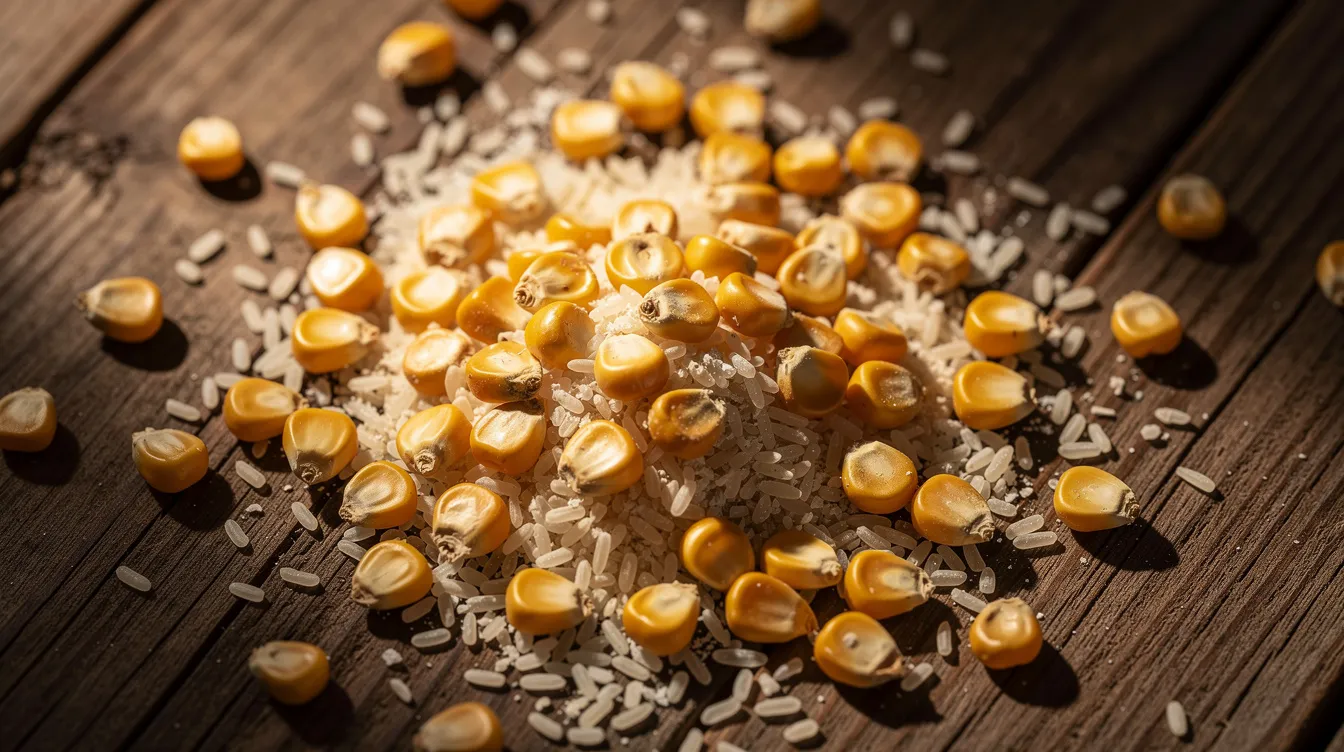
Maize and broken rice are available year-round for ethanol production, but they differ in starch content, yield, and market price. Maize at ₹26,000/MT yields roughly 400 litres of ethanol per tonne. Broken rice at ₹27,000/MT yields approximately 450 litres per tonne. The resulting per-litre feedstock cost: ₹65 for maize, ₹60 for rice. Agricultural residues like rice straw and bagasse are low-cost feedstocks for cellulosic routes, but for conventional grain-based production, the grain price and yield relationship drives the economics.
Enzymes, Yeast and Processing Chemicals
Enzymes for liquefaction and saccharification, yeast for fermentation, and nutrient chemicals together contribute approximately ₹0.90 to ₹1.00 per litre. Poor fermentation efficiency or microbial contamination raises this cost and reduces ethanol yield, directly cutting into profit. Process optimisation through dry milling, fermentation and distillation technology choices can lower enzyme loading and improve consistency.
Steam, Fuel and Boiler Operating Expenses
The boiler and steam system feeds cooking, distillation, and DDGS drying operations. Steam and fuel costs typically contribute ₹5 to ₹6 per litre. Coal, rice husk, briquettes, and natural gas are common fuel options; the choice depends on regional availability and price. For detailed norms, see the article on ethanol distillery boiler, steam, power and utilities requirements. Efficient condensate recovery and heat integration can reduce steam consumption per litre by 10-15%.
Electricity and Utility Costs
Key power loads include milling, pumps, agitators, centrifuges, cooling systems, and effluent treatment. Electricity cost per litre ranges from ₹0.50 to ₹1.00, depending on state tariff and whether the plant uses grid power or captive generation.
Water Treatment, ETP and ZLD Operating Expenses
Grain-based ethanol plants generate heavy effluent loads, requiring effluent treatment plants and often Zero Liquid Discharge systems. Chemicals, membrane replacement, sludge handling, and associated power consumption add approximately ₹1.50 to ₹2.00 per litre. For detailed guidance, refer to the article on ethanol plant water consumption, ETP and ZLD.
Labour, Maintenance and Plant Overheads
Operations, QA, maintenance, stores, security, and administration staff together add ₹0.40 to ₹1.00 per litre. These are largely fixed costs; higher capacity utilisation dilutes them across more litres produced.
Administrative Expenses and Logistics
Head-office expenses, insurance, statutory compliances, and ERP costs are part of realistic ethanol production cost models. Logistics and transportation costs are key components that influence the final landing cost of ethanol and raw materials. Grain transportation to the plant and ethanol, DDGS, and CO₂ dispatch to buyers can add ₹1 to ₹3 per litre depending on distance.
Depreciation and Finance Costs
Depreciation of plant, machinery, and civil works translates into a notional cost per litre in financial projections. Term loan interest and working capital interest affect total cost per litre, break-even, and net profit. These items are modelled in detail within ethanol plant project cost and means of finance structures and financial projections, working capital and DSCR analysis.
Cost Composition Summary (Grain-Based Ethanol)
| Cost Head | Approx. % of Manufacturing Cost |
|---|---|
| Feedstock (grains) | 65–75% |
| Steam / Fuel | 8–12% |
| Electricity / Power | 3–5% |
| Labour | 3–5% |
| Chemicals & Enzymes | 2–5% |
| Maintenance & Repairs | 2–4% |
| Admin, Logistics & Overheads | 2–4% |
Maize-Based vs Broken Rice-Based Ethanol Production Cost
In India’s grain-based ethanol ecosystem, the choice between maize and broken rice affects both ethanol production cost and by-product profile.
| Parameter | Maize | Broken Rice |
|---|---|---|
| Assumed grain price (₹/MT) | 26,000 | 27,000 |
| Ethanol yield (L/MT) | 400 | 450 |
| Raw material cost per litre (₹) | 65.00 | 60.00 |
| DDGS selling price (₹/tonne) | 12,500–15,500 | 22,000–29,000 |
A 10% increase in maize price (from ₹26,000 to ₹28,600 per MT) reduces the margin by roughly ₹0.92 per litre. The cheapest grain per tonne does not always produce the lowest cost per litre; yield and DDGS realisation matter equally. Detailed maize-based ethanol production cost and broken rice ethanol production cost assessments are typically developed during the DPR and feasibility report stage.
Ethanol Production Cost Calculation – Practical 100 KLPD Example
Consider a hypothetical 100 KLPD grain-based ethanol plant using maize. All figures below are illustrative.
- Installed capacity: 100 KLPD
- Annual operating days: 330
- Annual ethanol production: 33,000 KL (3.30 crore litres)
- Grain requirement at 400 L/MT yield: 82,500 MT/year
- Grain cost at ₹26,000/MT: ₹214.5 crore
| Cost Head | Annual (₹ crore) | Per Litre (₹) |
|---|---|---|
| Raw material (maize) | 214.50 | 65.00 |
| Steam & fuel | 18.48 | 5.60 |
| Electricity | 2.64 | 0.80 |
| Chemicals & enzymes | 3.30 | 1.00 |
| Labour & maintenance | 3.96 | 1.20 |
| ETP/ZLD & water | 5.94 | 1.80 |
| Admin & logistics | 2.31 | 0.70 |
| Total operating cost | 251.13 | 76.10 |
| Less: DDGS credit (~24,750 MT at ₹13,000/T) | (32.18) | (9.75) |
| Less: CO₂ credit | (0.99) | (0.30) |
| Net effective cost | 217.96 | 66.05 |
This gross manufacturing cost of ₹76.10 per litre and net effective cost of roughly ₹66 per litre are scenario-based. Actual results depend on grain contracts, energy cost, and plant performance.
Ethanol Selling Price and Revenue Calculation in India
Ethanol pricing in India is tightly regulated by the government based on feedstock types. Ethanol procurement prices vary across different feedstocks to incentivize production where needed. The EBP Programme guarantees procurement from oil marketing companies (OMCs) such as Indian Oil, Bharat Petroleum, and Hindustan Petroleum.
Ex-mill ethanol prices notified for ESY 2025-26 by the Ministry of Petroleum and Natural Gas:
| Feedstock | Ex-Mill Price (₹/L) |
|---|---|
| Maize | 71.86 |
| Damaged food grains / broken rice | 64.00 |
| Surplus FCI rice | 60.32 |
| Sugarcane juice | 65.61 |
Ethanol production from sugarcane juice is priced at ₹65.61 per litre. The ethanol procurement cost by oil marketing companies averages over ₹71 per litre for maize-based supply. Government policy revisions directly affect the baseline production and procurement economics of ethanol.
Annual ethanol sales revenue = Annual saleable ethanol litres × Net realised selling price per litre
For the 100 KLPD example at ₹71.86/L: annual ethanol revenue = 3.30 crore litres × ₹71.86 = ₹237.14 crore.
Additional Revenue from DDGS and CO₂ Recovery
Distillers Dried Grains with Solubles and recovered CO₂ are key by-products that reduce the effective ethanol manufacturing cost per litre. Ethanol producers who invest in quality DDGS drying and CO₂ purification capture incremental revenue that can determine whether the project operates at a healthy margin or barely breaks even.
For detailed economics, refer to the articles on DDGS production, revenue and profitability and CO₂ recovery plant cost and feasibility.
| By-Product | Annual Output | Realisation | Annual Revenue (₹ crore) | Per Litre (₹) |
|---|---|---|---|---|
| DDGS (maize) | 24,750 MT | ₹13,000/MT | 32.18 | 9.75 |
| CO₂ | ~3,300 MT | ~₹3,000/MT | 0.99 | 0.30 |
| Total | 33.17 | 10.05 |
By-product revenue should remain distinct from primary ethanol revenue in financial models. Conservative assumptions are advisable because DDGS market demand depends on poultry and aqua feed cycles, and corn oil extraction (common in Iowa ethanol plants and US markets) is not yet widely practised in Indian grain-based distilleries.
Profitability Analysis of a 100 KLPD Ethanol Plant
Combining the cost and revenue illustrations into an annual view:
| Line Item | ₹ Crore | Per Litre (₹) |
|---|---|---|
| Ethanol sales | 237.14 | 71.86 |
| DDGS revenue | 32.18 | 9.75 |
| CO₂ revenue | 0.99 | 0.30 |
| Total revenue | 270.31 | 81.91 |
| Total operating expenses | 251.13 | 76.10 |
| EBITDA | 19.18 | 5.81 |
| EBITDA margin | ~7.1% | |
| Depreciation (illustrative) | 6.00 | 1.82 |
| Interest (illustrative) | 5.50 | 1.67 |
| PBT | 7.68 | 2.33 |
Ethanol production gross profit margins range from 20-30% when measured as contribution margin (selling price minus variable costs) rather than EBITDA. Net profits for ethanol averaged $0.21 per gallon in 2025 based on US data tracked on Farmdoc Daily, though Indian margins differ because of regulated pricing and by-product economics.
For rigorous project appraisal, including IRR and DSCR, promoters should commission customised financial projections and financial modelling and review the detailed ethanol plant ROI, IRR, payback and sensitivity analysis framework.
Ethanol Plant Profitability – 30, 60, 100 and 200 KLPD Comparison
Capacity determines how effectively fixed costs are absorbed across each litre of ethanol produced. A 30 KLPD ethanol plant requires an investment of ₹50-60 crore, while larger plants of 100,000 to 200,000 KL annual capacity demand proportionally higher capital but benefit from lower per-litre overheads. Ethanol production plants typically require 12-18 months for setup regardless of capacity chosen.
| Parameter | 30 KLPD | 60 KLPD | 100 KLPD | 200 KLPD |
|---|---|---|---|---|
| Annual production (crore litres) | ~0.99 | ~1.98 | ~3.30 | ~6.60 |
| Relative fixed cost per litre | Highest | Moderate | Lower | Lowest |
| Capital investment trend | ₹50-60 Cr | ₹90-110 Cr | ₹140-170 Cr | ₹260-320 Cr |
| EBITDA margin pattern | Narrowest | Moderate | Healthy | Widest |
A 200 KLPD ethanol plant generating 6.60 crore litres annually at ₹71.86/L would produce ethanol revenue of approximately ₹474 crore before by-products. For a capacity-planning framework covering investment, market demand, and infrastructure requirements, see the article on ethanol plant capacity planning from 30 to 200 KLPD.
Factors Affecting Ethanol Production Profitability
Feedstock price volatility impacts the cost structure of ethanol production more than any other single variable. A seasonal spike in maize prices from ₹26,000 to ₹30,000 per MT raises per-litre raw material cost by ₹10 without any change in selling price. Operating costs are expected to rise due to inflation and market fluctuations in fuel, power tariffs, and chemicals.
Other critical factors: ethanol yield and fermentation efficiency (higher litres per tonne reduce per-litre cost), capacity utilisation (fixed costs spread thinner at higher throughput), DDGS and CO₂ market access, and working capital interest. The renewable fuel standard framework used in countries like the United States and India’s own EBP Programme both create policy floors for demand, but procurement price revisions and feedstock approvals introduce regulatory uncertainty.
A professional ethanol distillery feasibility study should quantify these drivers and test multiple scenarios.
Sensitivity Analysis – What Happens When Costs or Prices Change?
Using the 100 KLPD base case (EBITDA ₹5.81/L):
| Scenario | Change | EBITDA Impact per Litre |
|---|---|---|
| Grain price +10% | Raw material cost rises ₹6.50/L | EBITDA drops to ~₹-0.69/L |
| Ethanol yield -5% | More grain per litre | EBITDA drops by ~₹3.25/L |
| Steam & power +10% | Utility cost rises ₹0.64/L | EBITDA drops to ~₹5.17/L |
| Selling price -5% | Revenue falls ₹3.59/L | EBITDA drops to ~₹2.22/L |
| Utilisation 90% → 80% | Fixed costs spread over fewer litres | EBITDA drops by ~₹0.80/L |
A 10% grain price increase alone can eliminate EBITDA entirely. Ethanol plants can achieve operational efficiency improvements of up to 15% through process optimisation, which provides a buffer against cost escalation.
Break-Even Analysis for Grain-Based Ethanol Plants
Contribution per litre equals selling price minus variable costs per litre. If contribution is approximately ₹10 per litre and annual fixed operating costs are ₹12 crore, the break-even volume is 1.20 crore litres, or roughly 36% of a 100 KLPD plant’s annual capacity. Financial break-even, including interest and depreciation, requires higher utilisation, typically above 85-90%.
Detailed break-even and DSCR analysis forms part of the complete DPR and bank finance package.
How to Improve Ethanol Plant Profitability
Procurement strategies matter: long-term contracts with farmers or aggregators, diversification across maize, broken rice, and other permitted food grains, and using damaged food grains where policy allows. Upgrading enzymes and yeast, automating CIP systems, and improving fermentation control can lift ethanol yield per tonne. Boiler efficiency improvements, condensate recovery, and variable frequency drives reduce energy cost per litre. Improving DDGS quality and targeting specialised feed markets (poultry, aquaculture) captures price premiums. Better working capital planning and competitive interest rate negotiation improve net profit per litre. The environmental impact of production can be managed through ZLD compliance and efficient water use, reducing both risk and long-term operating expenses. Reducing carbon emissions through biomass-based fuel and energy recovery also aligns with evolving regulatory expectations.
Importance of a Detailed Project Report for Ethanol Plant Investment
Preparation of Detailed Project Reports is essential for project finance and feasibility analysis in India. Banks evaluate project cost, means of finance, feedstock sourcing, manufacturing economics, five-to-seven-year financial projections, DSCR, and sensitivity analysis before sanctioning term loans. Ethanol plants need approvals from local and central governments, and the DPR documents the complete compliance and feasibility roadmap.
The government provides an interest subvention of 6% for ethanol loans under certain schemes, and the government supports ethanol production through viability gap funding. These incentive mechanisms increase the importance of a well-structured DPR that accurately reflects production efficiency, supply chain arrangements, and realistic profitability assumptions.
Generic templates or borrowed feasibility reports often fail at the appraisal stage. Customised, location-specific DPRs prepared by experienced professionals reduce the risk of underestimating ethanol production cost or overestimating revenue.
Professional Ethanol Plant DPR and Financial Advisory Services
CA Manish Gugliya, FCA, DISA (ICAI), leads Project Report Bank with more than 20 years of experience in project finance, DPR preparation, and manufacturing project advisory. Services include customised ethanol plant DPRs for bank finance and loan proposals, financial modelling for 30-200 KLPD grain-based plants, CMA Data preparation, and project feasibility studies specific to ethanol and biofuel projects. Advisory assignments are tailored to project size, feedstock choice, technology, and funding plan.
Serious promoters can share preliminary project details over WhatsApp to initiate a consultation. Phone and email remain available as secondary options.
Frequently Asked Questions
What is the ethanol production cost per litre in India for grain-based plants?
Gross manufacturing operating cost for a grain-based ethanol plant typically falls between ₹70 and ₹76 per litre, depending on whether maize or broken rice is used. Net cost per litre drops by ₹8 to ₹12 after adjusting for DDGS and CO₂ credits. Promoters must estimate their own project-specific cost using actual raw material, utility, and labour assumptions rather than relying on a single industry average.
Is maize-based ethanol production always cheaper than broken rice-based ethanol?
No. Maize-based ethanol production cost is not automatically lower. The relative cost per litre depends on local grain prices, ethanol yield per tonne, logistics cost, and DDGS realisation. In regions where broken rice is abundantly available at competitive prices and offers higher yield per tonne, rice-based production can be more economical. Promoters should compare at least two or three feedstock scenarios in their DPR.
How much revenue can a 200 KLPD ethanol plant generate annually?
At 200 KLPD with 330 operating days and a net realisation of ₹71.86 per litre, annual ethanol revenue reaches approximately ₹474 crore before by-product income. DDGS and CO₂ revenue could add another ₹60-70 crore depending on output and market conditions. Working capital requirements and grain sourcing arrangements must scale accordingly, adding both opportunity and risk.
What determines the break-even capacity of an ethanol distillery?
Break-even capacity depends on contribution per litre (selling price minus variable costs) and total fixed operating costs. For a 100 KLPD plant with illustrative contribution of ₹10 per litre and ₹12 crore in annual fixed costs, operating break-even occurs at roughly 36% of capacity. Financial break-even including depreciation and interest requires higher utilisation, typically 85-90% or above.
Why is a DPR important before investing in an ethanol plant?
A professionally prepared DPR identifies realistic ethanol production cost per litre, working capital needs, DSCR, break-even capacity, and sensitivity to grain price and ethanol price fluctuations before the promoter commits capital. Lenders expect detailed, professionally prepared documents that demonstrate repayment capacity and project viability across multiple scenarios. Engaging specialists reduces the risk of cost underestimation or profitability overstatement at the planning stage.
Conclusion
Ethanol production cost per litre in India is shaped primarily by grain procurement economics, conversion efficiency, and energy costs. By-product revenues from DDGS and CO₂ recovery can improve margins, but the base case profitability remains sensitive to feedstock price movements, capacity utilisation, and the government-notified ethanol procurement price under the EBP Programme.
Each ethanol manufacturing project must be evaluated on its own merits through realistic financial projections, sensitivity analysis, and a bankable feasibility report. Entrepreneurs and project promoters planning 30-200 KLPD grain-based ethanol plants can connect with Project Report Bank via WhatsApp for customised DPRs, financial modelling, and project finance advisory by CA Manish Gugliya.