Key Takeaways
- Grain-based ethanol plants are capital-intensive projects where a 100 KLPD facility may require ₹150–200 crore in total investment. Even small errors in assumptions around maize price, ethanol realisation or capacity utilisation can shift project IRR by several percentage points and extend payback by years.
- Ethanol plant ROI should not be evaluated using a single metric. Lenders and investors examine project IRR, equity IRR, NPV, DSCR and sensitivity analysis together rather than relying on headline profit margins alone.
- Maize and broken rice prices, DDGS by-product realisation, capacity utilisation levels and energy costs are typically the biggest drivers of ethanol plant investment returns in India.
- Building and operating an ethanol plant yields an annual return on investment ranging from 15% to 35%, but actual outcomes depend entirely on project-specific execution, feedstock efficiency, operational scale and market dynamics.
- Project Report Bank, led by CA Manish Gugliya, FCA, DISA (ICAI), provides professional DPR preparation, financial modelling and project finance advisory for ethanol distillery promoters seeking bankable investment decisions.
Introduction – Why ROI, IRR and Payback Matter in Ethanol Projects
India’s ethanol industry has entered a phase of significant market expansion. The Indian government aims for 20% ethanol blending by 2025, driven through the Ethanol Blended Petrol (EBP) Program that guarantees procurement from oil marketing companies. The ethanol market size was valued at USD 104.80 billion in 2025, and India’s ethanol market is projected to reach USD 158.45 billion by 2034. This strong ethanol demand, backed by government policies promoting renewable energy sources and reducing carbon emissions, has generated considerable interest in grain-based ethanol plants using maize, broken rice and other grains as feedstock. Ethanol production primarily uses sugarcane, maize and rice, and ethanol can also be produced from damaged food grains to prevent wastage.
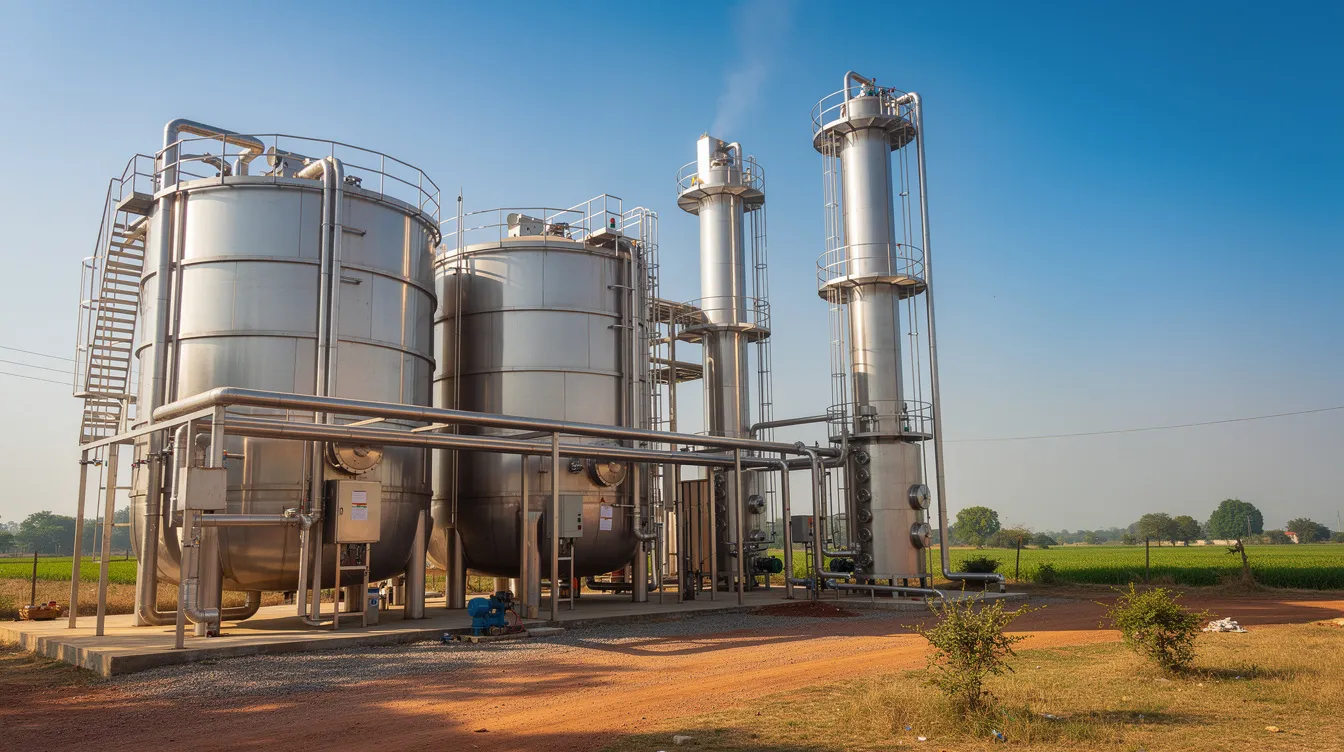
An ethanol manufacturing plant is a long-term, capital-intensive asset. A 30 KLPD ethanol plant requires an investment of ₹50–60 crore, investment for a medium plant of 50–60 KLPD is approximately ₹85–90 crore, and larger capacities of 100–200 KLPD can require ₹150–300+ crore. The capital expenditure is high due to specialised machinery and environmental compliance costs, and a typical ethanol plant requires 12–18 months to commission. With this scale of commitment, understanding ethanol plant ROI before deploying equity and debt is not optional – it is essential.
Optimistic “high margin” pitches are not sufficient for investment decisions of this magnitude. Promoters, banks and investors need structured evaluation of ROI, IRR, NPV, payback period, break even and DSCR based on realistic capacity utilisation and cost assumptions. Government support through the Interest Subvention Scheme and Viability Gap Funding helps stabilise project economics, but the financial viability of an ethanol plant remains sensitive to market prices and regulatory frameworks. This article examines each of these financial metrics with illustrative calculations, sensitivity analysis and practical risk assessment.
Planning a Grain-Based Ethanol Plant in India? CA Manish Gugliya, FCA, DISA (ICAI), provides professional assistance in preparing Detailed Project Reports (DPR), CMA Data, project financial models, ROI and IRR evaluations, sensitivity analysis, and bank finance proposals. For project-specific advisory and financial projections, contact CA Manish Gugliya through WhatsApp via ProjectReportBank.com.
Understanding Ethanol Plant ROI (Return on Investment)
Ethanol plant ROI measures annual return as a percentage of total project investment. Promoters commonly use it for a quick sanity check on whether the project generates adequate returns relative to the capital deployed.
Formula: ROI (%) = (Annual Return ÷ Total Project Investment) × 100
The critical question is how “annual return” is defined. This should be the average annual profit after tax or average annual free cash flow, not a single year’s peak performance. Accounting profit, EBITDA and free cash flow are different measures for a grain-based ethanol manufacturing plant. Depreciation reduces accounting profit but does not consume cash. Interest and principal repayments consume cash but affect equity returns differently from operating margins. Ethanol gross profit margins typically range between 20–30%, but net margins after depreciation, interest and tax are considerably lower.
Illustrative Example: Consider a 100 KLPD grain-based ethanol plant with a total project cost of ₹180 crore and an average annual profit after tax of approximately ₹27 crore at stabilised operations. The simple ROI would be approximately 15%. These figures are purely illustrative.
Simple ROI has significant limitations: it ignores the timing of cash flows, does not distinguish between early and late cash generation, and can mislead when comparing ethanol plants with different capacities, lifespans or ramp-up patterns. This is precisely why IRR and NPV provide a more robust decision framework.
Ethanol Plant IRR – Project IRR vs Equity IRR
Internal Rate of Return is the discount rate at which the net present value of project cash flows becomes zero. Unlike simple ROI, IRR explicitly incorporates the time value of money.
Two distinct IRR measures are relevant for ethanol projects:
- Project IRR (unlevered): Calculated using free cash flows before interest and principal repayment. This measures the economic attractiveness of the ethanol plant independent of financing structure.
- Equity IRR (levered): Calculated using cash flows remaining after debt service. Leverage can amplify equity IRR when project returns exceed borrowing cost, but it also magnifies downside risk.
Cash flow components for a grain-based ethanol plant typically include initial capital expenditure in Year 0, ramp-up of EBITDA over Years 1–3, stabilised operations from Year 3 onward, working capital movements, tax outflows, and terminal or salvage value at the end of plant life.
Published case studies illustrate observed ranges. A grain-based ethanol distillery in Purnia, Bihar with ₹400 crore CapEx showed a post-tax project IRR of approximately 21.6% with a payback period of 5.4 years. A 60 KLPD project by Ark Bioenergies in Karnataka showed an equity IRR of approximately 23.5% and DSCR of 2.2×. These are project-specific outcomes, not guaranteed benchmarks.
Lenders normally focus on project IRR and DSCR, while promoters and equity investors pay closer attention to equity IRR. Excessively high equity IRR projections based on aggressive leverage can be risky if ethanol prices or feedstock costs move adversely.
Ethanol Plant Payback Period Calculation
Payback period is the time required for cumulative cash inflows to recover the initial investment. The payback period for ethanol plants typically ranges from 3 to 5 years in well-structured projects with government incentives.
Simple Payback uses undiscounted cumulative annual cash flows. If a 100 KLPD ethanol plant generates approximately ₹40 crore annual free cash flow against a ₹180 crore investment, simple payback would be roughly 4.5 years. This ignores the time value of money entirely.
Discounted Payback applies a chosen discount rate (for example, 12%) to each year’s cash flow before accumulation. This method better reflects the true cost of capital and risk. Discounted payback will always be longer than simple payback for the same project.
A shorter payback does not automatically indicate a superior project. It ignores cash flows beyond the payback year and may favour smaller or under-invested plants that have weaker long-term competitiveness. Bankable DPRs for ethanol projects present both payback measures alongside IRR, NPV and DSCR to provide decision-makers a complete picture.
NPV Analysis of a Grain-Based Ethanol Plant
Net present value is the sum of discounted future cash flows minus the initial investment. A positive NPV at the promoter’s required rate of return implies that the ethanol project creates economic value beyond the minimum acceptable return.
Selecting an appropriate discount rate requires considering cost of equity, cost of debt, project risk, policy stability and alternative investment opportunities. For Indian ethanol projects, a weighted average cost of capital in the range of 12–14% is commonly used in financial modelling.
The relationship between NPV and IRR is straightforward: if the project IRR exceeds the chosen discount rate, NPV is positive. If IRR falls below the required return, NPV turns negative even if accounting profits appear healthy.
A professionally prepared ethanol distillery detailed project report integrates NPV analysis with sensitivity scenarios, which is often reviewed closely by banks, NBFCs and institutional investors before sanctioning large debt facilities.
Illustrative ROI, IRR and Payback Analysis for a 100 KLPD Ethanol Plant
The following analysis is entirely illustrative and uses clearly stated assumptions. These figures are not industry benchmarks or guaranteed returns. Ethanol production can create 200–300 jobs per 100 KLPD plant, and ethanol plants typically require 1 to 10 acres of land depending on configuration.
Assumptions and Plant Parameters
| Parameter | Assumption |
|---|---|
| Installed capacity | 100 KLPD |
| Operating days | 330 per year |
| Capacity utilisation (stabilised) | 85% |
| Annual ethanol production | ~2.81 crore litres |
| Ethanol selling price | ₹58 per litre |
| DDGS yield | ~10 kg per litre of ethanol produced |
| DDGS selling price | ₹25,000 per MT |
| Total project cost | ₹180 crore |
| Debt : Equity | 70:30 (₹126 crore : ₹54 crore) |
| Term loan interest rate | 12% (before subvention) |
| Loan tenure | 10 years with 1-year moratorium |
Machinery costs represent 50–70% of project costs, and ethanol production requires high-quality, corrosion-resistant machinery including fermentation tanks, heat exchangers and milling equipment, along with storage tanks for raw material and finished ethanol.
Stabilised Year Financial Snapshot (Illustrative)
| Item | ₹ Crore (Approx.) |
|---|---|
| Ethanol sales revenue | 163.0 |
| DDGS and by-product revenue | 70.3 |
| Total revenue | 233.3 |
| Raw material cost (~65% of revenue) | 151.6 |
| Utilities, energy, water | 23.3 |
| Labor costs, maintenance, overheads | 16.3 |
| Total operating costs | 191.2 |
| EBITDA | 42.1 |
| Depreciation | 12.0 |
| Interest | 13.0 |
| Profit before tax | 17.1 |
| Tax (~25%) | 4.3 |
| Net profit after tax | 12.8 |
Ethanol production costs are primarily driven by raw material expenses, accounting for 70–80% of total costs. Energy costs are a significant component of operational costs, and operational costs include labor, utilities and maintenance. Ethanol production requires substantial energy and water inputs.
Derived Financial Metrics (Illustrative)
| Metric | Illustrative Value |
|---|---|
| Simple ROI (avg. annual PAT / investment) | ~14–16% |
| Project IRR (unlevered, 12-year horizon) | ~18–21% |
| Equity IRR (levered) | ~22–26% |
| NPV at 12.5% discount rate | Positive |
| Simple payback | ~4.5–5.5 years |
| Discounted payback | ~6–7 years |
| Average DSCR | ~1.6–2.0× |
By-product revenue from co-products such as DDGS improves the net operating margin of ethanol plants. These results assume stable operations, consistent feedstock supply from reliable suppliers and timely payments from OMCs. Actual outcomes will vary based on location, execution quality and market conditions.
Ethanol Plant Sensitivity Analysis – Major Profitability Drivers
Sensitivity analysis examines how changes in key assumptions impact ethanol plant ROI, IRR, NPV and payback. Investors should model different scenarios for price and operational outcomes when assessing ethanol projects. This is a standard requirement for investor-ready DPRs and bank appraisals.
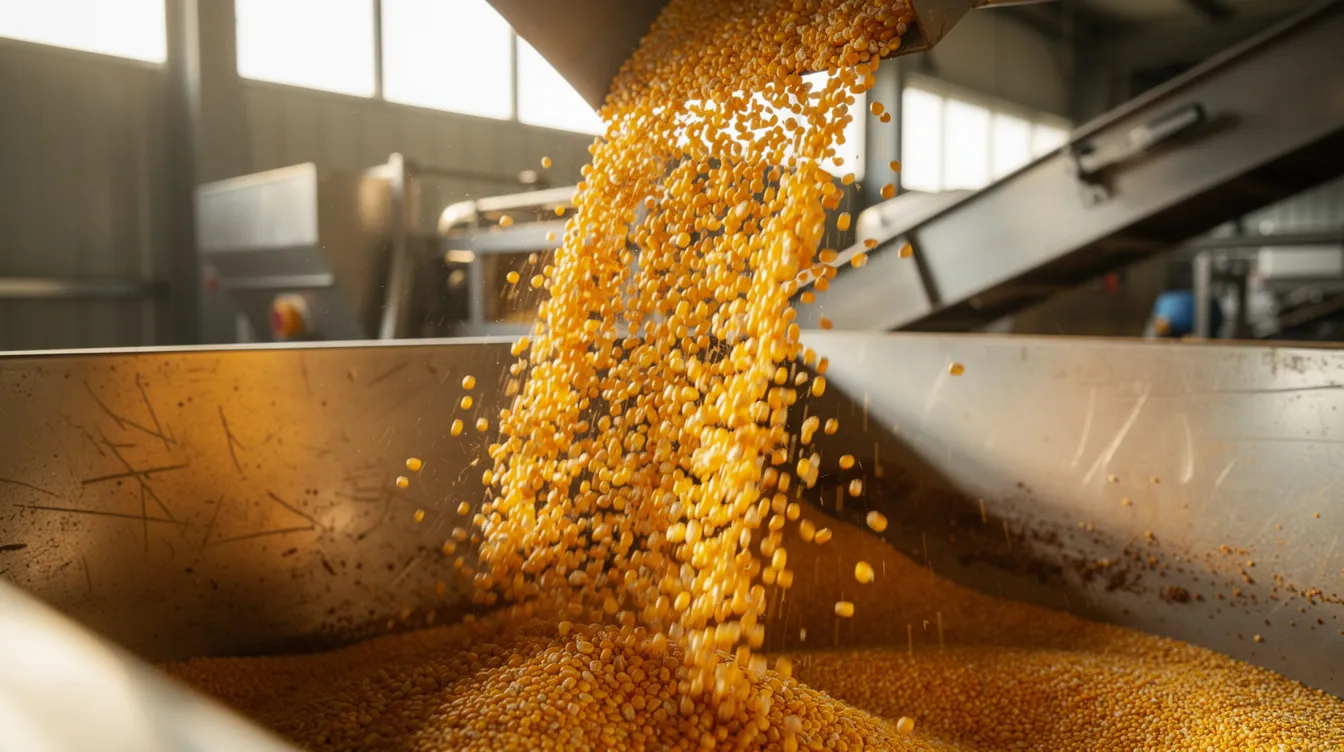
The financial viability of an ethanol plant is sensitive to market prices. Market risk arises from fluctuations in price and demand for both ethanol and its by-products. The major sensitivity variables for grain-based ethanol plants are maize and broken rice procurement cost, ethanol selling price, capacity utilisation, DDGS realisation and energy costs. Ethanol production requires reliable suppliers for consistent raw material quality, and raw material availability directly impacts production cost stability.
Illustrative Sensitivity Table (Impact on Base Case)
| Scenario | EBITDA Impact | Project IRR Impact | Payback Impact |
|---|---|---|---|
| Base case | – | ~19% | ~5 years |
| Raw material cost +5% | -₹7.6 crore | ~16–17% | +0.5–1 year |
| Raw material cost +10% | -₹15.2 crore | ~14–15% | +1–1.5 years |
| Ethanol price –5% | -₹8.2 crore | ~15–16% | +0.5–1 year |
| DDGS realisation –10% | -₹7.0 crore | ~16–17% | +0.5 year |
| Capacity utilisation at 70% | -₹8.5 crore | ~14–16% | +1–2 years |
| Combined downside | -₹25+ crore | ~10–12% | +2–3 years |
A ₹500/tonne increase in maize procurement cost translates into roughly ₹1.5–2.0 per litre increase in production cost, which directly erodes EBITDA margin and IRR. Price volatility in agricultural raw material markets is a persistent challenge. High-quality feedstock and efficient utilisation are critical for maximising profitability in ethanol production. Capacity utilisation significantly influences the financial outcomes of ethanol plants.
Break-Even Analysis for Ethanol Distilleries
Break-even analysis identifies the production volume at which total revenue equals total cost. Two types are relevant:
- Operating break even: Includes depreciation and interest; represents the production level needed to avoid accounting losses.
- Cash break even: Focuses on cash expenses and debt service; represents the minimum output needed to meet all cash obligations.
For a 100 KLPD ethanol plant, fixed and variable costs must be separated. Fixed costs include salaries, insurance, certain utility minimums and overheads. Variable costs include raw materials, process chemicals, variable power and steam, and transportation costs. The contribution margin per litre is the difference between selling price and variable cost per litre.
Break-even for ethanol manufacturing typically ranges from 3 to 5 years. If total annual fixed costs are approximately ₹35 crore and contribution margin is roughly ₹20 per litre, the break-even volume would be approximately 1.75 crore litres, representing about 53% of rated capacity. This provides a comfortable buffer if planned utilisation is 85%. Lenders verify that forecast capacity utilisation comfortably exceeds break even across normal and stress scenarios. For detailed project costing and viability insights, a structured feasibility study is essential.
Comparison of Investment Returns Across 30, 60, 100 and 200 KLPD Plants
Plant capacity directly affects capital intensity, operating leverage and working capital needs. A large plant does not automatically guarantee higher percentage ethanol plant ROI.
Illustrative Comparative Overview
| Parameter | 30 KLPD | 60 KLPD | 100 KLPD | 200 KLPD |
|---|---|---|---|---|
| Indicative project cost | ₹50–60 crore | ₹85–145 crore | ₹150–200 crore | ₹250–400 crore |
| Cost per KLPD | ₹1.7–2.0 crore | ₹1.4–2.4 crore | ₹1.5–2.0 crore | ₹1.25–2.0 crore |
| Fixed cost per litre | Higher | Moderate | Lower | Lowest |
| Feedstock sourcing radius | Smaller | Moderate | Wider | Widest |
| Working capital intensity | Moderate | Moderate | Higher | Highest |
Economies of scale favour larger grain-based ethanol plants through lower fixed cost per litre and better bargaining power. However, a 200 KLPD plant faces challenges in assured maize or broken rice availability over wider distances, higher distribution costs and greater financing complexity. Smaller production plant capacities may reach operating break even at lower absolute volumes but struggle with higher per-litre utilities, manpower and overhead costs. Detailed capacity planning and ROI comparison are best handled through project-specific financial models. The competitive landscape varies significantly by region, and ethanol plants need reliable suppliers for raw materials across all capacity ranges. Ethanol manufacturers must align their plant design and automation level with realistic raw material catchment and OMC offtake visibility.
Financial Risks Affecting Ethanol Plant ROI and IRR
The major financial risks that can materially alter ethanol plant investment returns include:
- Raw material price volatility: Agricultural price cycles can shift maize and broken rice costs by 10–20% across seasons, directly compressing margins. Agricultural residues like rice straw and bagasse offer alternative low-cost feedstocks but have yield limitations.
- Policy and regulatory changes: Ethanol procurement pricing by the Indian government, environmental regulations, state excise policies and import dependency considerations can all impact realisation.
- Commissioning delays: A 3–4 month delay increases interest during construction and reduces equity IRR materially when heavy term loans are involved.
- Capital cost escalation: Rising steel, equipment and labour costs can push actual CapEx 10–15% above estimates, straining project economics.
- Working capital constraints: Inability to procure affordable maize in peak season or delayed receivables from OMCs stress cash flows and DSCR even if the P&L appears profitable.
- Environmental compliance costs: ETP and ZLD systems, water charges and liquid discharge treatment can add significant unbudgeted CapEx and OpEx if not planned correctly. Environmental impact assessments and government approvals add to timelines and costs. Environmental concerns around water sourcing and effluent management require careful budgeting.
Practical risk mitigation includes conservative assumptions in the detailed project report, adequate contingency in project cost, feedstock procurement contracts, moderated leverage, and robust sensitivity analysis shared with lenders. Investors must conduct rigorous due diligence before committing to ethanol projects to understand the associated risks and returns.
What Banks and Investors Examine in Ethanol Project Returns
Banks, NBFCs and institutional investors appraise ethanol distillery DPRs by examining project IRR, equity IRR, NPV at a reference discount rate, average and minimum DSCR, payback and promoter contribution ratio. Government procurement and blending policies provide revenue visibility for ethanol producers, which strengthens the bankability of projects, and government incentives often play a crucial role in stabilising revenue for ethanol production facilities. Ethanol demand is maintained by government mandates for blending with fuel use, and the Indian government funds ethanol production through various schemes.
Project IRR measures overall economic attractiveness, while DSCR evaluates capacity to service term loans from annual cash flows. A project may show attractive IRR but still fail DSCR norms if debt is too high or repayment is too front-loaded. Lenders assess sensitivity cases to ensure DSCR remains within acceptable minimum thresholds even under downside conditions.
Transparent, well-structured CMA Data, realistic financial projections and reconciled assumptions increase confidence among credit committees. Professional bank finance DPR preparation and financial modelling services help ensure that expenditure projections, supply chain assumptions and financial analysis meet institutional standards.
How to Improve Ethanol Plant Investment Returns
Improving ethanol plant ROI requires operational efficiency and financial discipline rather than unrealistic assumptions about pricing or demand.
- Feedstock procurement: Long-term arrangements with farmers and aggregators, strategic location near maize or broken rice belts, and timing bulk purchases to seasonal price patterns help stabilise raw material costs.
- Plant design and capacity optimisation: Selecting appropriate capacity based on raw material catchment and OMC offtake visibility, and investing in reliable technology to minimise downtime. Modern ethanol plants can significantly reduce operational costs through advanced technology such as cogeneration units. Ethanol production can achieve operational cost reductions of up to 15% through efficient operations.
- Energy efficiency: Efficient boilers, steam and power integration, waste heat recovery and cogeneration improve margins meaningfully. Ethanol serves as an alternative fuel and fuel additive, and the production process benefits from integrated energy systems.
- Financial structuring: Balanced debt-equity ratio, realistic moratorium and repayment schedule, adequate working capital lines and contingency provisions. Disciplined project execution and avoidance of unnecessary CapEx materially support stronger project IRR and payback.
The overall profitability of ethanol plants depends on a combination of feedstock efficiency, operational scale and market dynamics. Key players in the ethanol industry, including entities like Archer Daniels Midland Company globally, demonstrate that scale and supply chain integration matter significantly. While India’s ethanol producers operate in a different market context, the principles of long term sustainability, cost discipline and solid foundation in financial planning apply universally. Government policies also support this sector as ethanol serves not only as a profitable business opportunity but contributes to reducing fossil fuels dependency and supporting India’s import dependency reduction goals. Ethanol also finds applications beyond fuel use, including in the pharmaceutical industry and as a component in alcoholic beverages production.
Role of a Professional DPR and Financial Feasibility Study
A well-prepared ethanol distillery DPR integrates technical configuration, plant layout, machinery sizing, cost breakdown and comprehensive financial modelling tailored to the specific location, capacity and feedstock strategy. It should include detailed project cost, means of finance, projected P&L, cash flows, balance sheets, DSCR analysis, break-even analysis, ROI, IRR, NPV and multi-variable sensitivity analysis. A structured project feasibility study helps promoters decide whether to proceed, scale up, downsize or phase a grain-based ethanol project before committing major capital.
Project Report Bank, led by CA Manish Gugliya, FCA, DISA (ICAI), specialises in customised ethanol plant DPRs, financial modelling, CMA Data preparation and project viability evaluation across different capacities from 30 to 200 KLPD.
Professional DPR and Financial Modelling Services start from ₹25,000, subject to project scope and complexity. For project-specific advisory and financial feasibility assessment, contact CA Manish Gugliya through WhatsApp via ProjectReportBank.com.
Frequently Asked Questions
Is there a standard ROI for ethanol plants in India?
There is no universal standard. Ethanol plant ROI varies widely by feedstock, capacity, cost of finance, location and execution quality. Published case studies suggest project IRR ranges of 16–24% for grain-based ethanol plants, but only project-specific modelling using realistic assumptions can produce a meaningful figure for a given proposal.
How should promoters choose between maize and broken rice?
The choice depends on local raw material availability, seasonal price patterns and DDGS yield differences. Maize generally provides better ethanol yield per tonne but prices fluctuate with agricultural cycles. Broken rice availability varies by region. A multi-feedstock ethanol distillery approach can help manage this risk.
What is the typical timeline from project conception to stabilised returns?
From government approvals to commissioning, ethanol plants typically require 12–18 months. Most plants take an additional 1–2 years to reach stable capacity utilisation of 80–85%. Stabilised returns are therefore usually observable from Year 3 onward.
Does adding CO₂ recovery improve project IRR?
Ethanol co-products such as recovered carbon dioxide can add secondary revenue streams for plants where local industrial demand exists. However, the additional CapEx must be justified by realistic offtake contracts and pricing. A CO₂ recovery plant feasibility assessment should be conducted before including it in the project report.
How does capacity utilisation affect ethanol plant ROI?
Capacity utilisation is one of the strongest drivers. Operating at 70% versus 90% utilisation can reduce annual revenue by approximately 22%, while fixed costs remain largely unchanged. This directly compresses EBITDA, extends payback and can push DSCR below acceptable thresholds.
Conclusion – Evaluating Ethanol Investments Beyond Headline Returns
Ethanol manufacturing plants in India offer significant opportunity due to strong ethanol demand and supportive government policy. However, investment decisions must be driven by rigorous financial analysis covering ROI, IRR, NPV, payback, DSCR and sensitivity analysis rather than policy headlines or generic profitability claims alone. Ethanol produced through grain-based routes can be a profitable business, but the numbers must be defensible.
Integrated financial modelling, conservative assumptions on maize and broken rice cost, realistic ethanol pricing and disciplined capacity utilisation planning are essential for sustainable ethanol plant investment returns across market cycles. The ethanol industry will continue to grow, but individual project success depends on execution quality and financial discipline.
For entrepreneurs and manufacturers planning grain-based ethanol plants, Project Report Bank provides customised DPRs, CMA Data, bank finance documentation and financial modelling tailored to specific capacity and location requirements. Reach out for a project-specific consultation.
Written by CA Manish Gugliya, FCA, DISA (ICAI) Practising Chartered Accountant | 20+ Years of Professional Experience Specialising in Detailed Project Reports, Project Finance, Financial Modelling, CMA Data, and Industrial Project Advisory.