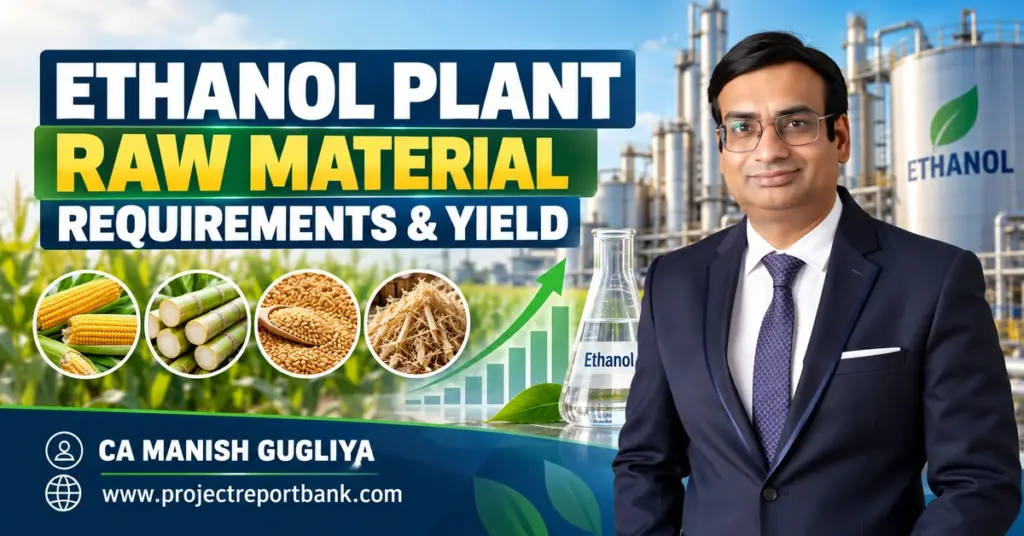
Key Takeaways
Ethanol plant raw material requirements refer to the type, quantity, quality and procurement logistics of grain feedstock needed to operate a grain-based ethanol distillery at its planned capacity. Getting these assumptions right is the single most important determinant of whether a project’s financial model holds up under scrutiny.
- For a typical Indian grain-based ethanol production plant, daily grain requirement in MT/day equals planned ethanol output in litres/day divided by practical ethanol yield in litres/MT. A 100 KLPD maize-based plant may need approximately 250–265 MT of maize per day.
- Indicative industrial ethanol yield in India ranges from approximately 380–400 litres per MT for maize and 400–450 litres per MT for broken or surplus rice, depending on starch content, moisture and plant efficiency.
- Raw materials account for roughly 60–75% of the production cost per litre. Even a 5% variation in practical yield or a ₹1,000/MT shift in grain price can materially alter DSCR, IRR and working capital requirements.
- Later sections provide ready-reference grain consumption tables for 30, 60, 100 and 200 KLPD plants, a maize versus broken rice comparison and a project finance perspective from Project Report Bank.
Introduction – Why Raw Material Planning Matters for Ethanol Projects
India targets 20% ethanol blending with petrol by 2025 under the Ethanol Blended Petrol programme, with ethanol production capacity required to reach approximately 1,700 crore litres. India’s ethanol demand is projected at roughly 10 billion litres, and the government supports locally produced ethanol for blending while banning imported ethanol for this purpose. Grain-based ethanol capacity must rise significantly to avoid shortages in meeting this national target.
In practical terms, ethanol plant raw material requirements encompass the type of grain used, the daily and annual quantity consumed, quality parameters such as starch percentage, moisture and foreign matter, and the logistics needed to supply a 30–200 KLPD ethanol production plant without interruption. Two distilleries with the same installed capacity can have very different production cost structures depending on feedstock prices, ethanol production yield per ton of grain and achievable plant utilisation.
The feedstocks eligible for grain-based ethanol production in India include maize (corn), broken rice, surplus or damaged foodgrains and other starchy grains, as permitted under the National Policy on Biofuels (2018, amended 2022). From a project finance perspective, bankers and investors closely scrutinise raw material assumptions in a Detailed Project Report because these assumptions directly drive working capital, DSCR, IRR and overall project viability. Optimistic yield numbers without technical support can undermine the credibility of an entire financial projection.
Readers planning capacity-level decisions can cross-reference raw material assumptions with the concepts covered in Project Report Bank’s article on ethanol plant capacity planning from 30 to 200 KLPD.
Major Raw Materials Used in Grain-Based Ethanol Plants
Ethanol production relies on feedstocks rich in sugars, starch or cellulose. Broadly, feedstocks for ethanol production include sugar-based, starch-based and lignocellulosic biomass categories. Sugar-based feedstocks include sugarcane juice, molasses and sugar beet and require the least preparation for fermentation. Starch-based feedstocks include corn, wheat and cassava, and form the backbone of grain-based ethanol plants in India. Grain-based plants predominantly use starchy grains and milling by-products, subject to current biofuel policy and food-security safeguards.
Common evaluation parameters across all feedstocks include typical starch content, moisture range, oil and fibre content, ethanol yield per MT, regional availability, price volatility and storage behaviour under Indian climatic conditions.
Maize (Corn) as a Primary Feedstock
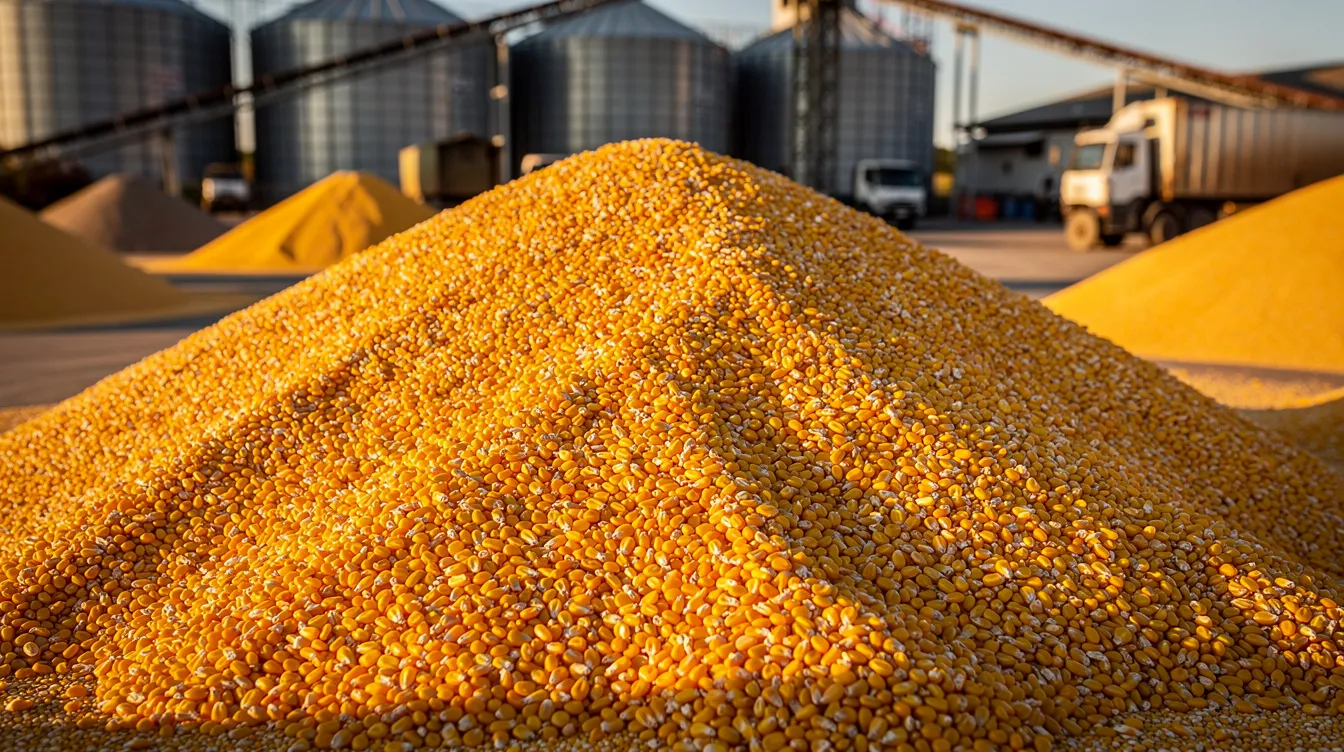
Maize is the dominant grain for ethanol production globally and an increasingly important feedstock in Indian grain-based ethanol plants, particularly in Maharashtra, Karnataka, Madhya Pradesh, Bihar and Telangana. India’s maize production has reached approximately 37 million tonnes from around 12 million hectares in recent years.
Typical Indian maize has a starch content in the range of 58–62% with desired moisture levels at the plant gate of 12–14%. Presence of broken kernels and foreign matter directly reduces fermentable starch and affects ethanol yield. Indicative maize ethanol yield per ton falls in the range of approximately 380–400 litres per MT under practical operating conditions, as estimated in the NITI Aayog Roadmap for Ethanol Blending in India. Design or theoretical yields may be higher, but financial models should use conservative practical benchmarks.
Logistically, maize arrivals are seasonal across Kharif and Rabi cycles. Procurement via mandis versus direct from farmers, storage in silos versus godowns and transport distances all influence the ethanol raw material cost per litre. Promoters considering maize-centric projects can review detailed project economics in the maize-based ethanol plant project report and DPR published by Project Report Bank.
Broken Rice as an Ethanol Feedstock
Broken rice is a by-product of rice milling, usually consisting of 25–100% broken kernels, and is widely available in major rice-producing states like Chhattisgarh, Telangana, Andhra Pradesh, Odisha and Uttar Pradesh. Its starch content tends to be higher than maize, typically around 68–72%, which translates to a somewhat higher ethanol yield under efficient processing.
Quality parameters that affect ethanol production yield per ton include the fraction of brokens, presence of husk and bran, moisture content, and percentage of discoloured or damaged grains. Higher impurities increase effluent load and may cause fouling, reducing effective yield. Indicative broken rice ethanol yield per ton ranges from approximately 400 to 420 litres per MT for open-market broken rice and up to 450 litres per MT for cleaner FCI-grade rice, based on industry benchmarks.
Eligibility of broken rice for ethanol under government guidelines and FCI allocations may change, and supply through auctions has been interrupted in the past. Promoters must verify current permissions at the DPR stage. Those considering rice-based production may refer to the broken rice and damaged foodgrain ethanol plant DPR for further planning detail.
Damaged and Surplus Foodgrains
Damaged foodgrains are grains declared unfit for human consumption due to moisture, pest damage, discolouration or prolonged storage in FCI warehouses. Surplus foodgrain stocks during years of oversupply have historically been notified as eligible for ethanol production under specific government approvals and recommendations by the National Biofuel Coordination Committee.
Technical implications include higher variability in moisture and contamination, greater enzyme consumption, risk of mycotoxins and inconsistent fermentation performance. Ethanol yield per ton of grain from damaged stocks is typically lower than from clean grain due to these quality issues.
Procurement depends on government tenders or auctions, and availability is not guaranteed across a project’s 20–25 year life. In late 2023, for example, supply of surplus rice from FCI was abruptly stopped. DPRs should therefore not rely solely on low-cost damaged grain assumptions for base-case projections.
Other Technically Feasible Grain Feedstocks
Other starch-based raw materials such as sorghum (jowar), pearl millet (bajra) and barley are technically processable through saccharification and fermentation, though their starch content is generally lower and fibre or lignin content higher than maize or rice. In a different category, lignocellulosic feedstocks include agricultural residues and wood chips but require pretreatment and hydrolysis to release sugars, placing them in the second generation ethanol category rather than the conventional grain route.
Use of alternative grains for fuel ethanol depends on evolving regulations, food-security considerations and relative economics compared to maize and broken rice. A multi-feedstock ethanol production plant designed to handle different raw materials with minimal changeover time can offer procurement flexibility, but involves higher capex and operational complexity. The multi-feedstock ethanol distillery project report from Project Report Bank provides a structured framework for evaluating this approach.
Ethanol Production Yield per Ton of Grain
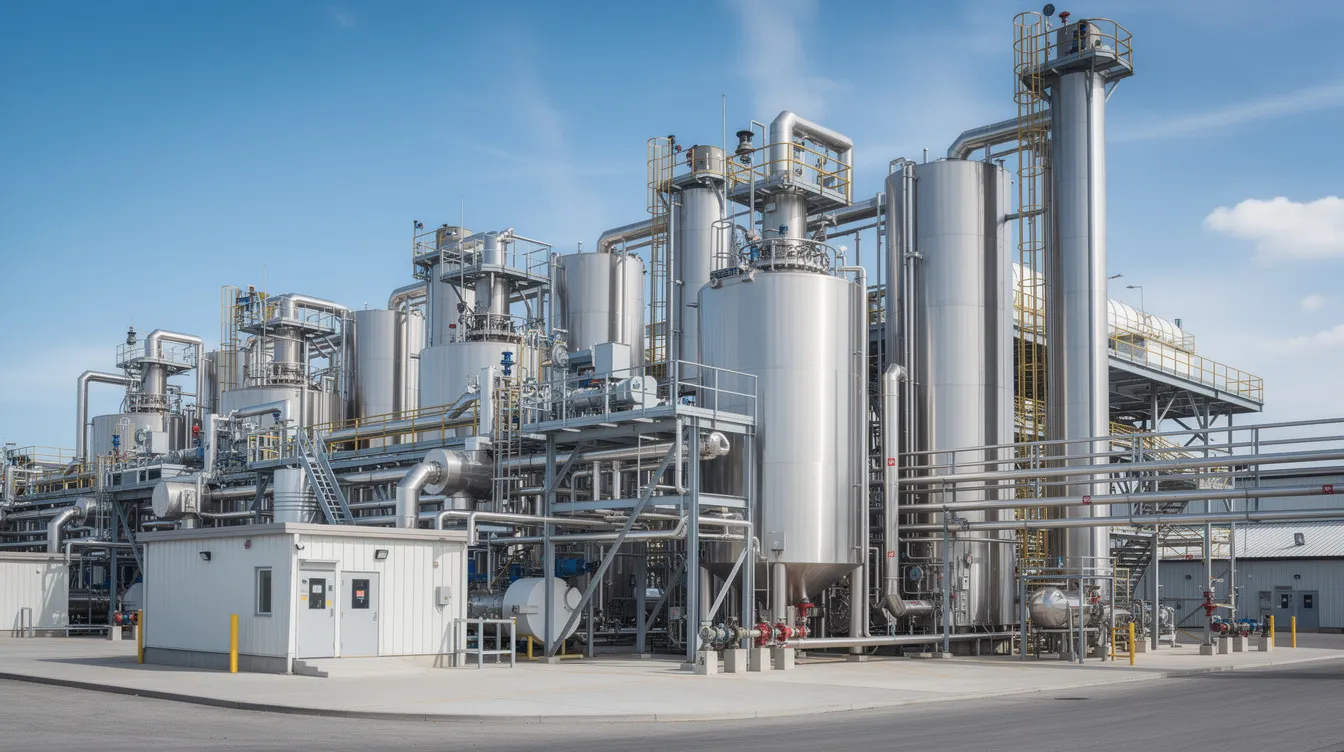
Ethanol production involves a series of steps: feedstock supply, preparation, sugar conversion, fermentation, distillation and by-product recovery. In a grain-based plant, the process flow runs from milling through liquefaction, starch conversion into fermentable sugars using enzymes, fermentation by microorganisms such as yeast which convert those sugars into ethanol and carbon dioxide, followed by distillation and dehydration. Readers seeking a detailed process walkthrough can refer to the grain-based ethanol manufacturing process and flow chart.
Conversion efficiency at each stage determines the overall ethanol production yield per ton. Yield losses occur due to incomplete starch conversion, fermenter inefficiency, distillation losses and moisture in the grain. It is essential to distinguish between theoretical yield (based on stoichiometric conversion of pure starch), design yield (what the technology vendor guarantees under specified conditions) and practical operating yield (what the plant achieves after commissioning, accounting for grain variability and downtime). The ethanol production technology article covering dry milling, fermentation and distillation explains how each process stage contributes to or reduces overall recovery.
Yields differ between maize and broken rice primarily due to starch content, oil and fibre fractions, foreign matter and particle size after milling. Project promoters should obtain vendor-certified yields and cross-validate with independent consultants rather than relying on optimistic brochures.
Indicative Ethanol Yield Comparison Table
| Raw Material | Indicative Ethanol Yield (L/MT) | Basis | Key Yield Factors | Important Considerations |
|---|---|---|---|---|
| Maize (corn) | ~380–400 (industrial benchmark, India) | As-received (12–14% moisture) | Starch 58–62%, hybrid type, milling efficiency, enzyme dosage | Foreign matter, seasonal quality variation; vendor-certified yields preferred |
| Broken/Damaged Rice | ~400–420 (open market); up to ~450 (FCI grade) | As-received | Starch 68–72%, impurity level, bran/husk fraction | Regulatory eligibility may change; higher effluent; cleaning overhead |
| Other Eligible Grains (sorghum, millets) | ~365–400 (limited Indian industrial data) | As-received | Lower starch, higher fibre; enzyme/process adjustments | Limited commercial deployment; multi-feedstock design needed |
Yields towards the higher end assume high-starch, low-moisture grain processed in efficient modern plants. Initial ramp-up periods typically show lower yields. DPRs and financial models should use conservative mid-range values unless strong technical evidence supports higher numbers.
How to Calculate Ethanol Plant Raw Material Requirements
The fundamental formula for grain-based ethanol plant raw material consumption is straightforward:
Daily Raw Material Requirement (MT/day) = Daily Ethanol Production Target (litres/day) ÷ Practical Ethanol Yield (litres/MT)
Daily production refers to the actual operated output, not the nameplate installed capacity. If a 100 KLPD plant operates at 85–90% utilisation, effective daily ethanol production is approximately 85,000–90,000 litres. The practical yield chosen should reflect vendor guarantees adjusted for the specific grain quality expected at the project site.
Annual grain requirement is derived by multiplying the daily requirement by effective operating days, typically 320–330 days per year at 85–90% utilisation:
Annual Grain Requirement (MT/year) = Daily Requirement (MT/day) × Effective Operating Days
Adjustments should account for moisture variation in incoming grain (wetter grain means less fermentable dry matter per MT), handling and storage losses of 0.5–2%, process losses from incomplete conversion, and safety stock buffers.
Worked Example – 100 KLPD Maize-Based Plant: Assuming practical yield of 380 litres per MT and 330 operating days, daily maize requirement equals 100,000 ÷ 380 ≈ 263 MT per day. At roughly 25 MT per truck, this translates to about 10–11 truckloads daily. Annual maize requirement would be 263 × 330 ≈ 86,800 MT. If yield improves to 400 L/MT, daily requirement drops to 250 MT and annual to approximately 82,500 MT. If yield falls to 360 L/MT, daily requirement rises to 278 MT and annual to approximately 91,700 MT.
These calculations should align with the capacity and utilisation assumptions used in a project’s DPR.
Raw Material Requirement for 30, 60, 100 and 200 KLPD Ethanol Plants
The following table provides approximate grain consumption figures based on stated assumptions. These are illustrative for understanding scale and logistics and must be recalculated with location-specific grain quality and technology guarantees for each project.
Assumptions: Maize yield 380 L/MT; Broken rice yield 400 L/MT; Operating days 330/year.
| Plant Capacity (KLPD) | Daily Ethanol (L/day) | Maize Required (MT/day) | Annual Maize (MT/year) | Broken Rice Required (MT/day) | Annual Broken Rice (MT/year) |
|---|---|---|---|---|---|
| 30 | 30,000 | ~79 | ~26,100 | ~75 | ~24,750 |
| 60 | 60,000 | ~158 | ~52,200 | ~150 | ~49,500 |
| 100 | 100,000 | ~263 | ~86,800 | ~250 | ~82,500 |
| 200 | 200,000 | ~526 | ~173,600 | ~500 | ~165,000 |
The raw material required for a 100 KLPD ethanol plant using maize is roughly 263 MT per day, while a smaller 30 KLPD plant may need around 79 MT. For a large-scale 200 KLPD facility, procurement, logistics and storage planning must handle over 500 MT of grain daily.
Lower plant utilisation reduces annual grain requirement but increases the fixed cost per litre of ethanol produced. Higher yield reduces both daily and annual grain requirement for the same KLPD, directly improving raw material cost per litre.
Maize vs Broken Rice – Which Feedstock Offers Better Ethanol Yield?
From a purely technical standpoint, both maize and broken rice can deliver comparable grain-based ethanol production yield ranges. However, the choice between them depends on local prices, logistics, by-product markets and regulatory eligibility.
| Parameter | Maize | Broken Rice |
|---|---|---|
| Practical Ethanol Yield (L/MT) | ~380–400 | ~400–450 |
| Illustrative Landed Cost (₹/MT) | ~₹15,000–17,000 | ~₹16,000–20,000 |
| Illustrative RM Cost per Litre | ~₹39–45 | ~₹40–50 |
| Seasonal Availability | Kharif + Rabi; reasonably stable | Milling season dependent; FCI allocations variable |
| DDGS Characteristics | Higher protein; established poultry-feed demand | Different composition; regional acceptance varies |
A lower price per MT of grain does not always mean lower cost per litre if ethanol yield per ton is weaker. Local poultry and cattle-feed demand can influence DDGS realisation differently for maize versus rice-based DDGS. Geographies with strong maize supply (Maharashtra, Karnataka, MP) may naturally favour maize, while states with surplus rice milling (Chhattisgarh, AP) may favour broken rice. Compared to grain routes, B heavy molasses provides approximately ₹21 per litre profit and C heavy molasses approximately ₹18 per litre profit, which promoters should assess when evaluating grain-based versus molasses-based ethanol cost and viability.
Raw Material Cost per Litre of Ethanol
The core formula linking feedstock economics to production cost is:
Raw Material Cost per Litre = Delivered Raw Material Cost per MT ÷ Practical Ethanol Yield (L/MT)
For maize at an illustrative landed cost of ₹15,000/MT and practical yield of 380 L/MT, raw material cost works out to approximately ₹39.47 per litre. If the maize cost rises to ₹17,000/MT with the same yield, cost per litre increases to approximately ₹44.74. If yield simultaneously drops to 360 L/MT, cost per litre may rise to ₹47.22.
For broken rice at ₹16,000/MT with yield of 400 L/MT, cost per litre is approximately ₹40. At ₹20,000/MT or lower yield, this figure can approach ₹50 per litre.
Additional components that effectively raise the true raw material cost per litre include inward freight and handling charges, unloading, weighing and sampling expenses, storage losses from moisture gain or pest damage, and interest on working capital blocked in grain inventory. Together, these can add ₹2–5 per litre depending on location and volume. These calculations feed directly into the per-litre cost of production used for profitability, DSCR and IRR analysis in a professionally prepared DPR.
Raw Material Storage and Inventory Planning
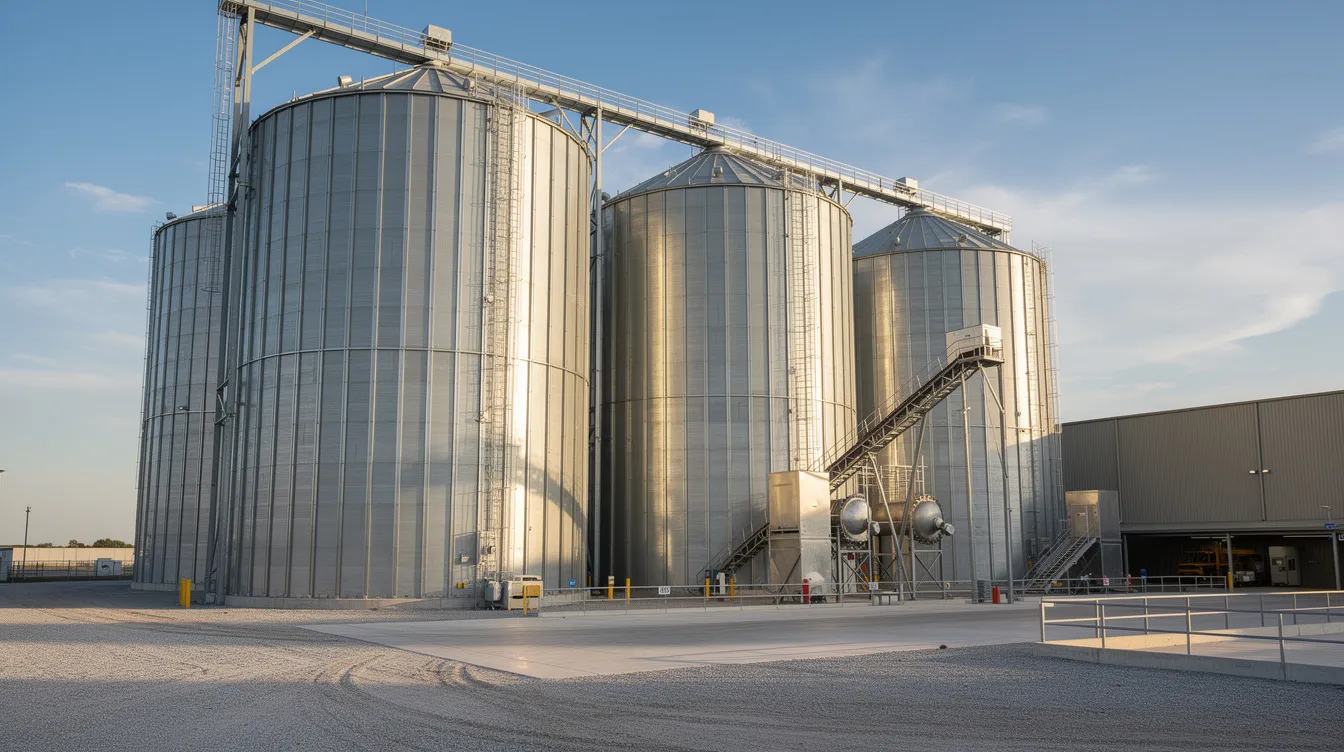
A grain-based ethanol production plant must plan adequate storage infrastructure to ensure continuous operations during procurement gaps, monsoon disruption or market volatility. Typical storage options include steel grain silos with aeration and fumigation systems, conventional covered godowns and silo-bag systems for interim needs.
Key design considerations include the number of days of raw material stock to be held (typically 15–45 days depending on supply stability), moisture control and aeration to prevent spoilage, and layout of receiving pits, conveyors and material handling systems for water management and efficient grain flow.
From a financial perspective, higher storage capacity increases capex, and inventory carrying cost including interest, insurance and storage expenses affects working capital projections. These must be captured in CMA Data and bank loan proposals. The grain-based ethanol plant setup cost in India article from Project Report Bank covers how storage and silo infrastructure fits into overall project investment.
DDGS Yield and Other By-Products
In a grain-based ethanol plant, after starch is converted to ethanol, the remaining protein, fibre, oil and unfermented solids are recovered as Distillers Dried Grains with Solubles. This is an important co product sold as animal feed for livestock, poultry and aquaculture.
The process involves separation of wet cake, evaporation of thin stillage, mixing with soluble syrup and drying to obtain DDGS at approximately 10–12% moisture for stability during transport. Indicative DDGS yield is roughly 320–330 kg per MT of maize processed, though exact recovery depends on grain composition, process design and drying parameters.
DDGS price fluctuates with feed ingredient markets including soymeal and maize. Transportation cost, regional demand from the poultry and dairy industry, and whether product is sold bagged or in bulk all affect revenue realisation. Promoters should avoid over-estimating DDGS revenue in financial models. Conservative pricing and volume assumptions are advisable, especially during early years when product quality and marketing channels are still being established. Carbon dioxide captured during fermentation and biogas from co generation of effluent treatment are additional potential value streams, though their revenue contribution should likewise be modelled conservatively.
Impact of Raw Material Yield on Ethanol Plant Profitability
In the grain-based ethanol industry, even small variations in ethanol feedstock conversion efficiency can significantly alter EBITDA margin, DSCR and project IRR. Average profit from ethanol production is often cited at ₹20–25 per litre, but this figure is highly sensitive to raw material cost, which itself depends on grain price and conversion yield.
The chain of impact is direct: higher practical ethanol yield per MT reduces grain required for a given KLPD, which lowers raw material cost per litre, which increases gross margin, cash generation and loan repayment capacity.
A simple sensitivity framework illustrates this:
- Base case: Maize at ₹15,000/MT, yield 380 L/MT → RM cost ~₹39.5/L
- Scenario A (yield drops 5% to 361 L/MT): RM cost rises to ~₹41.6/L
- Scenario B (grain price rises 10% to ₹16,500/MT): RM cost rises to ~₹43.4/L
- Scenario C (both adverse): RM cost rises to ~₹45.7/L
Since raw material constitutes 60–75% of total production cost, these shifts can erode DSCR margins and push project IRR below the threshold that lenders consider bankable. Promoters should have their financial models stress-tested under different raw material cost and yield combinations before finalising project funding.
Raw Material Planning for a Bankable Ethanol Plant DPR
A bankable DPR for an ethanol production plant must integrate engineering, market and financial perspectives on raw material. Key components include:
- Detailed feedstock selection rationale comparing maize versus broken rice versus multi-feedstock options
- Region-specific availability study covering competing uses from the food and feed industry, starch producers, breweries and exports
- Historical price analysis using 5–7 years of mandi data with projected price bands and escalation
- Logistics mapping from procurement centres to the plant, including freight cost assumptions
- Independently validated process yield parameters from technology providers
- Transparent material balance showing ethanol plant grain consumption per day at different utilisation levels
- Storage and inventory planning tied to procurement strategy
- Working capital assessment and CMA Data preparation reflecting inventory days and seasonal procurement peaks
Optimistic yields without technical support weaken the credibility of financial projections. At Project Report Bank, the approach under the guidance of CA Manish Gugliya is to build raw material assumptions on verifiable data and scenario-tested models rather than promotional brochures. The energy and systems design of the plant must align with the ethanol distillery machinery and equipment cost assumptions to produce a coherent DPR.
Major Risks in Ethanol Feedstock Procurement
The principal risk categories affecting ethanol distillery feedstock procurement include:
- Price risk: Sudden spikes in maize or broken rice prices due to poor monsoon, export parity with global corn markets, or changes in MSP regimes. In a country where crude oil imports drive the petrol supply chain, grain price volatility adds a second layer of cost uncertainty to ethanol fuel economics.
- Volume and availability risk: Crop failure, restricted FCI surplus supply (as occurred in 2023), or competing demand pulling grain out of the domestic pool.
- Quality risk: High aflatoxin, excessive moisture or foreign matter in grain consignments reducing effective yield and increasing enzyme consumption.
- Regulatory risk: Changes in biofuel policy, feedstock eligibility, ethanol pricing formula or procurement tenders by Oil Marketing Companies that could indirectly compress distillery margins.
Practical mitigation strategies include maintaining a diversified supplier base, designing multi-feedstock capability where geography supports it, implementing robust quality testing and rejection criteria at the plant gate, and building scenario-based risk analysis into the DPR. Shifts in transport cost, emissions regulations and gasoline pricing can all influence the broader environment in which ethanol producers operate.
Practical Recommendations for Ethanol Project Promoters
Based on advisory experience across grain-based ethanol projects, the following recommendations may support better project planning and development:
- Conduct a dedicated feedstock availability and logistics study before freezing the project site, covering a procurement radius of at least 100–150 km.
- Avoid assuming the highest advertised ethanol yield per ton of grain in base-case projections. Use conservative mid-range benchmarks and document the basis.
- Explore procurement arrangements with farmer-producer organisations, aggregators and millers to build a mixed supply base. Long-term fixed-price contracts are rare in Indian agriculture, but formula-linked agreements can reduce exposure.
- Clearly separate installed capacity (KLPD) from expected average operated capacity in initial years. Capacity utilisation growth should follow a realistic ramp-up pattern.
- Factor in seasonal working capital peaks during bulk procurement windows when grain prices may temporarily rise.
- Have technology offers and raw material assumptions independently reviewed by a professional advisor before approaching banks or investors.
- Include structured sensitivity analysis in the DPR covering yield drops, grain price increases and combined adverse scenarios.
- Assess by-product revenue (DDGS, CO₂) conservatively. Treat initial-year by-product realisation as lower than steady-state.
A well-prepared DPR with robust raw material planning supports finance approval and helps promoters manage operations prudently once the plant is commissioned.
Frequently Asked Questions (Project Finance & Planning Focus)
These FAQs address practical planning questions that extend beyond the main article, focusing on financing, long-term assumptions and multi-feedstock strategy.
How should I fix long-term grain price assumptions for my ethanol DPR?
DPRs should typically use a multi-year average of mandi or wholesale prices for the project region, adjusted for transport, quality premiums and moderate inflation-linked escalation rather than assuming current spot prices will persist. At least 5–7 years of historical price data for maize or broken rice should be analysed, and three scenario bands (base, high, low) should be documented with clear data sources so that lenders can evaluate how assumptions were derived.
Can I lock in long-term supply contracts to reduce raw material risk?
Absolute long-term fixed-price contracts are uncommon in Indian agriculture due to production volatility. Some promoters sign medium-term arrangements with aggregators, rice millers or FPOs, often using formulas linked to market benchmarks. A practical approach is to structure procurement so that a base quantity is covered by such arrangements and the balance is purchased on the open market, with the DPR reflecting a blended effective price for the supply base.
How do lenders look at raw material risk in ethanol project finance?
Banks examine feedstock availability radius, competing demand, historical crop production in nearby districts, existence of alternative suppliers and whether the DPR includes independent validation of yields and grain consumption. Lenders typically request sensitivity analysis where grain prices rise and ethanol realisation falls simultaneously. Realistic modelling of these scenarios, rather than optimistic single-point projections, improves the credibility of the proposal and the confidence in DSCR adequacy.
Is a multi-feedstock plant always better from a financing perspective?
While multi-feedstock design diversifies raw material risk, it generally involves higher capex and more complex operations. In regions where one feedstock such as maize is abundant and price-stable, a single-feedstock design may produce a lower cost per litre and stronger returns. The decision should be based on a structured comparison of incremental capex and operating complexity versus expected reduction in procurement risk, demonstrated through financial modelling rather than assumed as universally superior.
Conclusion & Professional Advisory Note
In grain-based ethanol production, sustainable profitability depends on three interconnected pillars: assured feedstock availability, realistic ethanol production yield per ton of grain and disciplined financial planning of raw material cost and inventory. The ethanol production process, from feedstock procurement through starch conversion, fermentation and distillation, offers multiple points where value can be gained or lost depending on the quality of planning.
Formulas for ethanol plant raw material calculation, whether expressed as MT per day or MT per year, are only as reliable as the yield and price assumptions underlying them. A 30, 60, 100 or 200 KLPD ethanol production plant will be financially viable under Indian conditions only if these assumptions are defensible and stress-tested across realistic scenarios.
At Project Report Bank, under the guidance of CA Manish Gugliya, we support promoters through customised DPRs, financial projections, working capital and DSCR analysis, and sensitivity-tested feasibility studies for maize, broken rice and multi-feedstock ethanol projects. Serious project promoters may share brief project details via WhatsApp or through www.projectreportbank.com to discuss tailored ethanol plant DPR preparation and project finance advisory. No guaranteed approvals or specific returns are promised; the value lies in preparing assumptions and projections that can withstand professional scrutiny.
CA Manish Gugliya FCA, DISA (ICAI) More than 20 years of professional experience in project reports, financial projections, CMA Data, project finance and business advisory.