India’s ethanol blending programme has transformed from a small-scale experiment into one of the country’s most significant energy-security initiatives. With E20 effectively achieved five years ahead of schedule, the ethanol sector now enters a phase where financial discipline, feedstock competitiveness and allocation security matter more than capacity expansion alone. This article examines the policy, commercial realities and investment outlook from a project-finance perspective.
Key Takeaways
- India’s ethanol blending programme has grown from under 1.5% blending in ESY 2013–14 to approximately 20% in ESY 2025–26, with ethanol procurement by oil marketing companies rising from about 38 crore litres to over 1,200 crore litres annually.
- India imports approximately 85–90% of its crude oil requirements. The programme has reportedly saved over ₹1.9 lakh crore in foreign exchange since 2014, while substituting over 316 lakh metric tonnes of crude oil and avoiding approximately 952 lakh metric tonnes of carbon emissions.
- E20 has created large, recurring demand but also a real risk of overcapacity. Ethanol production capacity now significantly exceeds the blending requirement, shifting the industry challenge from demand creation to allocation competition.
- As of the latest government communication, no decision has been taken to mandate nationwide blending above 20%. References to higher ethanol blends like E25, E30 or E100 remain at a conceptual and pilot stage.
- Serious investors should base ethanol distillery decisions on a Detailed Project Report, realistic financial projections and sensitivity analysis – not just on headline E20 policy announcements.
Introduction – India’s Ethanol Blending Policy and the E20 Milestone
India’s ethanol blending journey reflects a deliberate policy shift to reduce dependence on imported crude oil and lower carbon emissions from road transport. Average ethanol blending rose from under 1.5% in ESY 2013–14 to around 20% in ESY 2025–26, achieved five years ahead of the original 2030 target set under the National Policy on Biofuels, 2018.
Blending ethanol with petrol directly reduces the volume of petroleum consumed per litre of fuel sold at retail outlets, helping India reduce crude oil imports and support farmers by creating an assured market for sugarcane, maize and other crops. However, with the E20 target now met, the ethanol industry outlook in India depends less on demand growth and more on commercial allocation, administered pricing, feedstock competition and financing discipline.
The rest of this article analyses the ethanol blended petrol policy, E20 programme and industry outlook from a project-finance and DPR perspective – focusing on feasibility, bank finance, risk and practical investment considerations.
What Is the Ethanol Blending Programme (EBP) in India?
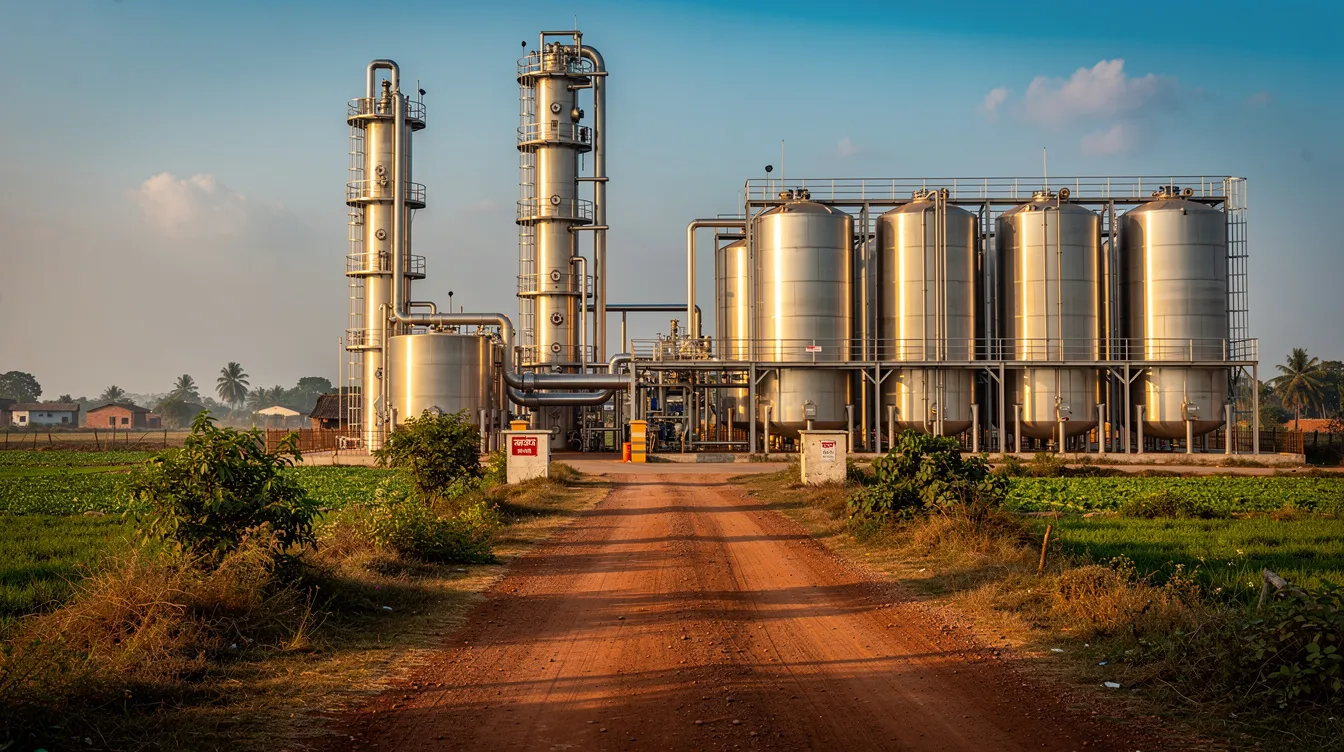
The Ethanol Blended Petrol (EBP) Programme involves mixing anhydrous ethanol with petrol and selling ethanol blended petrol through retail outlets of Indian Oil, BPCL, HPCL and other OMCs under the Ministry of Petroleum & Natural Gas. E20 fuel contains 20% ethanol and 80% petrol. Common blend labels include E5 (5% ethanol), E10 (10%) and E20 (20%), with E20 now the primary policy milestone.
The programme’s objectives include:
- Reduce crude oil imports and foreign exchange outflow
- Provide an assured market for domestic ethanol producers and support farmers growing sugarcane, maize and other feedstock crops
- Lower tailpipe carbon emissions – ethanol can lower lifecycle greenhouse gas emissions compared to traditional petrol
The EBP programme operates on an ethanol supply year (ESY, December–November) rather than the financial year. Ethanol procurement and allocation are managed through OMC tenders and long-term offtake arrangements. Blending ethanol into petrol supports the rural economy and stabilises agrarian incomes while enhancing energy security by reducing oil import dependency.
Evolution of India’s Ethanol Blending Policy
India’s national biofuel policy framework took formal shape with the National Policy on Biofuels, 2018, which classified feedstocks into 1G (molasses, sugarcane juice, sugar, syrup), 2G (cellulosic, crop residues) and permitted use of food grains under certain conditions. The original blending targets were E10 in the early 2020s and E20 by 2030.
The 2022 amendments advanced the 20% ethanol blending target from 2030 to ESY 2025–26, and expanded the feedstock basket to include maize and surplus rice subject to DFPD approvals. The ethanol blending policy diversifies feedstocks to reduce reliance on a single crop and also seeks to create new investment opportunities in the biofuel sector. Ethanol can be derived from sugarcane, maize, and damaged food grains.
Key milestones include the launch of EBP, notification of the national policy in 2018, crossing 10% blending in ESY 2021–22, the 2022 policy amendment advancing the E20 deadline, approximately 12% blending in ESY 2022–23, about 14.6% in ESY 2023–24, and attainment of approximately 20% blending in ESY 2025–26. Ethanol production capacity grew from about 421 crore litres in 2014 to approximately 2,000 crore litres by mid-2026.
E20 Programme – Current Status, Achievements and Implementation
The E20 programme in India represents the nationwide roll-out of 20% ethanol blended petrol, targeting average 20% blending across the country in ESY 2025–26. India measures ethanol blending on an ethanol supply year basis. Year-wise average blending achievements include approximately 12% in ESY 2022–23, about 14.6% in ESY 2023–24, and approximately 19.2% in ESY 2024–25 rising to 20% in ESY 2025–26.
E20 availability at retail outlets is being phased, with some fuel stations supplying E20 and others E10 or E15, depending on region and infrastructure. Utilizing ethanol significantly reduces carbon dioxide emissions compared to pure fossil fuels, and ethanol blending helps stabilise petrol prices in India compared to global rates. The blending policy helps cushion the economy against global oil price shocks, particularly relevant given that India imports approximately 85–90% of its crude oil requirements.
Vehicle compatibility is essential for successful ethanol blending to avoid fuel efficiency loss. Post-2023 modern vehicles in India are generally E20-compliant per OEM declarations and testing by ARAI/SIAM. Older vehicles are usually designed for up to E10–E15. Controlled tests show modest mileage variation – a vehicle’s mileage may be marginally lower per litre compared to pure petrol – and no large-scale engine failure has been reported where recommended fuel grades are used. OMCs have expanded ethanol storage at depots from about 5.39 crore litres in 2017 to over 16.9 crore litres, supporting over 20 days of storage cover.
Government Policy Framework for Ethanol Producers
The ethanol policy framework in India is anchored in administered pricing and centralised ethanol procurement by public sector oil marketing companies through annual and multi-year tenders.
Procurement and Pricing:
The government fixes ethanol prices from various feedstocks annually. For ESY 2024–25, ex-mill prices include sugarcane juice/syrup at ₹65.61/L, B heavy molasses at ₹60.73/L, and C-heavy molasses at ₹57.97/L. Ethanol from maize is priced at ₹71.86 per litre (with the ESY 2023–24 base price at ₹66.07 per litre before incentive adjustments). Damaged food grains attract ₹64.00/L.
Feedstock Categories:
- Sugarcane juice and syrup
- B-heavy and C-heavy molasses from sugar mills
- Surplus rice from FCI stocks
- Maize and other permitted grains
Government Support:
The government offers financial incentives for establishing new distilleries under the ethanol blending policy. Under past Ethanol Interest Subvention Schemes (2018–2022), 1212 ethanol projects were approved. Ethanol production from grain was included in 2021’s interest subvention schemes. A more recent scheme for cooperative sugar mills was notified in March 2025. GST on ethanol for EBP was reduced to 5%.
Regulatory Requirements:
Setting up an ethanol plant requires NOC from Grampanchayat, Consent to Operate from the State Pollution Control Board, machinery layout approval from the State Excise Department, environmental clearances, PESO licensing for storage, and fire safety approvals. State governments also play a role through excise and environmental compliance norms.
Ethanol Demand, Supply and Production Capacity in India
To achieve 20% blending, India’s ethanol requirement is estimated at around 1,016 crore litres annually at baseline petrol consumption, rising to approximately 1,350 crore litres factoring in consumption growth. Actual demand depends on petrol sold volumes and blending coverage across regions.
India’s ethanol production capacity reached 1,528 crore litres by 2023 and approximately 1,700 crore litres capacity was targeted by 2025. By mid-2026, installed capacity has grown to approximately 2,000 crore litres – well above the E20 requirement.
This creates two possible scenarios:
- Balanced capacity: If operational capacity roughly matches E20 demand, distilleries enjoy stable utilisation and predictable margins.
- Overcapacity: If national capacity significantly exceeds demand, dedicated ethanol plants and new distilleries compete intensely for OMC allocations, pushing margins down and leaving higher-cost plants underutilised.
The gap between installed and operational production capacity matters. Water availability, feedstock supply, state excise restrictions and working capital limits can cap capacity utilisation for ethanol distilleries. Regional concentration in sugarcane-surplus states like Uttar Pradesh, Maharashtra and Karnataka, and grain-surplus states like parts of Bihar and Madhya Pradesh, causes inter-state ethanol movement and logistics challenges.
Impact of E20 Policy on Grain-Based Ethanol Plants
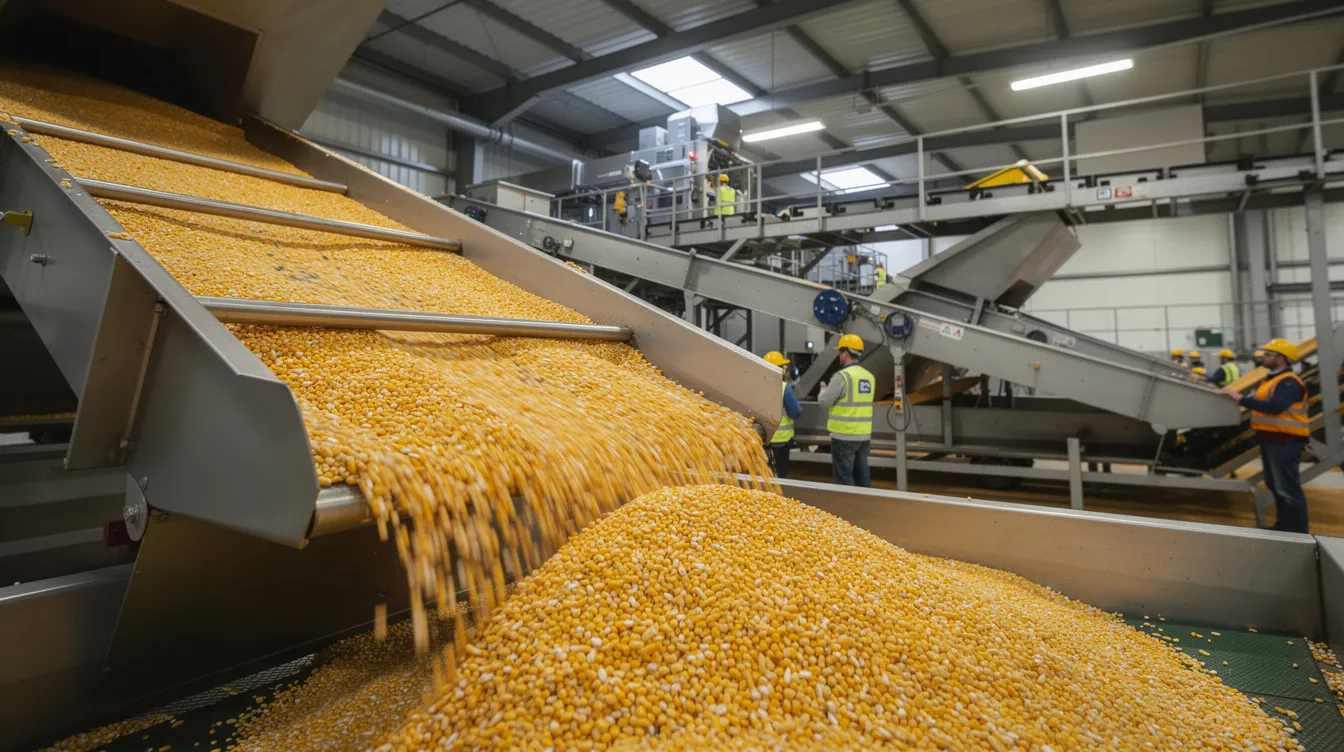
Ethanol production from maize has increased significantly in India. Maize is now India’s largest ethanol feedstock, with rice being the second largest source. The rising importance of grain-based ethanol in India’s ethanol blending programme reflects the reality that sugarcane diversion alone cannot sustain E20 long-term. In ESY 2025–26 tenders, approximately 72% of ethanol allocation came from the grain sector.
Maize area increased from 10.74 million to 14.41 million hectares, and India’s maize demand may rise to 109 million tonnes by 2047–48, reflecting competition between fuel production and food/feed sectors. Rice surplus is being diverted to ethanol production in India. Agricultural residues for second-generation ethanol reduce reliance on food crops, though 2G commercial production remains nascent.
Grain procurement dynamics – seasonal crop patterns, MSP versus market prices, storage and transport costs – directly affect the per-litre contribution margin. Typical conversion yields vary by technology and grain quality; detailed feedstock calculations should be part of every ethanol plant raw material and yield assessment.
Multi-feedstock flexibility is a strategic hedge. Plants able to switch between maize, broken rice and other approved grains can optimise costs when OMC procurement prices are fixed but raw material prices fluctuate. By-products strengthen plant economics: distillers grain (DDGS) provides high-protein animal feed revenue, and CO₂ recovery adds a secondary income stream, as detailed in the DDGS production and profitability analysis.
Financial Impact of Ethanol Blending Policy on Project Profitability
The ethanol blending policy and administered prices directly shape the revenue profile of ethanol distilleries. From a Chartered Accountant’s viewpoint, key financial components include:
- Capital cost: Land, civil works, plant and machinery, utilities, ETP/ZLD, fuel tank storage
- Fixed operating costs: Salaries, maintenance, insurance
- Variable costs: Feedstock, power, steam, chemicals
- Financing costs: Interest and repayment on term loans
Administered ex-mill prices are compared with fully loaded ethanol production cost per litre to arrive at contribution margin. Even small changes in maize or molasses prices can significantly impact profitability when one litre of ethanol produced carries a thin margin.
Illustrative Capacity Utilisation Impact (Hypothetical Grain-Based Plant):
| Parameter | 60% Utilisation | 75% Utilisation | 90% Utilisation |
|---|---|---|---|
| Revenue Coverage of Fixed Costs | Marginal | Adequate | Strong |
| Indicative EBITDA Margin | Low single digits | 12–16% | 18–22% |
| DSCR Trend | Below 1.2x (stressed) | 1.3–1.5x (acceptable) | 1.6x+ (comfortable) |
These are illustrative only, based on hypothetical assumptions. Actual results depend on plant-specific feedstock mix, location and financing structure.
Working capital requirements – raw material inventory, receivables from OMCs, minimum cash for utilities and wages – deserve careful assessment. Delays in OMC payments or allocation changes can strain cash flows. Banks and investors typically focus on conservative base-case cash flows when evaluating term loans, making financial projections and DSCR analysis central to any bankable DPR.
Future of India’s Ethanol Industry After Achieving E20
Once E20 is operationally achieved, the nature of risk changes from demand risk to allocation, pricing and competition risk among ethanol distilleries. As long as petrol consumption remains significant in India’s transport mix, E20 demands a large and recurring volume of pure ethanol each year, providing a stable demand base even as electric mobility gradually grows.
However, the latest official stance confirms that no decision has been taken to mandate nationwide blending above 20%. Projected blending targets include aspirations for 27% blending by 2030 in some NITI Aayog discussions, and flex fuel vehicles may enable E85 in specific corridors, but these are not binding national mandates.
Ethanol blending can lead to competition between fuel production and food supply, and ethanol blending raises concerns over food security and inflation – factors that may temper policy moves toward higher blends. If ethanol production capacity significantly exceeds E20 requirement plus industrial and chemical demand, distilleries may experience lower emissions of profitability, under-utilisation and margin pressure.
Possible diversification routes include industrial ethanol for chemicals and pharmaceuticals, export opportunities subject to policy, and gradual development of 2G ethanol from crop residues. Entrepreneurs should not assume that higher nationwide blending mandates will certainly arrive in a fixed time frame.
Opportunities for New Ethanol Plant Investors
Despite rising competition, ethanol plants still offer opportunities where feedstock is reliably available, efficient technology is used, and OMC offtake is reasonably assured. Distinct opportunity segments include:
- Greenfield grain-based ethanol distilleries in grain-surplus regions
- Brownfield expansions of existing sugar mills
- Multi-feedstock plants capable of switching between sugar and grain feedstocks
- Integration with DDGS or CO₂-based businesses
Demand projections alone are no longer sufficient. Investors must evaluate how their specific plant will compete in terms of cost per litre, efficiency and reliability relative to other distilleries bidding for the same OMC tenders. Detailed project reports, realistic financial models and scenario analysis now carry greater weight in bank appraisal.
For customised DPRs, feasibility studies and project finance planning, entrepreneurs can engage professional advisory support from Project Report Bank and CA Manish Gugliya before committing major capital.
Major Risks and Challenges Facing India’s Ethanol Industry
Ethanol distilleries operate within a tightly regulated, policy-driven environment. While this reduces market risk through assured offtake under the EBP programme, it concentrates risk in central government and OMC decisions.
Commercial and Policy Risks:
- Excess installed capacity versus OMC demand and import dependence on allocation
- Uncertainties in allocation volumes under the blended petrol EBP programme
- Slower escalation of administered ethanol prices versus input cost inflation
- Restrictions on specific feedstocks due to food security concerns
Raw Material Risks:
- Volatility in maize and molasses prices
- Competition from food crops and feed sectors
- Weather-related crop failures
- Transportation bottlenecks raising effective feedstock costs
Financial and Operational Risks:
- High project leverage and interest-rate movements
- Delays in project execution and commissioning
- Underestimation of working capital
- Environmental compliance costs including ZLD, water consumption and state-level excise changes
Mitigation Strategies: Conservative assumptions in DPRs, contingency buffers, proven technology suppliers, forward grain contracts where feasible, and transparent compliance records. From a banker’s perspective, sensitivity analysis around feedstock price, capacity utilisation and ethanol procurement price is critical. Projects should be appraised on downside scenarios, not best-case projections.
What Should Investors Examine Before Setting Up an Ethanol Plant?
From my professional experience, robust planning, documentation and financial analysis are non-negotiable before approaching banks or investors for ethanol plant finance.
A Detailed Project Report should cover technical configuration, plant capacity in KLPD, dual-feed or single-feed design, utilities sizing, land and building requirements, project cost estimates and implementation schedule. DPRs should be project-specific, not generic templates.
Key evaluation areas include:
- Market assessment: Regional petrol consumption, OMC depot mapping, historical allocation patterns
- Feedstock planning: Crop patterns in the catchment area, competition from internal trade buyers, transport costs, alternative feedstock options
- Finance structure: Debt-equity mix, promoter contribution, term-loan tenure, moratorium, CMA Data
- Analytical tools: DSCR computation, break-even analysis, IRR and payback calculations, sensitivity analysis for downside scenarios
- Regulatory checklist: Environmental clearance, state excise licences, factory and fire NOCs, PESO approvals
Ethanol plant investment should be based on an independently evaluated business case. A lower fuel efficiency in returns due to aggressive assumptions is far more dangerous than conservative planning.
CA Manish Gugliya’s Professional Perspective on the Ethanol Industry Outlook
After a decade of policy-driven expansion, India’s ethanol sector is entering a consolidation and optimisation phase. The next five to seven years are likely characterised by stabilisation around E20 as a baseline, selective growth in 2G ethanol capacity, and sharper focus on lowest-cost production rather than blanket capacity addition.
Projects with strong feedstock linkages, efficient technology, prudent leverage and diversified revenue – ethanol plus DDGS plus CO₂ – are better placed to withstand policy or allocation shocks. While discussions on higher blends and flex fuel vehicles will continue, prudent financial planning should assume that nationwide E20 remains the primary mandated level for a reasonably long horizon.
From a project-finance standpoint, disciplined project selection and monitoring will determine whether ethanol remains a value-accretive sector for lenders, investors and entrepreneurs. I encourage bankers and investors to differentiate between well-structured, professionally evaluated ethanol projects and speculative capacity based solely on policy optimism.
Frequently Asked Questions
The following questions address practical queries from ethanol plant promoters, MSME entrepreneurs and bankers on aspects that complement the main article.
Has India officially decided to move beyond E20 to higher nationwide blends?
As of the latest government notifications, no binding decision has been taken to mandate blends above 20% nationally. E85 is authorised only for certified flex fuel vehicles. Aspirational targets like 27% blending by 2030 appear in policy discussions but are not formalised mandates. Project finance should not assume higher blends as a certainty.
Can a new ethanol distillery still obtain bank finance after E20 is achieved?
Yes, provided the project has a solid DPR, clear feedstock plan, realistic financial projections, acceptable DSCR and proper collateral. Several banks remain active lenders to the ethanol sector but are more selective. Projects demonstrating competitive cost structure, multi-feedstock flexibility and assured OMC allocation stand a better chance.
Is grain-based ethanol more risky than molasses-based ethanol?
Grain-based plants face greater exposure to raw material price volatility since maize and rice prices are influenced by MSP, food demand and seasonal patterns. However, this risk is manageable with proper planning, by-product monetisation through DDGS and CO₂, and multi-feedstock design. A detailed comparison is available in the grain-based versus molasses-based ethanol analysis.
Why is a feasibility study essential before investing in an ethanol plant?
A feasibility study tests commercial viability, highlights risks and mitigation options, supports bank appraisal and prevents costly mistakes in capacity, location or feedstock selection. Without it, investors risk committing capital to a project that may not generate sufficient cash flow to meet its obligations – regardless of how favourable the ethanol policy appears at a headline level.
How does forex savings from ethanol blending benefit the broader economy?
The EBP programme has saved over ₹1.9 lakh crore in foreign exchange since 2014 by substituting imported crude oil with domestically produced ethanol. This reduces India’s exposure to global oil price shocks, supports the rupee, and channels spending towards domestic agriculture and manufacturing rather than petroleum imports.
Conclusion – India’s Ethanol Industry at a New Stage
India’s ethanol blending programme has progressed from negligible blending to near-E20, reducing crude oil imports and carbon emissions while catalysing major investment across ethanol distilleries, sugar mills and agro-processing infrastructure. The environmental benefits and forex savings are substantial and well-documented.
The next phase will focus less on expansion at any cost and more on financial viability, efficient operations, sustainable feedstocks and prudent leverage. Entrepreneurs and investors who approach ethanol projects with realistic assumptions, strong DPRs, robust financial models and adequate risk buffers are more likely to build sustainable, bankable businesses in this maturing sector.
For customised ethanol plant DPRs, feasibility studies, CMA Data and project finance advisory tailored to your specific capacity and location, connect with Project Report Bank and CA Manish Gugliya via WhatsApp or visit www.projectreportbank.com.
CA Manish Gugliya, FCA, DISA (ICAI) Website: www.projectreportbank.com