Key Takeaways
- A grain storage feasibility study evaluates technical, financial, and operational viability before a promoter commits ₹20–₹100+ crore to steel silos or warehouse infrastructure in India.
- Storage capacity alone does not guarantee profitability – utilisation rates, contracted tariffs, grain throughput and operating costs determine whether a project generates adequate cash flow.
- Banks and investors evaluate DSCR, project IRR and cash flow sustainability rather than just projected accounting profit; realistic assumptions about demand and utilisation are non-negotiable.
- Project Report Bank, led by CA Manish Gugliya (FCA, DISA, 20+ years of experience), prepares customised grain storage feasibility studies, DPRs and financial models for projects ranging from 5,000 MT to 50,000 MT.
- This article focuses on medium and large commercial grain storage facilities, covering market demand, silo storage technology, project cost benchmarks, financial feasibility, sensitivity analysis and banking requirements across India.
Introduction – Why Grain Storage Feasibility Study Matters in India
India’s dependence on organised food grain storage infrastructure is difficult to overstate. The Food Corporation of India manages approximately 85 million tonnes of food grains annually, yet an estimated 60–70% of food grains in India are stored inadequately – in open yards, temporary covers or poorly maintained godowns. Proper grain storage prevents contamination and preserves nutritional value, and its absence directly undermines food security systems at both national and farm-gate levels.
Post-harvest losses remain significant. Research from ICRIER estimates wheat losses at approximately 7.87%, paddy at 6.37% and soybean at 15.34% at farmer and market levels. These losses represent not just wasted harvested grain but also lost farmer income and wasted public investment in procurement. A successful feasibility study can reduce post-harvest losses through better planning and infrastructure development.
Modern grain storage projects now include steel silos, scientific warehouses and integrated bulk handling systems, typically ranging from 5,000 MT to 50,000 MT capacity. No promoter should invest ₹20–₹100 crore without a structured grain storage and silo project feasibility study that tests demand, technology, location, commercial assumptions and financial viability. A high-level feasibility study assesses whether a project concept is worth pursuing; a detailed project report (DPR) provides the full technical and financial blueprint for bank or investor presentation; and stand-alone financial projections model revenue, costs, DSCR and returns under stated assumptions.
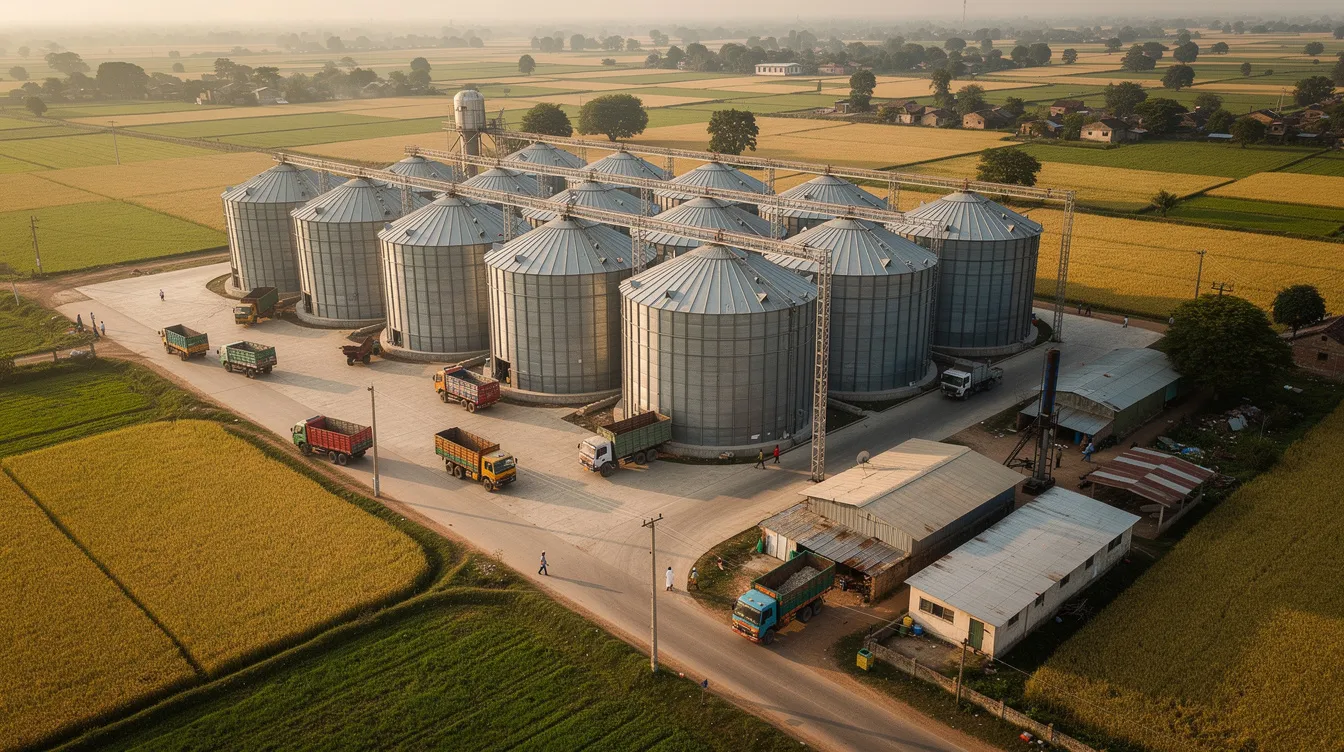
Understanding Grain Storage & Silo Project Feasibility – Five Core Tests
Feasibility is a multi-dimensional assessment – not merely a rough cost-benefit calculation or a spreadsheet of estimated profits. A bankable grain storage feasibility study must pass five core tests before a promoter commits major capital:
- Market and demand feasibility – Is there documented, paid demand for storage capacity from government agencies, traders, processors or exporters within the catchment area?
- Technical feasibility – Is the proposed storage method (steel silos, warehouses, integrated cleaning and drying) appropriate for the grain types, volumes and operating conditions? The study includes a technical assessment for optimal storage equipment and design.
- Location and infrastructure feasibility – Does the site offer proximity to procurement centres, highway or rail connectivity and suitable soil and drainage conditions?
- Commercial and operating feasibility – Can the facility generate enough revenue from storage tariffs, handling charges and ancillary services to cover operating costs and create margins?
- Financial and investment feasibility – Can projected cash flow service debt, provide acceptable returns to equity and survive downside scenarios?
At Project Report Bank, we structure our feasibility studies along these five pillars for grain silo, warehouse, PACS and rail-linked terminal projects. A project that fails even one test deserves serious reconsideration before construction begins.
Types of Grain Storage Projects in India and Their Business Models
Feasibility depends heavily on the chosen storage model, throughput pattern and customer profile. The choice depends on contracted demand, funding access, land availability and the promoter’s operational capability:
- Steel grain silos – Bulk storage for 10,000–50,000 MT. Silos can store large quantities of grain efficiently with controlled aeration and temperature monitoring. Investment typically ₹15–₹40+ crore. Targets FCI, state agencies, large processors. See the Steel Grain Silo Plant Project Report & DPR for detailed configurations.
- Conventional and modern bagged-grain warehouses – Bag storage is the most common storage method in India. Suitable for 5,000–25,000 MT, lower capital cost, greater flexibility in commodity handling. A Modern Food Grain Warehouse & Godown DPR covers this model in detail.
- Road-fed grain silo facilities – Mid-capacity silos served by truck logistics, suitable for procurement surplus districts.
- Rail-linked grain silo terminals – Higher capacity with rail siding access, serving long-distance bulk grain transportation. See the Rail-Linked Grain Silo Terminal DPR for traffic and logistics requirements.
- Hub-and-spoke grain storage systems – A central silo hub with satellite collection centres, creating integration across the supply chain.
- PACS & FPO rural storage facilities – Smaller capacity (500–5,000 MT), allowing farmers to avoid distress sales by providing enough space to hold grain until market prices improve.
- Integrated grain cleaning, drying and storage plants – Combine processing infrastructure with storage, adding revenue from cleaning and drying services.
A complete storage facility is more than a single grain silo – it is a combination of silos or warehouses, conveying systems, dryers, cleaners and dispatch infrastructure.
Market Demand & Commercial Feasibility for Grain Storage Facilities
Strong storage demand in a district does not automatically translate into bankable revenue for a particular project. It involves assessing market demand and existing storage capacity to determine whether a new facility can achieve adequate utilisation.
Key demand assessment factors include:
- Mapping grain production catchment (wheat, paddy, maize, pulses, oilseeds) and procurement centres within a 50–100 km radius.
- Evaluating existing storage capacity – warehouses, steel silos, CAP (cover-and-plinth) storage – and their occupancy rates.
- Distinguishing between government-contracted storage (FCI, state civil supplies) and open-market demand from millers, traders and processors.
- Analysing seasonal versus annual utilisation patterns – procurement peaks post-harvest may not sustain year-round occupancy.
- Storage tariff assumptions per MT per month, benchmarked against actual FCI and state tender rates.
- Revenue potential from handling, cleaning and drying services beyond base storage charges.
Grain storage solutions should be tailored to local production trends and market demands. Decentralised storage can reduce distress sales for farmers post-harvest by providing facilities where they need not sell immediately. Proper storage allows farmers to sell when market prices are favourable. However, bankers scrutinise capacity utilisation projections carefully – documented offtake or storage agreements substantially strengthen a grain warehouse feasibility report.
Technical Feasibility – Storage Capacity, Silo Storage Technology and Process Design
Technical feasibility links the storage technology, storage capacity planning and process design with the project’s business model.
Storage technology choices:
- Steel silos for bulk storage offer superior grain quality preservation through controlled aeration systems, temperature monitoring and moisture management. Modern silos are equipped with aeration and temperature monitoring sensors, and remote monitoring systems track grain temperature and moisture in real time.
- RCC silos are suitable for specific applications but less common commercially in India.
- Conventional warehouses with proper ventilation ducts, floor specifications, stack plans, rat-proofing and ventilation serve bagged-grain requirements.
Critical technical parameters:
- Grain moisture content should be around 12–14% for safe long-term storage. Temperature fluctuations can cause moisture migration in stored grain, creating hot spots that accelerate spoilage.
- Insect pests can raise temperature and moisture levels in stored grain, compounding quality deterioration.
- Aeration systems help maintain grain quality during storage by equalising temperature and moisture. Proper aeration through aeration fans is essential for extended periods of storage.
- Proper cleaning before storage reduces contamination risks. Clean grain entering the facility reduces downstream quality issues.
- Grain stored in silos loses only about 0.2% moisture, compared to significantly higher losses in uncontrolled storage conditions.
- Hermetic storage can reduce losses by up to 98% in suitable applications.
- Grain bags can hold about 10,000 bushels of grain, offering flexibility for certain operations.
For detailed machinery selection and grain silo machinery, equipment and cost analysis, and the grain storage process flow chart and bulk handling system design, Project Report Bank provides comprehensive technical guidance integrated with financial modelling.
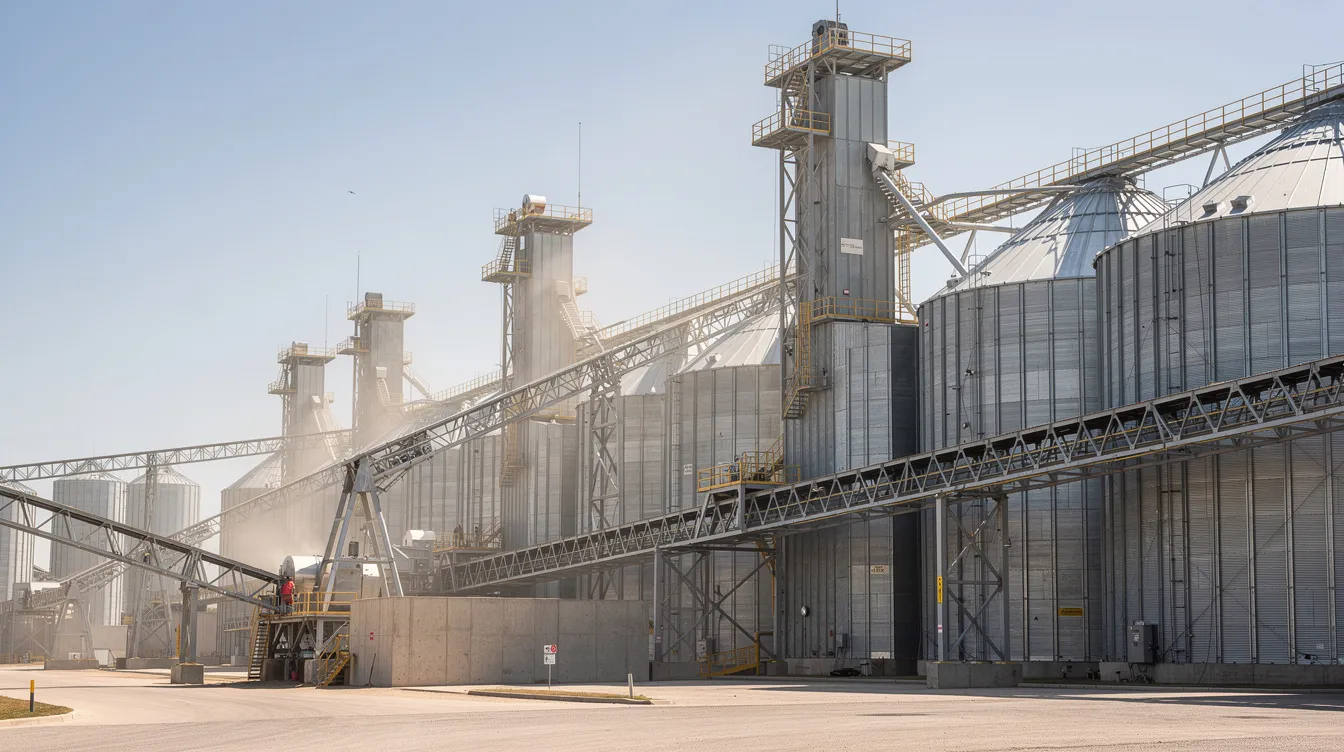
Location, Land & Infrastructure Feasibility for Grain Storage Projects
Location affects construction cost, operating costs, utilisation and grain throughput more than most promoters initially expect. Proper site selection must consider access to transport routes and local infrastructure.
- Proximity to procurement mandis and grain production clusters – reducing transportation costs for farmers and traders.
- Highway or rail connectivity – essential for efficient grain movement. On-farm or nearby storage can reduce transportation costs significantly (international benchmarks suggest savings up to CAD 69,400 annually for comparable operations).
- Land requirements – vary from 2–3 acres for a 5,000 MT facility to 7–10+ acres for a 50,000 MT steel silo complex. Soil bearing capacity, flood risk and drainage must be assessed.
- Regulatory and zoning considerations – land-use permissions, industrial vs agricultural land classification and local development regulations. Environmental compliance is essential in the feasibility study to mitigate risks.
- Future expansion capabilities should be integrated into the initial design of storage facilities – adequate land and layout planning for phased capacity growth.
For detailed guidance on layout, truck circulation and loading/unloading bays, refer to the analysis of grain storage warehouse land, building and plant layout requirements.
Project Cost, Storage Capacity Configuration & Capital Investment
Project cost depends on storage capacity, technology (steel silos versus warehouses), level of automation, equipment specification and site conditions. Financial evaluation includes estimating capital and operational expenditures comprehensively.
Key cost components include land and site development, civil works and foundations, silo structures or warehouse buildings, grain handling and conveying equipment, dryers and cleaners, electrical and automation systems, preoperative expenses, contingencies, interest during construction and initial working capital margin.
Indicative Project Cost Comparison (Steel Silo Based Facility, Mid-Range Automation, 2026 Price Level):
| Storage Capacity | Indicative Project Cost (₹ Crore) | Approx. Cost per MT (₹) |
|---|---|---|
| 5,000 MT | 6–9 | 1,20,000–1,80,000 |
| 10,000 MT | 10–16 | 1,00,000–1,60,000 |
| 25,000 MT | 22–32 | 88,000–1,28,000 |
| 50,000 MT | 35–50 | 70,000–1,00,000 |
All figures are illustrative estimates based on mid-range specifications. Actual costs depend on site conditions, equipment suppliers, civil construction requirements and automation level. A 500-ton storage facility costs significantly more per MT than a 20,000-ton terminal due to economies of scale. Modern multi-commodity storage facilities may require ₹90,000–₹1,15,000 per tonne depending on the configuration. International benchmarks indicate a 300-ton silo costs approximately CAD 138,800.
The analysis should address capital investment versus expected revenue streams to establish whether the project cost is justified. For detailed cost benchmarks, see the grain silo and warehouse setup cost in India and the grain storage project cost and means of finance analysis.
Revenue Model, Operating Costs & Profitability Drivers
Revenue in grain storage projects flows from occupied storage capacity and grain throughput – not simply from installed capacity on paper.
Revenue streams: storage tariff per MT per month (benchmarked at ₹50–₹80+ per MT/month depending on region and contract type), handling charges (inward and outward loading and unloading), drying and cleaning charges, rail siding usage fees where applicable, and ancillary services such as weighing and short-term warehousing.
Operating costs: manpower and security, power consumption for aeration systems and conveyors, dryer fuel or electricity, repairs and maintenance, AMC for automation, insurance, administrative overheads, pest control, periodic fumigation and dust management.
High grain silo automation can reduce labour requirements but increases depreciation and interest cost, affecting EBITDA margin differently for each project. The feasibility study should include calculations for key financial metrics like NPV and IRR to evaluate whether the revenue model supports the business.
Capacity utilisation is the single most important profitability driver. At 50% utilisation, a typical 25,000 MT storage facility may barely cover operating costs and debt service. At 70% utilisation, the facility may achieve adequate DSCR. At 85%+, the project can generate meaningful equity returns. This sensitivity is why contracted demand matters far more than theoretical supply.
Financial Feasibility – Projections, DSCR, IRR and Break-Even Analysis
A grain storage project financial feasibility assessment converts technical and commercial assumptions into 10–12 year financial projections covering EBITDA, net profit, cash flow from operations, DSCR, project IRR, equity IRR, ROI, NPV and payback period.
Illustrative Example – 25,000 MT Steel Grain Silo Facility:
| Parameter | Assumed Value |
|---|---|
| Project Cost | ~₹27 crore |
| Debt : Equity | 70 : 30 |
| Interest Rate | 12% p.a. |
| Loan Tenure | 12 years (1-year moratorium) |
| Average Utilisation (Year 1–3) | 70%, 80%, 85% |
| Average Storage Tariff | ₹65 per MT per month |
| Indicative DSCR (Average) | 1.45–1.65 |
| Indicative Project IRR | 14–18% |
| Payback Period | 7–9 years |
These are illustrative calculations based on stated assumptions, not projections of guaranteed outcomes. Bank norms typically require average DSCR of 1.5–2.0 with no year below 1.2–1.25.
Lenders focus on DSCR and cash flow timing rather than only projected accounting profit. Front-loaded repayments combined with slow ramp-up in utilisation can stress DSCR in early years – this is precisely where sensitivity analysis becomes crucial.
For promoters ready to discuss their grain storage project’s financial structure and DPR requirements, reach out to CA Manish Gugliya via WhatsApp to explore a customised feasibility study.
Sensitivity Analysis & Project Risk Assessment for Grain Silos and Warehouses
Grain silo project viability depends on how robust cash flows remain under stress scenarios, not just in the base case. Risk assessment also addresses compliance with local regulations and operational risks.
Key scenarios to evaluate:
- Utilisation 15–20% lower than planned
- Storage tariff 10% lower than assumed
- Project cost 10–15% higher due to construction overruns
- Interest rate increase by 1–2%
- Implementation delay of 6–9 months
- Loss of a major government storage contract
| Scenario | Utilisation | Avg. Tariff | Equity IRR Impact | DSCR Impact |
|---|---|---|---|---|
| Downside | 55–60% | ₹55/MT/month | IRR drops to 8–11% | DSCR may fall below 1.25 |
| Base Case | 75–85% | ₹65/MT/month | IRR 14–18% | DSCR 1.45–1.65 |
| Upside | 90%+ | ₹75/MT/month | IRR 19–22%+ | DSCR 1.8+ |
Operational risks include grain quality disputes, higher-than-expected grain losses, moisture content variations during storage and the impact of inadequate clean grain supply on facility reputation. A structured risk assessment is a central part of Project Report Bank’s grain silo project feasibility study for banks and investors.
Regulatory, Contractual & Banking Considerations
Regulatory and approval requirements vary by state, location, project size and whether the facility handles food grains under government contracts.
Statutory approvals: land-use conversion where required, building plan approval, factory or warehouse licences, pollution control clearances where applicable, fire NOC and safety compliance, labour registrations.
Sector-specific requirements: WDRA registration for warehouses issuing negotiable warehouse receipts, technical norms in FCI or state civil supplies tenders, food safety and hygiene expectations for bulk grain storage.
Banking and finance: Banks typically expect promoter contribution of 25–30%+, collateral coverage, professionally prepared CMA Data, DSCR above 1.5 on average, and loan tenures of 10–15 years with 1–2 year moratorium for large storage facility projects. RBI priority sector lending norms allow agriculture infrastructure loans up to ₹100 crore per borrower for storage projects.
Feasibility Study Checklist for Grain Storage Investors and Lenders
This checklist summarises what banks, investors and promoters should verify before approving a grain silo or warehouse project.
| Evaluation Area | Key Feasibility Question |
|---|---|
| Demand | Is there documented paid demand for at least 60–70% utilisation from identified customers? |
| Location | Does the site offer proximity to procurement centres, road/rail connectivity and suitable land? |
| Technology | Is the proposed storage method (steel silos, warehouse, integrated) appropriate for the grain types and volumes? |
| Capacity & Throughput | Are storage capacity and annual throughput assumptions backed by catchment data? |
| Investment | Is the project cost justified by projected revenue under realistic utilisation? |
| Utilisation | Are occupancy assumptions realistic given seasonal patterns and competing facilities? |
| Finance | Can projected cash flow service borrowings with DSCR above lender thresholds? |
| Risk | Can the project survive a downside scenario without defaulting? |
| Implementation | Are approvals, contracts, construction timelines and management capability in place? |
This checklist does not replace a full feasibility study but helps promoters quickly identify major gaps before investing in detailed analysis.
Common Mistakes in Grain Storage & Silo Project Feasibility Studies
Many grain storage and silo projects struggle because of avoidable planning and projection errors:
- Assuming near 100% utilisation from Year 1 without contracted demand.
- Ignoring seasonal revenue variations – procurement peaks may sustain only 4–6 months of high occupancy.
- Overestimating tariffs compared to actual FCI and state tender rates.
- Underestimating civil and foundation costs for steel silos, particularly in areas with poor soil bearing capacity.
- Neglecting equipment replacement and maintenance costs over a 15–20 year operating horizon.
- Expanding storage capacity in locations where demand is weak but land is cheap.
- Copying generic DPR numbers or CMA Data formats without adjusting to local grain flows, storage facility type and actual financing terms.
- Treating grain losses as zero and ignoring quality-related claims, which is unrealistic for long-term silo storage.
Serious investors should invest time and professional fees upfront to avoid large capital misallocation. The cost of a thorough feasibility study is a fraction of the cost of a poorly planned ₹25–₹50 crore facility that cannot achieve break-even.
How Project Report Bank & CA Manish Gugliya Support Grain Storage Project Promoters
With more than 20 years of experience as a practising Chartered Accountant, I work with entrepreneurs, infrastructure developers and project promoters to evaluate grain storage investments through structured financial and technical analysis.
Services for grain storage and silo projects include:
- Project feasibility studies covering all five dimensions of viability
- Detailed project reports for bank finance and investor presentation
- Financial projections and financial modelling with scenario analysis
- Project cost and means of finance planning
- CMA Data preparation for bank loan applications
- DSCR, IRR, ROI and sensitivity analysis
- Investor-ready DPRs for equity fundraising
All financial projections are based on clearly stated assumptions and are not guarantees of loan sanction, government contracts, profitability or investment returns. Professional fees for grain storage feasibility studies generally start from ₹50,000 upwards depending on project scope and complexity, with a payment structure of 30% advance at commencement and 70% after submission of the first complete draft.
To discuss your specific grain storage or grain silo project feasibility requirements, reach out to CA Manish Gugliya via WhatsApp or through the Project Report Bank website.
Conclusion – Making an Informed Grain Storage Investment Decision
Grain storage infrastructure development in India presents a genuine opportunity – the gap between supply of scientific storage and demand from government agencies, traders and processors is well established. But creating a viable business from this gap requires aligning storage capacity with contracted demand, selecting suitable technology for the grain types and volumes involved, and ensuring the project’s financial structure can withstand realistic operating conditions.
Food security, efficient grain storage and private returns must be balanced. Overbuilding capacity without utilisation destroys value just as surely as underinvesting in infrastructure. A rigorous grain storage and silo project feasibility study remains the foundation for bankable DPRs, successful project finance and long-term commercial viability.
If you are a serious promoter, FPO, PACS or investor planning a grain storage or silo project in India, contact CA Manish Gugliya via WhatsApp or through ProjectReportBank.com for a customised feasibility study and DPR tailored to your project’s specific requirements.
Frequently Asked Questions (FAQ)
What is a reasonable timeline to complete a grain storage feasibility study and DPR in India?
A full feasibility study and detailed project report for a medium or large grain storage facility typically takes 3–6 weeks, depending on data availability, site clarity and banking requirements. Factors such as the promoter’s readiness with land details, demand documentation and financing preferences significantly influence the timeline. Complex configurations like rail-linked grain silo terminals or hub-and-spoke systems may require additional time for traffic, logistics and capacity analysis – sometimes extending to 6–8 weeks.
How do banks in India typically evaluate term loans for grain silo and warehouse projects?
Banks evaluate the promoter’s profile and track record, equity contribution (typically 25–30%+), total project cost, technical feasibility, projected DSCR over the loan tenor, collateral value and the promoter’s existing exposure across the banking system. Many lenders also seek comfort from WDRA registration or documented long-term storage contracts with government agencies or established private clients. A detailed, professionally prepared grain silo bank loan feasibility report and CMA Data improve the clarity of the proposal but do not guarantee sanction.
Is it better to start with 5,000 MT storage capacity and expand later, or build 25,000–50,000 MT in one phase?
The decision depends on contracted demand, funding access, land availability and the promoter’s ability to manage construction and operational risk. Phased expansion can reduce initial risk and allow the business to demonstrate utilisation before committing additional capital, but it may slightly increase the per-MT cost due to repeated mobilisation and smaller-scale equipment procurement. At Project Report Bank, we normally compare phased and single-phase options through IRR and NPV analysis during the feasibility stage, helping promoters make an informed choice.
Can a grain storage project be viable without government storage contracts like FCI or state tenders?
Private commercial viability is possible, particularly near dense processing or trading clusters where millers, exporters and commodity traders require scientific storage. However, tariff levels in the open market can be more volatile, and utilisation risk is generally higher than under long-term government contracts. The feasibility study must separately model both government-linked and purely private demand scenarios to give the promoter and lender a realistic picture of revenue stability.
What is the minimum project size for which a professional feasibility study is recommended?
Once investment crosses approximately ₹5–₹10 crore for a grain storage facility, a structured feasibility study becomes strongly advisable given the capital at risk, the complexity of demand assessment and the financing requirements. Even smaller PACS or FPO grain warehouse projects benefit from at least a basic feasibility and financial viability assessment before availing bank loans or government subsidies, as the growth potential and repayment obligations still require disciplined analysis.