
Key Takeaways
- Grain silo capacity planning in India involves matching 5,000–50,000 MT of static grain storage with actual procurement demand, inventory turnover cycles, financing constraints, and available land – not simply choosing the largest silo a supplier offers.
- Storage capacity in metric tonnes depends on silo volume in cubic metres, grain bulk density, and the usable-fill factor; static capacity is fundamentally different from annual throughput, and both must be addressed separately in any project evaluation.
- Investors must choose between flat bottom grain silos and hopper bottom silos based on operating pattern, grain discharge needs, and project scale – hopper bottom silos typically cost more to construct than flat bottom silos but allow gravity-assisted discharge.
- A properly prepared DPR, financial projections, DSCR analysis, and CMA Data are essential before freezing silo capacity and approaching banks for project finance in India.
- Project Report Bank, led by CA Manish Gugliya, provides customised DPRs and project-finance advisory for grain storage projects across the 5,000–50,000 MT range.
Introduction – Why Grain Silo Capacity Planning Matters
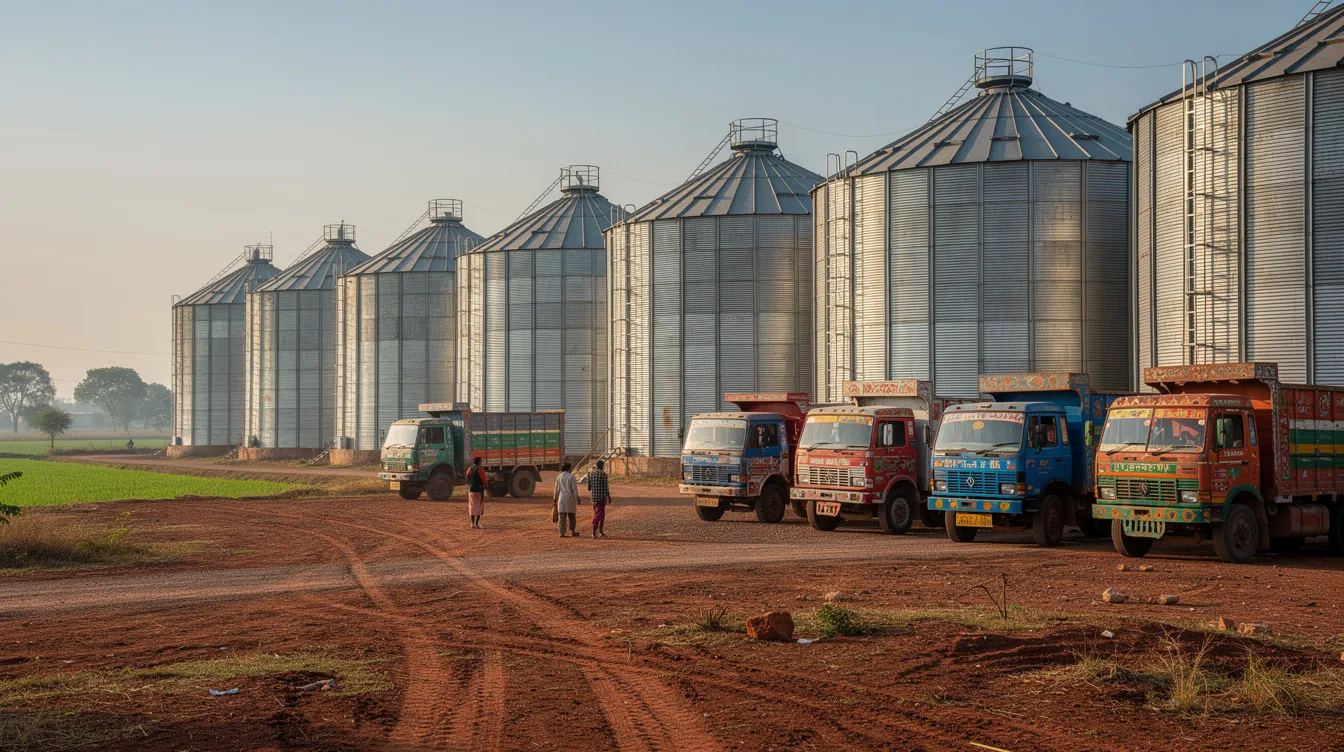
India produces over 300 million tonnes of food grain annually across wheat, paddy, maize, pulses, and other crops. A significant share still relies on conventional godowns and open-air storage (CAP), where moisture, insects, and fungal damage cause losses that modern steel silos can substantially reduce. Grain silo capacity planning is therefore not a secondary engineering exercise – it is the single most consequential decision an investor makes before committing capital to a storage infrastructure project.
Silo capacity is not about selecting one large grain silo. A facility comprises multiple grain storage silos – both flat bottom and hopper bottom – integrated with receiving systems, conveyors, bucket elevators, cleaning equipment, and dispatch arrangements. Selecting the wrong capacity – oversized or undersized – directly impacts utilisation, revenue, working capital, interest burden, DSCR, and long-term project viability.
Seasonality intensifies this challenge. Rabi and Kharif harvest cycles, MSP-based procurement by FCI and state agencies, and concentrated dispatch windows mean that silo capacity must accommodate peak harvest demand during short procurement periods while remaining financially sustainable across months of lower throughput. Establishing expected peak inventory helps determine required silo capacity and avoid costly mismatches between infrastructure and grain movement.
Planning silo capacity requires balancing operational scale and future growth. A structured Detailed Project Report connects capacity planning with project cost, means of finance, cash flows, and sensitivity analysis. For a comprehensive framework covering steel silo projects, entrepreneurs may refer to the Steel Grain Silo Plant Project Report & DPR in India.
Understanding Grain Silo Storage Capacity
Grain silo storage capacity is expressed in metric tonnes but is fundamentally derived from the geometric silo volume in cubic metres and the grain bulk density. The distinction between different capacity definitions is important:
- Total capacity is the theoretical maximum volume of a silo based on its geometric dimensions.
- Net capacity is the actual volume that can safely store grain after accounting for headspace, equipment clearances, and structural constraints.
- Effective capacity accounts for the angle of repose and safety margins – typically 85–95% of geometric volume.
- Static storage capacity refers to the total rated capacity of all bins in a facility at a given time.
- Annual grain handling throughput is the total grain received and dispatched through the facility over a year.
Incorporating headspace and unusable volumes is critical for accurate capacity planning. A 10,000 MT wheat silo complex, for instance, may handle 25,000–30,000 MT per year if grain is received and dispatched across multiple filling and emptying cycles during Rabi and Kharif seasons.
Storage capacity utilisation and turnover ratio determine how many times average inventory cycles through the facility annually. If a 10,000 MT facility maintains average inventory of 8,000 MT and turns it over three times, annual throughput reaches approximately 24,000 MT. This distinction between static capacity and throughput is vital for revenue modelling – lenders and investors evaluate both metrics when appraising grain storage DPRs.
Grain Silo Capacity Options – 5,000 MT to 50,000 MT
Investors in India commonly evaluate grain storage installations in the 5,000, 10,000, 15,000, 25,000, 30,000, and 50,000 MT static capacity range for storing wheat, paddy, rice, maize, corn, and soybeans.
| Static Capacity | Illustrative Bin Configuration | Typical Application | Handling Scale | Expansion Considerations | Key Observations |
|---|---|---|---|---|---|
| 5,000 MT | 2 × 2,000 MT flat bottom + 1 × 1,000 MT hopper bottom | District trader depot, FPO cluster, small mill buffer | 60–120 TPH, 1–2 truck bays | Layout designed for future doubling to 10,000 MT | Lower entry cost; limited economies of scale |
| 10,000 MT | 4 × 2,500 MT flat bottom silos | Regional mandi, flour/feed mill buffer, state agency storage | 100–200 TPH, 2–3 truck bays | Space for 2–3 additional bins | Common threshold for bank-financed projects |
| 15,000 MT | 3 × 5,000 MT flat bottom silos | Multi-commodity trader, medium agro-processor | 150–250 TPH, 3 truck bays | Can grow to 25,000 MT with modular additions | Moderate complexity; requires clear demand justification |
| 25,000 MT | 5 × 5,000 MT flat bottom + 1–2 hopper bottom dispatch bins | PPP grain hub, large commercial warehouse, integrated processor | 200–400 TPH, 4+ truck bays | Civil layout for rail siding or Phase-2 expansion | Needs long-term contracts or assured throughput |
| 30,000 MT | 6 × 5,000 MT flat bottom silos | Regional logistics hub, multi-state trader network | 250–400 TPH, 4–5 truck bays | Possible rail linkage in future phase | Higher fixed costs; utilisation planning essential |
| 50,000 MT | 8–10 × 5,000–6,250 MT in clusters | Rail-linked terminal, FCI hub, large conglomerate | 400+ TPH, multiple unloading bays, rail siding | Phased: 25,000 MT Phase-1, 50,000 MT target | Infrastructure-scale; consortium financing typical |
Small and medium grain traders generally consider 5,000–10,000 MT. Regional procurement centres and integrated rice mills or wheat flour mills may need 10,000–25,000 MT of buffer storage. FPO and PACS-backed projects often start at 5,000 MT. Large infrastructure developers handling multi-state grain logistics typically plan at 25,000–50,000 MT. Note that all bin configurations above are illustrative – final steel grain silo capacity, bin size, and number must be engineered for each site and grain mix.
Grain Silo Capacity Calculation Formula
Using precise formulas for calculating silo volume is necessary for accurate capacity planning. The fundamental relationship is:
Storage Capacity (MT) = Effective Grain Storage Volume (m³) × Grain Bulk Density (MT/m³)
Where:
Effective Grain Storage Volume = Geometric Volume × Usable-Fill Factor
The formula for cylindrical silo volume is V = πr²h (equivalently, V = πD²h / 4). Weight capacity is calculated using W = V × ρ, where ρ is the grain bulk density. For a hopper bottom silo, add the conical section volume (1/3 × base area × cone height), though hopper bottom silos have lower effective storage height than flat bottom silos because the cone displaces storage space.
Worked Example – Flat Bottom Wheat Silo:
Consider a flat bottom grain silo with diameter 12 metres and effective grain storage height of 18 metres:
- Geometric volume = π × (12²/4) × 18 = π × 36 × 18 ≈ 2,036 m³
- Usable-fill factor at 90% → Effective volume = 2,036 × 0.90 ≈ 1,832 m³
- Wheat bulk density ≈ 0.75 MT/m³ → Storage capacity = 1,832 × 0.75 ≈ 1,374 MT
Suppliers might rate such a bin at approximately 1,400–1,500 MT. Silo height and diameter significantly affect storage capacity – a modest increase in diameter from 12 m to 14 m increases cross-sectional area by over 36%.
Silo diameter significantly affects storage capacity, and silo height is constrained by structural integrity requirements, wind loads, and seismic considerations relevant to specific Indian regions.
Indicative Bulk Density Ranges (illustrative only):
- Wheat: ~0.70–0.78 MT/m³
- Maize / corn: ~0.65–0.72 MT/m³
- Paddy / rough rice: ~0.55–0.60 MT/m³
Different grains exhibit varying bulk densities and storage requirements. Grain type influences bulk density and weight capacity. Moisture content affects grain density and storage safety – higher moisture reduces flowability and increases the angle of repose, which limits the effective fill level in silos. Grain bulk density affects how much weight a silo can hold, so DPRs should use conservative, project-specific assumptions validated through lab testing rather than nominal textbook values.
Silo Bin Configuration for Different Storage Capacities
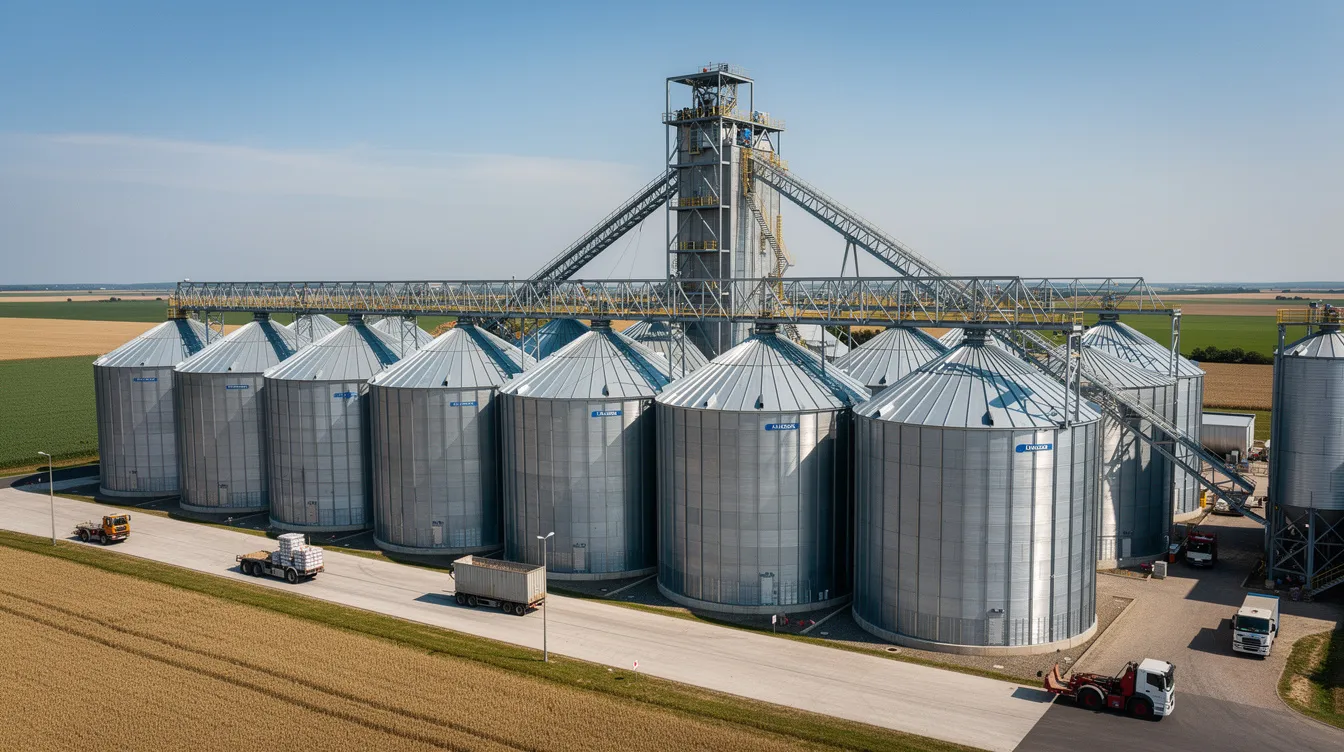
Total project capacity is almost always split across multiple bins rather than housed in a single structure. Silo arrangement can prioritize better grain segregation and operational flexibility – separating wheat from paddy, MSP lots from commercial procurement, or different moisture batches.
Grain characteristics affect silo design and operational efficiency. Flat bottom silos utilize nearly 100% of their height for storage and are ideal for large-scale grain storage centers. Hopper bottom silos allow grain to flow out by gravity, making them suitable for dispatch bins where quick, convenient unloading and cleaning are essential.
Operational benefits of multiple bins include the ability to store wheat, paddy, and maize separately; ease of fumigation and aeration management; reduced disruption during maintenance of individual units; and the flexibility to facilitate segregation by client, grade, or season.
The trade-off between fewer large silos and more smaller bins involves capital cost per MT (larger bins generally cost less per unit stored), civil foundation complexity, risk concentration (one large bin offline versus one of many), and overall layout and land requirement. All configurations are conceptual – final silo design, including the choice between flat bottom or hopper bottom, the outlet diameter for discharge, and structural dimensions, should come from qualified mechanical and structural engineers.
How to Select Between 5,000 MT, 10,000 MT, 25,000 MT and 50,000 MT
Capacity choice must reflect local procurement volumes, seasonal peaks, grain turnover, client contracts, road and railway connectivity, and access to bank finance. Each capacity band carries distinct operational and financial characteristics.
5,000 MT Grain Silo Capacity Planning
A 5,000 MT facility is suitable for district-level grain traders, small rice or flour mills, and FPO or PACS clusters needing scientific grain storage. Hopper bottom silos are better for small to medium-sized operations where frequent dispatch and ease of cleaning matter. Grain handling capacities of 60–120 TPH with truck-fed inflows are generally adequate.
From a finance perspective, the project cost and land requirement are lower, making bankability easier for MSMEs. However, scalability is limited if regional grain availability grows. Many promoters build 5,000 MT as Phase-1, keeping layout and utilities designed for future expansion to 10,000 MT.
10,000 MT Grain Silo Capacity Planning
This is a common threshold for regional grain storage projects linked to mandis, agro-processing units, or institutional contracts. Design typically involves 3–5 flat bottom silos with at least one hopper bottom silo for quick dispatch, and handling systems around 100–200 TPH. Such projects move beyond MSME scale and require well-prepared Bank Finance DPRs and CMA Data to demonstrate utilisation and DSCR to lenders.
25,000 MT Grain Silo Capacity Planning
This capacity suits integrated agro-processing companies, multi-commodity traders, or PPP projects linked with government procurement. Bin configuration might involve 5 × 5,000 MT flat bottom silos plus auxiliary hopper bottom silos, with higher material handling capacities in the 200–400 TPH range. Operational implications include more sophisticated stock management, quality labs, independent fumigation, and integration with transport networks. From a project finance perspective, long-term contracts or assured throughput become essential to justify the large fixed investment.
50,000 MT Grain Silo Capacity Planning
Projects at 50,000 MT sit in the infrastructure category – typically rail-linked grain terminals, bulk logistics operators, or large food-processing conglomerates. India’s FCI Hub & Spoke silo programme plans over 111 lakh MT of steel silo capacity at 249 locations, with individual hubs often targeting this scale.
Such projects require clusters of large flat bottom grain silos, multiple hopper bottom silos, heavy-duty conveyors and elevators equipped with PLC/SCADA automation, and often a rail siding. Higher land requirements (approximately 7 acres for silo blocks, roads, weighbridges, and utilities), environmental and safety compliance, and consortium or multi-bank funding are typical. An oversized 50,000 MT project with low utilisation can significantly strain DSCR, so phased expansion – 25,000 MT in Phase-1, scaling to 50,000 MT – is generally recommended.
Storage Capacity vs Annual Grain Throughput
Static installed capacity and annual throughput are distinct metrics. A 10,000 MT facility may handle 30,000 MT per year through multiple receiving and dispatch cycles. Turnover rate affects whether to design for short-term or long-term storage. Daily grain throughput determines required silo turnover capacity, and this must be sized for peak seasonal flow.
Annual Throughput (MT) ≈ Average Grain Inventory (MT) × Inventory Turnover Cycles per Year
| Static Capacity (MT) | 2× Turnover | 3× Turnover | 4× Turnover |
|---|---|---|---|
| 5,000 | 10,000 | 15,000 | 20,000 |
| 10,000 | 20,000 | 30,000 | 40,000 |
| 25,000 | 50,000 | 75,000 | 100,000 |
| 50,000 | 100,000 | 150,000 | 200,000 |
Contract structures – storage-only rent, handling charges, or trading margins – determine how throughput translates into revenue. Lenders evaluate peak inventory for working capital assessment and annual throughput for income projections. Both must be clearly justified in financial projections and CMA Data.
Grain Handling Capacity – TPH Planning
Tonnes per hour (TPH) is the critical design metric for bucket elevators, conveyors, receiving pits, and dispatch systems. Proper logistical planning is essential for efficient grain handling and storage. Required TPH depends on procurement days available during harvest season, working hours per shift, truck arrival patterns, and the target time to fill or empty a given silo bin. Silo dimensions should match transport vehicle payload capacities to ensure smooth loading and unloading operations.
Example: A 10,000 MT grain silo facility with a 150 TPH handling system would theoretically require about 67 hours of continuous operation to move total capacity. Accounting for downtime, cleaning, equipment changeover, and process interruptions, actual elapsed time could be 80–100 hours. For facilities with short procurement windows, higher TPH or parallel equipment lines become essential.
Proper sizing of grain cleaning, pre-storage handling, and dispatch lines is essential – the Grain Storage Process Flow Chart & Bulk Handling System page covers the complete process flow in detail.
Land and Layout Requirements for Grain Silo Capacity Planning
Land requirement varies significantly based on silo count, diameter, layout pattern, truck circulation, railway siding provision, and future expansion corridors. Site conditions and local regulations impact silo design and construction – soil bearing capacity, water table depth, seismic zone, and municipal setback rules all influence foundation cost and space.
Key layout components include:
- Silo foundations with safe spacing between bins
- Receiving pits, truck unloading docks, and weighbridges
- Pre-cleaning and grading plant with dust extraction
- Conveyor galleries and bucket elevator towers
- Internal roads, truck parking, and turning space
- Electrical substation, DG sets, control room, and safety systems
- Ground-level fire-fighting equipment, water storage, and ventilation system provisions
- Open or covered buffer storage and ancillary buildings
Road-fed grain storage facilities differ from rail-linked terminals in land shape, frontage requirements, and the need for wagon tipplers or rail loops. Approximate ranges can be used for preliminary planning, but final land requirement must emerge from a concept layout prepared jointly with technical suppliers and the DPR team.
Machinery Selection According to Silo Storage Capacity
Machinery sizing should be driven by peak receiving and dispatch demands rather than total silo capacity alone. Effective silo design minimizes grain spoilage and maximizes operational efficiency. Core equipment groups include:
- Steel silos – flat bottom and hopper bottom, with aeration ducts and temperature sensors
- Receiving hoppers, truck tippers, and intake pits
- Bucket elevators and belt or chain conveyors
- Grain cleaners, graders, and dryers where the factory or process flow requires them
- Dust extraction and aspiration systems
- Aeration and ventilation system installed inside the grain storage silos to maintain grain quality and prevent conditions requiring pesticides
- Temperature, moisture, and level monitoring instrumentation
- Discharge gates, sweep augers, and truck or wagon loading systems equipped with automation
- Electrical panels, PLC/SCADA, and safety systems
Machinery capacity is typically scaled when moving from 5,000 to 25,000 MT projects. Readers can explore the detailed Grain Silo Machinery, Equipment & Cost in India page and, where cleaning and drying are integrated, the Integrated Grain Cleaning, Grading, Drying & Storage Plant Project Report.
Financial Impact of Selecting Grain Silo Capacity
From a project finance perspective, each step up in capacity affects project cost, fixed overheads, working capital, revenue potential, and risk profile. Comparison of operational costs includes construction, maintenance, and energy use across different capacity bands.
Project investment components include land and site development, civil works and foundations, steel silos (flat bottom and hopper bottom – noting that hopper bottom silos typically cost more to construct), grain handling machinery and structures, electrical systems and automation, pre-cleaning or drying equipment, contingency, pre-operative expenses, and interest during construction.
Capital cost per MT of installed silo capacity generally improves with higher installed capacity and good utilisation. Industry benchmarks for large 50,000 MT steel silo complexes without rail linkage fall in the range of ₹8,000–₹12,000 per MT of static storage capacity, with rail terminals roughly doubling the cost. However, actual cost for a specific project can only be determined after supplier discussions and site-specific estimation – the Grain Silo & Warehouse Setup Cost in India article provides further context.
Capacity selection shapes fixed operating expenses, energy cost per unit handled, required working capital for grain inventory, repayment profile, DSCR, and breakeven utilisation level.
Financial Feasibility and Bank Finance DPR for Grain Silo Projects
A bankable DPR translates technical choices into financial projections, loan structuring, and DSCR analysis. Project planning should incorporate financial feasibility and business viability analysis from the outset. Key DPR elements include:
- Justification of chosen storage capacity based on grain availability, procurement catchment, and contracts
- Estimation of annual throughput and capacity utilisation ramp-up over 5–7 years
- Selection of business model: storage-only, storage plus handling, or trading-linked
- Fixed asset schedule, working capital assessment, and means of finance
- Projected P&L, cash flows, and DSCR under base and sensitivity scenarios
CMA Data for bank loans must reflect realistic grain storage capacity utilisation consistent with the DPR. Professional advisory services offer customized financial and operational guidance – Project Report Bank assists in preparing customised CMA Data and financial projections for grain silo capacity planning projects in the 5,000–50,000 MT range.
Capacity Planning for Different Grain Storage Business Models
Optimal grain silo capacity varies meaningfully across business models:
- Private commercial warehouses focus on rental income with moderate throughput – 10,000–25,000 MT capacity with stable utilisation is often suitable
- Grain trading operators need high turnover and flexible dispatch – storage capacity based on peak inventory and rapid dispatch cycles
- Integrated processors synchronise silo capacity with plant throughput, using silos as a raw material buffer maintained at several weeks’ supply
- Road-fed facilities primarily serve truck arrivals from local mandis, where space and access for large quantities of trucks determine layout
- Rail-linked terminals focus on rake-based bulk movement requiring constructed infrastructure like wagon tipplers
- Hub-and-spoke networks combine central 25,000–50,000 MT hubs with smaller rural storage nodes
- PACS and FPO projects are designed around local farmer aggregation with more modest capacity and simpler handling
Centralised bulk storage offers economies of scale but requires higher logistics expenditure. Decentralised models place storage closer to farms with greater operational flexibility. Each model demands a different capacity approach within the DPR.
Common Mistakes in Grain Silo Capacity Planning
- Selecting silo capacity solely from supplier recommendations without independent demand analysis
- Confusing static grain storage capacity with annual grain throughput in revenue projections
- Ignoring peak seasonal procurement while sizing TPH and number of bins
- Neglecting bulk density, angle of repose, and usable fill factor, leading to overestimation of effective silo volume
- Choosing only flat bottom or only hopper bottom grain silos without considering operating pattern and discharge needs
- Underestimating site development, railway siding, and foundation costs at 25,000–50,000 MT scale
- Over-optimistic capacity utilisation assumptions in financial projections, resulting in weak DSCR
- Not providing layout flexibility for future expansion – grain storage strategies must address climate-related challenges and future growth
- Inadequate provision for aeration, temperature monitoring, fumigation, and dust safety, compromising grain quality
These errors directly affect bank appraisal outcomes and can cause project delays. Early engagement with professional DPR and finance advisory helps avoid them.
Planning Future Grain Silo Capacity Expansion
Phased capacity expansion is often commercially sensible in India given demand uncertainty, evolving procurement contracts, and bank exposure limits. Reserve 20% to 30% capacity in land and utilities for future expansion needs.
An entrepreneur might start with a 10,000 MT road-fed grain silo facility, keeping civil layout, power supply, and road alignment designed for expansion to 25,000 MT. When throughput and contracts justify it, additional flat bottom grain silos are constructed and conveyors or elevators upgraded.
Design elements like the control room building, electrical substation, and internal road network can be oversized initially at marginal cost. New silos and specific machinery lines are better added later when cash flow supports them. Each expansion stage should be backed by updated DPRs, revised financial projections, and fresh DSCR assessment.
Frequently Asked Questions About Grain Silo Capacity Planning
These FAQs address practical questions investors commonly raise when considering 5,000–50,000 MT grain silo projects in India. All capacities, densities, and configuration examples are indicative and must be validated for each project.
How do I estimate land requirement for a 10,000–25,000 MT grain silo project?
Land requirement depends on number and diameter of silos, spacing, internal roads, weighbridge placement, and whether the project is road-fed or rail-linked. For preliminary planning, a 10,000 MT facility may require roughly 1.5–3 acres while a 25,000 MT project may need 3–5 acres, depending on layout density and expansion provisions. Irregular plot shapes, setbacks, and approach road geometry can add significantly beyond what silo footprints alone indicate. Sharing site drawings with your DPR team and silo supplier early allows capacity decisions, layout, and financial planning to be aligned from the outset.
Can I mix flat bottom and hopper bottom grain silos in one facility?
Yes, mixing both types is common and generally recommended. Flat bottom grain silos provide economical large-volume storage, while hopper bottom silos allow quick gravity-assisted grain discharge and easier cleaning – making them suitable as dispatch or day bins feeding truck or rail loading points. Civil foundations, conical hopper dimensions, heights, and conveyor routing must be planned so both types integrate smoothly. The DPR and equipment layout should treat the full complex as one integrated system.
How sensitive is silo capacity to changes in grain bulk density?
Because Storage Capacity = Volume × Bulk Density, a 10–15% change in density due to moisture or grain type alters MT capacity by a similar percentage for the same silo volume. For example, if a silo holds 2,000 m³ and bulk density shifts from 0.75 to 0.68 MT/m³, capacity drops from about 1,500 MT to around 1,360 MT. Conservative density assumptions are preferable so that promised capacity to clients and banks remains achievable even when grain condition varies. Projects should validate density with lab tests for the specific grain, variety, and moisture range expected.
What capacity-related information must be clearly presented in a bank finance DPR?
Essential items include chosen silo capacity in MT with configuration details, grain types with assumed bulk densities, expected annual throughput and turnover cycles, peak procurement and dispatch assumptions, layout summary with land requirement basis, and any phased expansion plan. These technical assumptions must tie directly into the revenue model, operating cost per MT, working capital assessment, and term-loan repayment schedule. Bankers typically expect sensitivity analysis showing DSCR impact under lower throughput scenarios.
Is it necessary to match silo capacity exactly with my processing plant capacity?
Grain silo storage for an integrated plant is typically planned to provide several weeks or months of raw material buffer, not just daily throughput. A 200 TPD (tonnes per day) plant might opt for 10,000 MT silo capacity to hold 1–2 months of wheat, depending on supply chain reliability and the purpose of strategic inventory management. Higher buffer protects against seasonal price spikes but increases capital and working capital blocked in inventory. The optimum storage duration and capacity should be determined in conjunction with financial modelling.
Conclusion – Choosing the Right Grain Silo Storage Capacity
Choosing between 5,000, 10,000, 25,000, and 50,000 MT grain silo capacity in India requires balancing actual and projected storage demand, seasonal procurement peaks, grain characteristics and bulk density variations, material handling capacity and logistics connectivity, land and layout flexibility, future expansion plans, and financing capacity. The factors that determine the right capacity are commercial and financial as much as they are technical.
The most financially viable solution is not necessarily the largest silo complex, but the capacity that can be realistically utilised and financed while maintaining comfortable DSCR and acceptable risk levels over the long term. A capacity justified by demand, operations, and investment economics will always outperform one built on aspirational projections.
Entrepreneurs and project promoters planning 5,000–50,000 MT grain storage silos are welcome to connect with CA Manish Gugliya via WhatsApp for project-specific DPRs, financial modelling, CMA Data, and bank finance advisory. Professional fees for Bank Finance DPR & Loan Proposal Assistance start from approximately ₹25,000, depending on project scope and complexity – all work is customised rather than based on generic templates. Careful grain silo capacity planning, backed by sound technical inputs and robust financial analysis, can convert a capital-intensive grain storage idea into a bankable and sustainable infrastructure project.
About the Author
CA Manish Gugliya, FCA, DISA (ICAI), is a practising Chartered Accountant with over 20 years of professional experience in project finance, Detailed Project Reports, CMA Data preparation, financial projections, and industrial project feasibility analysis across India. He has specialised experience with agro-processing, grain and cereal processing, and grain storage infrastructure projects, including advisory on silo capacity planning, bank finance structuring, and investor documentation. The insights in this article are based on practical experience in DPR preparation and financial modelling – engineering design of silos is always carried out by qualified technical specialists. Project Report Bank operates as a professional advisory platform providing customised analysis and documentation rather than off-the-shelf templates.