India’s organised animal feed manufacturing sector is expanding rapidly, driven by rising demand for poultry, dairy, meat, fish and livestock products. For project promoters evaluating investments in the ₹5 crore to ₹100+ crore range, a professionally prepared grain based animal feed manufacturing project report is the foundation of sound decision-making. This article serves as a central hub connecting 20 specialist guides on feed plant setup, machinery, capacity planning, working capital, financial projections and feasibility.
Key Takeaways
- India’s commercial animal feed production reached approximately 57.73 million metric tonnes in 2025, making it the second-largest feed producer in Asia. The global animal feed market was valued at USD 548.1 billion in 2025 and is projected to reach 702.75 billion USD by 2034, growing at a CAGR of 2.8%.
- Raw material cost – maize, soybean meal, broken rice, wheat bran, DDGS – accounts for 70–85% of operating expenses in feed manufacturing, necessitating high quality market research and procurement strategy for project viability.
- Plant setup decisions covering 50–300 TPD capacity, mash vs pellet feed, and integrated animal feed manufacturing vs standalone ingredient plants must be supported by structured financial projections, cost analysis, DSCR and internal rate of return (IRR) assessment.
- Project Report Bank, led by CA Manish Gugliya, FCA, DISA (ICAI), prepares customised, bankable DPRs, CMA data and feasibility studies for animal feed manufacturing projects.
- This article links to 20 detailed guides covering poultry feed, cattle feed, grain-based ingredients, machinery, capacity planning, working capital, financial projections and feasibility – forming a complete decision-making resource.
Introduction – Investment Opportunities in Grain-Based Animal Feed Manufacturing in India
India’s dependence on organised feed production is growing as commercial livestock farming expands across poultry, dairy, aquaculture and small ruminants such as sheep and goats. The global animal feed market is projected to reach $460 billion by 2027, and increasing demand from developing countries continues to reshape industry trends. Within India, animal feed production supports the output of eggs, meat, milk and fish, making feed manufacturing a critical link in the agricultural value chain.
Compound feed factories rely heavily on corn (maize), broken rice, wheat bran, oilseed cakes and DDGS. Global demand for these raw materials, combined with seasonal price volatility, directly affects production cost and profitability. Animal feed production surpassed 310 million tons globally in 2024, while poultry feed demand grows annually by up to 20% in certain regions – underscoring both the opportunity and the competitive intensity in this sector.
A professionally prepared DPR covering technical feasibility, capital cost estimation, working capital modelling, sensitivity analysis, DSCR and IRR is essential before committing to equipment orders or land acquisition. Financial projections are crucial for assessing the viability of animal feed projects and for structuring a bankable proposal. The sections below are structured as a decision-making framework, with each topic linking to specialised articles for deeper analysis.
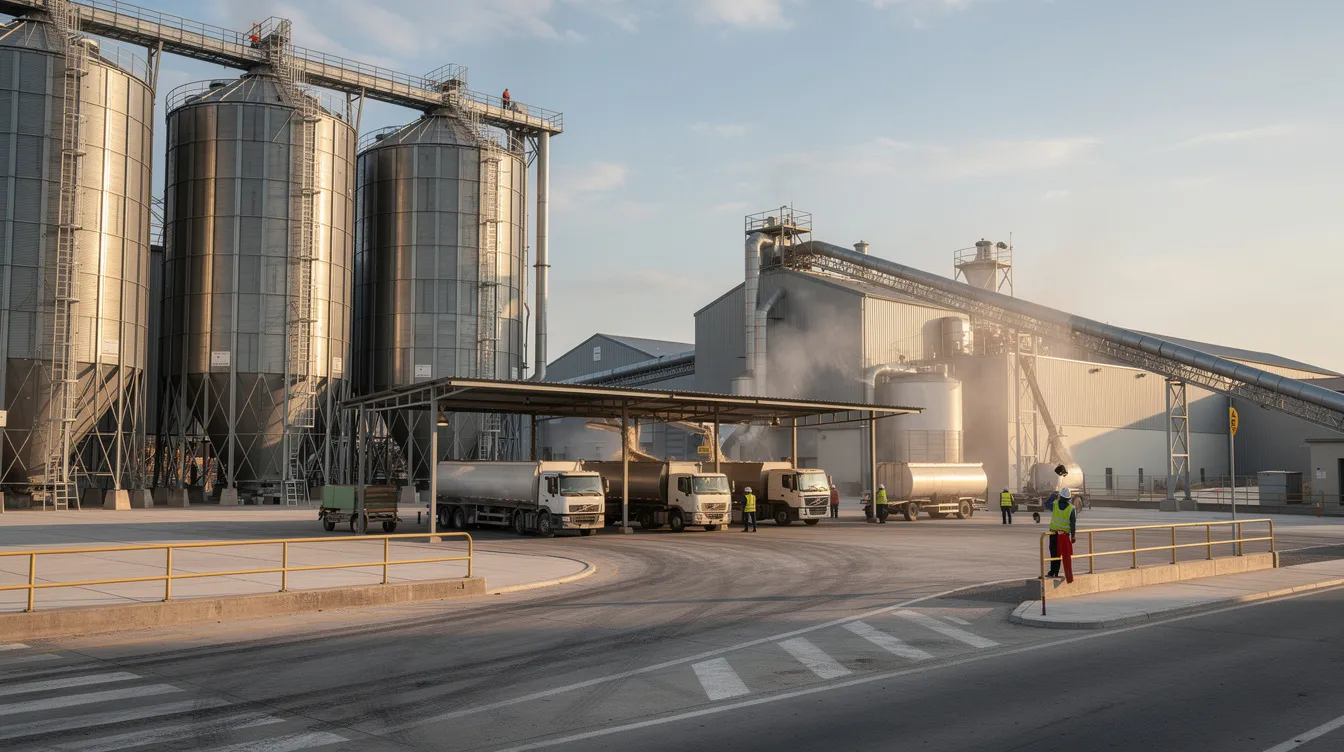
Understanding the Grain-Based Animal Feed Manufacturing Industry
The animal feed industry in India spans organised compound feed mills and unorganised on-farm mixing. The organised sector accounts for roughly 60% of total feed output. Cattle feed production surpassed 310 million tons in 2024 globally, growing 1.8% year-on-year, while India’s commercial feed volumes have expanded at approximately 4.5% annually. Beef cattle feed accounts for nearly 65% of global ruminant feed production, highlighting the scale of ruminant feed demand worldwide. The global pet food market, valued at approximately $130 billion, represents a separate but adjacent segment relevant to some feed manufacturers looking at pets and specialty animals.
Key feed categories include compound feed for broiler and layer poultry, cattle feed pellets for dairy cows and beef cattle, mash feed, crumble feed and concentrates. Animal feed formulations typically include cereals, vitamins, and minerals tailored to different animal species. Feed conversion ratio (FCR) – the efficiency with which animals convert feed into growth – is the central performance metric. Better formulation and grain quality improve FCR, directly affecting farmers and integrators.
Market demand drivers include:
- Rising incomes and protein consumption in urban and semi-urban India
- Growth of commercial dairy and poultry integration
- Government programmes supporting livestock productivity and feed infrastructure
- Shift from on-farm mixing to commercial, quality-controlled feed manufacturing
Economics vary by livestock category. Poultry feed is volume-driven with thin margins but high throughput. Cattle feed has different formulation and price dynamics. Multi-species or integrated mills spread risk but increase operational complexity. Market analysis in a project report must identify target customers and demand-supply trends specific to the proposed project region.
Major Grain-Based Animal Feed Manufacturing Projects
Promoters typically evaluate several key factors when choosing a project model. The table below compares five common industrial configurations:
| Project Type | Major Products | Target Market | Key Technology | Typical Capacity (TPD) | Investment Characteristics |
|---|---|---|---|---|---|
| Poultry Feed Mill | Pellets, crumbles, layer mash | Broiler/layer farms, integrators | Pelleting, crumbling, feed analysers | 5–50 | High volume, tight quality control, thin margins |
| Cattle Feed Plant | Pellets, dairy mash | Dairy cooperatives, commercial farms | Fibre handling, pelletising | 10–100 | Lower protein formulations, steady demand growth |
| Integrated Multi-Species Mill | Poultry, cattle, aqua feed | Multiple livestock segments | Flexible formulation, multiple lines | 50–300 | Higher capex, diversified revenue, complex operations |
| Automatic Pellet Plant | Fully automatic pellets/crumbles | High-end poultry, aquaculture, export | Steam conditioning, PLC automation | 5–50+ | High capex and energy, superior product value |
| Feed Concentrate Plant | High-density concentrate, mineral premix | Farms adding own grains, dealers | Precise weighing, mixing, packaging | 1–20 | Lower pelleting cost, margin from nutrition premium |
For detailed analysis of commercial broiler and layer poultry feed manufacturing plants, refer to the dedicated project report. Promoters considering dairy and cattle feed projects with grain-based rations should review the Industrial Cattle Feed Manufacturing Plant Project Report. Multi-species operations are covered in the Integrated Animal Feed Mill Project Report, while automated pelleting with conditioning, cooling and screening is addressed in the Automatic Feed Pellet Manufacturing Plant Project Report. For concentrate and mash feed manufacturing, see the Industrial Animal Feed Concentrate Manufacturing Plant Project Report.
Project shortlisting should consider local demand density, tie-ups with integrators or cooperatives, available raw materials, existing distribution network and investment appetite.
Grain-Based Feed Ingredient Processing and Value-Addition Projects
Many entrepreneurs consider standalone grain-based ingredient processing units that supply large compound feed manufacturers or integrated poultry and dairy companies. These projects focus on cleaning, grading, grinding and standardising feed ingredients rather than producing finished compound feed. Raw materials for animal feed include grains, protein sources, and vitamins – and each ingredient has distinct processing requirements.
| Raw Material | Processed Products | Typical Buyers | Core Technology | Key Viability Factors |
|---|---|---|---|---|
| Maize | Maize meal, grits, germ | Feed mills, pet food | Cleaning, degerminator, hammer mill | Maize cost, moisture, transport |
| Broken Rice | Cleaned broken rice, rice powder | Compound feed plants | Grading, separation, milling | Rice mill proximity, quality consistency |
| Wheat Bran | Stabilised wheat bran | Feed mills, dairy farms | Cleaning, sifting, stabilisation | Supply from flour mills, storage |
| DDGS | Dried, pelletised DDGS | Feed mills, poultry integrators | Drying, pelletising, standardisation | Ethanol plant supply reliability |
| Maize Wet Milling By-Products | Gluten, germ, fibre | Feed mills, specialty feed | Wet milling, separation, drying | Capital intensive, technical expertise |
For maize ingredient preparation, refer to the Maize Feed Ingredient Processing Plant Project Report. Broken rice applications are covered in the Broken Rice Feed Ingredient Processing Plant Project Report. Wheat bran quality management is detailed in the Wheat Bran Processing Plant Project Report. DDGS processing, increasingly relevant due to India’s ethanol blending policy, is addressed in the Grain-Based DDGS Processing Plant Project Report. Maize wet milling by-product valorisation is covered in the Maize Wet Milling By-Product Recovery Plant Project Report.
Key economic considerations include local grain availability, moisture and raw material storage control, transport costs, industrial off-taker contracts, and quality certification demanded by feed manufacturers.
Animal Feed Manufacturing Process and Production Technology
The manufacturing process for animal feed includes cleaning, grinding, mixing, and packaging grains through a defined production process flow:
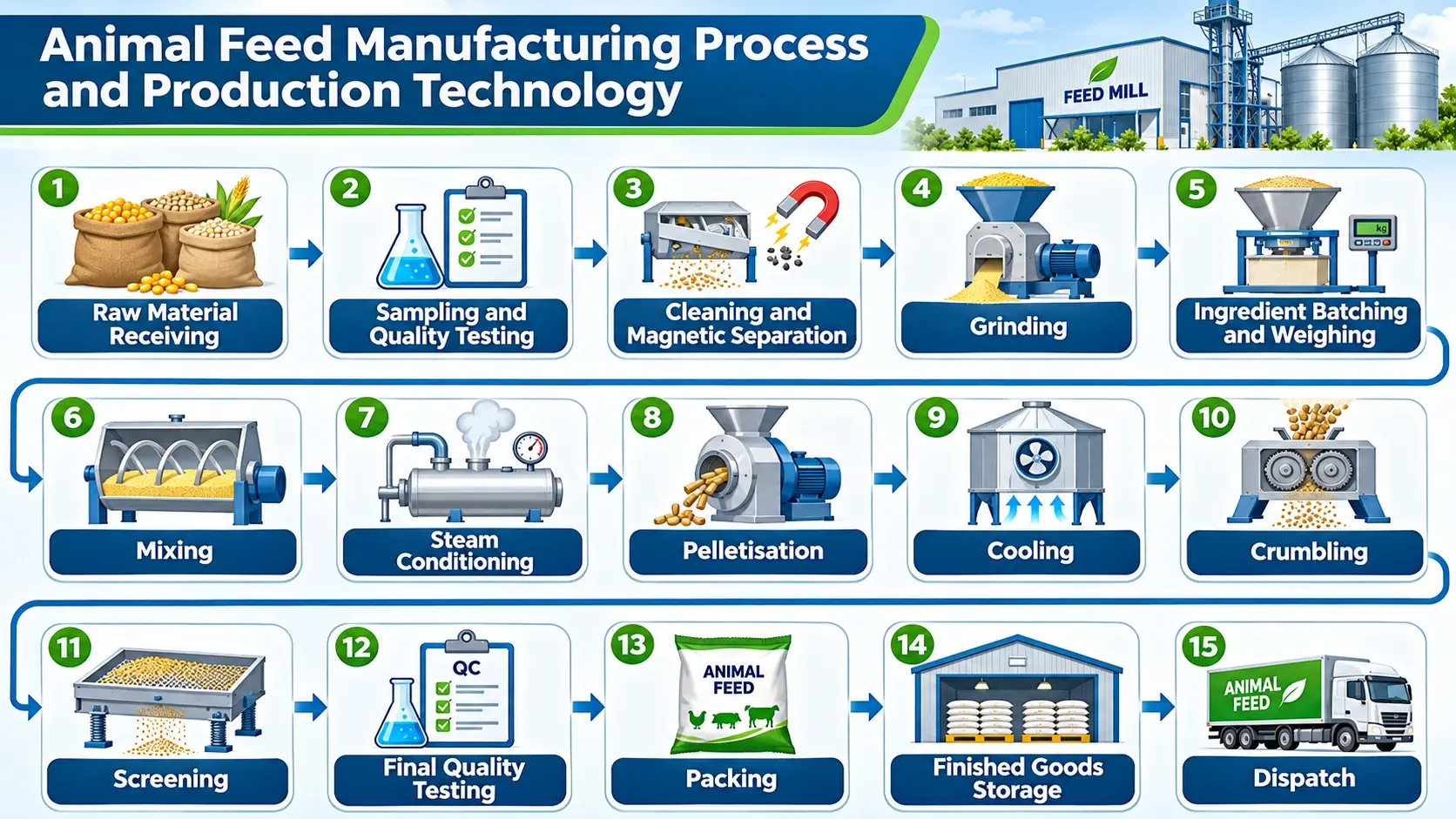
Raw Material Receiving → Sampling and Quality Testing → Cleaning and Magnetic Separation → Grinding → Ingredient Batching and Weighing → Mixing → Steam Conditioning → Pelletisation → Cooling → Crumbling → Screening → Final Quality Testing → Packing → Finished Goods Storage → Dispatch
- Hammer milling reduces particle size to 1–3 mm, improving digestibility and mixing uniformity
- Batch mixing ensures homogeneous blending of grains, protein sources, feed additives, vitamins and minerals
- Steam conditioning softens material for better pellet binding and reduces pathogens
- Cooling stabilises pellet moisture and hardness after pelleting
- Crumbling produces smaller feed pellets suitable for starter birds
- Screening removes fines and ensures consistent pellet size for quality sales
Mash feed is the simplest form – ground and mixed without pelleting. Pellet feed offers better feed conversion and is preferred for broiler, layer and cattle finishing operations. Crumble feed serves poultry starters. Extrusion technology, used for aquaculture and specialty pets feed, is not mandatory for standard grain-based feed manufacturing.
Production efficiency depends on automation (PLC/SCADA-based batching, recipe management, traceability), dust control, explosion safety and preventive maintenance. A DPR’s technical section must clearly describe the chosen process route, equipment list, plant layout and utilities needed.
Animal Feed Mill Machinery, EPC, Infrastructure and Storage Requirements
Core machinery for an industrial feed plant includes:
- Raw material handling: weighbridges, intake pits, bucket elevators, screw conveyors
- Cleaning and magnetic separators for removing stones, metals and foreign matter
- Hammer mills or roller mills for efficient grinding
- Ribbon or paddle mixers for homogeneous blending
- Steam boilers and conditioners for pellet feed lines
- Pellet mills, dies and related accessories
- Coolers, crumblers and screening equipment
- Bagging machines, stitchers and labelling systems
- Dust collection and explosion protection systems
- Laboratory equipment: moisture meters, proximate analysers
For integrated EPC and automated plant design, refer to Automatic Animal Feed Mill Machinery, Layout and EPC Cost. Grain storage design for year-round supply is covered in the Industrial Grain Storage Silos Project Report. Pelleting line design – conditioners, pellet presses, coolers and crumblers – is detailed in the Industrial Feed Pelleting Plant Project Report.
Plant layout must include areas for storage, production, and packaging with linear material flow, segregation of dusty and clean zones, safe boiler rooms, and space for future expansion. Utilities – power (HT/LT), boiler fuel, water supply, internal roads, weighbridge and laboratory – appear as line items in the DPR project cost estimate.
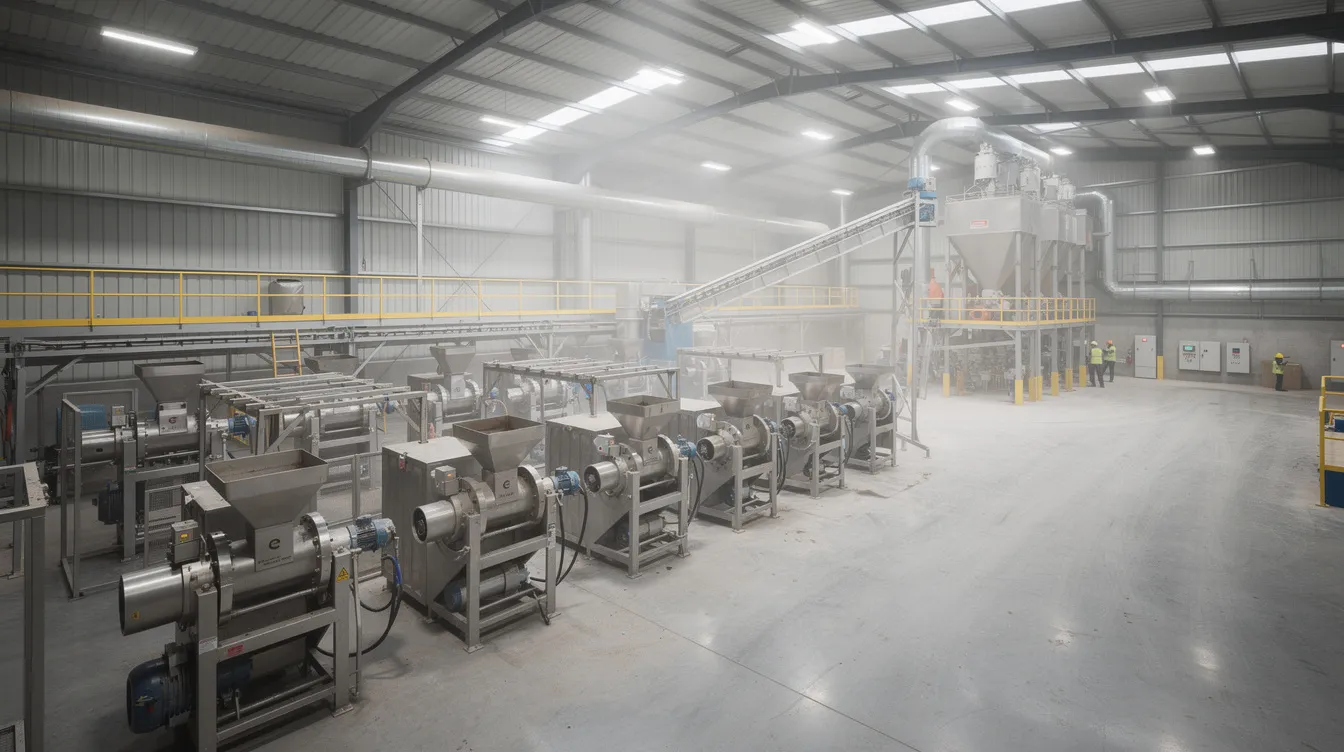
Animal Feed Manufacturing Plant Capacity Planning – 50 TPD to 300 TPD
Medium to large mills in India are commonly planned in the 50–300 TPD range. Animal feed production capacity ranges from 20,000 to 100,000 MT annually depending on scale and operating days. Animal feed manufacturing plants require site selection based on logistics, raw material access and proximity to customer clusters. Capacity selection drives machinery sizing, building design, working capital and market-entry strategy.
| Parameter | 50 TPD | 100 TPD | 200 TPD | 300 TPD |
|---|---|---|---|---|
| Annual Output (~300 days) | ~15,000 MT | ~30,000 MT | ~60,000 MT | ~90,000 MT |
| Typical Market Radius | District-level | Multi-district | State-level | Multi-state |
| Machinery Complexity | Moderate | Higher redundancy | Multiple lines | Full automation |
| Storage & Silo Needs | Moderate | Significant | Large silos required | Bulk rail/road handling |
| Management Intensity | Owner-managed | Professional team | Multi-department | Corporate-grade |
Installed capacity differs from practical throughput. Plants typically operate 16–20 hours per day across 2–3 shifts with ~300 working days annually. Utilisation ramp-up over the first 3–4 years is normal – 50–60% in year one, reaching 85–90% by year four. Bottleneck machines (pellet mills, mixers) must be sized to support target output. For detailed line balancing analysis, refer to the Animal Feed Mill Capacity Planning guide.
Phased expansion is advisable: design civil and utility infrastructure for eventual 2× capacity but install only phase-one pelleting and storage to manage investment and demand risk.
Grain-Based Animal Feed Mill Setup Cost and Capital Investment
Animal feed manufacturing plant setup costs include machinery and land as the two largest components. Machinery costs constitute the largest portion of capital expenditure, typically 40–45% of total project cost. A 32 TPD cattle feed pellet plant in India involves total investment of approximately ₹3.80 crore, with plant and machinery alone costing about ₹1.66 crore. The project report should detail the machinery and equipment required for production at the planned scale.
Key capital cost heads in a DPR typically include:
- Land and site development
- Building and civil construction (25–30% of capex)
- Plant and machinery, domestic and imported (40–45%)
- Grain receiving, storage silos and warehouses (10–15%)
- Boilers, compressors, transformers and electrical panels (5–10%)
- Laboratory, office and pollution control systems
- Installation, commissioning and preliminary expenses
- Contingencies and working capital margin
Exact animal feed mill setup cost in India depends on capacity, technology level (manual vs fully automatic), degree of in-house storage and location-specific construction process costs. Environmental sustainability should also be considered during plant construction and equipment selection. For deeper cost-breakdown discussion, see Grain-Based Animal Feed Plant Setup Cost. Project Report Bank’s DPR work uses multiple vendor quotations, BOQ-based civil estimates and realistic contingency margins rather than generic template values.
Existing Animal Feed Mill Expansion, Automation and Modernisation
Promoters already operating 20–50 TPD plants often evaluate brownfield expansion to 100+ TPD. Unlike greenfield projects, expansion can utilise existing building, utilities and infrastructure, reducing incremental cost.
Common expansion levers include:
- Adding extra pellet presses or crumbler lines
- Upgrading grinders and mixers for higher throughput or fibre handling
- Installing automatic batching systems for recipe accuracy
- Introducing grain silos for bulk receiving and year-round supply
- Optimising plant layout to de-bottleneck material flow
Automation upgrades lower labor costs per ton, improve traceability, enhance safety and reduce steam and electrical consumption. However, expansion DPRs must evaluate incremental returns, residual machinery life, impact on working capital and DSCR. The Animal Feed Mill Expansion Project Report provides detailed guidance for brownfield and modernisation planning.
Working Capital Requirements for Animal Feed Manufacturing Plants
Working capital is critical in grain-based feed manufacturing because operating costs for animal feed plants are primarily driven by raw materials, especially maize, soybean meal and broken rice. A 100–200 TPD plant may need to stock 30–60 days of raw materials and 10–20 days of finished feed, translating into substantial bank cash credit requirements.
Key working capital components:
- Seasonal grain procurement and buffer stocking
- Finished goods inventory (10–20 days)
- Credit to distributors and institutional buyers (15–30 days)
- Supplier credit from grain merchants and oilseed processors
- Operating cycle length and current ratio norms
- Drawing power calculations and margin money from promoters
- Receivable risk and liquidity management
Volatile ingredient prices can compress margins and increase funding needs. Professional DPRs include month-wise working capital and fund-flow projections essential for realistic loan sanctioning. For detailed working capital assessment methodology, see Animal Feed Manufacturing Plant Working Capital.
Animal Feed Mill Financial Projections, Profitability, DSCR and IRR
Serious investors and bankers expect 5–7 year financial projections with properly structured assumptions. Financial projections include capital investment, operating costs, and pricing trends for the proposed project. A project report must include a clear financial overview, including costs and funding sources. Animal feed manufacturing plants have gross profit margins of 15–25% depending on scale, product mix and operational efficiency.
Key projection elements include:
- Installed capacity and utilisation ramp-up assumptions
- Product mix (broiler, layer, cattle feed, aqua)
- Selling prices and raw material consumption norms per ton
- Power, fuel and labor costs per ton
- Packing, transport and overhead allocation
- Contribution per ton (selling price minus variable cost)
- EBITDA, PBT and PAT computation
- A break-even analysis determines the minimum production level needed to avoid losses
The Debt Service Coverage Ratio (DSCR) is important for evaluating loan repayment capacity. Lenders assess both average and minimum DSCR across the loan tenure. Project IRR estimates for organised Indian feed plants range from 17–20% in favourable scenarios, but sensitivity analysis around feed selling price, raw material cost and capacity utilisation is essential since raw materials account for 75–85% of operating expenses. Financial projections assess capital investment and operating costs in an integrated manner.
For detailed projection formats and ratio analysis, refer to Animal Feed Mill Financial Projections. Project Report Bank’s models are assumption-driven, transparent and custom-built for each plant’s specific configuration.
Bank Loan DPR, CMA Data and Project Finance for Animal Feed Manufacturing
A bankable Detailed Project Report (DPR) is the primary document for obtaining term loans and working capital limits from Indian banks. An organized structure in project reporting enhances comprehension and effectiveness during bank appraisal. A professional project report covers technical feasibility, market assessment, and financial soundness.
Typical DPR contents include:
- Promoter profile and business background
- Project description, location and market analysis
- Technical configuration, plant capacity and layout
- Project cost and means of finance (debt-equity structure typically 70:30 to 80:20)
- Implementation schedule
- Projected P&L, balance sheet and cash flow
- DSCR, IRR and sensitivity analysis
- CMA data (projected balance sheet, P&L, fund flow, MPBF working capital assessment)
Security, collateral and overall financial viability readings influence the bank’s internal credit rating. Professional advisors can prepare robust DPRs and CMA data but cannot guarantee loan approval – final decisions rest with the lending institution. For documentation guidance, see Animal Feed Plant Bank Loan DPR and CMA Data.
Technical Feasibility, Business Risk Assessment and Investor Readiness
Technical feasibility for a grain-based animal feed manufacturing project requires validation of achievable throughput, power consumption per ton, boiler capacity, moisture targets and pellet durability indexes. A detailed project report for an animal feed manufacturing plant requires market research alongside technical validation. The environmental impact of operations – emissions, dust, waste – must be assessed and mitigated.
Key risk areas include:
- Raw material sourcing and seasonal availability
- Grain price volatility affecting margin sustainability
- Freight and logistics cost sensitivity
- Equipment supplier reliability and staff training requirements
- Product quality consistency and contamination risks
- Sales concentration on few customers
- Capacity utilisation risk during ramp-up
- Regulatory and compliance changes
- Working capital stress under adverse scenarios
An investor-ready feasibility study goes deeper than a standard DPR, incorporating multiple demand and price scenarios with downside cases. There are important differences between a basic project report, a bankable DPR, a comprehensive feasibility study and an investor-ready documentation pack suitable for strategic investors. See the Animal Feed Manufacturing Plant Feasibility Study for detailed risk analysis methodology.
Regulatory Approvals and Quality Compliance for Industrial Feed Plants in India
Statutory approvals are necessary for operating an animal feed manufacturing unit. Compliance with local regulations and quality standards is critical in animal feed production. Requirements vary by state, product type and plant scale, and must be confirmed with local authorities.
Likely compliance areas include:
- Business incorporation (company, LLP, firm) and Udyam MSME registration
- Factory licence and Shops & Establishment registration
- Local municipal permissions, land-use and building plan approvals
- Fire safety and electrical safety clearances
- Pollution control consents (air emissions from boilers, dust collectors, noise)
- BIS standards for applicable feed categories (mineral mixtures, certain ingredients)
- Feed quality testing, traceability and labelling requirements
- GST, PAN, TAN and other tax registrations
- Labour and industrial compliance as per state norms
DPRs typically include a section listing likely statutory approvals with the caveat that promoters must verify current norms at the time of implementation. Animal health considerations and feed safety standards continue to evolve, requiring ongoing compliance monitoring.
How to Select the Right Animal Feed Manufacturing Project
Investors must evaluate several key factors before choosing between poultry feed, cattle feed, integrated multi-species mills, feed concentrates and standalone grain-based ingredient units. The successful establishment and successful operation of any feed plant depends on matching project configuration with local conditions.
| Criterion | Poultry Feed | Cattle Feed | Integrated Mill | Concentrate Plant | Ingredient Unit |
|---|---|---|---|---|---|
| Capital Intensity | Medium-High | Medium | High | Low-Medium | Low-Medium |
| Raw Material Dependence | Very High | High | Very High | Moderate | Very High |
| Margin Profile | Thin, volume-driven | Moderate | Diversified | Premium possible | Variable |
| Market Complexity | Competitive | Cooperative-driven | Multi-segment | Dealer network | B2B contracts |
| Scalability | High | Moderate | High | Moderate | Moderate |
| Suitable For | Integrators, large entrepreneurs | Dairy belt promoters | Corporate groups | Trading companies | Grain processors |
Factors influencing project selection include proximity to poultry or cattle clusters, availability of maize and other grains, existing marketing relationships, capital budget, risk appetite, working capital capacity and management bandwidth. Markets in the Middle East, South America and other regions also present export opportunities for certain feed products, though domestic demand remains the primary driver for most Indian promoters. Project Report Bank helps clients compare 2–3 alternative project configurations through side-by-side financial projections before finalising the model and capacity. For related grain processing projects, promoters may also explore opportunities like integrated rice milling plants.
Explore All 20 Grain-Based Animal Feed Project Reports and Specialist Guides
This hub article connects to 20 detailed guides organised in six clusters for easy navigation:
A. Animal Feed Manufacturing Plants
- Poultry Feed Manufacturing Plant Project Report
- Industrial Cattle Feed Manufacturing Plant Project Report
- Integrated Animal Feed Mill Project Report
- Automatic Feed Pellet Manufacturing Plant Project Report
- Industrial Animal Feed Concentrate Manufacturing Plant Project Report
B. Feed Ingredient Processing and Value Addition
- Maize Feed Ingredient Processing Plant Project Report
- Broken Rice Feed Ingredient Processing Plant Project Report
- Wheat Bran Processing Plant Project Report
- Grain-Based DDGS Processing Plant Project Report
- Maize Wet Milling By-Product Recovery Plant Project Report
C. Machinery, Pelleting Technology and Industrial Infrastructure
- Automatic Animal Feed Mill Machinery, Layout and EPC Cost
- Industrial Grain Storage Silos Project Report
- Industrial Feed Pelleting Plant Project Report
D. Plant Setup Cost, Capacity Planning and Expansion
- Grain-Based Animal Feed Plant Setup Cost
- Animal Feed Mill Capacity Planning
- Animal Feed Mill Expansion Project Report
E. Working Capital, Financial Projections and Bank Finance
- Animal Feed Manufacturing Plant Working Capital
- Animal Feed Mill Financial Projections
- Animal Feed Plant Bank Loan DPR and CMA Data
F. Feasibility Assessment and Investor Readiness
Professional DPR and Financial Feasibility Consultancy for Large-Scale Animal Feed Projects
Project Report Bank is a Chartered Accountant-led professional advisory platform headed by CA Manish Gugliya, FCA, DISA (ICAI), with more than 20 years of experience in project finance, DPRs and industrial feasibility studies. The advisory focus serves clients and promoters evaluating grain-based animal feed manufacturing and feed ingredient processing investments.
Core services include:
- Customised Detailed Project Reports for greenfield and brownfield projects
- Bank loan DPRs and CMA data preparation
- Financial modelling with assumption-driven projections
- Working capital assessment and fund-flow analysis
- DSCR, IRR, NPV and sensitivity analysis
- Investor-ready project documentation
- Project finance advisory and means of finance planning
Services assist with term loan and working capital planning but do not constitute guarantees of loan sanction or business profitability. Abc machinery vendors and other equipment suppliers provide technical quotations independently while Project Report Bank maintains financial analysis independence.
Planning a Large-Scale Animal Feed Manufacturing Project in India?
If you are evaluating a new animal feed manufacturing plant, industrial feed ingredient processing unit, integrated feed mill or expansion project, a professionally prepared DPR and financial feasibility study can help assess investment requirements, production economics, working capital needs and funding readiness.
Contact CA Manish Gugliya through ProjectReportBank.com for professional project report preparation, financial projections, CMA data and industrial project finance advisory. Share your proposed location, planned capacity, product category, estimated investment and funding requirement through the website’s contact form or WhatsApp facility.
Frequently Asked Questions
How long does it typically take to implement a grain-based animal feed manufacturing plant after DPR approval?
Typical timelines involve 1–2 months for detailed engineering and vendor finalisation after DPR completion, 4–8 months for civil construction and machinery delivery, and 1–2 months for installation, trial runs and stabilisation. A 100–200 TPD plant may take 8–14 months from DPR finalisation to commercial production, though actual duration depends on plant size, location approvals, land acquisition timelines and vendor schedules. Promoters should build realistic implementation schedules into their proposed project plans.
Is it better to start with mash feed only and add pelletisation later?
Mash-only plants require lower initial investment and simpler layouts but may face market limitations where customers prefer feed pellets. A combined mash and pellet configuration costs more but offers flexibility and better capacity utilisation across different animal species. The decision should be based on local demand for animals like poultry and cattle, available capital, and long-term growth strategy. Where pellet demand is established, investing in pelleting from day one is generally more suitable.
How should promoters plan for volatility in maize and other grain prices?
Promoters should build multiple scenarios into financial projections – base, optimistic and stressed raw material cost cases. Maintaining adequate working capital lines, focusing on procurement efficiency through staggered purchases, and reviewing pricing and margin assumptions periodically are practical strategies. Data on historical price movements should inform sensitivity analysis. A well-structured financial model helps identify the threshold at which margin compression becomes unsustainable.
Can one DPR and financial model be reused for different plant locations or capacities?
While the structure of a DPR can serve as a framework, core assumptions such as land cost, freight, wage levels, local demand, utility tariffs and raw material access change by location and capacity. Serious investors should commission an updated, project-specific DPR rather than rely on a generic report. This is particularly important for bank finance proposals where data accuracy directly influences credit appraisal.
At what stage should we engage Project Report Bank for our animal feed manufacturing project?
Engaging at the concept stage – after preliminary market research but before finalising machinery orders or land purchases – allows project cost, capacity, layout, means of finance and bankability to be optimised through a professionally prepared DPR and feasibility analysis. Early engagement helps avoid costly design changes and ensures the financial structure supports sustainable growth from the outset.
Conclusion – Building a Technically Viable and Financially Sustainable Animal Feed Manufacturing Project
Success in grain-based animal feed production requires the right project choice, sound market assessment, robust process and machinery selection, disciplined cost analysis and realistic financial projections. Raw material management, working capital discipline, plant efficiency and continuous risk monitoring are as important as initial capital investment decisions.
- A bankable DPR with capacity planning and DSCR/IRR-based appraisal improves decision quality and funding readiness
- Sensitivity analysis and feasibility studies help identify risks before capital is committed
- Experienced professionals like CA Manish Gugliya and the Project Report Bank team bring structured financial analysis to medium and large-scale animal feed manufacturing projects, helping promoters build technically viable and financially sustainable operations