Key Takeaways
- An industrial animal feed concentrate and mash feed manufacturing plant must be planned around product mix, capacity (5–20 TPH), raw material strategy and regional demand for cattle feed, poultry feed and other livestock nutrition products.
- A professional Detailed Project Report with 10-year financial projections, DSCR, IRR and sensitivity analysis is essential for obtaining bank loans and investor funding in India.
- Mash feed manufacturing is mechanically simpler than feed pellets production but still requires industrial-grade grinding, mixing, dosing, quality control systems and compliance with Indian feed regulations.
- Raw materials – particularly maize, soybean meal and oil cake – account for approximately 80–85% of total operating costs, making procurement strategy central to financial viability.
- Project Report Bank, led by CA Manish Gugliya (FCA, DISA), prepares customised, bankable DPRs and financial models for animal feed manufacturing projects across India.
Introduction – Industrial Animal Feed Concentrate & Mash Feed Manufacturing Industry in India
Industrial animal feed manufacturing is a structural pillar of India’s livestock economy. The global animal feed market was valued at USD 548.1 billion in 2025, and India produced 57.729 million metric tonnes of compound feed in the same year – placing it fourth globally. Balanced cattle feed improves growth, reproduction and milk production, while scientifically formulated poultry mash and concentrates enhance feed conversion efficiency across animal species. This creates permanent demand from dairy cooperatives, commercial cattle farms, integrated poultry operations and institutional buyers.
The shift from loose agro-residues to organised animal feed manufacturing is accelerating. Rising protein consumption growth, increasing per capita milk availability and expanding commercial poultry farming are driving demand for consistent, nutritionally balanced feed formulations. The global demand for animal feed serves both food-producing livestock and companion animals, with nutritionally balanced pet food production also growing – though this article focuses specifically on livestock feed, essential for cattle, sheep and pigs.
The focus here is on medium-to-large industrial plants (5–20+ TPH) – capital-intensive projects requiring a comprehensive industrial animal feed concentrate manufacturing plant project report covering technical feasibility, financial modelling, risk assessment and regulatory compliance. Educational content is essential for informing entrepreneurs about project planning and finance options before committing significant capital. Project Report Bank, led by CA Manish Gugliya, provides this professional advisory.
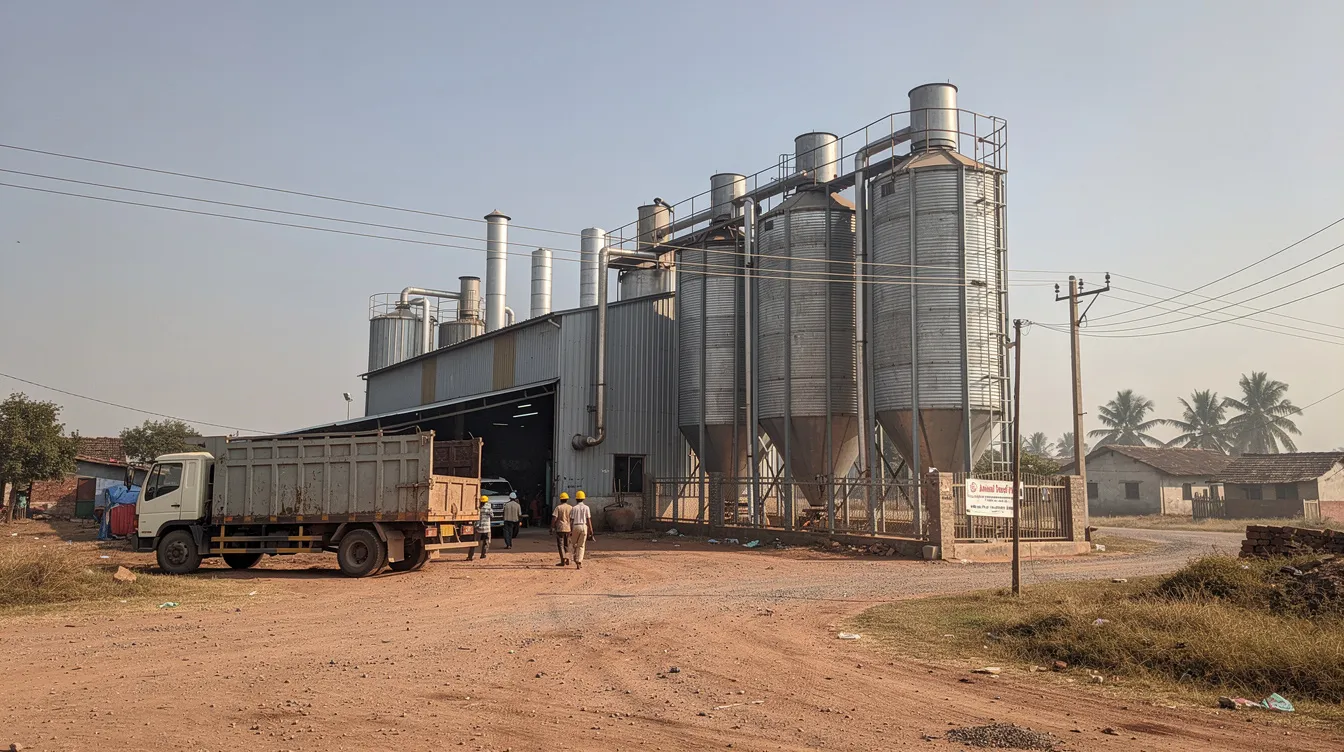
What Is Animal Feed Concentrate and Mash Feed?
“Concentrate” refers to nutritional density and formulation purpose, while “mash” describes the physical form – a loose, ground mixture. A product can simultaneously be a concentrate and a mash. Animal feed includes mash, pellets, crumbles and liquid feed; this project primarily addresses concentrate mash.
Animal Feed Concentrate – Definition & Commercial Role
Animal feed concentrates contain high levels of protein, minerals, vitamins and additives, designed to be fed alongside roughages to balance diets for dairy cattle, buffaloes, calves, sheep and goats. Typical ingredients include cereal grains (particularly maize, broken rice), oilseed meals (soybean meal, groundnut cake, mustard cake), de-oiled cakes, mineral mixture, vitamin premix and salt. Industrial production requires automatic batching systems, micro-dosing of premixes and strict quality checks for protein, fibre, moisture and aflatoxin levels. Concentrates may be sold as mash or further processed as feed pellets. Complete feed pellets contain proteins, energy and additives in a single form, while premix feed pellets are used as feed additives in small amounts – both distinct from concentrate mash.
Mash Feed – Definition & Manufacturing Characteristics
Mash feed is ground, homogeneously mixed feed supplied in non-pelletised form. It can serve as complete feed (layer mash, broiler mash) or as a concentrate depending on formulation. The core unit operations – grinding, batching, mixing, premix addition and bagging – are mechanically simpler than pellet production, as no steam conditioning, pelleting, cooling or crumbling is inherently required. This reduces machinery costs and energy consumption. Packaging typically uses 25–50 kg HDPE bags, with some dust and segregation risk during transport compared to pellets.
Concentrate vs. Mash Feed – Industrial & Financial Comparison
| Aspect | Animal Feed Concentrate | Mash Feed (Physical Form) |
|---|---|---|
| Nutritional density | High protein, energy, minerals | Varies – can be high or moderate |
| Intended use | Supplement alongside roughage | Complete feed or supplement |
| Machinery required | Grinding, batching, mixing, dosing | Same as concentrate (mash-only) |
| Investment level | Moderate (mash line) to high (pellet line) | Lower than pellet plants |
| Feed manufacturing complexity | Formulation-driven | Process-driven |
| Quality control focus | Nutrient guarantees, contaminants | Particle size, homogeneity |
| Typical buyers | Dairy farms, dealers, cooperatives | Poultry farms, cattle farms, dealers |
Product formulations for animal feed should align with the nutritional requirements of the target species. Classification for regulatory and labelling purposes depends on formulation, protein levels and intended use.
Market Potential and Commercial Demand in India
India’s animal feed industry is growing at approximately 4.5% annually, driven by commercial dairy expansion and poultry farming intensification. Customer profiling is essential for understanding targeted market segments – dairy cooperatives, private dairies, organised cattle farms, feed dealers and institutional buyers each have distinct volume, quality and credit expectations. Market analysis and demand-supply gap assessment are crucial for project feasibility.
Regional demand clusters near milk collection belts (Punjab, Haryana, Gujarat, Maharashtra, Karnataka, Uttar Pradesh) and poultry hubs (Andhra Pradesh, Telangana) offer stronger commercial potential. Leading animal feed manufacturers often outsource to regional plants through contract manufacturing. The demand outlook remains positive as domestic feed production grows alongside organised dairy and egg production expansion. The animal farming industry increasingly relies on purchased, scientifically formulated feeds rather than traditional on-farm mixing. Even globally, the American Feed Industry Association tracks similar trends in the United States producing feed at industrial scale, while firms like Akralos supplies animal feeds across European markets – underscoring the global nature of this industry.
Validation of local demand requires assessing livestock population, existing animal feed plant capacities, pricing benchmarks and the competitive share of feed pellets versus mash feed in the target geography.
Types of Animal Feed Concentrate and Mash Feed Products
Product diversification directly influences project feasibility, working capital and branding. Major product categories for an industrial animal feed manufacturing facility include:
| Product Type | Target Segment | Key Characteristics | Commercial Considerations |
|---|---|---|---|
| Dairy cattle concentrate | Dairy farms, cooperatives | 20–22% crude protein, minerals | High volume, price-sensitive |
| High-protein cattle feed | Commercial fattening | 24%+ protein, energy-dense | Premium pricing, niche demand |
| Calf starter feed | Dairy/cattle farms | Digestible, palatable | Smaller volumes, quality-critical |
| Buffalo productivity feed | Buffalo dairies | High energy, mineral-enriched | Regional demand clusters |
| Sheep & goat concentrate | Smallholders, institutional | Species specific nutrition solutions | Emerging segment |
| Poultry mash (starter/grower) | Commercial poultry farms | Broiler growth feed, layer feed, breeder feed formulations | Competitive, margin-sensitive |
| Mineral-enriched supplements | All livestock | Mineral and vitamin supplements | Regulatory licensing required |
Advanced compound feed formulations, specialized feeds and even shrimp feed formulations represent adjacent opportunities for integrated feed mills. Pet food annually represents a growing niche globally, though it requires distinct formulation and regulatory compliance. Each formulation must be designed by a qualified animal nutritionist – universal recipes are not appropriate.
Industrial Manufacturing Capacity and Plant Configuration
Plant capacity is specified in tonnes per hour (TPH) and translated into annual production capacity based on operating hours and days. Assuming 300 operating days per year under normal operating conditions:
| Parameter | 5 TPH | 10 TPH | 20 TPH |
|---|---|---|---|
| Daily output (1 shift, 8 hrs) | 40 MT | 80 MT | 160 MT |
| Daily output (2 shifts, 16 hrs) | 80 MT | 160 MT | 320 MT |
| Annual output (1 shift, 75% utilisation) | 9,000 MT | 18,000 MT | 36,000 MT |
| Annual output (2 shifts, 80% utilisation) | 19,200 MT | 38,400 MT | 76,800 MT |
| Hammer mill capacity | 3–5 TPH | 8–10 TPH | 15–20 TPH |
| Mixer capacity | 1–2 MT/batch | 2–3 MT/batch | 3–5 MT/batch |
| Manpower (approx.) | 15–25 | 25–40 | 40–70 |
India’s largest feed plants operate well beyond these capacities. Practical uptime is always lower than theoretical – changeovers between cattle feed and poultry mash formulations, preventive maintenance and bagging bottlenecks must be factored into any DPR. Annual production capacity ranging from 10,000 MT to 80,000+ MT covers the spectrum of regional to multi-state operations, while extensive production capacities characterise national-scale integrated manufacturers.
Raw Materials Required for Animal Feed Concentrate and Mash Feed
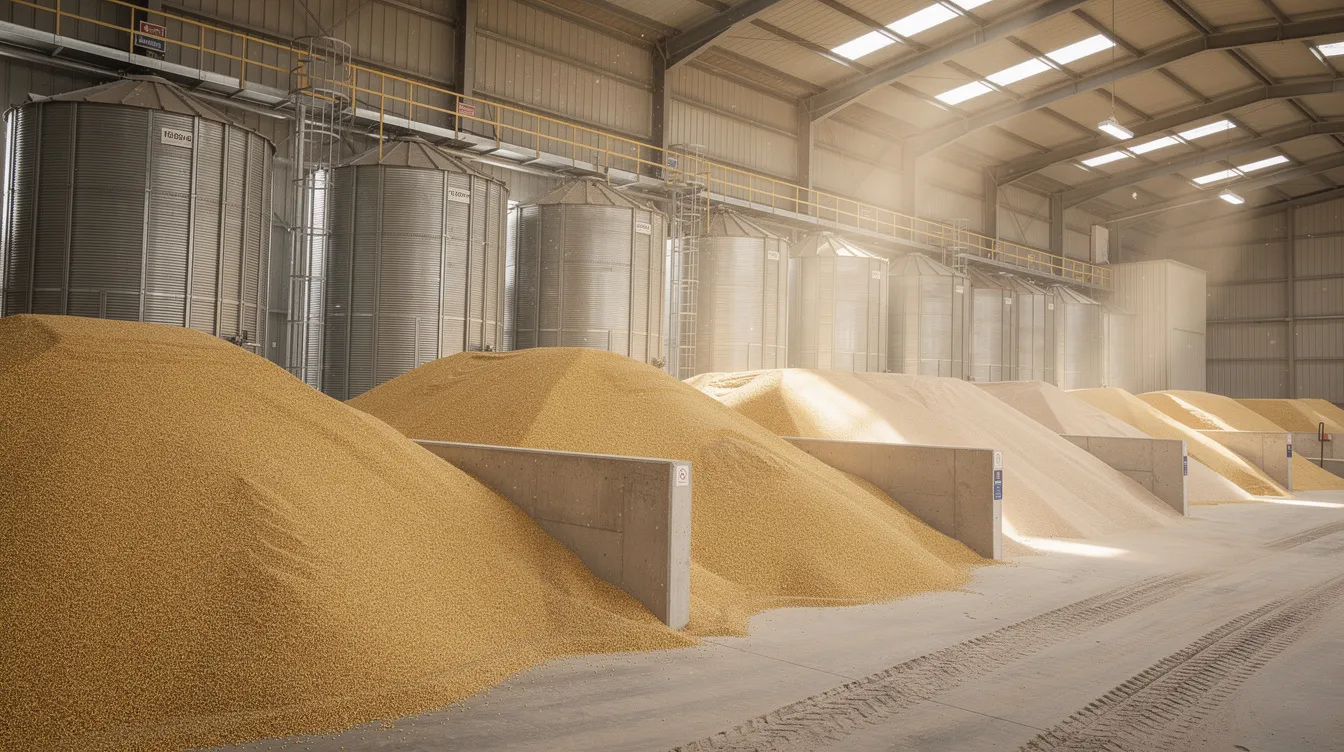
Animal feed production requires maize, soybean meal and oil cake as primary ingredients. Proximity to raw material sources is vital for minimising transportation costs in project planning, and sourcing strategies should prioritise suppliers close to the plant.
| Category | Examples | Function | Key Quality Parameters | Storage Precaution |
|---|---|---|---|---|
| Energy grains | Maize, broken rice, wheat | Energy | Moisture <14%, aflatoxin <20 ppb | Dry, ventilated bins |
| Protein meals | Soybean meal, groundnut cake, mustard cake | Protein | Protein %, moisture, mycotoxins | Cool, covered godowns |
| Bran/fibre | Wheat bran, DORB, rice bran | Fibre/energy | Fibre %, foreign matter | Short shelf-life; rotate stock |
| Feed additives | Mineral mix, vitamin premix, salt | Micro-nutrients | Assay, heavy metals | Sealed, cool storage |
| Liquids | Molasses (where applicable) | Energy/palatability | Brix, moisture | Tanks with pumps |
| Packaging | HDPE/PP bags, liners | – | Strength, printing quality | Dry storage |
Raw material supply and raw material storage management are critical. Maize prices fluctuate significantly – as of August 2026, maize traded at approximately ₹26/kg and soybean meal at ₹48/kg. Sustainability and supply chain risks should be assessed in sourcing, including mycotoxin contamination, seasonal availability and supplier concentration. Raw material procurement strategy (spot versus forward buying) is a key element of any feed manufacturing feasibility study. The ability to track feed materials through the supply chain supports both quality and regulatory compliance.
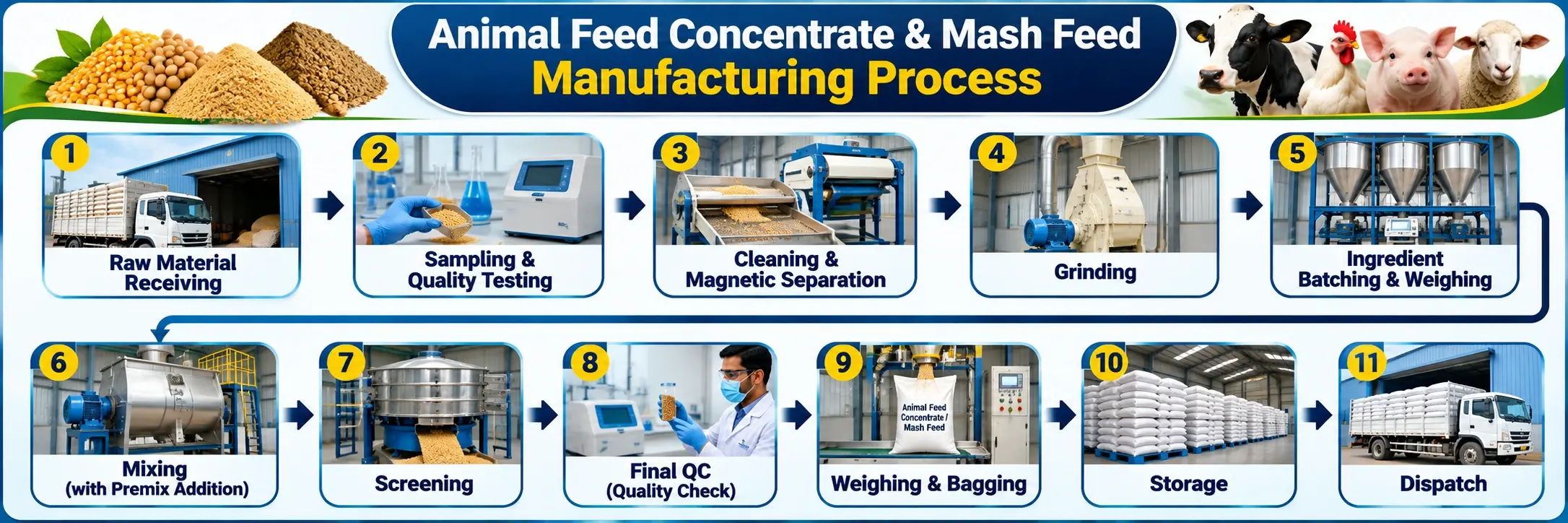
Animal Feed Concentrate & Mash Feed Manufacturing Process
The manufacturing process flow includes raw material reception, cleaning, grinding, batching, mixing and packaging. Animal feed manufacturing involves seven key production steps, and animal feed production processes vary significantly between mash and pellet feed production.
Process flow: Raw Material Receiving → Sampling & Quality Testing → Cleaning & Magnetic Separation → Grinding → Ingredient Batching & Weighing → Mixing (with premix addition) → Screening → Final QC → Weighing & Bagging → Storage → Dispatch.
Raw materials are ground to the required particle size using hammer mills fitted with appropriate screens – coarser for certain cattle feed, finer for poultry mash feed. Batching uses formula-based PLC-controlled weighing for accuracy against nutritional guarantees. Horizontal ribbon or paddle mixers ensure homogeneity, with separate micro-ingredient dosing lines preventing cross-contamination.
For pellet feed plants (not covered in this mash-only project), conditioning uses steam and moisture before pelleting or extrusion. Pelleting shapes the feed into pellets, crumbles or extruded forms. Cooling stabilises the temperature and moisture of formed feed. These steps are only added if the project expands into pelletised products – refer to the Automatic Feed Pellet Manufacturing Plant Project Report for detailed coverage.
Finished animal feed is packed and dispatched for distribution. Quality control systems are essential to ensure the nutritional consistency of animal feed products – sampling at multiple stages, laboratory analysis for moisture, protein, fat, fibre, ash and contaminants must be part of standard operating procedures.
Plant & Machinery Required for Industrial Feed Manufacturing
Machinery selection directly affects plant capacity, feed quality, energy consumption and project cost. Machinery costs account for the largest portion of capital expenditure. Animal feed plants require grinding, mixing and pelleting equipment (the last only for pellet-capable plants). For mash-only operations, key equipment includes:
- Raw material intake hoppers, chain conveyors and bucket elevators
- Pre-cleaners and magnetic separators
- Hammer mills (sized to plant TPH)
- Ingredient storage bins with load cells
- Automatic batching and micro-dosing systems
- Horizontal ribbon or paddle mixers
- Liquid dosing equipment (where applicable)
- Dust collection and aspiration systems
- Vibro screens
- Finished feed bins
- Automatic bagging and sewing machines
- PLC/SCADA controls, electrical panels, compressors
- In-house laboratory instruments
Pelleting machines shape feed into uniform pellets using heat and pressure, and cooling equipment is essential to stabilise feed pellets after production – but these apply only to pellet-capable plants. Packaging machines automate the final stage of feed production. Some plants feature automated production lines with SCADA integration for traceability. Machinery and equipment details in a DPR should include specifications, capacities and estimated costs. For 2–5 TPH mash feed plants, machinery costs range from ₹20 lakh to ₹1.5 crore depending on automation and brand.
Land, Building, Utilities and Infrastructure
Industrial land should be located with good road access, proximity to grain markets and key cattle feed or poultry markets. Typical requirements scale with capacity – a 10 TPH plant may need 1–2 acres including production shed, raw material godowns, finished goods warehouse, QC lab and utility rooms. Core utilities include power (scaling from approximately 100 kVA for 5 TPH to 400+ kVA for 20 TPH), DG backup, water for dust suppression and cleaning, and air compressors. Waste management systems and dust extraction are necessary environmental measures. Layout should allow logical flow from intake to dispatch with provision for future expansion. Compliance with local zoning laws, Factory Act requirements and building bye-laws is mandatory.
Animal Feed Concentrate Manufacturing Plant Cost in India
Total capital investment varies substantially by capacity, location, automation and specifications. Machinery costs represent the largest portion of capital expenditure after land. The minimum investment for a small-scale feed plant starts at approximately USD 4.5 million for a 20,000 MT/year capacity. A mid-size plant with 60,000 MT/year annual production capacity requires about USD 9 million, while a large-scale facility with 100,000 MT/year can cost around USD 12 million.
| Cost Component | Typical Share of Fixed Investment |
|---|---|
| Land acquisition and site development | 8–15% |
| Factory building and civil works | 15–22% |
| Plant and machinery (incl. installation) | 35–45% |
| Electricals and utilities | 5–8% |
| Material handling and storage | 4–6% |
| Lab, office equipment, furniture | 2–3% |
| Pre-operative and preliminary expenses | 3–5% |
| Contingency | 5–7% |
| Working capital margin | 8–12% |
All estimates are illustrative planning assumptions. Any actual DPR prepared by Project Report Bank uses current supplier quotations, local civil cost estimates and GST impacts specific to the client’s project.
Manufacturing Cost Per MT and Operating Economics
Raw materials account for approximately 80–85% of total operating costs in animal feed manufacturing, with maize alone often dominating the operating cost structure. Operating costs are primarily driven by raw material consumption, especially maize. Utilities represent around 5–10% of total operating expenses. Operating costs increase significantly by the fifth year due to inflation in wages, power and commodity prices.
| Cost Component | Approximate Share |
|---|---|
| Raw materials and ingredients | 75–85% |
| Premixes and additives | 3–5% |
| Packaging | 2–3% |
| Power and fuel | 3–5% |
| Labour and supervision | 2–4% |
| Repairs, overheads, QC, insurance | 2–4% |
Animal feed manufacturing plants have gross profit margins of 15–25%, while net profit margins for animal feed plants range from 5–12% depending on scale, product mix and procurement efficiency. Distribution costs and transportation costs further compress realised margins. Cattle feed concentrates may command slightly higher selling prices per MT than generic mash feed due to premium ingredients, but also carry higher raw material cost. At lower capacity utilisation, fixed costs per MT rise and compress EBITDA. Sensitivity tables showing impact of ±5–10% changes in maize and soybean meal prices should be included in every DPR. Under favourable conditions, the sector offers healthy profitability potential for well-managed, adequately capitalised operations.
Working Capital Assessment and Cash Conversion Cycle
Working capital assessment should include inventory holding, receivables and cash buffers. For an animal feed manufacturing plant, raw material stocking is usually the largest component – maize and oilcakes may need 15–45 days of inventory depending on procurement strategy, while finished goods typically cycle within 7–15 days. Receivable periods to dealers commonly range from 15–45 days, partially offset by supplier credit of 7–30 days. The cash conversion cycle (inventory days + receivable days – payable days) determines cash-credit requirements. Seasonal pre-harvest stocking strategies to lock in lower maize prices can sharply increase peak working capital needs. Project Report Bank’s DPRs and CMA Data include month-wise working capital projections and drawing power calculations.
Financial Projections and Bankable DPR Analysis
A project report should include sections on executive summary, market analysis and financial projections. Financial projections should cover capital costs, operating expenses and means of finance across a minimum 7–10-year horizon. Core statements include projected P&L, cash flow, balance sheet, term loan amortisation, working capital estimates and key ratio analysis.
Financial viability analysis includes evaluating project returns like ROI, IRR and payback period. DSCR analysis demonstrates annual debt-servicing capacity – sustainable DSCR is critical for bank appraisal of any animal feed manufacturing plant’s financial feasibility. IRR must distinguish between project IRR (on total project cost) and equity IRR (on promoter contribution). Net present value analysis discounts projected free cash flows at an appropriate rate to determine whether the investment creates value.
Break-even analysis determines the minimum production level needed to cover fixed and variable costs – typically expressed as a percentage of installed capacity. Payback period measures investment recovery time but has limitations as it ignores post-payback cash flows and the time value of money. A comprehensive project report must demonstrate both technical feasibility and financial viability through internally consistent, integrated financial models.
Sensitivity Analysis and Financial Risk Assessment
Sensitivity analysis tests the robustness of the feed plant’s financial feasibility under variable assumptions. Key variables include maize price (±5–10%), soybean meal price (±5–10%), average selling price (±3–5%), capacity utilisation shifts, interest rate changes and wage/power escalation. Supply chain disruptions and supply chain risks – such as delayed raw material delivery or quality failures – must also be modelled.
| Scenario | EBITDA Impact | DSCR Impact |
|---|---|---|
| Base case | As projected | Comfortable |
| Maize +10% | Significant decline | Strained |
| Selling price −5% | Moderate decline | Marginal |
| Utilisation −15% | Major decline | Below threshold |
Indian banks and investors appreciate DPRs that show systematic risk assessment rather than only a single best-case projection.
Bank Finance, Term Loans and Equity Investment
Industrial animal feed concentrate and mash feed plants are typically financed with 25–35% promoter equity and 65–75% bank term loan for eligible fixed assets. Detailed Project Reports are essential for obtaining bank loans and investor funding. Documents usually required include the DPR, CMA Data, projected financial statements, DSCR calculations, promoter financials and collateral details. Investor-ready documentation is important for effective communication with potential funders, particularly equity investors who scrutinise IRR, NPV and payback. Central schemes such as AHIDF may offer interest subvention and moratorium benefits – but current eligibility should always be verified before relying on them in project decisions.
Licences, Regulatory Compliance and Quality Standards
Statutory compliance and regulatory approvals are critical components of a project report for animal feed. Key requirements include business entity registration, GST, factory licence, trade licence, consent from the State Pollution Control Board, fire safety NOC and electrical inspections. Environmental regulations around dust, noise and effluent must be met.
Animal feed is regulated under central and state laws, including BIS standards such as IS 2052:2023 for compounded cattle feed. The Animal Feeds and Feed Ingredients (Quality Control) Order, 2026 mandates BIS certification for certain feed products from April 2027. Animal feed manufacturing is distinct from human food regulation and may not automatically fall under FSSAI. Labelling must declare product name, species, composition, batch number, dates and manufacturer details.
Industrial Project Risks and Mitigation Strategies
| Risk | Impact | Mitigation |
|---|---|---|
| Raw material price volatility | Cost overrun, margin erosion | Forward contracts, diversified sourcing |
| Aflatoxin/mycotoxin contamination | Product rejection, health liability | Routine lab testing, supplier qualification |
| Customer/dealer concentration | Revenue risk | Diversified distribution network |
| Machinery breakdown | Production loss | Preventive maintenance, spares inventory |
| Working capital shortage | Operational stress | Conservative CMA planning, adequate limits |
| Regulatory non-compliance | Penalties, shutdown | Professional compliance monitoring |
| Implementation delays | Interest during construction, DSCR impact | Realistic scheduling, milestone tracking |
Lenders and investors are more comfortable with DPRs that transparently acknowledge risks and propose realistic mitigation strategies.
Implementation Schedule for an Industrial Feed Manufacturing Plant
A realistic implementation schedule helps assess interest during construction and the timing of cash inflows. Typical stages include: concept and market study (Month 0–2), DPR preparation and financing (Month 2–5), land acquisition and design (Month 3–7), civil construction (Month 6–12), machinery procurement and installation (Month 8–14), commissioning and trial runs (Month 14–16), and commercial production (Month 16 onwards). Actual timelines vary widely based on regulatory approvals and supplier lead times. Critical dependencies include bank loan sanction before major orders, timely utility connections and alignment of recruitment with trial production.
Why a Professional DPR Is Important for Industrial Feed Manufacturing Projects
Industrial feed manufacturing projects involve significant capital and recurring working capital. A customised Detailed Project Report integrates market study, technical configuration, raw material strategy, product mix, manpower, regulatory roadmap and 10-year financial projections. Realistic estimation of animal feed concentrate manufacturing plant cost, optimised capacity selection, accurate working capital and DSCR analysis, and a basis for investor discussions are concrete benefits. For Indian banks, the quality and internal consistency of the DPR and CMA Data can materially influence term loan and cash-credit sanctions for cattle feed and poultry feed plants.
Professional DPR & Feasibility Services by CA Manish Gugliya
ProjectReportBank.com is a Chartered Accountant-led professional advisory platform specialising in Detailed Project Reports, CMA Data, financial modelling and project finance advisory for manufacturing projects, including animal feed manufacturing plants. Services include bankable DPRs, 10-year financial projections, project cost and means-of-finance structuring, DSCR and ratio analysis, break-even and sensitivity analysis, and investor-ready documentation – all prepared under the professional supervision of CA Manish Gugliya (FCA, DISA, ICAI), leveraging over 20 years of experience.
Planning an industrial animal feed concentrate or mash feed manufacturing plant in India? Obtain a customised Detailed Project Report, project cost assessment and financial feasibility study from CA Manish Gugliya at www.projectreportbank.com.
Frequently Asked Questions
The following FAQs address common practical queries from promoters of industrial animal feed manufacturing plants.
What is the approximate investment required for an industrial animal feed concentrate and mash feed plant in India?
Investment depends on capacity, land cost, automation and location. A 20,000 MT/year plant may require approximately USD 4.5 million, a 60,000 MT/year plant about USD 9 million, and a 100,000 MT/year facility around USD 12 million. Machinery, civil works, land and working capital margin are the major components. Project Report Bank prepares project-specific cost estimates using current quotations and local assumptions for each DPR.
Can I start with mash feed only and add feed pellet production later?
Yes. Many animal feed manufacturing plants start as mash-only units with simpler, lower-CapEx configurations and later retrofit steam-conditioning, pellet mills and coolers when market demand for feed pellets justifies the additional investment. It is advisable to design civil layout, structural loads and utility corridors upfront to allow future pellet section addition with minimal disruption.
How much working capital does an industrial feed plant typically require?
Working capital depends on raw material stock levels (typically 15–45 days), finished goods inventory (7–15 days), credit periods to dealers (15–45 days) and supplier credit terms. Raw material stocking is usually the largest component given that raw materials constitute 80–85% of operating costs. Month-wise working capital and cash-credit requirements should be modelled in the DPR and CMA Data.
Which approvals and quality standards apply to animal feed manufacturing in India?
Key requirements include factory licence, GST, State Pollution Control Board consent, fire NOC and compliance with BIS standards such as IS 2052:2023 for compounded cattle feed. The 2026 Quality Control Order mandates BIS certification for certain feed products from April 2027. Animal feed regulation is distinct from FSSAI (human food); state-level feed laws may impose additional licensing requirements.
Why is a professional feasibility study necessary before investing?
Each animal feed plant’s viability depends on specific regional demand, product mix, raw material economics and financing structure. Generic templates cannot capture these variables. A professional DPR reduces the risk of underestimating project cost, overestimating sales or ignoring working capital and DSCR stress – and is typically a precondition for serious bank and investor discussions in India.
Conclusion – Investment Potential and Financial Feasibility
India’s livestock sector presents strong underlying demand for balanced, scientifically formulated animal feed – a structural trend driven by dairy commercialisation, poultry intensification and the growing role of enhance animal growth nutrition in farming economics. Industrial mash feed and concentrate plants offer viable manufacturing opportunities for entrepreneurs and established businesses willing to invest in proper capacity, quality systems and efficient raw material procurement.
However, project viability is not guaranteed by demand alone. It must be demonstrated through detailed, project-specific financial modelling – with DSCR, IRR, NPV, break-even and sensitivity analysis reflecting real-world risks including commodity price volatility, competitive pricing and operational ramp-up realities. The operating cost structure, dominated by maize and protein meal procurement, requires disciplined inventory management and working capital planning.
Entrepreneurs, dairy and poultry integrators, MSMEs and corporate investors planning an industrial animal feed concentrate or mash feed manufacturing plant in India are encouraged to engage Project Report Bank and CA Manish Gugliya for customised Detailed Project Reports, feasibility studies and complete bank finance documentation at www.projectreportbank.com.