Key Takeaways
- DDGS stands for Distillers Dried Grains with Solubles – a high protein co-product of grain-based ethanol production that contains approximately 26–30% crude protein after drying and is widely used in animal feed for cattle, poultry and aquaculture.
- A comprehensive Grain Based DDGS Processing Plant Project Report must cover the complete process of drying, processing and pelletisation, along with project cost estimation, machinery selection, working capital assessment and financial feasibility analysis.
- Typical Indian DDGS drying and pelletisation projects range from 50 to 300 TPD capacity, and project economics depend heavily on raw material tie-ups with grain-based ethanol distilleries, energy efficiency of dryers and stable demand from feed mills.
- Financial metrics often evaluated for DDGS projects include ROI, IRR, and break-even analysis, supported by sensitivity tests on fuel cost, selling price and capacity utilisation.
- Project Report Bank, led by CA Manish Gugliya (FCA, DISA), prepares customised, bankable DPRs and financial models for DDGS processing plants, addressing the individual requirements of each promoter’s project configuration and location.
Introduction – Grain-Based DDGS Processing Plant Project Report in India
When grain – maize, broken rice, sorghum or wheat – is fermented and distilled to produce ethanol, the remaining nutrients concentrate into a by-product stream known as whole stillage. After separation, evaporation and industrial drying, this stream yields Distillers Dried Grains with Solubles, commonly referred to as DDGS. Because the starch has been consumed during fermentation, DDGS emerges as a protein rich feed ingredient with meaningful energy, fibre and mineral content, making it valuable for compound cattle feed, poultry feed and aquaculture feed formulations.
India’s rapid expansion of grain-based ethanol plants under the E20 blending programme has created a parallel opportunity: setting up dedicated DDGS drying, processing and pelletisation facilities. DDGS production generates approximately 300–350 kg of dried distillers grains per tonne of ethanol produced, and with India’s ethanol output scaling up substantially, the volume of wet and dried distillers grains available for commercial feed use is growing every year.
This article serves as a practical guide for Indian promoters evaluating such investments. It covers the manufacturing process, plant machinery, capacity planning, project cost, operating economics, financial projections and risk analysis from a Chartered Accountant’s professional perspective. It is important to distinguish between an integrated ethanol plus DDGS drying plant – where whole stillage is produced on-site – and a standalone DDGS drying or pelletisation unit that purchases wet distillers grains or wet cake from nearby distilleries. Both models have distinct capital requirements, supply risks and financial structures, and a well-prepared Grain Based DDGS Processing Plant Project Report must address these differences clearly.
What Is DDGS? Composition, Characteristics and Industrial Applications
DDGS is the solid co product recovered after grain-based ethanol production. During the distillation process, whole stillage is separated into wet distillers grains (wet cake) and thin stillage using decanter centrifuges. The thin stillage is then concentrated through evaporation to produce condensed distillers solubles (CDS). These condensed distillers solubles are added back to the wet cake to increase nutrient content and create what is called Distillers Wet Grains with Solubles (DWGS). Industrial drying of DWGS yields the final DDGS product.
DDGS production must account for variations in grain type and quality affecting nutritional values. The composition differs meaningfully depending on whether the feedstock is corn, rice or another cereal.
Illustrative Nutrient Comparison (As-Fed Basis, ~10–12% Moisture)
| Parameter | Corn DDGS | Rice DDGS | Wheat DDGS |
|---|---|---|---|
| Crude Protein | 26–30% | 18–22% | 28–35% |
| Crude Fat / Oil | 8–11% | 4–6% | 3–5% |
| Crude Fibre | 7–9% | 10–12% | 6–8% |
| Moisture | 10–12% | 10–12% | 10–12% |
| Ash | 4–7% | 6–9% | 4–6% |
Actual analysis depends on fermentation efficiency, process conditions and the specific grain lot. Values above are indicative ranges from published Indian and international data.
Corn DDGS contains 26–30% crude protein, making it a valuable alternative to soybean meal in many feed rations. Rice DDGS has a protein content of 18–22% but with higher fibre, which limits its use in certain monogastric diets. DDGS provides a significant energy contribution alongside protein. Notably, DDGS has high phosphorus content, reducing enzyme supplementation needs in many feed formulations.
Quality parameters critical for feed mill buyers include moisture content and water activity for storage stability during extended storage periods, mycotoxin and microbiological contamination levels, colour (darkening signals heat damage and lysine loss), particle size and flowability. Quality DDGS is well-digested by poultry and ruminants, and its nutritional quality determines buyer willingness to pay.
Key Industrial Applications:
- Compound cattle feed and dairy feed – DDGS inclusion rates in dairy rations can reach 25%, supporting animal performance and replacing a significant portion of conventional protein sources
- Poultry feed – broiler diets typically include 10–15% DDGS; layer diets use 5–20% depending on DDGS quality and its effect on egg production
- Aquaculture feed uses DDGS as a partial protein source, subject to formulation constraints
- Blending in integrated animal feed mills and feed concentrate plants
Market Potential and Demand for Grain-Based DDGS in India
India achieved its target of 20% ethanol blending (E20) with petrol in June 2025, ahead of schedule. Nearly 46% of ethanol feedstock now comes from maize and about 15% from rice procured via the Food Corporation of India, according to USDA reporting on India’s biofuels landscape. This policy-driven expansion of grain-based ethanol producers has created strong growth in domestic DDGS production volumes.
The market demand for DDGS is driven by its use in poultry, dairy, and aquaculture feeds. India’s poultry industry is the largest consumer of DDGS, followed by organised dairy feed manufacturers. Rising soybean meal prices have increased DDGS demand in India, as DDGS is typically priced lower than soybean meal on a per-tonne basis while offering a competitive protein and energy profile. DDGS is now a standard consideration in feed formulations across most organised compound feed mills.
Regional demand patterns vary. South India, particularly Tamil Nadu and Andhra Pradesh, has substantial poultry feed demand. North and West India have stronger dairy cattle feed requirements. Proximity to grain distilleries affects the delivered price significantly, given the transport economics of high-moisture materials.
Market pricing for DDGS varies based on protein content, moisture levels, and competition with other feed ingredients such as rapeseed meal, rice bran and maize. For export markets, consistent quality, low mycotoxins and proper packaging are prerequisites that most Indian producers are still working to achieve. Stable demand from domestic organised feed mills remains the primary revenue opportunity.
DDGS Plant Business Models and Investment Opportunities
The commercial configuration of a grain based DDGS manufacturing plant determines its capital requirement, supply risk and margin structure. Promoters should evaluate the following models:
Integrated grain distillery + DDGS drying plant: Whole stillage supply is captive. Investment in evaporation, utilities and boiler capacity is shared with the ethanol project. The DDGS unit benefits from consistent availability of wet cake and lower transport costs.
Standalone wet DDGS drying and processing unit: Purchases wet cake or DWGS from nearby ethanol plants. Focus is on drying, blending and pelletisation. High dependence on long-term raw material contracts; supply disruption is the primary risk.
Dry DDGS grading, blending and pelletisation facility: Purchases already dried DDGS. Lower thermal energy load but requires careful quality control, storage and logistics management. Suitable where multiple suppliers exist within an economic radius.
Integrated DDGS and compound feed ingredient plant: Combines DDGS processing with automatic feed pellet manufacturing or industrial cattle feed manufacturing, capturing more of the feed value chain.
A notable business case exists for distilleries currently selling loose wet cake at low realisations and looking to upgrade to value-added dried and pelletised DDGS for better margins.
DDGS Drying, Processing and Pelletisation Manufacturing Process
The complete process chain from grain to final ddgs product begins at the distillery, but the investment scope of a DDGS processing project typically starts at the stillage handling stage.
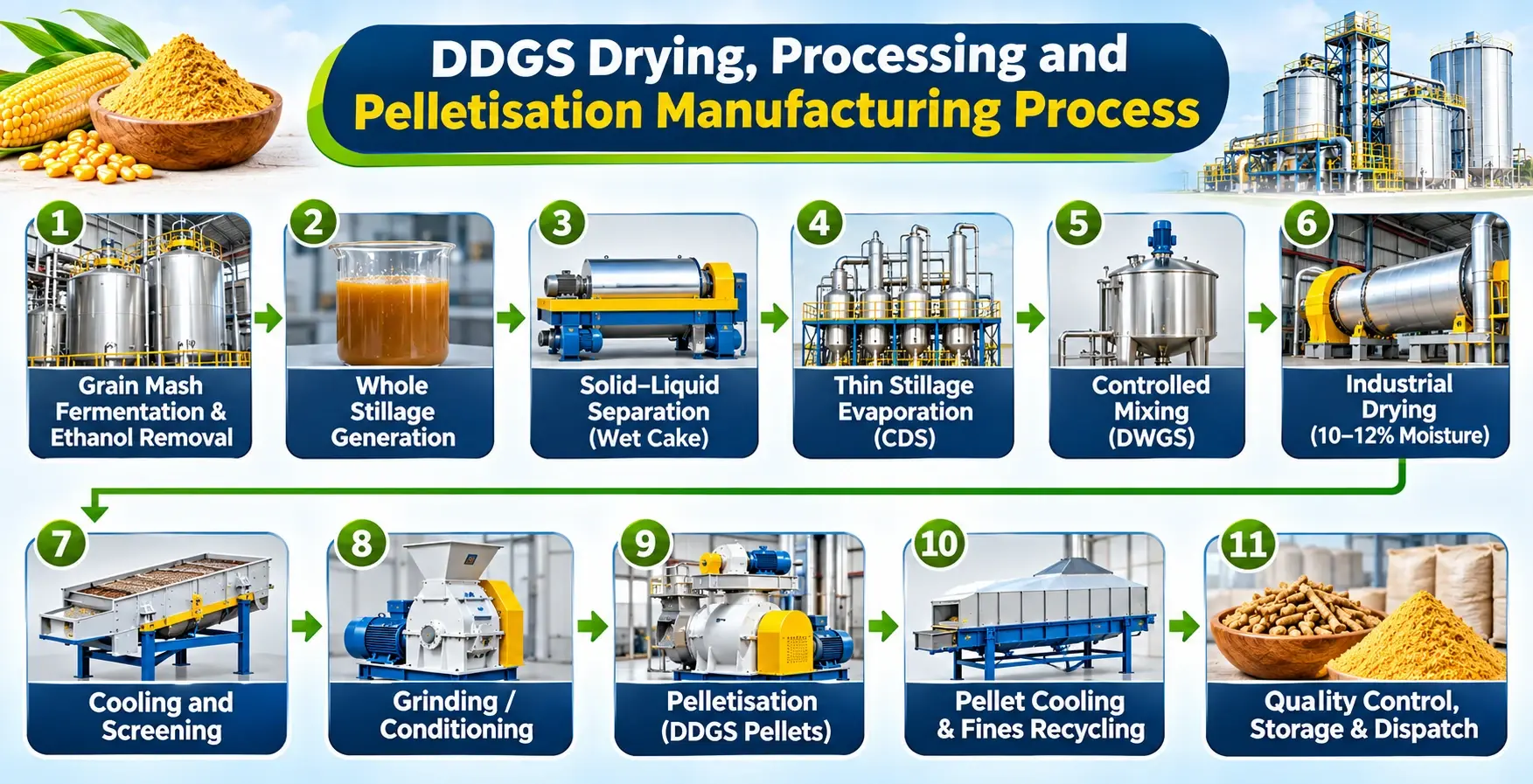
Sequential Process Steps:
- Grain mash fermentation and ethanol removal – Grain is cleaned, ground and fermented; ethanol is recovered through the distillation process. The production process includes cleaning, grinding, and fermentation at the distillery level.
- Whole stillage generation – The liquid residue remaining after distillation, containing all non-fermented solids.
- Solid–liquid separation – Decanter centrifuges separate wet distillers grains (wet cake, ~60–65% moisture) from thin stillage.
- Thin stillage evaporation – Multi-effect evaporators concentrate thin stillage into condensed distillers solubles (CDS).
- Controlled mixing – CDS is blended with wet cake in mixers or pug mills to produce DWGS with target nutrient levels.
- Industrial drying – The drying process reduces moisture content to stabilise DDGS for storage, targeting 10–12% outlet moisture.
- Cooling and screening – Dried grains with solubles are cooled and screened for particle size uniformity.
- Grinding / conditioning – Where pelletisation is planned, material may be ground and steam-conditioned.
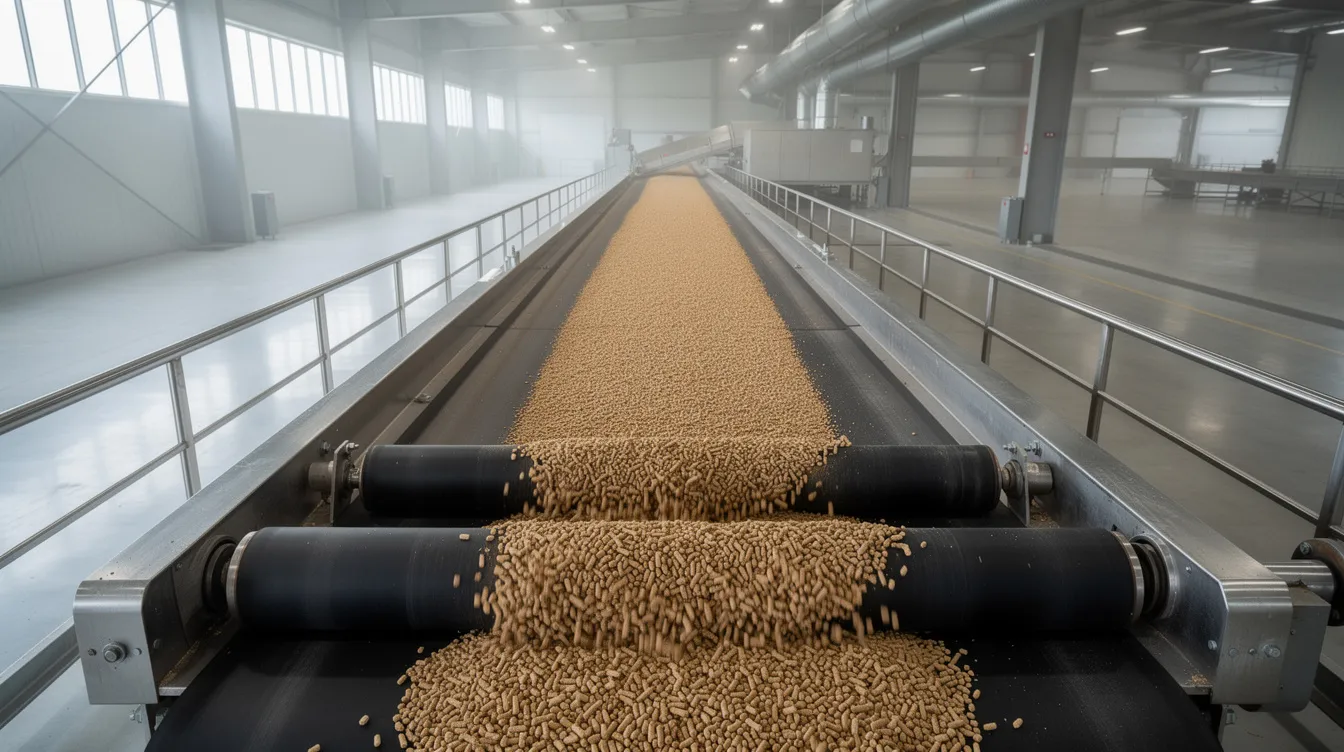
- Pelletisation – Ring die or flat die pellet mills compress conditioned DDGS into pellets.
- Pellet cooling and fines recycling – Pellets are cooled, screened; fines are recycled.
- Quality control, storage and dispatch – Laboratory testing for protein, moisture, fibre, fat, ash and mycotoxins before bulk loading or bag packaging.
Process Flowchart:
Whole Stillage → Decanter Centrifuge → Wet Cake + Thin Stillage → Evaporator (thin stillage to CDS) → Mixer (wet cake + CDS) → Industrial Dryer → Cooler → Screen → Pellet Mill → Pellet Cooler → Storage / Packaging
For plants receiving already dried DDGS: Dried DDGS Intake → Screen → Hammer Mill → Steam Conditioner → Pellet Mill → Cooler → Screen → Storage / Packaging
Process integration – using heat recovery from dryer exhaust for evaporation, reusing condensate – strongly influences the energy cost and overall financial feasibility of the plant.
DDGS Drying Technologies and Key Processing Machinery
The choice of dryer technology is the single most important machinery decision in a DDGS processing plant, affecting product quality, energy consumption and capital cost.
Dryer Technology Comparison:
| Parameter | Direct-Fired Rotary Drum | Steam Tube Bundle |
|---|---|---|
| Heat Source | Hot flue gas / air | Steam (indirect) |
| Energy (MJ/kg water) | 3.5–5.8 | 3.0–4.5 |
| Thermal Efficiency | 55–70% | 65–80% |
| Product Quality Risk | Higher (scorching, protein damage) | Lower (no combustion gas contact) |
| Relative Capital Cost | Moderate | Higher |
| Maintenance Complexity | Moderate | Higher (tube inspection) |
Source: Lozzar Process and US DOE data
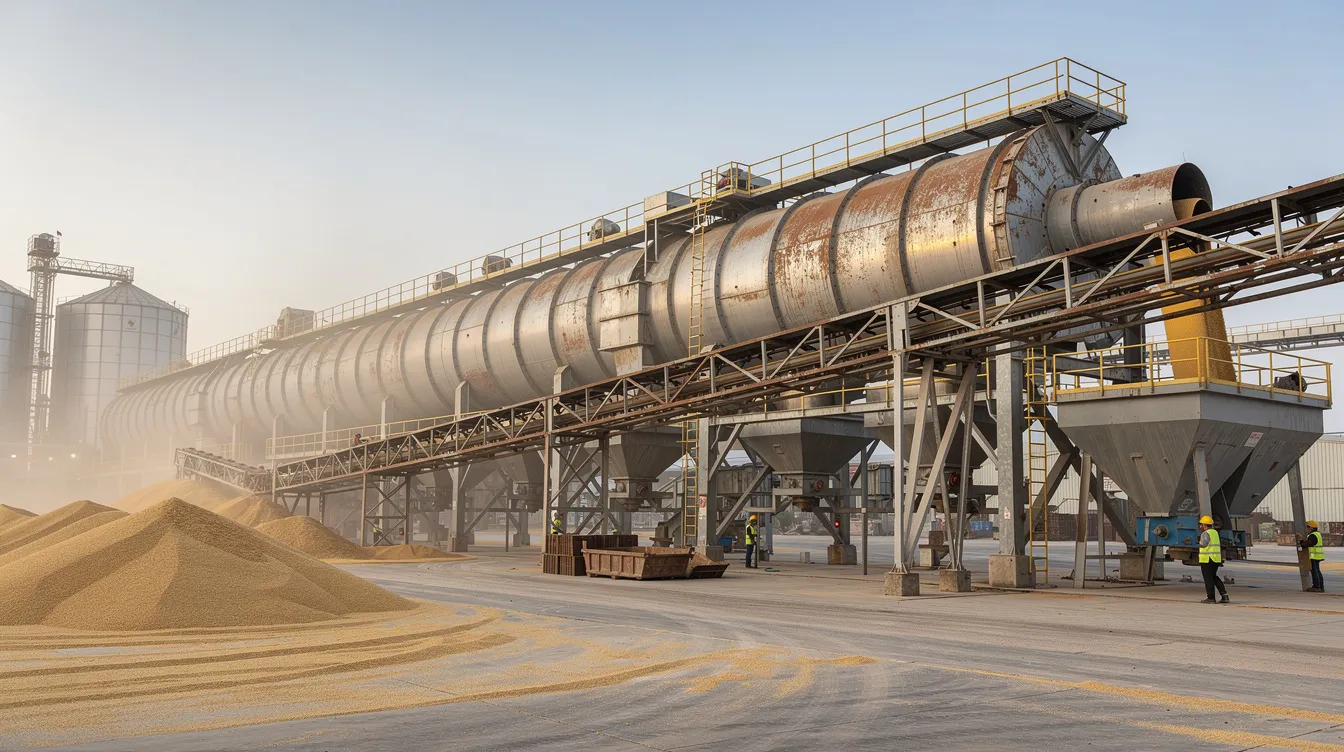
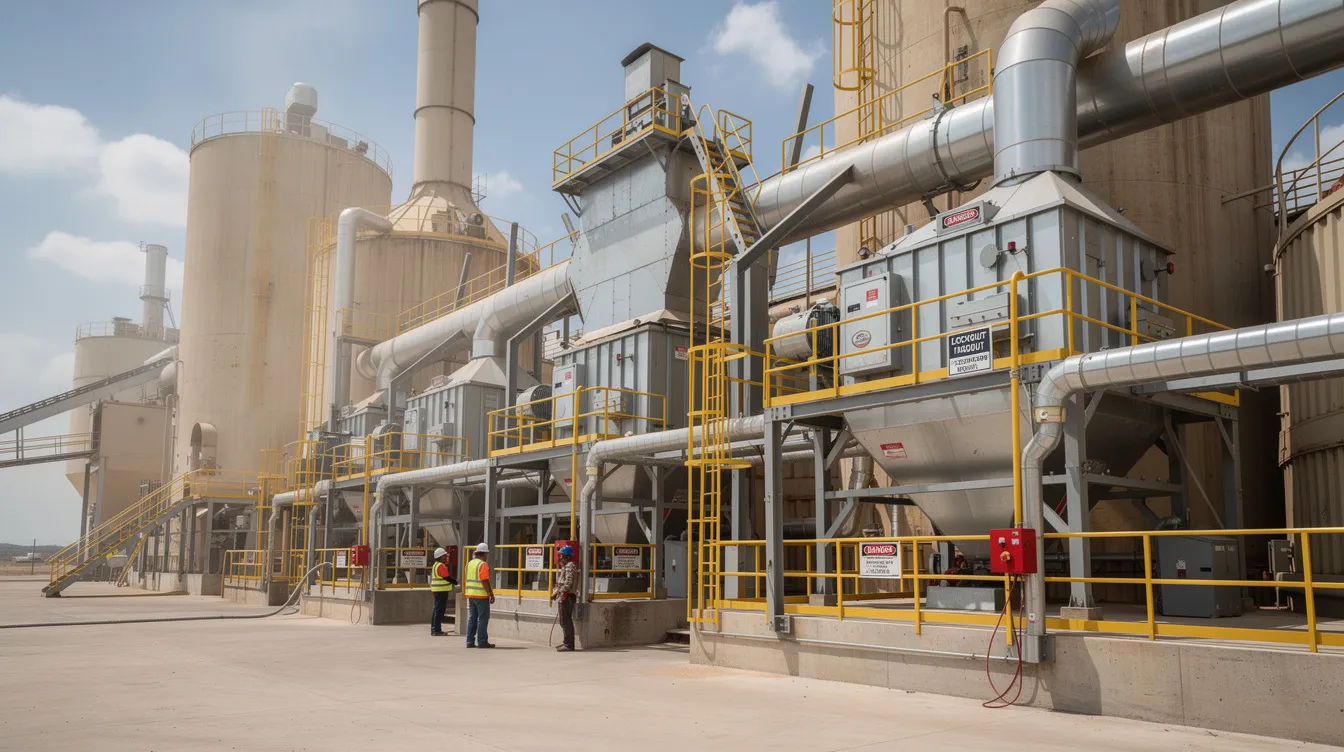
Technical specifications should outline the machinery and equipment for processing DDGS. Essential equipment includes decanter centrifuges, multi-effect evaporators, wet cake conveyors (screw and belt type), bucket elevators, the main DDGS dryer with cyclone separators and bag filter dust collection, hammer mills, steam conditioners, pellet mills, pellet coolers, vibrating screens, storage silos and bagging machines.
Safety systems are critical: fine organic dust from DDGS is combustible, requiring explosion vents or suppression systems, temperature interlocks and fire detection equipment. Machinery suppliers should be evaluated not just on price but on energy efficiency, product quality preservation and after-sales support.
DDGS Processing Plant Capacity Planning and Material Balance
Capacity must be defined precisely – whether it refers to wet cake input (TPD), dried DDGS output (TPD) or pellet production output (TPD).
Typical capacity brackets in India:
- 25 TPD – small pilot or ancillary units (a Corn DDGS Oil Extraction Unit typically operates at 25 TPD)
- 50–100 TPD – medium-scale drying linked to a single grain distillery
- 200–300 TPD – large integrated facilities or distillery clusters
Illustrative Mass Balance (Solids Conservation):
Assume 100 TPD wet cake input at 60% moisture (40% solids = 40 tonnes dry matter). Adding 5 TPD dry solids from CDS gives 45 TPD total solids. To achieve final product at 12% moisture (88% solids): DDGS output = 45 ÷ 0.88 ≈ 51 TPD. Water to evaporate ≈ 54 TPD. This evaporation load drives the entire dryer sizing, steam generation capacity and fuel requirement.
Operating assumptions for DPR purposes:
- Operating days: 300–330 per year
- Capacity utilisation ramp-up: Year 1 at 60%, Year 2 at 75%, Year 3 at 90%, Year 4 onwards at 95%
Land, Building, Infrastructure and Utility Requirements
Land area, building specifications and utility sizing depend on capacity, level of integration with an existing distillery and local industrial zoning norms. Co-location with or adjacency to a grain distillery reduces infrastructure duplication and transport costs substantially.
Indicative Infrastructure Components (100 TPD DDGS Drying + Pelletisation):
| Category | Broad Scope |
|---|---|
| Land | Industrial plot with road access for bulk trucks; area depends on layout and storage needs |
| Process Building | Dryer hall, pellet mill bay, conveyor galleries |
| Utility Block | Boiler house, cooling tower, water treatment, electrical room, compressor |
| Storage | Covered godowns or silos for dried DDGS and pellets; wet cake receiving bay |
| Support | Admin block, QC laboratory, weighbridge, fire hydrant network |
Key utility requirements include steam and thermal energy for dryers and evaporators (solid fuel, biomass or gas-fired boiler), electrical power for drives, pellet mills and material handling, water for boiler feed and cooling, and compressed air for actuators and packaging. DDGS plants need proper storage to prevent moisture-related quality issues – adequate ventilation and temperature control in storage areas is essential.
DDGS Drying and Pelletisation Plant Project Cost in India
The DDGS drying and pelletisation plant project cost varies considerably with capacity, dryer technology, level of integration with distillery utilities and automation level. A detailed project report should include cost estimates for land, construction, machinery, and utilities, each assessed through vendor quotations and site-specific inputs.
Major Capital Cost Heads:
- Land and site development
- Civil construction and structural work
- DDGS dryers and associated fans, cyclones, ductwork
- Evaporation and solubles handling systems (if not shared with distillery)
- Pelletisation machinery (hammer mill, conditioner, pellet mill, cooler)
- Material handling and storage systems
- Boiler, power distribution and other utilities
- Pollution control equipment
- Laboratory and QC instruments
- Engineering, installation, commissioning
- Preliminary and pre-operative expenses, interest during construction
- Contingencies and margin for working capital
For reference, the setup cost for a Corn DDGS Oil Extraction Unit is approximately ₹4 Crores at 25 TPD scale. Larger integrated DDGS drying and pelletisation facilities at 100–200 TPD scale involve substantially higher investment – industry benchmarks suggest ₹30–50+ Crore depending on technology and automation.
A greenfield integrated grain-based ethanol plus DDGS plant shares boiler, utilities and evaporation costs across the ethanol and DDGS operations. A standalone DDGS unit must invest separately in its own boiler, storage and handling infrastructure, which raises per-tonne capital cost.
Project Report Bank bases cost estimates on recent vendor quotations, reference projects and updated equipment prices at the time of DPR preparation, rather than generic template numbers.
Raw Material Procurement and Working Capital Planning
For DDGS processing, the primary raw materials are wet distillers grains or DWGS sourced from grain-based ethanol plants using maize, broken rice or other cereals. Proper grain procurement and quality are essential for optimum DDGS production economics – the nutrient profile of DDGS depends directly on the grain fed into the distillery. DDGS production requires high-quality maize as raw material for corn DDGS operations.
Procurement approaches include long-term off-take agreements with a single distillery, aggregation from multiple plants in a region, and moisture-based or protein-based pricing of wet cake. Rapid deterioration risk and microbial growth in high-moisture wet cake demand quick turnaround from distillery to dryer, favouring co-location.
Other inputs include boiler fuel (coal, biomass or gas), lubricants, process chemicals and PP bags for packaging. The working capital cycle involves short raw material inventory (hours to days for wet cake), finished goods inventory of 15–30 days, customer credit of 30–60 days and supplier payables. CMA data prepared for bank loans must present these norms transparently to support cash credit requirements and margin money.
Production Cost and Operating Economics
Major operating cost components per tonne of finished DDGS or pellets include raw material cost (or by-product allocation in integrated plants), fuel and power for drying and pelletisation, direct labour, repairs and maintenance, packaging, quality testing and factory overheads.
DDGS production involves cleaning, grinding, and drying processes – of these, drying consumes the most energy. Specific thermal energy for rotary dryers ranges from 3.5 to 5.8 MJ per kg of water evaporated. Efficient decanting and evaporation reduce the water load reaching the dryer, directly lowering fuel costs.
Pelletisation adds electrical power and maintenance costs but enables higher selling prices and improved logistics through better bulk density. Gross profit margins for biomass pellet plants range from 20–30%, and DDGS pelletisation operations can achieve similar or better margins with consistent feed quality and reliable supply.
Production cost per tonne is derived by dividing total annual operating cost by saleable quantity, adjusted for capacity utilisation in each year of the projection.
Revenue Model, Sales Realisation and Profitability
Revenue streams for a grain based DDGS manufacturing plant include sale of loose DDGS to compound feed manufacturers, sale of DDGS pellets to organised poultry, cattle feed and aquafeed plants, contract drying services and bundled feed ingredient supply.
DDGS pricing varies based on protein content and moisture. Higher protein corn DDGS commands better realisation than lower protein rice DDGS. The rising demand from organised feed mills supports pricing stability, though price volatility linked to soybean meal and maize market movements is a continuing risk.
Illustrative Revenue Calculation:
Assume 100 TPD DDGS pellet output, 300 operating days, 85% utilisation = 25,500 tonnes annually. At an assumed realisation (which must be verified at the time of DPR), annual gross revenue can be estimated and compared with the operating cost structure. Annual net profit for a 25 TPD DDGS unit can reach ₹3.34 Crores under favourable operating conditions, indicating that well-managed projects at larger scales offer meaningful returns.
Profitability is sensitive to small changes in selling price and energy cost, reinforcing the need for scenario analysis before investment.
Financial Projections and Project Feasibility Assessment
A professional Grain Based DDGS Processing Plant Project Report should include at least 7–10 years of financial projections covering project cost and means of finance, capacity utilisation ramp-up, sales projections, operating expenses, EBITDA, depreciation, interest, profit before tax, profit after tax, cash flow statements and projected balance sheets.
Credit evaluation metrics include the term loan repayment schedule, Debt Service Coverage Ratio (DSCR) profile, break-even analysis (in capacity and time), Project IRR, Equity IRR, Net Present Value (NPV) and payback period. The payback period for a Corn DDGS Oil Extraction Unit is approximately 1.2 years at 25 TPD, though larger integrated plants may have longer payback timelines due to higher capital investment.
Sensitivity analysis should test the impact of changes in DDGS selling price, fuel cost, wet cake purchase cost and capacity utilisation on DSCR and IRR under base, optimistic and conservative scenarios. Project Report Bank, as Chartered Accountants, bases assumptions on realistic benchmarks and makes all key assumptions explicit for transparency with bankers and investors.
Bank Loan and Project Finance for DDGS Processing Plants
Typical financing involves promoter equity contribution of 25–35% of project cost, term loans for plant and machinery, and working capital limits for inventory and receivables. Lenders evaluate raw material tie-ups with ethanol producers, realistic sales arrangements with feed mills, DSCR adequacy and promoter experience in agro-processing.
Supporting documents include the Detailed Project Report with technical and financial sections, CMA data, promoter net worth statements, collateral details and statutory approvals in principle. Government support through schemes from NABARD, SIDBI or state-level policies may be available depending on project location and classification, but eligibility must be verified case by case.
Project Report Bank assists promoters in structuring means of finance, calibrating loan tenure and moratorium to match projected cash flows, and preparing lender-ready DPRs and CMA data.
Statutory Approvals, Quality Standards and Environmental Compliance
Core registrations include business constitution (company, LLP), PAN, GST, factory licence and local industrial area approvals. Environmental compliance includes air emission controls and effluent treatment planning, with Consent to Establish and Consent to Operate from the State Pollution Control Board required before operations commence. Zero Liquid Discharge (ZLD) is an environmental requirement in many DDGS processing plants, particularly in water-stressed regions.
Quality certifications like FSSAI are essential for DDGS suppliers serving organised feed mills, though not all animal feed ingredient operations fall under food-grade licensing. Laboratory testing of protein, moisture, fibre, fat, ash and mycotoxins for each batch is standard practice expected by buyers. Regulatory compliance with fire safety norms and electrical safety approvals is also necessary given the combustible dust environment. The precise list of approvals is project- and state-specific.
Key Risks in DDGS Processing Plant Projects and Mitigation
| Risk Category | Key Risk | Impact | Mitigation |
|---|---|---|---|
| Supply | Disruption in distillery operations | No wet cake available; idle capacity | Long-term contracts with multiple distilleries |
| Market | DDGS selling price decline | Lower margins, DSCR stress | Diversified customer base; contract pricing |
| Energy | Fuel price volatility | Operating cost escalation | Efficient drying technology; waste heat recovery |
| Quality | Mycotoxin contamination, moisture variation | Product rejection; buyer loss | Incoming raw material testing; process controls |
| Safety | Dust explosion in dryers or pellet mills | Equipment damage; human safety | Explosion suppression; preventive maintenance |
| Financial | Capacity under-utilisation | Fixed costs spread over fewer tonnes | Conservative capacity planning; phased expansion |
Banks scrutinise these risks during appraisal and a professionally prepared feasibility report must address them explicitly with quantified mitigation strategies.
Sensitivity Analysis and Investment Decision-Making
Sensitivity analysis is vital for DDGS pelletisation plant financial feasibility because small shifts in selling price or steam cost can materially affect DSCR and IRR. Key variables to stress-test include wet cake input price, DDGS pellet selling price, fuel and power tariffs, capacity utilisation ramp-up and interest rate assumptions.
Promoters should examine worst-case combinations – for example, higher raw material cost and lower selling price simultaneously – before committing to large capacity additions. Base, optimistic and conservative scenarios should demonstrate the range of annual EBITDA, minimum and average DSCR, Project IRR and payback period outcomes. Project Report Bank routinely includes such sensitivity and risk analysis in its DDGS processing plant financial feasibility studies.
Importance of a Professional DDGS Processing Plant DPR
A Detailed Project Report for a grain based DDGS processing plant is not a document prepared merely for bank submission. It is an integrated assessment covering engineering design, project cost, financial projections and risk analysis that should help the promoter make an informed investment decision.
A bankable DPR must be based on vendor quotations for major machinery, site-specific infrastructure assumptions, updated market information for DDGS and competing feed ingredients, and project-specific loan terms. Off-the-shelf template reports that do not capture specific raw material contracts, energy balance calculations or regional ddgs market conditions are of limited value for serious investment decisions.
Professional DPR and Financial Feasibility Services by Project Report Bank
CA Manish Gugliya, FCA, DISA (ICAI) brings over 20 years of professional experience in industrial DPR preparation, project finance, CMA data and investment feasibility across manufacturing sectors in India.
Services for DDGS processing plant projects include:
- End-to-end Detailed Project Report preparation (technical + financial)
- Ten-year financial projections and financial modelling
- CMA data preparation and bank finance DPRs
- Project cost estimation, means of finance planning and loan structuring
- DSCR, IRR, NPV, payback and break-even analysis with sensitivity tests
- Related expertise in maize feed ingredient processing plants and automatic feed pellet manufacturing
How the engagement works: Initial discussion to understand capacity, location and integration with ethanol plants → collection of technical data and machinery quotations → preparation and iteration of draft DPR → finalisation of bankable documentation and support during lender queries.
Serious ethanol distillery operators, feed manufacturers and project investors planning a grain based DDGS processing plant are invited to contact Project Report Bank for a customised DPR and financial feasibility analysis tailored to their specific project.
Frequently Asked Questions
Can a standalone DDGS drying plant be viable without owning a distillery?
A standalone unit can be commercially viable provided it secures long-term wet cake supply contracts with one or more distilleries within an economically viable transport radius. The key factors are consistent availability of wet cake, competitive moisture-based purchase pricing and efficient dryer operation. The primary risk is supply disruption – if the distillery curtails production, the standalone unit loses its raw material. Promoters should assess this through a dedicated financial model with conservative supply assumptions before committing capital.
What is the typical target moisture for commercial DDGS?
The industry standard target moisture content for dried distillers grains with solubles is around 10–12%. Moisture below 10% can indicate excessive heat exposure and possible protein damage. Moisture above 12% increases mould risk and shortens shelf life, particularly during extended storage periods in warm and humid Indian conditions. Buyers typically specify maximum 12% moisture in purchase contracts.
Is pelletised DDGS always more profitable than selling loose DDGS?
Not necessarily. While DDGS pellets can command better prices and offer logistics advantages through higher bulk density and easier handling, the additional capital expenditure on pellet mills, conditioners and coolers, along with higher electricity and maintenance costs, must be weighed carefully. The profitability of pelletisation depends on the price premium achievable in a specific regional market, the volume of production and the efficiency of the pellet line. A customised DPR with separate financial comparison of bulk versus pelletised DDGS scenarios is the appropriate tool for this decision.
How long does it take to get a bankable DDGS plant DPR prepared?
An indicative timeframe is 3–6 weeks, depending on data availability from the promoter, responsiveness of machinery suppliers on quotations and the complexity of the project configuration. The process involves initial discussion, data collection, draft preparation, promoter review and finalisation. Projects with established distillery partnerships and available vendor quotations move faster.
What are the major operating expenses in a DDGS drying plant?
The largest controllable operating cost is typically fuel or steam for the drying operation, which can represent 30–40% or more of variable costs. Other significant heads include raw material or wet cake purchase cost, electricity for drives and pellet mills, direct labour, repairs and maintenance, and packaging. Improving dryer thermal efficiency and reducing the moisture load through effective decanting and evaporation are the most impactful levers for controlling production cost per tonne.