Key Takeaways
This article serves as a comprehensive industrial feed pelleting plant project report guide for Indian promoters and investors planning 2–20 TPH animal feed manufacturing plants. It covers technology selection between pelleting and extrusion, steam conditioning principles, machinery configuration, capital investment structure and financial feasibility from the professional DPR and project finance advisory perspective of Project Report Bank, led by CA Manish Gugliya, FCA, DISA (ICAI).
- Raw materials, steam conditioning efficiency, electrical power consumption and correct machinery configuration collectively determine pellet feed quality, energy use and overall feed manufacturing profitability. Technology, capacity and plant layout must be finalised before locking in machinery orders or preparing a bankable DPR for term loans and investor funding.
- Ring-die pellet mills with proper steam conditioning remain the preferred technology for most 2–20 TPH commercial feed plants in India, while extrusion is essential for floating fish feed, shrimp feed and premium pet food applications.
- Detailed project cost estimation must include fixed and working capital along with operational costs – the ex-works price of a pellet mill or extruder represents only a fraction of the total investment required to commission an industrial animal feed plant.
- A well-structured DPR can facilitate bank loans and investment proposals only when it integrates verified equipment quotations, realistic capacity utilisation assumptions, sensitivity analysis and defensible financial projections.
- This article covers end-to-end topics: process flow, machinery list, indicative capital cost structure, operating cost build-up, DSCR/IRR analysis framework, regulatory aspects, risk mitigation and how Project Report Bank prepares customised DPRs for feed pelleting and extrusion projects.
Introduction – Industrial Feed Pelleting, Steam Conditioning and Extrusion Technology in India
Industrial feed pelleting, steam conditioning and extrusion have become the core processing technologies for modern commercial animal feed plants in India. Across poultry, cattle, pig, aquaculture and pet feed segments, the shift from traditional mash feed to processed pellet feed and extruded feed products is driven by measurable improvements in feed conversion efficiency, animal performance, handling convenience and shelf life. With global aquaculture production reaching 103.3 million MT in 2024 and the global fish feed market valued at USD 24.80 billion in 2025 – projected to reach USD 61.41 billion by 2034 at a CAGR of 10.6% – the demand for technically advanced feed processing infrastructure in India continues to accelerate.
The distinction between conventional pellet feed and extruded feed is fundamental. Pelleted feed is dense, non-expanded product manufactured on ring-die pellet mills after steam conditioning – the standard for broiler grower, layer, cattle and pig feed. Extruded feed is an expanded, often floating product produced through high-temperature short-time processing in single-screw or twin-screw extruders – essential for floating fish feed and premium pet food. A broiler finisher pellet and a floating fish feed pellet serve entirely different markets and require different machinery, energy profiles and capital outlays.
Indian investors moving from small mash mills to 5–10 TPH integrated feed manufacturing plants must correctly choose between pelleting-only, extrusion-only or combined pelleting–extrusion configurations. This choice directly affects capital expenditure, specific energy consumption (kWh/ton, kg steam/ton), pellet durability index (PDI), fines percentage, feed conversion at farm level and overall plant profitability. This article serves as a practical techno-economic guide for preparing a bankable industrial feed pelleting plant project report and feasibility study in the Indian context.
For readers exploring broader plant configurations, related articles on the Automatic Feed Pellet Manufacturing Plant Project Report, Integrated Animal Feed Mill Project Report and Poultry Feed Manufacturing Plant Project Report address wider plant topics, while this article concentrates specifically on pelleting, steam conditioning and extrusion technology choices, machinery costs and investment feasibility.
Industrial Feed Pelleting Technology – Working Principle and Applications
Industrial pellet mills convert conditioned mash into cylindrical feed pellets using mechanical compression. The mash is forced through holes in a rotating die by pressure rollers, forming dense pellets of controlled diameter and length. Two principal machine types exist: ring-die and flat-die pellet mills.
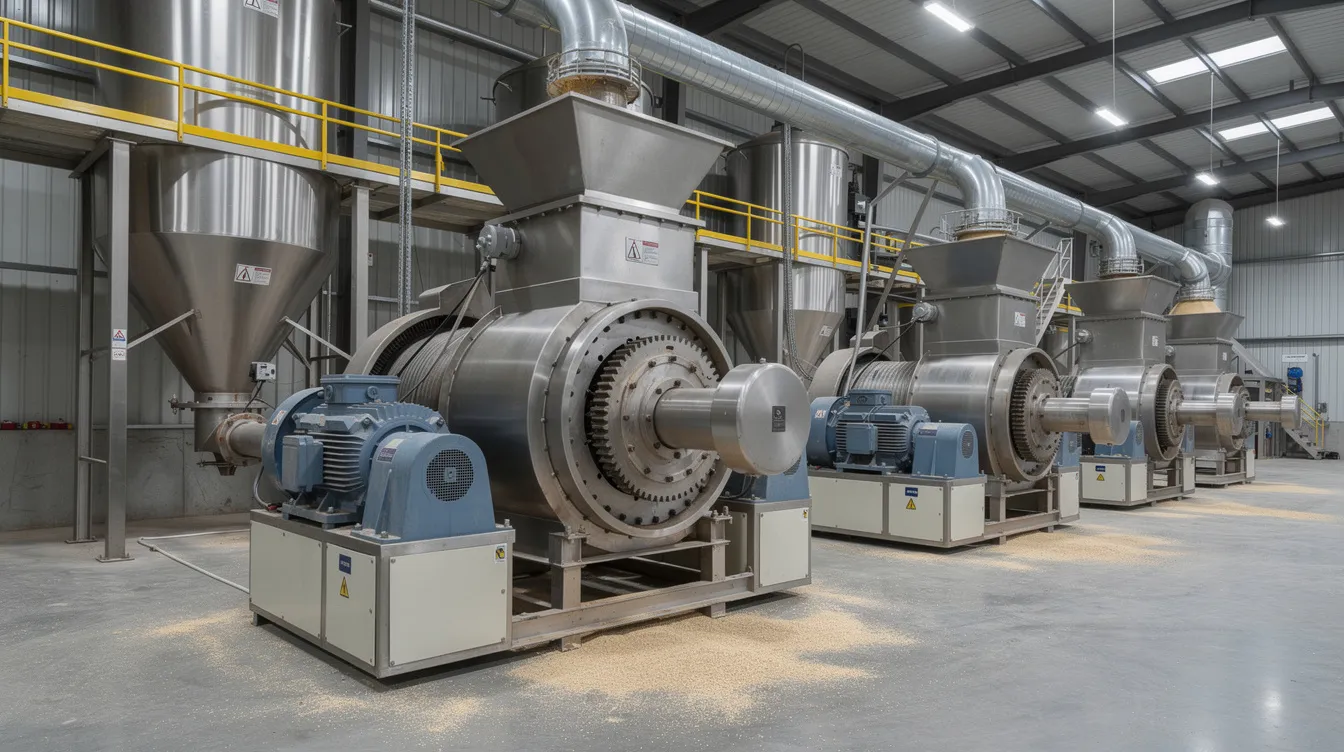
Ring-die pellet mills are the standard for continuous industrial feed manufacturing at capacities from 1 to 20 TPH. The key components include a rotating die ring with precision-drilled holes, two or three pressure rollers, a variable-speed feeder, an integrated conditioner, a heavy-duty gearbox and a main motor drive (often fitted with a variable-frequency drive for process control). Die hole diameter is typically 4–6 mm for poultry feed and up to 8–10 mm for cattle feed. The compression ratio – the ratio of effective die length to hole diameter – determines pellet hardness, durability and throughput. Higher compression yields harder pellets with better PDI but increases energy consumption and reduces throughput.
Flat-die pellet mills are simpler in construction and suited to small business or on-farm operations, typically below 1 TPH. Their limitations in wear, automation and throughput make them unsuitable for continuous industrial processing. Pellet machines of this type can produce various feed types including grass and corn stalk pellets, but they are not the focus of a serious industrial feed pelleting plant project report.
Feed formulation, particle size of raw materials from the hammer mill and mash moisture significantly influence pellet quality. For commercial poultry feed, target PDI ranges of 90–95% are common, though exact targets vary by buyer specification. Pellet coolers (counterflow type), crumbler units for starter feeds and screening systems to remove and recycle fines complete the pelleting line. Poor cooling or inadequate screening increases fines, product returns and operating cost, directly affecting the bottom line.
For most 2–20 TPH commercial feed plants in India, ring-die pellet mills with proper steam conditioning represent the preferred technology due to their combination of durability, throughput and energy efficiency.
Feed Steam Conditioning Technology – Process, Equipment and Operational Efficiency
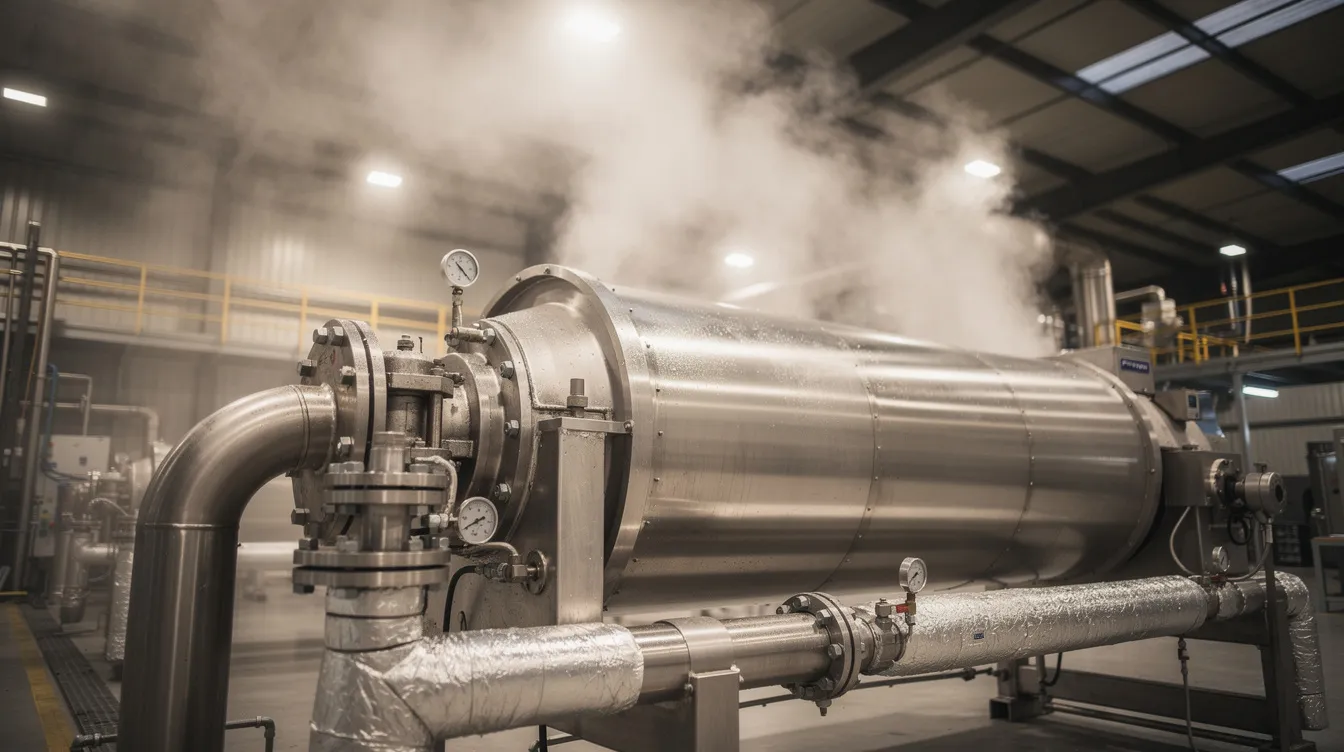
Steam conditioning is the controlled addition of moisture and heat to mash before it enters the pellet mill. Its purpose is to soften particles, enable partial starch gelatinisation – which improves pellet durability and digestibility – and strengthen pellet binding. Hot conditioning uses steam to raise temperature and moisture, typically from around 12–13% to 15–17% moisture at the conditioner outlet. The process also contributes to pathogen reduction, particularly Salmonella risk in poultry feed.
Steam quality is critical. Steam should be dry and saturated, delivered at typically 3–6 bar gauge pressure at the conditioner inlet. Conditioning temperature for many poultry rations targets 75–90°C, while cattle feed may use somewhat lower temperatures. These values are formulation-specific – a high-fat ration behaves differently from a high-fibre formula. Steam addition of 3–6% by weight of incoming mash is typical.
Conditioner Configurations
| System Type | Typical Retention Time | CapEx Level | Suitable Feed Types | PDI Improvement | Notes |
|---|---|---|---|---|---|
| Single-shaft paddle conditioner | 20–30 seconds | Lower | Standard poultry, cattle feed | Moderate (5–8 points) | Most common in Indian mills |
| Double-shaft conditioner | 30–60 seconds | Medium | Higher-quality poultry, pig feed | Good (8–12 points) | Better mixing uniformity |
| Long-term retention conditioner (LTC) | 60–120+ seconds | Higher | High-hygiene poultry, medicated, export aqua | Significant (10–15 points) | Recommended for pathogen-sensitive applications |
Boiler sizing must match the pellet mill’s steam demand. A typical ring-die pellet line consumes approximately 45 kg of steam per tonne of feed for conditioning. Boiler selection (fire-tube or water-tube, fired by coal, briquettes, biomass or gas), steam piping with adequate pressure-reducing valves, steam traps and condensate return systems are essential components. Poor condensate management wastes fuel and destabilises conditioning.
Better conditioning can reduce specific energy consumption at the pellet mill by 20–30% and increase throughput without major mechanical upgrades – a direct contribution to improved plant economics.
Industrial Feed Extrusion Technology – Process and Applications
Extrusion is a process that shapes and cooks feed under high temperature and mechanical shear. The feed dough is plasticised inside a barrel and forced through a die to create expanded or dense products with controlled density and texture. The basic elements of an extruder include a feeding system, preconditioner, barrel with heating/cooling zones, screw(s), die plate and a cutting system.
Single-screw extruders are simpler in design and lower in investment. They are often used for sinking fish feed or simple pet food, but have limitations in flexibility compared with twin-screw systems. Twin-screw extruders, with intermeshing co-rotating screws, provide finer control over expansion, handle higher fat or fresh meat inclusion levels, and allow precise adjustment of product density – essential for manufacturing floating aquaculture feed and premium pet food. However, twin-screw systems carry significantly higher capital and maintenance costs.
Preconditioned extrusion – where steam and liquids are added in a preconditioner before the barrel – is essential for floating fish feed production. Preconditioning improves starch gelatinisation, reduces mechanical energy demand inside the barrel and improves product expansion and uniformity.
Post-extrusion operations include drying (multi-pass belt or chamber dryers to reduce moisture to 10–12% for safe storage), cooling to stabilise temperature and prevent condensation, oil or functional coating using spray or vacuum coaters for high-fat aqua feeds, and screening to remove fines and broken pieces.
Extruders are not general-purpose replacements for pellet mills. They serve specific applications – floating and sinking fish feed, shrimp feed, pet food and certain speciality livestock feeds – where buoyancy control, expansion, texture and cooking are essential. An animal feed extrusion plant project report should separately address the extra thermal load, higher electrical demand and more complex process control compared with a conventional pelleting DPR.
Feed Pelleting vs Extrusion – Technical and Financial Comparison
Both pelleting and extrusion are proven industrial feed manufacturing technologies, but they serve different product segments with distinct technical and financial profiles.
| Comparison Parameter | Conventional Pelleting | Extrusion Processing |
|---|---|---|
| Processing principle | Mechanical compression through die | High-temperature shear cooking through die |
| Typical applications | Poultry, cattle, pig feed; standard livestock rations | Floating fish feed, shrimp feed, premium pet food |
| Equipment complexity | Moderate | High |
| Steam conditioning | Essential; 3–6% steam, 75–90°C | Preconditioning important; barrel adds thermal load |
| Specific power use | 4–40 kWh/ton (pellet mill motor) | Higher; extrusion + drying adds significantly |
| Product density control | Dense, non-expanded pellets | Controllable; floating or sinking products possible |
| Product texture | Uniform product with smooth surface | Expanded, porous or dense depending on settings |
| Capital investment per TPH | Lower | Significantly higher |
| Maintenance complexity | Regular die and roller replacement | Complex; screw and barrel wear, hydraulics |
| Operating cost per tonne | Lower | Higher (energy, maintenance, consumables) |
Pelleting is generally preferred for high-volume commodity poultry feed, layer feed, cattle feed and pig feed where dense pellet feed is sufficient and cost per tonne must be minimised. Extrusion is almost mandatory for floating fish feed, most shrimp feed and many premium pet foods where precise control of buoyancy, shape and fat coating justifies a higher selling price. Typical gross margins for fish feed production range from 20–30%, with net margins estimated between 8% and 15%.
An integrated animal feed complex in India might install 10–20 TPH pelleting lines for poultry and cattle feed alongside a separate 1–5 TPH extrusion line for aqua or pet feed, sharing raw materials, utilities and quality control infrastructure. The choice between pelleting-only and combined layouts should be driven by target market, selling price expectations, formulation mix, energy cost structure and long-term product strategy – all of which should be analysed in the industrial feed pelleting plant project report.
Industrial Feed Pelleting and Extrusion Manufacturing Process Flow
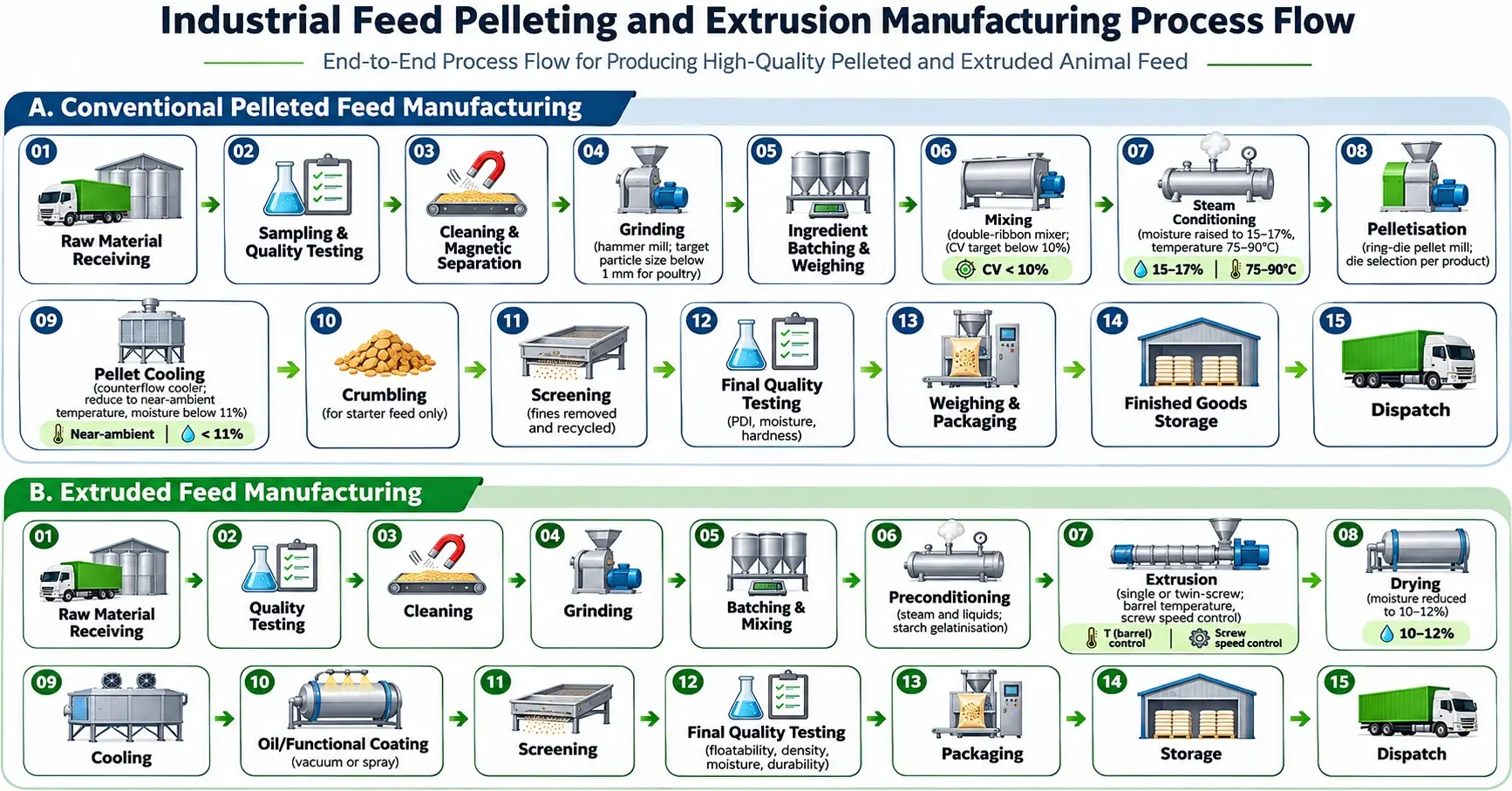
A. Conventional Pelleted Feed Manufacturing
Raw Material Receiving → Sampling & Quality Testing → Cleaning & Magnetic Separation → Grinding (hammer mill; target particle size below 1 mm for poultry) → Ingredient Batching & Weighing → Mixing (double-ribbon mixer; CV target below 10%) → Steam Conditioning (moisture raised to 15–17%, temperature 75–90°C) → Pelletisation (ring-die pellet mill; die selection per product) → Pellet Cooling (counterflow cooler; reduce to near-ambient temperature, moisture below 11%) → Crumbling (for starter feed only) → Screening (fines removed and recycled) → Final Quality Testing (PDI, moisture, hardness) → Weighing & Packaging → Finished Goods Storage → Dispatch
The technical process of feed manufacturing includes grinding, mixing, conditioning and pelleting as its core sequence. Cold conditioning manages moisture to prevent spoilage and degradation – moisture levels in cold conditioning should be maintained between 12% and 14%. Cooling stabilises feed pellets’ temperature and prevents condensation, maintaining structural integrity of the final pellets.
B. Extruded Feed Manufacturing
Raw Material Receiving → Quality Testing → Cleaning → Grinding → Batching & Mixing → Preconditioning (steam and liquids; starch gelatinisation) → Extrusion (single or twin-screw; barrel temperature, screw speed control) → Drying (moisture reduced to 10–12%) → Cooling → Oil/Functional Coating (vacuum or spray) → Screening → Final Quality Testing (floatability, density, moisture, durability) → Packaging → Storage → Dispatch
At each major stage, critical control factors include raw materials quality, moisture management, temperature profiles and residence time. Process deviations directly affect pellet durability, fines generation, shelf life and overall product consistency. A bankable feed plant DPR should convert these flows into practical layout diagrams and mass-balance calculations rather than merely listing steps.
For more detail on integrated process flows and automatic animal feed mill machinery, layout and EPC cost, promoters should consult the related cluster article.
Industrial Feed Pelleting Machinery and Equipment Requirements
The major equipment zones in an industrial feed manufacturing line cover raw material handling, grinding, batching and mixing, conditioning, pelleting or extrusion, cooling and drying, screening and crumbling, coating, packaging and utilities with automation.
Key equipment groups:
- Raw material handling: Dump pits, chain and bucket elevators, drum cleaners, de-stoners, magnetic separators, and storage silos or bins
- Grinding: Industrial hammer mills with capacity matched to pellet mill throughput; rotor design and screen selection directly affect particle size and power consumption
- Batching and weighing: Automatic systems with load cells, micro-ingredient dosing and PLC-based recipe control for formulation accuracy and traceability
- Mixing: Double-ribbon or paddle mixers; typical mixing time 3–5 minutes per batch to achieve uniform product distribution
- Steam boilers and conditioners: Fire-tube boilers (briquettes, coal, gas or agro-waste fuel), steam distribution piping, pressure-reducing valves and conditioners as described above
- Pellet mills: Ring-die pellet mills sized to rated TPH; die, rollers and gearbox are wear components requiring regular replacement
- Extruders: Single-screw or twin-screw systems with preconditioners; used only where extrusion is required for the product
- Cooling, drying, crumbling, screening: Counterflow coolers, multi-pass dryers (for extruded products), crumblers and vibratory sieves
- Liquid dosing and coating: Spray or vacuum coating systems for adding oils, liquids and functional ingredients
- Conveying: Mechanical (screw, chain, bucket) and pneumatic systems
- Packaging: Automatic bagging with weighing scales, bag stitching or sealing, and palletising
- Dust collection and pollution control: Cyclones, bag filters and explosion-relief arrangements
- Automation: Electrical panels, motor control centres, PLC/SCADA systems and central control rooms
- Laboratory and QC: Quality control measures and laboratory facilities are essential parts of the manufacturing process – routine testing of PDI, moisture, fat content, minerals, hardness and particle size
Machinery specifications play a critical role in the DPR, including equipment types and their capacities. The specific make, model and configuration must be selected through vendor discussions, site conditions and DPR-based capacity calculations rather than generic lists.
Industrial Feed Pelleting Machinery Cost in India
Exact industrial feed pelleting machinery cost in India varies significantly by capacity, brand (domestic vs imported), degree of automation, heavy MS or stainless-steel construction and scope of supply. Any quotation should be project-specific.
The CapEx estimation in an industrial feed pelleting plant project report should group costs into: core process machinery (pellet mill, conditioner, extruder), pre-processing (grinding, mixing, batching), post-processing (cooling, crumbling, screening, coating, packaging), utilities and automation, and installation/EPC with applicable duties.
Indicative Machinery Budget Shares
| Equipment Group | Approx. Share of Machinery Budget (%) |
|---|---|
| Pellet mill + conditioner block | 20–25% |
| Grinding, mixing, batching | 15–25% |
| Cooling, screening, crumbling | 10–15% |
| Packaging and automation | 5–10% |
| Utilities (boiler, steam, water, air) | 10–15% |
| Installation, piping, E&I | 8–12% |
From available Indian industry evidence: a 5–10 MT/day pelleted cattle feed plant typically requires machinery and small boiler investment of approximately ₹50–90 lakh. For reference, a 5 HP cattle feed machine costs approximately Rs. 72,500 at the entry level. For 10–15 TPH pellet lines with domestic equipment, total machinery investment ranges from ₹2–8 crore depending on automation and scope. Twin-screw extruders of 500–1000 kg/hr capacity with PLC control cost ₹15–25 lakh, while small single-screw extruders (50–150 kg/hr) cost ₹1–2.85 lakh.
Cost escalation factors include moving from manual to fully automatic systems, choosing high-alloy wear-resistant dies and screws, adopting PLC/SCADA automation or opting for European/Japanese technology over standard Indian equipment. Promoters should obtain at least 2–3 vendor quotations for each major equipment group at the DPR stage rather than relying on outdated generic internet numbers.
For detailed industrial cattle feed manufacturing plant project report configurations, the related cluster article provides segment-specific guidance.
Feed Pelleting and Extrusion Plant Capacity Planning
Capacity planning is central to project feasibility. Banks and investors assess whether the proposed TPH rating, working hours and capacity utilisation assumptions are realistic for the selected technology and market demand.
Illustrative Capacity Planning Table
| Nominal Capacity | Operating Hours/Day | Operating Days/Year | Year 1 Utilisation | Steady-State Annual Production (MT) | Recommended Technology |
|---|---|---|---|---|---|
| 2–3 TPH | 16–18 | 300 | 50–60% | 7,200–16,200 | Pelleting only |
| 5 TPH | 18 | 300 | 55% | ~14,850 rising to ~27,000 | Pelleting; optional extrusion |
| 10 TPH | 18–20 | 300–330 | 60% | ~32,400 rising to ~54,000 | Pelleting + extrusion line |
| 15–20 TPH | 20 | 300–330 | 60% | ~54,000 rising to ~110,000 | Integrated complex |
A mid-size fish feed plant typically produces 20,000 MT/year. These are illustrative assumptions only. Rated capacity (e.g. 10 TPH on maize–soy pellet feed at standard conditions) differs from actual throughput after accounting for formulation difficulty, steam quality, operator skill and planned maintenance downtime. Frequent product changeovers – between poultry, cattle and aqua feed or between different pellet sizes – reduce effective capacity and should be factored into DPR utilisation assumptions.
Typical bottlenecks include under-sized boilers, inadequate grinding or mixing capacity, limited cooler capacity and under-rated conveying systems. The DPR should verify every section’s rated capacity to avoid mid-line constraints.
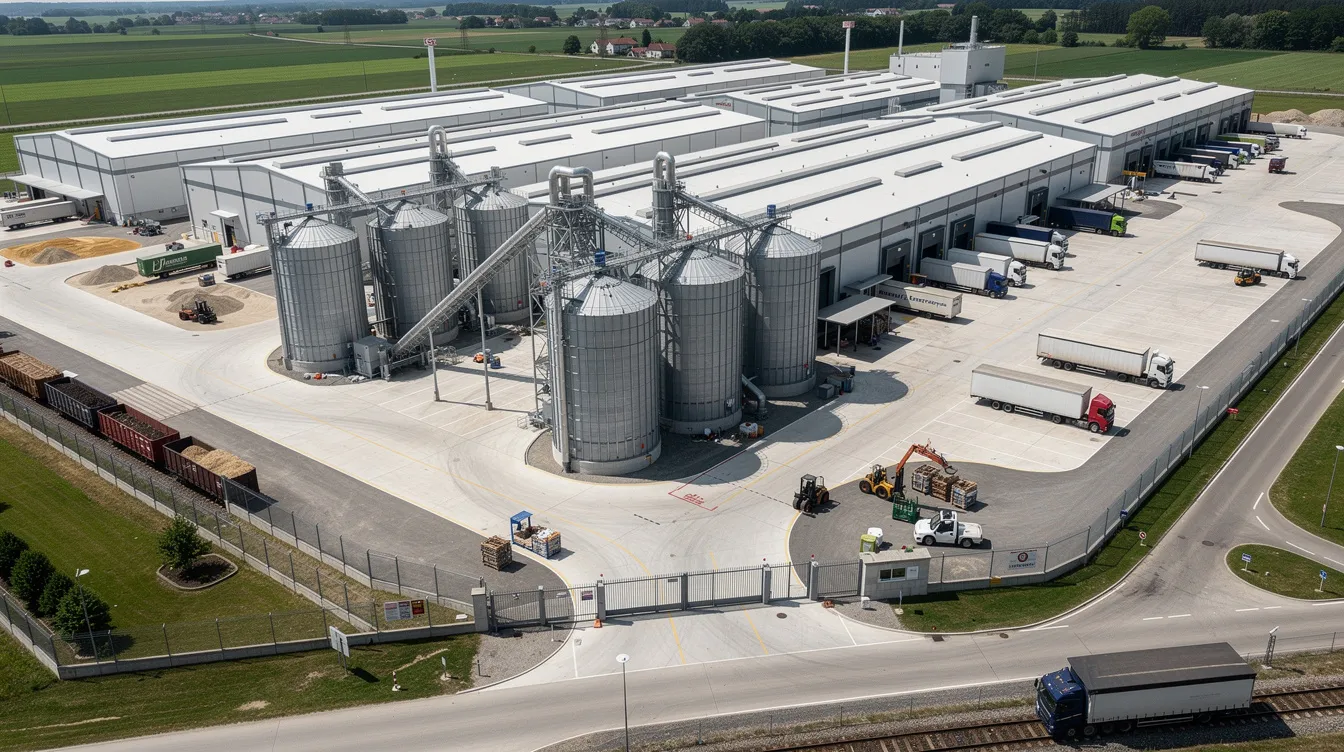
Feed Pelleting and Extrusion Plant Setup Cost and Capital Investment
Total project cost for an industrial feed pelleting or extrusion plant in India extends far beyond the ex-works machinery price. Construction and civil works, including land area and layout, need to be detailed in the DPR.
Major capital cost heads include:
- Land acquisition or long-term lease and site development
- Factory buildings: raw material godowns, process block, finished goods warehouse
- Main process machinery and equipment
- Steam boiler and utility infrastructure (compressor, power, water treatment)
- Electrical cabling, panels and instrumentation
- Raw material and finished-product storage infrastructure
- Installation, commissioning, engineering and project management
- Pollution-control systems and fire safety
- Preliminary and pre-operative expenses (design, approvals, interest during construction)
- Contingencies and margin for working capital
Indicative Capital Cost Allocation
| Cost Head | Approximate Share of Total Project Cost (%) |
|---|---|
| Plant and machinery | 35–45% |
| Buildings and civil works | 20–30% |
| Utilities and electrical | 8–12% |
| Pre-operative and preliminary expenses | 3–5% |
| Contingencies | 3–5% |
| Working capital margin | 8–12% |
These splits are illustrative and subject to project-specific design. Greenfield projects require full investment in land, buildings and utilities, whereas expansion projects within existing feed mills may share boilers, power connections and laboratories, significantly reducing total investment and financing needs.
Utilities, Power Consumption, Steam and Water Requirements
Feed pelleting and extrusion plants are energy-intensive, with significant electrical loads for motors and fans and thermal loads for steam generation and drying.
Specific electrical energy consumption depends on grinding fineness, conditioning, pellet mill or extruder load and automation level. In Indian broiler feed plants, pellet mill motor energy ranges from 4 to 40 kWh/tonne, with whole-line consumption (grinding, mixing, pelleting, cooling) typically in the range of 85–135 kWh/ton. Coal consumption for boiler fuel runs approximately 8–10 kg per tonne of feed.
Water requirements include boiler make-up, cleaning, possible conditioning water addition and staff amenities. Water quality – particularly hardness and TDS – may require treatment through softeners or RO to protect boilers and process equipment. Compressed-air systems serve instrument air, bagging machines, dust filters and automation valves; under-sized compressors lead to plant stoppages. Backup power through DG sets is essential for continuous operation.
Energy monitoring – metering major drives, accounting for boiler fuel consumption – should be built into the project at design stage to control per-tonne utility cost and support continuous improvement in energy efficiency.
Feed Pelleting and Extrusion Plant Operating Cost and Production Economics
Raw materials are the dominant component of total feed manufacturing cost. Understanding raw material requirements is crucial for the feasibility of feed manufacturing projects – raw materials typically account for 75–85% of operating expenditures in feed production, depending on formulation and market prices for grains, oilcakes and protein concentrates.
Illustrative Operating Cost Framework
| Cost Component | Share in Total Feed Cost (%) | Nature |
|---|---|---|
| Raw materials (grains, oilcakes, premixes, minerals) | 70–85% | Variable |
| Electricity | 3–6% | Mixed |
| Steam and boiler fuel | 1–3% | Variable |
| Labour and supervision | 2–4% | Mixed |
| Repairs, maintenance, dies, rollers | 1–3% | Mixed |
| Packaging | 1–2% | Variable |
| QC, administration, overheads | 1–3% | Fixed/Mixed |
| Freight and transportation | 2–4% | Variable |
It is important to differentiate total cost per tonne of finished feed from incremental pelleting or extrusion conversion cost. Conversion cost (power, steam, labour, maintenance, packaging per tonne, excluding raw materials) typically represents 15–30% of ex-factory cost. Improved PDI, lower fines, optimised die selection, better conditioning and higher throughput all improve conversion economics by reducing reprocessing, wear and waste.
Financial Projections and Feed Pelleting Plant Feasibility
A serious industrial feed pelleting plant project report must include detailed multi-year financial projections and feasibility indicators. DPRs detail project costs and financial projections – not merely a list of machinery and an approximate capital estimate. Financial projections in a DPR should include cost breakdown, profitability statements and working capital requirements.
Key components of the financial model:
- Project cost and means of finance: Means of finance details include equity, loans and potential subsidies, structured according to promoter capacity and lender requirements
- Working capital assessment: Based on holding norms for raw materials, work-in-progress, finished goods and receivables
- Revenue projections: Annual production volume linked to capacity utilisation ramp-up, product mix (poultry, cattle, aqua feed) and selling prices
- Profitability analysis: EBITDA, depreciation, interest, profit before and after tax; profitability analysis includes break-even, ROI and cash flow analysis
- Cash flow projections: Term loan drawdown, repayment schedule, interest outgo and net cash surplus
- Feasibility metrics: Break-even capacity, DSCR (year-wise and average), IRR, NPV, payback period
For context, break-even for a fish feed plant is estimated in year 2, with payback achievable within 3–4 years at typical gross margins of 20–30%. These are segment-specific benchmarks – poultry and cattle feed margins tend to be narrower due to commodity pricing pressures.
Sensitivity analysis should test variations in maize/soy prices, electricity tariffs, sales realisation, capacity utilisation and interest rates. Project Report Bank under CA Manish Gugliya typically builds such scenarios into customised DPRs to give promoters and lenders a realistic picture of downside risk.
Plant Layout, Automation and EPC Planning
Plant layout is a material-flow–driven exercise that must align with the chosen process – pelleting, extrusion or both – and the available land parcel. Zoning should place raw material intake and storage at the entry point, grinding and batching sections above or beside the pelleting/extrusion floor, and packaging with finished-goods storage at the output end for smooth truck access.
Utility placement is equally important: boiler house at a safe distance with clear access to chimney, fuel yard and water source; transformer and DG sets positioned for reliable power supply; steam piping and dust-collection ducting integrated into the structural design.
Automation integration through PLC/SCADA for batching, pelleting and extrusion improves process consistency, reduces labour dependency and enables data logging for quality traceability. When machinery is sourced from multiple suppliers, clear scope boundaries and communication protocols must be defined.
Safety provisions – escape routes, fire hydrants, dust explosion risk management around hammer mills and bag filters, and segregation of electrical rooms from dusty process areas – should be incorporated at the design stage. A well-planned EPC approach should include clear tender documents, performance-guarantee trials and operator training, guided by a properly prepared DPR and implementation schedule. Project implementation schedules should map out critical timelines for developing the feed plant.
Feed Plant Regulatory Compliance and Environmental Requirements in India
Regulatory and environmental requirements differ by state, plant capacity, fuel choice and product category. Statutory approvals must be listed in the DPR including environmental compliance and factory licenses.
Typical requirements include:
- Company incorporation, factory and shop establishment registrations
- Local land-use and building-plan approvals
- State Pollution Control Board Consent to Establish (CTE) and Consent to Operate (CTO)
- Boiler registration and periodic inspection under the Indian Boiler Act
- Fire NOC from local fire department
- Compliance with Factories Act provisions for occupational safety
Environmental management in the DPR includes pollution control measures and compliance with regulations – dust control through cyclones and bag filters, emission norms for boilers (especially coal or biomass fired), noise control and proper waste and wastewater handling.
Feed-quality regulatory aspects include applicable BIS or FSSAI-linked standards, adherence to buyer specifications for poultry and cattle feed, and additional requirements for medicated feed or export-oriented aqua feed. Voluntary certifications such as ISO 22000, HACCP or GMP+ may be commercially important for large buyers and export markets. Specific legal advice should be obtained for each product category and location.
Major Technical, Commercial and Financial Risks
Medium- and large-scale feed manufacturing investments carry interlinked risks. A robust industrial feed pelleting plant project report should identify and mitigate these systematically.
Risk Mitigation Framework
| Risk | Description | Mitigation Strategy |
|---|---|---|
| Incorrect machinery selection | Over-sizing or under-sizing pellet mill, extruder or boiler | Vendor technical due diligence; capacity simulation in DPR |
| Poor steam quality | Wet steam causing low PDI, excessive fines and die plugging | Ensure dry saturated steam; install steam traps and condensate return |
| High energy consumption | Excessive kWh/ton due to poor grinding, conditioning or worn dies | Energy audits; VFD on major drives; regular die and roller replacement |
| Raw material quality variation | Inconsistent particle size, moisture or contaminants like iron and sand | Multi-supplier sourcing; incoming QC protocols; magnetic separation |
| Capacity underutilisation | Market demand insufficient to utilise installed capacity | Conservative utilisation assumptions; phased expansion planning |
| Project cost escalation | Underestimated civil, utility or pre-operative expenses | Detailed project cost estimation with contingency; verified quotation-based budgets |
| Working capital stress | Inadequate margin for raw material and receivable financing | Realistic working capital assessment linked to operating cycle |
| Commodity price volatility | Maize and soy prices affect 70–85% of production cost | Sensitivity analysis on raw material prices; combination of forward contracts and diversified sourcing |
Structured risk analysis, as typically undertaken by Project Report Bank during DPR preparation, improves bankability and reduces costly surprises during commissioning.
How to Prepare a Bankable Industrial Feed Pelleting Plant DPR
A Detailed Project Report for an industrial feed pelleting plant requires technical and financial feasibility analysis – it is an integrated document, not merely a descriptive write-up. DPRs outline project objectives and scope clearly, and typically follow a standardised format for consistency across bank-appraisal requirements. A DPR includes market analysis and feasibility studies alongside technical specifications.
Essential content blocks:
- Market and product analysis: Segment-wise demand assessment (poultry, cattle, aqua, pet feed) and competitive landscape – market analysis encompasses demand-supply assessment and competitive dynamics
- Technology and process selection: Pelleting vs extrusion vs combined, with justified rationale
- Capacity planning and location analysis: Raw material availability, logistics, local utility tariffs
- Technical sections: Process description, machinery list with specifications, plant layout, utilities sizing, manpower planning and project implementation schedule
- Financial sections: Project cost and means of finance, term loan assessment, promoter contribution, working capital assessment, revenue and cost projections, profitability statements, cash flow and fund-flow statements
- Analytical sections: Break-even analysis, DSCR computation, IRR/NPV, payback period, sensitivity analysis and risk assessment
Promoters planning specialised segments should also refer to the Industrial Animal Feed Concentrate Manufacturing Plant Project Report and Grain-Based DDGS Processing Plant Project Report for segment-specific insights, integrating those with this technology-focused DPR.
Professional DPR, Financial Feasibility and Project Finance Advisory
Project Report Bank is a Chartered Accountant-led professional advisory platform, led by CA Manish Gugliya, FCA, DISA (ICAI), with more than 20 years of professional experience. The platform specialises in customised Detailed Project Reports, financial modelling, CMA data preparation, feasibility studies and project finance advisory for manufacturing projects across India, including industrial animal feed processing plants.
Core services relevant to feed pelleting, steam conditioning and extrusion projects include:
- Preparation of bankable DPRs, CMA data and loan proposals for term loan and working capital financing
- Techno-economic feasibility reports with DSCR and repayment analysis
- Project costing and means-of-finance structuring
- Sensitivity analysis and investor-ready financial models
- Coordination with machinery suppliers to validate capacity and integrate vendor quotations into the financial model
Unlike template-based document providers, Project Report Bank works with project-specific assumptions: proposed capacity, raw materials basket, target product mix, technology configuration, local utility tariffs and financing terms. This ensures that the resulting industrial feed pelleting plant project report is a reliable decision-making document rather than a generic store-bought pdf.
Planning an industrial feed pelleting, steam conditioning or extrusion processing plant in India? Contact ProjectReportBank.com for a customised Detailed Project Report, investment assessment, machinery cost analysis, financial projections and bankable project feasibility study. Share your proposed location, target production capacity, feed product category, machinery preferences and estimated investment through the website’s WhatsApp inquiry channel or contact form.
Frequently Asked Questions
What is the approximate cost of an industrial feed pelleting plant in India?
Total project cost depends on capacity, technology (pelleting-only vs combined pelleting–extrusion), automation level, civil construction scope and utility infrastructure. For a 5–10 MT/day pelleted cattle feed plant, machinery and boiler investment is typically ₹50–90 lakh, with land and building adding ₹40–100 lakh. Larger 10–15 TPH lines with domestic equipment range from ₹2–8 crore for machinery alone. Only a project-specific estimate based on verified quotations and site conditions can provide credible figures for a bankable DPR. Privacy choices regarding vendor pricing should be respected when sharing competitive quotation data.
What is the difference between feed pelleting and extrusion, and can an extruder replace a pellet mill?
Pelleting compresses conditioned mash through a die to produce dense, non-expanded pellets – the standard for poultry, cattle and pig feed. Extrusion cooks feed under high temperature and shear to produce expanded products, essential for floating fish feed and premium pet food where density control and buoyancy are critical. Extruders are not universal replacements for pellet mills – they cost more per TPH, consume more energy and are justified primarily where the product demands expansion, cooking or floatability, and where the market supports higher selling prices. A developer pellet feed line for juveniles in aquaculture, for example, may require extrusion, while standard broiler feed does not.
Why is steam conditioning essential before pelletisation?
Hot conditioning uses steam to enhance feed digestibility during pelleting. Without adequate conditioning, pellet mills operate under higher mechanical stress, producing pellets with poor PDI, excessive fines and higher die wear. Conditioning raises mash temperature and moisture, enabling partial starch gelatinisation which binds particles together. Cold conditioning maintains pellet integrity by regulating moisture levels downstream. Poor conditioning increases energy consumption by 20–30% and reduces throughput – the economic impact compounds over thousands of operating hours annually. Proper conditioning is therefore not optional but a fundamental requirement for any reliable industrial pelleting operation.
What financial projections do banks expect in a feed pelleting plant DPR?
Banks typically require projected financial statements for 5–7 years including profit-and-loss, cash flow and balance sheet projections. Key metrics include break-even capacity utilisation, year-wise DSCR (minimum 1.25–1.50 expected by most lenders), IRR, NPV and payback period. The DPR should demonstrate that projected cash flows can adequately service term loan repayments and interest while maintaining sufficient working capital. Sensitivity analysis showing the impact of changes in raw material prices, selling prices and capacity utilisation on DSCR is essential to ensure the document is not dismissed as unrealistically optimistic. A well-structured DPR aids in securing bank financing by presenting defensible, assumption-backed projections.
Why should promoters conduct a feasibility study before finalising machinery orders?
Committing to machinery before understanding the complete project economics is a common and costly mistake. A buy decision on a pellet mill or extruder without evaluating boiler sizing, utility infrastructure, civil costs, working capital needs and market demand can lead to over-sizing, under-utilisation, inadequate utilities or misaligned product mix. A comprehensive feasibility study integrates technology selection, capacity planning, capital cost, operating economics and financial projections into a single coherent analysis. This helps promoters avoid mid-course corrections that can delay commissioning and escalate project costs – making the feasibility study an investment that protects a much larger capital commitment.
Conclusion – Investment Planning for Industrial Feed Pelleting and Extrusion Projects
Successful industrial feed pelleting and extrusion projects in India depend on informed technology selection – ring-die pellet mill, extruder, or both – combined with correct capacity planning, efficient steam conditioning, robust utility infrastructure and disciplined financial planning. Machinery cost, plant setup cost and operating economics must be evaluated together with product-market positioning and raw material sourcing strategy to judge true project feasibility. The importance of energy optimisation, moisture and quality control, and structured risk management cannot be overstated – these factors sustain healthy DSCR, IRR and payback performance in the face of volatile commodity and power prices.
A customised, technically accurate, bankable industrial feed pelleting plant project report prepared by professional advisors is a critical step before committing large capital to pellet mills, steam boilers or extrusion lines. The document should serve as a financial roadmap – not a formality.
Entrepreneurs, MSMEs and corporate investors planning feed pelleting, steam conditioning or extrusion plants in India are invited to reach out to ProjectReportBank.com for DPR preparation, feasibility analysis, financial modelling and project finance advisory support.