An integrated multi-species compound animal feed mill is not a scaled-up version of a single-product cattle feed or poultry feed plant. It is a manufacturing configuration that shares common grinding, mixing and pelleting infrastructure across multiple animal species while managing distinct formulations, quality protocols and production schedules under one roof. The financial viability of such a project depends on coordinated planning of species-specific feed formulation, raw material procurement, capital expenditure, production economics, working capital and long-term debt servicing. This article examines the technical, operational and financial dimensions that a bankable integrated animal feed mill project report must address.
Key Takeaways
An integrated multi-species feed mill in India is a central facility, typically rated at 5 to 20 TPH, producing cattle feed, poultry feed, sheep and goat feed, pig feed and other compound feeds. It shares core machinery (hammer mills, mixers, pellet mills, boilers, packing systems) but requires species-specific formulations, separate bins or hoppers, production scheduling and contamination-control protocols. An integrated animal feed mill processes raw agricultural commodities into balanced compound feeds for multiple livestock categories within a single industrial complex.
- A bankable integrated animal feed mill project report must cover realistic plant capacity planning (e.g. 5, 10 or 20 TPH), detailed project cost (land, building, machinery, utilities, working capital), raw material strategy, 7 to 10 year financial projections, sensitivity analysis and risk assessment. Key components of a feed mill project report include an executive summary, market assessment, and financial projections.
- Raw material costs for maize, soybean meal, bran, de-oiled cakes and premixes typically form 80 to 85% of operating expenses, making procurement and working capital planning as critical as machinery selection.
- From a project finance perspective, lenders evaluate DSCR, break-even capacity utilisation, IRR and sensitivity to commodity price movements rather than relying on theoretical installed TPH alone. Financial projections include break-even analysis, cash flow statements, ROI and net present value (NPV) assessments.
- Project Report Bank, led by CA Manish Gugliya, FCA, DISA (ICAI), provides customised DPR preparation and project finance advisory for integrated animal feed manufacturing projects across India, focusing on project-specific feasibility rather than generic templates.
What Is an Integrated Multi-Species Compound Animal Feed Mill?
An integrated multi-species compound animal feed manufacturing plant is a central feed mill designed to manufacture formulated feed for dairy cattle, buffalo, broilers, layers, sheep, goats, pigs and, where equipped with extrusion capability, aquaculture species. The defining feature is shared infrastructure: raw material silos, hammer mills, mixers, pellet mills, boilers and packing systems serve multiple product lines. Separate hoppers, batching bins, scheduling routines and hygiene protocols prevent cross-contamination between species or between medicated and non-medicated batches.
Certain feeds cannot simply run through a standard pelleting line without technical modifications. Aquaculture feed, for example, requires extrusion, drying and coating modules rather than conventional steam pelleting. High-fat pet food formulations need dedicated processing routes. The design of an integrated plant must account for these distinctions at the planning stage.
Compared with a standalone cattle feed or poultry feed plant, an integrated mill offers flexibility to shift production between species based on relative demand and margins. However, single-species mills, such as a dedicated Industrial Cattle Feed Manufacturing Plant, are simpler to operate and require less complex production scheduling. Design implications for multi-species plants include species-wise feed formulation management, product changeover time, cleaning procedures, segregated storage and optional dedicated micro-dosing for premixes and medications.
Market Potential and Commercial Opportunities in India
India’s industrial compound feed production reached 57.729 million metric tons in 2025, growing at approximately 4.5% annually. The India animal feed market was valued at about USD 14.5 billion in 2025, with forecasts projecting approximately USD 21 billion by 2031 at a CAGR of around 6.4%. Globally, the animal feed market was valued at USD 548.1 billion in 2025, and the animal feed market is expected to reach USD 702.75 billion by 2034. Animal feed manufacturing plants produced 1.266 billion tons of feed in 2022, and animal feed production creates 1.266 billion tons of feed annually worldwide. Conduct market research on industry trends and customer demand before finalising any project plan.
Demand drivers include growth of commercial poultry integrators, organised dairies, productivity-focused dairy farmers and contract broiler farming. The shift from farm-mixed feed to branded compound animal feed production continues to accelerate. Market research is essential for poultry feed manufacturing feasibility as well as for cattle and small ruminant segments. Project feasibility requires assessing local livestock populations and competitor pricing strategies in the target geography.
Major customer segments include dairy cooperatives, poultry integrators, commercial cattle and goat farms, piggery clusters, contract manufacturing clients for large brands, and dealer-led rural retail distribution. Regions near maize, soybean and rice-wheat belts (Madhya Pradesh, Maharashtra, Telangana, Punjab, Haryana, Uttar Pradesh) offer advantages in inbound freight and round-the-year raw material supply. Commercial models range from merchant (open market), captive (within own farming group), contract manufacturing (job work for brands) to integrated farm-to-feed-to-food operations, each influencing pricing power and sales risk in a DPR.
Product Portfolio and Multi-Species Manufacturing Strategy
Defining a clear, realistic product mix is fundamental to an integrated animal feed plant DPR. The product mix determines machinery configuration, raw material basket and contribution margins. Animal feed includes mash, pellets, crumbles, and liquid feed as the primary physical formats. Four major types of livestock feed pellets exist: complete, remix, concentrated, and pure forage. Livestock feed pellets are high in nutritional levels, and animal feed formulations enhance digestibility and feed conversion rates.
| Species | Feed Types | Physical Form | Main Customers | Manufacturing Notes |
|---|---|---|---|---|
| Dairy Cattle/Buffalo | Lactation, maintenance, calf starter | Mash, pellets | Small dairy farmers, cooperatives | Lower protein, larger volumes |
| Broiler Poultry | Starter, grower, finisher | Pellets, crumbles | Integrators, contract farms | Higher protein/energy, precision required |
| Layer Poultry | Pre-lay, layer, post-moult | Mash, pellets | Layer farms, egg producers | Calcium-rich, specific amino acids |
| Sheep/Goat | Grower, fattening | Pellets, mash | Commercial goat/sheep farms | Smaller pellet diameter often needed |
| Pig | Starter, grower, finisher | Pellets | Piggery clusters (regional) | Segregated storage in some regions |
Investors with a poultry-heavy project should also review the Poultry Feed Manufacturing Plant Project Report for species-focused formulation, process and financial details. Limiting initial SKUs to 8 to 12 products for volume and brand building is practical; production campaigns should be planned by animal species and form (mash vs pellet), with separate inventory tracking for medicated and non-medicated feeds.
Integrated Animal Feed Mill Capacity Planning
Determine the production scale before setting up the plant. Animal feed plants typically produce 1 to 40 tons per hour. Typical industrial capacities in India are 5 TPH (small commercial), 10 TPH (standard regional) and 20 TPH (large integrated). Animal feed production capacity ranges from 20,000 to 100,000 MT annually depending on configuration and operating schedule. Capacity must be matched with realistic market capture assumptions.
| Parameter | 5 TPH Mill | 10 TPH Mill | 20 TPH Mill |
|---|---|---|---|
| Operating Hours/Day | 8 | 8 | 16 |
| Working Days/Year | 300 | 300 | 300 |
| Theoretical Annual Capacity (MT) | 12,000 | 24,000 | 96,000 |
| Realistic Utilisation (Year 1) | 55-65% | 55-65% | 50-60% |
| Realistic Utilisation (Year 3) | 70-80% | 70-80% | 65-75% |
For a 10 TPH mill at 8 hours per day and 300 days per year, theoretical production is 24,000 MT per annum. After adjusting for downtime, product changeover, maintenance and realistic ramp-up, actual output in the first year may be 13,200 to 15,600 MT. Bottlenecks can arise at any stage: grinding, mixing, pelleting, cooling or packing may have different effective throughputs, requiring careful line design. The DPR should include a capacity utilisation trajectory and evaluate break-even utilisation based on fixed overheads and contribution per MT.
Raw Materials and Feed Ingredient Procurement Strategy
For most Indian compound animal feed production businesses, raw materials such as maize, wheat bran, rice bran, soybean meal and de-oiled cakes represent nearly 80 to 85% of the per MT feed cost. Raw materials account for 80-85% of operating expenses. Raw material requirements include cereals, protein meals, and vitamins. Maize accounts for the bulk of total operating expenses in feed production, with soybean meal being the second largest cost component. Operating costs for animal feed plants are primarily driven by raw materials.
| Ingredient | Primary Role | Procurement Notes |
|---|---|---|
| Maize/Corn (Maize Processing Project Report) | Energy | Kharif arrival, price-volatile |
| Soybean Meal (Soybean Meal Processing Project Report) | Protein | Seasonal, import-dependent in deficit years |
| Wheat Bran (Wheat Bran Processing Project Report) | Fibre, energy | Linked to flour milling output |
| Rice Bran | Energy, fat | Quality variable, rancidity risk |
| De-Oiled Cakes (De-Oiled Cake Processing Project Report) | Protein | Regional availability, aflatoxin risk |
| Molasses | Palatability, energy | Seasonal, linked to sugar crushing |
| Oils and Fats | Energy density | Price-volatile |
| Minerals, vitamins, feed additives | Micronutrients | Premix sourcing, amino acids from specialised suppliers |
A 10% rise in maize or soybean meal prices can materially change contribution margins per MT, which is why sensitivity analysis on raw material costs is essential in the financial section of the DPR. Seasonal procurement patterns (Kharif maize, oilseed harvests), storage requirements (moisture limits, aflatoxin control), raw material storage infrastructure and supplier diversification must be planned in detail. Basic in-house quality testing for moisture, crude protein and adulteration checks, supplemented by periodic external lab testing, protects formulation integrity.
Integrated Compound Animal Feed Manufacturing Process Flow
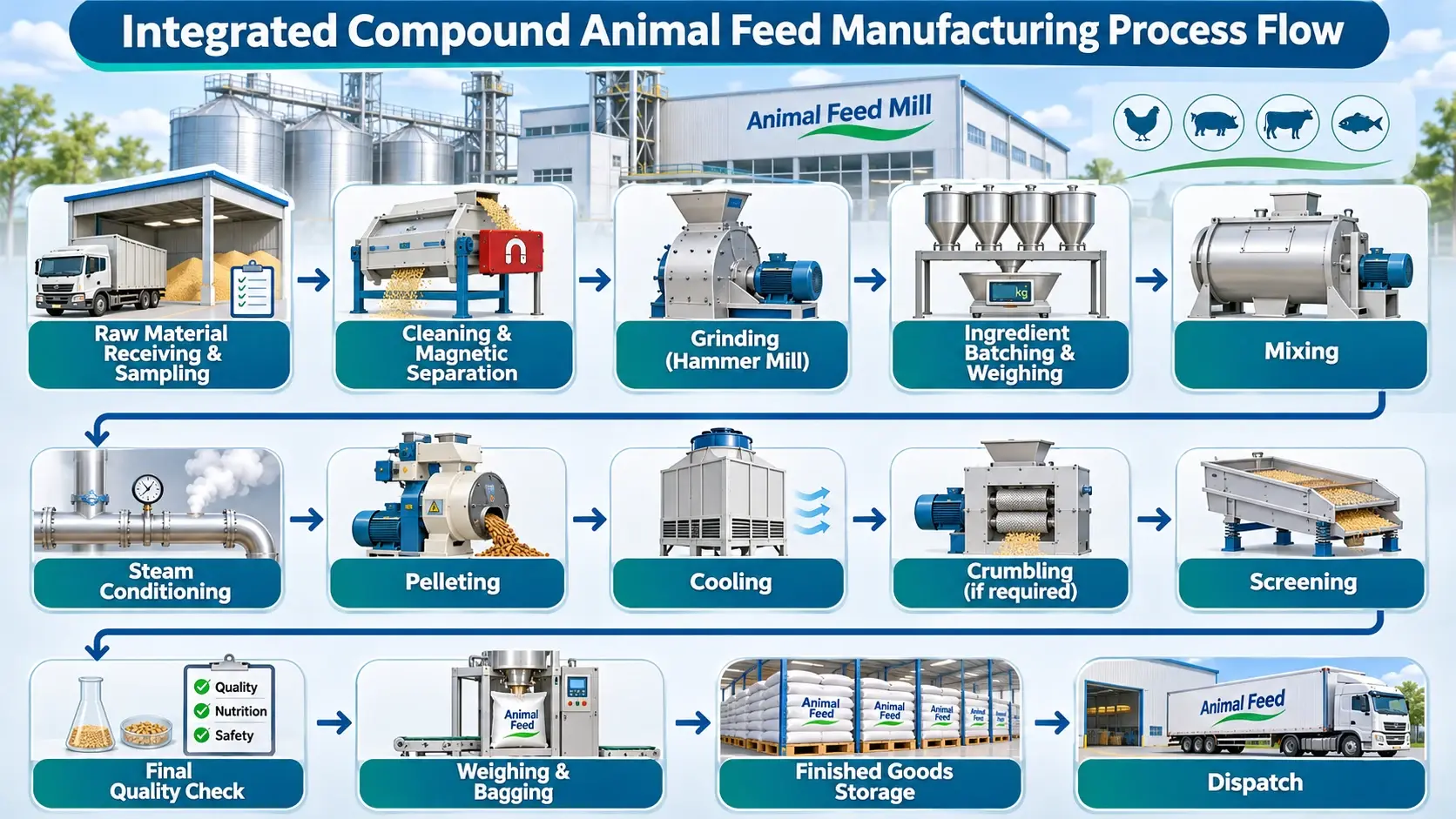
The production process follows a defined sequence from raw material receiving to dispatch. Mash feed bypasses pelleting; aquafeed (if included) follows a separate extrusion route. The manufacturing process typically involves grinding, mixing, and pelleting. The process includes raw material receiving, cleaning, grinding, and mixing as foundational stages.
Process Flow:
Raw Material Receiving & Sampling → Cleaning & Magnetic Separation → Grinding (Hammer Mill) → Ingredient Batching & Weighing → Mixing → Steam Conditioning → Pelleting → Cooling → Crumbling (if required) → Screening → Final Quality Check → Weighing & Bagging → Finished Goods Storage → Dispatch
Key stage purposes:
- Receiving and sampling: Verifying incoming ingredient quality against specifications
- Cleaning: Removing stones, dust, ferrous materials via screens and magnetic separators
- Grinding: Controlling particle size for species-specific requirements using hammer mills
- Batching and weighing: Ensuring formula accuracy through automated or manual dosing
- Mixing: Achieving homogeneity with a mixing machine (ribbon or paddle type)
- Steam conditioning and pelleting: Gelatinising starch, binding ingredients and forming feed pellets through a pellet machine with ring die
- Cooling: Stabilising pellet temperature and moisture before storage
- Crumbling and screening: Producing crumble-sized particles for starter feeds and removing fines
- Packaging: 50 kg bags via a packaging machine, or bulk loading where feasible
PLC-based batching and mixing systems, recipe management software, batch traceability and online moisture/temperature monitoring improve consistency. Higher automation improves quality but increases initial equipment costs.
Animal Feed Mill Machinery and Equipment
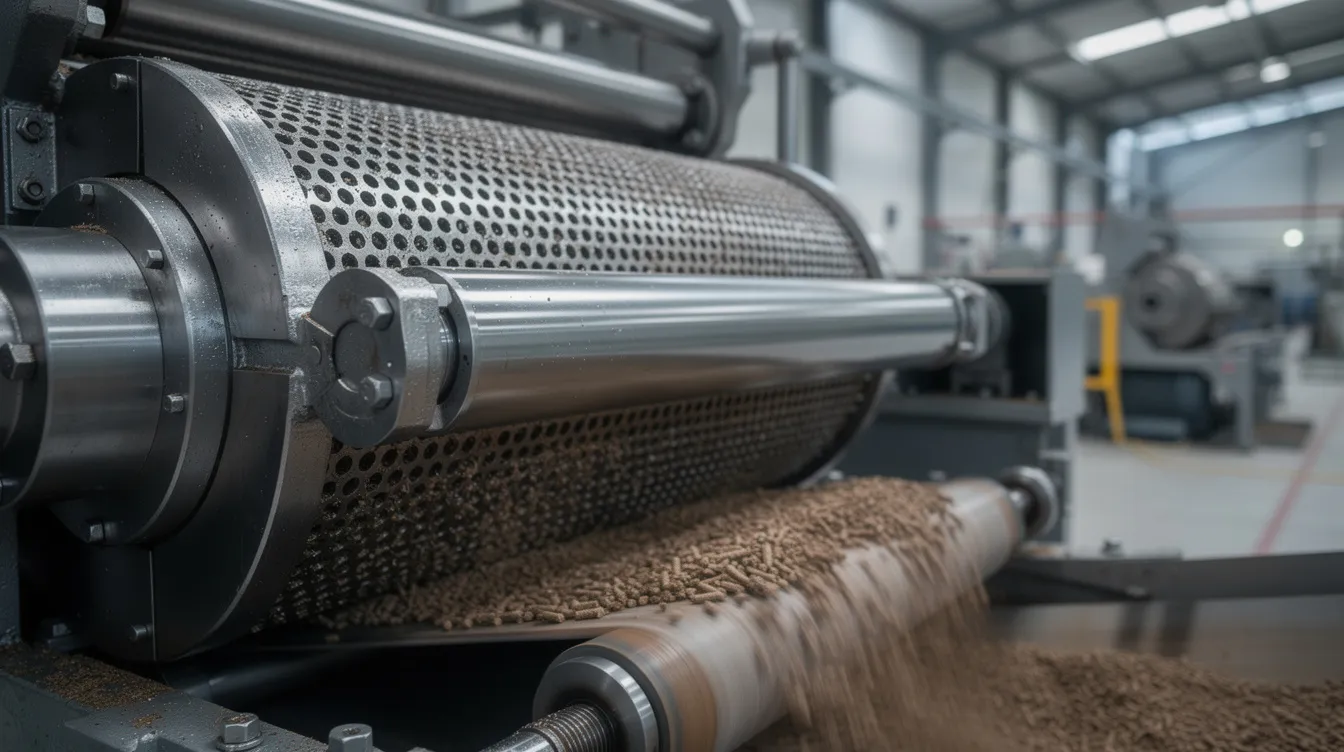
The machinery configuration and automation level largely determine both the capital cost of the feed manufacturing plant and its operating efficiency, labor costs and product quality. Animal feed manufacturing requires evaluating technological and quality assurance factors. Select appropriate machinery based on production technology and target output. Animal feed manufacturing plants require grinders, mixers, and pelletizers as essential equipment.
| Equipment Group | Function | Selection Considerations |
|---|---|---|
| Intake pits, receiving hoppers | Raw material unloading | Truck access, pit depth |
| Conveyors, bucket elevators | Material transfer | Capacity matching, maintenance access |
| Raw material silos, bins | Ingredient storage | Number of ingredients, segregation needs |
| Cleaning machines, magnetic separators | Contaminant removal | Feed safety, throughput |
| Hammer mills/grinders | Size reduction | TPH capacity, screen sizes, wear parts |
| Dosing and weighing systems | Formula accuracy | Manual vs automatic batching |
| Mixers (paddle or ribbon) | Blending | Mixing time, CV of mix, batch size |
| Liquid dosing systems | Adding molasses, oil, fat | Accuracy, cleaning between batches |
| Steam conditioners | Pre-pelleting treatment | Retention time, steam distribution |
| Pellet mills | Pellet formation | Die specifications, TPH rating |
| Pellet coolers | Temperature/moisture reduction | Counter-flow vs cross-flow |
| Crumblers | Pellet size reduction | Roller gap setting |
| Vibratory screens | Fines separation | Mesh sizes per product |
| Bagging scales, sewing machines | Packaging | Speed, accuracy, bag sizes |
| Dust collection, aspiration | Environmental control | Regulatory compliance |
| Boilers, steam distribution | Steam generation | Fuel type, capacity, registration |
| Electrical panels, automation | Process control | PLC-based vs manual |
| Lab equipment | Quality testing | Moisture, protein, fat, fibre, pellet durability |
Equipment costs depend on type, brand, and automation level. Feed grinders cost several thousand to tens of thousands of dollars. Pelletizers are essential for producing feed pellets from raw materials. A domestic hammer mill rated at 1 to 2 TPH costs approximately Rs 2 to 8 lakh; a full 10 to 15 TPH production line including grinding, mixing, pelleting, cooling and automation ranges from Rs 2 to 8 crore depending on specifications. Evaluate technological requirements carefully. Semi-automatic plants suit 5 TPH mills with lower upfront cost, while fully automatic systems with computerised batching suit 10 to 20 TPH integrated mills where quality consistency and labor costs justify the investment. Accurate machinery cost estimation requires current vendor quotations; the DPR should include reasonable installation, freight, taxes and contingency loadings.
Land, Factory Building, Storage and Plant Layout
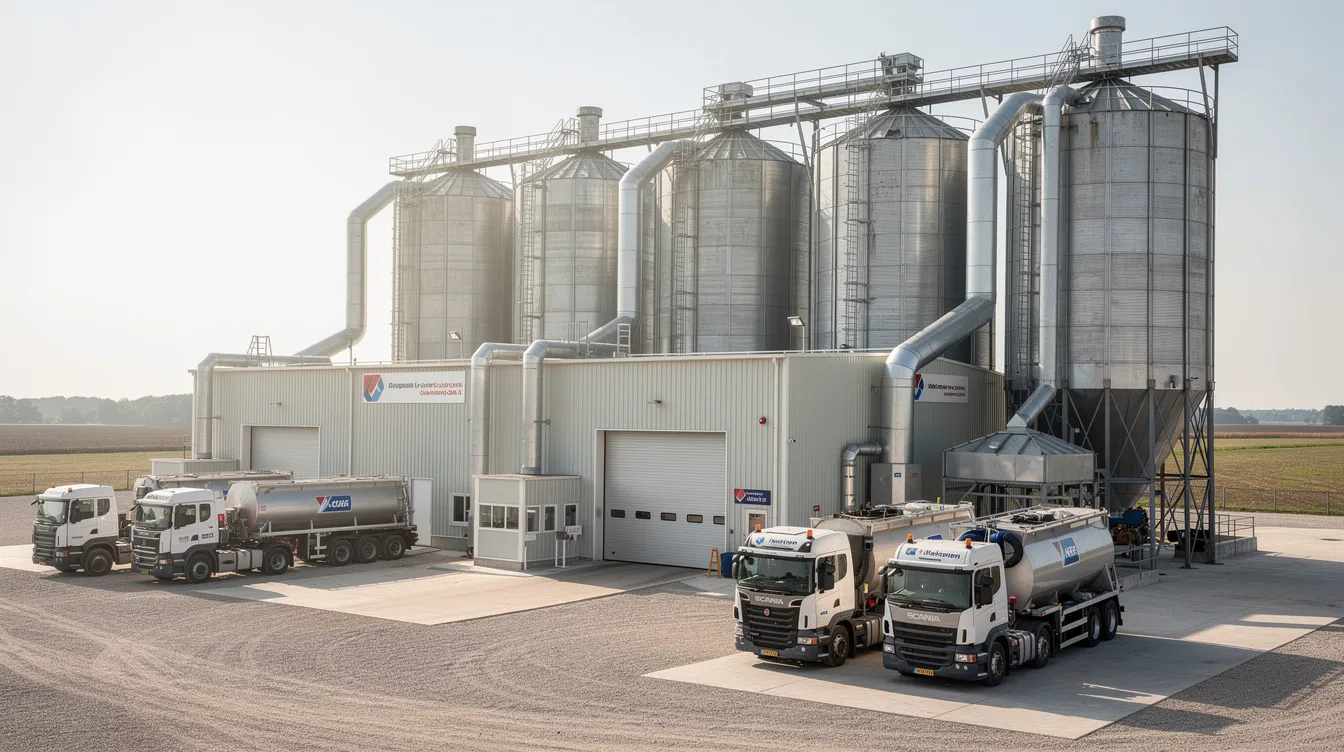
Plan the general layout of the manufacturing plant area before finalising site acquisition. Land and building costs vary by state, industrial zone and local regulations. Proper infrastructure includes storage silos for raw materials and finished goods. Utilities required for operation include a continuous water source and power supply.
Functional zones typically include: raw material truck unloading area, weighbridge, raw material silos or warehouses, grinding and mixing block, pelleting and cooling tower (often multi-storey), finished goods warehouse, quality control laboratory, boiler and utilities block, maintenance workshop, and administrative office. For a 10 TPH plant, many promoters need roughly 1.5 to 2.0 acres depending on storage and expansion plans, though local regulations and set-back norms must be considered. Layout should support segregation of certain feed materials (e.g. pig feed where culturally sensitive, medicated products) to reduce accidental mixing risks. Structural design must be done by qualified engineers.
Integrated Compound Animal Feed Mill Project Cost Structure
The compound animal feed mill project cost comprises fixed capital (land, building, plant and machinery, utilities, pre-operative expenses) and working capital. Prepare capital for investment and operating costs before committing to implementation. A complete animal feed manufacturing plant costs between $10,000 and $850,000, with costs depending heavily on capacity, automation and location. Setting up a poultry feed mill costs $12,000 to $500,000 depending on scale. Animal feed manufacturing plant costs range from $10,000 to $850,000. Animal feed production costs vary by geographical location.
| Cost Component | Illustrative Share (10 TPH Plant) |
|---|---|
| Land & Site Development | 5-10% |
| Civil Works and Buildings | 15-20% |
| Plant & Machinery (process equipment) | 35-45% |
| Material Handling & Storage (silos, conveyors) | 8-12% |
| Utilities (boiler, DG set, compressors) | 5-8% |
| Electrical & Automation | 4-6% |
| Laboratory & Quality Control | 1-2% |
| Pre-Operative & Preliminary Expenses | 3-5% |
| Contingency | 5-10% |
| Margin for Initial Working Capital | 10-15% |
A basic 5 TPH feed mill may require total project outlay in the lower single-digit crore range. A modern 20 TPH integrated plant can cross several tens of crore rupees. Per-MT fixed capital cost reduces with higher capacities if the market is strong. The DPR must clearly distinguish between fixed capital investment (excluding working capital) and total project cost (fixed capital plus margin for working capital). Lenders appraise the complete project cost and means of finance.
Operating Costs and Production Economics
Major operating cost heads include raw materials, packaging, power and fuel (including boiler fuel), labor costs and supervision, repairs and maintenance, quality control, factory overheads, selling and distribution, and administrative costs, plus interest and depreciation. Labor costs vary based on regional market conditions. Fixed costs such as depreciation and administrative overheads remain constant regardless of utilisation.
Animal feed manufacturing plants have gross profit margins of 15-25%. Industry data suggests EBITDA per tonne of Rs 1,100 to 2,300 for efficient operations. Poultry feeds generally use higher protein and energy (more expensive soybean meal and oil) than standard dairy cattle feed, resulting in higher per MT production cost but potentially better realisations. The distinction between contribution margin (selling price minus variable costs), gross margin per MT, EBITDA and net profit after tax must be shown year-by-year in each DPR based on the proposed product mix.
Revenue Model and Product-Wise Profitability Drivers
Revenue streams for a multi-species animal feed mill include sale of cattle feed, poultry feed (broiler, layer feed), small ruminant feed, pig feed (where relevant), mineral mixture or premix sales, and contract manufacturing income. Realisation per tonne for organised compound feed ranges approximately Rs 25,000 to 32,000 depending on species and formulation.
Cattle feed often has lower absolute margin per MT but large volume potential. Poultry feed linked to large integrators offers steady off-take but tighter prices. Niche products like calf starter, high-performance broiler starter or mineral premixes yield higher per kg margins but lower volumes. Sales channels include direct sales to farmer groups, institutional supply to integrators, distributor-led networks and bulk supply to cooperatives. Each channel has different implications for transportation costs, marketing spend and receivable days. Increasing turnover alone does not guarantee stronger cash flows or profits; the DPR must examine product mix optimisation, channel strategy and receivables management.
Financial Projections and Overall Financial Viability
A professional animal feed manufacturing plant financial feasibility analysis must be built on a 7 to 10 year financial model. Financial projections include ROI and net present value (NPV) assessments. Financial projections include break-even analysis and cash flow statements. The model covers yearly capacity utilisation by product, selling price assumptions for each feed type, raw material cost forecasts, detailed operating cost budget, profit and loss statement, cash flow statement, balance sheet, term-loan repayment and interest schedule.
Core financial indicators include project IRR, equity IRR, NPV at a chosen discount rate, payback period, break-even point in MT and percentage utilisation, and average and minimum DSCR over the loan tenure. Lenders in India typically expect DSCR above 1.5 to 2.0 for agro-processing projects, with debt-equity ratio commonly acceptable up to approximately 2.33:1. Sensitivity analysis should test the impact of lower capacity utilisation, higher raw material costs, reduced selling prices and higher interest rates on DSCR and IRR to assess the resilience of the business model.
From a project finance perspective, the emphasis must be on realistic, evidence-based projections and conservative planning, not on presenting inflated revenue figures to secure loan sanctions.
Working Capital Requirements and Cash Flow Management
Compound animal feed processing is typically working-capital intensive because promoters must hold raw material inventory of volatile commodities and extend credit to dealers or institutional buyers. Financial viability depends on accurate cost assessment and working capital analysis.
Major working capital components include raw material inventory (often 30 to 60 days for maize, soybean meal, bran), finished goods inventory (7 to 15 days depending on order cycle), trade receivables (30 to 60 days for dealers and cooperatives), and trade payables (credit received from suppliers). Banking instruments commonly used include cash credit limits against stock and receivables, and occasional bill discounting for institutional orders. Robust cash flow management, including pricing discipline, careful buying and credit control, is essential for maintaining timely term-loan servicing and avoiding liquidity stress.
Bank Loan, Means of Finance and DPR Requirements
Typical financing structure for a new integrated multi-species feed manufacturing project combines promoter equity (usually 25 to 40% of fixed capital cost) with bank term loan for fixed assets and separate working capital limits for inventory and receivables. Implementation timelines should outline phases of land acquisition, construction, and machinery installation to support draw-down scheduling.
Bank appraisal focuses on technical feasibility, sufficiency of proposed market, experience and net worth of promoters, quality of the Detailed Project Report and CMA Data, and adequacy of projected cash flows to service proposed term loans. Key documents normally required include KYC and financial statements, land documents, machinery quotations, civil cost estimates, government approvals status, and professionally prepared DPR and CMA Data. Project Report Bank, led by CA Manish Gugliya, prepares customised bankable DPRs and CMA Data for integrated animal feed projects aligned with practical lender expectations.
Sensitivity Analysis and Key Investment Risks
Risk assessment should address raw material price fluctuations and operational downtime as primary threats to project viability. Animal feed is a commodity-linked business where margin compression can occur rapidly.
| Risk Factor | Potential Impact | Mitigation |
|---|---|---|
| Maize/soy price increase 5-10% | EBITDA reduction, DSCR stress | Diversified sourcing, buffer inventory |
| Lower capacity utilisation | Fixed cost burden, cash flow shortfall | Conservative demand planning, phased investment |
| Selling price pressure | Margin erosion | Product differentiation, quality reputation |
| Higher power and fuel costs | Operating cost increase | Energy-efficient equipment, fuel contracts |
| Delayed receivables | Working capital strain | Credit limits, advance deposits |
| Pellet quality issues | Customer loss, reputational damage | In-house quality systems, trained operators |
| Regulatory changes | Compliance cost, production interruption | Proactive monitoring, professional advisory |
Each risk should be tested via sensitivity analysis in the financial model to see its impact on EBITDA, DSCR and IRR.
Quality Control, Approvals and Regulatory Compliance
Consistent and safe animal feed manufacturing requires adherence to quality and regulatory standards. Quality control procedures should include testing for moisture and contamination levels. Environmental compliance includes obtaining necessary clearances for pollution and waste management.
Regulatory requirements for an animal feed plant in India include local industrial licences, pollution control board consents, factory licence, boiler registration (if steam is used), fire safety NOC, labour law compliances, and legal metrology registration for standard weight packaging. Relevant BIS standards for compound feed for cattle and poultry should be consulted in current official publications. Basic in-house lab equipment for moisture, crude protein, crude fat, fibre, ash and physical pellet quality testing is necessary, along with periodic external accredited lab testing. Multi-species plants must implement documented SOPs for avoiding cross-contamination, proper labelling, traceability and segregation of restricted ingredients.
Is an Integrated Multi-Species Feed Mill Financially Viable in India?
An integrated multi-species feed mill can be financially attractive where regional demand spans cattle, poultry and other livestock, raw material supply is reliable, and promoters can manage technical complexity and working capital intensity. Shared fixed overheads across multiple product lines and production flexibility to switch between animal species based on relative margins are genuine advantages.
Possible downsides include more sophisticated production planning requirements, higher formulation and quality-control challenges, risk of operational complexity outpacing managerial capacity, and higher capital investment for multi-line machinery and storage. Promoters should validate demand, raw material access, competitor landscape and their own managerial bandwidth before selecting an integrated versus single-species model, ideally through a detailed feasibility study and DPR. Projects with realistic capacity planning, conservative margins, disciplined procurement and strong governance are more likely to sustain debt servicing and generate acceptable IRR.
How Project Report Bank and CA Manish Gugliya Can Assist
Project Report Bank is a Chartered Accountant-led project and financial advisory platform specialising in customised Detailed Project Reports, CMA Data, financial modelling and project finance advisory for manufacturing and agro-processing plants across India. A full study of project-specific variables is the foundation of every DPR prepared.
Core services for integrated multi-species compound feed mills include: preparation of customised bankable DPRs, detailed project cost estimation, 10-year financial projections and modelling, DSCR and ratio analysis, sensitivity analysis, CMA Data for working capital, and guidance on means of finance and loan structuring. Beyond documentation, advisory support includes critical review of capacity, product mix, pricing assumptions, raw material sourcing strategy, working capital cycle and risk factors from a lender’s perspective, while technical process design is validated with qualified feed technologists or engineers.
Serious promoters and established businesses planning an integrated animal feed project are invited to share proposed plant location, planned capacity, targeted species and products, existing machinery quotations and approximate investment budget through ProjectReportBank.com or WhatsApp for a tailored scope and fee proposal.
Frequently Asked Questions (FAQs)
The following questions address practical concerns often raised by promoters planning an integrated multi-species animal feed mill in India.
What minimum capacity is practical for an integrated multi-species feed mill in India?
While 3 to 5 TPH plants exist, the complexity and additional investment in flexibility usually make integrated multi-species configurations more practical from around 5 TPH upwards. A 10 TPH mill represents a common balance between investment efficiency and sufficient scale for regional players to serve both dairy and poultry customers. Below 5 TPH, the overhead of managing multiple formulations, separate storage and changeover protocols may not justify the integration premium over a simpler single-species plant.
Can I start with cattle feed only and later add poultry and other feeds in the same plant?
Many promoters initially commission the plant as a focused cattle feed manufacturing plant and later activate additional production lines and silos for poultry and other feeds. This phased approach reduces initial capital requirements and allows market validation. However, such expansion must be anticipated in the original layout and structural design. Retrofitting additional silos, conditioners or pellet dies into a building not designed for expansion can involve costly rework, structural modifications and extended downtime.
How long does it typically take to implement an integrated animal feed mill from concept to commissioning?
Under normal conditions: 2 to 3 months for detailed planning, DPR preparation and bank finance processes (which can vary widely), 3 to 5 months for civil construction depending on site conditions and monsoon, and 2 to 3 months for machinery delivery, installation and trial runs. Overall, 9 to 12 months is a realistic planning horizon for many projects. Delays in land acquisition, government approvals or machinery supply can extend this timeline.
Is it necessary to install raw material silos, or can I operate with only warehouses?
Smaller and cost-conscious plants can function using covered godowns and mechanised material handling. Silos offer advantages in bulk handling, quality preservation (reduced moisture ingress and pest exposure), labour saving and automated batching. The DPR should compare both options financially, particularly for 10 to 20 TPH plants where daily material throughput volumes make manual handling increasingly impractical and costly.
Why should I invest in a professional DPR instead of using a generic project report template?
Integrated multi-species feed mills involve substantial capital investment, high working capital needs and exposure to volatile commodity prices. Banks and investors expect project-specific assumptions, sensitivity analysis and realistic financial projections. Generic templates do not capture local market conditions, regional raw material pricing, site-specific building costs or financing realities for the promoter’s particular business plan. A customised DPR prepared by an experienced professional like CA Manish Gugliya improves decision quality and bankability by stress-testing the project economics against real-world risks before capital is committed.
About the Author
CA Manish Gugliya, FCA, DISA (ICAI), is a practising Chartered Accountant with over 20 years of experience in Detailed Project Reports, project feasibility studies, CMA Data preparation, financial modelling, bank finance advisory and industrial project consulting across India. Through ProjectReportBank.com, he and his team support entrepreneurs, MSMEs and established businesses in planning and financing manufacturing, agro-processing and integrated animal feed projects with customised, analytically sound DPRs and financial documentation. This article reflects his professional perspective on evaluating the financial viability and bankability of integrated multi-species compound animal feed mills. Readers are encouraged to seek project-specific professional advice before committing capital.