Key Takeaways
- This is a Chartered Accountant-led guide to preparing a poultry feed manufacturing plant project report for large-scale commercial units above 5 TPH in India, covering technical configuration, capital investment, working capital, profitability and bankable financial feasibility.
- Broiler feed production and layer feed production drive year-round poultry feed demand; raw materials like maize and soybean meal form 70–80% of the cost of chicken feed and other animal feed, making procurement strategy the single most important profitability lever.
- Total capital investment for a modern large scale poultry feed manufacturing plant (5–20 TPH) in India typically ranges from several crore to ₹50 crore or more, with separate provision for machinery, buildings, land and initial working capital.
- A bankable poultry feed manufacturing plant project report must include 10-year financial projections, DSCR, IRR, break-even, sensitivity analysis and transparent assumptions to satisfy Indian banks and investors.
- Project Report Bank, led by CA Manish Gugliya (FCA, DISA), prepares customised, bank-ready DPRs and financial models for poultry feed manufacturing plants – not generic templates. Serious promoters are invited to seek project-specific advisory support.
Introduction – Poultry Feed Manufacturing Industry in India
India’s poultry sector is among the fastest-growing segments of animal husbandry. Rising consumption of poultry meat and eggs, expanding commercial poultry farming and the shift toward integrated broiler operations have created sustained demand for compound poultry feed. The global poultry feed market was valued at USD 225.19 billion in 2025 and is expected to reach USD 302.66 billion by 2034, and India represents one of the most rapidly expanding markets within this space. The poultry feed production industry in India is the fastest growing within the broader animal feed sector.
Poultry feed production costs typically account for 65–75% of total poultry production expenses, which means that feed quality, consistency and cost directly determine farm-level profitability. This has accelerated the shift from traditional feed mixing on farms to organised feed manufacturing through automated poultry feed mill plant operations. The poultry feed manufacturing industry also faces a demand-supply gap for balanced feed, particularly in regions where pelleted feed adoption is still growing.
For any entrepreneur or investor considering a poultry feed manufacturing business at industrial scale, a professionally prepared poultry feed manufacturing plant project report is the essential starting point. It evaluates technical feasibility, project cost, working capital, profitability, DSCR, IRR and project risk before capital is committed.
What Is a Large-Scale Poultry Feed Manufacturing Plant?
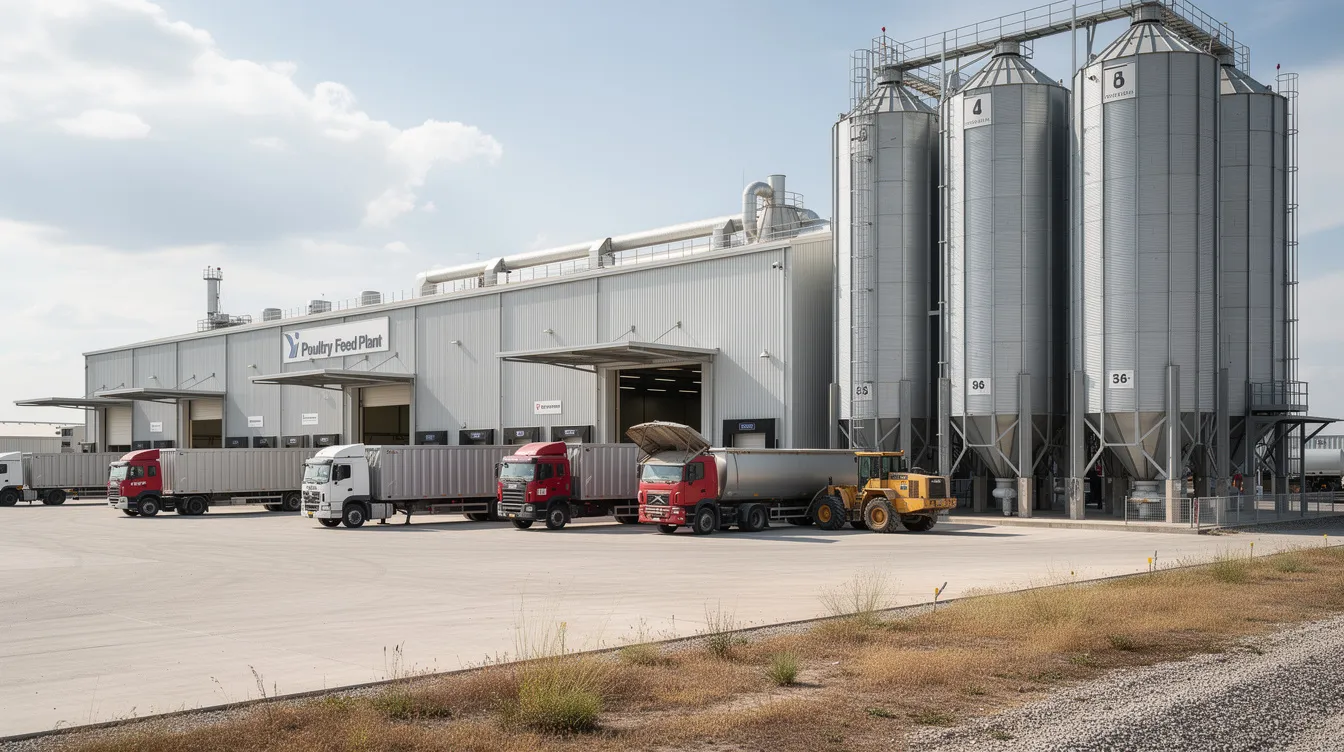
A large scale poultry feed manufacturing plant in India typically operates at 5–30 tonnes per hour (TPH) or above, running one or two shifts to serve regional or multi-state markets. These plants produce multiple feed forms – mash feed, feed pellet products and crumble feed – across broiler starter, grower, finisher, layer and breeder formulations. The finished product portfolio may also include duck or other livestock feed using the same core process lines.
Operating models include captive consumption by integrated poultry companies, contract manufacturing for third-party brands, bulk supply to large farms and branded bagged chicken feed distribution through dealer networks. Key factors distinguishing large industrial plants from smaller units include higher automation level (PLC-based recipe management, SCADA monitoring, automated bagging), more stringent quality systems, sophisticated logistics planning and substantially higher capital investment.
Poultry Feed Manufacturing Plant Capacity Planning
Plant capacity must be understood in terms of nameplate capacity (TPH) versus commercially achievable annual production. Annual production capacity for large poultry feed plants typically ranges from 100,000 to 200,000 MT depending on configuration. Factors reducing actual output from theoretical maximum include planned maintenance, power outages, raw material stockouts, recipe changeover time and seasonal demand fluctuations.
| Capacity (TPH) | Operating Hours/Day | Working Days/Year | Theoretical Annual Output (Tonnes) | Assumed Utilisation (Yr 3) | Saleable Output (Tonnes) |
|---|---|---|---|---|---|
| 5 | 16 | 300 | 24,000 | 75% | 18,000 |
| 10 | 16 | 300 | 48,000 | 80% | 38,400 |
| 20 | 16 | 300 | 96,000 | 80% | 76,800 |
| 30 | 16 | 300 | 1,44,000 | 85% | 1,22,400 |
Mixed product portfolios (mash plus pellets; broiler and layer feeds) influence achievable output due to different retention times in conditioning, pelleting and cooling stages. Capacity decisions feed directly into the investment cost, utility sizing, staffing plan and the financial feasibility model within the poultry feed manufacturing plant project report.
Raw Materials Required for Poultry Feed Manufacturing
Raw materials account for 70–80% of total feed production cost, making procurement strategy the primary driver of profitability. Operating costs are primarily driven by raw material consumption, especially maize, which forms 45–65% of most broiler feed formulations.
Major energy sources include maize, broken rice, wheat and grains. Primary protein sources are soybean meal, groundnut cake, sunflower meal, cottonseed meal and DDGS. Other ingredients include de-oiled rice bran, vegetable oils, limestone, dicalcium phosphate, synthetic amino acids, vitamin-mineral premixes, toxin binders and enzymes. Poultry feed must adhere to nutritional quality and formulation standards for health and growth, providing balanced nutrition across life stages.
Sourcing logistics must account for seasonal availability and price fluctuations of key raw materials. Formulations differ between broiler and layer feed, and a qualified poultry nutritionist should guide formulation rather than relying on any single published recipe as universal.
Raw material storage requires dedicated silos for maize, covered godowns for soybean meal, and separate storage for premixes. Moisture control, mycotoxin monitoring and FIFO inventory management are non-negotiable quality requirements.
Poultry Feed Manufacturing Process – Step-by-Step
The poultry feed manufacturing process includes grinding, mixing and pelleting as its core stages, with several supporting operations ensuring quality and consistency. The standard sequence is:
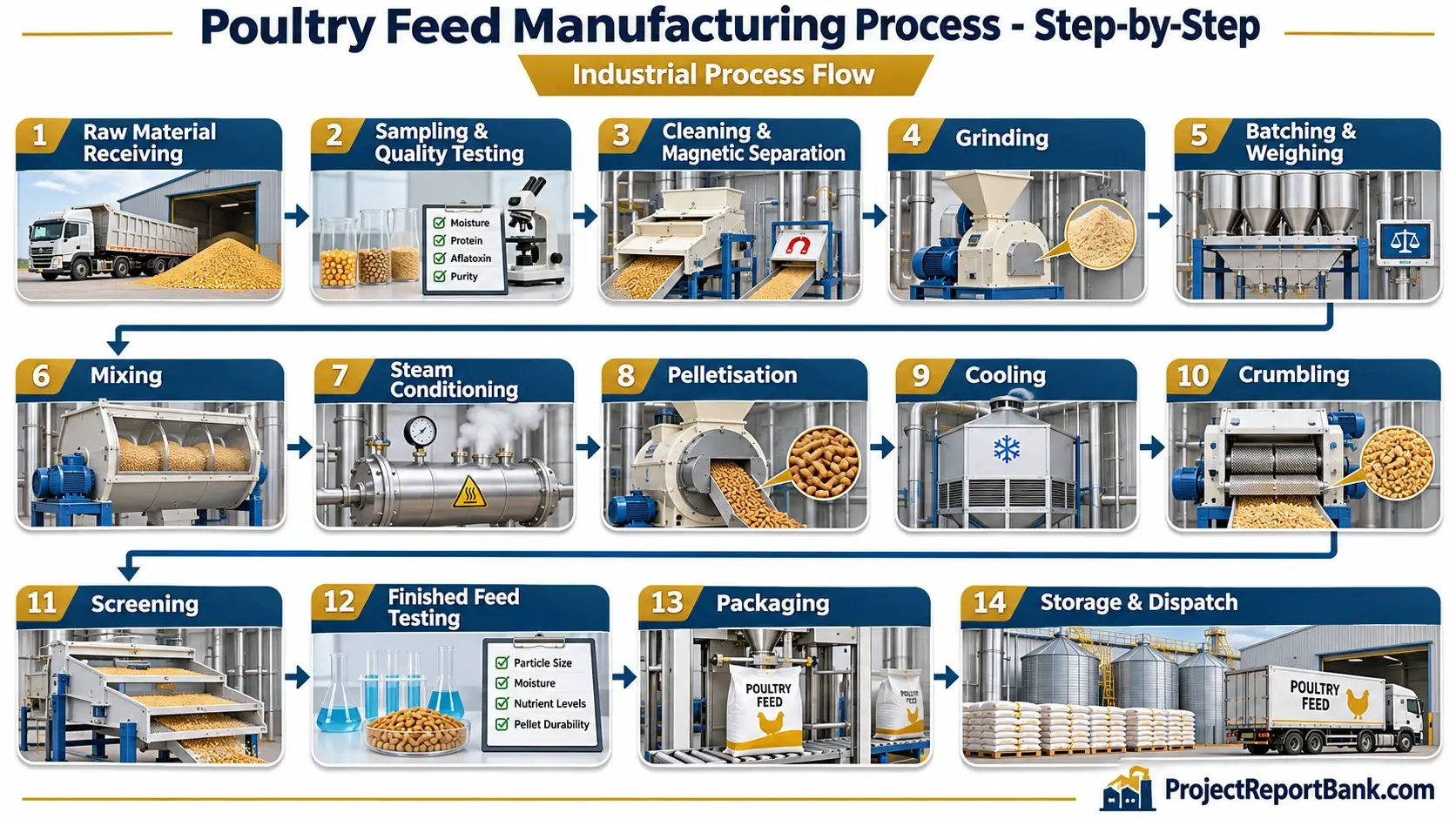
Raw Material Receiving → Sampling & Quality Testing → Cleaning & Magnetic Separation → Grinding → Batching & Weighing → Mixing → Steam Conditioning → Pelletisation → Cooling → Crumbling → Screening → Finished Feed Testing → Packaging → Storage & Dispatch
Mash feed production terminates after mixing and screening. Pellet feed continues through conditioning, pelleting, cooling and crumbling. Cooling systems reduce pellet temperature from 70–90°C after production to near ambient levels. Quality assurance systems are crucial for managing feed safety and compliance with industry standards, including moisture testing, pellet durability index checks, microbiological analysis and comparison of laboratory results with formulation targets. Mixing time and uniformity directly affect the consistency of every batch.
Poultry Feed Manufacturing Plant Machinery and Equipment
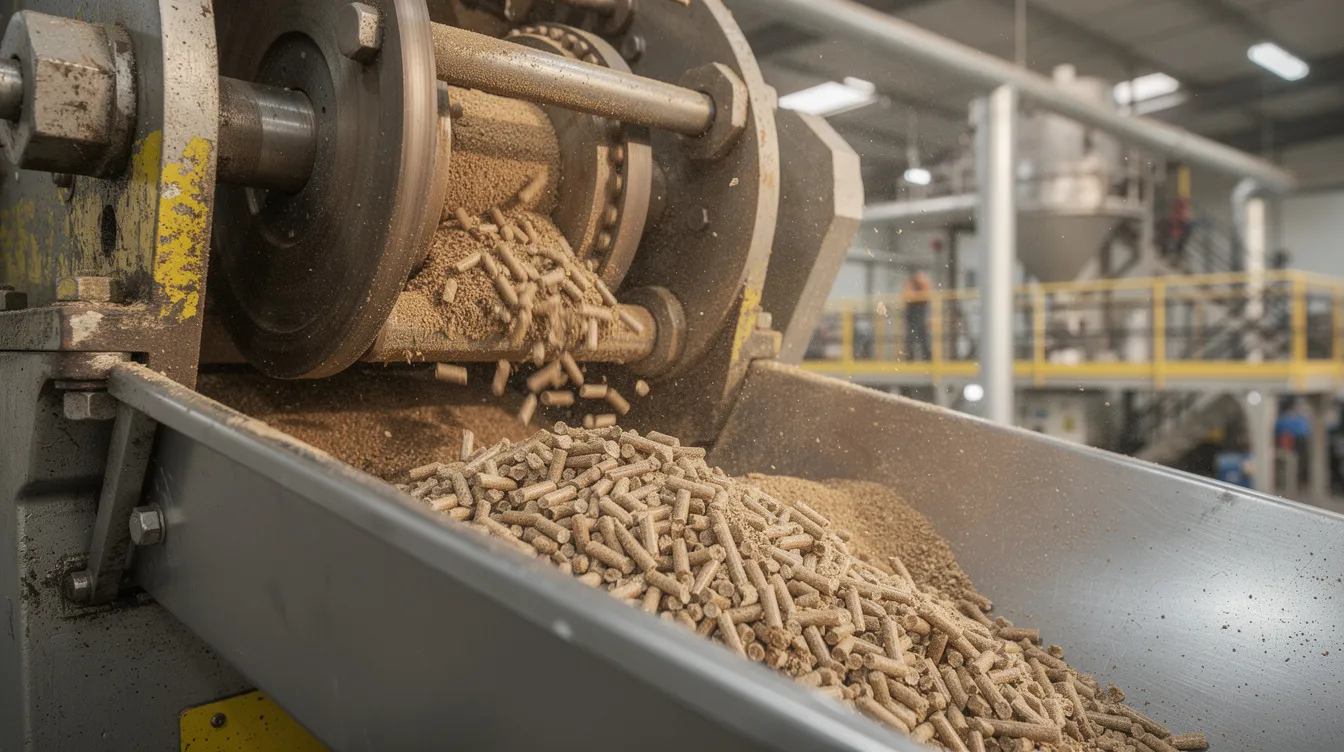
Selection of essential equipment directly affects throughput, energy efficiency, feed quality and the total machinery and investment cost. A poultry feed mill requires hammer mills for grinding raw materials to target particle size. Mixers ensure uniform blending of raw materials in feed production, typically ribbon or paddle type matched to batch volume. Pellet mills can produce up to 25 TPH of feed pellets depending on configuration and die specification. Automated bagging machines pack 10–50 kg bags at 6–12 bags per minute.
| Equipment Category | Function | Notes |
|---|---|---|
| Hammer Mills | Grinding to uniform size | Screen size varies by feed type |
| Batch Weighing System | Accurate dosing | PLC-controlled, load cells |
| Mixer (Ribbon/Paddle) | Blending | CV < 5% target |
| Steam Conditioner | Moisture & heat treatment | For pelleted feed lines |
| Pellet Mill (Ring Die) | Pellet formation | Multiple dies for different diameters |
| Counter-flow Cooler | Temperature reduction | Reduces finished pellets to ambient |
| Crumbler | Size reduction for starter | Adjustable roller gap |
| Packaging Machine | Bagging | Automatic stitching or heat-seal |
| Boiler | Steam generation | Coal, biomass or gas-fired |
| Dust Collection | Environmental control | Bag filters, cyclones |
Equipment costs for a 10 TPH pelleted plant are approximately USD 1.2–2.5 million for equipment alone; civil works, silos and electrical infrastructure typically add 50–100% on top. Equipment procurement must involve verified quotations, not generic internet estimates. A fully automatic plant reduces manpower requirements but raises capital investment compared to semi-automatic alternatives.
Land, Building, Infrastructure and Utility Requirements
Poultry feed plants typically require 3,500–6,000 m² of land depending on capacity, storage configuration and expansion provisions. Location selection should consider proximity to raw materials and major poultry farming hubs, year-round road connectivity for heavy vehicles, and industrial zoning status. A well-structured plant layout optimizes production flow and storage for raw materials and finished goods, with unidirectional material movement from receiving to dispatch.
Key structures include the production tower or horizontal layout, silo foundations, boiler house, electrical substation, finished goods warehouse, quality control laboratory, weighbridge and administrative block. Utility requirements cover contracted electrical power load with DG backup, steam generation for conditioners, compressed air, industrial water and dust control systems.
Poultry Feed Plant Setup Cost in India
Setting up a poultry feed plant costs between $12,000 and $500,000 for smaller units, while capital investment for a poultry feed mill at commercial scale ranges from $350,000 to $5 million. A 1 ton/hour feed production line costs about $14,000 to $15,000, but large-scale plants at 5–20 TPH involve substantially higher total project cost. Pre-operational expenses typically range from $20,000 to $50,000 covering trial runs, interest during construction and establishment costs.
| Cost Head | 5 TPH (₹ Crore) | 10 TPH (₹ Crore) | 20 TPH (₹ Crore) |
|---|---|---|---|
| Land & Site Development | 1.0–2.5 | 1.5–3.5 | 2.5–5.0 |
| Buildings & Civil Works | 2.0–4.0 | 3.5–6.0 | 6.0–10.0 |
| Plant & Machinery | 4.0–8.0 | 10.0–20.0 | 18.0–30.0 |
| Electrical & Utilities | 0.5–1.5 | 1.0–2.5 | 2.0–4.0 |
| Pre-operative & Contingency | 0.5–1.0 | 1.0–2.0 | 1.5–3.0 |
| Working Capital Margin | 1.0–2.0 | 2.0–4.0 | 3.5–6.0 |
| Indicative Total | 9–19 | 19–38 | 33–58 |
All figures are illustrative planning estimates. Actual costs depend on location, specifications, automation level and prevailing equipment price.
The investment cost must be finalised using verified machinery quotations and civil construction estimates. Project Report Bank develops plant-specific capital cost assessments as part of customised DPRs.
Working Capital Requirements for Poultry Feed Manufacturing
Working capital finances the gap between inventory purchases, production and collection of receivables. For a feed manufacturing plant, major inventory components include bulk maize (15–30 days), soybean meal, premixes and packaging materials. Finished goods inventory of broiler and layer feed typically covers 7–15 days. Trade receivables from distributors and farms commonly extend to 15–30 days, while supplier payables may run 30–45 days.
For a 10 TPH plant producing approximately 38,000 tonnes annually, working capital requirements can range from ₹2–4 crore depending on stock-holding policies and credit terms. Banking arrangements typically involve cash credit limits backed by stock and book debts, with promoter margin money requirements. Similar working capital assessment frameworks apply across agro-processing projects.
Cost of Production and Poultry Feed Manufacturing Profitability
Operating costs are primarily driven by raw material consumption, especially maize, followed by soybean meal, energy, labour and overheads. Recent market data suggests raw material cost per tonne for broiler feed ranges from approximately ₹27,900 to ₹34,700. With processing costs of ₹900–1,200 per tonne and packaging, the total manufacturing cost often falls in the ₹30,000–39,000 per tonne range.
Selling prices for broiler feed have recently reached approximately ₹46/kg, while layer feed trades at ₹30–32/kg. Poultry feed plant gross profit margins range from 15–25% under favourable conditions, though net margins can compress to single digits during raw material price spikes. Medium-scale plants achieve net monthly profits of USD 50,000–90,000 at stable utilisation levels. Unit cost reduces as production capacity utilisation improves, because fixed costs spread over higher output.
Poultry Feed Plant Financial Feasibility – 10-Year Projections
A serious poultry feed manufacturing plant project must be evaluated over a 10-year horizon with transparent assumptions. Financial projections include ROI and net present value assessments alongside DSCR, IRR, break-even analysis, cash flow statements and projected balance sheets.
Key assumption blocks include installed capacity, ramp-up schedule (Year 1: 50–60%, Year 2: 70%, Year 3+: 80–85%), average selling prices, raw material consumption coefficients, power costs, manpower plans and escalation rates. Typical planning assumptions include interest rates of 10–14% per annum and debt-equity ratios of 1.5:1 to 2:1.
| Year | Utilisation | Production (T) | Revenue (₹ Cr) | EBITDA (₹ Cr) | PAT (₹ Cr) | DSCR |
|---|---|---|---|---|---|---|
| 1 | 55% | 26,400 | ~99 | ~8 | ~2 | ~1.1 |
| 3 | 80% | 38,400 | ~153 | ~15 | ~6 | ~1.5 |
| 5 | 85% | 40,800 | ~170 | ~18 | ~9 | ~1.8 |
| 10 | 85% | 40,800 | ~195 | ~22 | ~12 | ~2.5+ |
Illustrative framework for a 10 TPH plant. Actual projections require customised assumptions. Lenders typically expect average DSCR above 1.25–1.30. Similar DSCR and loan repayment analysis methodologies apply across manufacturing DPRs.
Promoters should engage professionals for plant-specific financial models rather than relying on back-of-envelope calculations.
Bank Loan and Project Finance for Poultry Feed Manufacturing Plants
Typical financing involves a debt-equity ratio of 1.5:1 to 2:1, with separate working capital limits. Banks expect a detailed poultry feed manufacturing plant project report, realistic market study, verified machinery quotations, vetted civil estimates, projected DSCR above threshold levels, adequate promoter contribution and acceptable collateral security.
A poultry feed manufacturing project report helps secure loans and attract investors by presenting integrated technical, commercial and financial analysis. CA-prepared CMA data, cash flow projections and ratio analysis align the proposal with banking norms. Detailed Project Reports serve as essential documents for project financing negotiations. Supporting documents for a project report may include financial projections, machinery quotations and regulatory approvals.
Government Approvals, Compliance and Applicable Regulations
Regulatory requirements vary by state. Environmental compliance requires licenses from pollution control boards and safety clearances for operation. Poultry feed mills need environmental impact assessment approval in most cases. A feed production license is mandatory for poultry feed mills, and two rounds of facility inspection are typically required for compliance. Specific additive-handling permits are needed if additives are used. Local regulations may vary based on the plant’s location.
Other approvals include factory registration under the Factories Act, boiler registration, fire safety NOC, electrical safety clearances and GST registration. Entrepreneurs should not automatically assume FSSAI requirements apply; instead, the exact regulatory framework for animal feed in their state must be verified.
Market Demand, Sales Strategy and Distribution
Market analysis identifies potential customers for products like broiler and layer feed. Broiler feed demand is higher than layer feed in India, and packaged poultry feed is growing faster than traditional feed. Poultry feed demand remains consistent throughout the year, supporting stable production planning.
Major customer segments include independent poultry farms, integrated broiler companies, contract farmers, wholesalers and regional distributors. Market mapping involves identifying bird populations within a 200–300 km radius, assessing existing suppliers, and identifying quality or service gaps. Realistic market demand assessment is a core input to capacity selection and financial projections in the poultry feed manufacturing plant project report. Effective distribution requires consistent feed quality, reliable supply and competitive pricing that balances market share with sustainable margins.
Major Risks in Poultry Feed Manufacturing Projects
Despite strong structural demand, individual projects carry significant risks.
| Risk Category | Key Concern | Mitigation |
|---|---|---|
| Raw Material Price | Maize and soybean meal volatility | Forward contracts, buffer stocks, supplier diversification |
| Operational | Under-utilisation, breakdowns | Conservative projections, preventive maintenance |
| Market | Competition, credit defaults | Diversified customer base, disciplined credit control |
| Financial | Higher interest rates, cost overruns | Adequate contingency, conservative debt structure |
| Biosecurity | Disease outbreaks reducing demand | Geographic diversification, quality systems |
| Quality | Mycotoxin contamination | Lab testing, vendor approval protocols |
A structured risk and sensitivity framework strengthens bankability and prepares promoters for real-world volatility.
Sensitivity Analysis – What Can Make the Project Financially Unviable?
Lenders expect formal sensitivity analysis showing how cash flows perform under adverse scenarios.
| Scenario | Impact on DSCR | Impact on IRR |
|---|---|---|
| Base Case | Acceptable (>1.3) | 17–20% |
| +5% Raw Material Cost | Moderate decline | Reduced by 2–3% |
| -10% Selling Price | Significant decline | Reduced by 4–6% |
| Utilisation -10 percentage points | Notable decline | Reduced by 3–5% |
| Combined adverse (higher cost + lower price) | May breach threshold | May approach single digits |
Combined adverse movements can push DSCR below acceptable levels, requiring promoters to inject additional equity or slow capacity ramp-up.
Is a Large-Scale Poultry Feed Manufacturing Plant a Good Investment in India?
The poultry feed sector shows strong structural growth, with compound feed requirements expected to expand significantly. However, the difference between an attractive industry and a financially viable individual project depends on local market conditions, raw material access, competitive positioning, logistics advantages, adequate capital investment and working capital, and the ability to maintain consistent quality.
For investments typically ranging from ₹5 crore to ₹50 crore or more, a rigorous project-specific DPR and feasibility analysis is indispensable before final commitment.
Why a Professional Poultry Feed Manufacturing Plant DPR Is Important
A professionally prepared poultry feed manufacturing plant project report integrates market assessment, process design, essential equipment selection, capital investment planning, working capital assessment and bank-oriented financial modelling. It enables promoters to objectively test capacity scenarios, evaluate mash versus pellet configurations, choose appropriate automation levels and estimate payback and IRR before placing machinery orders.
Bankability requires that assumptions, DSCR calculations, break-even analysis and risk-mitigation measures be presented in formats familiar to Indian banks and financial institutions. Generic templates cannot achieve this.
Professional DPR and Financial Feasibility Services by CA Manish Gugliya
Project Report Bank is a Chartered Accountant-led project finance and DPR advisory platform with over 20 years of professional experience under CA Manish Gugliya (FCA, DISA). Services relevant to poultry feed manufacturing include customised DPRs, bank finance proposals, CMA data preparation, financial projections and financial modelling, project cost assessment, means of finance planning, working capital assessment, DSCR and IRR analysis, and sensitivity analysis tailored to specific feed plants.
Serious entrepreneurs and manufacturers interested in planning a poultry feed manufacturing plant or expansion in India are invited to contact Project Report Bank via www.projectreportbank.com or WhatsApp for project-specific DPR and financial feasibility support.
Frequently Asked Questions
What capacity is suitable for a first large-scale poultry feed plant in India?
For first-time industrial promoters, capacities in the 5–10 TPH range offer meaningful economies of scale while managing investment risk. Very large plants (20–30 TPH) are typically more suitable for established integrators with assured captive demand and strong distribution. Production goals should be matched to verified local market demand rather than aspirational volumes.
Can one plant handle both broiler feed production and layer feed production?
Modern feed manufacturing plants are designed to handle multiple formulations using the same core process line with automatic batching ensuring recipe-wise production. Proper scheduling, changeover planning and strict flushing procedures are necessary to avoid cross-contamination between different feed types and maintain formulation accuracy.
How long does it take to implement a large poultry feed manufacturing plant project?
Setting up a poultry feed plant can take 12 to 18 months from final investment decision to commercial production, depending on land acquisition, regulatory approvals, civil construction pace, machinery delivery and commissioning. A contingency period should be incorporated into the project schedule to accommodate typical delays.
How do raw material prices affect poultry feed manufacturing profits?
Since raw materials represent 70–80% of production cost, even a 5–10% increase in maize or soybean meal prices can significantly erode margins. Financial models must capture this sensitivity, and procurement strategies such as forward contracts and buffer stocks are essential risk-mitigation measures.
Is prior poultry farming experience necessary to invest in a feed manufacturing plant?
While domain experience is helpful, it is not mandatory. Promoters without direct industry experience should ensure access to qualified nutritionists, experienced plant managers and capable marketing teams. They should rely more heavily on professional DPR preparation and technical consulting to reduce execution risk.