Key Takeaways
- Broken rice and cereal milling by-products such as rice bran, wheat bran and maize screenings can be converted into consistent, specification-based animal feed ingredients through organised industrial processing, offering significantly better value than simple commodity trading.
- A medium-to-large-scale feed ingredient processing plant (50–100 TPD) in India typically requires a total project cost ranging from approximately ₹5–15 crore depending on capacity, level of automation, land cost and whether the plant is greenfield or attached to an existing mill, with machinery alone accounting for 40–60% of core capital expenditure.
- Under realistic assumptions-conservative capacity utilisation ramp-up, stable raw material spreads and confirmed industrial buyer arrangements-many such plants target a payback period in the range of 4–6 years, though this can vary materially based on location and operational efficiency.
- Raw material procurement strategy, working capital planning and adherence to processing quality standards are more decisive for long-term profitability than marginal differences in machinery price or plant layout.
- All financial illustrations presented in this article are indicative. Serious promoters should commission a customised feasibility study and detailed project report before finalising project cost, means of finance and debt structure.
Introduction: Broken Rice Feed Ingredient Processing as an Industrial Investment
A broken rice feed ingredient processing plant project report is among the most requested documents in India’s agro-industrial project advisory space today-and for good reason. India’s enormous rice milling base generates millions of tonnes of broken rice annually, a valuable byproduct of rice mills that serves as a high-energy, easily digestible carbohydrate source for livestock and poultry feed formulations. Combined with other cereal byproducts-rice bran, wheat bran, maize bran and assorted milling fractions-this raw material base represents a substantial industrial opportunity for organised feed ingredient manufacturing.
The distinction matters. Buying broken rice or bran from a mandi and reselling it to a local feed compounder is a trading operation. Setting up a dedicated processing plant with cleaning, grading, grinding, quality control and standardised bulk dispatch is an industrial investment that operates more like an organised food processing facility. The latter can command more stable realisations per tonne, win longer-term supply contracts with large feed mills and create a defensible competitive position.
India’s animal feed industry-spanning poultry, swine and aquaculture-continues to grow. Organised compound feed manufacturers increasingly demand consistent, tested and traceable feed ingredients rather than variable-quality commodity lots. This shift creates space for dedicated feed ingredient processors who can bridge the gap between scattered milling units and large-scale feed manufacturing plants.
From the professional perspective of CA Manish Gugliya, FCA, DISA (ICAI), with more than 20 years of experience in project finance, DPR preparation and investment appraisal at Project Report Bank, the first step for any serious promoter considering this project is a structured, bankable detailed project report. Without a properly prepared DPR covering technical configuration, project cost, financial projections, working capital assessment and risk analysis, promoters risk committing capital based on incomplete assumptions.
Understanding Broken Rice and Cereal By-Product Feed Ingredients
Broken rice consists of rice kernels that fracture during the milling, hulling or polishing process in a rice mill. While food-grade broken rice has its own market-used in breakfast cereals, rice flour for bakery applications and even industrial starch-feed-grade broken rice serves as an energy-dense ingredient in compound animal feed formulations. The key difference lies in quality specifications: feed-grade material may contain higher proportions of small fragments, slightly elevated moisture and cosmetic defects that make it unsuitable for food products but perfectly acceptable for nutritional use in feed.
Beyond broken rice, India’s grain processing ecosystem generates substantial volumes of other cereal milling by-products. These include rice bran and rice polish (arising from the polishing stage in a rice mill), de-oiled rice bran or DORB (the residue after oil extraction from full-fat rice bran), wheat bran from flour mills, maize bran and screenings from maize processing units, and various other cereal fractions. Each material has distinct nutritional characteristics and processing requirements.
| Material | Source | Processing Requirement | Potential Feed Application |
|---|---|---|---|
| Broken rice (100%) | Rice mills-from milling of common and parboiled rice | Cleaning, destoning, moisture control (≤14%), grading by fragment size, optional grinding | Energy ingredient for cattle, poultry, pig and aqua feed |
| Rice bran / rice polish (full-fat) | Rice milling and polishing operations | Stabilisation to reduce lipase activity, drying to ≤12%, foreign matter removal | Energy and fat source in poultry feed, dairy rations |
| De-oiled rice bran (DORB) | Solvent extraction or mechanical pressing of rice bran | Ensure residual fat <2%, moisture ≤11%, particle uniformity, low free fatty acids | Fibre and protein supplement in compounded cattle and poultry feeds |
| Wheat bran | Flour milling operations | Screening, grading, moisture control, particle size adjustment | Fibre source for ruminant feeds, layer rations |
| Maize bran / screenings | Maize processing, starch and corn starch units | Screening, drying, cleaning, grinding, aflatoxin testing | Energy and starch source in blended compound feeds |
| Other cereal fractions (sorghum, millet off-grades) | Grain processing clusters | Product-specific cleaning, sizing and quality testing | Formulation-dependent use based on local availability |
Specifications for feed-grade broken rice must meet nutritional parameters including moisture (typically ≤13–14%), foreign matter (<0.5%), and aflatoxin limits (often <20 ppb for institutional buyers). Quality assurance protocols should include testing for moisture and contaminants at every incoming lot. Rice bran, particularly full-fat bran, is prone to rancidity due to lipase activity-limiting its shelf life to 3–6 months under good storage conditions, compared to 9 months or more for properly stored DORB. In comparable rice milling contexts, husk and bran sales alone can generate ₹40–60 lakh annually for a mid-sized rice mill, underscoring the economic significance of by-product management.
It is important to distinguish genuine milling by-products from contaminated, mouldy or rejected materials that are unsuitable even for animal feed. Quality control is crucial for products entering the animal feed supply chain; large feed mills routinely reject lots failing mycotoxin or moisture specifications.
Indian Market Potential and Industrial Demand
India’s rice milling sector is among the largest in the world, spread across major paddy procurement and processing states such as Andhra Pradesh, Telangana, Chhattisgarh, Punjab, Uttar Pradesh and West Bengal. Broken rice availability is structurally linked to this milling ecosystem-a complete 4 TPH rice milling line typically yields 67–70% head-rice recovery, with the remaining output comprising broken rice, bran and husk in varying proportions. This means that every harvest season generates substantial volumes of by-products available for organised feed ingredient processing.
The animal feed industry, including poultry, swine and aquaculture segments, is among the fastest-growing consumers of cereal-based energy ingredients. Feed inflation has deepened strain on poultry and dairy farms, with prices of de-oiled rice bran meal rising by approximately 68% in recent periods. This cost pressure drives feed manufacturers to explore alternative ingredients, including processed broken rice, which can compete with or substitute maize as an energy source in feed formulations-subject to nutritionist validation and local price structures.
Demand for processed broken rice and cereal feed ingredients comes from organised cattle feed plants, poultry feed mills, integrated poultry players, aqua feed manufacturers, and independent feed ingredient distributors. Regional procurement and sales patterns tend to follow milling clusters: sourcing near large rice and wheat flour mill complexes and selling to feed mills within an economical freight radius. Bulk industrial buyers typically prefer contracted supply arrangements with consistent quality specifications over spot-market purchases.
Promoters should avoid relying on speculative national market-size numbers. Instead, the feasibility study and DPR stage should validate demand with specific feed mills and industrial buyers in the target region, confirming product specifications, volume commitments and pricing mechanisms before committing to land and machinery.
Project Scope and Business Models for Feed Ingredient Processing
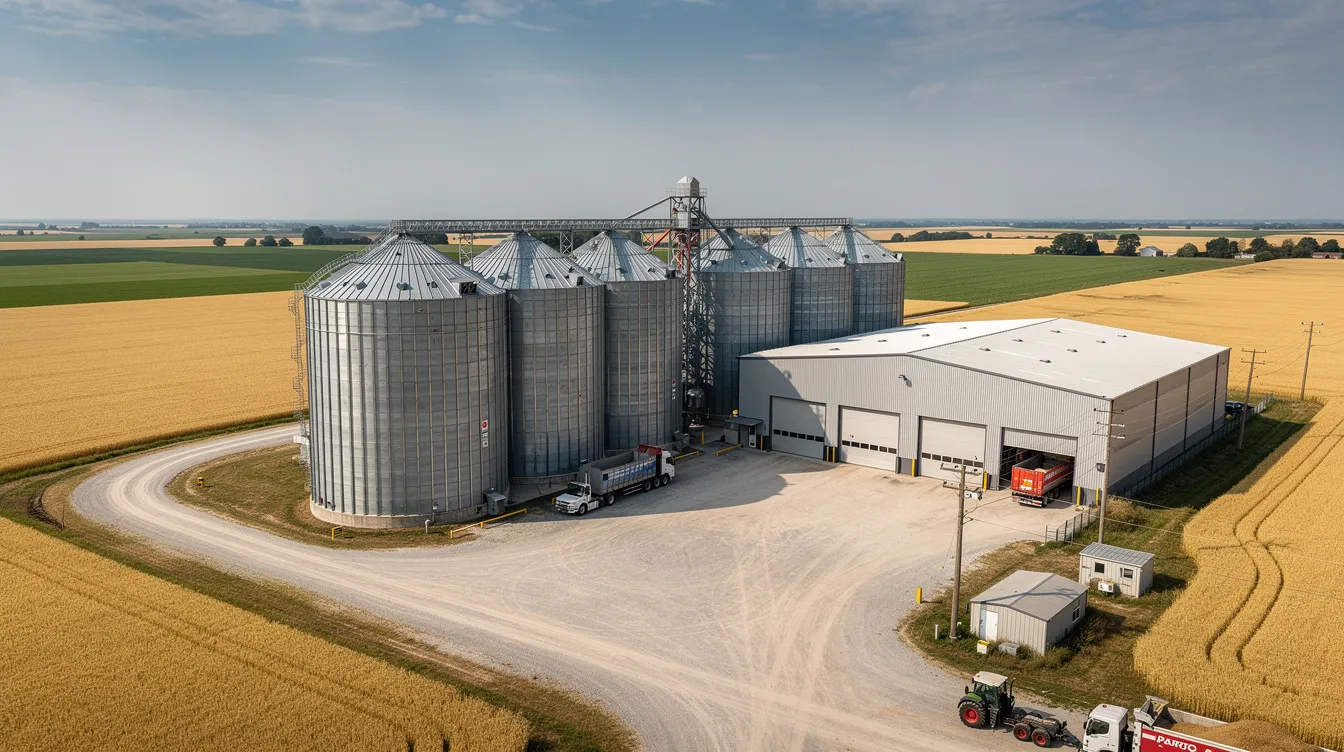
The choice of business model directly influences project cost, complexity, operating risk and the type of DPR required. Promoters should evaluate the following configurations:
Model A – Broken rice cleaning, grading and bulk dispatch. This is the simplest industrial configuration. The plant receives raw broken rice from mills, removes impurities, grades by fragment size and dispatches in bulk or bags. Capital expenditure is relatively low, but the operation depends heavily on raw material spread and has limited value addition.
Model B – Broken rice grinding into flour for animal feed. Here, the plant adds a grinding stage to produce broken rice flour of specified particle size for direct inclusion in feed formulations. This requires hammer mills and sieving equipment, increasing power consumption and capex, but allows the plant to serve customers who need ready-to-use energy ingredients rather than whole fragments.
Model C – Cereal by-product segregation, sizing and bagging. The plant handles multiple raw materials (rice bran, wheat bran, maize bran) sourced from different mill types, cleaning and sizing each for separate sale. This diversifies the product portfolio but requires contamination control between ingredient streams.
Model D – Multi-ingredient processing and blending plant. Catering to multiple feed mills, this configuration combines cleaning, grinding and blending of several cereal by-products into custom mixes. It demands more sophisticated layout, changeover protocols and quality systems, but can serve a wider customer base.
Model E – Integrated feed ingredient operation with optional pelletisation. This adds pellet pressing capability and is closer to an automatic feed pellet manufacturing plant. Capital requirements are substantially higher, but the operation can supply finished pellets alongside loose ingredients.
Model F – Captive processing linked to an existing rice mill or feed mill. Many rice millers already generate broken rice and bran; adding a dedicated feed ingredient line captures additional margins rather than selling by-products in unprocessed form. This model benefits from shared infrastructure, utilities and raw material supply.
Pure trading operations involve low capex but offer limited control over quality and margins. An engineered processing plant entails higher investment but can secure more stable industrial contracts. The DPR should lock in the chosen business model and product mix before finalising machinery specifications and building layout.
Plant Capacity Planning and Production Configuration
The following illustrative plant capacities serve as reference points for investment planning. These are sample scenarios, not universal recommendations-actual capacity should be determined by raw material availability, confirmed customer demand and the promoter’s financial capacity.
| Capacity Scenario | Approximate Covered Area (sq ft) | Typical Workers per Shift | Indicative Daily Raw Material Requirement (MT) |
|---|---|---|---|
| 25 TPD | 3,000–5,000 | 8–12 | 26–28 |
| 50 TPD | 5,000–8,000 | 12–18 | 52–55 |
| 100 TPD | 8,000–15,000 | 18–30 | 104–110 |
| 200 TPD | 15,000–25,000 | 30–50 | 210–220 |
To translate daily capacity into annual output, realistic assumptions must be applied. Most Indian feed ingredient plants operate 280–300 days per year, accounting for maintenance shutdowns, seasonal raw material gaps and festival periods. A single-shift operation (8–10 hours) at 50 TPD and 290 operating days yields approximately 14,500 MT per year at full capacity.
Capacity utilisation ramp-up is a critical financial assumption. New plants commonly achieve 50–60% capacity in year 1 while developing customers and stabilising production. By year 2, utilisation typically reaches 70–80%, stabilising near 85–90% from year 3 onward. These assumptions flow directly into the projected profit and loss account and DSCR calculations in the DPR.
Production configuration choices also matter. A single-line broken rice processing setup is simpler to operate but concentrates risk on one raw material and one product. Combo lines that can switch between broken rice, wheat bran and maize by-products diversify risk but require changeover time management and contamination control protocols.
Broken Rice and Cereal By-Product Processing Technology & Process Flow
The core processing philosophy is straightforward: convert variable-quality bulk by-products from mills into standardised, testable feed ingredients that meet industrial specifications demanded by large feed manufacturers. The manufacturing process typically involves cleaning, grading and packaging-with additional steps depending on the chosen business model.
Recommended Process Flow:
Raw Material Receiving → Sampling & Quality Testing → Pre-Cleaning → Magnetic Separation → Destoning → Screening & Grading → Moisture & Contaminant Testing → Grinding/Crushing (where required) → Sieving & Particle-Size Classification → Product Segregation/Blending → Final Quality Control → Weighing & Bagging/Bulk Loading → Finished-Goods Storage → Dispatch
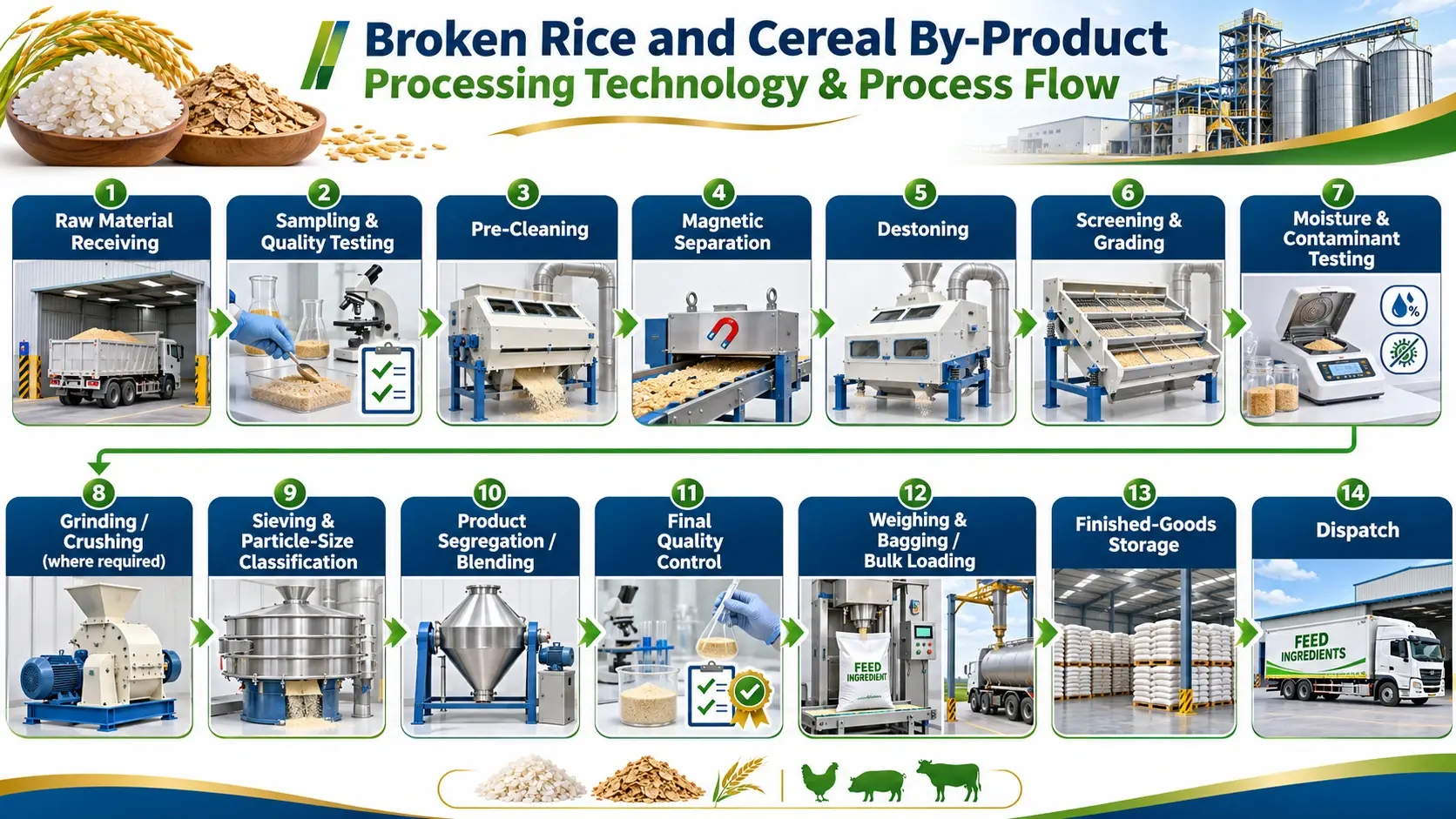
Raw material receiving and sampling: Every incoming lot must be sampled for moisture, foreign matter and visual quality before unloading. Reject or penalise lots exceeding moisture or contamination thresholds.
Pre-cleaning and magnetic separation: Vibrating screens remove coarse impurities (husk fragments, string, stones). Magnetic separators extract metallic contaminants-essential for preventing equipment damage and ensuring feed safety.
Destoning and screening: Gravity destoners remove small stones and sand. Multi-deck vibratory screens grade material by fragment size, separating coarse and fine fractions for different product specifications.
Grinding and sieving: Hammer mills reduce particle size to feed-compatible specifications. According to NDDB operational guidelines, hammer milling often accounts for up to 50% of total electricity consumption in feed plants during ingredient size reduction, consuming between 8–30 kWh per tonne depending on configuration and target fineness. Sieving and classification ensure that 80% of particles pass through the required screen size.
Blending and final quality control: Where the plant handles multiple ingredients, batch blending ensures homogeneity. Final quality control includes moisture verification, aflatoxin spot checks and visual inspection before bagging.
Weighing, bagging and dispatch: Automated or semi-automatic bagging systems fill, weigh and seal bags. Bulk loading into trucks is an option for high-volume industrial customers.
Traceability and batch-wise quality records are particularly important for large integrated feed mill customers who demand supplier quality audits and consistent lot-wise documentation. Steps such as pelletisation or thermal treatment apply only to selected product configurations and are not mandatory for basic feed ingredient supply.
Plant Machinery and Equipment Requirements
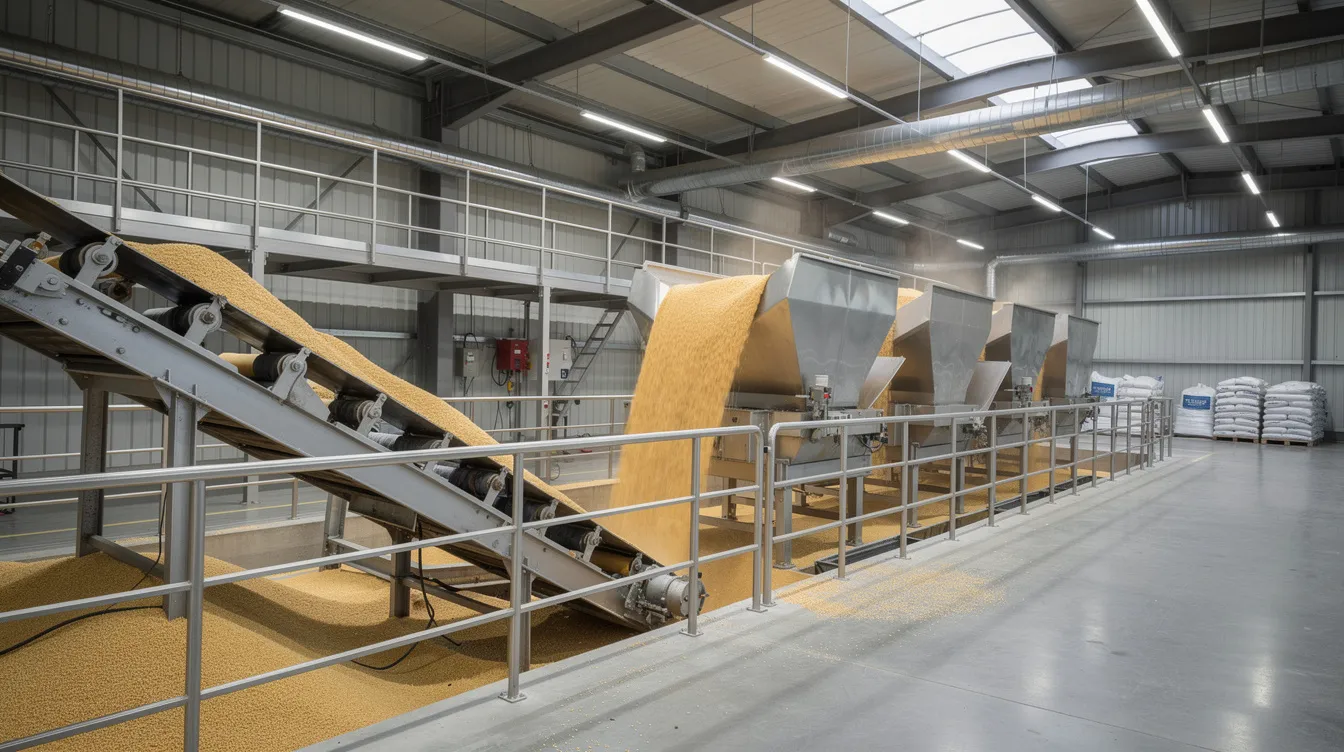
Machinery selection must align with the chosen business model, capacity and target product specifications rather than simply matching brochure capacities. For a cereal by-product feed ingredient plant, the following categories of equipment are relevant:
- Receiving hoppers and conveyors: Belt or chain conveyors and bucket elevators for moving material between processing stages. Selection depends on throughput and plant layout.
- Pre-cleaners and vibrating screens: Remove coarse impurities and separate material by size. Screen area and vibration intensity should match the throughput and material type.
- Magnetic separators: Extract metallic contamination. Essential across all configurations for both safety and feed quality.
- Destoners and grading systems: Gravity-based separation of stones and dense impurities. Particularly important for broken rice sourced from smaller mills with less refined cleaning.
- Hammer mills / pulverisers: The core size-reduction equipment. Indian manufacturers offer models ranging from 2–3.5 TPH at 5–10 HP to 14–17 TPH at 135 kW, with capacities depending on screen configuration, rotor speed and material hardness.
- Sieves and classifiers: Post-grinding particle size verification. Multiple deck sieves allow simultaneous classification into different size fractions.
- Blenders: Batch or continuous blenders for multi-ingredient operations. Not required for single-ingredient plants.
- Dust extraction and aspiration systems: Critical for both operator safety and product quality. Dust control systems are critical for handling combustible organic dust-a real hazard in cereal processing environments.
- Bagging and weighing machines: Manual, semi-automatic or fully automatic systems. Trade-offs exist between labour cost, accuracy and throughput.
- Storage bins and silos: Separate bins for different raw materials and finished products. Broken rice has a higher bulk density (~700–800 kg/m³) than bran, affecting silo design.
- Electrical panels and automation: PLC-based control for automated lines; manual starters for simpler configurations.
- Laboratory and quality testing equipment: Moisture meters, sieve shakers, aflatoxin test kits, weighing balances.
Machinery may represent 40–60% of core plant capex. In a comparable rice mill project, machinery accounts for 50–65% of total rice mill project costs. A 4 TPH machinery line for rice milling costs ₹65 lakh–1.4 crore, providing a reference point for feed ingredient machinery budgeting. Indian brands cost 30–45% less than imported brands, while premium imports deliver 5–8% higher head-rice recovery in milling applications. For a feed ingredient plant, the choice between domestic and imported equipment depends on required precision, wear resistance and after-sales support availability. A 2 TPH mini rice mill machinery set costs ₹22–37 lakh, illustrating how capex scales with capacity.
Land, Building, Infrastructure and Utilities Planning
A 4 TPH rice mill requires 1.5–2 acres of land as a general reference. For a medium-scale broken rice and cereal by-product feed ingredient plant (50–100 TPD), typical land requirements range from 0.75–1.5 acres depending on layout, covered storage needs and future expansion planning. Larger integrated multi-line plants require proportionally more space. Land prices vary substantially across India ranges of industrial zones, from under ₹10 lakh per acre in some Chhattisgarh or Telangana industrial estates to well over ₹1 crore per acre near major urban centres.
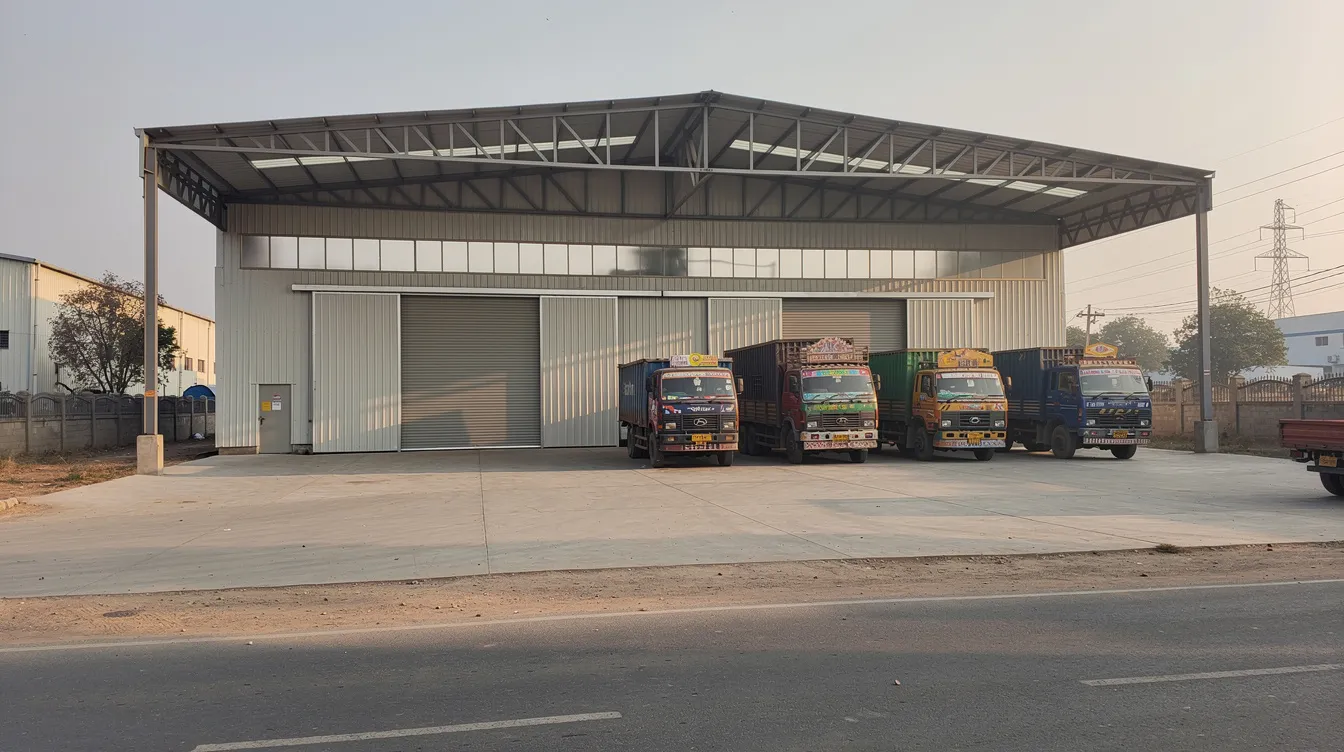
The choice between PEB shed (pre-engineered building) and RCC structures is significant. PEB construction is 22–30% cheaper than RCC for comparable covered area. Approximately 70% of new rice mills in 2026 used PEB construction, reflecting the industry’s preference for speed and cost efficiency. PEB rice mill sheds can be built in 4–6 months, compared to 12–18 months for RCC construction for rice mills. PEB construction allows for easy modular expansion-a valuable feature for plants planning phased capacity addition. A 4 TPH rice mill shed costs ₹1,400–2,600 per sq ft in 2026, which serves as a useful benchmark for estimating building spend for feed ingredient processing sheds of similar specification.
Space planning should cover:
- Raw material receiving yard with truck turning radius
- Covered pre-processing and processing hall
- Separate finished-goods warehouse for different product types
- Internal roads for truck movement, parking and an electronic weighbridge
- Administrative and laboratory block
- Total area should accommodate current operations plus at least 30–40% expansion potential
Infrastructure and utility needs include sanctioned power load with transformer and LT panel, DG backup for critical operations, compressed air if pneumatic conveying is used, minimal process water, dust extraction with bag filters, fire-fighting equipment and ventilation systems. A well-conceived site plan should allow phased expansion without disrupting ongoing production.
Plant Setup Cost and Total Project Investment Framework
Actual investment varies widely by capacity, project location, level of automation and whether the plant is greenfield or attached to an existing rice mill or feed mill. First-time investors often underestimate costs by 18–25%, particularly in areas such as electrical infrastructure, civil foundations, installation and pre-operative expenses that are frequently overlooked when the focus is solely on machinery quotations.
A professional project cost framework for a broken rice and cereal by-product feed ingredient plant should split investment into the following heads:
- Land and site development
- Factory building and civil works (PEB shed or RCC structure)
- Main processing machinery line
- Material handling systems and silos
- Electrical installations and transformer
- Pollution control and dust extraction
- Laboratory and quality control equipment
- Weighbridge and internal roads
- Installation, erection and commissioning
- Pre-operative and preliminary expenses
- Contingency provision (typically 5–10% of fixed capital)
- Margin money for working capital
| Cost Head | Indicative % of Total Project Cost (50–100 TPD Plant) |
|---|---|
| Land & site development | 8–15% |
| Building & civil works | 15–22% |
| Plant & machinery (including installation) | 35–45% |
| Electrical, utilities & pollution control | 5–8% |
| Lab, weighbridge & miscellaneous fixed assets | 2–4% |
| Pre-operative & preliminary expenses | 3–5% |
| Contingency | 3–5% |
| Margin for working capital | 10–18% |
These are approximate, assumption-based indicative estimates and will vary based on location, vendor selection and configuration.
The distinction between fixed capital investment (land, building, plant and machinery, utilities) and current assets financed as working capital (raw materials, finished goods, receivables and cash balances) is fundamental. Together, these define the total project cost used in bank finance proposals and the means of finance structure. For reference, a 4 TPH rice mill costs ₹1.2–2.5 crore in 2026, with approximately ₹1.8 crore capital expenditure for a standard configuration. The total cost for a 2 TPH mini mill ranges from ₹35–60 lakh. Feed ingredient plants of 50–100 TPD capacity, depending on complexity, may require ₹5–15 crore total project cost including working capital margin.
Professional DPR preparation verifies these assumptions through vendor quotations, layout-based civil estimates and realistic working capital modelling-not generic thumb rules.
Raw Material Procurement and Supply Chain Strategy
Raw material sourcing economics are the single largest driver of contribution margin for a broken rice and cereal by-product feed ingredient plant. Raw material cost often represents more than 50–60% of cost of the finished ingredient, meaning even small changes in procurement price directly compress or expand margins.
Practical procurement routes include direct tie-ups with rice mills, flour mills and maize processing units; aggregation through local traders; and purchase through commodity auctions or mandi systems. Wholesale broken rice prices vary significantly-from approximately ₹18.6/kg at export-oriented mandis to around ₹30/kg at all-India average wholesale level, depending on type, quality and harvest timing.
Key commercial and quality parameters to lock into contracts include:
- Price formula (linked to benchmark rice or maize prices)
- Moisture limits (≤14% for broken rice, ≤12% for bran)
- Foreign matter allowance (<0.5% for broken rice)
- Minimum lot size and delivery terms
- Rejection and discount clauses for non-conforming lots
- Payment terms and credit period
Seasonal availability is a critical planning factor. Paddy procurement and milling activity peaks after kharif harvest (October–February in most states) and again after rabi in certain regions. Wheat bran availability follows rabi wheat harvest. Plants must design storage capacity and working capital buffers to manage these seasonal inflows and maintain continuous production during lean periods.
Supply concentration risk-over-dependence on a few mills-should be mitigated by diversifying across regions and suppliers. Plants located in Andhra Pradesh or Telangana can source from the dense rice milling clusters of those states; those in Punjab can tap both rice and wheat milling complexes. Export contracts for broken rice may also compete for the same raw material, adding price pressure during periods of strong global demand.
Production Cost Structure and Operating Economics
Beyond project cost, operating economics determine whether the plant can sustain profitability across business cycles. Economic analysis must consider raw material costs and selling prices together with all conversion cost elements.
Major operating cost heads include:
- Raw material purchases (typically 55–70% of total operating cost)
- Electricity and fuel (power-intensive grinding consumes 8–30 kWh/tonne; at industrial tariffs of ₹8–10/kWh, power cost for grinding alone ranges from ₹64–300 per tonne)
- Direct labour and supervision
- Packing materials (PP bags, stitching thread)
- Repairs and maintenance (especially for high-wear components in hammer mills and screens)
- Internal transport and handling
- Quality control testing
- Administrative overheads
Conversion cost per tonne-separating raw material cost from processing and overhead cost-is the metric that reveals whether the spread between input price and finished ingredient selling price is sufficient to cover operating expenses and debt service. For mid-sized cleaning and grading plants at 65–75% utilisation, processing cost is estimated at ₹900–1,400 per tonne (₹0.90–₹1.40 per kg) excluding raw material cost, based on analogous commodity processing benchmarks. Plants with extensive grinding add to this figure.
Manufacturing losses and handling shrinkage of 0.5–1.5% of input volume must be factored in. Moisture loss or gain also affects the effective yield and realised revenue per tonne of input. Energy-efficient machinery, optimised layout and disciplined preventive maintenance can materially reduce per-tonne operating costs and improve DSCR, especially at higher throughputs.
Revenue Model, Pricing Strategy and Profitability Drivers
Core revenue streams for a broken rice and cereal by-product feed ingredient plant include:
- Sale of cleaned and graded broken rice as an energy ingredient for animal feed
- Sale of ground broken rice flour for direct inclusion in compound feed
- Sale of screened and sized wheat bran, maize bran and other cereal by-products
- Contract processing income where the customer supplies raw material
Pricing can follow spot-market mechanisms or medium-term supply contracts with formula-driven pricing linked to benchmark commodity prices. Spot sales offer flexibility but expose the plant to price and volume volatility. Contract supply provides cash flow predictability but limits upside when market prices rise.
Revenue in the DPR is modelled as production volume (MT) multiplied by average net realisation per MT, separated by product category where the plant handles multiple ingredients. Product mix assumptions significantly influence gross revenue-for instance, a plant processing both broken rice (higher unit value) and rice bran (lower unit value) will have a blended realisation that depends on the proportion of each product.
Key profitability drivers are stable raw material-spread (gap between procurement and selling price), higher capacity utilisation, efficient logistics both inward and outward, reduced rejections and stronger negotiating power with large feed manufacturers. For reference, a 4 TPH rice mill delivers ₹35–50 lakh annual EBITDA; a well-configured feed ingredient plant can target comparable or better margins depending on scale and market conditions. The payback period for a 4 TPH rice mill is 3–4 years-serving as a broad reference, though feed ingredient plant economics differ in raw material mix and value-addition structure.
EBITDA and profit before tax vary significantly with market conditions. A conservative base case plus downside scenarios should always be presented in the DPR without over-promising margins to lenders or investors.
Working Capital Assessment and Liquidity Planning
Working capital components specific to a feed ingredient plant include stock of raw materials (broken rice, bran), in-process stock, finished goods inventory, trade receivables from feed mills, and minimum cash balances-net of trade payables and short-term credit received from upstream mills.
An indicative working capital cycle might look like this: 15–25 days of raw material holding, 1–3 days of processing time, 7–15 days of finished goods holding, and 15–30 days of credit offered to industrial buyers, partially offset by 7–15 days of supplier credit. This cycle drives the quantum of funds locked in working capital at any point.
Working capital for a 4 TPH rice mill is ₹40–80 lakh, providing a reference for grain-based processing operations. For a larger feed ingredient plant, working capital requirement as a percentage of total project cost is often 20–30%, depending on credit terms and seasonal raw material procurement needs.
Even profitable plants can experience liquidity stress if raw material inventory builds up during peak harvest or if receivables stretch beyond projected limits. This reinforces the need for realistic working capital limits in CMA Data and bank proposals. At Project Report Bank, CA-led financial modelling explicitly integrates working capital projections, drawing power calculations and DSCR impact into the project appraisal.
Financial Projections, Bank Loan Feasibility and Investment Metrics
A robust broken rice feed ingredient processing plant project report must include detailed 7–10 year financial projections: projected profit and loss accounts, balance sheets and cash flow statements based on clear capacity, pricing and cost assumptions.
For bank loan feasibility, the following elements are analysed:
- Term loan requirement and promoter equity contribution
- Working capital limits (cash credit and short-term facilities)
- Repayment schedule with moratorium period
- Interest costs on term and working capital borrowings
- Depreciation on plant, machinery and building
- Tax computation
- Year-wise and average DSCR
- Break-even turnover and margin of safety
Financial projections should cover break-even analysis and profit margins across the projection period. Break-even analysis calculates the minimum production required to cover costs-a critical metric for lenders assessing downside risk. Financial viability analysis utilises metrics like return on investment (ROI) and internal rate of return (IRR). Rice mill ROI ranges from 18–25% post-tax IRR in well-managed operations; feed ingredient plants may fall in a comparable band depending on configuration and market conditions.
Project IRR, equity IRR, NPV and payback period are computed using discounted cash-flow techniques. Lenders and investors look at these metrics rather than headline turnover alone. A DSCR above 1.3–1.5 is generally considered healthier, but this is not an automatic guarantee for loan sanction-qualitative factors such as promoter experience, security cover and confirmed market linkages also carry weight.
Financial projections must be internally consistent, driven by realistic throughput, price and cost assumptions validated during the feasibility study, rather than optimistic one-line estimates.
Illustrative Financial Sensitivity and Scenario Analysis
Sensitivity analysis evaluates how changes in costs, prices and utilisation affect profitability and debt servicing capacity. For a project where raw material constitutes 55–70% of operating cost, even a 5% increase in procurement price can materially compress contribution margins.
The DPR should model at least the following scenarios:
| Scenario | Key Change | Directional Impact on DSCR |
|---|---|---|
| Base Case | Assumptions as projected | Comfort zone |
| Selling Price –5% | Average realisation reduced by 5% | Tight |
| Raw Material Cost +5% | Procurement cost increased by 5% | Tight to stressed |
| Capacity Utilisation –15% | Throughput lower by 15 percentage points | Stressed |
| Combined Downside | Lower utilisation + compressed spread | Significantly stressed |
A small change in raw material price can compress contribution sharply because raw materials represent such a high share of total cost. Similarly, lower capacity utilisation increases the burden of fixed costs (depreciation, interest, salaried staff) on each tonne of output. Sensitivity analysis helps promoters and lenders understand risk and decide appropriate debt-equity mix, contingency provisions and procurement or hedging strategies. The rate of return under adverse scenarios often determines whether lenders are comfortable with the proposed debt quantum.
Statutory Registrations, Licensing and Quality Standards
The typical statutory and regulatory framework for a cereal by-product feed ingredient processing plant in India includes:
- Business constitution and registrations: Proprietorship, partnership, LLP or private limited company; PAN; Udyam registration for MSME units.
- GST registration: Required for all commercial operations above threshold limits.
- Factory licence: Under state-specific Factories Act provisions where employment and power thresholds are met. Licensing costs for a 4 TPH rice mill range from ₹1.5–3.5 lakh, serving as a benchmark. Total licensing can take 90–150 days if filed sequentially-a timeline that promoters must build into their implementation schedule.
- Pollution Control Board approvals: Consent to establish and consent to operate from the State Pollution Control Board, especially relevant because of dust emissions and noise. Environmental management must address dust emissions and noise pollution throughout plant operations.
- Fire and industrial safety: Building plan approval and fire safety clearance, particularly important given combustible dust hazards in cereal processing.
- Labour laws: ESI and PF registration where applicable; compliance with state labour regulations.
- Feed product standards: While the plant processes feed ingredients rather than final food products, compliance with applicable BIS standards (such as IS 3593:2022 for de-oiled rice bran or IS 3648 for rice bran as livestock feed) may be required by institutional buyers. State animal husbandry department regulations for feed materials may also apply.
- Quality documentation: Batch-wise testing records, traceability systems and quality certificates demanded by large industrial buyers. Statutory approvals may include pollution control and factory licences as minimum requirements.
Approvals and cost are state-specific and can change. The DPR and implementation plan should identify all applicable licences, estimated timelines and sequencing so that plant commissioning is not delayed by overlooked permissions.
Project Risks and Mitigation Strategies
Cereal by-product and broken rice feed ingredient projects face commodity, quality, operational, financial and regulatory risks that must be systematically evaluated. Detailed project reports (DPR) provide thorough documentation for identifying and addressing these risks at the planning stage.
| Risk | Potential Impact | Mitigation Strategy |
|---|---|---|
| Raw material price volatility | Compressed contribution margins | Long-term procurement contracts, formula-based pricing, supplier diversification |
| Supply shortage / seasonal gaps | Low plant utilisation, fixed cost burden | Multi-source procurement, strategic inventory, regional diversification |
| Moisture, mould and mycotoxin contamination | Product rejection by buyers, feed safety issues | Incoming lot testing, proper storage design (aeration, ventilation), aflatoxin screening |
| Customer concentration | Revenue instability if anchor buyer reduces offtake | Diversified industrial buyer base, contract supply to multiple feed mills |
| Working capital shortfalls | Cash flow pressure, inability to procure raw material | Realistic banking limits, promoter margin, disciplined receivables management |
| Machinery breakdown | Production losses, delivery defaults | Preventive maintenance, critical spares inventory, service agreements |
| Combustible dust hazards | Fire or explosion risk | Dust extraction systems, fire detection, housekeeping protocols |
| Regulatory changes | Export restrictions, feed formulation norm changes affecting demand | Monitor policy environment, maintain domestic focus as primary market |
Specific feed-quality risks deserve emphasis: aflatoxin and mycotoxin presence in stored grains, insect infestation, and cross-contamination between feed ingredients of different nutritional profiles all require batch-testing and rejection protocols. Risk analysis and mitigation actions should be formally documented in the DPR and regularly reviewed during operations.
Commercial Feasibility and Investment Decision Framework
Beyond technical fit, investors must examine commercial feasibility: long-term availability of broken rice and other by-products in the catchment area, proximity to feed mills, logistics economics for both raw materials and finished goods, and the presence of competing processors in the same region. Even the cheapest way to configure a plant is not commercially viable if the freight economics to key customers wipe out the processing margin.
Project feasibility studies assess technical viability, market demand and financial assessment together. A structured decision framework for promoters should follow this sequence:
- Raw material security assessment – verify availability, pricing trends and supplier reliability
- Market validation with at least a few anchor customers – confirm specifications, volumes and pricing
- Preliminary project cost and financing plan – including promoter equity and term loan structure
- Financial modelling and sensitivity analysis – DSCR, IRR, NPV under multiple scenarios
- Review of risk-return profile and promoter capability
- Final investment decision
Practical deal-breakers include: fragmented and expensive raw material supply, freight costs that wipe out margins, or working capital requirements beyond promoter capacity. In such cases, the project may need to be scaled down, relocated to a better-supplied region or redesigned entirely. Commercial feasibility must also be revisited whenever there are significant regulatory changes affecting demand or raw material pricing. The DPR should serve as a decision-making tool-one that can even lead to the conclusion that the proposed configuration should be modified or deferred.
Why a Professional Detailed Project Report (DPR) Is Essential
There is a meaningful difference between a machinery supplier’s cost estimate, a preliminary project concept on a spreadsheet, and a comprehensive bankable DPR. A professional DPR for a broken rice and cereal by-product feed ingredient plant covers:
- Project background, rationale and market demand analysis
- Technical configuration, capacity selection and process description
- Detailed project cost with vendor-supported assumptions
- Means of finance including promoter contribution and term loan structure
- Production cost build-up and revenue modelling
- Projected financial statements (P&L, balance sheet, cash flow) for 7–10 years
- DSCR, IRR, NPV, payback period and break-even analysis
- Working capital assessment and CMA Data
- Risk assessment and sensitivity analysis
- Implementation schedule and milestone planning
Banks, financial institutions and serious investors increasingly insist on structured documentation prepared or vetted by experienced Chartered Accountants and domain professionals. A well-prepared DPR improves the quality of lender discussions, highlights potential weaknesses early, and supports better structuring of term loans, moratoriums, repayment profiles and security packages.
Professional DPR and Project Finance Advisory by CA Manish Gugliya
CA Manish Gugliya, FCA, DISA (ICAI), is a practising Chartered Accountant with more than 20 years of experience in project finance, DPR preparation, CMA Data, financial modelling and industrial project feasibility for manufacturing and food processing projects across India.
Key professional services relevant to broken rice and cereal by-product feed ingredient projects include:
- Customised detailed project reports for bank finance and investor discussions
- CMA Data preparation for term loan and working capital limits
- Projected financials with transparent assumptions
- Project viability and sensitivity studies
- Means-of-finance planning and loan structuring
- Investor-ready documentation for equity fundraising
The advisory process begins with an initial discussion on proposed capacity, project location and business model, followed by a high-level viability scan, data collection on raw material sourcing and potential buyers, preparation of technical and financial sections, and iterative refinement before finalisation for submission.
Promoters exploring wider feed-sector investments may also find value in related project advisory work, including the integrated animal feed mill project report, the maize feed ingredient processing plant project report and the industrial animal feed concentrate manufacturing plant project report.
Serious promoters planning a broken rice and cereal by-product feed ingredient processing plant are invited to contact Project Report Bank through projectreportbank.com for a customised feasibility study, DPR and project finance advisory tailored to their proposed capacity, location and financing requirements.
Related Grain-Based Feed & Feed Ingredient Projects
- Integrated Animal Feed Mill Project Report – Broken rice ingredient plants can serve as upstream raw material suppliers to integrated feed manufacturing units producing complete compound feeds.
- Maize Feed Ingredient Processing Plant Project Report – Maize and corn by-products compete with and complement broken rice in feed formulations; promoters may consider both ingredient lines.
- Industrial Cattle Feed Manufacturing Plant Project Report – Cattle feed plants are among the largest institutional buyers of cleaned and graded broken rice and cereal by-products.
- Automatic Feed Pellet Manufacturing Plant Project Report – Promoters considering pelletisation as a value-added processing stage can review pellet plant economics and machinery requirements.
Frequently Asked Questions (FAQs)
The following questions address common practical doubts from promoters exploring broken rice and cereal by-product feed ingredient plants, beyond what is covered in the main sections. Answers are general guidelines; plant-specific clarifications should be addressed through a customised DPR or professional consultation.
What is the practical difference between a broken rice trading business and a broken rice feed ingredient processing plant?
A trading business typically buys and sells broken rice from mills with minimal cleaning or grading, relying on spot-market margins and volume. A processing plant invests in machinery, quality testing infrastructure and standardisation capability to supply consistent, specification-based ingredients to large feed mills. The processing model can command relatively better and more stable realisations per tonne, win longer-term industrial contracts and add value by controlling moisture, particle size and contamination levels.
The processing approach demands higher fixed investment, technical manpower and working capital, but it is structured as an organised manufacturing unit rather than a commodity pass-through operation. Over time, this positioning provides greater pricing power and customer loyalty compared to pure trading, where the operator is easily substituted by any other trader offering a marginally lower price.
Can an existing rice mill add a broken rice and cereal by-product feed ingredient line as a diversification project?
Many rice mills already generate broken rice, rice bran and polish as part of their normal milling operations. Adding a dedicated feed ingredient processing line allows the mill to capture additional margins instead of selling by-products at unprocessed commodity prices. A rice mill project that integrates a feed ingredient line can leverage existing raw material supply, utilities and site infrastructure.
Key considerations include available space for additional machinery and a peb shed or building extension, compatibility of utilities (power load, compressed air), segregation of food-grade and feed-grade material flows, and the need for separate quality control protocols. Such diversification projects still require a structured DPR and financial projections, as banks evaluate the add-on line independently in terms of incremental capex, working capital and cash-flow impact on the overall operation.
What typical project cost range and payback period can investors expect for medium-scale broken rice feed ingredient plants?
Actual rice mill project cost and feed ingredient plant cost depend on capacity (25–100 TPD), land cost, PEB or RCC configuration, machinery brand and level of automation, and whether the plant is greenfield or integrated with an existing facility. Many medium-scale plants of this type target a payback period in the general range of 4–6 years under conservative assumptions, though this can shorten or lengthen depending on raw material spreads, capacity utilisation and debt structure.
Promoters should not rely on generic cost rs per tonne or percentage-based benchmarks. Instead, they should commission a customised detailed project report and feasibility study to derive project-specific capex, working capital and payback estimates grounded in verified quotations, local land prices and confirmed buyer demand.
Is it viable to export processed broken rice feed ingredients or should plants focus only on domestic feed mills?
India has historically been a significant exporter of broken rice and cereal by-products. However, export viability depends on current trade policies, international demand, compliance with importing-country feed regulations, and logistics costs. In some periods, government export restrictions on broken rice have disrupted supply commitments. Regions in developed countries, central Africa and Southeast Asia have historically imported Indian broken rice for both food and feed use, but regulatory requirements and phytosanitary compliance vary.
New plants should primarily secure stable domestic demand from organised feed manufacturers and treat exports as an opportunistic or diversification option. Export-oriented plans must be evaluated in the DPR with explicit assumptions on FOB prices, freight and regulatory risk, rather than assumed as a guaranteed upside.
How should investors choose between focusing only on broken rice or building a multi-ingredient cereal by-product processing plant?
A single-ingredient plant handling only broken rice has a simpler process, more focused quality control and potentially lower initial project cost, but is more exposed to single-raw-material and single-product risk. If broken rice prices spike or availability tightens (for example, due to competition from ethanol plants or government stock allocations), the plant has no fallback.
A multi-ingredient plant handling broken rice, wheat bran, maize by-products and possibly cassava flour or other starch sources can diversify risk and serve more customers. However, it requires more complex layout, changeover protocols, separate storage for each ingredient and robust quality systems to prevent cross-contamination. The full plant configuration should be decided based on local raw material availability, existing relationships with feed mills and the promoter’s operational capability-and formalised through a professional feasibility study before locking in machinery orders.
Conclusion: Structuring a Bankable Broken Rice Feed Ingredient Project
India’s rice milling and cereal processing ecosystem generates abundant volumes of broken rice and milling by-products that can be converted into consistent, specification-based feed ingredients through organised industrial processing. Steady demand from animal feed manufacturers-cattle feed, poultry feed, aqua feed and pig feed-provides a structural market foundation for such plants.
Project success depends on four pillars: a technically suitable plant configuration matched to the chosen product mix, commercially secure sourcing and off-take arrangements validated before investment, a financially viable project cost and working capital structure modelled through proper financial projections, and disciplined risk management covering quality, procurement and operational hazards.
Investors should avoid underestimating project cost-especially working capital, infrastructure and pre-operative expenses-or overestimating capacity utilisation and raw material-selling price spreads. Relying solely on vendor quotations without independent financial modelling is a sign of insufficient preparation that frequently leads to funding gaps or cash flow stress during implementation.
Serious promoters planning a broken rice and cereal by-product feed ingredient processing plant should undertake a structured feasibility study and commission a customised detailed project report integrating market validation, technical design and long-range financial projections. A professionally prepared DPR remains the most reliable foundation for converting this industrial opportunity into a bankable, investable project.
For project-specific DPR preparation, CMA Data, financial modelling and project finance advisory, connect with CA Manish Gugliya and Project Report Bank at projectreportbank.com.