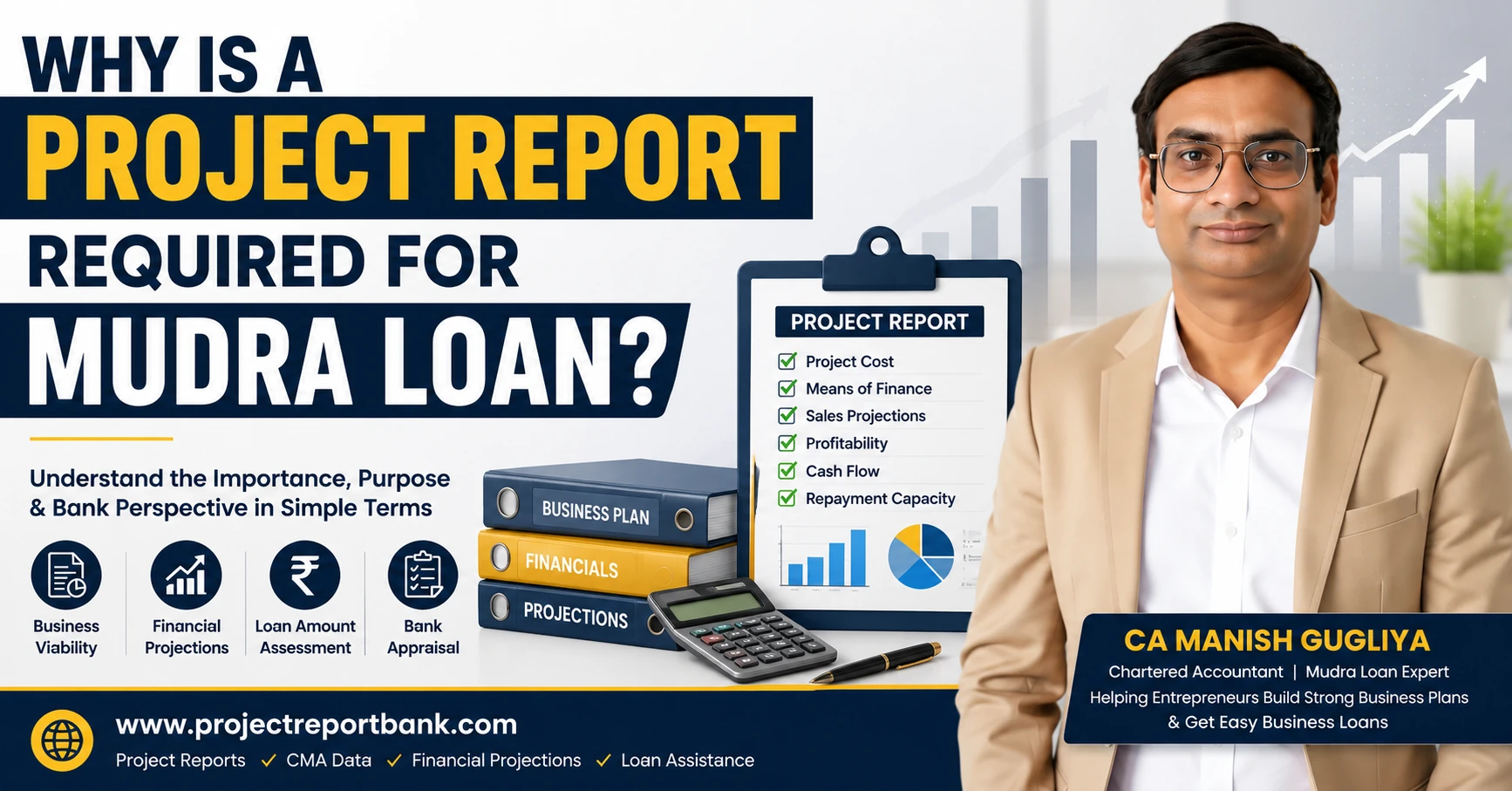
A project report is required for Mudra Loan because banks need a structured, documented basis to evaluate your business proposal before lending. A Mudra loan project report outlines business plans and financial needs, translating your business idea into measurable numbers – project cost, expected sales, operating costs, cash flow, and repayment capacity – so the lender can judge whether the loan is serviceable. Without this detailed document, a bank has no reliable way to appraise a collateral-free credit proposal under the Pradhan Mantri Mudra Yojana.

Key Takeaways

  • Banks use the project report to understand business viability, project cost, means of finance, financial projections, and repayment capacity – not just the loan amount requested.
  • A project report is essential for Mudra loan applications, especially for Kishor and Tarun category loans where amounts and complexity are higher.
  • A well-structured report improves chances of loan approval but does not, by itself, guarantee sanction or override eligibility and credit norms.
  • The report helps both banker (for appraisal) and entrepreneur (for planning realistic cash flow and avoiding over-borrowing).
  • ProjectReportBank.com, led by CA Manish Gugliya (FCA, DISA), specialises in preparing bank ready project reports, CMA data, and financial projections for MSME and Mudra Loan applicants.
The image depicts an entrepreneur sitting across from a bank officer at a desk, collaboratively reviewing financial documents, including a well-structured project report and cash flow statements, essential for securing a business loan. The scene emphasizes the importance of detailed financial projections and a clear business overview in the loan process.

Why Do Banks Ask for a Project Report for Mudra Loan?

Banks cannot rely on verbal assurance alone. Most banks require a project report for Mudra loan applications because they need documented evidence to appraise creditworthiness – particularly since MUDRA loans are collateral-free and require detailed credit evaluation.

The report helps the bank understand the nature of business (trading, service, manufacturing unit), promoter background and education qualification, loan purpose, project cost, working capital needs, estimated monthly sales, expenses, projected profit, cash flow, and repayment capacity. Mudra loan schemes are categorised into Shishu, Kishore, and Tarun, and different lenders – PSU banks, private banks like ICICI Bank and Axis Bank, and NBFCs – may use different formats but seek the same core information. The report supports the credit file and helps the officer present the case internally, but it does not ensure approval on its own. Mudra loans support micro, small, and medium enterprises (MSMEs) across manufacturing, trading, services, and allied activities.

For a broader introduction, refer to the Mudra Loan Project Report Basics guide. This article focuses specifically on importance and purpose.

What Is the Main Purpose of a Mudra Loan Project Report?

The main purpose is to convert a business idea or expansion plan into numbers a banker can evaluate logically. It traces the chain: business idea → investment requirement → project cost → means of finance → operations → anticipated revenue → expenses → profit → cash generation → EMI and loan repayment.

Mudra loans offer up to ₹10 lakh without collateral, and many borrowers are first-time entrepreneurs. The report outlines financial needs and repayment plans, helping applicants check whether their plan is financially sensible before taking debt. It is not a marketing brochure – it is a financial and operational summary answering the banker’s questions about feasibility, risk, and repayment schedule. For MSME and small units, this document often doubles as an msme loan project report used for both Mudra and non-Mudra term loan or working capital facility proposals, and shares similarities with a pmegp project report or a pmegp loan application in structure.

10 Reasons Why a Project Report Is Important for Mudra Loan

Each reason below reflects common bank appraisal practices observed across PSU and private banks. These are based on practical CA-level experience with business loan project report preparation and CMA data.

1. Explains the Business Model to the Bank

The report provides a business overview and business description stating what you will sell, manufacture, or service, and who your target customers are. Technical and operational clarity is defined in project reports – covering commercial manufacturing processes, related services, and how revenue is generated daily. For existing businesses, this should align with past turnover and bank statements; for new units, it should reflect realistic market analysis of local demand.

2. Establishes the Actual Loan Requirement

Many applicants pick a round loan amount without breakdown. The project report justifies the loan amount needed by the business by detailing machinery, equipment, initial stock, renovations, deposits, and working capital margin. This makes the request evidence-based rather than guesswork. Read more about how banks decide the Mudra Loan amount.

3. Explains How the Loan Will Be Used

Banks must ensure funds serve business purposes. The report maps each portion of the loan to a specific asset or need – for a salon: chairs, mirrors, equipment, initial stock; for a manufacturing unit: machines, installation, initial raw materials, power connection deposits. Mismatches between declared use and actual quotations are a common red flag.

4. Shows the Total Project Cost

Project cost means the total investment – machinery, furniture, small tools, computer, interior/renovation, initial stock, licence fees, security deposits, space or land requirement, preliminary expenses, and working capital margin. The report should detail project cost and means of finance clearly. Not every project has every component; a trading shop differs from a manufacturing unit. For deeper guidance, see proper project costing for Mudra Loan approval.

5. Explains the Means of Finance

The equation: Project Cost = Promoter Contribution + Proposed Bank Finance + Any Other Legitimate Sources. Banks check that the entrepreneur plans to bring reasonable own capital (savings, family support) and is not expecting 100% financing. A balanced structure – showing the promoter’s financial inclusion in the project – strengthens the case during appraisal and is cross-checked with bank statements and other financial documents.

6. Demonstrates Expected Sales and Revenue

Realistic sales projections show the earning potential. The report should include assumptions: expected daily or monthly customer footfall, average billing, machine capacity utilisation, and seasonal variations. Banks look for sensible numbers – a new shop rarely hits peak turnover in month one. See also turnover vs profit in Mudra Loan approval.

7. Shows Expected Profitability

Lenders focus on projected profit after expenses, not just turnover. The projected Profit & Loss shows gross profit, operating expenses (rent, salary, electricity, advertising strategies, transport, maintenance), interest, depreciation, and net profit. Extremely high margins without justification raise concerns. Profit is not the same as cash – which leads to the next point.

8. Helps Assess Cash Flow and Repayment Capacity

Banks sanction loans only when repayment appears comfortable from projected cash flow. The cash flow statement should show inflows from sales, outflows for purchases, expenses, taxes, and loan EMIs. Banks look at indicators like the debt service coverage ratio – commonly expecting 1.2–1.5 for comfort. Project reports include assessment of repayment capacity as a core element. See income assessment for Mudra Loan approval.

9. Helps the Bank Assess Business Feasibility

Business feasibility means whether the combination of investment, expected sales, pricing, target market, and costs makes sense locally. Bankers check if projected sales are consistent with location and competition, if expense levels match reality, and if profit margins align with sector norms. Project reports provide proof of business viability and support due diligence.

10. Creates a Structured Basis for Loan Appraisal

The report organises everything – executive summary, project company profile, company’s background, business plan, project cost, means of finance, financial projections, and repayment schedule – into one detailed document. This helps credit officers present the case internally and avoids repeated queries for missing data. Banks reject over 60% of MSME loan applications at first screening partly because project reports are weak or incomplete.

The image depicts a small workshop filled with various machinery and neatly organized raw materials, showcasing a well-structured environment ideal for manufacturing processes. This setup highlights the importance of having a detailed project report for business loans, such as a Mudra loan, to support financial projections and operational efficiency.

How Does a Project Report Help a Bank Assess Mudra Loan Eligibility?

Eligibility depends on multiple factors: applicant profile, business type, credit history, existing borrowings, and bank policies. The report helps verify whether the business activity falls under PMMY-eligible categories, whether projected income can cover EMI plus other obligations, and whether the proposal fits within the Mudra category. Banks also examine KYC, bank statements, GST returns, tax returns, and other financial documents required for Mudra Loan approval. Project reports evaluate risk and support due diligence, but cannot compensate for poor repayment history or ineligible activities.

How Does a Project Report Help Determine the Right Mudra Loan Amount?

The correct loan amount should come from project costing, not the maximum available limit. Here is a purely illustrative example for a small manufacturing unit:

Cost ComponentIllustrative Amount (₹)
Machinery and equipment4,00,000
Furniture and installation50,000
Initial raw material and stock1,50,000
Working capital buffer50,000
Other expenses (registrations, deposits)50,000
Total project cost7,00,000

If promoter contribution is ₹2,00,000, the requested bank finance is ₹5,00,000 – making the loan amount logical. These figures are illustrative only; actual amounts vary by business, quotations, rent agreement terms, and bank norms.

Why Are Financial Projections Important in a Mudra Loan Project Report?

Banks look at future financial projections because Mudra Loans are repaid from future income. Financial projections typically cover three to five years and project reports demonstrate financial viability with forecasts. Key financial statements include profit and loss, balance sheet, and cash flow.

Projected Sales

Shows expected turnover broken by month or year. Banks check for reasonable growth, not sudden jumps. Sales projections are the starting point for all other calculations.

Projected Profit and Loss

Summarises income minus all operating costs – purchase of goods, salaries, rent, electricity, transport, and overheads. Omitting key expenses (a common mistake) makes the proposal look artificially attractive but weak on scrutiny. Loss statements should be shown honestly if early-period losses are expected.

Projected Balance Sheet

Shows what the business will own (assets) and owe (liabilities). Banks use this to see whether owner’s capital is growing, how much is locked in stock, and whether borrowing levels are reasonable.

Projected Cash Flow

Shows actual money movement – identifying months where cash could be tight even if the business is profitable on paper. EMI outflows must be factored in.

Working Capital Assessment

Working capital is the money needed for day-to-day operations. The report should show how much working capital limit is required and how it will be funded. Wrong estimation leads to cash shortage or under-utilised funds.

Repayment / Debt Servicing Capacity

Lenders look for comfortable surplus after EMI. The report should show EMI amount, interest rate assumption, loan tenure, and net surplus. Inflating sales to show high surplus backfires when bankers cross-check with market reality.

Project Report for New Business vs Existing Business

New Business

No past turnover exists. The report must justify the business idea through market analysis, target customers, pricing, competition, break even analysis, and the entrepreneur plans for gradual sales build-up. Promoter’s skills, prior experience, employees working alongside, and achievements export orders (if any) strengthen the proposal. Overly optimistic first-year numbers are a red flag.

Existing Business

Projections should link to past financial statements, GST returns, bank statements, and past repayment behaviour. Sudden jumps in projected turnover compared to last 2–3 years need clear reasons – new machinery, new contract, change of location. Banks often use both the project report and CMA data for appraisal of term loans, CC limits, and working capital facility alongside Mudra or non-Mudra loans.

Is a Project Report Mandatory for Every Mudra Loan?

There is no single universal rule. Very small Shishu-category tickets may sometimes be processed with simplified forms, while a comprehensive project report is vital for Kishor and Tarun category loans. From a practical standpoint, even where not strictly mandatory, preparing a report is strongly recommended – it makes appraisal smoother. For detailed scheme and bank-policy discussion, read whether a project report is mandatory for Mudra Loan.

What Happens If the Project Report Is Weak or Unrealistic?

An unrealistic report does not always mean outright rejection, but it causes delays, repeated queries, and loss of confidence. Typical issues include projected turnover far above local market potential, very high margins, ignoring key expenses, underestimating working capital, mismatch between machinery quotations and project cost figures, unexplained promoter contribution, and financial analysis that contradicts the described business model. The aim is not “perfect” numbers but reasonable, internally consistent assumptions. These are among the most common mistakes that professional preparation can help avoid.

Can a Good Project Report Guarantee Mudra Loan Approval?

No. A good report improves clarity, speeds up appraisal, and enhances perceived seriousness – but sanction depends on creditworthiness, CIBIL score, existing loans, income assessment, business administration track record, type of business risk, internal bank exposure norms, verification results, and complete financial information in the file. A strong report is a necessary but not sufficient condition. Avoid any expectation of “guaranteed Mudra Loan” or “100% approval.”

Does the Project Report Help the Applicant Too?

The project report is not only for the bank. Project reports serve as a roadmap for entrepreneurs. While preparing it, you understand actual startup cost, the funding gap, minimum sales required to cover expenses and EMIs, likely monthly expenses, and whether the proposed debt level is comfortable. This process often reveals over-optimistic assumptions, allowing you to reconsider scale or timing. It helps avoid over-borrowing and reduces the risk of business strain – especially important for small business owners and micro enterprises who may not maintain formal budgets, invest in mutual funds as reserves, or have detailed financial needs planning otherwise.

Example – How a Bank May Read a Mudra Loan Project Report

Consider a hypothetical paper-cup manufacturing unit in a tier-2 city (2026). Project cost: machines ₹4,00,000; furniture and installation ₹50,000; initial raw materials ₹1,50,000; working capital margin ₹50,000; other charges ₹50,000 – total ₹7,00,000. Promoter contributes ₹1,50,000; requested Mudra Loan ₹5,50,000.

The bank would check: are quotations reasonable? Do means of finance align with margin norms? Do projected monthly sales of ₹80,000 (initially) minus expenses and EMI leave a positive surplus? Does the DSCR exceed 1.2? This example is for educational purposes only and does not represent any lender’s sanction criteria.

The image shows a person focused on a calculator while reviewing printed financial documents at a desk, indicating they are preparing a well-structured project report for a business loan. The materials on the desk likely include financial statements and projections relevant to their business idea and loan process.

What Should a Good Mudra Loan Project Report Contain?

A good report should include: applicant/promoter profile with details information on experience and promoter background, business overview and objectives, products/services and project commercial aspects, project logistics details, target market analysis, detailed project cost and means of finance, machinery/equipment list with indicative quotations and required third party details and third party details of suppliers, working capital requirement and cycle explanation, sales assumptions and revenue projections, projected profit and loss, balance sheet and cash flow, repayment plan and EMI assumptions, key indicators like DSCR, technical feasibility assessment, and a clear statement of assumptions. A standard project report format is accepted by most banks including banks like SBI and HDFC. Exact contents may vary by lender and loan process. The report should include a repayment schedule and expected revenue. A project report includes business description and market analysis. For the full format, see Mudra Loan Project Report Basics.

Should a Mudra Loan Project Report Be Prepared by a CA?

There is no universal rule requiring CA certification for every Mudra Loan project report – especially for small loans under the Mudra scheme. However, professional help is valuable when projections are multi-year, working capital needs careful calculation, CMA data is requested, or the applicant is unfamiliar with financial statements. A well structured project report prepared by a CA ensures internal consistency across project cost, P&L, balance sheet, and cash flow. ProjectReportBank.com offers support for CA-prepared project report for Mudra Loan and MSME finance – though this does not guarantee approval.

Frequently Asked Questions About Why Project Report Is Required for Mudra Loan

Why is a project report required for Mudra Loan specifically, when my business is very small?

Even for small loans, the bank must document why the money is needed, how it will be used, and whether projected cash flow can support EMI payments. A simple 3–4 page report with realistic financial projections covering project cost, sales, and repayment is often sufficient for micro units. The purpose is transparency, not burden. Banks require a project report for most business loans, including small Mudra loans.

Does a strong project report reduce the documents I need to submit?

No. A strong project report does not replace mandatory KYC, bank statements, GST returns, or other financial documents. The report and supporting documents work together – projections explain the future while actual documents show past conduct. Incomplete documentation can delay sanction even if the report is excellent.

Can unrealistic projections affect Mudra Loan appraisal?

Yes. Unrealistic turnover, inflated margins, or underestimated expenses force repeated queries and reduce the credit officer’s confidence in your proposal. It helps banks assess the viability of your business proposal only when assumptions are reasonable and internally consistent.

Can I use the same project report for multiple banks?

The core business plan and financial projections can often be reused, but each submission should be reviewed for the new bank’s format and margin norms. If a bank raised genuine concerns earlier, those should be corrected before presenting to another lender. Minor customisation is usually required.

Is a CA required to prepare a Mudra Loan project report?

Not always legally required, but professionally prepared reports with consistent financial analysis tend to be appraised more smoothly. If your proposal involves complex working capital calculations, multi-year projections, or CMA data, engaging a CA or experienced consultant is a practical recommendation.

Conclusion

The fundamental reason why a project report is required for Mudra Loan is straightforward: it translates your business proposal into measurable financial information that a lender can appraise logically. The report connects investment → project cost → means of finance → sales → expenses → profit and cash flow → repayment capacity in one structured document.

A realistic, well-prepared project report cannot guarantee approval, but it meaningfully improves clarity, speeds up appraisal, and helps both banker and entrepreneur make better-informed decisions. Avoid inflated or copy-paste figures. Focus on honest, supportable assumptions that match your actual business model and local market conditions.

Treat the project report as a serious planning tool for long-term business stability – not just a loan formality. That mindset, in my experience preparing hundreds of MSME and Mudra Loan project reports over two decades, is what separates proposals that move forward from those that get stuck in repeated queries.

Facebook
Twitter
LinkedIn