Key Takeaways
- A mudra loan project report is a structured business and financial document that explains your small business, total project cost, expected income and expenses, and your ability to repay the loan under the Pradhan Mantri Mudra Yojana (PMMY).
- Banks and financial institutions use this report to assess whether a proposed micro enterprise is viable and whether projected cash flows can comfortably cover loan instalments.
- Mudra loans are available in three categories – Shishu (up to ₹50,000), Kishor (₹50,000 to ₹5 lakh), and Tarun (₹5 lakh to ₹10 lakh) – and the depth of the project report typically increases with the loan amount.
- A well-prepared report improves approval chances, but it does not guarantee sanction; banks also evaluate credit history, scheme eligibility, and their own internal lending policies.
- This article is written from the practical perspective of CA Manish Gugliya, who regularly prepares such reports for micro and small enterprises across India.
Introduction: When the Bank Asks for a Mudra Loan Project Report
Imagine walking into a bank branch in 2026 to apply for a mudra loan. You explain your business idea – maybe a food processing unit, a mobile repair shop, or a readymade garments operation. The officer listens, nods, and then hands you a checklist that asks for a “project report” covering your project cost, expected monthly sales, operating expenses, EMI capacity, and promoter contribution.
If you have never dealt with bank loans before, this can feel overwhelming. Terms like financial projections, working capital, repayment schedule, and loan project report may sound like they belong in a business administration textbook rather than a conversation about your small shop.
Here is the simple answer to the core question: a mudra loan project report is a written explanation of your business and the numbers behind it, prepared so the bank can understand what you plan to do with the money and how you will pay it back. It is a document that converts your entrepreneur plans into information a credit officer can evaluate.
In the sections ahead, I will explain the meaning in simple words, the purpose, the importance, what information is usually included, how it helps the bank, common misunderstandings, and whether you can prepare one yourself. This article stays at the beginner level – advanced topics like CMA data preparation, detailed project report format, and multi-year financial analysis are covered in separate guides.

Table of Contents
What Is a Mudra Loan Project Report?
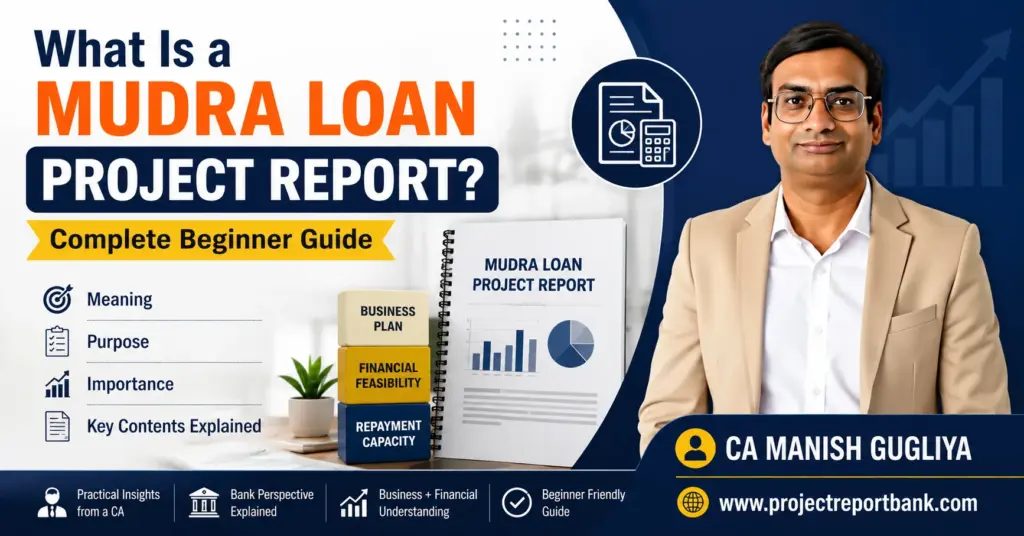
A mudra loan project report is a structured business and financial document that explains your small business, total project cost, proposed mudra finance, expected sales and expenses, and how you will repay the loan under the Pradhan Mantri Mudra Yojana (PMMY).
In practical terms, it is a type of loan project report prepared specifically for mudra loans of up to ₹10 lakh, which are collateral free and targeted at non-corporate, non-farm small enterprises. Mudra loans are categorized into Shishu (up to ₹50,000), Kishor (₹50,000 to ₹5 lakh), and Tarun (₹5 lakh to ₹10 lakh), and the level of detail expected in the report generally increases as the loan amount rises.
The report converts a business idea or expansion plan into banker-friendly information. It covers project cost, means of finance (how the cost will be funded – own contribution versus bank loan), basic financial projections, and a repayment schedule. A mudra loan project report includes business and financial details that help the lender see whether the proposal makes commercial sense.
From a bank’s view, the mudra project report is one of several appraisal inputs. The lender also checks KYC documents, credit history (CIBIL score), mantri mudra yojana pmmy scheme rules, and its own internal policies before making a decision. Formats may vary between lenders – a standard format is accepted by banks like SBI and HDFC Bank, but individual branches of ICICI Bank, Axis Bank, or Union Bank may ask for slightly different details information.
Mudra Loan Project Report Meaning in Simple Words
Think of a mudra loan business project report as the written story of your business. It answers four basic questions for the bank: what business will you do, how much money is needed, where will the money come from, and how will you pay back the loan.
Let me use a simple hypothetical. Suppose a person in Jaipur wants to start a mobile repair shop in 2026 and needs ₹3 lakh under the Kishor category. The project report would describe the type of business (mobile repair and related services), the shop location and space or land requirement, the tools and equipment needed, estimated renovation cost, expected monthly sales from repairs and accessories, typical monthly expenses like rent, salary for employees working in the shop, electricity, and the approximate monthly profit after all costs.
These numbers in a PMMY project report are estimates, but they should be grounded in practical assumptions – local demand for mobile repairs, realistic selling prices, actual market rentals, and genuine cost of spare parts. Beginners do not need to compute complicated ratios at this stage. What matters is that you can show how the business will regularly generate enough cash to pay EMIs for the mudra loan.
What Is the Purpose of a Project Report for Mudra Loan?
The purpose of a project report for mudra loan is to help both borrower and banker see whether the proposed micro enterprise is financially sensible and can service the loan.
For the applicant, preparing a mudra loan project proposal forces you to think through costs, margins, and cash flow before taking on debt. It is a reality check on your own business idea. For the banker, the PMMY project report is a concise document that allows the credit officer to quickly understand what business is being financed and how the loan will be repaid.
In my experience as a practising CA, a clear mudra loan business project report reduces repeated questions from the branch, speeds up understanding, and helps the file move more smoothly through the process. That said, the role of project report in mudra loan appraisal is important but it is only one part of the decision. Credit score, past conduct of accounts, and scheme norms are also considered.
Present the Business Proposal Clearly
The report should briefly introduce the promoter, the business idea, products or services offered, and the proposed location. It should describe whether the mudra loan is for starting a new business or expanding an existing one. Including the company’s background, the promoter’s education qualification, and relevant experience helps build credibility. This part is usually one to two pages of simple, jargon-free text – a business overview rather than heavy tables.
Explain the Loan Requirement and Use of Funds
This section presents the total project cost and the split between own contribution and bank loan under the mudra scheme. It includes concrete categories: machinery, furniture, vehicle, initial stock, shop renovation, working capital margin, and any other cost items. The report should include business description and funding needs so the bank can see that the requested loan amount logically matches the project cost and intended activity.
Estimate Income, Expenses, and Repayment Capacity
This part summarises expected monthly or yearly sales, major operating expenses, and approximate profit before EMI. The repayment plan in a project report outlines how the loan will be repaid – showing that after paying rent, salaries, purchases, and other costs, enough surplus remains to comfortably cover mudra loan instalments. The goal here is high-level projections, not deep ratio analysis. Detailed DSCR tables and multi-year CMA data belong in separate specialised articles.
Why Is a Project Report Important for a Mudra Loan?
Most banks, NBFCs, and MFIs ask for at least a basic project report for business loans under PMMY, especially above very small amounts. Banks require a project report to assess loan viability – it is not just paperwork but a tool that helps the lender gauge risk.
From the borrower’s view, preparing a project report for micro enterprise finance helps avoid underestimating costs or overestimating sales before committing to EMIs. From a lender’s view, the importance of project report for mudra loan lies in its ability to show whether expected cash flows look sufficient for the requested working capital limit or term loan.
Unrealistically high sales, very low expenses, or inconsistent figures often raise queries and can reduce trust in the loan application. The project report should provide realistic figures rather than inflated projections.
If you want to understand whether every applicant must submit such a report, you can refer to guidance on is a project report mandatory for a Mudra Loan.
What Information Is Usually Included in a Mudra Loan Project Report?
This is not a full format or template walkthrough, but here is what a basic PM mudra loan project report typically contains.
The promoter profile contains educational qualifications and relevant experience – who you are, what you have done, and why you are suited to run this business. It is essentially the project company profile section. Market analysis should assess local demand and identify competitors, sometimes with a brief comparative study of similar businesses in the area.
Key sections of a mudra loan project report include an executive summary and market analysis alongside a project cost summary with items like machinery, tools, furniture, initial stock, and working capital. Means of finance shows the split between own funds and the mudra loan. Technical and operational details include information on required infrastructure, resources, manufacturing processes if applicable, and land requirement.
Financial projections include a 5-year P&L, balance sheet, and cash flow – though for smaller Shishu loans, simpler month-wise or year-wise estimates may suffice. Some lenders also want a basic break even analysis and simple viability indicators, which help cross-check repayment capacity. This is not an exhaustive list; banks may request additional documentation beyond the project report, such as vendor quotations, GST returns, or financial documents required for Mudra Loan approval.
How Does a Mudra Loan Project Report Help a Bank?
To a credit officer, the project report is a quick map of who the borrower is, what the business does, and whether the requested mudra loan appears justified.
Banks use the project report to test if project cost is reasonable, if own contribution appears adequate, and if projected sales and margins are in line with the sector. Internally, banks combine information from the PMMY project report with CIBIL scores, banking history, and scheme eligibility under mudra yojana. Private sector banks like HDFC Bank or ICICI Bank and public sector banks follow broadly similar principles, though internal checklists differ.
The report makes it easier for higher-level sanctioning authorities, who have not met the applicant, to understand the loan project in a consistent format. It provides complete financial information in one place. But the project report is an appraisal input, not an approval certificate. Final decisions depend on many factors beyond the document.

Is a Mudra Loan Project Report the Same as a Business Plan?
While there is overlap, a mudra loan project report and a general business plan are not exactly the same.
A business plan often covers broader strategy: market positioning, competition analysis, advertising strategies, marketing channels, staffing plans, and long-term growth vision. It may discuss all the products and services a company plans to offer, export orders, achievements export orders, and even a focus on scaling to multiple locations – think expansion plans for a chain like a local version of Big Bazaar.
A loan-oriented mudra project report focuses more narrowly on project cost, funding mix, near-term financial projections, and repayment schedule. It prioritises project commercial aspects and project logistics details over grand strategy. For small mudra loans, a concise loan project report may act as a practical business plan in itself, as long as it clearly explains what will be done and how it will earn money.
Project Report for New Business vs Existing Business
The basic idea of a project report is similar for both new and existing units, but the supporting information differs.
For a new business seeking a mudra loan, projections rely mainly on market research, planned capacity, expected selling prices, and estimated operating expenses. The banker has no past data to verify assumptions, so clarity and realism in the financial statements matter even more.
For an existing business, the mudra loan project report can also include past turnover, profit trends, bank statements, financial statements, and GST data to support projections. The banker will compare projected numbers with historical performance to check if assumptions are reasonable. If your report claims a 50% jump in sales with no operational change, expect questions.
I will leave a detailed comparison of formats and data requirements for new versus existing businesses for a separate specialised article.
Simple Example of a Mudra Loan Project Report
Consider a hypothetical scenario: a woman entrepreneur in Indore plans to start a small tailoring unit in 2026 with a total project cost of ₹8 lakh under the Kishor/Tarun category. All figures below are illustrative only.
Project cost breakdown (hypothetical):
| Item | Amount (₹) |
|---|---|
| Industrial sewing machines (4 units) | 2,40,000 |
| Cutting tables and pressing equipment | 80,000 |
| Small generator | 60,000 |
| Shop interior and renovation | 1,00,000 |
| Initial fabric stock | 1,20,000 |
| Working capital (2–3 months expenses) | 2,00,000 |
| Total project cost | 8,00,000 |
Means of finance (hypothetical):
| Source | Amount (₹) |
|---|---|
| Promoter contribution | 2,00,000 |
| Mudra loan (term loan + working capital) | 6,00,000 |
| Total | 8,00,000 |
The report would then connect this investment to monthly sales – say ₹80,000 from school uniforms, readymade garments, and alteration work – and deduct purchases of fabric, rent, salaries for employees working, electricity, and transport costs to arrive at an estimated monthly profit of ₹18,000–₹22,000. If the EMI on the ₹6 lakh mudra loan at a typical interest rate comes to approximately ₹12,000–₹13,000 per month, the report demonstrates that projected cash flows are sufficient to cover the instalments with some cushion.
This is conceptually what a bank ready project report does: it tells a coherent financial story from investment to revenue to repayment.

Common Misunderstandings About Mudra Loan Project Reports
As a practising CA, I often see confusion among first-time applicants about what a mudra loan project report can and cannot do.
“A project report guarantees mudra loan approval.” This is incorrect. Banks still check creditworthiness, scheme rules, and internal risk norms. Your report can be excellent and your CIBIL score can still hold things up. The report improves your approval chances but does not guarantee anything.
“Any figures can be entered because they are only projections.” Entering random or inflated figures is risky. When a banker questions your assumptions – and experienced officers do – inconsistent numbers damage credibility. I have seen proposals where projected profit exceeded the turnover of established competitors in the same area. That kind of constructive criticism from a banker is not personal; it is the process working as intended.
“The bigger the projected profit, the better the report.” Exaggerated projections may actually reduce trust. A report showing modest but well-supported margins is far more convincing than one promising unrealistic returns.
“A project report is only a formality.” It should reflect genuine financial thinking about the business. A report copied from someone else’s project work without adapting to your actual situation will likely create problems when details do not match reality. Whether the business involves commercial manufacturing processes, trading, or services, the numbers need to fit your specific context.
Different Banks, Different Practices
Not every bank or branch demands the same level of detail in a mudra loan project report. Some may accept a very simple write-up for tiny Shishu loans, while others want more structured projections even for ₹2–3 lakh proposals. Axis Bank, Union Bank, or any private sector bank may have its own templates and required third party details like vendor quotations.
Treat any specific checklist from your lender as the final word for that application. This variation is normal – banks follow their own risk and documentation guidelines. One lender asking for a pmegp project report-style document and another asking for something simpler does not mean one is wrong.
What Makes a Mudra Loan Project Report Credible?
A credible PM mudra loan project report tells one consistent financial story: the business idea, costs, and profits match each other logically.
Realistic sales assumptions based on capacity, working hours, and local demand are more persuasive than round, inflated numbers with no explanation. Expenses such as rent, salaries, utilities, raw materials, and transport must be properly provided for. Reports that ignore these often look unreal to bankers. The report should be neat and easy to understand – disorganised submissions create a poor first impression.
Internal consistency matters. Stock levels, turnover, and working capital should support each other. If you claim ₹5 lakh in monthly sales but show only ₹30,000 in raw material purchases for a manufacturing unit, that gap will draw immediate questions. Third party details like supplier quotations add credibility to cost estimates.
I generally advise applicants to include brief written assumptions – average daily customers, average ticket size, capacity utilisation – so that bankers can see how you arrived at your projections. This turns the report from a set of numbers into an analysis the lender can follow.
Can You Prepare a Mudra Loan Project Report Yourself?
Many micro entrepreneurs with simple business models can prepare a basic business project report for mudra loan themselves if they are comfortable with basic arithmetic and understand their trade well. Self-preparation works best for small, simple proposals – a single shop, a vehicle for transport services, or a small service unit with straightforward income and expense patterns.
More complex proposals involving multiple activities, higher loan amounts, or combined term loan and working capital limit often benefit from professional assistance. Professional help from a CA or experienced consultant is especially useful where banks expect multi-year financial projections, linked cash flows, and compliance with specific templates.
If you want to understand what professional preparation typically involves, you can explore guidance on CA-prepared project report for Mudra Loan.
Is a CA-Prepared Project Report Mandatory for Mudra Loan?
As of now, there is no universal rule that every mudra loan project report must be prepared or certified by a Chartered Accountant. Requirements differ between lenders and loan sizes. Some banks or branches may insist on a CA-prepared or CA-certified project report above certain limits as part of their internal documentation standards, but this is not a uniform PMMY rule.
Always confirm with your specific bank branch what is required for your proposal instead of relying on generic statements from any website or intermediary. Even where CA certification is not legally mandatory, many borrowers choose professional support to ensure that figures are consistent and aligned with bank expectations. The expertise a professional brings often helps present the financial analysis and financial projections in a format the lender is accustomed to reviewing.
For a deeper look at this question, you may find it useful to read about how to apply for a Mudra Loan and the documentation typically expected.
Conclusion
A mudra loan project report converts your business idea into an organised business and financial proposal. At its core, it follows a simple chain: Business Plan → Financial Feasibility → Repayment Capacity.
A useful project report should be realistic, internally consistent, understandable, and supported by reasonable assumptions. It is not a magic document that guarantees a loan. It is a tool that helps both you and the bank understand whether the proposed venture under the pradhan mantri mudra yojana makes financial sense.
From my perspective as CA Manish Gugliya, I would encourage every entrepreneur to understand the numbers in their project report rather than treating it merely as paperwork required by the bank. When you truly understand your costs, margins, and repayment capacity, you are not just preparing a document – you are preparing yourself to run a successful business. The mudra scheme and its focus on financial inclusion for small businesses across India works best when borrowers approach it with clarity and honest numbers.
The report is a partial fulfilment of the loan application requirements. Your own preparation, understanding, and realistic planning complete the picture.
Frequently Asked Questions About Mudra Loan Project Reports
These FAQs briefly answer common beginner questions. For detailed guidance on specific topics, refer to the linked resources throughout this article.
Is a project report compulsory for every Mudra Loan application?
While many banks expect at least a basic project report or written note for business loans under mudra yojana, the strict requirement, depth, and project report format can vary by lender, loan size, and branch policy. For very small Shishu loans, some branches may accept a simpler submission. Applicants should always check with their bank and refer to dedicated guidance on whether a project report is mandatory for their specific mudra proposal.
Who can sign or submit a Mudra Loan project report?
Normally the borrower – whether proprietor, partner, or company director – signs and submits the project report to the bank as part of the loan file. Some banks may additionally ask for a CA’s signature or certification on financial projections for larger or more complex proposals, but this is not a uniform PMMY rule. If any additional certification is needed, the bank will specify it.
How many years of projections are needed in a basic Mudra project report?
Many simple mudra loan project reports focus on at least the first year in detail and may include two to three years of broad projections. Some lenders, particularly for Tarun loans, expect up to five years. When in doubt, preparing three-year projections with clearly documented assumptions is a reasonable approach.
Can I revise my Mudra Loan project report after submitting it to the bank?
If the banker raises queries or suggests corrections to assumptions, it is usually possible to submit a revised project report before final sanction. However, frequent or unjustified changes to numbers may reduce confidence. Revisions should be based on better information or genuine corrections, not attempts to fit what the bank wants to hear.
Does the government provide an official PMMY project report format?
While some banks and agencies share sample mudra loan project profiles or formats, there is no single mandatory format prescribed for all sectors and lenders across India. Use any sample only as a starting point and adapt it to match your actual business model, data, and the specific checklist given by your bank.