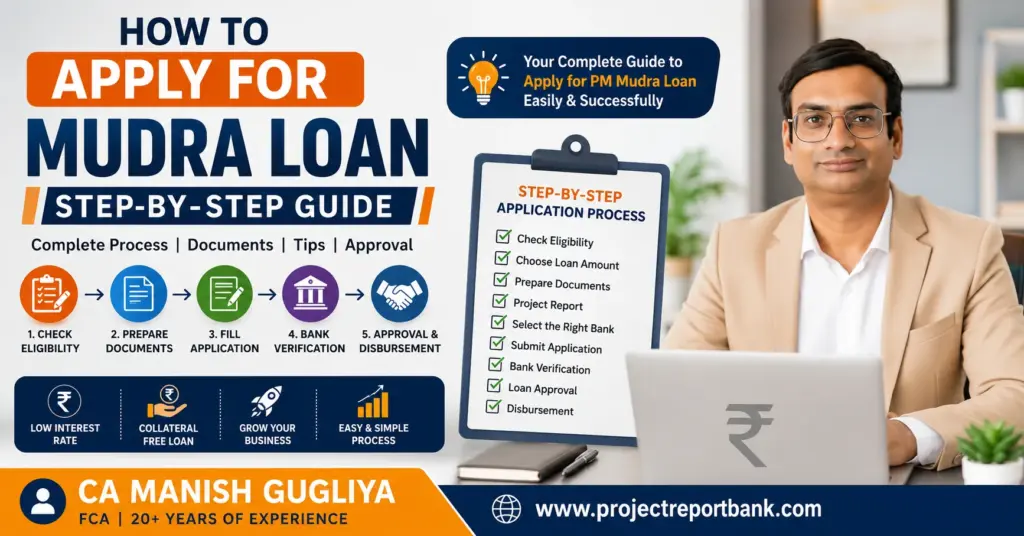
If you are a small business owner, shopkeeper, manufacturer, or first-time entrepreneur planning to apply for a Mudra Loan, this guide will walk you through every single step-from checking eligibility to receiving the money in your bank account. I have written this based on what I have seen work (and fail) in real bank branches over two decades of practice.
Key Takeaways
- This is a practical, step-by-step Mudra Loan application guide based on 20+ years of CA experience helping entrepreneurs get approved with fewer queries and faster processing. If you follow this process correctly, you save yourself weeks of back-and-forth with the bank.
- MUDRA loans are available up to Rs. 10 lakhs for non-farm, non corporate micro and small businesses under PM Mudra Yojana (PMMY). You can apply through commercial banks, small finance banks, NBFCs, MFIs, or online via the JanSamarth portal.
- The core of fast approval is simple: correct eligibility, right Mudra category (Shishu, Kishore, or Tarun), realistic loan amount estimation, strong and complete documents, and a professional project report that clearly shows repayment capacity.
- Both online and offline Mudra loan application methods are explained in detail below, along with practical tips to avoid common rejection reasons and improve your approval chances significantly.
- The article also covers interest rates across banks, common mistakes I have seen borrowers make, a detailed real-life example of a successful applicant, expert CA advice, and a comprehensive FAQ section addressing doubts that most applicants have before visiting the bank.
Introduction: What is PM Mudra Yojana & Why Process Matters
The Pradhan Mantri MUDRA Yojana (PMMY) supports micro and small businesses by providing collateral-free institutional credit up to Rs. 10 lakh. Loans up to Rs. 10 lakhs require no collateral security. MUDRA Yojana was launched on April 8, 2015, and since then, over 52 crore loan accounts have been sanctioned with more than ₹33 lakh crore disbursed across the country.
PMMY loans are intended for non-corporate, non-farm micro enterprises. This means mudra loans are meant for traders, manufacturers, service providers, small units, first-time entrepreneurs, and self-employed individuals-not for large companies or purely personal consumption needs.
Loans are offered under the scheme in categories depending on the stage and funding needs of the business:
- Shishu – for very small, early-stage units
- Kishore – for growing businesses needing moderate funding
- Tarun – for established or expanding units needing higher amounts
Interest rates are decided by individual lending institutions but are generally competitive. You can understand PM Mudra Yojana in detail here before starting your application.
In my 20+ years of practice as a Chartered Accountant, I have noticed the same mistakes repeated by applicants again and again:
- Picking a random loan amount without any cost breakup
- Submitting incomplete or mismatched documents
- Not preparing even a basic project report
- Misunderstanding who is eligible and who is not
These mistakes lead to delays, extra bank queries, or outright rejection-even when the business idea itself is perfectly viable. Understanding the complete mudra loan application process from eligibility to disbursement significantly improves your approval chances and reduces those frustrating repeated bank visits.
Table of Contents

Step-by-Step Mudra Loan Application Process (Steps 1 to 12)
This section gives you a clear, step by step mudra loan application guide covering eligibility, category selection, documents, bank process, and final disbursement. I have written it in the simplest language possible so that even a first-time applicant can follow it without confusion.
Step 1 – Check Your Eligibility
Before anything else, you need to confirm that you are eligible. PMMY applicants must be Indian citizens aged 18 to 65 with a viable business plan. Eligibility criteria must be fulfilled to apply for MUDRA loans-there are no shortcuts here.
Who can apply:
- Individuals running or planning to start a small business (sole proprietorship)
- Partnership firms and small entities
- Artisans, shopkeepers, street vendors, and service providers
- Small manufacturing units
- Allied agriculture activities like dairy, poultry, beekeeping, fishery (not pure crop farming)
Eligible business activities include:
- Trading – kirana shop, mobile accessories shop, stationery store
- Manufacturing – readymade garments unit, small fabrication workshop, food processing
- Services – beauty parlour, coaching centre, repair shop, tailoring unit
- Allied agriculture – dairy farming, poultry, small processing units
Both new businesses and existing businesses can apply. A new boutique owner starting from scratch is eligible, just as an existing auto repair shop looking to expand qualifies.
Who cannot apply:
- Large corporates or entities beyond micro/small classification
- Purely agricultural farming operations (crop cultivation on farmland)
- Personal consumption or household loans
- Speculative or illegal business activities
- Defaulters with existing banks or NBFCs
You can check Mudra Loan eligibility and qualifying business types to understand where your business fits.
Step 2 – Decide the Right Mudra Category (Shishu, Kishore, Tarun)
PMMY loans are available under four categories: Shishu, Kishore, Tarun, and Tarun Plus. Choosing the right one depends on your business stage and how much funding you actually need.
| Category | Loan Amount | Best For |
|---|---|---|
| Shishu | Up to Rs. 50,000 | Very small, early-stage businesses |
| Kishore | Rs. 50,001 to Rs. 5 lakhs | Growing businesses needing moderate capital |
| Tarun | Rs. 5,00,001 to Rs. 10 lakhs | Established or expanding businesses |
| Tarun Plus | Rs. 10,00,001 to Rs. 20,00,000 | Borrowers who have repaid a previous Tarun loan |
Practical examples:
- Shishu: A street food cart vendor needs ₹40,000 for a new cart and initial stock. Shishu loans work perfectly here.
- Kishore: A woman starting a small readymade garments unit needs ₹3 lakh for sewing machines, fabrics, and working capital. Kishore category fits.
- Tarun: An existing printing press owner wants ₹8 lakh to buy an advanced digital printer and expand operations. Tarun is the right pick.
- Tarun Plus: The Tarun+ category offers loans from Rs. 10,00,001 to Rs. 20,00,000, but only for those who have successfully repaid a previous Tarun loan. This was introduced in October 2024.
Interest rates may vary by category and bank. Public sector banks generally charge around 8%–12%, while some private banks may go higher. Always check current rates with your chosen bank before finalising.
You can learn more about different types of Mudra Loans to pick the right category for your situation.
Step 3 – Estimate Your Loan Requirement Properly
This is where most applicants go wrong. Banks do not appreciate a random number thrown at them. They want to see that you have thought through your costs logically.
Break your requirement into clear components:
- Machinery and equipment cost
- Furniture and fixtures
- Interior setup or shop renovation
- Initial stock or inventory
- Working capital for 3–6 months (rent, salaries, utilities, raw materials)
- Contingency buffer (5–10% of total)
Example calculation – Starting a beauty parlour:
| Cost Head | Estimated Amount |
|---|---|
| Interior work | ₹80,000 |
| Chairs, mirrors, styling equipment | ₹1,50,000 |
| Initial beauty products stock | ₹30,000 |
| Working capital (4 months) | ₹70,000 |
| Contingency | ₹20,000 |
| Total Project Cost | ₹3,50,000 |
This is a Kishore category loan. The numbers are realistic, broken down, and easy for any banker to understand.
Asking for too high an amount without supporting logic triggers risk alarms. Asking for too little may leave you underfunded and struggling. Either way, the bank may question your planning. This is exactly how banks decide your Mudra Loan amount-by checking whether your estimate matches business reality.

Step 4 – Prepare Required Documents in Advance
Required documents for PMMY loan application often include identity proof, address proof, and financial records. But the full list goes deeper than that.
Complete document checklist:
- Identity proof: Aadhaar Card (mandatory for most banks), PAN Card, Voter ID, Passport, or Driving Licence. Identity proof options include Aadhaar, PAN, and Voter ID.
- Address proof: Address proof can be shown through recent utility bills or taxes-electricity bill, water bill, or property tax receipt. Rent agreement also works.
- Recent passport-size photographs (2–4 copies)
- Business proof: Udyam Registration, Shop and Establishment certificate, Trade licence, GST Registration (where applicable). Business proof is required if an existing business is applying.
- Bank statements: Last 6–12 months from your primary account
- Quotations: At least 2 supplier quotations for machinery, equipment, or major purchases
- Rent agreement or ownership proof of business premises
- Income proof: ITR (especially for Kishore/Tarun), Form 16 if salaried income exists alongside business
- Project report (covered in next step)
Common document mistakes I have seen:
- Name spelled differently in Aadhaar and PAN (e.g., “Rajesh” vs “Rajesh Kumar”)
- Old address on Aadhaar that does not match current business location
- Unsigned or unregistered rent agreement
- Missing quotations for major machinery items
- Bank statements with too many unexplained cash deposits
Getting your documents right the first time saves enormous effort. You can read about financial documents required for Mudra Loan approval and common documentation mistakes that delay Mudra Loan approval for detailed guidance.
Step 5 – Prepare a Professional Project Report
A project report is a detailed document that tells the bank exactly what your business is, how much it will cost, where the money will go, how much you expect to earn, and most importantly-how you will repay the loan.
Key elements bankers check in a project report:
- Business background and promoter details
- Total cost of the project and means of finance
- Projected Profit & Loss statement (monthly and yearly)
- Break-even analysis
- Cash flow statement
- Debt Service Coverage Ratio (DSCR)
- Repayment schedule aligned with expected income
For Kishore and Tarun categories, most bank branches now expect at least a basic project report. For shishu loans (up to ₹50,000), a simple application with basic business details is usually enough.
A CA-prepared project report carries significantly higher trust because the numbers are realistic, the projections are grounded in market reality, and the repayment schedule is properly structured. Banks know that a professional has verified the assumptions.
Find out whether a project report is mandatory for Mudra Loan and understand why a CA-prepared project report improves Mudra Loan approval.
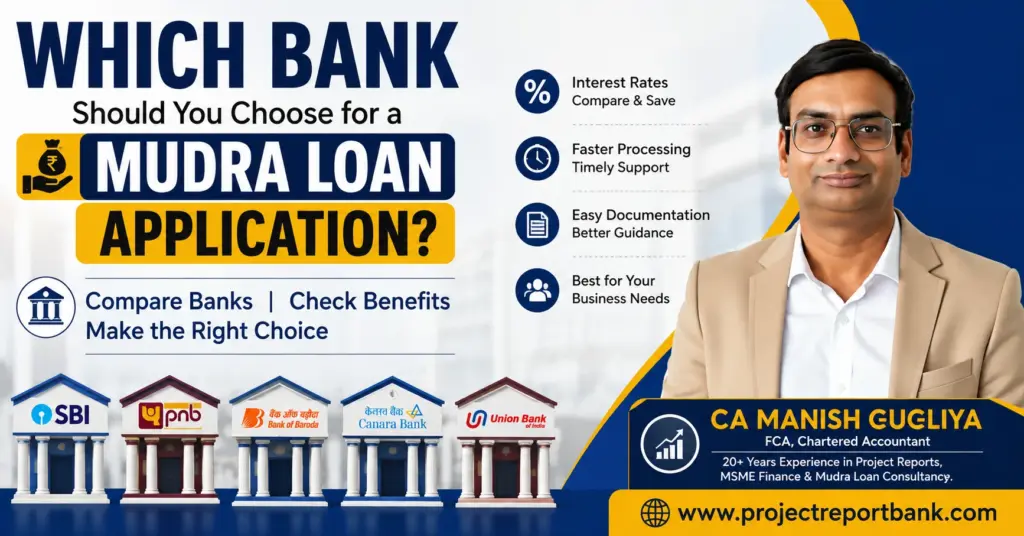
Step 6 – Select the Right Bank for Your Mudra Loan
Applications for PMMY can be made through public and private banks, RRBs, MFIs, and online portals. Mudra Loans are offered by Public Sector Banks (SBI, Bank of Baroda, PNB), Private Banks (HDFC, Axis, ICICI), Regional Rural Banks, small finance banks, Cooperative Banks, and selected NBFCs and MFIs.
My advice: start with your existing bank. If you already have a savings or current account with regular transactions, that bank already knows your financial behaviour. This existing relationship often speeds up processing significantly.
Compare banks on these practical points:
- Interest rate offered at that particular branch (rates vary-Bank of Baroda may offer 8.40%–11.10%, SBI around 12.15% onwards, some private banks higher)
- Processing time and branch workload
- Staff familiarity and comfort level with Mudra scheme
- Whether they require a guarantor or co-applicant (scheme says collateral-free, but some branches may ask for personal guarantee)
- Digital support and online tracking capability
Check with at least two lenders before finalising. Even a 1% difference in interest rate can save you thousands over the loan tenure.
Step 7 – Fill the Mudra Loan Application Form Correctly (Online & Offline)
Offline application: Visit the chosen bank branch, collect the PM Mudra Yojana application form, and fill in your personal details, business details, loan purpose, required amount, and preferred repayment period. Take your time and be accurate.
Online application: MUDRA loans can be applied online through the JanSamarth portal (jansamarth.in) or through some banks’ own websites. You enter similar information digitally and upload scanned copies of your documents.
Typical information fields on the form:
- Full name (as per Aadhaar/PAN)
- Current and permanent address
- KYC details (Aadhaar number, PAN number)
- Business name, nature, and type of activity
- Business vintage (how many years/months running)
- Approximate annual turnover
- Proposed project cost and loan amount requested
- Purpose of loan (machinery, working capital, expansion)
- Existing loans or EMIs, if any
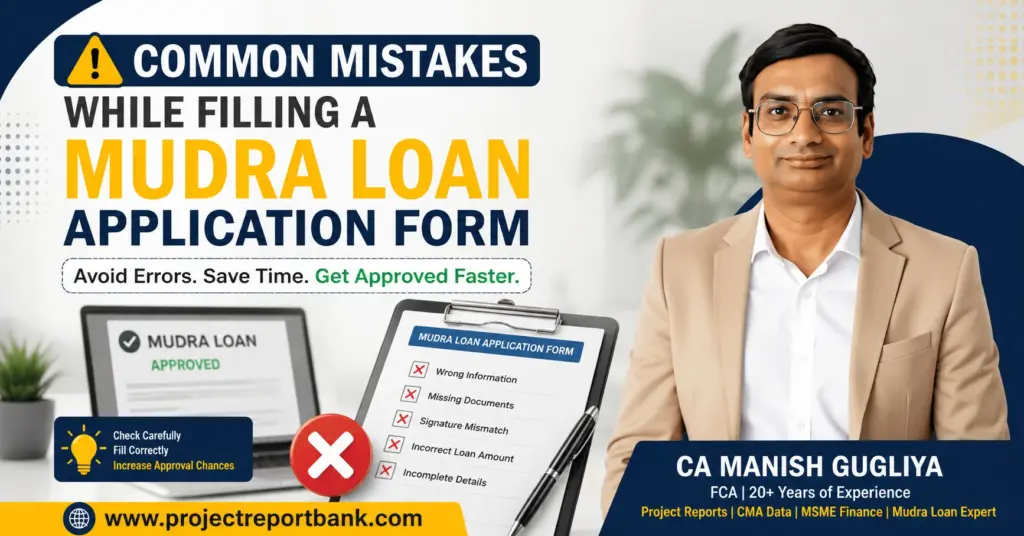
Common form-filling mistakes:
- Leaving mandatory fields blank or writing “NA” where a real answer is needed
- Stating turnover or income that does not match your bank statements
- Over-optimistic income estimates that the bank will question
- Not disclosing existing loans, credit cards, or EMI obligations
Step 8 – Submit Documents & Get Acknowledgement
After completing the form, attach self-attested copies of all documents and submit them as a properly arranged file. If applying online, upload documents as per portal instructions in the correct format.
Arrange documents in a logical order:
- KYC documents (Aadhaar, PAN, photos)
- Address and business proof
- Bank statements
- Quotations and estimates
- Project report
Carry originals to the branch for verification. The bank usually provides an acknowledgement receipt or application reference number. Keep this safely and note the date of submission-you will need it for follow-up.
Learn how to arrange your Mudra Loan file before visiting the bank for a smoother experience.
Step 9 – Bank Verification & Field Visit
Loan approval is subject to verification of identity, documents, business viability, and repayment capacity. After receiving your application, the bank may:
- Conduct telephonic verification (calling you to confirm details)
- Visit your business place or proposed site
- Carry out residence verification, especially for new applicants or higher amounts
During the field visit, bank officials generally check business activity, shop setup, machinery, stock presence, and basic stability of operations. They are not looking for perfection-they want to see that a real business exists or is genuinely being set up.
Be honest and clear during any interaction. Misrepresentation discovered at this stage can lead to immediate rejection, even if your documents looked perfect on paper.
Step 10 – Credit Appraisal by the Bank
Credit appraisal is the bank’s internal process to evaluate whether you can actually repay the loan. The lending institution evaluates the entrepreneur’s credit profile during the application process, checking multiple factors.
Key appraisal factors:
- Average monthly bank balance and transaction pattern
- Regularity of existing EMIs (if any)
- Cheque return history (bounced cheques are a red flag)
- Stability and consistency of income
- Realistic sales projections in the project report
- Cash flow adequacy for proposed EMI
- DSCR (Debt Service Coverage Ratio-ideally above 1.2)
- Existing liabilities that reduce your available repayment capacity
You can understand how banks read your bank statement for Mudra Loan and know how your Mudra Loan EMI and interest are calculated to prepare better for this stage.
Step 11 – Loan Approval & Sanction Letter
After successful appraisal, the bank issues a sanction letter. This is the official document that confirms your loan has been approved.
The sanction letter mentions:
- Sanctioned amount
- Interest rate (fixed or floating)
- Repayment tenure and EMI amount
- Processing charges or insurance charges (if any)
- Security or guarantee conditions (if applicable)
- Special conditions or covenants
Read the sanction letter carefully. Pay attention to prepayment rules, processing fees, and any conditions that require compliance. Minor negotiation on tenure or EMI date is sometimes possible-discuss politely with the branch manager if needed.
Step 12 – Loan Documentation & Disbursement
This is the final step. You sign the loan agreement, undertaking forms, ECS/NACH mandate for EMI deduction, and any guarantor documents if applicable.
How disbursement works:
- Funds credited directly to the borrower’s bank account
- For machinery purchases, some banks pay the supplier directly from the loan account
- Working capital may be released in parts or as a running account facility
Use the funds only for the approved business purpose-machinery, stock, setup, working capital. Keep all bills, invoices, and receipts safely. These may be needed for future verification, subsidy claims, or when you apply for a top-up or higher loan later.

Online vs Offline Mudra Loan Application (With Comparison Table)
Both routes-online and offline-are available when you apply for PM Mudra loan. The best choice depends on your comfort with technology, local bank branch support, and how urgently you need the loan processed.
Online Application
You can use the official JanSamarth portal (launched June 2022) or some banks’ own online application systems to submit your mudra loan online application. The portal pulls data from your Aadhaar, PAN, Udyam, and even income records through CBDT integration.
Requirements: Mobile-linked Aadhaar, scanned documents, basic digital literacy, stable internet.
Advantages:
- Apply from home, any time of day
- Faster initial data capture and tracking
- Auto-verification of KYC details reduces errors
Limitations:
- Many branches still call the applicant for physical verification even after online submission
- Digital literacy can be a barrier for some entrepreneurs
- Document upload quality issues can delay processing
Offline Application
Visit the nearest bank branch, meet the loan officer, collect the physical application form, and submit hard copy documents.
Advantages:
- Direct human interaction and immediate doubt clarification
- Better for first-time borrowers or complex projects
- More control over how your file is presented and explained
Disadvantages:
- May require multiple visits
- Dependent on branch working hours and staff availability
- Slower initial screening compared to online
Comparison Table
| Aspect | Online Application | Offline Application |
|---|---|---|
| Convenience | Apply from anywhere, 24×7 | Requires branch visit during working hours |
| Personal Guidance | Limited; chat/helpline support | Face-to-face interaction with loan officer |
| Document Handling | Upload scanned copies digitally | Submit physical copies, show originals |
| Processing Transparency | Track status online via reference number | Follow up in person or by phone |
| Best For | Tech-comfortable applicants, repeat borrowers | First-time entrepreneurs, complex business cases |
A note on interest rates: The channel you choose (online or offline) does not generally change your Mudra Loan interest rates. Rates are decided by the bank’s internal policy and your risk profile as a borrower. Always check the latest rate range on the bank’s website or by visiting the branch.
From my experience, first-time entrepreneurs often benefit from starting offline where they can get guidance, and then using online services for status tracking and future top-up applications.

Common Mistakes, Practical Tips & Real-Life Example
Many otherwise-eligible applicants face rejection or delay not because of bad business ideas, but because of avoidable mistakes in their mudra loan application process. Let me walk you through what I have seen go wrong-and what works.
Common Mistakes While Applying
- Incomplete document sets: Missing even one required document (like a quotation or Udyam certificate) can stall your file for weeks
- Mismatched KYC details: Different names or addresses across Aadhaar, PAN, and bank account
- Unrealistic loan amount: Asking for ₹10 lakh when your business plan supports ₹4 lakh
- Inflated sales projections: Banks have seen thousands of project reports-they can spot unrealistic numbers instantly
- Missing quotations: Not providing supplier quotes for machinery or equipment costing more than a few thousand rupees
- Messy bank statements: Frequent large cash deposits, unexplained withdrawals, cheque bounces
- Hiding existing obligations: Not disclosing running EMIs, credit card dues, or other loans
- Fake or doctored documents: This leads to immediate rejection and can permanently damage your credibility with all banks
Beware of fraud; genuine lenders do not ask for upfront fees for sanctioned loans. If anyone asks you to pay money before your loan is sanctioned, it is a scam.
Tips to Improve Approval Chances (CA-Level Practical Advice)
- Maintain clean banking history for at least 6 months before applying. Avoid cheque bounces, keep a reasonable minimum balance, and reduce cash-only transactions. Banks read your statement like a story-make sure it tells a good one.
- Choose a realistic loan amount aligned with your business scale and repayment capacity. If your business can comfortably support ₹5,000 per month EMI, don’t apply for a loan that demands ₹12,000 per month. Understand the minimum Mudra Loan amount and work upward from there.
- Prepare realistic financial projections and a strong project report, ideally with the help of a CA. Your DSCR should be comfortably above what the bank expects (typically 1.2 or higher).
- Arrange documents professionally in a single, neat file. Treat your application like a business proposal, not a formality. The bank officer handling your file has dozens of applications on their desk-a clean, complete file gets attention faster.
- Answer bank queries honestly regarding your business model, margins, suppliers, and risk factors. Trying to hide weaknesses only makes the banker suspicious.
- Know about prepayment options. Early closure of a Mudra Loan can save significant interest cost. Understand the rules around prepayment of Mudra Loan before signing.
Practical Example: A Successful Mudra Loan Applicant
Let me share a realistic example based on cases I have handled.
Priya’s Beauty Parlour – Jaipur, 2025
Priya, a 28-year-old woman from Jaipur, wanted to start her first beauty parlour. She had completed a professional beautician course and had 2 years of experience working at another salon. She needed around ₹3.5 lakh to set up her own unit.
Here is what she did right:
- Checked eligibility: She confirmed she was an Indian citizen, had a viable business plan, and her activity (beauty services) qualified under PMMY. She selected Kishore category.
- Worked with a CA: Together, we estimated costs properly-₹80,000 for interiors, ₹1,50,000 for styling chairs, mirrors, and equipment, ₹30,000 for initial beauty products, ₹70,000 for 4 months working capital, and ₹20,000 contingency. Total: ₹3,50,000.
- Collected all documents: Aadhaar, PAN, Udyam Registration (she registered her unit online), rent agreement for the shop space, quotations from two equipment suppliers, and her last 12 months’ bank statement showing regular savings.
- Got a project report prepared: The report showed expected monthly revenue of ₹45,000–₹60,000 from month 3 onwards, with break-even by month 6. EMI of approximately ₹11,500 per month (at roughly 10.5% for 3 years) was comfortably covered by projected cash flow. DSCR was above 1.5.
- Applied at her existing bank: She visited her SBI branch where she had maintained a savings account for 4 years. The loan officer knew her transaction history. She filled the form carefully, submitted a complete file, and responded to the field visit with confidence.
- Sanction received: Within 12 working days of submission, her loan was sanctioned. Amount was credited to her account, and for major equipment, the bank issued a cheque directly to the supplier.
What happened next: Priya repaid her EMIs on time for 3 years. Her disciplined repayment built a strong credit history, and she later became eligible for a higher Tarun category loan to expand her business with a second branch.
This is the power of proper preparation. Priya’s file had no gaps, no inflated numbers, and no missing documents. The bank had zero reason to delay.

Expert Advice from CA Manish Gugliya & FAQs
Expert Advice (From My 20+ Years of Practice)
I am CA Manish Gugliya (FCA), and I have spent over 20 years preparing project reports, CMA data, and arranging MSME and Mudra finance for clients across manufacturing, trading, services, and allied sectors. Here is what I have learned from watching hundreds of applications succeed-and some fail.
Banks are far more comfortable when the project cost is broken down logically. A single line saying “Business Setup – ₹5,00,000” tells the banker nothing. But when you show ₹1,80,000 for machinery, ₹60,000 for furniture, ₹1,00,000 for stock, ₹1,20,000 for working capital, and ₹40,000 for contingency-that same ₹5 lakh suddenly looks well-planned and credible.
Realistic numbers always outperform inflated projections. I have seen applicants project monthly sales of ₹3 lakh for a small kirana store in a village with 200 households. The bank rejected it instantly. A conservative but believable projection of ₹80,000–₹1,00,000 per month would have sailed through.
A neat, complete file gets faster internal approval. Branch managers often signify their comfort by moving well-organised files to the credit committee first. A messy, incomplete file sits at the bottom of the pile.
A CA-prepared project report and properly analysed bank statement often convert a borderline case into an approved one. I have personally seen this happen dozens of times-the applicant’s business was viable, but the original self-prepared file looked unconvincing. After restructuring the project report with realistic assumptions and proper DSCR calculation, the same bank approved the loan within days.
Through ProjectReportBank.com, I regularly help entrepreneurs create bank-ready project reports for Mudra Loans, including financial projections, DSCR calculation, and EMI planning. If you are unsure about your numbers or documentation, seek professional help rather than submitting a weak file that wastes your time and the bank’s.
Frequently Asked Questions
The FAQ below addresses additional questions not fully covered in the steps above.
Q1: Can I apply for a Mudra Loan online without visiting the bank?
The initial application can absolutely be submitted online through the JanSamarth portal or some banks’ own digital platforms. However, most banks still require physical KYC verification, original document checking, and often a field visit before final sanction and disbursement. Think of online application as the starting point, not the entire journey.
Q2: Do I need GST registration and Udyam Registration to get a Mudra Loan?
They are not mandatory for every case. A small local tailoring shop or a street vendor below the GST threshold can still get a Mudra Loan. However, having Udyam Registration and GST (where your turnover crosses the applicable limit) strongly supports your application and is always recommended. It signifies that your business is formally recognised.
Q3: Is a project report compulsory for all Mudra Loan amounts?
For small Shishu category loans (up to ₹50,000), many banks rely on a simple application form and basic business details provided by the applicant. But for Kishore and Tarun categories, branches increasingly expect at least a basic project report. A professionally prepared report significantly improves trust and can be the difference between approval and rejection.
Q4: What if my Mudra Loan application is rejected by one bank?
Rejection by one bank does not permanently block you. Ask the bank for the specific reasons-whether it was documents, weak projections, poor bank statement history, or something else. Fix those issues, strengthen your file, and then reapply at the same bank after improvement or approach another lender after a reasonable gap (usually 3–6 months). Many successful borrowers I know got approved on their second attempt simply by fixing their project report and cleaning up their documents.
Q5: How can I estimate my EMI and total interest before applying?
Use online Mudra Loan EMI calculators available on most bank websites. EMI depends on three factors: loan amount, interest rate, and tenure. For a ₹5 lakh loan at 10% for 3 years, your EMI would be approximately ₹16,130 per month. Read a detailed resource on Mudra Loan interest calculation and the total cost of a Mudra Loan to avoid surprises.
Q6: Can a new business with no track record get a Mudra Loan?
Yes. New businesses are eligible. However, banks perceive slightly higher risk with new ventures, so your project report and cost estimation become even more important. Having relevant experience or training in your proposed business area (like Priya’s beautician course in the example above) adds credibility.
Q7: Can I apply to multiple banks simultaneously?
Technically, you can approach multiple banks. However, each bank will pull your credit report, and multiple credit inquiries in a short period can lower your score slightly. A better approach: research 2–3 banks, compare their conditions and rates, and then apply to the one that fits best.
Q8: Is there any subsidy on Mudra Loans?
PMMY itself does not provide a direct subsidy on the loan amount. However, Shishu category borrowers benefit from a government-backed interest subvention in some cases. Additionally, the Credit Guarantee Fund for Micro Units (CGFMU) covers the default risk for lenders, which is why banks can offer these loans without collateral from you.
Q9: Can partnership firms or small companies apply under PMMY?
Yes. Partnership firms and small entities engaged in eligible non-farm business activities can apply. You will need the partnership deed, firm’s PAN, business registration, and each partner’s KYC documents in addition to the standard requirements.
Q10: What happens if my business faces a downturn after taking the loan?
If you face genuine difficulty in repayment, approach the bank proactively. Banks can sometimes reschedule the loan-adjusting tenure or restructuring EMIs based on your revised cash flow. Ignoring the problem and missing EMIs is the worst thing you can do.
Conclusion
You now have a complete roadmap for how to apply for a Mudra Loan-from checking eligibility and picking the right category, to preparing documents, getting a professional project report, surviving the bank’s credit appraisal, and finally receiving disbursement.
The difference between fast approval and frustrating rejection almost always comes down to preparation, not the quality of your business idea. Clean documents, realistic numbers, honest communication with the bank, and a properly structured project report are the four pillars that hold your application together.
If you want a bank-ready project report, EMI planning, or complete Mudra Loan file preparation support, connect with me-CA Manish Gugliya-through ProjectReportBank.com. I have helped hundreds of entrepreneurs across India get their Mudra Loans approved with professional project reports and realistic financial projections. Your next step is just one conversation away.
- Common Mistakes While Filling a Mudra Loan Application Form

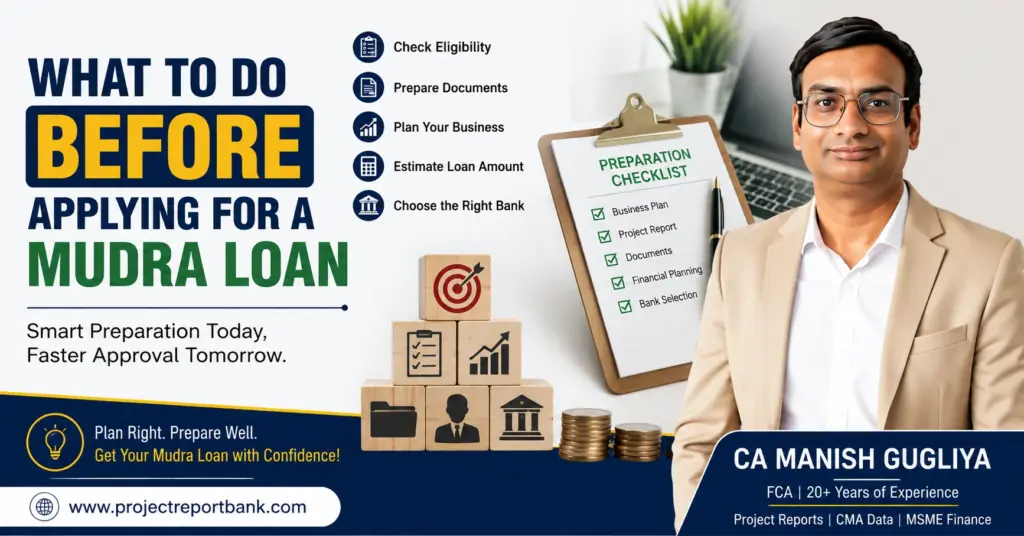
- What to Do Before Applying for a Mudra Loan
- Which Bank Should You Choose for Your Mudra Loan Application?
- Online vs Offline Mudra Loan Application: Which Method Is Better for Faster Approval?
- How to Fill the Mudra Loan Application Form Correctly
- How to Apply for a Mudra Loan: Step-by-Step Guide (By CA Manish Gugliya, FCA)