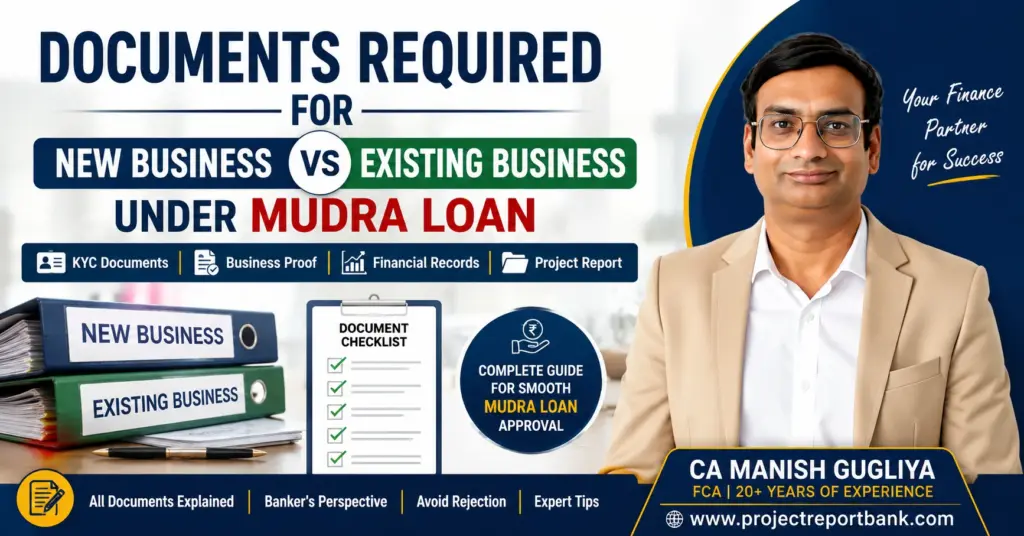
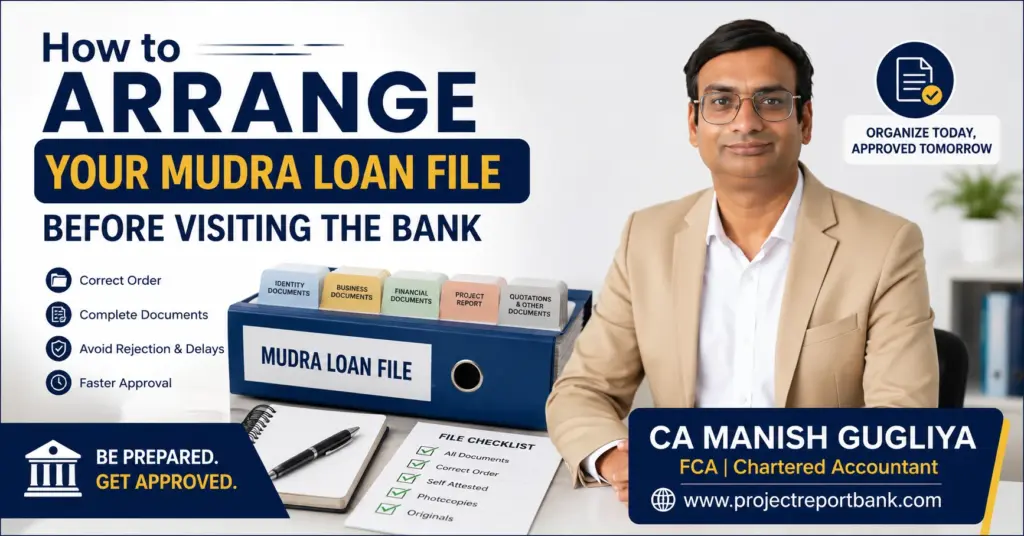
Most mudra loan applications don’t get delayed because of eligibility – they get delayed because the file is a mess. I’ve seen this hundreds of times. The applicant has every document but hands over a loose bundle of mixed papers. The banker flips through, can’t find the bank statement, asks the applicant to come back, and two weeks are lost.
This guide shows you exactly how to arrange your mudra loan file so the credit officer can verify everything in one sitting.
Key Takeaways
A neat, logically arranged mudra loan file can cut verification time by half and often decides whether the banker takes your case seriously in the first meeting. Mudra loans are available to individuals and MSMEs – including sole proprietorships and partnership firms – and no collateral is required for loans up to ₹10 lakh. But collateral-free does not mean documentation-free.
- Group documents into clear sections: Personal, Business, Financial, Project, and Supporting – placed in a fixed, professional order inside a single file.
- Every photocopy should be clear, self-attested where required, page-numbered, and matched with an index page at the front.
- Always carry originals separately, plus at least one extra photocopy set, passport photos, and basic stationery when visiting the bank branch.
- A neatly indexed file reduces processing delays in loan applications – this alone can move your file ahead of dozens of others sitting on the same desk.
This guide is written from my perspective as CA Manish Gugliya (FCA), based on 20+ years of preparing bank-ready mudra loan files for MSMEs and small businesses across India.
Why Proper Mudra Loan File Arrangement Matters
Picture two applicants walking into the same branch on the same morning. The first hands over a plastic bag with photocopies, loose quotations, and an unsigned form. The branch manager asks for Udyam registration – the applicant digs through the pile for five minutes and can’t find it. File returned, visit wasted.
The second applicant places a clip file on the desk with a cover page, an index, and coloured section dividers. The credit officer opens it, finds Aadhaar and PAN on page 2, Udyam on page 12, project report on page 18. Verification begins immediately.
Under Pradhan Mantri Mudra Yojana, banks have disbursed over ₹40.07 lakh crore through more than 57 crore accounts as of March 2026. Branches handle many files daily. Here is why arrangement matters:
- Faster verification – organizing documentation helps loan officers verify identity quickly and complete their checklist without shuffling papers.
- Better first impression – a structured file signals seriousness and repayment capacity to the branch manager.
- Fewer missing papers – clear arrangement reduces the chance of forgetting bank statements, GST returns, rent agreements, or machinery quotations.
- Smoother internal approval – when the branch forwards your file to the regional office or sanction committee, a well-ordered file with page numbers gets reviewed faster.
Table of Contents
Documents Required Before You Start Arranging the File
Before thinking about file order, collect every document first. For a comprehensive list, you can refer to the Mudra Loan Documents Required guide. Below is a quick reference table that explains why each paper matters.
| Document Type | Why It Is Needed |
|---|---|
| PAN Card | KYC documents include PAN card – mandatory for all eligible borrowers and for income verification |
| Aadhaar Card | KYC documents include Aadhaar card – serves as both identity and address proof |
| Passport-Size Photographs (4–6) | Mudra application form must be completed with photographs; banks paste them on forms and KYC cards |
| Address Proof (utility bills, rent agreement, property tax receipt, bank passbook) | Verifies current residential and business address |
| Business Registration (trade licence, Shop & Establishment, FSSAI, partnership deed) | Proof of business identity includes registration certificates or trade licenses |
| Udyam / MSME Registration | Confirms micro enterprises engaged in income generating activities under the government of india scheme |
| GST Registration & Returns (if applicable) | Required for businesses above threshold; shows trading and services turnover |
| Bank Statement (last 6–12 months) | Income documentation requires a bank statement from the last 12 months to assess cash flow |
| ITR (previous 1–2 years) | ITR from the previous year is needed if applicable – shows tax compliance and income |
| Project Report / Business Plan | A project report detailing expected sales and costs may be necessary, especially for Kishore and Tarun categories |
| Machinery & Equipment Quotations | Supports the proposed activity cost; must include vendor name, date, and detailed breakdowns |
| Rent Agreement / Shop Documents / NOC | Confirms business premises stability for the beneficiary micro unit |
| Existing Loan Details (sanction letters, EMI schedules) | Helps banker check if borrower has successfully repaid previous loans and calculate present obligations |
| SC/ST/OBC / Category Certificates | Proof of eligibility for SC/ST/OBC categories may be required for priority or subsidy benefits |
A business profile should detail the nature and purpose of the loan – even a one-page write-up on letterhead helps. Note that the document mix changes for new vs existing businesses.
Shishu loans provide up to ₹50,000 (or rs 50,000) with minimal paperwork. Kishore loans range from ₹50,001 to ₹5 lakh with moderate documentation. Tarun loans range from ₹5 lakh to ₹10 lakh and require the strictest documentation including CA-certified financial documents.

Best Order to Arrange Your Mudra Loan File
Every bank or financial institution has its own format, but over 20+ years of practice, the sequence below has consistently worked well across public sector banks, private banks, small finance banks, and even financial institutions like NBFCs for mudra loan file preparation.
Arrange your loan application documents in a sequential order for clarity:
- Cover page – applicant name, business name, contact details, mudra category (Shishu / Kishore / Tarun), and proposed loan amount
- Index page – with section numbers and page ranges
- Completed application form – filled accurately and signed; include any bank-specific forms
- Passport photographs – 2–4, neatly pasted or in a transparent pouch
- Aadhaar card copy
- PAN card copy
- Other ID proofs (Voter ID, Passport, Driving Licence)
- Address proof documents
- Business registration documents
- Udyam Registration certificate
- GST registration and latest returns
- Business profile on letterhead – nature of activity, location, customers, experience
- Business plan summary
- Detailed project report
- CMA data or projected profit & loss and cash flow (for term loan and working capital assessment)
- Machinery/equipment quotations, vehicle quotations, renovation estimates
- Bank statements (last 6–12 months, all operative accounts)
- ITR acknowledgments (previous 2 years)
- CA-certified financials (for existing businesses seeking Kishore/Tarun)
- Summary of existing EMIs
- Existing loan sanction letters and latest statements
- Credit card statements (if EMI is significant)
- CIBIL report copy (if already obtained)
- Supporting documents – rent agreement, property papers, unit photographs, other documents like training certificates
- Bank-specific declarations or undertakings
This order follows the banker’s natural workflow: first they check basic details and identity, then business existence, then project viability, then financial capacity, and finally supporting evidence. Include proof of identity with a self-attested copy of PAN, Aadhaar, or other ID at the appropriate position.
How to Divide the File into Logical Sections
Instead of one long bundle, divide your file using coloured separators or printed section sheets. This lets bankers jump to any part in seconds.
Label five core sections clearly:
- Personal Documents – KYC proofs, photographs, personal declarations. Quick to check; builds basic individual borrowers profile.
- Business & Registration Documents – firm identity (proprietorship / partnership / company), Udyam, GST, licences, shop documents. Bankers recheck this during site visit and appraisal for various types of micro enterprises.
- Financial Documents – bank statements, ITR, financial statements, existing loans. This section is assessed based on the credit needs and repayment capacity of the applicant.
- Project & Quotations – business plan, project report, term loan and working capital requirements, quotations, cost sheets. Critical for justifying loan amount beyond ₹50,000, especially for Kishore and Tarun where capital assets are involved.
- Supporting & Miscellaneous – rent agreement, unit photographs, category certificates, training certificates showing necessary skills, and previous correspondence with the bank.
Each section should begin with a mini-cover sheet listing what is inside. No loose papers should float outside these sections.
Self-Attestation, Originals, and Use of Folders
“Self-attested” simply means signing each photocopy with your full signature, date, and writing “Self-attested” at the bottom. Use self-attested photocopies of documents unless originals are requested.
Documents to self-attest: Aadhaar, PAN, address proof, Udyam, GST, bank statements (if not directly bank-printed), ITR, and major licences. Quotations and project reports usually don’t need attestation unless the lender specifically asks.
Always carry originals of Aadhaar, PAN, business registration, Udyam, rent agreement, and bank passbook in a separate small folder – shown only for verification, never submitted.
Best file type: A good-quality plastic clip file or lever arch file with transparent sleeves for key KYC and financials works best. Avoid thick spiral binding – bankers need to photocopy or scan selected pages, and rigid binding makes that difficult. The file should be flexible but secure, with no torn or loose sheets.
Index Page, Page Numbering, and Common Mistakes
An index page on the inside cover acts as a roadmap for the banker, especially when your mudra loan file runs 40–80 pages for higher loan amounts. Here is a sample:
| Section No. | Document Description | Page Range |
|---|---|---|
| 1 | Application Form & Photographs | 1–4 |
| 2 | KYC / Identity & Address Proofs | 5–12 |
| 3 | Business & Registration Documents | 13–20 |
| 4 | Project Report & Quotations | 21–35 |
| 5 | Financial Documents & Bank Statements | 36–50 |
| 6 | Existing Loans & Credit History | 51–55 |
| 7 | Supporting & Miscellaneous | 56–62 |
Number every page in pencil at the bottom right corner and ensure page numbers match the index. This becomes a reference point during queries from the branch manager or regional office.
Common mistakes that cause delays:
- Random document order with no index – file kept “pending for clarification”
- Unsigned or incomplete application forms – returned on the spot
- Blurred or cropped photocopies – identity cannot be verified
- Expired trade licences or outdated address proof – re-submission required
- Multiple versions of the same Aadhaar (old and new address) without marking which is current
- Missing machinery quotations – loan amount may be reduced at the bank’s sole discretion
- No self-attestation on KYC copies – repeated visits
For more real-life examples, read about common documentation mistakes that delay mudra loan approval.

Pre-Visit Checklist, Carry-Along Items, and Professional Tips
Before leaving home, run through this checklist. It is based on typical questions bankers ask during first mudra loan meetings.
Pre-Visit Checklist:
- ☐ File arranged in defined order with cover page
- ☐ Index page ready and page numbers match
- ☐ All KYC and key documents self-attested
- ☐ At least one extra photocopy set prepared
- ☐ Completed application form filled, signed, photographs pasted
What to carry with your file:
- Original KYC documents and business registrations
- Original rent agreement or property proof
- Latest bank passbook
- Business visiting card
- 4–6 extra passport photographs
- Rubber stamp of firm (if any)
- Pen, stapler, and a small notebook
- Mobile phone with scanned copies of all documents (keep data secure; share only with authorized bank staff)
Professional tips from my practice:
Reach the bank at least 30–45 minutes before closing. Be prepared to clearly explain your business model, how the loan will fund income generating activities, and your term loan or working capital requirement. Politely ask the banker if any additional documents specific to that branch or the scheme are needed – because the policy framework allows each lender some flexibility. Being confident about your proposed activity and how assets created from the loan extended will generate savings and employment creation makes a strong impression.
Sample Ideal Mudra Loan File Layout, FAQs & Author Bio
Here is how the complete mudra loan file should look when opened on the banker’s table:
| Position in File | Contents |
|---|---|
| Top | Cover page (name, business, loan amount, mudra category) |
| 2 | Index page |
| 3 | Application form with photographs |
| 4 | KYC block (Aadhaar, PAN, address proof) |
| 5 | Business registration, Udyam, GST |
| 6 | Business profile on letterhead |
| 7 | Project report and business plan |
| 8 | Machinery / equipment quotations |
| 9 | Bank statements and financial documents |
| 10 | ITR and CA-certified financials |
| 11 | Existing loan details and credit history (satisfactory credit track record helps) |
| 12 | Supporting documents (rent agreement, photos, certificates) |
| 13 | Bank-specific annexures and declarations |
This layout works whether you are applying at a bank, NBFC, or through a digital mudra loan portal. The maximum loan amount is ₹10 lakh under PMMY, though Tarun+ loans can go up to ₹20 lakh. The minimum loan amount is ₹30,000 and repayment tenure can be up to 5 years. Interest rates are determined by individual banks. The minimum age for applicants is 18 years and the maximum age limit is 65 years. No collateral security is required for loans – the scheme is designed as financial assistance for non corporate micro units development and the refinance agency MUDRA provides funding support to lenders.
Whether you’re looking for a business loan, a personal loan for a dream car through other channels, or covering loans for credit needs of micro enterprises – the documentation and eligibility principles remain consistent. A loan that has been availed and repaid builds a satisfactory credit track record, which helps when the loan is extended to the next phase or a higher stage. The government of india, through this scheme, provides a policy framework where the interest and finance terms are at the lender’s discretion, and the first charge on assets created stays with the bank. The borrower’s educational qualification is not a barrier – what matters is the proposed activity and whether the applicant demonstrates necessary skills. Every application is assessed based on the credit profile, and the beneficiary micro unit’s viability matters more than the applicant’s formal education.

Is an index page compulsory for a Mudra loan file?
No bank will formally reject your file for lacking an index page. But from my experience, files without an index sit longer on the “pending” pile. When a credit officer handles 15–20 files a day, an index lets them locate any document in seconds. For Shishu loans around ₹50,000, a simple handwritten index works. For Kishore and Tarun, a typed index is strongly recommended.
Should I clip originals and photocopies together?
Never. Keep originals in a separate small folder. Submit only self-attested photocopies inside your main file. The banker will ask to see originals for verification and return them the same day. Mixing them risks losing an original document inside the bank’s internal filing system.
Can I submit a handwritten project report for a Shishu loan?
For very small Shishu loans, some banks accept a simple handwritten business plan summary – what you sell, who your customers are, expected monthly income and expenses. But even here, a neatly typed one-page report creates a better impression. For Kishore and Tarun, a proper project report is practically mandatory.
Does proper file arrangement guarantee loan approval?
No. Loan sanction depends on eligibility, credit history (whether previous loans were repaid), business viability, and cash flow projections. But good file arrangement removes one of the biggest friction points – it ensures the banker can evaluate your application without delays, and it demonstrates that you are serious about the funding you are requesting.
How many photocopy sets should I carry?
Carry at least two complete sets. One goes to the bank as part of the submitted application. The second stays with you as a personal record and backup in case the bank asks for a replacement. Some services and branches require a third set for their regional office.
Written by CA Manish Gugliya (FCA) – a Chartered Accountant with over 20 years of hands-on experience in Business Valuation, Project Reports, CMA Data Preparation, Business Planning, MSME Finance, Startup Advisory, and Mudra Loan Consulting. He helps individual borrowers and micro enterprises prepare bank-ready files that get processed faster. Visit ProjectReportBank.com for ready-to-use project reports, CMA data templates, and practical Mudra loan guidance.
- Why a CA-Prepared Project Report Improves Mudra Loan Approval Chances
- How to Arrange Your Mudra Loan File Before Visiting the Bank
- Common Documentation Mistakes That Delay Mudra Loan Approval
- Udyam Registration for Mudra Loan: Complete Document Guide by CA Manish Gugliya
- Is Project Report Mandatory for Mudra Loan?
- Quotations Required for Machinery and Equipment Under Mudra Loan
- Bank Statement Requirements for Mudra Loan
- Financial Documents Required for Mudra Loan Approval
- Documents Required for New Business vs Existing Business Under Mudra Loan: Complete Comparison Guide