Key Takeaways
- Udyam registration for mudra loan is not legally compulsory under PMMY, but most banks strongly prefer it for faster processing and higher loan amounts.
- Mudra loans are available in three categories: Shishu, Kishor, and Tarun, offering collateral-free funding up to ₹10 lakh under mudra yojana. No collateral is required for loans under Mudra Yojana.
- Applicants can still avail loans with alternative business proofs (bank statements, shop license, rent agreement) if they lack Udyam or GST, especially for shishu loan and smaller Kishore amounts.
- Proper business documents directly impact eligibility, interest rates, and sanction speed for any business loan under the pradhan mantri mudra yojana.
- Documentation requirements differ across commercial banks, small finance banks, and non banking financial companies, so always confirm the exact checklist with your lender before submitting your loan application.
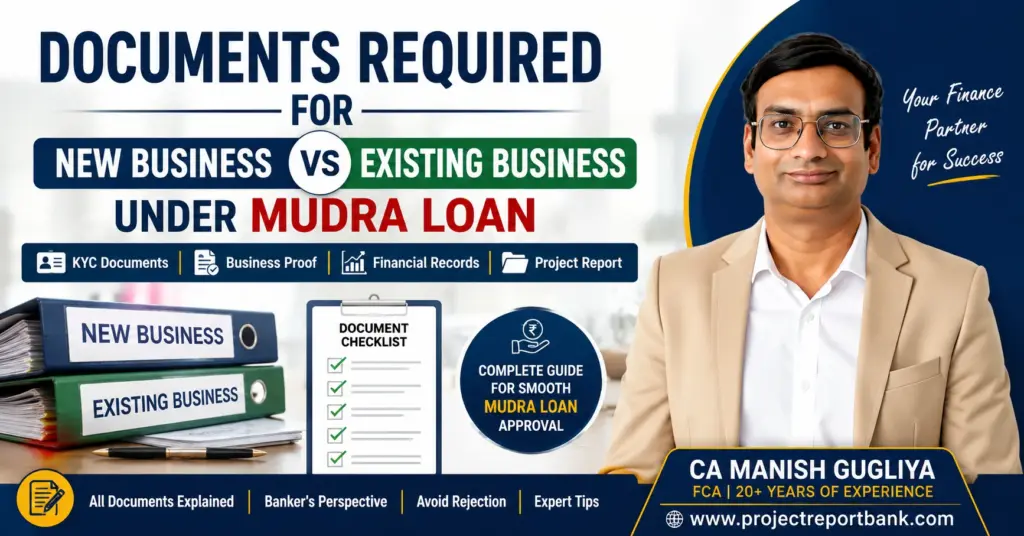
- As CA Manish Gugliya, I will share practical, experience-based tips on documents required for new vs existing businesses to help you prepare for a smooth pm mudra loan process.
Introduction: Why Business Documents Matter for Mudra Loan
I recently worked with a small trading business owner in Jaipur whose mudra loan application sat untouched at the bank for three weeks. His business was profitable, his repayment capacity was solid, but his file was incomplete. Missing rent agreement, outdated shop license, no Udyam certificate. That delay was entirely avoidable.
The pradhan mantri mudra yojana pmmy offers collateral-free mudra loans up to rs 10 lakh, but banks still need strong business identity and financial documents to assess eligibility criteria. Many first-time applicants assume that just an aadhaar card and PAN are enough. That misconception leads to rejection or very low sanction, especially for amounts above rs 5 lakh.
A mudra loan requires a completed application form, two passport-sized photographs, and proper KYC. Applicants must be aged between 18 to 65 years. Beyond these basics, banks look for Udyam Registration, GST certificate, shop license, address proof, utility bills, and income proof to confirm your enterprise is genuine and active.
Document expectations are noticeably stricter for Kishore and tarun loan categories than for very small Shishu amounts. Tarun loans offer ₹5 lakh to ₹10 lakh for established businesses, and banks naturally want more proof before releasing larger sums.

Is Udyam Registration Mandatory for Mudra Loan?
Udyam registration for mudra loan is not a legal requirement under the PMMY scheme guidelines, but in my experience, many bank branches strongly prefer it, especially for loan amounts above ₹1–2 lakh.
Udyam registration is an online process to obtain an MSME certificate from the Government of India. It classifies micro units, small, and medium enterprises based on investment and turnover using Aadhaar and PAN. The registration is free and does not require third-party agents. You receive a unique Udyam Registration Number (URN) that proves the existence of your enterprise.
An Udyam certificate streamlines loan applications by verifying business legitimacy. Having an Udyam registration enhances credibility for accessing loans and can assist in verifying business information for banks. Lenders prioritize MSME applications with Udyam registration for quicker processing. It may also help access priority sector lending from banks and supports eligibility for various government schemes beyond the mudra scheme.
From practical banking experience, for Shishu loans some banks accept alternative proofs. But for Kishore and Tarun categories, branches almost always ask for Udyam as primary MSME proof. Since Udyam registration can be completed in a single day on the official portal, I strongly recommend obtaining it before approaching any bank or financial institutions.
Make sure your Udyam details (business name, address, activity) match your PAN, GST, and bank records. Mismatches here are a top reason for documentation delays during underwriting.
Table of Contents
GST Registration for Mudra Loan: When Is It Required?
GST registration is not automatically required for every borrower. It depends on whether your business is legally liable under GST based on turnover or nature of supplies.
Typical GST registration thresholds are approximately ₹40 lakh for goods and ₹20 lakh for services (lower in some states). These limits change per government notifications, so verify with your CA or check CBIC circulars. Note that agricultural businesses are not eligible for mudra loans, so that sector is not relevant here.
Who usually needs GST for Mudra Loan?
- Wholesalers and retailers with turnover above threshold
- Manufacturers selling inter-state
- E-commerce sellers
- Service providers crossing threshold limits
Many PMMY borrowers under Shishu and low Kishore categories operate below GST limits. Banks accept other documents instead. However, if your bank statements show high monthly credits but you have no GST registration, the bank may question the gap and cap your loan amount lower. Income proof includes bank statements from the last 12 months, and banks cross-check these against declared turnover.
A borrower with GST returns gives the credit officer a clear picture of cash flow and income. Without GST, the officer must rely more heavily on bank statements, sales records, and business photographs, which takes longer.
Can You Get Mudra Loan Without GST or Udyam Registration?
Yes. Many micro-entrepreneurs successfully get mudra loans without GST or Udyam, especially smaller amounts. Mudra loans are available for individuals and MSMEs across India.
Shishu loans provide up to ₹50,000 for startups. Kishore loans range from ₹50,001 to ₹5 lakh for expansion. For these categories, banks commonly accept:
- 6–12 months of bank statements (read more about bank statement requirements for Mudra Loan)
- Sales bills and purchase invoices
- Business photographs showing premises and goods
- Rent agreement of shop or office
- Electricity bill for business premises
- Municipal or shop license
A home-based food business I worked with obtained a Kishore loan using business photographs, a rent agreement, sales bills, and consistent bank account credits. No GST, no Udyam. It worked because the alternative proof was thorough.
However, absence of these registrations can limit your maximum loan amount and invite closer scrutiny for loans nearing 5 lakh or 10 lakh. For a detailed guide, see Can I Get Mudra Loan Without GST or Udyam Registration?
If you plan to expand your business and require funds for bigger loans later, obtain Udyam and GST registration now. It saves time and builds a paper trail.
Other Business Documents Banks Usually Ask for Under PMMY
Apart from Udyam and GST, banks ask for several other documents depending on the nature and size of your business operations. Proof of business ownership is required for mudra loans, and KYC documents include Aadhaar, PAN, and voter ID.
Common business registration and identity documents:
| Document | Who Needs It | Mandatory? |
|---|---|---|
| Shop & Establishment License | Retail shops, offices | Often required |
| Trade License | Manufacturing, trading businesses | Varies by city/state |
| FSSAI License | Food businesses | Yes, if in food sector |
| Professional Tax Registration | Service providers in applicable states | Sometimes asked |
| Import Export Code | Exporters/importers | Only if applicable |
| Current Account Proof | All applicants ideally | Strongly preferred |
Premises and address proof: Banks ask for a registered rent agreement or ownership proof, electricity bill or telephone bill in the business or owner’s name. Your current address and business address must match across all KYC documents.
Ensure licenses are valid and not expired. Trade names must match across documents. Renew municipal or panchayat trade licenses before submitting your application process paperwork. No single document on this list is universally mandatory for all mudra loan documents. Requirements vary by bank, loan amount, and business profile.
Documents Required for New vs Existing Businesses (Including Financial Papers)
Banks evaluate new and existing businesses very differently.
New businesses need:
- Proposed business profile and plan
- Quotations for machinery or equipment on supplier letterhead (see machinery and equipment quotations for Mudra Loan)
- A basic project report with estimated income, expenses, and cash flow projections
- Business location proof (rent agreement or ownership)
- Personal KYC: Aadhaar, PAN, passport-sized photographs
Existing businesses need:
- Udyam Certificate and GST returns (if registered)
- Bank statements from the last six months to 12 months
- Income tax returns for 1–3 years
- Sales and purchase registers
- Copies of existing licenses
Financial documents play a decisive role. For a complete breakdown, see financial documents required for Mudra Loan approval.
Banks insist on a structured project report for Kishore and Tarun categories to understand loan utilisation and repayment planning. Even for the Tarun Plus category, which provides the maximum loan amount of ₹10 lakh to ₹20 lakh for expanded businesses, a detailed project report is expected. Learn more at Is a Project Report Mandatory for Mudra Loan?

Business Documents by Type of Entity & Common Mistakes to Avoid
Document needs differ across entity types even within the same mudra scheme framework.
Proprietorship: Banks rely on the owner’s KYC, Udyam Registration, local shop license, business bank statement, rent agreement, electricity bill, and business photographs. This covers most small businesses and non corporate micro units.
Partnership Firms & LLPs: Submit the Partnership Deed or LLP Agreement, firm PAN, Udyam and GST (if applicable), and a resolution letter naming the partner authorised to borrow.
Private Limited Companies: Certificate of Incorporation, Memorandum and Articles of Association, company PAN, board resolution, director KYC, Udyam Registration, GST certificate, and current account statement in the company name.
Home-based and online businesses: Use a combination of Udyam, digital store proof, courier invoices, and bank statements. Online businesses can apply online and submit other documents in pdf format.
Common documentation mistakes I see repeatedly:
- Mismatched address across Aadhaar, PAN, Udyam, GST, and bank
- Spelling errors in business name across documents
- Expired FSSAI or trade license submitted without renewal
- Missing rent agreement for business premises
- Incomplete or inconsistent GST details on returns
Quick fixes: Update KYC before applying, correct Udyam details online, renew all licenses, ensure your business registration address matches your loan application, and keep bank statements no older than 30 days.
Practical Tips, FAQs and Conclusion: Improving Your Chances of Mudra Loan Approval
Prepare a single organised file containing your Udyam Certificate, GST certificate (if applicable), shop and trade licenses, bank statements for the last six months, ITRs, rent agreement, electricity bill, and key quotations before visiting the bank. This applies whether you submit physically or apply for mudra loan online.
Maintain a clean bank statement. Avoid cheque bounces, maintain average balance, and route all business sales through the account. This directly affects your sanction and the interest rates offered. Interest rates for mudra loans vary by bank, so compare across lenders. Mudra loans have a repayment tenure of up to 5 years.
Loan approval depends on the lender’s assessment of the application, not just on having the right documents. Mudra Yojana supports micro and small enterprises in India as a government initiative providing financial assistance through micro finance institutions, refinance agency channels, and commercial banks. Mudra stands for Micro Units Development and Refinance Agency.
Clarify your exact requirement. Whether it is ₹2 lakh working capital or ₹5 lakh for assets and machinery, prepare a simple utilisation plan to discuss with the credit officer. This demonstrates you are an eligible and serious applicant ready to submit a strong loan application.
For online-only businesses, banks accept website screenshots, payment gateway records, and courier invoices as proof. If home address and shop address differ, declare both clearly and maintain consistency across identity documents. Students or homemakers starting a new business can apply if they meet the scheme’s eligibility criteria and provide a viable business plan. Banks verify on-ground business existence through field visits, so keep your trading or service premises accessible.
In my 20+ years of practice, I have seen that complete, accurate, and well-organised documentation is the single biggest factor separating fast approvals from frustrating delays. Treat document preparation as seriously as running your business. ProjectReportBank.com can assist with professional project reports, CMA data, and documentation planning for Mudra and other business loans.

Frequently Asked Questions on Udyam Registration and Mudra Loan
This FAQ section addresses specific queries borrowers commonly ask after understanding basic mudra loan documents and Udyam requirements.
Can I update my Udyam Registration details after getting a Mudra loan?
Yes. Udyam details like address, activity, and contact information can be updated anytime on the official Udyam portal even after your beneficiary micro unit has received funding. If your business address or activity changes, update Udyam first and then submit the updated certificate to your bank so internal records remain consistent for future renewals or top-ups.
Is Udyam Registration required if my turnover is below ₹5 lakh?
Udyam registration is not legally compulsory even for very small turnover, but it remains beneficial. It helps prove MSME status and gives comfort to banks during assessment. Even small street vendors or home-based units can obtain Udyam quickly using Aadhaar and PAN, which may improve chances of getting more than just a basic Shishu limit.
Will banks accept my home address as business address for Mudra loan?
Many micro and home-based businesses operate from residential premises, and banks commonly accept this if clearly declared. Support it with address proof like an electricity bill or ration card. Keep the same address consistently across Aadhaar, PAN, Udyam, bank account, and loan application to avoid confusion during field verification.
Can I change my business location after sanction of Mudra loan?
Yes, but inform your lender in writing and update all supporting required documents: rent agreement, electricity bill, Udyam Registration, and GST registration. Non-disclosure of major shifts (such as moving to another city) may create issues during periodic inspections or when applying for future business loans.
Does having Udyam Registration guarantee Mudra loan approval?
No. Udyam improves your documentation strength and credibility, but banks still examine bank statements, income, credit history, and overall business viability. Treat Udyam as one important piece of the puzzle alongside clean banking, proper financial records, and a realistic project report. If your situation is complex, consult your CA or visit ProjectReportBank.com for tailored guidance.
- Why a CA-Prepared Project Report Improves Mudra Loan Approval Chances

- How to Arrange Your Mudra Loan File Before Visiting the Bank

- Common Documentation Mistakes That Delay Mudra Loan Approval
- Udyam Registration for Mudra Loan: Complete Document Guide by CA Manish Gugliya
- Is Project Report Mandatory for Mudra Loan?
- Quotations Required for Machinery and Equipment Under Mudra Loan

- Bank Statement Requirements for Mudra Loan

- Financial Documents Required for Mudra Loan Approval
- Documents Required for New Business vs Existing Business Under Mudra Loan: Complete Comparison Guide