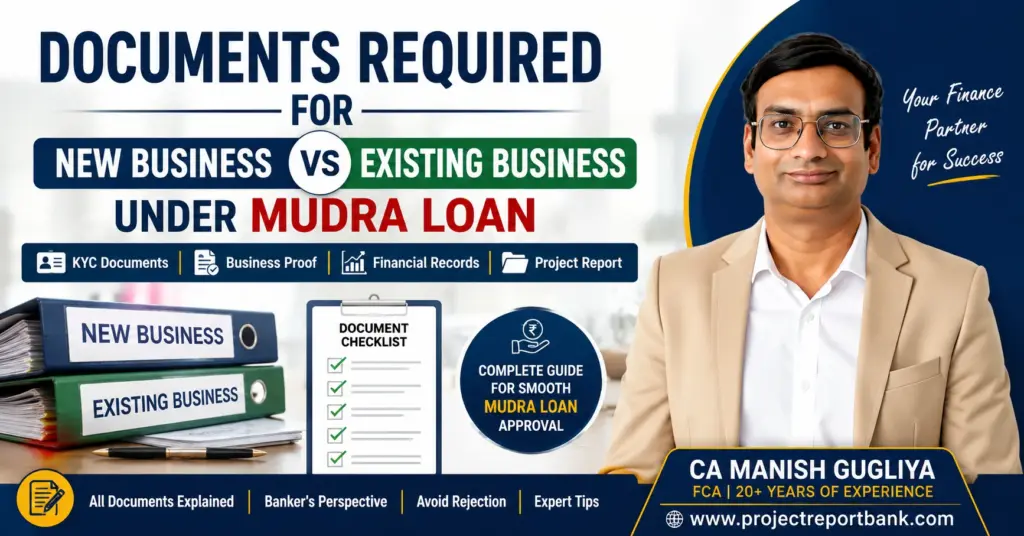
Documentation is the single most important stage of getting a Mudra Loan approved. I have seen thousands of applications over 20+ years of practice, and I can tell you this clearly – most delays and rejections happen because of missing or wrong documents. Not because the business idea is bad. Not because the applicant is not eligible. Simply because the documents were not right.
Under the Pradhan Mantri Mudra Yojana (PMMY), banks and financial institutions need to verify your identity, your business activity, your ownership details, and your repayment capacity. Documentation requirements for PMMY loans vary for new and existing businesses. A new business has no financial history. An existing business has a track record. So the bank asks different documents from each.
This guide gives you a clear, side-by-side comparison. After reading this, you will know exactly which documents to prepare – whether you are starting fresh or already running a business.
The short answer: New businesses mainly need projected financial documents (business plan, project report, estimated cash flows, machinery quotations). Existing businesses mainly need historical financial documents (Income Tax Returns, bank statements, profit & loss accounts, GST returns). Basic KYC documents are required for all PMMY loan applications. The documentation process is typically easier for existing businesses because most records already exist, but preparation quality matters more than business stage.
Table of Contents
Understanding Why Document Requirements Differ
Banks are not asking documents just for the sake of formality. Every document serves a specific purpose in the bank’s risk assessment process.
Risk assessment is different for each category. When an existing business applies for a Mudra Loan, the bank can look at past sales, cash flows, profits, and losses. The bank can assess creditworthiness based on real numbers. But when a new business applies, there is no operating history at all. The bank must rely on projections, promoter credentials, and the strength of the business plan.
Operating history vs projected feasibility. Existing businesses can submit a bank statement showing regular inflows. They can show income tax returns for the last two years. They can present GST returns proving turnover. New businesses cannot show any of this. Instead, they must submit estimated income statements, projected cash flows, and cost breakdowns.
Why the Project Report matters so much for new businesses. Since a new business has nothing to show, the project report becomes the most critical document. It explains the business idea, market demand, cost of machinery, working capital needs, revenue projections, and repayment schedule. Without a strong project report, no bank will approve a loan for a new business. For existing businesses, a project report is needed mainly for expansion or modernization.
Loan category thresholds also matter. Under the Mudra scheme, there are different categories – Shishu (up to Rs 50,000), Kishor (Rs 50,000 to Rs 5 lakh), Tarun (Rs 5 lakh to Rs 10 lakh), and Tarun Plus (up to Rs 20 lakh). For shishu loans, documentation is lighter for both new and existing businesses. For Tarun and Tarun Plus categories, banks require detailed project reports, financial projections, and comprehensive documentation. The maximum loan amount under Mudra is Rs 20 lakh under the Tarun Plus category.
Documents Required for New Business vs Existing Business: Quick Comparison
Here is a detailed comparison table showing how documents required differ between a new business and an existing business under Mudra Loan:
| Document Type | New Business | Existing Business | Mandatory / Optional |
|---|---|---|---|
| Aadhaar Card | Required for identity verification | Required for identity verification | Mandatory |
| PAN Card | Required for all applicants | Required for all applicants | Mandatory |
| Passport-size Photographs | Recent photos of promoter(s) | Recent photos of promoter(s) | Mandatory |
| Address Proof (Residential) | Utility bills, Voter ID, Passport, Driving Licence | Utility bills, Voter ID, Passport, Driving Licence | Mandatory |
| Business Address Proof | Rent agreement or ownership deed | Rent agreement or ownership deed | Mandatory |
| Loan Application Form | Filled Mudra loan application form | Filled Mudra loan application form | Mandatory |
| Project Report / Business Plan | Detailed report with projections, market analysis, cost of project | Expansion or modernization report (if applicable) | Mandatory for Kishor/Tarun/Tarun Plus |
| Estimated Financial Statements | Projected income, cash flow, balance sheet | Not needed (historical data used instead) | Mandatory for new business |
| ITR (Last 2 Years) | Not available (no history) | Must submit last two years’ returns | Mandatory for existing business |
| Bank Statement (6-12 Months) | Promoter’s personal statement (if available) | Business bank statement mandatory | Mandatory for existing business |
| Profit & Loss Account | Projected estimates only | Audited/unaudited for last 2 years | Mandatory for existing business |
| GST Registration | Not required if not registered yet | Required if registered | Mandatory for existing business (if applicable) |
| Udyam Registration | Optional at application stage | Should be valid and up-to-date | Recommended |
| Machinery / Equipment Quotations | Mandatory (proforma invoices from vendors) | Required if purchasing new assets | Mandatory |
| Trade License / Shop Establishment | If obtained | Must be valid and renewed | As applicable |
| Stock Statement | Not applicable | Required to show inventory | Mandatory for trading/manufacturing |
| Sales / Purchase Register | Not applicable | Required to show business activity | Mandatory for existing business |
| Educational / Experience Certificates | Helps strengthen application | Not usually needed | Optional |
| Partnership Deed / MOA-AOA | If applicable to business structure | If applicable to business structure | Mandatory for firms/companies |
| Existing Asset & Liability Statement | Not applicable | Required to show financial position | Mandatory for existing business |
Key takeaway: New businesses need more projected and planning documents. Existing businesses need more historical and compliance documents. The common thread is strong KYC and a clear explanation of how funds will be used.
Financial Documentation Requirements
This is where the biggest difference between new and existing businesses shows up.
New Business Financial Documents
Since operations have not started yet, a new entrepreneur cannot show past income or expenses. Banks accept projected financials instead:
- Estimated Income Statement – How much revenue you expect, and what your expenses will be
- Projected Cash Flow Statement – Month-by-month or year-by-year cash inflows and outflows
- Cost of Project – Total investment required (machinery, furniture, raw material, working capital)
- Means of Finance – How much is your own contribution (promoter’s share) and how much you need as a loan
- Quotations for machinery or inventory – Authentic proforma invoices with vendor GST details
- CMA Data – For higher loan amounts, banks may ask for Credit Monitoring Arrangement data
New businesses might not have prior borrowing history to show. MUDRA loans can be applied for without formal income proof for small loans (Shishu category). But for Kishor, Tarun, and Tarun Plus, projected financial documents become strictly required.
Existing Business Financial Documents
Existing businesses must provide historical financial records when applying for PMMY loans:
- Income Tax Returns for the last two years – This is one of the most important documents. Existing businesses typically provide Income Tax Returns for two years.
- Profit & Loss Account for at least the last two years
- Balance Sheet for the last two years
- Bank Statement for the last 6 to 12 months – Shows regular business inflows and repayment capacity
- GST Returns – Proves turnover and compliance
- Sales Register and Purchase Register – Shows trading or manufacturing activity
- Current year sales achieved to date – Demonstrates continuity
Winner: Existing Business – Existing businesses often have established financial records for assessment, making verification easier and faster. New businesses face more scrutiny because projections are uncertain. Banks often discount projected cash flows and impose higher promoter contribution (10-25%) for new ventures.
Business Proof and Registration Documents
New Business Registration Documents
For a new business, registration documents may be limited:
- Udyam Registration – If you have already registered your micro units with the government of India portal
- Trade License or Shop & Establishment Certificate – If obtained
- Partnership Deed – If the business is a partnership firm
- LLP Agreement – If structured as an LLP
- Company Incorporation Documents (MOA/AOA) – If registered as a private limited company
- Business Address Proof – Rent agreement for rented premises, ownership deed for own premises, and utility bills
- Photographs of business premises – If available
Business registration proof may be required for first-time borrowers. But banks show some flexibility for new businesses that are not yet fully registered, provided the business plan is strong.
Existing Business Registration Documents
For an existing business, banks expect complete and valid registration:
- GST Registration Certificate – Must be active with returns filed
- Udyam / Udyog Aadhaar Registration – Should be valid
- Shop & Establishment Licence – Must be renewed
- Trade Licence – Must be current
- Partnership Deed or Company Documents – As applicable
- Proof of business continuity – Utility bills in business name, ongoing licence, evidence of trading activity
Proof of business continuity is needed from existing businesses applying for PMMY loans. Banks verify that the business is genuinely operational.
Winner: Existing Business – All registration and licence documents already exist. The entrepreneur just needs to ensure they are valid and renewed. New businesses may need to spend time registering and obtaining initial licences before even applying.
Project Planning and Feasibility Documents
New Business Project Reports
A new business needs a detailed project report that covers:
- Executive summary of the business idea
- Promoter’s profile, educational background, and experience
- Market analysis – local demand, competition, target customers
- Operational plan – how the business will function day to day
- Detailed machinery and equipment list with quotations
- Cost of project schedule – civil works, machinery, working capital, pre-operative expenses
- Means of finance – promoter’s contribution vs mudra loans
- Revenue and expense projections for 3-5 years
- Cash flow projections for the loan tenure
- Repayment schedule showing how EMIs will be serviced
For loans under higher categories (Tarun, Tarun Plus, or above approximately Rs 2 lakh), a professionally prepared project report is strictly mandatory. New businesses may need to submit a detailed business plan – this is non-negotiable for serious loan amounts.
Existing Business Project Reports
Existing businesses applying for expansion, modernization, or working capital augmentation need a simpler project report:
- Focus on incremental investment needed
- Justification for expansion based on current demand
- Expected return on investment from the new assets
- Historical financial data supporting the projections
- Quotations for new machinery or equipment being purchased
Existing businesses can reuse their past financial data to strengthen projections. For modest expansions, banks often accept simpler plans.
Winner: Existing Business – The preparation complexity is significantly lower. Existing businesses already have data that feeds into projections. New businesses must build everything from scratch – market surveys, cost estimates, revenue projections – making the process more time-consuming.
Documents Required for New Business Under Mudra Loan
Here is a complete list of documents a new business applicant must prepare:
Mandatory Documents
- Aadhaar Card – Primary identity proof. Identity proof for PMMY includes Aadhaar Card, PAN Card, and Voter ID. The name must match across all documents.
- PAN Card – Required for all applicants applying for a business loan under the mudra yojana.
- Passport-size Photographs – Photographs required for PMMY include recent passport-sized photos of the applicant (usually two, not older than six months).
- Loan Application Form – The official Mudra loan application form filled completely with correct business details. Available at bank branches or online portals like Jan-Samarth.
- Address Proof (Residential) – Address proof can include recent utility bills or property tax receipts for PMMY applications. Passport, Voter ID, and driving licence are also accepted.
- Business Address Proof – If rented: rent agreement with landlord details. If owned: ownership deed or property tax receipt. Utility bills for the business premises.
- Project Report / Business Plan – The most critical document for a new business. Must include cost of project, means of finance, market analysis, revenue projections, and repayment schedule. Learn how to prepare a perfect project report for Mudra Loan.
- Quotations / Proforma Invoices – Quotations for machinery or inventory are mandatory when applying for PMMY loans. These must be authentic, recent, and ideally carry the vendor’s GST number.
- Estimated Financial Statements – Projected income statement, cash flow, and balance sheet for the loan tenure.
- Cost of Project and Means of Finance – Clear breakdown of total project cost and how it will be funded (own contribution + loan amount).
- Bank Account Details – Savings or current account details of the promoter. Mobile number and email ID linked to the account.
Optional / Conditional Documents
- Educational Certificates – Especially helpful if the business is technical (like manufacturing or service-based)
- Experience Certificates – If the promoter has prior industry experience, this strengthens the application
- Udyam Registration – If you have already registered (not always mandatory at the time of first application)
- Special Category Certificate – Category proof is required for applicants claiming benefits under special quotas (SC/ST/OBC/Minority/Women)
- Partnership Deed / LLP Agreement / MOA-AOA – Required only if the business structure demands it
- CMA Data – For higher loan amounts, lenders may request additional documents based on the loan amount and nature of business
Pro Tip: Even though some documents are optional, I always advise my clients to submit them. A stronger application gets faster approval. First-time borrowers may require additional documentation for loans, so prepare as much as you can.
Documents Required for Existing Business Under Mudra Loan
For businesses already in operation, the documentation list is more extensive because banks need to verify track record and continuity.
Mandatory Documents
- Aadhaar Card – For proprietor, all partners, or directors as applicable.
- PAN Card – Of the borrower and the business entity (if separate).
- Passport-size Photographs – Recent photos of all promoters.
- Address Proof (Residential) – Utility bills, Voter ID, Passport, or driving licence.
- Business Registration Documents – GST registration certificate, Udyam / Udyog Aadhaar, Shop & Establishment Licence, Trade Licence. All must be valid and renewed.
- Financial Statements – Profit & Loss Account and Balance Sheet for the last two years. Income Tax Returns for the last two years are typically required.
- Bank Statement – Last 6 to 12 months of the business bank account. This shows regular inflows, cash flows, and repayment capacity.
- GST Returns – Filed returns showing turnover trends and compliance. This is a critical income proof for existing businesses.
- Sales Register / Purchase Register – To verify revenue and trading or manufacturing activity.
- Existing Asset and Liability Statement – What the business owns and what it owes. Includes machinery bills, furniture, stock, and any existing loan details.
- Stock Statement – Current inventory position for trading and manufacturing units.
- Proof of Business Continuity – Current year sales, ongoing utility bills, active licences. This signifies that the business is genuinely operational.
- Business Address Proof – Rent agreement or ownership documents for the premises.
- Project Report / Expansion Plan – If applying for expansion funding. Must include quotations for new assets and justification for expansion.
Additional Documents (If Applicable)
- Partnership Deed or Company Documents – For partnership firms, LLPs, or companies
- Existing Loan Details – Outstanding balance, repayment record with other commercial banks or small finance banks
- Machinery Bills – Proof of existing equipment and assets
- Photographs of Business Premises – Showing active operations
Pro Tip: Many existing business owners think their past record alone is enough. But I have seen banks reject applications where GST returns were not filed regularly or the bank statement showed irregular cash flows. Consistency matters.
Common Documents Required for Both New and Existing Businesses
Regardless of whether you are starting new or expanding, these documents are universally required by every bank and lender under the Pradhan Mantri Mudra Yojana:
| Document | Purpose | Notes |
|---|---|---|
| Aadhaar Card | Identity verification | Must be linked to mobile number |
| PAN Card | Tax identity and compliance | Mandatory for all loan amounts |
| Passport-size Photographs | Applicant identification | Recent, clear photos |
| Residential Address Proof | Verify applicant’s address | Utility bills, Voter ID, Passport, Driving Licence |
| Business Address Proof | Verify business premises | Rent agreement or ownership deed |
| Filled Loan Application Form | Formal application submission | Must be complete with no blank fields |
| Bank Account Details | For disbursement and repayment | Active account in applicant’s name |
| Mobile Number and Email | Communication and OTP verification | Must be active and linked to Aadhaar |
| Photographs of Business Premises | Physical verification support | Shows the actual business location |
| Quotations for Assets to be Purchased | Justify use of funds | Must be recent and from credible vendors |
MUDRA loans require identity and address verification documents – this is non-negotiable for every applicant, every category, every stage.
Why Banks Ask Different Documents
Understanding the bank’s perspective helps you prepare better.
Credit Assessment
Banks and financial institutions use different credit assessment models for new and existing businesses. For an existing business, the bank can look at past bank statements, income tax returns, and sales data to assess creditworthiness. For a new business, the bank must rely on the promoter’s character, the business plan, and projected numbers.
Repayment Capacity
This is the most important factor for any lender. Existing businesses demonstrate repayment capacity through regular cash flows in their bank statement. New businesses can only estimate their repayment capacity through projected cash flows in the project report. Banks are naturally more cautious with estimates.
Business Viability and Continuity
Existing businesses have already proven they can operate. They have customers, suppliers, revenue, and trade references. New businesses have none of this – the project report becomes the only way to demonstrate viability.
Compliance and Identity Verification
Under RBI guidelines, all banks must follow KYC and AML (Anti-Money Laundering) norms. For existing businesses, prior GST filings, licence renewals, and regular banking activity serve as compliance proof. For new businesses, banks verify inception details more carefully. Specific documents vary based on loan category and business type.
Funding Purpose Verification
The bank needs to verify that the loan amount will be used for the stated purpose. Quotations for machinery, equipment, or raw material help the bank confirm this. This applies to both new and existing businesses, but the nature of verification differs.
Project Report Requirements: New vs Existing Business
The project report can make or break your Mudra Loan application. Let me explain what banks actually look for.
For New Businesses
A new business project report must be comprehensive. Banks want to see:
- Cost of Project – Complete breakdown of machinery, furniture, civil works, pre-operative expenses, and working capital
- Means of Finance – How much is the promoter contributing and how much is the loan
- Market Analysis – Local demand, competition, target market
- Revenue Projections – Monthly and yearly expected sales for 3-5 years
- Expense Projections – All operational costs including rent, salaries, raw material, utilities
- Cash Flow Projections – Showing enough surplus to service the business installment loan
- Repayment Schedule – EMI calculation and source of repayment
- Promoter’s Background – Education, experience, skills relevant to the business
For higher-ticket loans, CA verification of projections may be required. Incomplete or vague project reports lead to rejection or conditional sanctions. I have seen cases where a well-prepared project report got approval in days, while a poorly prepared one caused months of back-and-forth.
For Existing Businesses
An existing business project report for expansion is simpler:
- Focus on incremental investment only
- Use historical data to support projections
- Justify demand for expansion based on current order book or market trends
- Show return on investment from new assets
- Present current financials alongside projected post-expansion numbers
Banks are more confident with existing business reports because the base data is real, not estimated.
Pro Tip: Even for a small expansion, getting a professionally prepared project report significantly improves your chances. Banks take professionally formatted reports more seriously than handwritten or informal plans.
Common Documentation Mistakes
After reviewing thousands of Mudra Loan applications, here are the most common mistakes I see:
1. Name Mismatch
Your name on Aadhaar Card, PAN Card, bank account, and loan application form must be exactly the same. Even a small spelling difference causes delays.
How to avoid: Check all documents before submission. If there is a mismatch, get it corrected first.
2. Expired Address Proof
Submitting old utility bills or expired documents as address proof.
How to avoid: Use recent utility bills (not older than 3 months). Ensure your Aadhaar address is updated.
3. Old or Invalid Quotations
Quotations for machinery that are several months old, or do not carry the vendor’s GST number.
How to avoid: Get fresh quotations before applying. Ensure they include vendor name, GST number, item details, and date.
4. Missing Partner or Director Documents
For partnership firms, LLPs, or companies, applicants often forget to submit KYC of all partners or directors.
How to avoid: Prepare a checklist of all promoters and collect their documents in advance.
5. Incomplete Financial Statements
Missing pages, non-audited statements when audited ones are required, or missing ITR acknowledgments.
How to avoid: Get your CA to verify completeness before submission.
6. Unrealistic Projections
New businesses sometimes submit revenue projections that are unrealistically high without any supporting data.
How to avoid: Keep projections realistic and backed by market data. Banks will question numbers that seem inflated.
7. Wrong Business Activity Description
The business activity mentioned in the application does not match what is described in the project report or registration documents.
How to avoid: Ensure consistency across all documents – application, project report, Udyam registration, and GST.
8. Missing Signatures
Application forms or declarations submitted without proper signatures.
How to avoid: Review every page before submission. Sign wherever required.
9. Incomplete Project Report
Submitting a project report without cost of project, means of finance, or repayment schedule.
How to avoid: Follow a standard format or get it professionally prepared.
10. Poor-Quality Document Copies
Unreadable scans, blurred photographs, or low-quality photocopies.
How to avoid: Keep high-quality digital copies ready. Use a scanner, not a phone camera in poor lighting.
New Business vs Existing Business: Which Documentation Process is Easier?
- Choose New Business documentation path if you are starting fresh, have a strong business plan, and are willing to invest time in preparing projected financials and a detailed project report. You will need to build your case from scratch, but you have flexibility in how you present it. For startup businesses applying under Mudra, proper preparation can overcome the lack of history.
- Choose Existing Business documentation path if you have established financial records, regular bank statements, filed income tax returns, and active business registrations. Your existing records do most of the heavy lifting. The process is generally faster and smoother.
Which gets faster approval? In my experience, existing businesses with proper records get faster approvals – sometimes within a week for Shishu and Kishor categories. New businesses typically take longer because the bank needs to evaluate projections carefully. But I have also seen new business applications sail through when the project report was professionally prepared and all documents were complete.
The bottom line: Preparation quality matters more than business stage. A well-documented new business application can get approved faster than a poorly documented existing business application. The Pradhan Mantri Mudra Yojana is designed to support both categories – the objectives of PM Mudra Yojana specifically include funding for micro and non corporate small business sector enterprises across India.
Expert Tips from CA Manish Gugliya
Based on my 20+ years of helping entrepreneurs with MSME Mudra Loan applications, here are my practical recommendations:
1. Prepare All Documents Before Visiting the Bank
Do not go to the bank with incomplete documents hoping to “submit later.” Banks prioritize complete applications. Prepare everything, organize it in a folder, and submit together.
2. Keep Digital Copies of Every Document
Scan every document in high quality and save them in a dedicated folder on your phone and computer. Many banks and portals now accept digital submission. Digital copies also help if originals are lost.
3. Organize Documents in Proper Sequence
Follow a logical order: KYC documents first, then business registration, then financial documents, then project report, then quotations. This makes it easy for the bank officer to process your application quickly.
4. Get Your Project Report Professionally Prepared
I cannot stress this enough. A poorly written project report is the number one reason for rejection of new business applications. A professional report covers all sections the bank needs and presents data in the format banks expect. Check the complete Mudra Loan document checklist to ensure nothing is missed.
5. Match All Names and Details Across Documents
Before submission, cross-check that your name, address, PAN number, Aadhaar number, and business details are identical across every document. Even minor mismatches cause delays.
6. File Your GST and ITR on Time
For existing businesses, regular GST filing and ITR filing are not just legal requirements – they directly affect your eligibility for a Mudra Loan. Gaps in filing raise red flags for banks.
7. Show Promoter’s Contribution Clearly
Banks want to see that you have skin in the game. Whether you are a new or existing business, clearly show how much you are contributing from your own pocket. For new businesses, this is especially important – typically 10-25% of the project cost.
8. Do Not Overstate Income or Revenue
Be honest with your financials. Banks verify numbers. If your bank statement shows Rs 2 lakh monthly turnover but your project report claims Rs 10 lakh, the application will likely be rejected.
9. Check Eligibility Before Applying
The PMMY has grown significantly – as of March 2026, Mudra loans worth approximately Rs 40.07 lakh crore had been disbursed through more than 57 crore accounts. The scheme covers all eligible micro and small businesses, including manufacturing, trading, and services. But make sure your business activity qualifies before starting the documentation process.
10. Use Proper Banking Channels
Apply through commercial banks, small finance banks, NBFCs, or MFIs that operate as MUDRA’s refinance agency partners. You can also apply online through government of India portals. The Micro Units Development and Refinance Agency Limited (MUDRA) facilitates funding through these channels but does not lend directly.
Frequently Asked Questions
Is GST registration mandatory for Mudra Loan?
GST registration is not mandatory for Shishu loans or businesses below the GST threshold. But for existing businesses with turnover above the threshold, it is expected. Banks view GST registration positively as it shows compliance.
Is Udyam Registration required for Mudra Loan?
Udyam Registration is highly recommended but not always mandatory at the application stage. Having it strengthens your application. For existing businesses, it is practically expected by most banks.
Can I apply for a Mudra Loan without ITR?
For new businesses with no prior income, banks accept projected financials instead of ITR. For existing businesses, income tax returns for the last two years are typically required. MUDRA loans can be applied for without formal income proof for small loans under the Shishu category.
Is a Project Report compulsory for all Mudra Loan categories?
For Shishu loans (up to Rs 50,000), a simple business description may suffice. For Kishor, Tarun, and Tarun Plus categories, a detailed project report is practically mandatory. New businesses especially cannot skip this document.
Can I apply for Mudra Loan without business registration?
Yes, you can apply even without formal registration for small loans. However, some form of business proof – even a simple licence or address proof – is needed. Business registration proof may be required for first-time borrowers applying for larger amounts.
Do banks actually verify the documents?
Yes. Banks verify identity documents, address proof, quotations, business premises, and financial statements. Field verification of business premises is common, especially for larger loan amounts. Lenders may request additional documents based on the loan amount and nature of business.
Are scanned copies of documents accepted?
Most banks now accept scanned copies for initial processing, but original documents must be shown for verification at some stage. Always keep originals ready.
Can I submit documents later after applying?
Banks generally expect all documents at the time of application. Submitting documents in parts causes delays and may result in your application being pushed to the back of the queue. I always advise complete submission from day one.
Are documents different for women entrepreneurs?
The core documents are the same. Women entrepreneurs may benefit from priority processing under Mudra Yojana and may need to submit a category certificate if claiming special quota benefits. But the basic documentation remains identical.
What documents are needed for a vehicle loan under Mudra?
For a vehicle loan under PMMY (used for business purposes like auto-rickshaw or commercial vehicle), you need standard KYC documents plus the vehicle quotation, insurance details, and a simple project report explaining the business use.
What are the interest rates for Mudra Loans?
Interest rates vary by lender and loan category. They are typically competitive and linked to the bank’s MCLR or repo rate. Documentation quality and the borrower’s profile can influence the rate offered.
Is a bank statement mandatory for new business applicants?
Not always. Since a new business may not have a business bank account yet, the promoter’s personal bank statement may be requested. It is not strictly mandatory for Shishu loans but becomes important for larger loan amounts.
What is the difference between Shishu, Kishor, and Tarun loans?
Shishu loans cover up to Rs 50,000, Kishor from Rs 50,000 to Rs 5 lakh, Tarun from Rs 5 lakh to Rs 10 lakh, and Tarun Plus up to Rs 20 lakh. Documentation requirements increase with each category.
Can a startup apply for Mudra Loan?
Absolutely. The Pradhan Mantri Mudra Yojana (PMMY) provides loans for startups and existing businesses. Startups need to submit a strong project report, promoter credentials, and quotations. Check this guide on Mudra Loan for Startup Businesses.
What if my business is not registered as MSME?
You can still apply. Mudra loans are designed for the non corporate small business sector. Even unregistered beneficiary micro units can qualify, especially for smaller loan amounts.
Do I need a guarantor or collateral for Mudra Loan?
Mudra Loans are collateral-free. No guarantor is required. But proper documentation is even more important because the bank has no security to fall back on – it relies entirely on your documents and plan.
Can I apply for Mudra Loan online?
Yes. You can apply through portals like Jan-Samarth and Udyami Mitra. You will still need to submit all documents required digitally or at the nearest bank branch.
What happens if my documents are incomplete?
The application will be delayed, returned for corrections, or rejected. Incomplete documentation is the most common reason for Mudra Loan rejection.
Can an existing business apply under the Shishu category?
Yes, if the loan amount needed is up to Rs 50,000. The loan category depends on the loan amount, not on whether the business is new or existing.
What is the role of CMA Data in Mudra Loan?
CMA (Credit Monitoring Arrangement) Data is a detailed financial analysis required by banks for higher loan amounts. It includes current ratio, debt-equity ratio, and profitability analysis. For Tarun and Tarun Plus categories, CMA data may be required alongside the project report.
Are there different documents for manufacturing vs trading businesses?
The core KYC and financial documents are the same. But manufacturing units may need to provide additional documents like pollution clearance, factory licence, and detailed machinery lists. Trading businesses typically need stock statements and purchase/sales registers.
How long does it take for Mudra Loan approval?
With complete documents, Shishu loans can be approved in 7-10 days. Kishor and Tarun may take 2-4 weeks. Incomplete documentation can extend this to months.
Can I get a second Mudra Loan?
Yes, if the first loan is repaid satisfactorily. Existing borrowers with good repayment track record have an advantage. Documentation for a second loan is similar to existing business requirements.
What is the ministry responsible for Mudra Yojana?
The Ministry of Finance, Government of India, oversees the Pradhan Mantri Mudra Yojana through MUDRA (Micro Units Development and Refinance Agency Limited).
Can I use Mudra Loan for expanding my business?
Yes. Many existing businesses use Mudra Loans to expand operations, buy new machinery, increase working capital, or enter new markets. You will need to submit an expansion project report and quotations for new assets.
New businesses mainly need projected financial documents to qualify for a Mudra Loan – project report, estimated cash flows, cost of project, and machinery quotations. Existing businesses mainly need historical financial documents – ITR, bank statements, profit & loss accounts, and GST returns. In both cases, proper documentation significantly improves the chances of faster approval.
Whether you are a first-time entrepreneur or an experienced business owner looking to expand, prepare all your documents before visiting the bank. Organize them properly. Get your project report professionally prepared. Verify that every detail matches across all documents.
The Mudra scheme exists to help you. Your documents are the bridge between your business idea and the funding you need. Build that bridge well.
About the Author: CA Manish Gugliya (FCA) is a Chartered Accountant with over 20 years of practical experience in Project Reports, CMA Data, MSME Finance, Business Loans, and Mudra Loan consultancy. Through ProjectReportBank.com, he has helped thousands of entrepreneurs prepare bank-ready project reports and navigate the Mudra Loan application process with confidence.
- Why a CA-Prepared Project Report Improves Mudra Loan Approval Chances

- How to Arrange Your Mudra Loan File Before Visiting the Bank

- Common Documentation Mistakes That Delay Mudra Loan Approval
- Udyam Registration for Mudra Loan: Complete Document Guide by CA Manish Gugliya
- Is Project Report Mandatory for Mudra Loan?
- Quotations Required for Machinery and Equipment Under Mudra Loan
- Bank Statement Requirements for Mudra Loan
- Financial Documents Required for Mudra Loan Approval
- Documents Required for New Business vs Existing Business Under Mudra Loan: Complete Comparison Guide