Key Takeaways
- PM Mudra Yojana (PMMY), launched on 8 April 2015, offers collateral-free business loans up to ₹20 lakh to micro and small non-farm enterprises across India.
- Mudra loans are categorized into Shishu, Kishore, and Tarun, plus the new Tarun Plus category. Each slab is based on loan amount and stage of business growth.
- Interest rate, processing fee and repayment tenure are decided by the lending bank or NBFC, not directly by the government of india.
- PMMY is designed for income generating activities like manufacturing, trading, services and allied agricultural activities; it is not a personal loan for marriage, home renovation or consumer durables.
- As a practising Chartered Accountant, I advise applicants to understand eligibility, documentation, cash flow and repayment obligations before applying for a Mudra Loan.
Introduction: Why PM Mudra Yojana Matters for Small Businesses
Crores of small businesses in india struggle to access formal bank finance. They lack collateral, audited accounts and the documentation that banks expect. Many end up borrowing from informal lenders at steep rates.
PM Mudra Yojana is a flagship scheme started on 8 April 2015 to “fund the unfunded.” As of February 2025, more than 52 crore Mudra accounts have been sanctioned with total sanctions crossing ₹33 lakh crore. The scheme helps in eliminating reliance on informal lenders by bringing micro enterprises into the formal banking system.
Unlike a standard business loan or personal loan, PMMY offers collateral-free credit with simpler documentation, specifically designed for small borrowers. This article explains the key features of PM Mudra Yojana from my practical experience of preparing project reports and CMA data for Mudra and MSME finance clients over the past two decades.

Table of Contents
What Is PM Mudra Yojana and Who Can Apply?
PM Mudra Yojana is a government-backed credit scheme managed under the Department of Financial Services, Ministry of Finance. The Pradhan Mantri MUDRA Yojana aims to provide formal, collateral-free credit to non corporate, non farm sector micro enterprises engaged in income generating activities.
Loans are disbursed by Member Lending Institutions: public sector banks, private banks, regional rural banks, small finance banks, NBFCs and MFIs. MUDRA Ltd provides refinance and policy support. Loans are available to non-farm micro or small enterprises, and both proprietorship and partnership firms can apply for loans.
Eligible activities include manufacturing, trading and services, plus allied agricultural activities like dairy, poultry, livestock rearing, beekeeping and food processing. Traditional crop cultivation is funded through separate agri-credit schemes.
From my practice, typical borrowers include small shop owners, mobile repair centres, home-based food units, beauty parlours and small-scale manufacturers. If you are new to the scheme, I recommend reading this beginner’s guide to PM Mudra Yojana for step-by-step basics.
Why Understanding the Features Before Applying Is So Important
Many applicants walk into a bank asking for “Mudra Loan up to ₹10 lakh” without knowing the exact features, limits or repayment obligations. I regularly see borrowers confuse business finance with personal loan needs, assume the government provides interest subsidies, or expect guaranteed approval because the scheme carries a government name.
Clarity on the loan amount slabs, repayment tenure, emi obligation and processing norms helps avoid overborrowing and cash-flow stress in the first 12 to 24 months. Banks evaluate bank statements, basic project reports and credit scores even for Mudra loans. Understanding the scheme improves your preparation and approval chances. Treat PMMY as a serious business finance tool, not as free funding or assistance.
Key Features of PM Mudra Yojana (Explained Practically)
Each sub-section below covers one major feature of the scheme with practical observations from a Chartered Accountant’s viewpoint. These features apply across lending institutions, though each bank or NBFC can set its own detailed terms within the PMMY framework.
Collateral-Free Business Loan up to ₹20 Lakh
Loans under PMMY are collateral-free up to ₹10,00,000. The bank does not ask for property mortgage or third-party guarantee within the base scheme limits. Under the new Tarun Plus category (effective 24 October 2024), the collateral-free facility is extended up to ₹20 lakh for borrowers who have successfully repaid a Tarun loan. No collateral is required for loans up to ₹10 lakhs; the bank may take a personal guarantee and hypothecation of assets created out of the loan, but it will not insist on land or building as security.
This is a direct benefit for first-generation entrepreneurs and women without assets in their own name. A small mobile repair shop or tiffin service can start operations with Rs 2 to 3 lakh Mudra finance without pledging the family house. However, collateral-free does not mean default-free. Non-payment affects your CIBIL score and future borrowing ability.
Mudra Loan Categories: Shishu, Kishor, Tarun and Tarun Plus
There are four categories of mudra loans based on amount, designed to match each stage of business growth:
| Category | Loan Amount Range | Typical Borrower | Common Uses |
|---|---|---|---|
| Shishu | Up to ₹50,000 | First-time or very small units | Buying a sewing machine, small inventory, vendor cart |
| Kishor | ₹50,001 to ₹5,00,000 | Growing small businesses | Shop renovation, equipment, working capital stock |
| Tarun | ₹5,00,001 to ₹10,00,000 | Established micro enterprises needing expansion | Machinery, vehicle for business, larger inventory |
| Tarun Plus | ₹10,00,001 to ₹20,00,000 | Borrowers who availed and repaid Tarun loans | Major equipment, expansion, allied agri units |
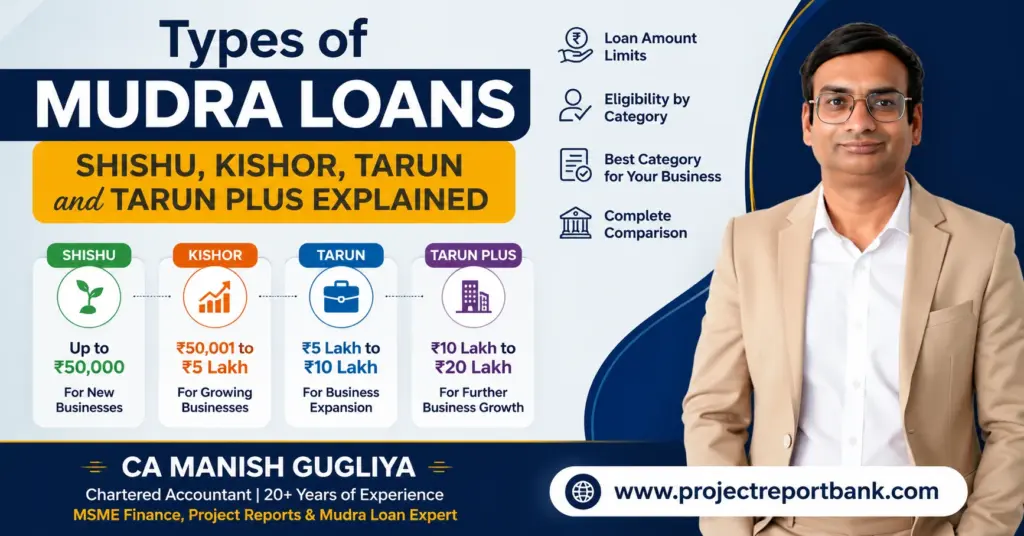
Shishu loans are up to ₹50,000. Kishore loans range from ₹50,001 to ₹5,00,000. Tarun loans range from ₹5,00,001 to ₹10,00,000. The Tarun+ category offers loans from ₹10,00,001 to ₹20,00,000. The maximum loan amount under PMMY is ₹10,00,000 for the base categories; Tarun+ extends the maximum loan to ₹20 lakh.
Loans up to ₹50,000 are available under the Shishu category. Kishore category loans range from ₹50,001 to ₹5,00,000. Tarun category loans range from ₹5,00,001 to ₹10,00,000. Mudra loans are available up to ₹10,00,000 under the standard framework.
Unlike a personal loan where categorisation is usually based on borrower income and profile, PMMY categories are tied to the loan amount and stage of the enterprise.

Eligible Businesses: Manufacturing, Trading, Services and Allied Activities
PMMY includes diverse sector coverage for manufacturing, trading, and services. Practical examples from my client base:
- Readymade garment shop, flour mill, small fabrication unit
- Mobile repair centre, beauty parlour, photocopy and printing shop
- Home delivery kitchen, coaching centre, online reselling
- Dairy, poultry, beekeeping, livestock rearing, food processing
Core agricultural crop activities are normally financed under KCC or agri schemes, while Mudra Loan is for non-farm micro enterprises and allied agri businesses. If you are planning a flour mill, a properly prepared project report strengthens your case for machinery finance under PMMY.
Consumption purposes such as marriage, travel, home interiors or buying a dream car are not eligible. For such credit needs, a standard personal loan is the right product, not a Mudra Loan.
Working Capital and Term Loan Facility
PMMY covers both types of business finance. A working capital facility funds day-to-day expenses and stock; a term loan finances long-term assets like machinery, equipment or shop renovation.
Working capital example: a small grocery store takes a Mudra cash-credit limit of ₹3 lakh to maintain sufficient inventory of fast-moving items. The MUDRA Card provides a convenient overdraft facility for drawing working capital as needed.
Term loan example: a tailoring unit takes a ₹4 lakh term loan to purchase industrial sewing machines and furniture, repayable over 3 to 5 years through emi.
Mixing long-term asset purchases and pure working capital in one loan often creates emi pressure. I recommend planning separate needs clearly before finalising the structure with your lender.
Availability Through Multiple Banks and Financial Institutions
PMMY loans are provided through public sector banks, private banks, regional rural banks, small finance banks, NBFCs, MFIs and NBFC-MFIs. This wide network makes access easy in both urban and rural areas.
While core features remain the same, documentation norms, interest rates, processing charges and services can vary from one lender to another. Approach the bank where you already maintain a savings or current account with good turnover; relationship history and bank statements help during appraisal.
Carry a basic project report, estimated profit and loss, and recent bank statements to your preferred branch. Randomly applying at multiple banks can generate unnecessary enquiries on your credit report.
Mudra Loan Interest Rate, Tenure and Repayment Flexibility
The government does not fix a single Mudra Loan interest rate. Each bank sets its own rate based on internal policy, borrower risk profile and rbi guidelines, typically linked to MCLR or another benchmark. Indicative ranges: public sector banks around 9% to 13% p.a., private banks 10% to 18%, NBFCs and MFIs sometimes higher. Processing fees for Mudra loans are nil across all categories in many public sector banks, though some lenders may charge nominal documentation fees.
Mudra loans have a maximum repayment period of 84 months. For Tarun Plus at Indian Bank, the rate is quoted at 1-year MCLR plus 3% spread, with repayment up to 84 months. Shorter tenure means higher emi but lower total interest cost.
Simple illustration: a ₹3 lakh loan at 12% p.a. for 5 years results in an emi of approximately ₹6,674 per month. Borrowers can use any standard emi calculator to estimate repayments before approaching the bank.
Though PMMY offers flexibility like moratorium or seasonal repayment in some case, final terms depend on the lending institution’s assessment of cash flow and risk.
Encouragement to Women and First-Time Entrepreneurs
Over 68% of MUDRA loans are distributed to women entrepreneurs. Many banks run special campaigns and may offer relaxed margin requirements for women-led micro enterprises.
First-time entrepreneurs with no previous business loan track record commonly use PMMY to start small ventures: boutiques, beauty salons, home food services, coaching classes and online selling. New entrepreneurs accounted for about ₹10.80 lakh crore in sanction amounts as of FY 2024-25.
Even if the loan is taken in the name of a proprietorship owned by a woman, banks may still examine household income to satisfy themselves about repayment capacity. I encourage women and beginners to prepare at least a basic business plan with estimated sales, expenses and break-even before approaching the bank, instead of simply stating a round loan amount.
Simplified Documentation Compared to Large Business Loans
Key documents generally asked for Mudra loans:
- KYC: PAN, Aadhaar, address proof, photographs
- Bank statements for last 6 to 12 months
- Basic project report or business plan
- Quotation for machinery or vehicle (if applicable)
- Business registration (Udyam, GST, Shop Act) if available
Documentation is lighter than large SME or corporate loans, but banks still apply normal KYC, credit checks and due diligence. PMMY is not a “no-document” scheme.
Well-prepared project reports, realistic sales projections and clean bank statements with regular turnover create a positive impression during appraisal. For existing businesses, GST returns, Udyam registration and simple profit-and-loss statements further strengthen eligibility.
Employment Generation and Local Economic Impact
PMMY supports non-corporate, non-farm micro and small enterprises with the objective of creating self-employment and additional jobs. The scheme aims to integrate micro-enterprises into the formal financial system. PMMY contributes to job creation and local economic growth across thousands of small towns and villages.
One tailoring unit financed under Mudra may employ 2 to 3 helpers. A small flour mill can provide income generation for machine operators, helpers and delivery staff. Many businesses financed under Mudra later grow into higher MSME credit lines once they build strong sales and repayment history.
Responsible usage of a Mudra Loan can gradually move a family from informal credit dependence to formal, documented banking and taxation, improving long-term financial stability and helping dreams of business growth turn into reality.
Feature vs Benefit Table for PM Mudra Yojana
This table converts the technical features into direct benefits for the applicant:
| Feature | Benefit to Applicant |
|---|---|
| Collateral-free loan up to ₹10 lakh (₹20 lakh under Tarun Plus) | Start a business without pledging property or assets |
| Four defined loan amount slabs (Shishu to Tarun Plus) | Choose the right category based on your business stage |
| Available through banks, RRBs, SFBs, NBFCs, MFIs | Apply at your nearest branch; rural and urban access |
| Both working capital and term loan facility | Finance daily stock needs and long-term machinery in one scheme |
| Support for new and women entrepreneurs | First-time borrowers and women get an easy way into formal credit |
| No fixed government interest rate | Compare lender offers to pick the best rate and emi for your cash flow |
| Credit Guarantee coverage (CGFMU) | Reduces lender risk, improves your sanction chances |
Real-Life Example: How a Small Tailoring Business Uses Mudra Loan
Priya (name changed), a woman in a Tier-2 city, applied for a Kishor category Mudra Loan of ₹3.5 lakh to start a tailoring and boutique shop.
Allocation: ₹2 lakh for two industrial sewing machines and an overlock machine (term loan), ₹1 lakh for initial fabric inventory (working capital), ₹50,000 for shop advance and basic branding.
Monthly cash flow: Expected sales of ₹60,000, expenses (rent ₹8,000, helper salary ₹10,000, electricity ₹2,000, raw materials ₹20,000, emi ₹7,800) totalling about ₹47,800, leaving a margin of ₹12,200 for savings and contingency.
A simple project report and clear purpose made approval smoother compared to a generic personal loan request of similar amount. After 3 years of clean repayment, Priya can later qualify for a Tarun or higher MSME loan to expand.

Common Myths and Mistakes About PM Mudra Yojana
Misinformation leads many applicants to be either overconfident or discouraged. Here are facts:
- Myth: Mudra Loan is free money or a subsidy. Reality: borrowers must repay principal with interest like any other loan. There is no blanket interest waiver under PMMY.
- Myth: Everyone is guaranteed approval. Reality: banks assess credit history, bank statements and repayment capacity. Rejection is normal if documentation or business viability is weak.
- Myth: No documents are required. Reality: KYC, bank statements, project report and business proof are standard. PMMY simplifies, but does not eliminate, documentation.
- Myth: Interest rates are the same at every bank. Reality: each lender sets its own rate based on its cost of funds and your risk profile.
- Myth: Personal expenses qualify. Reality: PMMY covers only income generating activities engaged in business; not marriage, holidays or consumer durables.
Common mistakes I see: incomplete application forms, inconsistent information across documents, weak bank statement conduct, requesting the maximum loan amount without business justification, and not being ready to explain the business model to the credit officer.
I recommend reading about the objectives of PM Mudra Yojana to align your expectations with the scheme’s real purpose. Updated understanding of the scheme prevents wasted effort.
Practical Tips Before You Apply for a Mudra Loan
- Estimate realistic needs first. Decide which category (Shishu, Kishor, Tarun or Tarun Plus) matches your actual requirement. Do not simply request the maximum loan amount available.
- Prepare a basic project report. Include projected income, expenses, break-even and repayment schedule. Professional help from a CA can make this document more credible to the bank.
- Check your credit score. Clear small overdues or credit card dues before applying. CIBIL score influences both approval and interest rate, even under PMMY.
- Organise all documents in advance. KYC, bank statements, GST registration or Udyam registration (where applicable), quotations for machinery, and a sanction request letter from your side should be ready before visiting the branch.
- Compare 1 to 2 lenders. Check interest rate, processing fee and services, but avoid filing too many simultaneous applications. Multiple enquiries on your credit report can hurt your profile.
The official scheme details are available on the Department of Financial Services page at financialservices dot gov dot in for anyone who wants to read the original government guidelines and links to data snapshots.
Frequently Asked Questions on Key Features of PM Mudra Yojana
These FAQs cover additional practical doubts not fully addressed above. Answers are based on my professional experience as a CA dealing with MSME finance; specific terms may vary from bank to bank.
Is PM Mudra Yojana a subsidy scheme or an interest-free loan?
PMMY is a credit scheme, not an interest subsidy or grant programme. Borrowers must repay principal with interest at commercial rates. While some state or central schemes may occasionally combine subsidies with Mudra-financed projects, those benefits are separate and subject to their own eligibility rules. Do not plan your business based on rumours of “free Mudra money.” Assume normal commercial interest rates when preparing your project report.
Can I use a Mudra Loan for purely personal purposes like marriage or buying a car?
Mudra loans are meant only for income generating activities, such as starting or expanding micro enterprises, purchasing business vehicles, tools or machinery. Using PMMY funds for non-business personal purposes (marriage, holidays, consumer durables) violates the scheme’s intent and can create problems during review or future loan applications. For purely personal needs, opt for a regular personal loan or suitable retail product. Keep Mudra strictly for business finance.
Do I need to have an existing business to be eligible for a Mudra Loan?
Both existing and new entrepreneurs can apply. Many Shishu and Kishor loans are sanctioned to first-time business owners with a clear project idea. Even for a new business, banks normally ask for a business plan, projected income and expenses, and basic understanding of the market. New entrepreneurs should collect quotations for machinery, rent agreements (if finalised), and be prepared to explain how they will attract customers and manage cash flow.
Is there any difference between a normal MSME business loan and a Mudra Loan?
Mudra loans are micro and small business loans up to ₹10 lakhs (or ₹20 lakh under Tarun Plus) covered under the PMMY framework with collateral-free features and standardised categories. The maximum loan amount under PMMY is ₹10 lakhs for the base three types. Larger MSME loans beyond these limits often require detailed financial statements, higher documentation and sometimes collateral security. Many banks treat PMMY as an entry-level product; successful Mudra borrowers can later graduate to higher MSME credit lines based on their track record.
How can a Chartered Accountant help me in getting a Mudra Loan sanctioned?
A CA can prepare realistic project reports, CMA data, cash-flow projections and organise documents like GST returns, bank statements and basic accounts. In my own practice, properly structured proposals reduce back-and-forth with the bank, present a clearer picture of repayment capacity and often lead to smoother sanction and disbursement. A strong project report backed by professional work acts as a formal letter of credibility for your loan request. Treat the Mudra application as a serious financial step and seek professional assistance if you are unsure about business projections or documentation.
This article reflects the views and practical experience of CA Manish Gugliya (FCA). Scheme details are updated as of early 2025 and should be reconfirmed with your lending institution before applying.
- PM Mudra Yojana Basics: Complete Guide to PMMY

- Latest Statistics and Growth of PM Mudra Yojana (PMMY) in India
- Common Myths About PM Mudra Yojana: Facts Every Business Owner Should Know
- PM Mudra Yojana vs Stand-Up India Scheme: Which Government Business Loan Is Right for You?
- PM Mudra Yojana vs MSME Loan: Which Is Better for Your Small Business in 2026?
- PM Mudra Yojana vs Traditional Business Loans: Which Is Better for Small Businesses?
- Types of Mudra Loans: Shishu, Kishor, Tarun and Tarun Plus Explained
- Key Features of PM Mudra Yojana Every Applicant Should Know
- Objectives of PM Mudra Yojana Explained