If you are an entrepreneur looking for a government business loan, you have probably come across both PM Mudra Yojana and the Stand-Up India Scheme. Many applicants confuse these two because both are launched by the Government of India to promote entrepreneurship, both offer bank loans for business purposes, and both cover manufacturing, trading, and services sectors.
But here is the truth: these two schemes serve very different purposes, target different applicants, offer vastly different loan amounts, and have completely different eligibility conditions. Choosing the wrong scheme wastes your time, delays your funding, and may even get your application rejected.
By the end of this article, you will know exactly which scheme fits your business profile – and how to apply smartly.
The short answer: If you need quick, collateral-free financing up to ₹20 lakh for a small or existing business, PM Mudra Yojana is your best bet. If you are a woman, Scheduled Caste (SC), or Scheduled Tribe (ST) entrepreneur starting a brand-new greenfield enterprise and need ₹10 lakh to ₹1 crore, the Stand-Up India Scheme is designed specifically for you. Both schemes aim to promote entrepreneurship in India, but they target different demographic groups and business stages.
What Is PM Mudra Yojana?
PM Mudra Yojana (Pradhan Mantri MUDRA Yojana, or PMMY) was launched on 8 April 2015 by the Government of India. Its core objective is to provide institutional, collateral-free credit to micro and small enterprises in non-farm sectors – including allied agricultural activities like dairy, poultry, fisheries, and beekeeping.
Here is what makes it unique:
- Who can apply: Any Indian citizen running or starting a non corporate small business – proprietorship, partnership, or individual enterprise. PM Mudra Yojana supports proprietorship and partnership firms. There is no restriction based on caste, gender, or community, though approximately 68% of mudra loans have gone to women borrowers.
- Loan categories: PM Mudra Yojana has three main categories for loans – Shishu, Kishore, and Tarun – plus a recently added fourth tier. We will cover these in detail below.
- Loan amount: PM Mudra Yojana offers loans up to ₹20 lakh (with the new Tarun Plus category introduced in October 2024).
- Collateral: Zero. No collateral security is required from the borrower under any Mudra category.
- Working capital: Both term loan and working capital needs are covered. You can use funds for purchasing equipment, raw materials, or meeting day-to-day operating expenses.
- Existing businesses: Mudra Yojana loans cater to both existing and new businesses. You do not need to start something from scratch. If you already have a running business and need working capital or expansion funding, you are eligible.
Mudra Yojana implements loans through various financial institutions like banks and MFIs – including public sector banks, private banks, regional rural banks, small finance banks, NBFCs, and microfinance institutions. To understand the full scope and objectives of PM Mudra Yojana, I recommend reading my detailed guide.
As of February 2025, approximately 52.07 crore loan accounts have been sanctioned under PMMY, with ₹33.19 lakh crore in total loans sanctioned and ₹32.40 lakh crore disbursed. These numbers show the massive reach of this scheme.
Table of Contents
What Is Stand-Up India Scheme?
The Stand-Up India Scheme was launched on 5 April 2016 by the Ministry of Finance. Its purpose is fundamentally different from Mudra – it aims to promote entrepreneurship specifically among women, Scheduled Caste (SC), and Scheduled Tribe (ST) persons by facilitating bank loans for setting up greenfield enterprises.
Here are the key details:
- Target beneficiaries: Eligible borrowers must be SC, ST, or women entrepreneurs, aged 18 years or above. The scheme seeks to address historical credit gaps faced by these targeted demographics who have traditionally struggled to access finance from commercial banks.
- Greenfield requirement: The enterprise must be a new greenfield project – meaning a first-time venture in that sector. Expansion of an existing business does not qualify. This is the single biggest difference between the two schemes.
- Loan range: Stand-Up India loans range from ₹10 lakh to ₹1 crore. This is a composite loan that covers both the term loan component (for capital investment) and working capital requirements.
- Ownership condition: If the business is a partnership or company (not individual), borrowers should hold at least 51% ownership of the business, and the controlling stake must be with the SC/ST or woman entrepreneur.
- Bank branch mandate: Stand-Up India mandates each bank branch to assist at least one SC/ST borrower and one woman borrower. This ensures that every bank branch in India actively participates in the scheme.
- Margin contribution: The borrower typically contributes a margin (usually around 15-25% of the project cost, depending on the bank). The remaining is funded through the composite loan.
- Repayment and moratorium: Repayment periods generally range from 7 to 10 years depending on the project nature and bank policy. A maximum moratorium period is allowed before repayment begins, giving the new enterprise time to stabilize.
- Credit Guarantee: The scheme is backed by a Credit Guarantee Fund for Stand-Up India (CGFSI), which reduces the risk for lending banks and helps eligible borrowers access funding even without traditional collateral security.
Stand-Up India addresses historical credit gaps faced by targeted demographics – women, SC, and ST communities – who have been underrepresented in entrepreneurship due to lack of financial assistance and institutional support.
As of March 2025, over ₹61,000 crore has been sanctioned under Stand-Up India to more than 2.5 lakh borrowers, showing significant economic empowerment of women and SC/ST entrepreneurs across India.
PM Mudra Yojana vs Stand-Up India: How They Compare at a Glance
| Factor | PM Mudra Yojana | Stand-Up India Scheme |
|---|---|---|
| Purpose | Collateral-free credit for micro/small non-farm businesses | Financial assistance for greenfield enterprises by women/SC/ST |
| Target Applicant | Any Indian entrepreneur (inclusive) | Only SC, ST, or women entrepreneurs |
| Loan Amount | Up to ₹20 lakh | ₹10 lakh to ₹1 crore |
| Collateral | Not required | Credit Guarantee backed; bank may assess |
| Existing Business | Yes, eligible | No – greenfield enterprise only |
| New Business | Yes, eligible | Mandatory requirement |
| Eligible Business Types | Manufacturing, Trading, Services, Allied Agriculture | Manufacturing, Trading, Services, Allied Agriculture |
| Ownership Requirement | No specific shareholding rule | ≥51% ownership by SC/ST or woman |
| Maximum Tenure | Varies by lender and loan size | 7–10 years typically |
| Working Capital | Covered | Covered (composite loan) |
| Documentation | Lighter for small amounts | Detailed project report required |
| Interest Rate | Bank-determined, varies | Bank-determined, varies |
| Government Support | No dedicated credit guarantee | Credit Guarantee Fund (CGFSI) |
| Best For | Small businesses needing quick, small-to-moderate credit | SC/ST/women starting large new enterprises |
The headline takeaway: PM Mudra Yojana is broader, faster, and designed for small-scale needs, while Stand-Up India offers larger funding but with stricter eligibility and documentation requirements.
Loan Amount and Categories
This is where the two schemes differ most visibly.
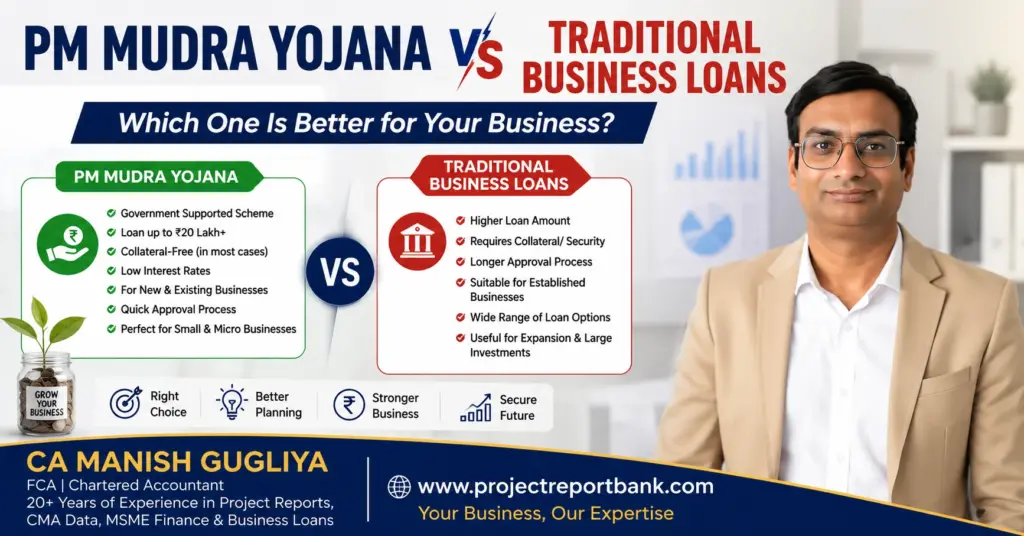
PM Mudra Yojana divides its loans into clear categories based on business stage and funding need:
- Shishu: Loans up to ₹50,000 – ideal for very small businesses just getting started, like a street food cart, home-based tailoring unit, or mobile repair shop.
- Kishore: Loans ranging from ₹50,001 to ₹5 lakh – suitable for businesses that have established themselves and need capital for growth, like a small dairy unit or beauty salon expansion.
- Tarun: Loans ranging from ₹5 lakh to ₹10 lakh – for businesses ready to scale operations, purchase larger equipment, or increase inventory significantly.
- Tarun Plus: Loans from ₹10 lakh to ₹20 lakh – introduced on 24 October 2024 specifically for entrepreneurs who have already availed and successfully repaid previous Tarun category loans.
You can learn more about the types of Mudra loans and which category suits your business.
Stand-Up India does not have sub-categories. Loans under Stand-Up India range from ₹10 lakh to ₹1 crore – a single, large funding window designed for substantial capital investment in new enterprises. The minimum itself (₹10 lakh) is where Mudra’s maximum used to end before Tarun Plus was introduced.
Winner: It depends on your funding requirement. If you need up to ₹20 lakh, Mudra is simpler and faster. If your project requires ₹20 lakh to ₹1 crore – say for a manufacturing plant or food processing unit – Stand-Up India is the only option among these two. The trade-off: larger Stand-Up India loans demand stronger project reports, detailed financial projections, and longer processing times.
Target Beneficiaries and Eligibility
This factor often decides which scheme an applicant can even access.
PM Mudra Yojana eligibility:
- Open to any Indian citizen – no restriction on caste, gender, or community
- Both new and existing businesses qualify
- PM Mudra Yojana supports non-corporate small businesses in manufacturing, trading, services, and allied agriculture
- No specific shareholding or ownership structure mandated
- Mudra Yojana encourages financial inclusion for micro-enterprises requiring quick access to credit
- Applicant must not be a defaulter with any bank or financial institution
Stand-Up India eligibility:
- Stand-Up India targets SC, ST, and women entrepreneurs exclusively
- Age must be at least 18 years
- The enterprise must be a new greenfield project – you cannot apply to expand an existing business in the same sector
- In case of a non-individual entity, at least 51% shareholding and controlling stake must be held by the SC/ST or woman borrower
- Applicant must not be a defaulter with any bank
- Each bank branch must facilitate at least one loan to one woman borrower and one SC/ST borrower
Why this matters: Many applicants waste weeks preparing for Stand-Up India only to realize their existing business disqualifies them. The greenfield condition is strict – and is the number one reason for rejection under this india scheme.
Winner: PM Mudra Yojana – for sheer accessibility. Any entrepreneur can apply regardless of gender, caste, or business stage. However, if you are a woman or SC/ST applicant launching a new enterprise, Stand-Up India gives you a dedicated channel with mandated bank branch support that Mudra does not offer.
Business Type and Sector Coverage
Both schemes cover manufacturing, trading, services, and allied agriculture sectors. The real difference is in the scale of businesses each scheme supports.
Businesses best suited for PM Mudra Yojana:
- Grocery / kirana shop
- Dairy or poultry unit (small scale)
- Beauty salon or barbershop
- Tailoring or garment unit
- Mobile repair shop
- Small flour mill
- Food stall or small restaurant
- Small-scale manufacturing unit
- Auto-rickshaw or small transport
Businesses best suited for Stand-Up India:
- Manufacturing factory (medium scale)
- Large service centre or diagnostic lab
- Engineering or fabrication unit
- Food processing plant
- Warehouse or cold storage facility
- Large trading enterprise
- Agro-processing unit
Winner: Neither – this depends on your business scale. If your business is small and service-oriented with moderate capital needs, Mudra fits perfectly. If you are planning a capital-intensive greenfield enterprise, Stand-Up India provides the funding and structure for it. The nature of your business and its capital requirements should drive this decision.
Collateral and Documentation Requirements
Collateral:
- PM Mudra Yojana: Completely collateral-free. No security of any kind is required from the borrower. This is one of the key features of PM Mudra Yojana that makes it accessible to first-time entrepreneurs.
- Stand-Up India: The Credit Guarantee Fund reduces lender risk significantly, and the scheme is designed to minimize collateral security requirements. However, individual banks may still assess risk and request security depending on the loan amount and project nature.
Documentation:
| Document | PM Mudra Yojana | Stand-Up India |
|---|---|---|
| Identity proof (Aadhaar, PAN, Voter ID) | ✔ | ✔ |
| Address proof | ✔ | ✔ |
| Business proof / shop lease | ✔ | ✔ |
| Bank statements | ✔ (for existing business) | ✔ |
| Quotations for equipment/assets | ✔ | ✔ |
| Project report | For Tarun/Tarun Plus | Mandatory |
| CMA Data | For larger amounts | Usually required |
| Udyam Registration | Recommended | Recommended |
| Caste certificate (SC/ST) | Not required | Required for SC/ST applicants |
| Shareholding proof | Not required | Required for non-individual entities |
| Financial projections | For larger loans | Mandatory |
| Greenfield declaration | Not applicable | Required |
Winner: PM Mudra Yojana – especially for Shishu and Kishore categories where documentation is minimal. Stand-Up India requires a detailed project report, business plan, CMA data, financial projections, and proof of greenfield status. This makes the application process significantly more demanding.
Interest Rates and Financial Terms
Here is something many applicants do not realize: neither scheme has a fixed government interest rate. The Government of India does not prescribe a specific rate for either scheme. Interest rates are decided by each bank or financial institution based on:
- The borrower’s credit history and repayment track record
- Business viability and projected cash flows
- Loan amount and tenure
- Risk assessment by the bank’s credit team
- Nature of collateral or guarantee available
Practical differences:
- Mudra loans tend to carry slightly lower interest rates for smaller amounts (especially Shishu and Kishore), because the risk is lower and processing is simpler. Rates typically range between 8% and 12% annually, though this varies across lenders.
- Stand-Up India loans, being larger (₹10 lakh to ₹1 crore), may attract higher scrutiny and potentially higher rates. However, the Credit Guarantee Fund backing can help negotiate better terms at some banks.
Neither scheme offers any subsidy on interest. The loan amount is fully repayable at the agreed rate.
Winner: PM Mudra Yojana – marginally, due to smaller loan sizes attracting lower rates and simpler risk assessment. But for Stand-Up India applicants with strong project reports and good credit history, competitive rates are achievable through careful bank selection.
PM Mudra Yojana vs Stand-Up India: Which Should You Choose?
Based on my 20+ years of experience helping entrepreneurs with business finance, here is my practical guidance:
Choose PM Mudra Yojana if:
✔ You run an existing small business and need working capital or expansion funding
✔ Your funding requirement is up to ₹20 lakh
✔ You want collateral-free financing with minimal documentation
✔ You need quick access to credit – speed matters to you
✔ Your business is in the micro or small category (kirana, salon, dairy, small manufacturing)
✔ You are a first-time applicant without an elaborate business plan
Choose Stand-Up India if:
✔ You are a woman, SC, or ST entrepreneur starting a new enterprise
✔ Your project requires ₹10 lakh to ₹1 crore in funding
✔ You are setting up a manufacturing unit, food processing plant, or other capital-intensive business
✔ You have a strong, bankable project report and detailed financial projections
✔ You are willing to invest time in the application process for a larger loan
✔ You want dedicated support – each bank branch is mandated to assist at least one woman borrower and one SC/ST borrower
Strongest all-around pick: For most small business owners reading this article, PM Mudra Yojana will be the more practical choice because of its simplicity, speed, and universal eligibility. Stand-Up India is the better choice specifically when you are an eligible applicant (woman/SC/ST), starting fresh, and need substantial capital that Mudra cannot provide.
Can You Apply for Both Schemes?
This is a question I get frequently from entrepreneurs. The short answer: yes, it is technically possible, but there are practical conditions.
- No government rule prohibits an eligible person from availing loans under both schemes, provided the loans are for different purposes or different business ventures.
- Practical reality: If you take a Mudra loan for working capital of an existing business, and later want to start a completely new greenfield enterprise as a woman or SC/ST entrepreneur, you could apply for Stand-Up India separately. The two loans would be for different businesses.
- Bank policies matter: Individual banks will assess your overall creditworthiness, existing borrowings, and repayment capacity before sanctioning a second loan under any scheme.
- Sequential strategy: Many smart entrepreneurs start with a Shishu or Kishore Mudra loan to establish their credit history, repay it successfully, and then apply for either a larger Mudra loan (Tarun/Tarun Plus) or a Stand-Up India loan for a new venture. This approach builds banking relationships and demonstrates financial discipline.
- What to avoid: Do not apply for both loans simultaneously for the same business from different banks. This creates duplication red flags and may result in rejection from both.
Common Mistakes Applicants Make
In my practice, I see the same errors repeatedly. Here are the most costly ones:
- Choosing the wrong scheme for their business size: An entrepreneur needing ₹5 lakh applies under Stand-Up India (minimum ₹10 lakh) or someone needing ₹50 lakh applies under Mudra (maximum ₹20 lakh). Match your funding requirement to the scheme’s range.
- Applying for Stand-Up India with an existing business: The greenfield requirement is non-negotiable. If you already operate a business in the same sector, your application will be rejected.
- Submitting a weak or generic project report: Banks evaluate your project report carefully, especially for Tarun/Tarun Plus under Mudra and all Stand-Up India applications. A poorly prepared report with unrealistic revenue projections is the fastest way to get rejected.
- Underestimating working capital needs: Many applicants focus entirely on the term loan for equipment and assets but forget to account for 3-6 months of operating expenses. This leads to cash flow problems within months of starting.
- Missing critical documents: Not having Udyam Registration, proper quotations, or a caste certificate (for SC/ST under Stand-Up India) delays the process by weeks.
- Poor financial projections in CMA Data: Banks look at projected revenue, expenses, break-even, and debt service coverage ratio. If your CMA data shows the business cannot repay the loan from its cash flows, expect rejection.
- Not checking credit history: If you have an existing loan default – even a small one – both schemes will likely reject you. Check your CIBIL score before applying.
Expert Advice from CA Manish Gugliya
After helping hundreds of entrepreneurs secure funding under both these schemes, here is my practical advice:
1. Match your scheme to your profile, not your ambition. Do not apply for Stand-Up India just because it offers up to ₹1 crore if you only need ₹8 lakh. And do not try to squeeze a ₹40 lakh project into Mudra’s ₹20 lakh limit. Be realistic.
2. Invest in a professional project report. Whether you are applying under PM Mudra Yojana or Stand-Up India, a well-prepared project report dramatically improves your approval chances. For Stand-Up India especially, the project report is the foundation of your entire application.
3. Prepare CMA Data carefully. CMA (Credit Monitoring Arrangement) data shows your projected balance sheet, profit and loss, fund flow, and ratios. Banks use this to assess whether your business can service the debt. Get this prepared by a qualified Chartered Accountant – it is not a form you fill casually.
4. Estimate working capital accurately. Calculate your raw material cycle, debtor collection period, creditor payment terms, and operating expenses for at least 6 months. Underestimating working capital is the single biggest reason businesses fail within the first year despite getting the loan.
5. Choose your bank wisely. Not all banks process government scheme loans with the same efficiency. Public sector banks and small finance banks tend to have dedicated departments for Mudra and Stand-Up India. Ask the branch manager specifically about their experience with these schemes before applying.
6. Build your credit history first. If you have no banking history, start with a small Shishu loan under Mudra, repay it on time, and build a track record. This makes you a stronger applicant for larger loans later – whether under Tarun Plus or Stand-Up India.
7. Do not rely on agents or middlemen. Both schemes are designed for direct applications through banks. Paying an agent does not improve your chances and often leads to inflated project costs or fraudulent documentation.
Conclusion
PM Mudra Yojana and the Stand-Up India Scheme are both powerful tools for economic growth and job creation in India – but they are designed for different entrepreneurs at different stages.
PM Mudra Yojana is your go-to scheme if you need fast, collateral-free funding up to ₹20 lakh for a small or existing business. It is inclusive, accessible, and serves as the backbone of MSME finance in India.
Stand-Up India is purpose-built for economic empowerment of women, SC, and ST entrepreneurs who are ready to launch a new enterprise with capital needs between ₹10 lakh and ₹1 crore.
Your choice should depend on five factors:
- Your business size and stage (existing vs. new)
- Your funding requirement
- Your eligibility (gender, caste category)
- Your documentation readiness
- Your long-term growth plans
Do not make this decision in isolation. A well-prepared project report and CMA data can make the difference between approval and rejection under either scheme. If you need professional assistance in preparing a bankable project report, CMA data, or financial projections for your Mudra or Stand-Up India loan application, reach out to a qualified Chartered Accountant who understands both banking requirements and government scheme guidelines.
Frequently Asked Questions
Which is better – PM Mudra Yojana or Stand-Up India?
Neither is universally “better.” If you need up to ₹20 lakh for a small or existing business, Mudra is more practical. If you are a woman or SC/ST entrepreneur starting a new enterprise needing ₹10 lakh to ₹1 crore, Stand-Up India is the right fit. The best scheme depends entirely on your business profile.
Can existing businesses apply under Stand-Up India?
No. Stand-Up India requires the enterprise to be a greenfield project – a first-time venture in that sector. If you want funding for an existing business, apply under PM Mudra Yojana instead, which supports both existing and new businesses.
Can women apply for PM Mudra Yojana?
Absolutely. PM Mudra Yojana is open to all Indian entrepreneurs regardless of gender. In fact, approximately 68% of all Mudra loans have gone to women borrowers. Women are also specifically eligible under Stand-Up India.
Is collateral required under these schemes?
PM Mudra Yojana is completely collateral-free – no security is required. Under Stand-Up India, the Credit Guarantee Fund reduces collateral requirements, but individual banks may still assess and request security based on the loan amount and risk profile.
Can SC/ST entrepreneurs apply under PM Mudra Yojana?
Yes. PM Mudra Yojana has no caste-based restrictions. Approximately 50% of Mudra loans have gone to SC/ST/OBC categories. However, Stand-Up India is specifically designed for SC/ST entrepreneurs with dedicated support at every bank branch.
Which scheme offers a higher loan amount?
Stand-Up India offers significantly higher funding – up to ₹1 crore compared to PM Mudra Yojana’s maximum of ₹20 lakh. If your project cost exceeds ₹20 lakh, Mudra will not be sufficient.
Is a project report mandatory for both schemes?
For Mudra, a project report is not strictly required for Shishu loans (up to ₹50,000) but becomes important for Kishore and essential for Tarun and Tarun Plus categories. For Stand-Up India, a detailed project report is mandatory for every application.
Can startups apply under these schemes?
Yes, both schemes support new businesses. However, Stand-Up India specifically requires a greenfield enterprise, making it well-suited for startups. Mudra also supports new businesses without any greenfield condition.
Which scheme is easier to get approved?
PM Mudra Yojana, particularly the Shishu and Kishore categories, is generally easier and faster to get approved due to lower loan amounts, minimal documentation, and no collateral requirement. Stand-Up India involves more rigorous appraisal, detailed project reports, and longer processing times.
Can both schemes be combined?
You cannot use both schemes for the same business simultaneously. However, you can avail a Mudra loan for one business and a Stand-Up India loan for a completely separate greenfield enterprise, provided you meet the eligibility criteria for both.
What is the repayment period under each scheme?
Mudra loan repayment periods vary by lender and loan size – typically 3 to 5 years for smaller categories. Stand-Up India loans have longer repayment periods, generally 7 to 10 years, with a moratorium period before EMIs begin.
What documents are required for these loans?
Both require identity proof, address proof, business proof, and bank statements. Mudra requires quotations and a project report for larger amounts. Stand-Up India additionally requires a detailed business plan, caste certificate (for SC/ST), shareholding proof for non-individual entities, and a comprehensive project report with financial projections.
Is Udyam Registration compulsory?
Udyam Registration is not strictly compulsory for either scheme, but it is strongly recommended. It strengthens your application and is often requested by banks as supporting documentation, especially for Tarun/Tarun Plus under Mudra and all Stand-Up India applications.
Which banks provide these loans?
PM Mudra Yojana loans are available through public sector banks, private banks, regional rural banks, small finance banks, NBFCs, and microfinance institutions. Stand-Up India loans are available through all commercial banks – each bank branch is mandated to participate. You can check the Stand-Up India portal for participating banks.
How long does loan approval take?
Mudra Shishu loans can be approved within 7-14 days. Kishore and Tarun may take 2-4 weeks. Stand-Up India applications typically take 4-8 weeks due to detailed project appraisal, documentation verification, and the larger loan amounts involved. Having a professionally prepared project report and complete documentation significantly speeds up the process under both schemes.
- PM Mudra Yojana Basics: Complete Guide to PMMY


- Latest Statistics and Growth of PM Mudra Yojana (PMMY) in India
- Common Myths About PM Mudra Yojana: Facts Every Business Owner Should Know

- PM Mudra Yojana vs Stand-Up India Scheme: Which Government Business Loan Is Right for You?

- PM Mudra Yojana vs MSME Loan: Which Is Better for Your Small Business in 2026?

- PM Mudra Yojana vs Traditional Business Loans: Which Is Better for Small Businesses?
- Types of Mudra Loans: Shishu, Kishor, Tarun and Tarun Plus Explained
- Key Features of PM Mudra Yojana Every Applicant Should Know

- Objectives of PM Mudra Yojana Explained