Many entrepreneurs hear about Mudra Loans but get confused when the bank asks whether they need a Shishu, Kishor, Tarun, or Tarun Plus loan. Picking the wrong category can delay your loan application or even lead to rejection. This guide explains every Mudra Loan type in simple language so you can walk into any bank with clarity and confidence.
Key Takeaways
Mudra loans under Pradhan Mantri Mudra Yojana (PMMY) are now classified into four categories – Shishu, Kishore, Tarun, and Tarun Plus – with the maximum loan amount under MUDRA now at ₹20 lakh following the October 24, 2024 government notification.
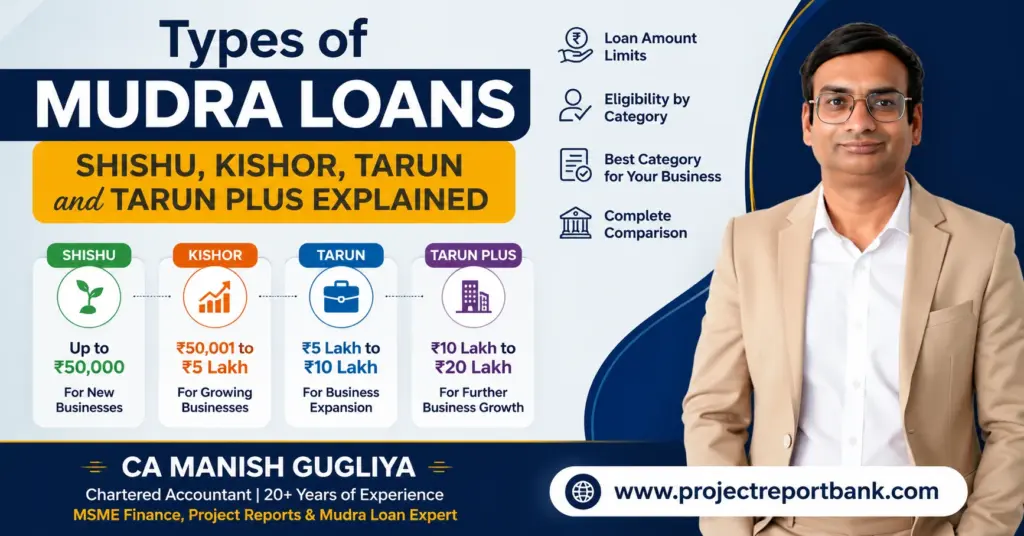
- Shishu covers loans up to ₹50,000 for idea-stage or very early businesses.
- Kishor covers loans from ₹50,000 to ₹5 lakh for early-growth small businesses.
- Tarun covers loans from ₹5 lakh to ₹10 lakh for established businesses ready to expand.
- Tarun Plus covers loans from ₹10 lakh to ₹20 lakh for borrowers who have successfully repaid loans under Tarun and need major expansion funding.
- Choosing the right loan category depends on whether your business is new or existing, your real fund requirement, and your repayment capacity – not just the highest amount available.
- All Mudra loans are collateral-free business loans for non farm micro and small businesses. No collateral is required for MUDRA loans. The interest rate and exact terms differ from bank to bank.
What Are the Types of Mudra Loans?
Pradhan Mantri Mudra Yojana (PMMY), a scheme launched on 8 April 2015 by the government of India, provides collateral-free business loans to non corporate, non farm micro enterprises through various financial institutions. These include commercial banks, non banking financial companies (NBFCs), micro finance institutions (MFIs), regional rural banks (RRBs), small finance banks, and cooperative banks. MUDRA Yojana enhances financial inclusiveness for small entrepreneurs who previously struggled to get formal credit.
MUDRA stands for Micro Units Development and Refinance Agency Ltd. It works as a refinance agency – it does not lend directly to borrowers but supports financial institutions that do. The goal is financial inclusion: bringing easy access to credit for millions of micro units across India.
The PM Mudra Loan types are divided into four categories aligned with the growth stages of a business and its funding needs:
- Shishu – for the idea or startup stage
- Kishor – for early growth
- Tarun – for established businesses seeking expansion
- Tarun Plus – for strong existing MSMEs needing major expansion
Banks classify Mudra borrowers by category for better risk assessment, suitable ticket size, and matching interest rate and documentation level with loan size. MUDRA loan interest rates range from 9% to 12%, and interest rates depend on the bank and loan category. MUDRA loans are usually cheaper than traditional business loans, while fixed interest rates for PM Mudra Yojana range from 19% to 21% in some MFI channels. Mudra loans can be used for income-generating activities in manufacturing, trading, and services.
Originally, the mudra scheme had three product offerings (Shishu, Kishor, Tarun) covering loans up to 10 lakh. The government notified Tarun Plus on 24 October 2024, increasing the Mudra Loan maximum amount to ₹20 lakh. MUDRA Yojana now offers collateral-free loans up to ₹20 lakh.
| Category | Loan Amount | Typical Business Stage | Suitable For |
|---|---|---|---|
| Shishu | Up to ₹50,000 | Idea / Startup | Tea stall, street vendor, home tailor |
| Kishor | ₹50,000 to ₹5 lakh | Early Growth | Small manufacturing unit, boutique |
| Tarun | ₹5 lakh to ₹10 lakh | Established Business | Trading firm, service business expanding |
| Tarun Plus | ₹10 lakh to ₹20 lakh | Major Expansion | Unit adding large machinery, opening new outlets |
The scheme supports various sectors including manufacturing and services. Eligible activities for Mudra loans include dairy, poultry, and beekeeping, though core agricultural businesses are not eligible for MUDRA loans. For a complete overview of how the mudra yojana works, read the guide on what is PM Mudra Yojana.
Table of Contents
Understanding the Four Mudra Loan Categories as a Growth Journey
Imagine a woman who starts a small tiffin service from her kitchen. She takes a Shishu Mudra Loan of ₹30,000 to buy utensils and a gas stove. Within a year, her customer base grows. She takes a Kishor loan of ₹2.5 lakh to rent a small commercial kitchen and hire two helpers. Two years later, she applies for Tarun funding to buy semi-industrial cooking equipment and delivery vehicles. After repaying that Tarun loan cleanly, she qualifies for Tarun Plus to set up a small food processing plant.
This is exactly how PMMY loan categories are designed. They are not four separate schemes but four slabs within the same mudra yojana, built to match the life cycle of a beneficiary micro unit from startup to expansion. The Shishu Kishor Tarun Mudra Loan progression depends on actual business performance – timely repayment, stable cash flows, and a growing asset base.

Banks look closely at past repayment records when considering upgrades to higher categories. The tarun category and Tarun Plus carry stricter scrutiny because amounts are larger and risk per account is higher. Tarun Plus has a special condition: you must have taken and satisfactorily repaid a Tarun loan. It is essentially a reward for disciplined borrowers ready for the next stage of entrepreneurship.
Shishu Mudra Loan Explained (Up to ₹50,000)
Shishu Mudra Loan is the entry-level PMMY loan category. Shishu loans offer up to ₹50,000 for startups and very small ventures – think street vendors, tea stalls, home-based tailoring units, mobile repair kiosks, or small beauty services. This is the ideal Mudra Loan for new business owners who need a small push to get started.
The purpose is mainly working capital (buying raw materials, initial stock) and basic equipment purchase. MUDRA loans are processed quickly without collateral requirements, and Shishu is the simplest to obtain. It is usually given as a term loan and sometimes through a mudra card for revolving working capital.
Eligibility criteria:
- Applicants must be aged between 18 to 65 years
- Must be involved in a non farm income-generating activity
- New or existing small businesses
- Acceptable credit history (though first-time borrowers with no history are also considered)
- Exact eligibility may vary across banks
Key documents for Shishu:
- Aadhaar and PAN card
- Simple application form
- Basic business plan or estimated cost sheet
- Shop or trade license (if available)
- Recent passport-size photographs
- Existing bank statement (if any)
Advantages: Easy access for first-time borrowers, no collateral, simple processing, shorter repayment tenure. Limitations: Small ticket size – may not be enough for machinery-heavy businesses.
Example: A woman starting a beauty parlour from home takes a Shishu loan of ₹40,000 to buy basic beauty equipment, a chair, mirror, and initial cosmetics inventory. Within six months, she builds a steady client base and begins planning for a Kishor upgrade. Eligible businesses include shop owners, vendors, and service providers just like her.
Kishor Mudra Loan Explained (₹50,000 to ₹5 Lakh)
Kishor Mudra Loan is the mid-level PMMY category. Kishore loans range from ₹50,000 to ₹5 lakh and are usually meant for existing small businesses ready to expand beyond the startup stage.
The ideal borrower is someone already running a business for at least 6 to 12 months, with basic turnover. They need funds for working capital, buying small machinery, adding staff, or shifting from a home setup to a rented shop or small unit.
Typical uses:
- Buying a commercial mixer for a small food-processing unit
- Adding an embroidery machine to a boutique
- Increasing inventory for a busy retail shop
- Upgrading from manual to semi-automatic equipment
Documentation expectations: KYC documents, basic business proof (GST registration, Udyam registration, trade license), bank statements for at least 6 months, and basic financials. Some banks may ask for a simple project report – something that Project Report Bank specialises in preparing.
Shishu vs Kishor – quick comparison:
| Feature | Shishu | Kishor |
|---|---|---|
| Loan Amount | Up to ₹50,000 | ₹50,000 to ₹5 lakh |
| Documentation | Minimal | Moderate |
| Focus | New business / idea | Existing turnover and cash flows |
| Collateral | None | None |
Suitable industries include small manufacturing (agarbatti units, fabrication shops), services (salons, repair workshops, coaching centres), and trading units (kirana stores, garment shops, mobile retailers). The financial assistance under Kishor helps eligible borrowers bridge their credit needs during the critical early growth stage.
Tarun Mudra Loan Explained (₹5 Lakh to ₹10 Lakh)
Tarun Mudra Loan is the highest category under the original PMMY framework. Tarun loans provide funding between ₹5 lakh and ₹10 lakh, designed for established small businesses planning significant expansion.
This loan category is suitable for enterprises with stable turnover records, GST filings, and proper books of account. The borrower is typically moving from micro to small MSME level across manufacturing, services, or trading.
Specific uses:
- Purchasing larger machines or equipment
- Setting up a bigger workshop or production facility
- Opening a second retail outlet
- Installing cold storage for food processing
- Upgrading to advanced technology
Banks look closely at financial statements, bank statements, previous Mudra or other loan repayment history, and usually require a detailed project report with projections for 3 to 5 years. You need to submit KYC documents to apply for MUDRA loans at this level too, along with substantial business proof.
Case study: A small printing press owner started with a Kishor loan of ₹3 lakh, built a steady customer base over two years, and then used Tarun funding of ₹8 lakh to buy a four-colour offset machine. This single purchase doubled his capacity, attracted bigger clients, and increased his monthly profit by nearly 40%.
Although Tarun loans are still collateral-free under PMMY guidelines, some banks may ask for a co-obligant or other comfort measures based on their internal policy. The benefits of proper documentation and a strong project report cannot be overstated at this stage.
Tarun Plus Mudra Loan Explained (₹10 Lakh to ₹20 Lakh)
Tarun Plus Mudra Loan is the newest extension of PMMY, announced on 24 October 2024. Tarun Plus loans range from ₹10 lakh to ₹20 lakh, making the maximum loan amount under MUDRA now ₹20 lakh.
So what is Tarun Plus? It is an enhanced category for strong existing Mudra borrowers who have already taken and satisfactorily repaid a Tarun loan and now need higher funds for large-scale expansion. You cannot apply directly for Tarun Plus without this track record – it is designed as a reward for disciplined entrepreneurship.
Tarun Plus covers the ₹10 lakh to ₹20 lakh range and is meant for established MSME units in manufacturing, services, trading, or allied agriculture activities (dairy, poultry, beekeeping – but not core farming). The applicant must be looking to invest in major equipment, bigger premises, or significant capacity increase.
Likely eligibility conditions:
- Clean repayment track under Tarun
- Healthy financial ratios
- Proper income tax and GST compliance
- A detailed, bank-ready project report showing viability of expansion
Repayment tenure may be extended compared to lower categories, but EMIs will be bigger and banks will scrutinise projections more carefully.
When is Tarun Plus better than Tarun?
- A small food-processing unit wants to upgrade to a semi-automated plant costing ₹18 lakh – Tarun’s 10 lakh limit is not enough.
- A fabrication workshop needs modern CNC machines worth ₹15 lakh to avail bigger contracts.
- A retail business owner wants to open multiple branded outlets with a total setup cost of ₹19 lakh.
In each case, the borrower has already proven their credit discipline under Tarun and can now expand with confidence using Tarun Plus.

Difference Between Shishu, Kishor, Tarun and Tarun Plus
Here is a side-by-side Mudra Loan category comparison so you can quickly spot the difference between Shishu, Kishor, Tarun and Tarun Plus:
| Feature | Shishu | Kishor | Tarun | Tarun Plus |
|---|---|---|---|---|
| Loan Amount | Up to ₹50,000 | ₹50,000 to ₹5 lakh | ₹5 lakh to ₹10 lakh | ₹10 lakh to ₹20 lakh |
| New Business | Yes | Yes (with some proof) | Generally existing | Existing only |
| Existing Business | Yes | Yes | Yes | Yes (must have repaid Tarun) |
| Business Stage | Startup / Idea | Early growth | Established | Expansion-ready |
| Documentation Level | Minimal | Moderate | Detailed | Most detailed |
| Project Report Needed | Usually not | Sometimes | Yes | Yes (with CMA data) |
| Repayment Tenure | 1–3 years | 1–5 years | Up to 5 years | Up to 5+ years |
| Common Purpose | Working capital, basic tools | Machinery, inventory, shop setup | Equipment, capacity building | Major machinery, new facility |
| Risk Profile (Bank View) | Low per account | Moderate | Higher | Highest |
All four categories are part of PM Mudra Loan types, all are collateral-free in principle, but scrutiny and documentation increase as the category and amount go up.
Which Mudra Loan category is best? The one that matches your actual business stage and realistic requirement. A tea stall owner borrowing ₹10 lakh under Tarun just because they can is a recipe for trouble. Similarly, an established manufacturer squeezing into Shishu’s ₹50,000 limit will not meet real growth needs. Match the category to your requirement, not the other way around.
Which Mudra Loan Category Should You Choose?
Choosing the right type depends on three things: business age, size of requirement, and repayment capacity. Over-borrowing causes stress. Under-borrowing limits growth. Here are practical examples:
- Tea stall or street food cart – Project cost ₹25,000 to ₹40,000. Choose Shishu. Bank needs basic KYC and a simple cost sheet.
- Beauty parlour shifting from home to rented shop – Cost ₹1.5 to ₹3 lakh for furniture, equipment, and 3 months rent deposit. Choose Kishor. Show 6 months of income flow.
- Small manufacturing unit buying its first semi-automatic machine – Cost ₹4 to ₹8 lakh. Kishor if under ₹5 lakh, Tarun if above. Bank checks turnover and cash flow stability.
- Retail garment shop adding a second outlet – Total setup cost ₹7 to ₹9 lakh. Choose Tarun. Show existing shop’s GST returns and profit record.
- Food processing unit moving to a much larger plant – Equipment and setup cost ₹15 to ₹18 lakh. Choose Tarun Plus (only if you have repaid a prior Tarun loan).
- Service business like coaching centre opening branches – Cost ₹8 to ₹16 lakh depending on locations. Tarun or Tarun Plus based on total project cost and prior loan history.

Think of it as a decision tree: Is your business new? If yes and need is small, go Shishu. Already running for a year and need up to 5 lakh? Kishor. Established with good records and need up to 10 lakh? Tarun. Already repaid Tarun and need up to 20 lakh? Tarun Plus.
Before finalising, discuss with your CA or Mudra consultant. Build realistic sales and profit estimates. The right category is the one where your EMIs are comfortable, not the one with the highest sanction.
Documents Required for Each Mudra Loan Category
While PMMY is designed for easy access, documentation requirements increase as you move from Shishu to Tarun Plus. Poor paperwork is the most common reason for delay or rejection. You can apply for MUDRA loans online or offline – but documents must be in order either way. MUDRA loans are available through banks and NBFCs across India.
Core documents common to all categories:
- Aadhaar card
- PAN card
- Recent passport-size photographs
- Proof of residential address
- Bank account details
- Application form
Additional for Kishor: Business proof (Udyam registration, GST, trade licence), bank statements for 6+ months, simple business plan or cost estimate.
Additional for Tarun and Tarun Plus: Past 2–3 years financial statements (profit and loss, balance sheet), GST returns, income tax returns, detailed project report with CMA data and projections, quotations for machinery purchase, and existing loan statements if any.
| Document | Shishu | Kishor | Tarun | Tarun Plus |
|---|---|---|---|---|
| Aadhaar + PAN | Yes | Yes | Yes | Yes |
| Address Proof | Yes | Yes | Yes | Yes |
| Business Registration | Optional | Yes | Yes | Yes |
| Bank Statements (6+ months) | Optional | Yes | Yes | Yes |
| GST Returns | No | Helpful | Yes | Yes |
| IT Returns | No | No | Yes | Yes |
| Project Report with CMA Data | No | Sometimes | Yes | Yes (detailed) |
| Machinery Quotations | No | Sometimes | Yes | Yes |
| Prior Loan Repayment Proof | No | No | Helpful | Mandatory |
For a deeper understanding of what makes a loan application strong, check the guide on key features of PM Mudra Yojana every applicant should know. Project Report Bank specialises in preparing bank-ready Mudra Loan project reports that match each PMMY category’s requirement.
Common Mistakes While Choosing Mudra Loan Category
In my 20+ years of MSME finance practice, I have seen many good loan applications delayed because of simple, avoidable mistakes – especially in selecting Mudra Loan categories and loan amounts. Let me share the most common ones.
Major errors:
- Applying directly for Tarun or Tarun Plus with a very new business (banks will likely redirect you to Shishu or Kishor)
- Overestimating project cost just to get a higher sanction – this increases your EMI burden with no real benefit
- Underestimating working capital need and then running short within months of starting
- Ignoring preparation of a project report – especially for Tarun and Tarun Plus, banks treat this as a deal-breaker
- Not showing a clear repayment plan with realistic revenue projections
Documentation mistakes:
- Incomplete KYC (expired Aadhaar, missing PAN)
- Mismatch between declared turnover and GST or IT returns
- Not providing proper quotations for machinery or setup costs
Pre-visit checklist before going to the bank:
- ✅ Category matched to your business stage
- ✅ Realistic requirement calculated (not inflated)
- ✅ Basic documents ready and current
- ✅ Project report prepared (for Kishor and above)
- ✅ Clarity on how funds will be used and how EMIs will be paid
Frequently Asked Questions on Types of Mudra Loans
1. Which Mudra Loan category is best for my small business?
The best category depends on your actual fund requirement, not the maximum available. If you need ₹30,000 to start a small street food cart, Shishu is best. If your existing garment shop needs ₹3 lakh for inventory expansion, Kishor is right. Match the category to your business plan, repayment capacity, and current stage. There is no “one best” category – only the one that fits your situation. A CA or Mudra consultant can help you decide after reviewing your cost estimates and turnover.
2. Can I directly apply for Tarun or Tarun Plus without taking Shishu or Kishor first?
Yes for Tarun – you can apply directly if your business is established and your project cost falls between ₹5 lakh and ₹10 lakh. There is no rule that you must start from Shishu and work up. However, for Tarun Plus, you must have already availed and satisfactorily repaid a Tarun loan. You cannot skip straight to Tarun Plus. Banks verify your prior repayment record before sanctioning Tarun Plus.
3. Can a new business apply under Kishor or Tarun?
A new business can apply under Kishor if the project cost justifies it and the applicant has some form of income or assets to show. For Tarun, banks strongly prefer existing businesses with at least 1–2 years of operations and documented turnover. A brand-new startup applying for ₹8 lakh under Tarun without any track record is very likely to face rejection. If you are new, start with Shishu or Kishor and build your credit history first. Read more about Mudra Loan for startup businesses for practical guidance.
4. Who can apply for Tarun Plus Mudra Loan and what extra conditions apply?
Only those borrowers who have previously taken a Tarun Mudra Loan (₹5–10 lakh) and repaid it satisfactorily. Your loan account must be clean – no defaults, no NPA status. Additionally, you need strong financials: proper GST and IT returns, healthy cash flow, and a detailed project report showing how the expanded business will service the higher loan. It is a reward-based category for disciplined borrowers, not for first-time applicants.
5. Is collateral or a guarantor required for Mudra Loans?
No collateral is required for any MUDRA loan – Shishu, Kishor, Tarun, or Tarun Plus. This is a fundamental feature of PMMY. However, some banks may informally ask for a co-obligant or personal guarantee for larger Tarun and Tarun Plus loans as an internal risk measure. This is not a PMMY requirement, but a bank-level practice. You can raise this with the bank manager, as officially the mudra scheme mandates collateral-free lending. There is also a credit guarantee mechanism to protect banks against defaults.
6. Do women-owned businesses get any special benefit under Mudra?
While there is no separate subsidy or lower interest rate exclusively for women under PMMY, government data shows a very high proportion of Mudra borrowers are women – especially under Shishu. Some state governments offer interest subvention or additional benefits to women entrepreneurs taking Mudra loans. Also, banks are mandated to ensure adequate lending to women borrowers. In regard to processing, there is no gender-based difference in eligibility criteria – women entrepreneurs are equally eligible across all four categories.
7. Can startups or students apply for Mudra Loans?
Yes. Anyone aged 18 to 65 with a viable non farm business idea can apply. Students above 18 who want to start a small enterprise – say, a mobile repair shop or a tiffin service near a college campus – can apply for Shishu. The key requirement is that the activity must be income-generating. Pure education expenses or personal consumption are not eligible. Banks look for a basic business plan and genuine intent to run the business.
8. Can one person hold multiple Mudra Loans at the same time?
Generally, a single person can have only one Mudra Loan outstanding at a time. You should repay or close the existing Mudra loan before applying for a new one, especially if upgrading from Shishu to Kishor or Kishor to Tarun. However, different enterprises operated by different family members can individually avail Mudra loans. Check with your specific bank regarding their policy on multiple loans.
9. How does upgrading from Shishu to Kishor or Tarun work in practice?
Once you have taken and repaid a Shishu loan, you can apply for a Kishor loan by showing your grown business, improved turnover, and clean repayment record. There is no automatic upgrade – you must submit a fresh loan application with updated documents and a revised project report. Banks value good repayment history highly. A borrower who paid every EMI on time has a much smoother experience moving to the next category.
10. Do interest rates vary between Mudra Loan categories?
Yes. Interest rates depend on the bank and the loan category. Shishu loans generally carry slightly lower rates due to small ticket size. MUDRA loan interest rates typically range from 9% to 12% at banks, though MFIs and NBFCs may charge higher rates. Fixed interest rates for PM Mudra Yojana through some micro finance institutions can range from 19% to 21%. Always compare rates across multiple financial institutions before choosing your lender.
11. What is the maximum repayment tenure for Mudra Loans?
There is no single fixed tenure for all categories. Typically, Shishu loans have 1 to 3 year tenure, Kishor 1 to 5 years, and Tarun or Tarun Plus up to 5 years or sometimes slightly longer depending on the bank and nature of the assets being financed. Longer-lived assets like machinery may justify extended repayment periods. Your EMI amount is directly linked to tenure – shorter tenure means higher EMI but less interest paid overall.
12. Can banks change the category I apply for?
Yes. If you apply for Tarun but your project cost and financial strength only justify Kishor, the bank has the right to sanction a lower amount under a different category. This is not unusual. Banks assess your actual credit needs against your capacity. If the bank suggests a lower category, consider it carefully – they may be protecting you from over-borrowing.
13. Is a project report compulsory for all Mudra Loan categories?
For Shishu, a project report is generally not required – a simple cost sheet or idea note is enough. For Kishor, some banks ask for a basic project report. For Tarun and Tarun Plus, a detailed project report with CMA data, cost of project, means of finance, projected profit and loss, and break-even analysis is practically compulsory. A well-prepared report from a professional project report service significantly improves your approval chances.
14. What happens if I default on a Mudra Loan?
Default has serious consequences – your CIBIL score drops, which makes future borrowing nearly impossible. The bank may classify your account as NPA (non-performing asset). Recovery proceedings can follow. For Tarun Plus aspirants, any past default on a Tarun loan will disqualify you from the higher category. Maintain discipline in repayment – even one missed EMI can flag your account.
15. Are there any prepayment charges on Mudra Loans?
Most banks do not charge prepayment penalties on Mudra Loans, especially on floating rate term loans. However, this varies by bank and lending institution. Always confirm prepayment terms before signing the loan agreement. Paying off your loan early can actually help your credit score and strengthen your case for upgrading to a higher category later.
16. Which businesses qualify specifically for Tarun Plus?
Any non farm micro or small enterprise in manufacturing, trading, or services – including allied agriculture like dairy, poultry, and beekeeping – can qualify for Tarun Plus, provided the borrower has repaid a Tarun loan cleanly. The business must demonstrate stable operations, tax compliance, and a clear need for the higher amount. New businesses and first-time Mudra borrowers are not eligible for Tarun Plus.
17. What documents are needed specifically for Tarun Plus that are not needed for Tarun?
Beyond everything required for Tarun, Tarun Plus typically needs proof of prior Tarun loan sanction and full repayment (loan closure letter or bank statement showing zero outstanding), updated financial statements reflecting growth since the Tarun loan period, and a more detailed project report showing how the expanded capacity will generate enough revenue to service the higher EMI. Some banks may also want an updated Udyam certificate.
18. Can I take a Mudra Loan if I have a low CIBIL score?
A low CIBIL score does not automatically disqualify you, especially for Shishu where many first-time borrowers have no credit history at all. However, for Kishor, Tarun, and Tarun Plus, a poor score due to past defaults will hurt your application. Banks use credit score as one indicator among several. If your score is low because of an old issue that has been resolved, explain it to the bank and provide supporting documents.
19. Can I use a Mudra Loan for working capital only, without buying any asset?
Absolutely. Mudra loans can be used purely for working capital – buying raw materials, paying salaries for a few months, stocking inventory. Both term loan and working capital facilities are allowed across all categories. Many Shishu and Kishor borrowers use the full amount as working capital. For Tarun and Tarun Plus, banks usually expect a mix of asset purchase and working capital.
20. What is a Mudra Card and which categories offer it?
A mudra card is like a debit card linked to a sanctioned working capital limit. The borrower can withdraw and repay funds as needed, up to the sanctioned limit. It is commonly issued under Shishu and sometimes Kishor. It offers flexibility – you do not have to take the full amount as a lump sum. Interest is charged only on the amount actually used, making it efficient for businesses with fluctuating cash needs.
21. Can online businesses or freelancers get Mudra Loans?
Yes, if the activity is income-generating and non farm. A freelance graphic designer buying a computer and printer, or someone running an e-commerce store needing inventory, can apply. The key is demonstrating a legitimate business activity. Pure personal use or speculative activities do not qualify. Documentation may include website details, client invoices, or platform earning statements.
22. Do Mudra Loans interact with other government schemes?
Mudra loans are separate from schemes like Stand-Up India, PMEGP, or state-level subsidy programs. However, some entrepreneurs combine a Mudra Loan with a state government subsidy for equipment or interest subvention. There is no restriction on benefiting from multiple government schemes as long as they are for different purposes or the combined benefit does not exceed scheme limits. Check with your district industries centre for local options.
23. What if my business needs more than ₹20 lakh?
PMMY currently caps at ₹20 lakh through Tarun Plus. If your project requires more, you will need to explore other MSME lending products – such as CGTMSE-backed loans (which offer credit guarantee cover up to ₹5 crore), bank term loans, or SIDBI’s direct lending programs. Your business essentially graduates out of the Mudra framework, which is a positive sign of growth.
24. Can NRIs apply for Mudra Loans?
No. MUDRA loans are available for non-farm micro enterprises operated by Indian residents only. NRIs and persons residing outside India cannot apply. The applicant must be an Indian citizen residing in India with a business operating within the country.
25. How long does it take to get a Mudra Loan disbursed?
For Shishu, disbursement can happen within 7 to 15 working days if documents are complete. Kishor may take 15 to 30 days. Tarun and Tarun Plus could take 30 to 60 days or more depending on document completeness, project report quality, and bank-level processing. The single biggest factor that delays disbursement is incomplete documentation – getting it right the first time saves weeks of back-and-forth.
Expert Guidance from CA Manish Gugliya
As CA Manish Gugliya (FCA), I have spent over 20 years helping entrepreneurs navigate MSME finance, project reports, CMA data preparation, and Mudra Loan consultancy. My experience is not from textbooks – it comes from sitting across the table from bank managers and understanding what they actually look for.
Here is my practical advice on selecting the right Mudra Loan category:
Start from the business plan, not the loan amount. Calculate your realistic project cost first – equipment, rent deposit, working capital for 3 months, miscellaneous expenses. Then match this total to Shishu, Kishor, Tarun, or Tarun Plus. Do not decide the amount first and build a plan around it. That approach leads to rejection or, worse, unserviceable debt.
Keep a margin. Banks like to see that you are putting in some of your own money. Even 10 to 15% own contribution shows the banker that you have skin in the game.
What banks practically expect: Clarity of purpose, clean banking transactions (no suspicious cash deposits), basic compliance with GST and income tax rules, and a project report that clearly shows how EMIs will be serviced from future profits.
Through Project Report Bank, we help entrepreneurs across India prepare bank-ready Mudra Loan project reports, CMA data, and complete documentation sets matched to each PMMY category’s requirement. A well-prepared application can mean the difference between approval in two weeks and rejection after two months.
Conclusion
Every successful MSME starts somewhere small. A tea stall. A home kitchen. A single sewing machine. The pradhan mantri mudra yojana and its four categories – Shishu, Kishor, Tarun, and Tarun Plus – are designed to support this entire journey step by step, from first idea to major expansion.
The core message is simple: choose the category and amount based on your genuine business need, current stage, and real repayment capacity. Do not chase the highest slab just because it exists. MUDRA loans are available for non-farm micro enterprises across India, and the right category is the one where your business can grow comfortably without EMI stress.
Invest time in planning, documentation, and consulting experienced professionals before you apply. It will improve your approval chances and save you months of frustration. Explore the PM Mudra Loan eligibility guide and other resources on Project Report Bank to prepare your strongest possible application.
Additional Short FAQ Section
Can I shift my Mudra Loan from one bank to another?
Balance transfer of a Mudra Loan is theoretically possible but rarely practised. You would need to close the existing loan and take a fresh loan from the new bank. Most borrowers find it easier to repay the current loan and then apply at the preferred bank for their next requirement.
Is Mudra Loan available for online or home-based businesses like YouTube channels or freelancers?
Yes, if the activity generates income and falls under services or trading. A freelancer buying equipment or an e-commerce seller stocking inventory can apply. Pure content creation with no clear business structure may face questions from banks, so prepare a business plan showing revenue and expenses.
What happens if my business needs more than ₹20 lakh after Tarun Plus?
You graduate beyond PMMY. Look into CGTMSE-backed loans, SIDBI schemes, or regular bank MSME term loans. Your Mudra repayment track record will be a strong point in any new application. This transition is natural growth – not a limitation.
Can NRIs or persons outside India apply for Mudra Loans?
No. PMMY is exclusively for Indian residents running non farm businesses within India. NRIs must explore other banking products for business finance in India.
CA Manish Gugliya (FCA) is a Chartered Accountant with 20+ years of practical experience in Project Reports, CMA Data, MSME Finance, Business Loans, and Mudra Loan consultancy, helping entrepreneurs prepare bank-ready project reports and obtain business finance through www.projectreportbank.com.
- PM Mudra Yojana Basics: Complete Guide to PMMY


- Latest Statistics and Growth of PM Mudra Yojana (PMMY) in India
- Common Myths About PM Mudra Yojana: Facts Every Business Owner Should Know

- PM Mudra Yojana vs Stand-Up India Scheme: Which Government Business Loan Is Right for You?

- PM Mudra Yojana vs MSME Loan: Which Is Better for Your Small Business in 2026?

- PM Mudra Yojana vs Traditional Business Loans: Which Is Better for Small Businesses?

- Types of Mudra Loans: Shishu, Kishor, Tarun and Tarun Plus Explained
- Key Features of PM Mudra Yojana Every Applicant Should Know

- Objectives of PM Mudra Yojana Explained