Key Takeaways
As CA Manish Gugliya (FCA) with over 20 years of MSME finance experience, I can tell you that many small entrepreneurs lose genuine funding opportunities simply because they believe myths spread through WhatsApp, YouTube, and local agents.
- Pradhan Mantri Mudra Yojana (PMMY) is a collateral free business loan scheme-now offering up to ₹20 lakh under four categories (Shishu, Kishore, Tarun, and Tarun Plus)-for non farm micro units. It is not free government money.
- Banks still verify eligibility criteria, documents required, CIBIL scores, and repayment capacity. No agent or middleman can guarantee a mudra loan.
- Fake approval letters, WhatsApp messages, and unofficial websites demanding advance “processing fees” are scams. Processing fees on Mudra loans are generally nil without any upfront payments required.
- A well-prepared project report, realistic loan amount, and clean documentation can significantly improve your genuine approval chances.
Introduction: Why Mudra Loan Myths Can Hurt Your Business
In my consulting practice, I regularly meet clients who walk in saying, “Sir, I saw on YouTube that I can get a guaranteed 10 lakh Mudra loan in 24 hours without any documents.” When I explain how things actually work, many feel they have wasted months chasing the wrong information.
This misinformation spreads rapidly through WhatsApp forwards, short YouTube videos with misleading thumbnails, and local loan agents who promise assured approval in exchange for upfront cash. The result? Many entrepreneurs either never apply (out of fear of rejection) or apply incorrectly-wrong loan amount, incomplete documents, unrealistic expectations.
This article breaks down the most common myths about pradhan mantri mudra yojana so that first-time entrepreneurs, shopkeepers, street vendors, women entrepreneurs, and micro enterprises can take informed decisions. Whether you run a small manufacturing unit or a tiffin service, treat this as a practical guide from 20+ years of banking and MSME finance experience. The scheme promotes local Indian businesses and entrepreneurship, and PMMY provides access to financial services in rural areas-but only if you approach it correctly.

Quick Refresher: What Is PM Mudra Yojana & Who Can Use It?
Pradhan Mantri Mudra Yojana, often called mantri mudra yojana pmmy, is a flagship scheme launched on 8 April 2015 by the Government of India. It provides collateral free credit for non corporate, non farm small and micro businesses in manufacturing, trading, and services sectors.
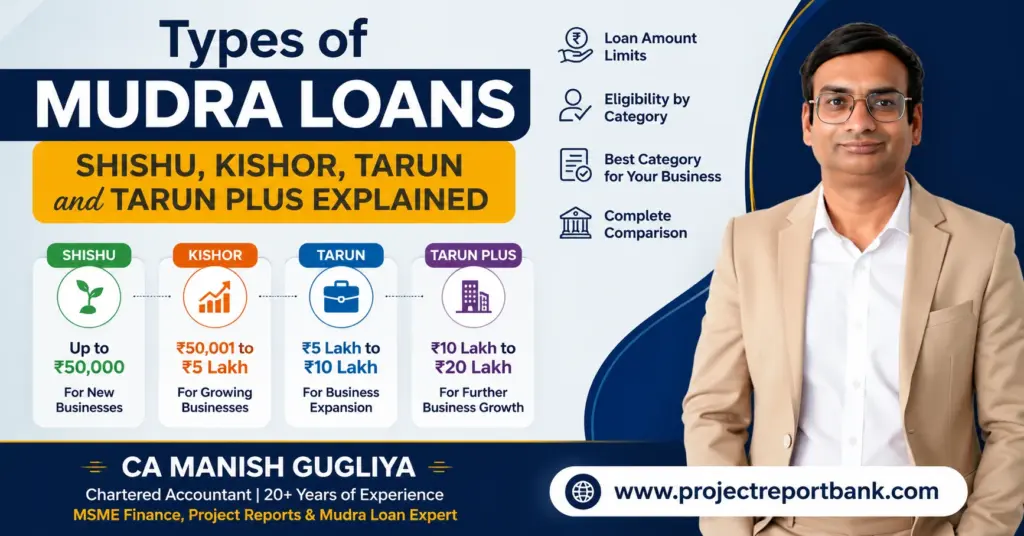
Here is where mudra stands today-the latest PIB data (April 2026) confirms over 57 crore loan accounts sanctioned with cumulative disbursement of ₹40.07 lakh crore. The overall loan limit has been enhanced to ₹20 lakh under four categories:
- Shishu: Shishu loans offer up to ₹50,000 for startups and very small micro businesses.
- Kishore: Kishore loans range from ₹50,001 to ₹5 lakh for businesses at an early stage of growth.
- Tarun: Tarun loans provide ₹5 lakh to ₹10 lakh for established businesses ready to scale.
- Tarun Plus: Tarun Plus loans range from ₹10 lakh to ₹20 lakh, available to borrowers who have successfully repaid loans under the tarun category.
Eligible borrowers include shop owners, vendors, and service providers-repair shops, beauty parlours, food stalls, small garages, and allied agri activities like dairy or poultry. However, agriculture-related businesses focused on crop farming are not eligible for MUDRA loans. Loans are available for non-farm income generating activities only, and applicants must be aged between 18 to 65 years.
Loans under PMMY are issued by banks, regional rural banks, small finance banks, non banking financial companies, and micro finance institutions. MUDRA is a refinancing agency and does not lend directly to citizens-it is a micro units development and refinance agency that supports the credit guarantee fund for micro units (CGFMU).
For a detailed scheme overview, read What Is PM Mudra Yojana? A Complete Beginner’s Guide. The mudra scheme also includes a mudra card-a RuPay debit card linked to the working capital loan account-allowing entrepreneurs to manage working capital through ATM, PoS, and online payments in a flexible manner.
Table of Contents
Why So Many Myths Exist Around Mudra Loans
Every government scheme that crosses 50 crore accounts naturally attracts rumours. Here is why myths about mudra yojana persist:
- Half knowledge: People hear that loans are collateral free and assume banks cannot ask for any documents or verification at all.
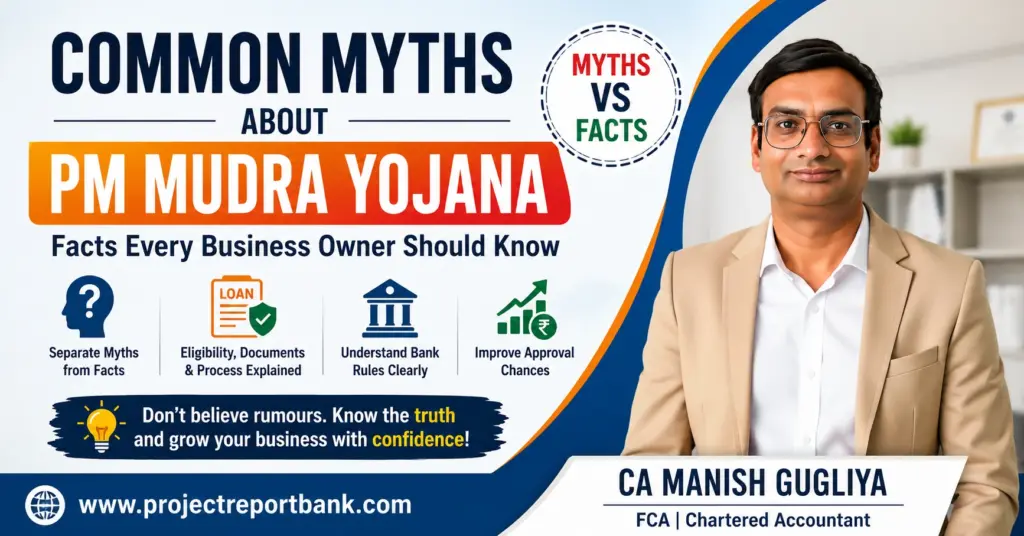
- Scheme confusion: Many confuse PMMY with Stand-Up India, PMEGP, or state subsidy schemes, leading to wrong assumptions about financial assistance and loan amount. See PM Mudra Yojana vs Stand-Up India Scheme for clarity.
- Social media chaos: Viral messages promising “instant mudra loan ₹10 lakh without CIBIL check” and thumbnails misusing government logos create false expectations.
- Middlemen and agents: Unregistered agents intentionally exaggerate benefits to collect advance file charges or processing fees.
- Documented scams: A fake PM Mudra loan letter was recently flagged promising ₹5 lakh for just ₹350 processing fee.
Genuine mudra loans are processed only by authorised lending institutions-never through unofficial third-party websites or middlemen. There are no authorized agents or middlemen for PMMY.
Common Myths About PM Mudra Yojana (Myth–Reality–Expert View)
This is the core of the article. Each myth below includes the reality and a practical explanation to help mudra loan applicants separate fact from fiction.
Myth 1: Mudra Loan Is Free Government Money
Reality: Mudra loans must be repaid with interest as they are commercial credit facilities. Only collateral is waived, not repayment. Interest rates for Mudra loans are determined by the respective lending institutions. Treating it as a grant leads to defaults and blocks future credit needs.
Myth 2: Anyone Can Get a Mudra Loan Without Documents
Reality: You need to fill a form and provide business details. KYC (Aadhaar, PAN), business proofs, quotations for machinery or stock, and bank statements are required. Documents required vary by loan category under PMMY. “Zero-document” promises are always fake.
Myth 3: No Bank Verification Happens
Reality: Banks verify your application before crediting funds. CIBIL score, existing loans, repayment history, and business viability are checked. Only collateral conditions differ from a traditional business loan-not the credit assessment itself.
Myth 4 & 5: Only New Businesses / Only Existing Businesses Can Apply
Reality: Both new and running micro units are eligible. A street vendor starting fresh can apply under the shishu category, while an established manufacturer can seek the tarun loan category. What matters is that the loan purpose covers income generating activities for business growth.
Myth 6: Collateral Is Always Required
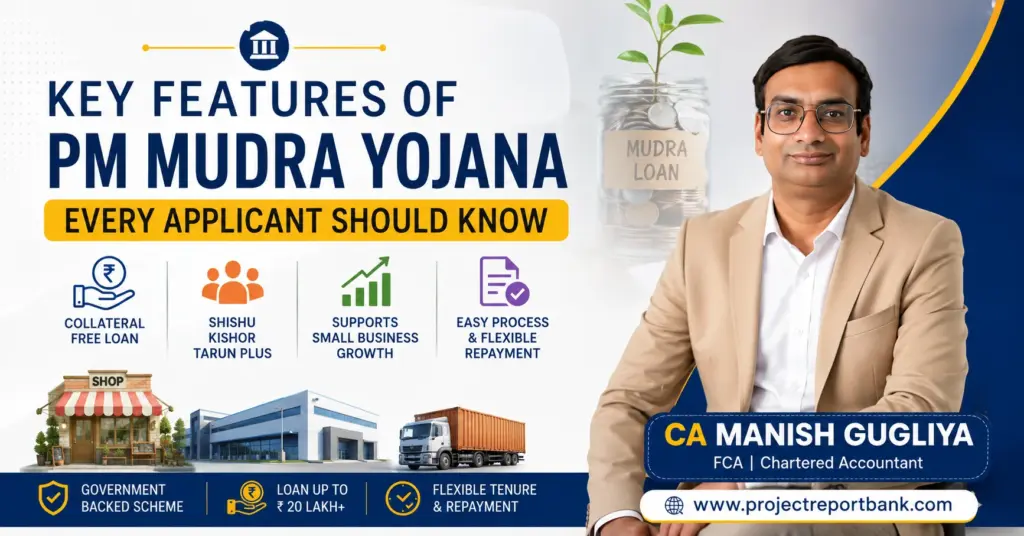
Reality: PMMY loans are collateral-free for amounts up to ₹20 lakh. No collateral is required for loans up to ₹10 lakh as per scheme guidelines. Banks may seek hypothecation of stock or equipment (primary security), but no fixed property mortgage is needed. Learn more about each loan category in Types of Mudra Loans Explained.
Myth 7: Government Gives Subsidy With Every Mudra Loan
Reality: The mudra loan scheme itself carries no blanket subsidy. Any interest subvention or capital subsidy comes through separate linked schemes and must be confirmed with your financial institution directly.
Myth 8: Only Unemployed People Are Eligible
Reality: Employment status is not the deciding factor. What matters is a viable business or self-employment activity and the ability to repay. Existing salaried individuals with side businesses can also be eligible borrowers.
Myth 9: Women Get Automatic Approval
Reality: Women account for approximately 60% of PMMY accounts, and many banks offer slightly better terms. But the loan application still needs to meet documentation and viability standards. A shishu loan for a woman running a small tailoring unit still requires KYC, a simple project report, and proof of business activity.
Myth 10: Banks Cannot Reject a Mudra Loan
Reality: PMMY is not a forced-lending scheme. Banks can and do reject applications for weak repayment capacity, inconsistent information, poor CIBIL, or non-viable projects. No public sector banks or other lender is obligated to approve every application.
Myth 11: Every Applicant Gets ₹20 Lakh
Reality: Actual loan size depends on business stage, loan category, project cost, and repayment capacity. Most first-time small businesses start with Shishu or Kishore. The average ticket size across all categories is around ₹1.02 lakh (FY25 data)-far from the maximum loan limit.
Myth 12: Mudra Loans Are Always Sanctioned in 24 Hours
Reality: Loan applications are processed within a few days if complete-but realistic timelines are a few days to a couple of weeks depending on the bank, documentation quality, and loan amount. You can apply for a Mudra loan online or offline, but instant approval is a myth.
Myth 13: Agents Can Guarantee Mudra Loan Approval
Reality: No outside agent can influence a bank’s internal appraisal. Any guarantee plus upfront fee is a scam. Only approach authorised banks, RRBs, or registered NBFCs for availing mudra loan.

Biggest Practical Mistakes During Mudra Loan Application
Many applications get delayed or rejected due to avoidable mistakes by borrowers, not because of the scheme itself:
- Mismatched documents: Aadhaar/PAN name mismatch, address differences, or missing business registration.
- Poor project report: Copy-paste profiles with unrealistic sales numbers and no clarity on how the loan amount will be used to purchase equipment or manage working capital requirements.
- Overasking: Requesting ₹10 lakh or ₹20 lakh when the actual funding needs are ₹2 lakh makes bankers doubt seriousness.
- No repayment plan: No clarity on monthly cash flow, EMI capacity, or business seasonality.
- Weak bank communication: Arguing that “RBI ordered you to give me a loan without questions” based on myths.
Quick case study: A small tailoring unit initially applied for ₹5 lakh but had turnover supporting only ₹1.5 lakh. After revising the loan amount, updating documents, and presenting a clearer mudra loan application form with realistic projections, the application was approved under Kishore within 10 days.
Myth vs Fact Comparison Table (For Quick Reference)
Here is a snapshot for quick scanning:
| Myth | Actual Fact | Expert Advice |
|---|---|---|
| Mudra is free money | It is a loan with interest; full repayment mandatory | Budget EMIs before applying |
| No documents required | KYC, business proof, quotations needed | Keep all documents ready and consistent |
| Every applicant gets ₹10–20 lakh | Loan amount depends on business need and capacity | Start with the category matching your stage of growth |
| No CIBIL check | Banks check credit history for all categories | Clear small dues before applying |
| Agents can guarantee approval | No authorised agents exist; upfront fees are scams | Apply directly at bank branch or Jan Samarth portal |
| Only unemployed are eligible | Anyone with viable business activity can apply | Show genuine income generating activities |
| Women loans are automatic | Women get priority, not guaranteed approval | Prepare documents like any other applicant |
| Banks cannot reject PMMY | Banks can and do reject weak applications | Invest in a proper project report |
How to Spot Fake Mudra Loan Offers and Scam Approvals
Fake mudra yojana messages and websites are increasing. Many micro businesses fall into the trap because they urgently need financial support.
- Fake letters: Government-logo letters promising ₹5–10 lakh for a small processing fee via UPI. These are fraudulent-PMMY charges no advance fees.
- Fake websites: Sites like “onlinemudraindia.co.in” that copy official design and ask for Aadhaar, OTP, and bank details promising guaranteed disbursal.
- Warning signs: Unsolicited WhatsApp/SMS, personal Gmail addresses, no physical branch, demand for advance money.
- What to do: Apply only with authorised banks, RRBs, small finance banks, NBFCs or MFIs. Use official portals like Jan Samarth or your bank’s website. Never share OTP or pay money for “file opening.”
- PIB Fact Check debunked a viral claim offering ₹10 lakh for ₹6,550-any fee demand before sanction is suspicious.
Tips to Improve Genuine Mudra Loan Approval Chances
While no one can guarantee approval, these steps play a pivotal role in strengthening your application:
- Prepare a clear project report showing what your business does, how the loan amount will be used (to purchase equipment, stock, or manage working capital), and how EMIs will be covered.
- Ensure all KYC and business documents are ready: Aadhaar, PAN, bank statements, GST registration (if applicable), Udyam/MSME registration, trade license, and quotations. PMMY offers collateral-free loans up to ₹20 lakh, but documentation must be solid.
- Choose the correct loan category and do not overstate requirements just to hit the maximum loan limit.
- Maintain clean repayment history on existing credit and assets financed through other loans.
- Be transparent with your bank about existing obligations and business challenges.
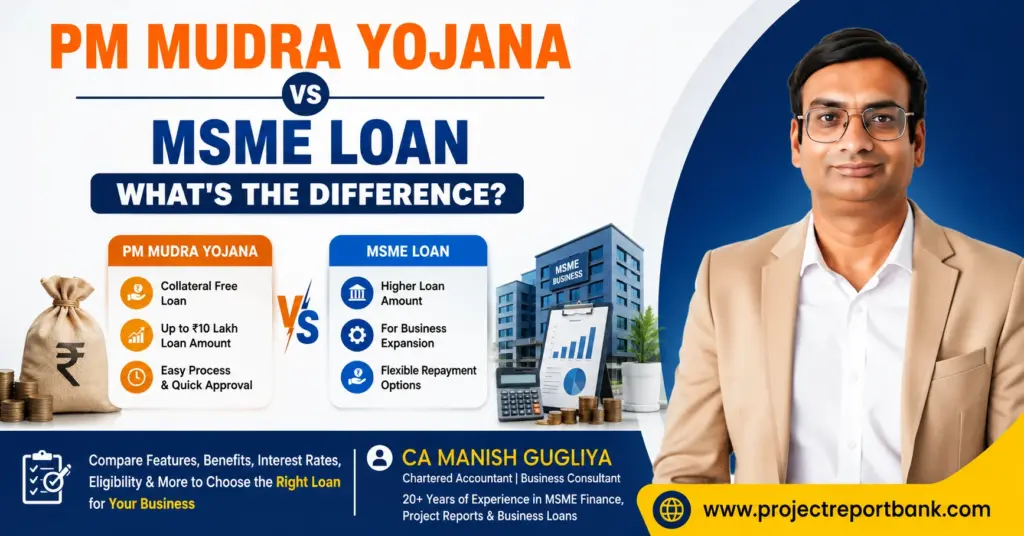
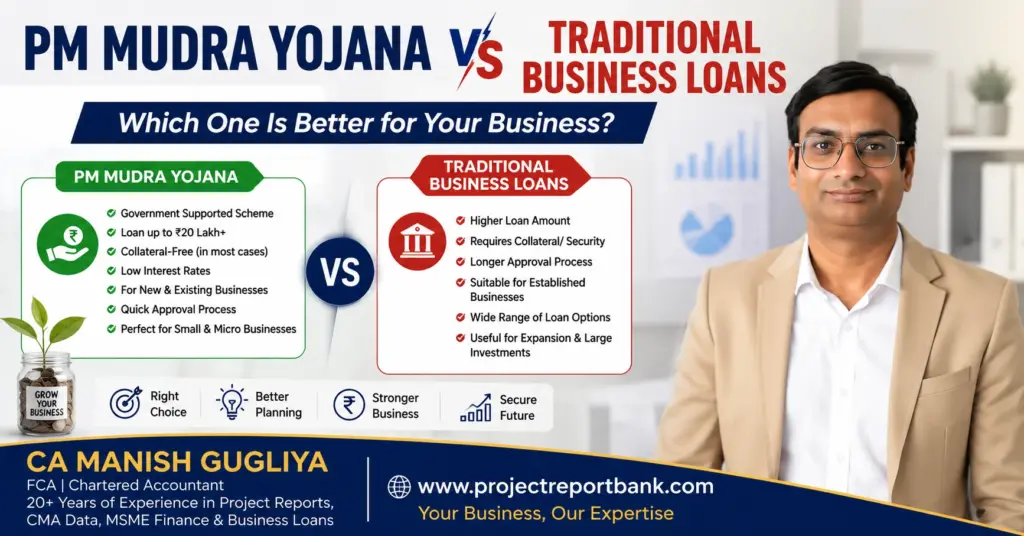
For deeper comparisons, see Key Features of PM Mudra Yojana and PM Mudra Yojana vs Traditional Business Loans.
Expert Advice from CA Manish Gugliya: Using PMMY Wisely for Your Business
After working with hundreds of MSMEs covering loans across Shishu, Kishore, and Tarun categories, I can say the real value of a Mudra loan lies in disciplined usage-not just getting approval.
- Treat it as a pure business loan. Diverting funds for personal expenses breaks trust with the bank and ruins future credit opportunities.
- Start small. Build a repayment track record with a shishu loan, then graduate to Kishore, Tarun, and eventually Tarun Plus as your growth demands.
- Maintain simple daily records-sales, expenses, bank reconciliation. This makes future loan renewals and enhancements dramatically easier.
- A strong project report is not a formality; it is your primary tool to convince the banker that your micro unit can safely repay.
At ProjectReportBank, we prepare bankable project reports, CMA data, and Mudra-specific financial projections tailored to your business. If you are serious about availing mudra loan funding for your micro business, consult through www.projectreportbank.com before applying-so you avoid common myths and errors at the documentation stage itself.
Frequently Asked Questions on Mudra Loan Myths & Realities
These FAQs address practical doubts that remain even after reading about the myths above.
Can I take a Mudra Loan if my business is not yet registered?
Yes. Small proprietors and street vendors can apply if they demonstrate genuine business activity with KYC documents. However, obtaining Udyam registration strengthens your application and is free of cost. Loans under PMMY are available for non-farm small businesses even without GST registration, though documentation expectations increase with loan size.
Is there any subsidy or interest waiver available with Mudra Loan?
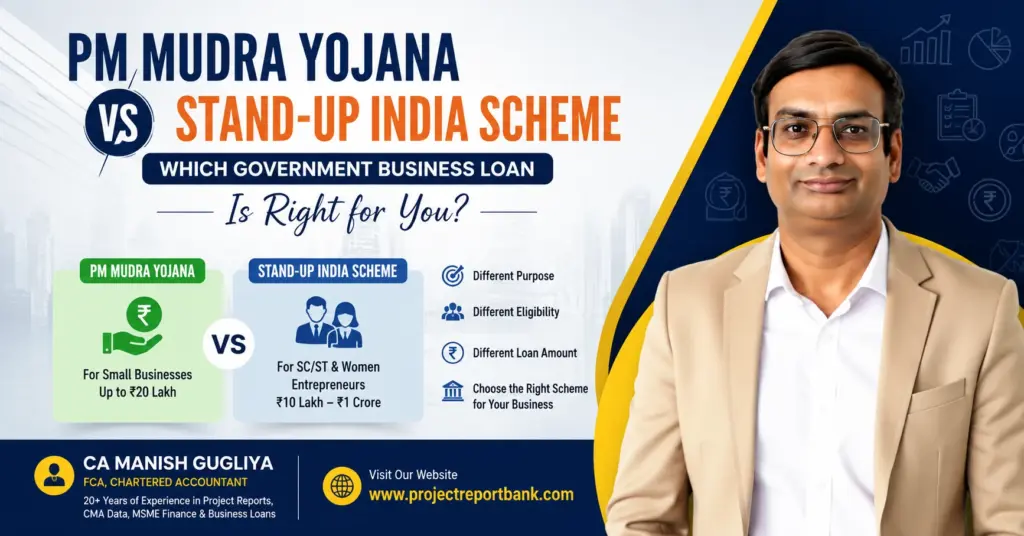
PMMY itself has no automatic subsidy or interest waiver built in. If any interest subvention or capital subsidy is available, it comes through separate central or state schemes. Always confirm directly with your bank or compare schemes-see PM Mudra Yojana vs MSME Loan.
Can I apply for multiple Mudra Loans from different banks simultaneously?
Banks check credit reports through CIBIL and similar bureaus. Multiple parallel applications for similar purposes raise red flags and can lead to rejections across all lenders. Apply to one financial institution at a time.
What if my Mudra Loan application is rejected-can I try again?
Absolutely. Understand the rejection reasons, improve your documents or project report, correct any CIBIL issues, and reapply-either at the same bank or another authorised lender. Rejection is not permanent.
Is Mudra Loan available for buying a personal house or car?
No. The mudra scheme is strictly for business purposes-commercial vehicles, machinery, stock, shop renovation, working capital, etc. Personal or consumption loans are outside the scope of PMMY. Only business-related funding needs qualify.
Conclusion: Ignore Myths, Focus on Preparation
PM Mudra Yojana is a powerful tool for small enterprises and micro units when approached with correct information, realistic expectations, and disciplined financial behaviour. Believing myths-such as guaranteed approval, free money, or zero-document loans-leads to disappointment, rejection, or even fraud.
Verify all information from official sources. Consult your bank or a professional like CA Manish Gugliya before sharing documents or paying fees to unknown persons. At ProjectReportBank, we help entrepreneurs prepare detailed project reports, CMA data, and application documentation to improve chances of genuine approval.
A well-planned, correctly structured Mudra loan can be the first real step towards scaling your micro business into a sustainable enterprise. Don’t let myths hold you back-prepare, apply, and grow.
- PM Mudra Yojana Basics: Complete Guide to PMMY

- Latest Statistics and Growth of PM Mudra Yojana (PMMY) in India
- Common Myths About PM Mudra Yojana: Facts Every Business Owner Should Know
- PM Mudra Yojana vs Stand-Up India Scheme: Which Government Business Loan Is Right for You?
- PM Mudra Yojana vs MSME Loan: Which Is Better for Your Small Business in 2026?
- PM Mudra Yojana vs Traditional Business Loans: Which Is Better for Small Businesses?
- Types of Mudra Loans: Shishu, Kishor, Tarun and Tarun Plus Explained
- Key Features of PM Mudra Yojana Every Applicant Should Know
- Objectives of PM Mudra Yojana Explained