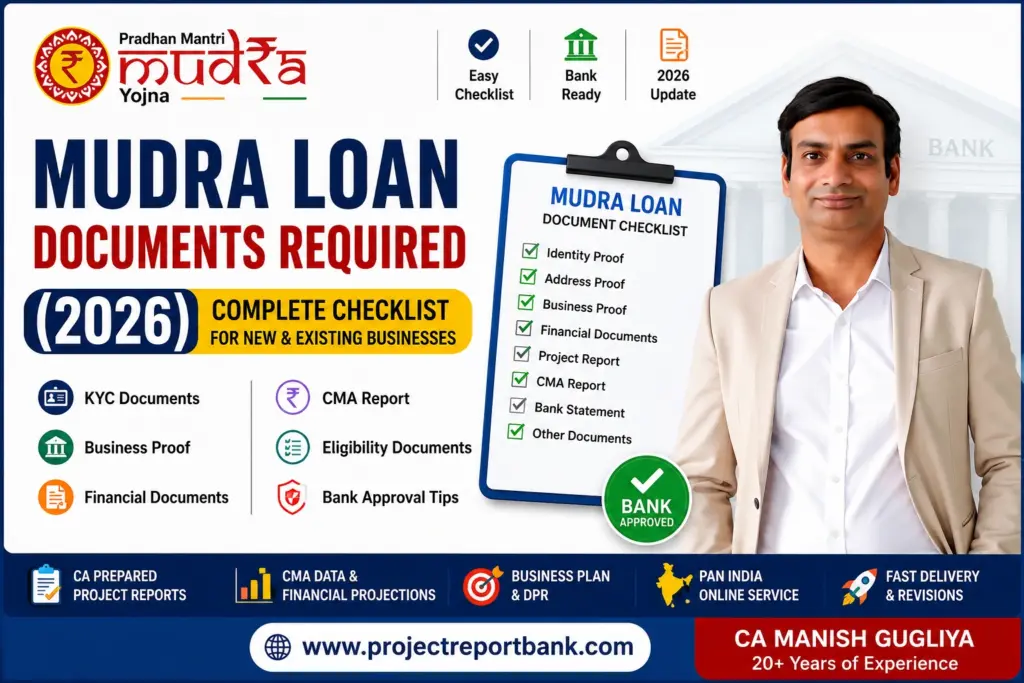
Every year, lakhs of entrepreneurs walk into banks to apply for a Mudra loan and walk out confused because they did not carry the right papers. I am CA Manish Gugliya, and after preparing hundreds of Mudra loan files across India over the last 20+ years, I can tell you that most rejections and delays happen not because of weak business ideas but because of incomplete or mismatched documents. This guide gives you the exact checklist, practical tips, and CA-level insights you need to build a bank-ready file in 2026.
Key Takeaways
Here is a quick summary before we go into details:
- Mudra loan is a collateral free business loan under Pradhan Mantri Mudra Yojana (PMMY) for micro and small non-farm enterprises, offering up to ₹10 lakh (some banks now offer Tarun Plus up to ₹20 lakh for borrowers who have successfully repaid earlier loans).
- Four core document groups are needed: KYC documents (identity + address proof documents), business proof, income proof and financials, and the mudra loan application form with a project report.
- Exact documents required change with loan amount (Shishu, Kishore, Tarun), business type (proprietorship, partnership, company, LLP), and whether the business is new or existing.
- Applicants must be aged between 18 to 65 years and businesses must be non-farm to qualify for Mudra loans.
- You can get a bank-ready Mudra Loan Project Report and CMA Data for any state from ProjectReportBank.com with online PAN India support under the guidance of an experienced Chartered Accountant.
Table of Contents
What Is Mudra Loan under Pradhan Mantri Mudra Yojana (PMMY)?
Mudra loan is a collateral free business loan designed for non corporate micro enterprises and small enterprises that need financial assistance to start or expand their operations. The Pradhan Mantri Mudra Yojana was launched on 8 April 2015 by the government of India. MUDRA stands for Micro Units Development and Refinance Agency. It works as a refinance agency, meaning it does not lend directly. Instead, loans are offered through banks, non banking financial companies, micro finance institutions, and small finance banks acting as lenders.
These loans are meant for income-generating activities like running a shop, trading, manufacturing, service business, transport, agency, rental, medical practice, and similar businesses. Agriculture production activities (like sowing crops) are excluded, but allied and support activities such as transport of agricultural goods or equipment servicing can be covered. The mudra scheme is a flagship scheme that has provided funding to crores of borrowers across India.
As a Chartered Accountant, I focus on what banks actually ask for at the branch level, not just what the scheme brochure says. Let me walk you through the real documentation requirements.
Categories of Mudra Loan: Shishu, Kishore, Tarun and Tarun Plus
The document intensity rises as the loan amount increases. Loan categories include Shishu, Kishor, and Tarun, and each has different documentation expectations:
- Shishu: up to ₹50,000 – suited for very small or new businesses; minimum loan amount starts from as low as a few thousand rupees; lighter documentation
- Kishore: ₹50,001 to ₹5 lakh – for businesses with some track record; requires stronger financial documents and business proof
- Tarun: ₹5 lakh to ₹10 lakh – maximum loan amount under standard PMMY; needs detailed ITR, project report, and cash flow projections
- Tarun Plus (where bank offers): ₹10,00,001 to ₹20,00,000 – reserved for borrowers with clean repayment records; even more rigorous documentation
Shishu loans often need simpler income proof and a basic business plan. Kishore and Tarun require detailed financial documents, income tax returns, and a professional project report. Banks may use different internal names, but required documents are largely similar across financial institutions.

Why Do Banks Ask for So Many Documents for Mudra Loan?
Even though the mudra loan is collateral free up to ₹10 lakh, banks still need to verify who you are, whether your business is real, and whether you can repay. Here is the logic behind each document group:
- KYC documents confirm identity and satisfy AML (anti-money laundering) compliance requirements
- Business proof confirms that the enterprise genuinely exists and operates legally
- Financial documents help the bank assess your repayment capacity through bank statements, ITR, and balance sheets
- Project report lets the credit officer judge business feasibility and justify the sanction without collateral
RBI guidelines and internal credit policies force lenders to document every file properly, especially for loans funded under government schemes.
CA Note: A neat, complete documentation set reduces queries and significantly improves your chances of faster sanction and disbursal. Mismatches in name, address, or figures across documents are the single biggest cause of hold-ups.
Complete Mudra Loan Document Checklist (2026 Overview)
This is a master checklist. Later sections break it down by applicant type and loan category. Mudra loan documentation includes identity, address, and business-related documents:
- Identity proof (PAN card, aadhaar card, voter ID, passport, driving licence)
- Address proof documents (Aadhaar, utility bills, rent agreement, passport, bank passbook)
- Passport-size photographs (2–6 as per bank)
- Business proof (business registration, trade licences, GST, Udyam, shop act licence)
- Financial documents and income proof (bank statements, ITR, balance sheet, P&L, GST returns)
- Project report / DPR and CMA Data
- Existing loan and banking documents
- Additional documents based on constitution (partnership deed, MOA, AOA, LLP agreement)
- Security and guarantee related documents, where bank insists even under collateral free norms
Later sections give exact lists for proprietorship, partnership, company, LLP, and for new vs existing businesses. ProjectReportBank.com can prepare customized document checklists for specific banks and states like Maharashtra, Gujarat, Madhya Pradesh, Uttar Pradesh, Bihar, Andhra Pradesh, Karnataka, Kerala, Odisha, Rajasthan, Tamil Nadu, Telangana, and West Bengal.
Personal KYC Documents Required for Mudra Loan
Every proprietor, partner, director, or key promoter must submit KYC documents, even if the business entity is a separate legal person.
Accepted identity proof: PAN card (almost always mandatory), aadhaar card, voter ID, driving licence, or passport. The PAN and Aadhaar combination is most commonly insisted upon.
Address proof options: Aadhaar, passport, latest utility bills (electricity, water, gas), bank passbook with updated address, registered rent agreement, or latest property tax receipt. The address on KYC and bank records should ideally match.
You will need 2–6 recent passport-size photographs depending on the bank. Some PSBs may also capture biometric or thumb impression during the application process.
Expert Tip: Keep the same mobile number and email ID across all KYC and loan application documents. This avoids OTP failures and communication gaps during mudra loan document verification.
Address Proof Documents: Residence and Business
Banks often need both your personal residence address proof and your business address proof. These are treated separately.
Residence address proof: Aadhaar, passport, voter ID, property tax bill, latest electricity or water bill, registered lease deed if staying on rent.
Business address proof: Shop and establishment licence, trade licence, GST registration certificate, Udyam certificate with address, rent agreement along with owner’s property tax or electricity bill, and municipal registration.
For home-based or online businesses, banks often accept a self-declaration plus Aadhaar address and any online registration or portal listing as supporting proof.
If your address changed recently, update it in Aadhaar and bank records before applying to avoid KYC mismatch delays.
Business Proof Documents for Mudra Loan
The nature and age of your business strongly influence what documents are required and your eligibility for the loan.
Typical business proof documents include: shop act registration, MSME / Udyam Registration, GST registration, trade licence, FSSAI (for food businesses), professional tax receipt, local municipal licence, and industry-specific permits.
For businesses like dry fruits, masala, medical store, car-related, transport, civil engineering, agency, rental, import-export, and shop-based ventures, banks may ask for specific licences or registrations. For example, a food business needs FSSAI, while a transport operator needs permits and fitness certificates. Browse those guides to understand practical licensing needs before filing your loan application.
Financial Documents and Income Proof for Mudra Loan
Shishu loans may be sanctioned with minimal or alternative income proof. But Kishore and Tarun generally require stronger financial documents.
Core financial documents:
- Bank statements from the last 6 months are often required for Kishore; 12 months for Tarun
- Income Tax Returns for the last two years (for existing business)
- Balance sheet and profit and loss statement – for larger loans, you need to provide projected and past balance sheets
- GST returns (GSTR-3B, GSTR-1)
- Details of existing loans and credit facilities
Income proof possibilities:
- For self-employed: ITR, GST returns, bank credits, and CA-certified financials
- For salaried persons starting a side business: salary slips and bank statements as supporting income proof
Where formal income proof is weak (common in very small or cash-based businesses), banks may consider alternative proofs like purchase bills, sales bills, rental agreements, stock statements, and trade references.
CA Note: Well-prepared CMA Data and financial projections can often compensate for thin historical financials, especially in Mudra for startup or new unit cases. This is where professional help makes a real difference.
Mudra Loan Application Form and Bank Formats
Each bank has its own mudra loan application form and annexures. Application forms for Mudra loans can be filled online or at banks. All fields must be filled carefully and consistently with supporting documents.
Typical details captured include: applicant KYC details, business profile, existing banking relationships, sales and profit figures, proposed loan amount, purpose of loan, security or guarantee details, and declarations. Loan applications require a duly filled loan application form – any mismatch between the application and documents (like different turnover or address) commonly leads to queries and delays.
ProjectReportBank.com helps clients fill bank-specific Mudra application forms correctly and align them with the project report and financial projections.
Project Report Requirement for Mudra Loan
For Kishore and Tarun categories, a detailed Mudra Loan Project Report is either mandatory or strongly preferred by most banks. A project report is required, especially for larger loan amounts. According to aggregated bank credit officer interviews, project report deficiencies cause nearly 45% of loan denials in Kishore and Tarun categories.
Key contents of a professional project report:
- Business description and promoter profile
- Market analysis and competitive landscape
- Cost of project and means of finance
- Sales and profit projections with cash flow statements
- DSCR (Debt Service Coverage Ratio) and repayment schedule
- Risk and sensitivity analysis
The project report helps the loan officer understand viability and justify sanction without collateral. It replaces, in effect, the security that would otherwise protect the bank.
ProjectReportBank.com prepares bank-ready Mudra project reports for all major states with state-specific cost and pricing assumptions. Whether you are applying through the Jan Samarth Mudra Loan portal or directly at a branch, or need a specialized report for used machinery or a Mudra loan without GST, you can get professional documentation support.

CMA Data and Financial Projections for Business Installment Loans
CMA Data (Credit Monitoring Arrangement) is a structured set of financial statements that many banks now insist on, even for smaller Mudra-based business installment loan applications.
Major statements in CMA:
- Past performance (2–3 years)
- Current year estimates
- Projected balance sheets and profit and loss (3–5 years)
- Fund flow statement
- DSCR working and maximum permissible bank finance calculation
Accurate CMA Data helps banks assess repayment capacity, working capital needs, and interest coverage before offering collateral free credit. Interest rates and repayment terms are often influenced by the strength of your CMA projections.
Pro Tip: Do not copy random Excel formats from the internet. Bank credit officers quickly notice inconsistent or unrealistic figures. A professionally prepared CMA from ProjectReportBank.com saves time and builds credibility.
GST, Udyam and Other Registration Documents
GST registration is not mandatory for all Mudra loan applications. However, GST and Udyam registration strongly support business credibility and can ease sanction, especially for Kishore and Tarun.
GST-related documents: GST registration certificate, GSTR-3B and GSTR-1 summaries for last 6–12 months, and GST-linked turnover summary.
MSME registration: Udyam Registration Certificate with correct NIC code and address – this is extremely useful for applicants in the msme sector.
For some home-based and very small businesses, a Mudra loan without GST is possible, but banks may limit loan amount or ask for stronger alternative proofs.
Documents for Existing Businesses vs New Businesses
For existing business:
- At least 1–3 years of business proof, ITRs, GST returns where applicable, stock and debtor details, and 12-month bank statements
- Banks will compare declared turnover with GST and ITR figures to check consistency
For new business:
- Emphasis falls on project report, CMA Data, promoter income proof, savings, qualifications, and experience
- Banks may still ask for basic business registration, rent agreement, quotations for machinery or stock, and any pre-orders or franchise documents
Example: A new shop owner applying for ₹3 lakh Kishore loan would submit promoter KYC, basic shop registration, quotations for initial stock and fixtures, and a CA-prepared project report. An existing trader applying for the same amount would submit 12 months bank statements, 2 years ITR, GST returns, and proof of existing turnover. The documentation packages are quite different even though the loan amount and category are identical.
Documents by Business Constitution: Proprietorship, Partnership, Company, LLP
Besides personal KYC, banks must verify the legal constitution of the entity taking the Mudra loan.
- Proprietorship: PAN and Aadhaar of proprietor, any business registration, current account proof, and simple declaration of ownership
- Partnership: Partnership deed, PAN of firm, registration certificate if registered, KYC of all partners, and authorization letter or partnership resolution authorizing one partner to sign loan documents
- Private Limited Company: Certificate of Incorporation, MOA, AOA, PAN of company, board resolution, list of directors, latest shareholding pattern, and KYC of directors and guarantors
- LLP: LLP Agreement, Certificate of Incorporation, PAN of LLP, list of designated partners, resolution or authorization, and KYC of partners
Banks will cross-check signatures and authorizations carefully. Internal entity documents and loan application must match exactly.
Documents by Business Type: Manufacturing, Trading, Service and Home Business
While core KYC and financials remain the same, some other documents differ by business model.
- Manufacturing: Quotations for machinery, land or shed documents or rent agreement, pollution or factory licences if applicable, power connection details. Assets created through the loan are often hypothecated.
- Trading and shops: Shop registration, supplier invoices, stock statements, trade licences
- Service businesses: Professional registrations, client agreements, digital presence proofs (website, listings), specialized licences (medical, agency, or consultancy)
- Home-based and online businesses: Aadhaar-based address proof, self-declaration of business place, online store screenshots, platform agreements, basic registrations – ideal for business ideas for housewives and business ideas for students
Sectors that commonly use Mudra funding include B2B businesses, real estate services, and business ideas for men – you can explore the top 10000 business ideas collection for more inspiration.
Special Documentation Cases: Women, Students, Franchise and Sector-Specific Loans
Some segments often ask whether extra or different documents are needed. Additional documents may be requested based on business type or loan category.
- Women entrepreneurs: Include any women-specific subsidy forms and proof of women ownership. SC ST OBC category certificates can also help access priority lending. Explore the Mudra loan for housewives guide for details.
- Students: Minimum age is generally 18+. Submit education certificates and consider parents as co-applicants or guarantors.
- Franchise businesses: Franchise offer letter, agreement draft, investment estimate, and brand approvals – see the Mudra loan for franchise article.
- Sector-specific loans: A medical store needs Drug Licence. A transport operator needs permits and fitness certificates. An import-export business needs IEC code. Each sector has unique licensing, and ProjectReportBank.com provides sector-specific project reports tailored to each line of activity.
Documents for Vehicle, Transport and Used Machinery under Mudra
Banks treat vehicles and used machinery slightly differently because these are physical assets that can be hypothecated. A vehicle loan under Mudra follows a specific documentation path.
For commercial vehicle Mudra loans: Vehicle quotation or proforma invoice, RC copy after purchase, insurance, permit papers, and route contract or trip agreement where available.
For transport operators: Existing vehicle list, fitness certificates, permits, and major customer contracts to support income estimation.
For used machinery: Valuation report, purchase invoice, seller KYC, photographs and condition report – see the Mudra loan for used machine guide for complete details.
Despite the asset being financed, many banks still treat this as collateral free under PMMY but hypothecate the vehicle or machinery for legal safety. No collateral is required for loans up to ₹10 lakh, but hypothecation of assets created is standard practice.
State-wise Variations in Mudra Loan Documentation
Core Mudra rules are national, but practical documentation expectations differ by state, bank, and even individual branch culture. Some coastal states insist more strongly on pollution control or food licences, while industrial belts may demand detailed electricity load documents.
ProjectReportBank.com offers state-specific Mudra project reports and documentation guidance for all major states through their dedicated pages.
Tip: Talk to your branch once, get their specific list, and then prepare documents as per that list plus CA inputs. This avoids repeatedly visiting with incomplete files.
How to Organize a Professional Mudra Loan File
Document quality and file organization can strongly influence the bank’s comfort level, even when eligibility and income proof are borderline.
Recommended file structure:
- Cover letter addressed to the branch manager
- Index page listing all enclosed documents
- KYC set (identity + address proofs)
- Business proof set
- Financials and ITR
- Project report and CMA Data
- Quotations and licences
- Declarations and undertakings
Use separators or clear labels so the credit officer can trace any document quickly during appraisal or audit. ProjectReportBank.com provides not just project reports but also sample cover letters, checklists, and file index formats to help borrowers who require funds present a professional documentation set.

Common Documentation Mistakes in Mudra Loan Applications
Here are the frequent real-world mistakes I see in Mudra files:
- Name mismatch between PAN card and aadhaar card (different spelling or initials)
- Outdated address proof that does not match current residence or business location
- Incomplete bank statements with missing pages or months
- Unsigned or undated project report
- Missing annexures in the loan application form
- Income or business details left blank or filled with figures that do not match GST returns or ITR
- GST registration expired or returns not filed for several months
- Passport-size photographs that are old or unclear
CA Warning: Submitting false documents or manipulated statements can lead to rejection, blacklisting, or even legal action. Always submit genuine documents and let a professional help you present them correctly.
Top Documentation Reasons Why Mudra Loans Get Rejected
Beyond “insufficient income,” here are the specific document-related reasons for rejection:
- Missing mandatory KYC (PAN or Aadhaar not submitted)
- No clear business proof or registration
- Weak or absent income proof for Kishore and Tarun categories
- Inconsistent data across documents (turnover in application differs from ITR or GST)
- Negative conduct in bank statements (frequent bounced cheques, overdrawn accounts)
- Incomplete or unrealistic project report without DSCR or repayment schedule
- Prior loan default or poor credit history visible in CIBIL report
Read the detailed reasons for Mudra loan rejected guide. If you have already been rejected, follow the rejected Mudra loan appeal process to improve your documentation and re-apply correctly. Consulting a CA or using ProjectReportBank.com services before re-applying significantly improves your chances.
How ProjectReportBank.com Helps with Mudra Loan Documentation
I am CA Manish Gugliya, and over the past 20+ years, I have prepared Mudra loan files for small businesses, startups, manufacturers, traders, and service providers across India. At ProjectReportBank.com, we offer:
- Customized Mudra loan project reports with DSCR, cash flow, and repayment schedules
- CMA Data aligned to bank norms and interest rate assumptions
- Detailed financial projections for 3–5 years
- Business plans and DPRs for every category from Shishu to Tarun Plus
- Documentation checklists and assistance in filling bank application forms
- Fast online delivery across all states
All reports are designed to match bank formats and expectations, helping applicants submit strong, consistent, and audit-ready loan files. We do not promise guaranteed approval – no honest professional can – but we ensure your documentation gives you the best possible chance. Users exploring the Jan Samarth Mudra Loan portal or applying through the MSME Mudra Loan route can contact us for tailored documentation packages.
Frequently Asked Questions on Mudra Loan Documents
Many doubts repeat at bank branches. Here are clear answers to the most practical document questions that borrowers and applicants face when trying to qualify for credit.
Is GST registration compulsory to get a Mudra loan?
GST is not compulsory for very small turnover businesses and Shishu cases. But for Kishore and Tarun, many banks expect GST registration if business turnover crosses the legal threshold. Even without GST, a Mudra loan may be possible if other documents and income proof are strong. Read the Mudra loan without GST guide for detailed scenarios. Rules can change, so always check with your bank and CA before applying.
Can I get a Mudra loan without ITR or formal income proof?
For small Shishu loans, banks sometimes accept alternative proofs like bank credits, sales bills, and basic business proof instead of ITR. For higher Kishore and Tarun amounts, at least 1–2 years of income tax returns are generally expected. Absence of ITR makes approval difficult unless backed by a strong business history and projections. If you do not have ITR yet, start filing returns immediately and use a CA-prepared project report and CMA Data to build your case for future applications.
Do I need to provide collateral or guarantor for Mudra loan?
Mudra loans up to ₹10 lakh are officially collateral free under PMMY. However, banks may still ask for the personal guarantee of the proprietor, partners, or directors. Hypothecation of assets financed (like a vehicle or machinery) is normal and does not count as separate collateral like a property mortgage. If a bank insists on property collateral for small Mudra limits, you can politely ask whether the loan is being processed under a standard business loan product instead of pure PMMY.
What documents should a first-time entrepreneur keep ready before visiting bank?
Keep this starter list ready: PAN card, aadhaar card, residence proof, basic business registration (shop act or Udyam), bank statements (even personal account if no business account yet), a simple project report, and any experience or education certificates relevant to your proposed business. Business registration proof may be needed for first-time borrowers. Prepare photocopies and scanned copies of all documents so you can also apply via online portals where applicable.
How long should my bank statement history be for Mudra loan?
Most banks ask for 6 months bank statements for very small limits and 12 months for higher Kishore and Tarun loans, especially for existing businesses. Clean banking with regular credits and no cheque returns makes a strong positive impression on the credit officer. Include statements of all operative accounts used for business, not only the one maintained with the lending bank, to show the full picture of income and expenses.
- Can Bank Reduce Mudra Loan Amount Without Your Consent? Complete Practical Guide (2026)

- What to Do If You Cannot Pay Your Mudra Loan EMI (2026 Guide)

- Can a Bank Refuse a Mudra Loan Because the Target Is Completed? Complete Guide (2026)
- Bank Refused My Mudra Loan Application – What Are My Rights?
- Mudra Loan for Used Vehicles (2026): Eligibility, Documents, Bank Rules & Complete Guide
- Rejected Mudra Loan – What to Do Next? Appeal Process Explained (2026)

- Mudra Loan Project Report Madhya Pradesh – Bank-Ready DPR & CMA Guide

- Project Report for Mudra Loan Maharashtra: Complete Guide for MSMEs, Startups and Small Businesses (2026)
- Mudra Loan Uttar Pradesh: Complete Guide for MSMEs, Startups and Small Businesses (2026)
- Mudra Loan Bihar 2026: Eligibility, Documents, Online Application Process & Project Report Guide
- Jan Samarth Mudra Loan 2026: Complete Guide to Online Application, Eligibility, Documents & Approval Process
- MSME Mudra Loan: Complete Guide for Small Businesses, Startups & Manufacturing Units in India (2026)
- Is the Mudra Loan Subsidy Real or Fake? Get the Facts Here

- Mudra Loan Without CIBIL Score: How to Qualify and Apply

- Mudra Loan for Used Machine (2026 Guide) – Eligibility, Documents, Valuation & Approval Tips