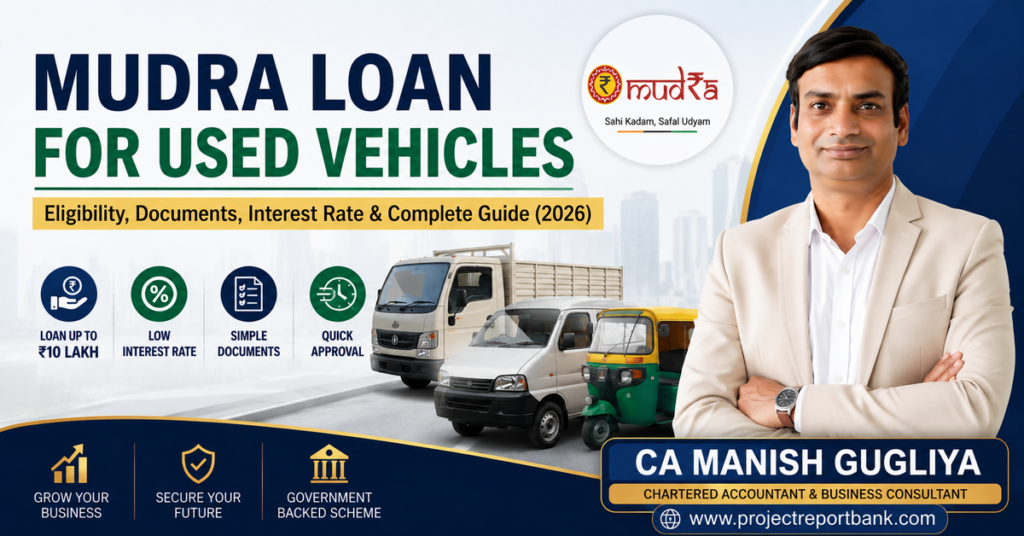
Key Takeaways
- Under Pradhan Mantri Mudra Yojana (PMMY), many banks in 2026 do finance second-hand commercial vehicles such as used pickup, used tempo, used truck, auto rickshaw, and taxi – provided the vehicle is within permissible age (generally up to 5–8 years old) and in roadworthy condition with clear documentation.
- Mudra loans can be used to purchase used vehicles for commercial purposes only. The vehicle must serve income-generating business activities like goods carriage, passenger transport, or last-mile delivery – never for personal use.
- The maximum loan amount under standard Mudra categories is up to ₹10 lakh (Tarun), with loans up to ₹10 lakhs requiring no collateral security. Margin money is typically 10–30% of the used vehicle’s valuation, and the repayment period ranges from one to five years.
- Interest rates are not fixed by PMMY – each bank or financial institution decides its Mudra loan interest rate based on RBI guidelines, borrower profile, and vehicle condition. Typical rates range from 9% to 15% p.a. in practice, though interest rates can reach up to 21% in some cases.
- Approval is not automatic. Borrowers must satisfy mudra loan eligibility criteria, maintain a satisfactory credit track record, submit necessary documents, and present a viable business plan or project report for the proposed transport activity.
- A professionally prepared Project Report (DPR) and CMA Data can significantly improve approval chances for used vehicle Mudra loans, especially for first-time entrepreneurs and small business owners in the transport sector.
Table of Contents
Introduction: Mudra Loan for Used Commercial Vehicles in 2026
Demand for used commercial vehicles is growing rapidly across India. Small transport operators, delivery partners, and rural entrepreneurs increasingly prefer second-hand pickups, tempos, trucks, and auto rickshaws because the initial investment is significantly lower, breakeven comes faster, and the return on investment is more practical compared to buying a brand-new vehicle.
For a driver wanting to start a goods carriage business or an auto rickshaw operator looking to own their vehicle, buying used makes complete sense. The challenge, however, is arranging affordable credit to fund that purchase. This is where Pradhan Mantri Mudra Yojana (PMMY) becomes relevant.
The mudra scheme, launched on 8 April 2015 by the Indian government, provides financial assistance through collateral-free mudra loans upto Rs 10 lakh via banks, NBFCs, MFIs, and other financial institutions. In 2026, many lending institutions do allow Mudra Loan for Used Vehicles – but availability depends on the bank’s internal policy, vehicle condition, documentation quality, and clear business usage under the scheme.
This guide is written from my practical experience as a Chartered Accountant who has helped hundreds of transport entrepreneurs obtain bank finance across India. The focus here is on what banks actually expect when you walk in with a used vehicle file – not just the theoretical scheme guidelines.
What is Mudra Loan? (PMMY Overview & Loan Types)
Pradhan Mantri Mudra Yojana (PMMY) operates through the Micro Units Development & Refinance Agency (MUDRA), which functions as a refinance agency supporting various financial institutions that lend to small and micro enterprises. The primary objective is to provide financial support to non corporate, non-farm micro enterprises engaged in income generation activities across India.
Mudra loans are strictly business loans. They cannot be used for purchasing a personal car or any vehicle meant for private use. Every loan extended under PMMY must be linked to a proposed activity that generates income – such as transport, logistics, goods carriage, passenger services, last-mile delivery, tailoring shops, livestock rearing, agri clinics, aggregation agro industries, or food-related agricultural businesses.
The mudra scheme is divided into three tiers – commonly referred to as shishu kishor tarun – classified purely by loan amount:
| Category | Loan Range | Typical Vehicle Use |
|---|---|---|
| Shishu | Up to ₹50,000 | Repairs, permits, initial expenses |
| Kishor | ₹50,001 to ₹5,00,000 | Used auto rickshaw, used pickup, used tempo |
| Tarun | ₹5,00,001 to ₹10,00,000 | Used truck, mini truck, fleet additions |
| Tarun Plus | ₹10,00,001 to ₹20,00,000 | For borrowers who have successfully repaid previous loans under Tarun |
Shishu loans offer up to ₹50,000 for startups. Kishore loans range from ₹50,001 to ₹5 lakh. Tarun loans provide funding between ₹5 lakh and ₹10 lakh. The recently introduced Tarun+ loans extend from ₹10 lakh to ₹20 lakh for eligible borrowers who have already cleared earlier Tarun category loans.
Mudra loans are available through banks, NBFCs, and MFIs – including public sector banks, private sector banks, regional rural banks, small finance banks, cooperative banks, and micro finance institutions authorised under PMMY. The product offerings from each lending institution may differ in terms of interest rates, tenure, and internal risk norms. Mudra loan interest rates are deregulated by banks, meaning each institution sets its own rate based on Reserve Bank of India guidelines and internal policies. Beyond transport vehicles, businesses can use mudra loans for acquiring machinery and tools, and the scheme also provides working capital for various business sectors, supporting shopkeepers and vendors in trading activities at the rural level and urban areas alike.
Can You Buy a Used Vehicle Under Mudra Loan?
Yes, in many cases you can. The PM Mudra Yojana officially lists transport vehicles for commercial use among eligible loan purposes, and PMMY’s framework on the government portal does not prohibit funding used commercial vehicles. However, whether a particular bank accepts a second-hand vehicle under Mudra depends on its individual credit policy.
From my experience handling transport-related Mudra files, here is what I have observed: some banks restrict Mudra to new vehicles only, while others readily finance a Mudra Loan for Second Hand Vehicle if the risk parameters are satisfied. Mudra loans are evaluated based on business viability and vehicle condition – not just the borrower’s profile.
Banks typically insist on the following criteria for a PM Mudra Loan for Used Commercial Vehicle:
- Vehicle must be used strictly for commercial or business purpose (goods carriage, passenger services, commercial taxi)
- Clear Registration Certificate (RC) with valid fitness and insurance
- Transparent ownership chain and no existing hypothecation or lien
- Proper valuation report from an authorised dealer or valuer to fix the loan amount
Banks see higher risk in used vehicles – maintenance uncertainty, shorter residual life, potential documentation issues – and may therefore ask for higher margin money or tighter eligibility compared to new vehicle loans.
Practical examples from my files:
A small goods carrier operator obtained ₹4,50,000 under Kishor/Tarun category for a 5-year-old Tata Ace pickup valued at ₹6,00,000. The bank sanctioned 75% of valuation, and the borrower arranged ₹1,50,000 as margin. In another case, an auto driver purchased a 4-year-old CNG auto valued at ₹1,80,000 and received ₹1,20,000 under Kishor category.
Approval remains at the discretion of the branch credit officer. If one branch declines, applicants should try another bank or branch – and in some cases, the bank may offer a regular commercial vehicle loan instead of routing it under Mudra.
Which Used Vehicles are Eligible Under Mudra Scheme?
The focus of mudra loans under the transport category is squarely on income-generating commercial vehicles – assets created for business, not personal convenience. Commercial vehicles eligible for Mudra loans include taxis, auto-rickshaws, and goods carriers, among others. Mudra loans also finance transport vehicles like trucks and vans.
Here are the specific categories banks commonly consider:
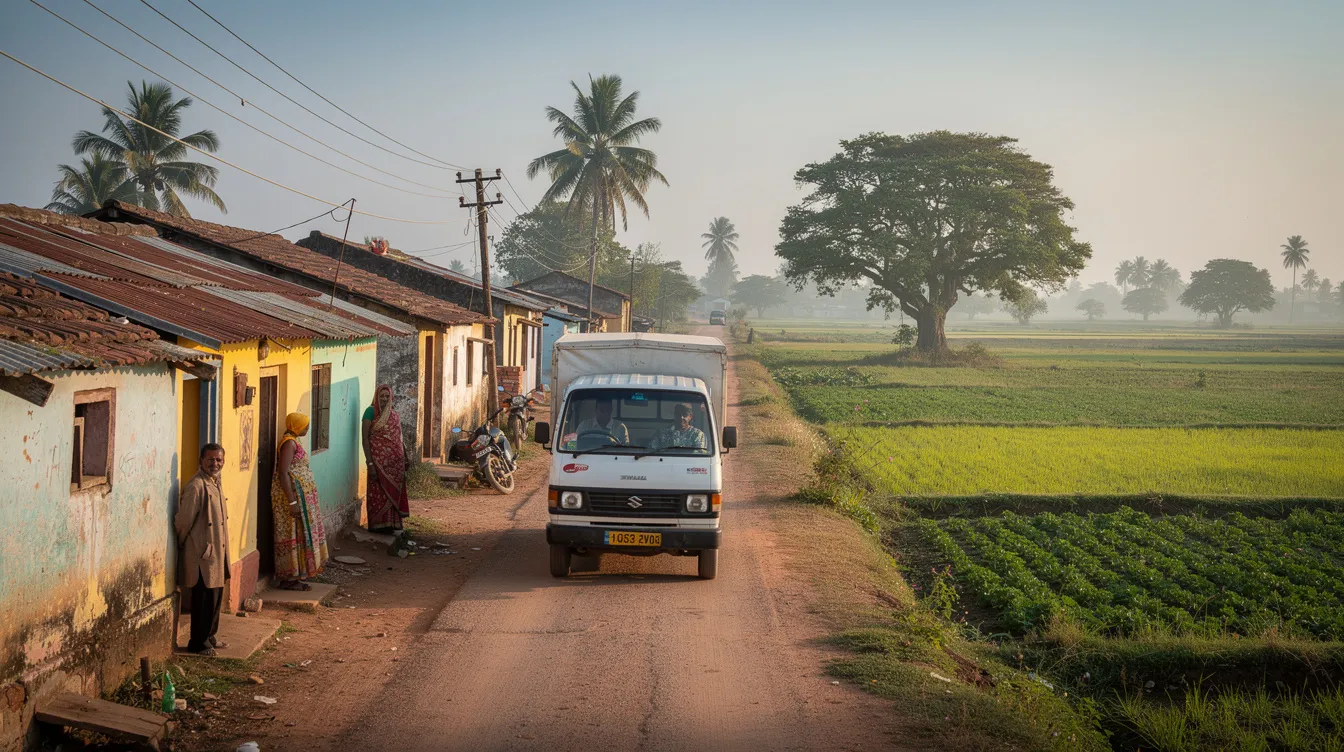
- Mudra Loan for Used Pickup (e.g., Tata Ace, Mahindra Bolero Pickup) – popular for local goods transport, last-mile delivery, and e-commerce logistics
- Mudra Loan for Used Truck (LCV, SCV, MCV) – for regional freight movement and contract carriage
- Mudra Loan for Used Tempo / Delivery Van – commonly used for FMCG distribution, courier services, and cold-chain delivery
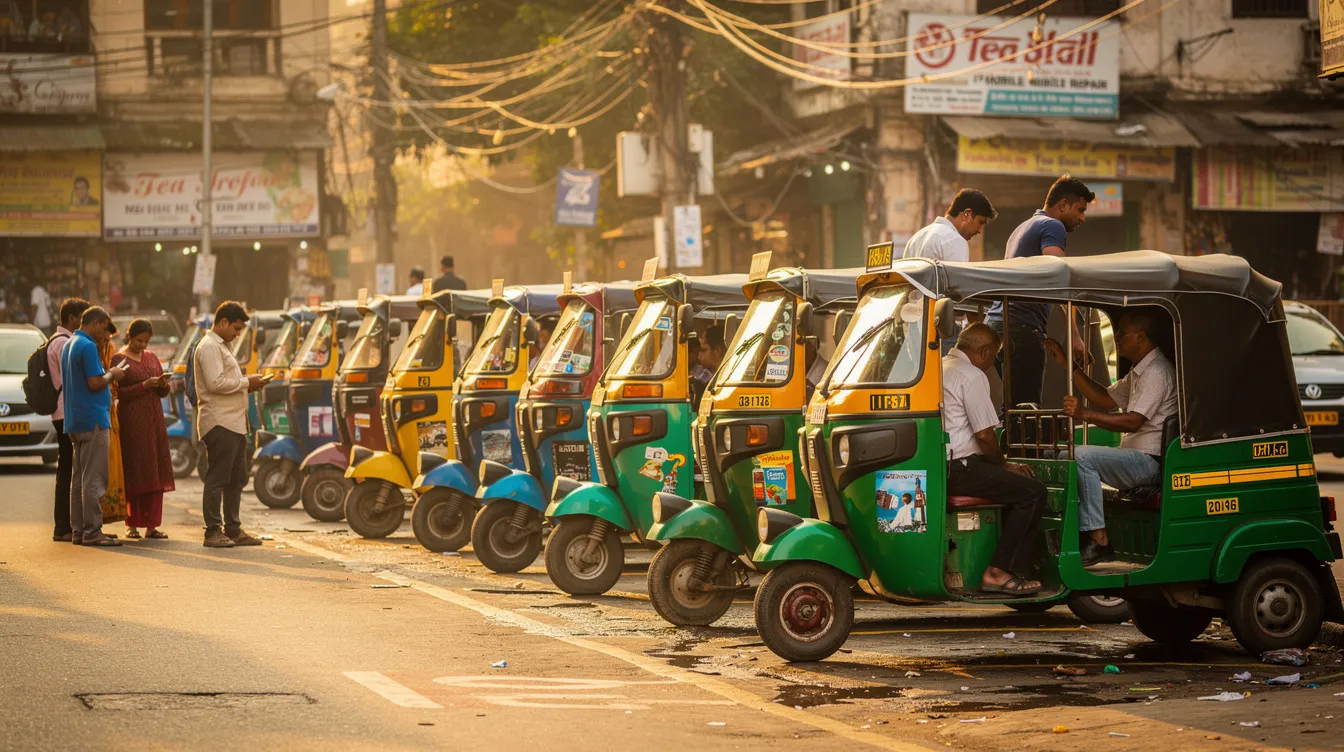
- Mudra Loan for Auto Rickshaw (petrol, CNG, e-rickshaw) – for urban and semi-urban passenger transport
- Used taxi (commercial registration mandatory) – for city cab services and outstation hire
Used vehicles for Mudra loans must be strictly for commercial purposes. Both goods carriers and passenger vehicles qualify, provided they carry valid commercial registration and permits.
In rural and semi-urban areas, shared autos, school vans, and mini passenger vehicles used for village connectivity are also financed. E-rickshaws and small electric delivery vehicles are increasingly considered, especially for urban last-mile and environment-friendly operations.
Some banks maintain internal negative lists – very old buses, heavy multi-axle trucks beyond a certain age, or models with poor resale value. Always confirm with your bank’s credit team before finalising the vehicle purchase.
Used Vehicle Conditions: Age, Fitness & Valuation Requirements
For a Mudra Loan for Used Vehicles, banks focus heavily on the remaining useful life, legal status, and technical condition of the vehicle. Each beneficiary micro unit applying for a used vehicle loan should expect detailed scrutiny.
Maximum age norms (approximate, varies by bank):
| Vehicle Type | Typical Max Age at Purchase | Min Residual Life Expected |
|---|---|---|
| Pickup / Tempo / LCV | 5–7 years | 3–5 years |
| Truck / Passenger Vehicle | 7–8 years | 3–5 years |
| Auto Rickshaw / E-Rickshaw | 5–6 years | 2–4 years |
Mandatory documents and technical checks:
- Registration Certificate (RC) in seller’s name with correct engine and chassis number
- Valid Fitness Certificate and Pollution Under Control (PUC) certificate
- Active comprehensive or at least third-party insurance policy
- No pending challans, tax dues, or legal disputes on the vehicle
Hypothecation and ownership clarity:
If an existing hypothecation to another bank or finance company exists, it must be cleared or a No Objection Certificate (NOC) obtained before transfer. After disbursement, the bank will endorse the RC in the borrower’s name with hypothecation in favour of the financing bank.
Valuation process:
A bank-approved valuer or dealer assesses market value based on the vehicle’s model, year of manufacture, running condition, tyre and body condition, and local demand. The loan amount is sanctioned as a percentage (often 60–80%) of this valuation – not necessarily the price negotiated between buyer and seller. Many urban banks insist on photographs and physical inspection by bank officials to rule out stolen or accident-damaged vehicles before sanction.
Mudra Loan Eligibility Criteria for Used Vehicles
Understanding the eligibility criteria is essential before approaching any bank. Here are the personal, business, and financial parameters banks assess – these apply to all individual borrowers and micro unit applicants.
Personal eligibility:
- Only Indian citizens can apply for a Mudra loan
- Applicants must be between 18 and 65 years old (at loan maturity)
- Stable residence proof and KYC compliance
- No serious criminal cases or unresolved loan defaults
Business-related eligibility:
- Borrowers must own a micro or small business engaged in transport, logistics, passenger services, courier, or related non-farm commercial activity
- Sole proprietor, partnership, HUF, small company, or owner-driver intending to operate the vehicle for income generation
- Udyam MSME registration is recommended but not always mandatory
- For detailed mudra loan eligibility norms, refer to the linked guide
Financial and credit criteria:
- Good credit history is essential for eligibility – banks typically look for CIBIL scores of 700+ though exceptions exist with strong justification
- Clean repayment history on existing loans, credit cards, and any previous loans
- Sufficient banking turnover or income proof to justify EMI capacity, especially for Kishor and Tarun category loans
- No educational qualification is formally required under PMMY, but the borrower should have the necessary skills or experience to operate the transport business
Even small enterprises without GST registration can apply if their turnover is below the threshold. For guidance on how such cases are handled, see Mudra Loan Without GST. New entrepreneurs can also apply under Mudra Loan for Startup Business when they have a well-prepared project report demonstrating expected earnings from the vehicle.
Documents Required for Mudra Loan for Used Vehicles
Incomplete documentation is one of the biggest reasons for delay and rejection. Treat this as your preparation checklist. Applicants need to submit identity and address proof along with all supporting papers.
Personal KYC documents:
- Aadhaar card, PAN card
- Voter ID / Passport / Driving Licence
- Recent passport-size photographs
Address and business documents:
- Residence proof (electricity bill, ration card, rent agreement)
- Business registration: GST certificate (if applicable), Shop & Establishment licence, Udyam MSME registration
- Partnership deed / LLP agreement or company incorporation documents for non-individual borrowers
Financial documents:
- Last 6–12 months bank statements of main operative account
- Last 2–3 years Income Tax Returns (if available) with computation
- Existing loan statements to assess total EMI burden and cash flow capacity
Vehicle-related documents for used vehicle purchase:
- Copy of RC, insurance, fitness certificate, PUC
- Seller’s KYC and PAN
- Form 29/30 or RTO transfer forms as per state requirement
- Valuation report from authorised valuer or dealer
- Proforma invoice or quotation for purchase price
Supporting documents:
- Projected income statement and basic project report
- Route permits, transport contracts, e-commerce delivery tie-up letters
- For a comprehensive generic checklist, refer to Mudra Loan Documents Required
The required documents may vary slightly across banks, so always confirm with your branch before submission.
Loan Amount, Margin Money & Interest Rate for Used Vehicle Mudra Loans
Under PMMY, the maximum loan amount is ₹10 lakh under the Tarun category (and up to ₹20 lakh under Tarun Plus for those who have cleared earlier Tarun loans). For used vehicles, the actual sanction depends on valuation, borrower capacity, and bank norms.
How loan amount is decided:
The bank generally sanctions a fixed percentage of the lower of the valuation report value or the purchase price. For older vehicles, banks may cap funding at 60–70% of value. For relatively newer used vehicles (2–3 years old), funding may go up to 75–80%.
Margin money examples:
| Vehicle Valuation | Loan Sanctioned (%) | Margin Money (Borrower’s Share) |
|---|---|---|
| ₹6,00,000 | ₹4,50,000 (75%) | ₹1,50,000 |
| ₹3,00,000 | ₹2,10,000 (70%) | ₹90,000 |
| ₹1,80,000 | ₹1,20,000 (67%) | ₹60,000 |
Margin may be higher if CIBIL is weak, vehicle age is on the higher side, or the borrower lacks adequate banking history.
Interest rates for Mudra loans on used commercial vehicles in 2026:
Mudra loan interest rates are deregulated – the Reserve Bank of India regulates the framework, but each bank sets its own rate. Typical rates range from 9% to 15% p.a. depending on bank, borrower profile, vehicle age, and relationship. In some cases, interest rates can reach up to 21% with higher-risk NBFCs or microfinance institutions.
As a reference point, Bank of Maharashtra’s current Mudra rate works out to approximately 11.80% p.a. for loans up to ₹10 lakh. Indian Bank’s Tarun Plus rate is around 11.25% p.a.
Some banks charge slightly higher processing fees for used vehicles versus new ones. Always compare offers from 2–3 banks or lending institutions. Interest is generally charged on a reducing balance basis with EMI payable monthly. Timely repayment builds credit history and helps in future top-up or second Mudra loan for fleet expansion.
Repayment Tenure, EMI Structure & Moratorium
The Mudra loan repayment period ranges from one to five years, depending on the vehicle’s residual life, loan amount, and bank policy. Repayment is through fixed monthly EMIs directly debited from the borrower’s bank account.
Typical tenures:
- 3–5 years for most used commercial vehicles
- Up to 6 years for relatively new used vehicles with good residual life (rare under Mudra, more common with NBFCs)
- 2–3 years for very old vehicles where the bank wants recovery before the vehicle’s useful life ends
EMI is calculated based on the term loan amount, applicable interest rate, and tenure. Banks provide an amortization schedule at the time of sanction. As a practical rule, choose an EMI that can be comfortably covered by the vehicle’s average monthly earnings after operating expenses (fuel, driver salary, tolls, maintenance, permits, insurance).
Some banks offer a moratorium (holiday period) of 1–3 months from disbursement to allow time for RC transfer, permits, and starting operations. However, interest usually continues to accrue during this period, increasing the effective cost.
On prepayment and foreclosure: many banks allow part-prepayment without heavy penalty in mudra loans, helping borrowers reduce interest cost. Early closure terms should be confirmed with the bank beforehand. Maintaining a dedicated bank account for business collections helps demonstrate healthy cash flow and ensures EMIs are honoured without delay, improving future creditworthiness with the lending institution.
Banks & Lending Institutions Offering Mudra Loans for Used Vehicles
Mudra loans are not disbursed directly by MUDRA Ltd. They are routed through various financial institutions – commercial banks, small finance banks, NBFCs, micro finance institutions, and regional rural banks, all acting as member lending institutions (MLIs).
Major public sector banks commonly financing used commercial vehicles under PMMY:
- State Bank of India (SBI)
- Punjab National Bank (PNB)
- Bank of Baroda
- Canara Bank
- Union Bank of India
- Indian Bank
The actual willingness to fund used vehicles under Mudra differs from branch to branch based on local credit policy, NPA experience, and internal circulars. My advice: visit 2–3 nearby branches and clearly ask about their policy for Mudra Loan for Used Commercial Vehicle.
Selected private sector banks, regional rural banks (RRBs), small finance banks, cooperative banks, and NBFCs also participate. Some may have more flexible used-vehicle norms in specific geographies – particularly NBFCs like Tata Capital, which offer used commercial vehicle finance with tenures up to 60 months.
The application process can be completed online or offline. You can apply online through bank portals or the JanSamarth platform, but for used vehicles, banks often insist on branch-level document verification, physical vehicle inspection, and face-to-face interaction.
Prioritise your existing banker – the bank where your salary or business account is maintained. Relationship history and known banking conduct significantly improve sanction chances for covering loans under Mudra.

Step-by-Step Application Process: Mudra Loan for Used Vehicles
Here is a clear, sequential process for first-time applicants – from planning to disbursement.
Step 1 – Define your business plan: Decide the type of vehicle (pickup, tempo, auto, taxi, truck). Estimate monthly earnings, expenses (fuel, driver, maintenance), and EMI capacity. Collect supporting contracts or letters from potential clients – logistics companies, aggregators, schools, local traders. A business plan is required for the Mudra loan application form.
Step 2 – Check eligibility and bank policy: Visit 1–2 banks to confirm they allow a Mudra Loan for Second Hand Vehicle under their current policy. Cross-check your profile against general Mudra Loan Eligibility criteria. Ask specifically about vehicle age limits, LTV norms, and documentation expectations.
Step 3 – Prepare documents: Compile all KYC, business, financial, and vehicle documents as outlined earlier. Refer to Mudra Loan Documents Required for additional detail. Ensure the RC is clean, insurance is active, and any existing hypothecation is cleared.
Step 4 – Prepare Project Report / DPR: Include details of route, expected trips per day, tariff per trip/km, fuel and maintenance costs, EMI calculation, and projected profit. Professional Project Report for Mudra Loan preparation and CMA Data for Bank Loan services from Project Report Bank can significantly strengthen your file.
Step 5 – Submit application: Fill in the bank’s Mudra application form (Shishu/Kishor/Tarun) carefully. Attach all documents, project report, quotation/valuation report, and consent for CIBIL check. If available, apply online through the bank portal or JanSamarth and later submit physical documents at the branch.
Step 6 – Sanction, documentation, and disbursement: The bank conducts a field visit, verifies the vehicle, and processes the loan. On approval, execute the loan agreement and hypothecation documents. The RC is updated in the borrower’s name with the bank’s hypothecation. Disbursement is usually made directly to the seller or dealer – not as cash to the borrower. The vehicle then becomes one of the capital assets hypothecated to the bank until the loan is fully repaid.
Common Reasons for Rejection of Mudra Loan for Used Vehicles
Understanding why banks reject applications helps you pre-correct issues and avoid unnecessary CIBIL inquiries. From my experience with transport-related Mudra cases, here are the most common rejection grounds:
Credit and banking issues:
- Poor CIBIL score or past defaults/settlements on previous loans
- Frequent cheque bounces and irregular banking behaviour
- Outstanding overdues on credit cards or other term loan accounts
Documentation problems:
- Incomplete or mismatched KYC and vehicle papers
- Unclear ownership chain or pending hypothecation not properly closed on the vehicle
- RC, fitness, or insurance expired, or outstanding fines/taxes
Vehicle-related issues:
- Very old vehicle beyond the bank’s maximum age limit or in poor physical condition
- Valuation significantly lower than the purchase price, making the loan structure unviable
- Vehicle model on the bank’s internal negative list
Business viability concerns:
- Weak or unrealistic project report that does not justify EMI repayment
- Lack of clarity on proposed operations, routes, or contracts
- Insufficient income proofs or banking history to support repayment capacity
For a detailed discussion of generic PMMY rejection grounds, see Mudra Loan Rejection Reasons. If you believe the rejection was unjustified, there is a formal process outlined in Mudra Loan Appeal Process.
Rejection at one bank does not permanently close your options. With corrective steps – improving documentation, choosing a better vehicle, or strengthening the project report assessed based on actual market data – you can re-apply at the same or another bank.
Tips to Improve Approval Chances (CA’s Practical Advice)
These are experience-based tips from handling real Mudra Loan for Used Commercial Vehicle files for small transport operators across India.
Prepare a strong, realistic Project Report: Clearly show routes, potential customers (local markets, schools, factories, e-commerce companies), and provide conservative income and cost estimates. Include EMI calculation and Debt Service Coverage Ratio (DSCR) to demonstrate repayment capacity. Banks take project reports seriously as a reference point for appraisal.
Get professional CMA Data prepared: Summarise future cash flows, projected balance sheet, and profitability for the transport business. Professional CMA Data gives confidence to bank credit officers and speeds up the appraisal process significantly.
Ensure complete documentation and compliance: Update all KYC, RC, insurance, fitness, PUC, and tax receipts before submitting the file. Register your business under Udyam MSME for better credibility. If eligible, obtain GST registration – though it is not mandatory below the threshold, as explained in Mudra Loan Without GST.
Improve your banking and credit profile: Regularise existing EMIs and clear small overdues before applying. Route maximum business transactions through your bank account to show healthy turnover and demonstrate adequate funding needs coverage. A satisfactory credit track record is one of the strongest factors in approval.
Choose the right vehicle and realistic loan amount: Avoid very old or problematic models just because they are cheaper. Keep margin money ready – at least 20–30% – to reduce the bank’s risk and signal your commitment. Banks view a higher own contribution as a strong positive signal that the borrower is serious about the venture.
Why a Professional Project Report Matters for Used Vehicle Mudra Loans
For transport-related mudra loans, especially for used vehicles, many banks informally treat the file like a small project. They want to see how the vehicle will generate stable income over its remaining useful life, and a well-prepared Detailed Project Report (DPR) provides exactly that assurance.
Key components of a good DPR for Mudra Loan for Used Vehicles:
- Borrower profile: Experience, licences, existing vehicles (if any), and necessary skills for transport operations
- Vehicle details: Make, model, age, valuation, expected remaining life, and condition report
- Market analysis: Routes, demand, competition, seasonal variations, and the proposed activity’s viability in the local area
Financial projections:
- Monthly revenue assumptions (trips per day, rate per trip/km)
- Operating expenses (fuel, driver salary, tolls, maintenance, permits, insurance)
- EMI schedule, annual profit estimates, and DSCR over 3–5 years
How a strong DPR helps bank officers:
It reduces appraisal time, provides written justification for sanction in the credit committee, and supports internal audit and compliance requirements for Mudra scheme loans. Without a proper DPR, the credit officer has no documented basis to recommend approval – especially for used vehicle cases where risk perception is higher.
Project Report Bank specialises in customised DPRs for transport businesses. A report tailored for a specific vehicle (e.g., used Tata Ace vs. used auto rickshaw) is far more convincing than a generic template. In my experience, a professionally prepared DPR and CMA Data often make the key difference between rejection and sanction when multiple applicants compete for limited Mudra targets at a branch.
Related Transport Business Ideas You Can Start with a Used Vehicle
A used commercial vehicle financed under Mudra can support multiple small business models beyond simple point-to-point goods transport, especially in tier-2/3 cities and at the rural level.
Business ideas worth exploring:
- Local goods carrier service for shops, wholesalers, and market traders – a reliable source of income generation in every town
- Last-mile delivery partner for e-commerce and courier companies – growing demand across India with women entrepreneurs also entering this space
- School van or passenger shuttle service (subject to local permits and fitness requirements)
- Refrigerated or specialised delivery for food, dairy, and medicines where feasible with vehicle modifications
- Rural transport operator connecting villages to nearby markets, providing essential connectivity
For a wider list, explore Business Ideas for Transport Business and Automobile Business Ideas for related opportunities like small garages, tyre shops, or spare parts businesses. Entrepreneurs looking to diversify once vehicle income stabilises can also check Small Business Ideas and Import Export Business Ideas.
For scaling up to a small fleet, refer to Mudra Loan for Transport Business. Select a business model that suits your local geography, personal experience, and risk appetite – and reflect that choice clearly in your Mudra project report.
Frequently Asked Questions (Mudra Loan for Used Vehicles)
Can I get a Mudra Loan for buying a used private car for personal use?
No. Mudra loans are intended for income-generating business activities, not personal use. The vehicle must be commercially registered and used for transport, logistics, or delivery business. Mudra loans support non-farm, non-corporate income-generating activities only.
Is a guarantor required for Mudra Loan for Used Truck?
Under PMMY, loans up to ₹10 lakh are collateral-free. However, some banks may still ask for a guarantor – especially for used vehicle cases where the asset value is uncertain or the borrower’s credit profile is weak. This is at the bank’s discretion.
Can I refinance my existing used vehicle loan under Mudra?
Generally, Mudra loans are meant for fresh purchases or new business activities. Refinancing an existing vehicle loan from another bank or NBFC under Mudra is not standard practice. However, some banks may consider it on a case-by-case basis – always check with your branch.
Is there any government subsidy or interest subvention on Mudra Loan for Used Vehicles?
As of 2026, there is no specific central government subsidy or interest subvention exclusively for used vehicle purchases under PMMY. However, some state governments may offer transport-sector subsidies or capital support for specific categories like Indian citizens from SC/ST communities or women entrepreneurs. Check your state’s MSME or transport department for any applicable schemes.
Can a driver without ITR get Mudra Loan for Used Auto Rickshaw if income is in cash?
Yes, it is possible. Many auto rickshaw drivers operate on cash income without filing ITR. Banks assess such applicants based on bank statements, daily savings patterns, and a credible project report. Shishu loans (up to ₹50,000) and smaller Kishor loans are more accessible in such cases. Demonstrating regular bank deposits – even small amounts – improves credibility. Applicants must be at least 18 years old to apply.
Can I buy more than one used vehicle under Mudra if total loan is within ₹10 lakh?
In principle, yes – if the total loan amount stays within the maximum limit of ₹10 lakh and the bank’s policy permits it. However, banks will assess whether your business can handle the operations and EMI for multiple vehicles. A strong project report covering both vehicles and their expected earnings is essential.
Do banks insist on GPS or tracking devices for financed vehicles?
Some banks and NBFCs do require GPS tracking devices to be installed on financed commercial vehicles as a risk management measure. This is more common for higher-value loans (Tarun category) and with private-sector lenders. Public sector banks are less likely to mandate this for smaller Mudra loans.
How long does it usually take to get sanction for a used vehicle Mudra loan?
Typical processing time is 7–21 working days from complete document submission, depending on the bank, branch workload, and vehicle inspection schedule. Delays usually occur due to incomplete documentation, pending valuation reports, or CIBIL issues. Having all documents ready and a professional DPR can cut this timeline significantly.
Is a project report mandatory for Shishu category loans for small repairs?
For shishu loans (up to ₹50,000), many banks do not insist on a formal detailed project report. A simple application form with basic business details may suffice. However, for Kishor and Tarun category loans – especially for used vehicle purchases – a project report is practically mandatory and significantly improves approval chances.
Can women entrepreneurs or SC/ST applicants get special benefits for Mudra transport loans?
Under PMMY, there is no separate interest rate concession specifically for women entrepreneurs or SC/ST borrowers. However, banks may prioritise such applications under their internal lending targets. Additionally, state-level schemes may offer supplementary capital subsidies or reasonable interest rates for these categories. The overall following criteria for mudra loan eligibility remain the same.
What happens if the vehicle is damaged or totalled during the loan tenure?
If the financed vehicle is damaged beyond repair, the insurance payout is typically assigned to the bank to cover outstanding dues. Any surplus after loan settlement goes to the borrower. Comprehensive insurance is therefore critical – banks insist on it for this exact reason.
Can I use a Mudra Loan to buy a used e-rickshaw?
Yes. E-rickshaws and small electric commercial vehicles are increasingly eligible under Mudra, especially for urban last-mile delivery and passenger services. The same conditions apply – commercial registration, valid permits, acceptable age, and proper valuation. Some state governments additionally promote electric vehicles with subsidies that can be combined with Mudra finance.
What is the maximum loan amount I can get under Tarun Plus for a used vehicle?
Under Tarun Plus, the maximum loan amount is ₹20 lakh – but this is available only to borrowers who have successfully repaid previous loans under the Tarun category. As of June 2025, 34,697 accounts had been disbursed under Tarun Plus for over ₹4,930 crore, showing genuine uptake of this enhanced category.
Where can I get help with my Mudra Loan application and project report?
For professional assistance with project reports, CMA Data, and bank-ready documentation for Mudra loans, you can visit Project Report Bank. A customised DPR prepared by an experienced Chartered Accountant significantly improves your chances of sanction.
Conclusion: How to Approach Mudra Loan for Used Vehicles Strategically
Mudra Loan for Used Vehicles is a practical and accessible route for small entrepreneurs in 2026 to enter the transport business with lower capital. Whether you are an owner-driver buying your first auto rickshaw, a delivery partner acquiring a used pickup, or a small fleet operator adding a second-hand tempo, the Pradhan Mantri Mudra Yojana provides affordable credit through a wide network of banks and financial institutions.
The key to success lies in preparation. Check your target bank’s policy on used vehicles under PMMY before finalising the purchase. Ensure all eligibility criteria and documents are in order. Support your application with a solid project report and CMA Data that clearly demonstrate viability and repayment ability. Choose a vehicle in good condition with sufficient residual life – it reduces bank risk and improves your sanction probability.
Remember, rejection at one bank is not the end. With better documentation, a stronger DPR, and professional guidance, many applicants later succeed in getting transport business finance – sometimes under Mudra and sometimes under regular commercial vehicle loan schemes offered by the same banks. The goal is to get your vehicle on the road and earning – and the right approach makes that happen.
About the Author CA Manish Gugliya (FCA, DISA ICAI) is a Chartered Accountant with over 20 years of experience in Project Reports, CMA Data, Mudra Loan Consulting, Business Planning, MSME Advisory, Startup Consulting, Bank Loan Documentation, and Business Valuation. Through Project Report Bank, he has helped entrepreneurs across India prepare bankable project reports and financial documentation for business loans.
Planning to purchase a used commercial vehicle through a Mudra Loan? A professionally prepared Project Report (DPR) and CMA Data can significantly improve your chances of bank approval. At Project Report Bank, CA Manish Gugliya provides customized project reports, financial projections, and bank-ready documentation for Mudra Loans, MSME finance, and transport businesses across India. Visit https://projectreportbank.com to get started.
- Atta Chakki Plant Project Report – A Professional DPR & Business Plan Guide

- Atta Chakki Plant ROI, IRR, Payback & Sensitivity Analysis
- Atta Chakki Plant Feasibility Study & Project Viability
- Atta Manufacturing Financial Projections, Working Capital & DSCR

- Atta Chakki Plant Project Cost & Means of Finance (India Focus)
- Atta Chakki Plant Land, Building & Layout Requirements
- Atta Chakki Plant Capacity Planning – TPD & Production Capacity
- Atta Manufacturing Process & Flour Mill Flow Chart (Expert Guide for Plant Promoters)
- Atta Chakki Machine Price & Automatic Atta Plant Machinery Cost – A Practical Guide for Entrepreneurs
- Atta Chakki Plant Setup Cost in India – Practical Cost Guide by CA Manish Gugliya
- Roller Flour Mill Project Report & DPR: Complete Guide for Bank Finance and Project Planning

- Roller Flour Mill ROI, IRR, Payback & Sensitivity Analysis: A Practical Guide for Investors and Bankers

- Roller Flour Mill Feasibility Study & Project Viability
- Roller Flour Mill Financial Projections & Working Capital
- Roller Flour Mill Project Cost & Means of Finance