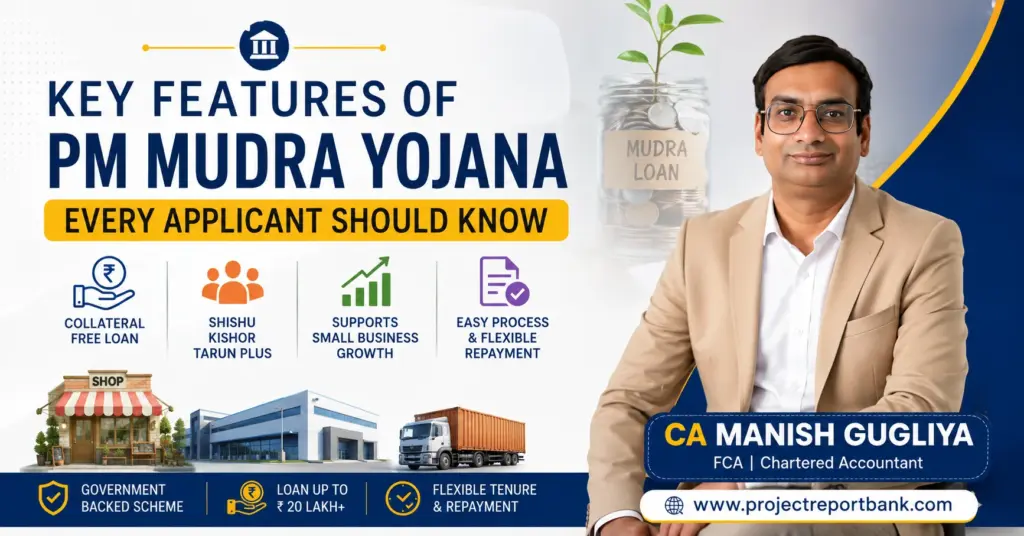
Access to finance remains the single biggest roadblock for Indian small businesses. Most first-time entrepreneurs, street vendors, and service providers struggle to get even a modest business loan from traditional banks because they lack collateral, audited financial statements, or a long credit history. Pradhan Mantri Mudra Yojana changed that equation when India launched this flagship scheme in April 2015. It opened a direct, structured channel for micro and small businesses to access collateral free loans through formal financial institutions. In this article, I will explain what PMMY is, why it matters so deeply for small enterprises, which businesses benefit the most, and how you can maximize its advantages.
Key Takeaways
Pradhan Mantri Mudra Yojana (PMMY) is a government-backed scheme that provides collateral free business loans up to ₹10 lakh under the Tarun category, and up to ₹20 lakh under the recently introduced Tarun Plus category (from October 2024), specifically designed for micro and small businesses across India.
- PMMY was launched in April 2015 to support entrepreneurs, and over ₹33 lakh crore loans have been sanctioned since then across more than 52 crore loan accounts.
- The scheme offers collateral free loans up to ₹20 lakh, removing the biggest barrier for first-time and small-scale borrowers.
- 70% of PMMY beneficiaries are women entrepreneurs, making it a powerful tool for inclusive growth.
- PMMY helps bring entrepreneurs into the formal economy by connecting them with banks, building credit history, and replacing expensive informal lending.
- This article covers specific benefits, eligible business types, real-life examples, common myths, and practical tips to get the most from this mudra scheme.

What Is PM Mudra Yojana and How Does It Work?
Pradhan Mantri Mudra Yojana is a flagship scheme of the Government of India that provides collateral free mudra loans to non corporate, non farm micro and small enterprises. MUDRA stands for Micro Units Development and Refinance Agency Ltd., which acts as a refinance agency. It does not lend directly to borrowers. Instead, it refinances loans given by commercial banks, NBFCs, MFIs, RRBs, and small finance banks to eligible micro units engaged in income generating activities.
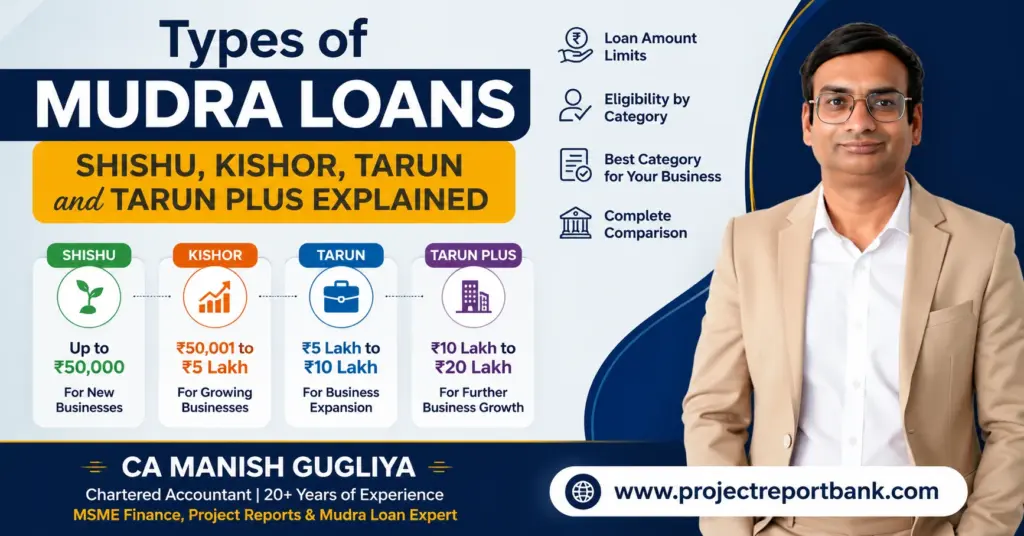
PMMY categorizes loans into four categories based on the stage and credit needs of the business:
- Shishu: Shishu loans are up to ₹50,000, ideal for very small or newly started units.
- Kishor: Kishore loans range from ₹50,001 to ₹5 lakh, suited for businesses in their next phase of growth.
- Tarun: Tarun loans range from ₹5 lakh to ₹10 lakh for established micro enterprises needing larger funding.
- Tarun Plus: Tarun Plus loans range from ₹10 lakh to ₹20 lakh, extended from October 2024 for borrowers who have successfully repaid loans under the tarun category.
Mudra loans can be used for working capital, purchasing inventory, buying machinery and tools, commercial vehicles, and shop renovation. They are not meant for personal, speculative, or purely agricultural purposes. Agriculture-related businesses are not eligible for MUDRA loans. Applicants must be Indian citizens engaged in income generating activities, and must be aged between 18 to 65 years. Eligible businesses include manufacturing, trading, and service sectors.
For a step-by-step beginner overview, refer to the guide on What is PM Mudra Yojana? A Complete Beginner’s Guide.
The interest rate is not fixed by the government-each lender decides based on the borrower profile and cost of funds. Public sector banks typically offer rates between 9% and 13%, while NBFCs and MFIs may charge higher. Repayment tenures generally range from 3 to 7 years depending on the loan amount and purpose. Loans are available through various financial institutions across the country, and many lenders now allow you to apply online.
Table of Contents
Why Small Businesses Need Dedicated Financial Support
In my 20-plus years of preparing project reports and helping small businesses with financial assistance, I have consistently seen that most Indian micro enterprises struggle more with timely finance than with business ideas. A trader with strong local demand, a technician with steady customers, a home-based tailor with festival orders-all of them need money at the right time, in the right amount. Here is what they typically need:
- Working capital for daily expenses-buying inventory, paying rent, electricity, staff salaries, and small repairs.
- Business expansion costs like adding a second counter, an extra room, or a delivery vehicle.
- Machinery and equipment purchases such as flour mill machines, bakery ovens, salon chairs, welding sets, or tailoring machines.
- Bulk inventory before festival seasons (Diwali, Eid, wedding season) to earn higher margins.
- Hiring employees or helpers as orders increase.
- Marketing and digital presence: flex boards, pamphlets, a basic website, or online listings.
Consider a grocery shop in a Tier-3 town losing customers because low working capital means empty shelves. Or a mobile repair technician operating from a roadside table, wanting to buy advanced tools and rent a proper shop. Or a home-based tailor who needs two more sewing machines before wedding season but cannot afford them upfront.
These businesses have demand and willingness. What they lack is structured, affordable finance-and that is exactly the gap PMMY is designed to fill for micro units with limited documentation and no collateral.

Why PM Mudra Yojana Is Important for Small Businesses
In my practice as a financial consultant, PMMY has often been the first formal loan for many micro entrepreneurs, and it has fundamentally changed how they interact with banks. Here is why PM Mudra Yojana is important:
- Easy access to business finance: PMMY simplifies eligibility for non corporate small businesses and self-employed professionals. Basic KYC, a simple project plan, and proof of business existence are usually sufficient. This removes the intimidation factor that keeps many entrepreneurs away from banks.
- Collateral free business loan: Most small entrepreneurs do not own property to mortgage. PMMY provides collateral free loans up to ₹20 lakh (no collateral is required for loans up to ₹10 lakh under standard norms), supported by credit guarantee schemes like CGFMU and CGTMSE. This is a reference point that separates PMMY from most traditional lending.
- Encourages first-time entrepreneurs: Even a new unit with a practical project and basic KYC can seek a mudra loan for startup business funding. About 20% of all PMMY sanctions have gone to new entrepreneurs, according to the Department of Financial Services Annual Report 2024-25.
- Supports rural and semi-urban businesses: Village-level shops, dairy units, repair units, and agri-allied traders gain access to institutional credit instead of depending on informal moneylenders charging 3–5% monthly interest. PMMY helps reduce regional economic disparities by promoting rural development.
- Promotes women entrepreneurs: 70% of PMMY beneficiaries are women entrepreneurs. The scheme supports women’s entrepreneurship and marginalized groups, giving them financial security and decision-making power. For more on this, see Top Benefits of Mudra Loan for Women Entrepreneurs.
- Creates employment and self-employment: A salon owner using PMMY funds to buy professional equipment can hire 1–3 extra workers. A small manufacturing unit purchasing a new machine adds helpers. PMMY promotes economic growth and job creation at the local level.
- Reduces dependence on informal lenders: PMMY aims to eliminate the dependency on informal lending. Shifting from daily or weekly informal repayments at exploitative rates to a structured EMI at a moderate interest rate improves cash flow and peace of mind.
- Encourages business formalization and financial inclusion: PMMY enhances access to formal banking services for small entrepreneurs. Opening current accounts, using digital payments, maintaining records, and making timely EMIs builds a credit history and future eligibility for higher MSME loans. PMMY integrates non corporate enterprises into the formal banking system. PMMY promotes financial inclusion for small businesses.
PMMY fits naturally into the broader MSME finance ecosystem, often acting as a stepping stone. Entrepreneurs who prove discipline under Mudra can graduate to standard MSME loans and larger term loans.
Major Benefits of PM Mudra Yojana for Business Growth
Beyond policy-level importance, here is how PMMY concretely helps a business grow once the loan is sanctioned:
- No collateral requirement: Unlike many traditional business loans, PMMY offers collateral free loans up to ₹20 lakh, removing the risk of losing personal assets. This is backed by credit guarantee from government-supported schemes.
- Affordable interest rate: While rates vary by bank and borrower profile, public sector commercial banks typically charge 9–13% per annum. Even higher-end NBFC rates are far cheaper than informal lenders who charge 36–60% annually.
- Flexible loan categories: The four categories-Shishu, Kishor, Tarun, and Tarun Plus-let businesses borrow the right loan amount for their stage. Learn more about types of Mudra loans explained.
- Working capital support: PMMY facilitates working capital for micro-enterprises. A trader can use a cash-credit or overdraft-type Mudra facility to maintain continuous stock without cash crunches between purchase and sale cycles.
- Equipment and modernization funding: From computerized embroidery machines to POS systems to small CNC tools, PMMY funds help businesses modernize, improve productivity, and compete better.
- Credit history building: Timely repayment of pmmy loans builds your CIBIL score, making it easier to access larger MSME or vehicle loans later. Every EMI paid on time is an investment in your borrower profile.
- Government-backed initiative: The psychological comfort of knowing the Government of India backs this mudra yojana gives entrepreneurs confidence to take the formal lending step.
| Parameter | PM Mudra Yojana | Informal Lending |
|---|---|---|
| Collateral | None up to ₹20 lakh | Usually none, but very high cost |
| Interest Rate | ~9–18% per annum (transparent) | 36–60%+ per annum (opaque) |
| Legal Protection | Formal contract, RBI-regulated | No legal remedy |
| Credit History | Builds CIBIL/credit score | No formal record created |
Which Businesses Benefit the Most from Mudra Loans?
In my experience preparing thousands of project reports and PMMY applications, certain business types benefit strongly:
- Retail and trading: Kirana shops, garment and tailoring shops, footwear stores, stationery shops, electronics and mobile shops, hardware and paint shops.
- Food and hospitality: Small restaurants, tea stalls, tiffin services, bakeries, dhabas, juice centers.
- Personal services: Beauty parlours, salons, spa and wellness centers, coaching classes, daycare centers.
- Repair and technical services: Mobile repair, cycle and motorcycle garages, electricians, plumbers, AC repair technicians.
- Small manufacturing and processing: Flour mills, small dairy units, agarbatti and candle making, spice grinding, packaging units, small furniture workshops. These units also support allied agricultural activities like dairy processing and poultry feed.
- Home-based and online businesses: Home kitchens, handicrafts, reselling, and digital freelancers are also eligible. Learn more about Mudra Loan for Home-Based Businesses.
Self-employed professionals-doctors setting up clinics, consultants, designers-can also benefit where they fall within the eligible non corporate beneficiary micro unit category.
Example 1: A small garment shop owner in a Tier-II town took a ₹3 lakh Kishor loan to buy festival-season stock in bulk and install display racks. Monthly sales jumped by about 30% during the season, and the stable EMI structure replaced the previous cycle of borrowing from a local money lender at 4% monthly.
Example 2: A flour mill operator used a ₹5 lakh Tarun loan to purchase a modern grinding and packaging machine. Wastage dropped, output increased, he hired one helper, and the maximum loan was repaid comfortably from steady local demand.

How PM Mudra Yojana Supports India’s Economy and MSME Ecosystem
Individual micro loans may seem small, but when lakhs of them flow into the economy simultaneously, the collective impact is enormous. More than ₹33 lakh crore has been disbursed under the PMMY, and PMMY has sanctioned over 52 crore loan accounts since its launch.
- Employment generation: Every small shop or unit funded under PMMY usually supports 1–5 jobs, including the owner and staff. Across crores of units, this translates into millions of livelihoods.
- MSME development: Mudra loans often serve as the first formal finance step. As businesses grow, they register as MSMEs and access further government support and subsidy schemes. You can explore the objectives of PM Mudra Yojana to understand this progression.
- Rural and semi-urban development: Funds flowing into villages and small towns improve local supply, services, and incomes. PMMY helps reduce regional economic disparities.
- Women empowerment: With 70% of accounts going to women-owned or women-led units, PMMY directly improves family-level financial security and decision-making power.
- Financial inclusion and digital adoption: Opening current accounts, using UPI and POS, and digital record-keeping improves tax compliance and access to future credit.
- Contribution to GDP and local manufacturing: The scheme encourages localized production and supports GDP contributions. Better access to finance boosts small manufacturing capacity, aligning with “Make in India” objectives. These key features of PM Mudra Yojana drive long-term national growth.
Common Myths About the Importance of PM Mudra Yojana
Many entrepreneurs either overestimate or underestimate PMMY because of widespread myths. Wrong expectations lead to frustration; missed understanding leads to missed opportunities.
- Myth: “Only startups can get mudra loans.” Reality: Both new and existing non farm micro and small businesses can apply. The applicant does not need to be starting fresh.
- Myth: “Only big or established businesses benefit.” Reality: Pradhan Mantri MUDRA Yojana targets micro and small enterprises-street vendors, tiny shops, and home-based units are exactly who it is built for.
- Myth: “Loan approval is guaranteed because it is a government scheme.” Reality: Each bank independently evaluates business viability, documents, security of the proposal, and the borrower’s repayment capacity.
- Myth: “Every applicant will get the maximum loan amount.” Reality: The sanctioned loan amount depends on genuine business need, projected cash flow, and the lender’s assessment.
- Myth: “PMMY is only for urban businesses.” Reality: Strong rural and semi-urban outreach through RRBs and small finance banks ensures villages and small towns have access.
- Myth: “Once you get one Mudra loan, you can’t upgrade.” Reality: Borrowers who have availed and successfully repaid loans can move from Shishu to Kishor to Tarun to Tarun Plus, expanding their eligibility at each phase.
For a deeper look, read Common Myths About PM Mudra Yojana. Understanding these myths is essential to correctly appreciate why PMMY is genuinely useful-but not a “free money” scheme.
Real-Life Style Examples: How Mudra Loans Change Small Businesses
While keeping names generic for privacy, here are case-style examples drawn from typical client scenarios that show the practical impact of PMMY on business growth.
Grocery Shop Expansion: A kirana store owner took a ₹3 lakh Kishor loan to increase inventory, add a refrigerator for dairy items, and introduce digital payment. Within six months, monthly sales grew noticeably as customers stopped going to better-stocked competitors. The structured EMI replaced a cycle of borrowing from a local supplier at steep markups.
Tailoring Unit Growth: A home-based tailor used a Shishu loan of ₹45,000 to purchase an extra sewing machine and an overlock machine before the wedding season. Orders doubled, she hired one helper, and the loan was repaid within 18 months. Her credit history now qualifies her for a Kishor loan to expand further.
Dairy and Flour Mill Setup: A small-town flour mill operator used a ₹4.5 lakh Tarun loan to buy a modern grinding and packaging machine. Wastage dropped, output increased, and stable local demand ensured easy EMI repayment. He now plans to expand into spice grinding in the next phase.
Mobile Repair Shop: A young technician shifted from a rented table on the roadside to a proper small shop using a ₹2 lakh Kishor loan. He invested in professional tools and a display counter. Customer trust improved, income increased by nearly 40%, and he built a banking relationship that opened doors for future funding.
In each case, the mudra loan replaced high-cost informal borrowing, supported working capital or assets purchase, and helped the borrower build a formal credit profile-exactly how this mudra yojana is designed to work.
Practical Tips to Maximize PM Mudra Yojana Benefits
Getting a loan is only half the work. Using it wisely is what creates real business growth.
- Prepare a clear business plan and projected cash flow before you apply. Even a simple one-page plan showing expected revenue, costs, and use of funds matters. For structured guidance, see the Mudra Loan Project Report Guide.
- Borrow only what you genuinely need and can comfortably repay from expected profits-not from best-case assumptions.
- Use funds strictly for business purposes: inventory, equipment, renovation, marketing. Never divert business loan money to personal or household expenses.
- Maintain basic records: sales, expenses, stock summary, and bank statements. This helps during future loan upgrades and tax compliance.
- Prioritize timely EMI payment. Set up auto-debit so repayment discipline builds a strong credit profile automatically.
- Keep buffer working capital so seasonal slowdowns do not force default.
- Review performance every 3–6 months. If growth is consistent, plan the next step-moving from Shishu to Kishor, or Kishor to Tarun.
Professional help from a CA or experienced consultant can significantly improve loan approval odds by preparing a realistic project report and CMA data tailored to your business.
Common Mistakes Entrepreneurs Should Avoid with Mudra Loans
Many small businesses fail to enjoy full PMMY benefits because of avoidable mistakes. Here are the most common ones:
- Borrowing more than required: Over-borrowing increases the EMI burden and creates stress during slow months. Always match the loan amount to actual business need.
- Using business loan funds for personal expenses: This breaks cash flow, creates a mismatch in records, and directly leads to repayment issues.
- Weak documentation and incomplete KYC: Careless paperwork is among the common reasons for Mudra loan rejection. Even basic errors in the form can cause delays.
- Lack of business planning: Buying a costly machine without checking local demand or seasonal patterns wastes capital and strains repayment.
- Ignoring cash flow management: Giving long credit to customers while paying suppliers in cash creates a liquidity crunch even when sales look high on paper.
- Not tracking credit score: Defaults or bounced EMIs harm your CIBIL score and affect all future loans-not just Mudra.
Avoiding these mistakes helps entrepreneurs get the full advantage of this important government business loan scheme and expand their eligibility for future finance.

Frequently Asked Questions on PM Mudra Yojana Importance
Here are answers to some of the most common practical questions entrepreneurs ask about why PM Mudra Yojana matters for their businesses.
Is PM Mudra Yojana suitable if my business needs are less than ₹1 lakh?
Absolutely. PMMY is especially useful for very small credit needs like ₹30,000–₹1 lakh, where formal credit is otherwise hard to access. The Shishu category covers loans up to ₹50,000, and the lower end of Kishor covers up to ₹5 lakh. For many micro enterprises, this is the only structured, institutional finance option available.
Can PMMY help me build eligibility for larger MSME loans in future?
Yes. Timely repayment of your Mudra loan builds your credit history, strengthens your banking relationship, and creates documented turnover records. This makes it significantly easier to access higher MSME or term loans later. You can understand the progression better by comparing PM Mudra Yojana vs MSME Loan.
If my business is home-based or online, is Mudra Loan still relevant?
Yes, as long as your business is a genuine income generating activity-home-based tailoring, cloud kitchen, online reselling, handicrafts, or digital services all qualify. The key eligibility requirement is that the business must be non corporate and non farm. Read more about Mudra Loan for Home-Based Businesses.
Does PMMY guarantee that my loan will be approved?
No. PMMY provides the framework, refinance support, and credit guarantee backing, but each bank or lender independently evaluates your proposal, documents, and repayment capacity. A well-prepared project report and clear business plan significantly improve approval chances.
How is PMMY better than taking a small loan from a local moneylender or supplier?
PMMY offers transparent and far lower interest rates (typically 9–18% versus 36–60%+ from informal lenders), legal protection under banking laws, a structured EMI schedule, and-critically-builds your formal credit history. Informal lending offers none of these links to long-term financial growth.
Conclusion: Should Your Small Business Consider PM Mudra Yojana?
Pradhan Mantri Mudra Yojana has become one of India’s most important government business loan schemes for micro and small enterprises. By offering collateral free finance, supporting first-time entrepreneurs, and enabling business expansion and employment at the grassroots level, it addresses the most fundamental problem small businesses face: access to affordable, structured credit.
When used wisely-with proper planning, disciplined repayment, and productive use of funds-a mudra loan can be the turning point that moves a small business from survival mode to growth mode. Whether you are a trader, service provider, or small manufacturer, PMMY deserves serious consideration.
If you are planning a new venture or looking to expand, assess your business funding requirements and seek professional help for preparing a strong PMMY project report and CMA data. A well-prepared application can make the difference between approval and rejection. You can also explore resources like Mudra Loan for Startup Businesses if you are just getting started.
- PM Mudra Yojana Basics: Complete Guide to PMMY


- Latest Statistics and Growth of PM Mudra Yojana (PMMY) in India
- Why PM Mudra Yojana Is Important for Small Businesses
- Common Myths About PM Mudra Yojana: Facts Every Business Owner Should Know
- PM Mudra Yojana vs Stand-Up India Scheme: Which Government Business Loan Is Right for You?

- PM Mudra Yojana vs MSME Loan: Which Is Better for Your Small Business in 2026?

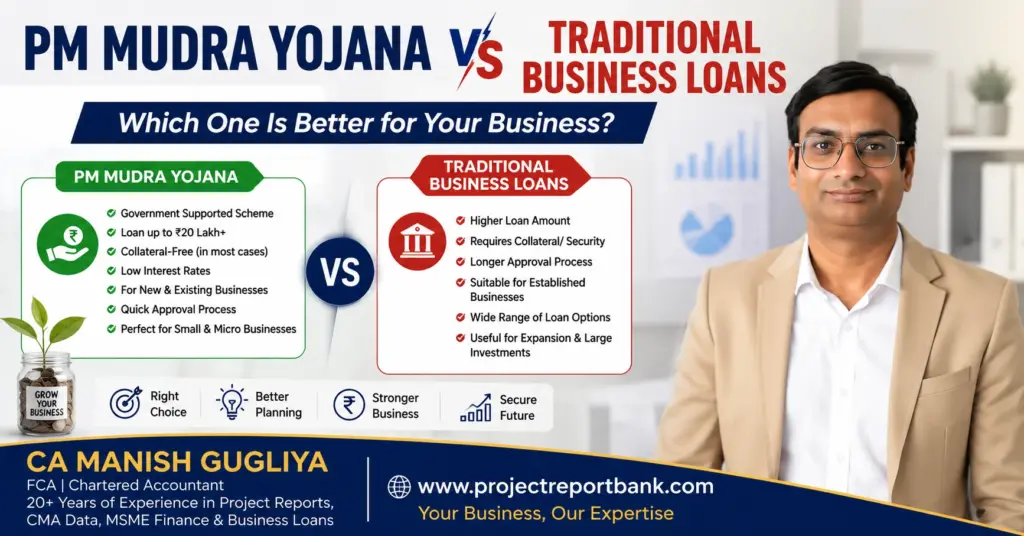
- PM Mudra Yojana vs Traditional Business Loans: Which Is Better for Small Businesses?
- Types of Mudra Loans: Shishu, Kishor, Tarun and Tarun Plus Explained
- Key Features of PM Mudra Yojana Every Applicant Should Know