Yes, you can get a Mudra loan for home business. This guide will show you how to apply for a Mudra loan for your home business, what you need, and the benefits you can gain.
Many applicants also remain confused about whether they can apply for a Mudra loan without GST registration or as a housewife running a small home business.
Key Takeaways
-
Mudra Loans provide financial assistance to micro enterprises, with a maximum limit of ₹10 lakh, aimed at promoting entrepreneurship in home-based businesses.
-
Eligibility for Mudra Loans includes being an Indian resident aged 18 to 65 and involved in legitimate, income-generating non-corporate, non-farm activities without requiring commercial space.
-
Common misconceptions surround the need for a commercial shop; home-based entrepreneurs can avail Mudra Loans with sufficient documentation and evidence of their business operations.
Introduction
The Mudra Loan Scheme, launched by the Government of India, aims to support micro enterprises by providing financial assistance to small business owners. The scheme was launched by the hon’ble Prime Minister to promote entrepreneurship and support micro enterprises. This initiative is part of the Pradhan Mantri Mudra Yojana (PMMY), which focuses on fostering entrepreneurship and employment creation.
In recent years, particularly post-COVID, there has been a noticeable rise in home-based businesses across India. Despite their growing presence, many home-based entrepreneurs face confusion regarding their eligibility for Mudra loans due to the lack of existing commercial space, formal registration, and often informal setups.
This guide seeks to dispel these misconceptions and serve as a clear Reference Point in regard to aspiring entrepreneurs.
Understanding Mudra Loans for Home-Based Businesses
Mudra loans are classified into four categories based on the funding needs and stage of growth development of the businesses: shishu loans, Kishor, Tarun, and stage Tarun+. Mudra loans are a type of credit facility designed to meet the needs of small and micro enterprises. This facility is tailored to different stages of business growth, ensuring that entrepreneurs receive appropriate support as their businesses develop.
The maximum loan amount provided under the Pradhan Mantri Mudra Yojana (PMMY) is ₹10 lakh, making it a substantial financial boost for micro enterprises engaged in various sectors.
These loans are offered by a range of institutions, including:
-
Commercial Banks
-
Regional Rural Banks (RRBs)
-
Small Finance Banks
-
Cooperative Banks
-
Micro Finance Institutions (MFIs)
-
Non-Banking Financial Companies (NBFCs)
-
Bank or financial institution
-
Financial Institution
The aim of the Mudra Loan Scheme is to provide financial assistance to micro enterprises, thereby promoting entrepreneurship and economic growth. The nature of the Mudra Loan Scheme is fundamentally supportive of small business development and economic growth, focusing on the genuine needs of entrepreneurs.
Following the COVID-19 pandemic, there has been a significant increase in home-based businesses, leading to a higher demand for accessible credit. A borrower can approach various lending institutions or apply online to access these loans. Mudra loans cater to these needs by providing working capital and term loans, allowing borrowers to sustain and expand their ventures.
Eligibility Criteria for Home-Based Entrepreneurs
Applicants for Mudra loans must meet specific eligibility criteria: they should be between 18 and 65 years old, be residents of India, and possess valid identification and proof of residence.
The loan must be for a business that falls under non-corporate, non-farm activities. This includes a wide range of legitimate, income-generating home-based businesses.
Businesses ineligible for Mudra loans include those that:
-
Don’t generate income
-
Are hobbies without a business plan
-
Lack proper address or ID verification
-
Involve hazardous materials prohibited in residential areas
The scheme aims to support genuine entrepreneurial ventures that undertake to contribute to economic growth development and funding, including those established as a partnership firm, and job creation through investment through the proposed activity, ensuring security and interest, while addressing any proprietary concern. The eligibility criteria are specifically designed to address the needs of the beneficiary at various stages of business development, ensuring that funding aligns with the growth plans and requirements of micro enterprises and entrepreneurs.
Many special categories of applicants are also eligible under the Mudra Loan Scheme, including women entrepreneurs, salaried persons planning side businesses, senior citizens, disabled persons, and SC/ST applicants. Different banks may offer additional support or flexible consideration depending on the applicant profile and business activity. Applicants can also explore detailed eligibility guides for Mudra loans for women entrepreneurs, senior citizens, salaried persons, disabled persons, and SC/ST applicants.
Types of Home-Based Businesses Eligible for Mudra Loans
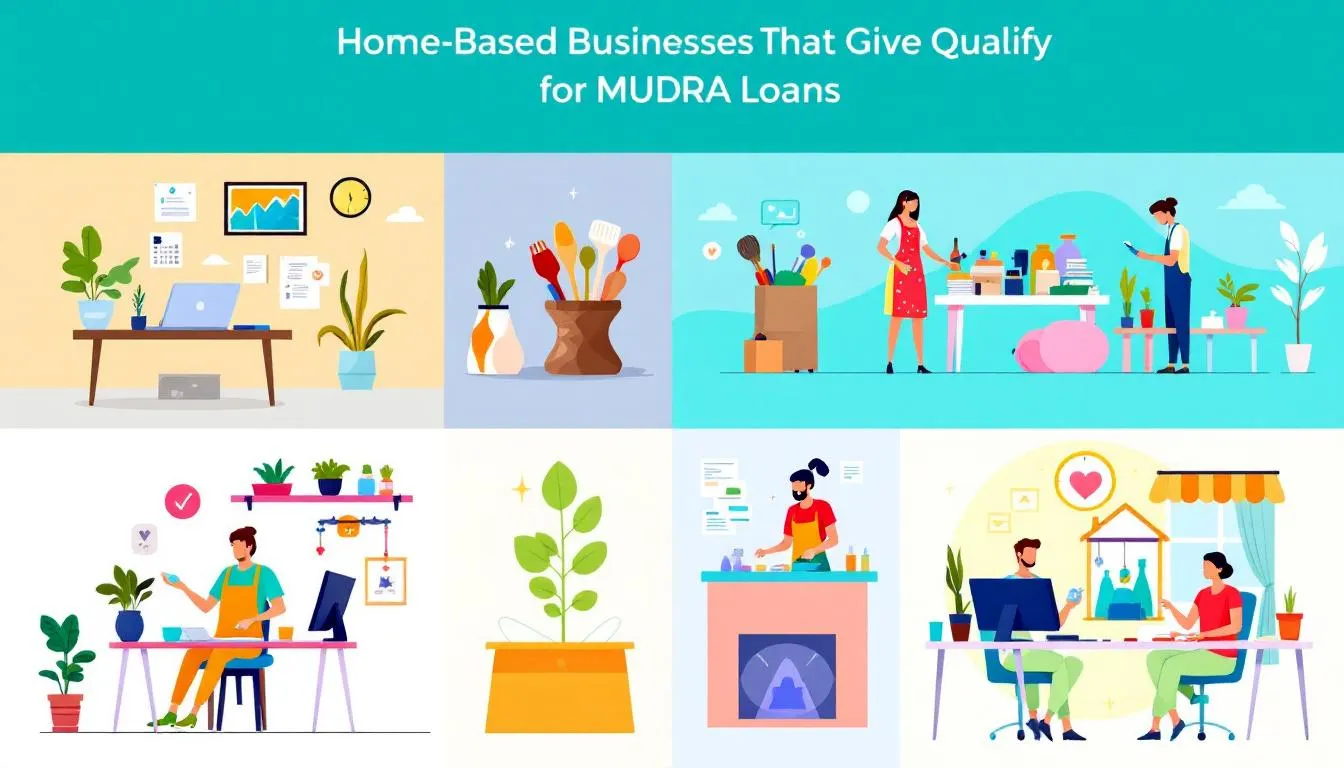
Diverse Sectors Covered: Mudra loans facilitate a diverse range of income-generating activities across various sectors, including trading, manufacturing, and services. These loans cater to a broad spectrum of home-based businesses, not limited to specific industries.
Allied agricultural activities, such as dairy, poultry, or beekeeping, are also eligible for Mudra loans under the scheme.
Food Service Businesses: Home-based food service businesses such as catering or tiffin delivery are eligible for Mudra loans, helping entrepreneurs expand and sustain their culinary ventures.
Small Manufacturing Units: Small manufacturing units producing handmade goods or artisanal products qualify for Mudra financing, enabling growth in craftsmanship and production capacity.
Service Enterprises: Businesses in the service sector, including beauty salons and repair services operated from home, can avail Mudra loans to support their operations and development.
Educational and Freelance Services: Online tuition and education consultancy services are recognized as eligible activities. Freelance content writing, a growing field, is also considered suitable for obtaining Mudra loans.
Artisans and Craftsmen: Artisans and craftsmen running home-based businesses can use Mudra loans to expand their operations and increase their income.
Examples of Successful Businesses: Tailoring, tiffin services, online tuition, and freelance content writing are examples of home-based businesses that have successfully availed Mudra loans.
Support for Allied Activities: These cases highlight the broad spectrum of activities allied and supported by extended Mudra loans, fostering entrepreneurship across various fields.
| Category | Loan Amount | Suitable For |
|---|---|---|
| Shishu | Up to ₹50,000 | New small business |
| Kishor | ₹50,000 – ₹5 lakh | Growing business |
| Tarun | ₹5 lakh – ₹10 lakh | Business expansion |
| Tarun Plus | ₹10 lakh – ₹20 lakh (selected banks) | Established and scalable businesses |
If you are planning to start a new small business, you may also explore some profitable business ideas suitable under the ₹5 lakh Mudra loan category.
Required Documentation for Mudra Loan Application
Mudra loan applications require specific documents for identity and business verification. Necessary identity proof includes Aadhaar card, PAN card, or voter ID. Address proof can be provided through utility bills, voter ID, or driving license.
Applicants must also complete a loan application form and submit supporting documents, such as a detailed business plan and a self-declaration, particularly for first-time borrowers or specific loan types.
A professionally prepared project report can significantly improve the chances of Mudra loan approval.
Preparing all necessary documents in advance can expedite loan processing, ensuring a smoother application process and increasing the likelihood of approval under the Pradhan Mantri Mudra Yojana.
Tips for a Successful Mudra Loan Application

1. Prepare a Viable Business Plan: A clear and detailed business plan outlining the intended use of the loan is essential to demonstrate your business goals and how the funds will be utilized.
2. Gather Supporting Financial Documents: Provide income certificates, IT returns, bank statements, and other documents that showcase your financial stability and ability to repay the loan.
3. Be Ready for Additional Proof: Lenders may request further financial proof such as balance sheets, assets, and sales tax returns to assess your creditworthiness. They may also consider the assets created through the loan, as these assets can serve as primary security or collateral for the loan.
4. Explore Digital Lending Options: Mudra loans are not limited to traditional banks; many digital lenders now offer accessible options for home-based entrepreneurs.
5. Understand Credit Score Impact: A poor credit score does not automatically disqualify you; business performance and a satisfactory credit track record can outweigh credit history. Even applicants with low or limited credit history may still qualify under certain conditions.
6. Provide Evidence of Home-Based Setup: Including pictures of your home business setup can help validate your application and dispel misconceptions about needing a commercial shop.
7. Approach Familiar Banks: Applying through banks where you have an existing relationship can improve your chances of loan approval due to established trust and history.
Case Studies of Successful Home-Based Businesses with Mudra Loans

Real-life success stories highlight the impact of Mudra loans on home-based businesses. For example, Shalini, a beneficiary micro unit entrepreneur, received support as a beneficiary micro unit under the Mudra scheme to establish a papad-making business from her home, generating local employment and income.
Similarly, Ravi, also a beneficiary micro unit entrepreneur, benefited as a beneficiary micro unit by using a Mudra loan to enhance his YouTube editing business through investment in better equipment and expansion of his client base. These case studies underscore the significant impact of Mudra loans on entrepreneurship and local economic growth.
These examples demonstrate the transformative power of Mudra loans, encouraging more home-based entrepreneurs to explore this financial assistance and contribute to the economy.
Addressing Common Concerns and Misconceptions
Misconception About Commercial Shop: Many aspiring entrepreneurs wrongly believe that a commercial shop is mandatory for a Mudra loan, causing confusion among women, students, and retirees.
Eligibility of Home-Based Businesses: Individuals running home-based businesses can avail Mudra loans without needing a commercial shop or GST registration.
Overcoming Loan Rejection: If a bank rejects a loan application due to the lack of a shop, applicants can clarify that the business is home-based.
Supporting Evidence: Providing supporting evidence like photos, bills, and local references can help overcome the misconception and facilitate loan approval.
What’s Not Allowed (or Difficult) Under Mudra for Home-Based Setups
Certain types of businesses are not allowed under Mudra loans. These include:
-
Businesses that do not generate income
-
Businesses that are “hobby only” with no business plan
-
Businesses that cannot be verified with proper address or ID
-
Businesses that involve hazardous materials not permitted in residential areas.
Additionally, businesses that require a commercial license or premises, such as large-scale food manufacturing, salons, or repair workshops with noise, may find it difficult to secure Mudra loans. These restrictions ensure that the loans support genuine, viable home-based businesses.
What if the Bank Rejects Due to Lack of Shop?
If a bank rejects your Mudra loan application due to the lack of a commercial shop, there are several steps you can take. First, clarify that your business is run from home and provide supporting evidence such as photos, bills, and local references.
If the issue persists, escalate the matter with the Lead District Manager (LDM) or through the online PMMY portal. Alternatively, consider digital lenders like SIDBI partners who may be more flexible with informal setups.
Who Is Not Eligible for Mudra Loan?
Mudra loans are generally not available for illegal, risky, or non-income-generating activities. Businesses related to betting, gambling, MLM schemes, speculative investment activities, or prohibited products may face rejection. Similarly, applicants without any genuine business activity, income proof, proper documents, or repayment capacity may also find it difficult to get approval.
Home-based businesses involving hazardous materials or activities not permitted in residential areas may also be ineligible. Banks mainly prefer genuine small businesses with proper business purpose, basic documentation, and visible income potential.
Summary
In summary, Mudra loans offer a valuable financial lifeline for home-based entrepreneurs, supporting a wide range of businesses from catering and manufacturing to online tuition and freelancing. By understanding the eligibility criteria, required documentation, and tips for a successful application, aspiring entrepreneurs can navigate the Mudra loan process with confidence.
The success stories of Shalini and Ravi demonstrate the transformative impact of Mudra loans on home-based businesses. With the right approach, you too can turn your home-based venture into a thriving enterprise. So, take the first step towards securing a Mudra loan and propel your business to new heights.