Key Takeaways
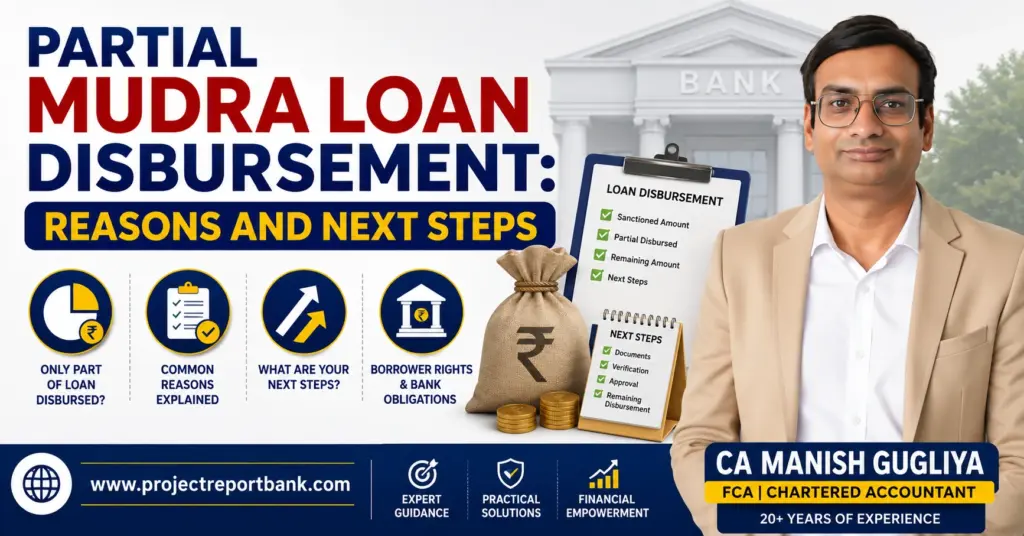
- A partial Mudra loan disbursement means only a portion of the sanctioned loan amount is credited initially, and this is a normal practice under Pradhan Mantri Mudra Yojana (PMMY) – not a sign of rejection.
- Banks can legally disburse Mudra loans in stages, especially for machinery purchase, project-based term loan components, or where invoice and utilization proof is required before releasing the next phase.
- Before expecting the remaining amount, the borrower should carefully read the sanction letter, visit the nearest branch to speak with the manager, and submit all pending documents such as invoices, photographs, and utilization certificates.
- Interest is charged only on the amount actually disbursed, so partial disbursement also helps prevent idle cash sitting in your business account.
- If there is an unexplained delay or sudden reduction in the remaining loan amount, you have every right to demand written clarification and escalate through the bank’s grievance process or the RBI Ombudsman.
Introduction: Why Only Part of My Mudra Loan Was Credited?
In my 20+ years of practice as a Chartered Accountant helping entrepreneurs with project reports, CMA data, and MSME finance across India, one question comes up almost every week: “Sir, my Mudra loan was sanctioned for ₹5 lakh but only ₹2.5 lakh was credited. Is there a problem?”
The short answer – usually, no.
Under the Pradhan Mantri Mudra Yojana, launched on April 8, 2015, to provide collateral free financial assistance to non corporate, non farm small enterprises, banks and NBFCs often release the loan amount in stages. This is especially true when the business loan covers fixed assets like machinery, vehicles, or shop renovation rather than simple working capital for trading and services.
Partial Mudra loan disbursement does not mean your application was rejected or that something went wrong. In most cases, it is a controlled lending practice to ensure proper use of government-backed funding. This article covers the meaning, legality, common reasons, documents required, your rights as a borrower, and a step-by-step action plan – everything you need to move from partial to full disbursement.

Table of Contents
What Is Partial Mudra Loan Disbursement?
A partial MUDRA loan disbursement occurs when the approved loan amount is released in stages rather than as a single lump sum. To understand this, you need to know two terms: the sanctioned amount (what the bank approves) and the disbursed amount (what has actually been paid out to you or to your suppliers so far).
Under the mudra scheme, loans are classified into Shishu (upto rs 50,000 for startups), Kishore (₹50,001 to ₹5 lakh), and Tarun (₹5 lakh to ₹10 lakh). The newer Tarun Plus category provides up to ₹20 lakh for existing borrowers who have successfully repaid a previous Tarun loan. Mudra loans range from ₹50,000 to ₹20 lakh depending on the category and credit needs of the applicant.
A loan sanction indicates the total approved amount before any disbursement occurs. Full disbursement means the entire sanctioned limit is released at once. Partial disbursement means only a part – say ₹3 lakh out of ₹7.5 lakh – is released initially.
Example: A borrower sanctioned a ₹7,50,000 term loan for bakery equipment. The bank first pays ₹3,00,000 directly to the oven supplier against the pro-forma invoice and releases the remaining ₹4,50,000 only after receiving installation proof and completing a site visit.
Many first-time entrepreneurs get confused because they see the sanction SMS and expect the full amount in their savings or current account immediately. If you are new to this process, I recommend reading about the difference between Mudra loan approval, sanction, and disbursement to understand each stage clearly.
Can Banks Partially Disburse a Mudra Loan?
Yes. Under RBI guidelines and standard PMMY practices, banks are allowed to disburse Mudra loans in phases based on project needs and risk assessment. This applies across Shishu, Kishore, and tarun category loans offered through various financial institutions including public sector banks, RRBs, and NBFCs.
For term loan components – money meant for machinery, vehicles, or shop construction – stage-wise release is common. Funds are released based on specific business milestones or requirements. For pure working capital needs (stock purchase, day-to-day expenses), banks more often disburse in a single release or issue a mudra card or overdraft facility.
How does stage-wise release typically work? The bank may release money at predefined stages:
- Advance payment to supplier
- After delivery confirmation
- After installation and site inspection
- After submission of utilization proof
Lenders use partial disbursement to mitigate risk by verifying fund utilization at each step. This is especially relevant for larger loans near the maximum loan limit of 10 lakh under the Tarun category. Partial disbursement also helps prevent idle cash in business accounts.
When you sign the sanction letter and loan agreement, you technically accept these conditions. This is why reading the sanction letter carefully before signing is essential. The Mudra Yojana was launched on April 8, 2015, to aid small enterprises in manufacturing, trading and services, and food processing sectors – and this flagship scheme supports income generation and employment creation across the country. The eligibility criteria are straightforward: eligible applicants must be aged between 18 to 65 years, running a non farm micro unit. Agricultural activities like farming are not eligible for Mudra loans. Any individual, proprietorship, partnership, or other legal entity engaged in a non corporate, non farm enterprise can apply online or at bank branches.
Collateral security is not required for Mudra loans – they are designed as collateral free finance for micro enterprises. This is no different from how standard business loans above ₹10 lakh work in terms of phased disbursement; banks across the sector follow similar risk management practices.
Common Reasons for Partial Mudra Loan Disbursement
From my experience helping borrowers across banks between 2015 and 2026, most cases of partial disbursement fall into predictable patterns. Partial disbursement is generally used for project expenditures or equipment purchases where funds are aligned with actual financial milestones.
Machinery or asset purchase in stages: The bank pays the supplier directly against invoices. If your equipment arrives in parts or from multiple vendors, the money flows in stages. This usually takes 1–3 weeks per stage. Submit clear, GST-compliant invoices early and confirm supplier details with the branch.
Site inspection pending: A bank officer or empanelled valuer needs to verify that your machine is installed or your shop is operational. This typically takes 3–10 working days. Proactively call and request a visit date.
Documentation gaps: Missing GST registration, incorrect invoices, incomplete KYC, or unclear quotations frequently hold up the next phase. These can delay things by a week or more. Ask for a written checklist and complete everything in one submission.
Margin money not deposited: Some banks require you to contribute 10–20% of the asset cost from your own money before they release their portion. Arrange your contribution early and share receipts.
Insurance or hypothecation formalities: Banks may require you to insure the financed assets or complete charge registration before releasing the balance. Get insurance quotes in advance.
Higher approval pending: For larger Tarun loans approaching the sanctioned limit, regional or head office approval may be needed. This can add 1–2 weeks. Stay in touch with your branch officer.
If your Mudra loan was sanctioned but not yet disbursed fully, understanding these reasons is the first reference point for troubleshooting. You can also read about the detailed Mudra loan installment disbursement process for a deeper understanding.
How to Check Whether the Remaining Mudra Loan Amount Will Be Released
Before worrying, verify exactly what the bank has committed regarding your disbursement schedule and pending conditions.
Read your sanction letter carefully. Look for phrases like “disbursement in stages,” “subject to submission of invoices,” or “payment directly to supplier.” These tell you the bank planned partial release from the start.
Ask the branch for specifics. Visit your branch and ask: “How much has been disbursed so far? What is the balance? What documents or milestones are pending?” Get answers in writing – even a short email works.
Check your loan account statement through net banking or the mobile app. Cross-verify any payments made directly to suppliers under the scheme.
Request written confirmation that the remaining amount will be released upon completing the listed conditions. This protects you from future disputes. For a step-by-step digital process, follow this guide on how to check Mudra loan disbursement status online.
Documents Required Before Remaining Mudra Loan Is Released
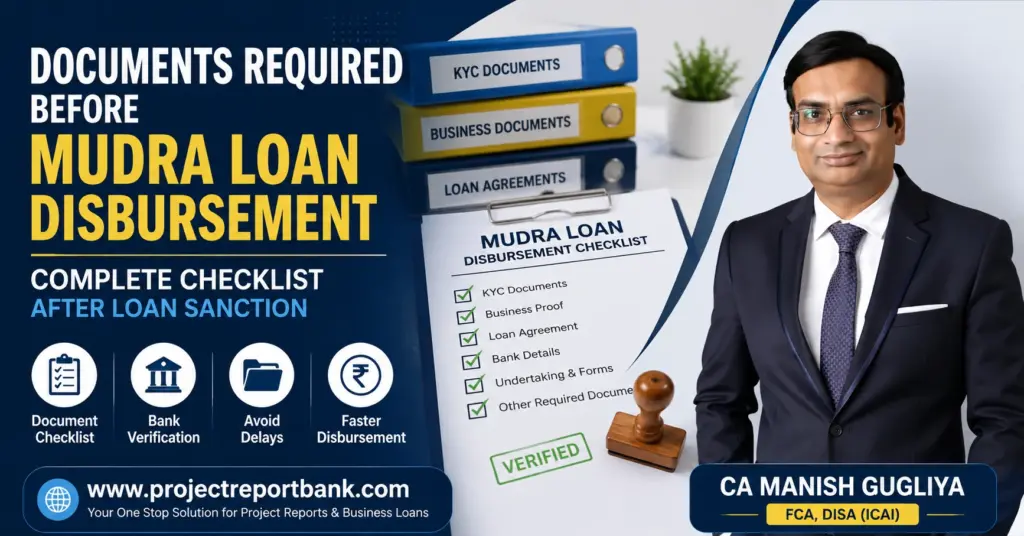
While Mudra loans under PMMY are collateral free, they are not document-free. Borrowers may need to provide proof of utilization to receive subsequent disbursements. Banks must collect specific proofs before releasing further installments:
- Original purchase invoices and GST bills for machinery, vehicle, or equipment
- Updated quotations if prices have changed since sanction
- Delivery challan and installation report with photographs
- Utilization certificate confirming first installment was used for the approved business purpose
- Updated Udyam/MSME registration, business licenses, and any pending KYC
- Insurance policy documents if asset insurance is mandatory
- Margin money deposit proof where applicable
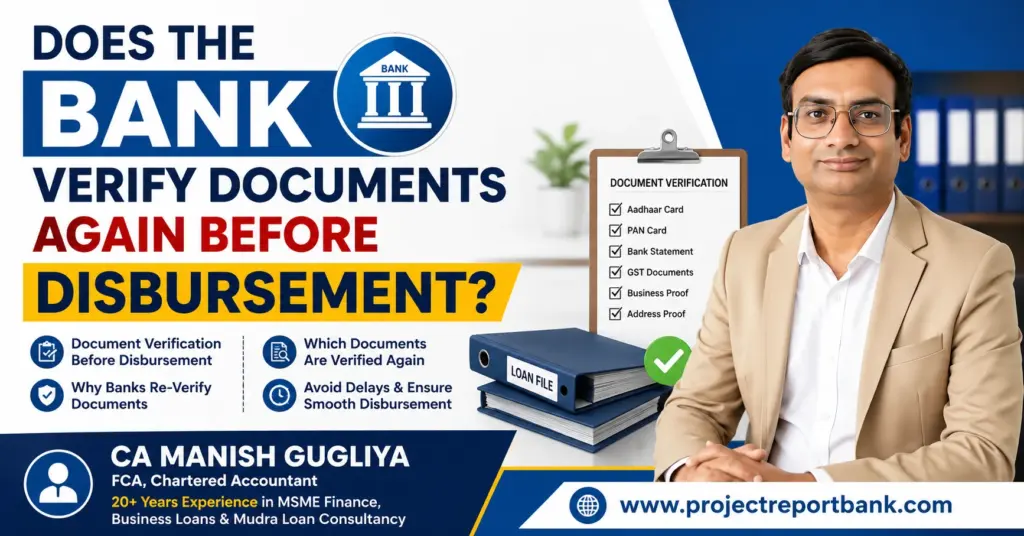
Documents required vary by bank. A common mistake is submitting incomplete or unclear paperwork. Always ask for the bank’s written checklist and tick off each item. For a complete breakdown, refer to this guide on documents required before Mudra loan disbursement. Your business plan and identity proof should already be on file from the initial application.
What Should You Do After Receiving Partial Disbursement? (Step-by-Step)
Here is a practical action plan – not theory, but exactly what to do:
Step 1: Verify the amount credited (or paid to the supplier) against the sanctioned loan amount in your letter. Note the balance as “undisbursed.”
Step 2: Re-read all sanction conditions, especially special conditions about stage-wise release and what triggers the next installment.
Step 3: Visit the branch and politely ask the loan officer for a written list of pending documents, inspections, or approvals.
Step 4: Collect and submit all required documents – invoices, GST bills, photographs, licenses, margin money proof – in one shot. Keep photocopies and email copies.
Step 5: Request written communication stating that after these conditions are met, the bank will release the remaining amount, with an approximate date.
Step 6: Follow up regularly – once a week if needed. Check online status. Avoid long gaps where the bank might mark your loan as “not required.”
Step 7: If delay continues without clear reason beyond 2–4 weeks, escalate: branch manager → regional office → bank grievance cell → RBI Integrated Ombudsman.
For more on what happens after sanction, read what happens after a Mudra loan is sanctioned.
When Should You Worry, and Can the Remaining Loan Amount Be Cancelled?
Some delay is normal. But watch for these warning signs:
- The bank avoids giving clear answers about pending requirements
- Repeated requests for new documents without written justification
- No site visit scheduled for weeks despite your readiness
- The file appears “stuck” with no movement at branch or regional level
For Mudra loans under ₹10 lakh, if all conditions are fulfilled and there is still no movement for more than 2–4 weeks, insist on written status.
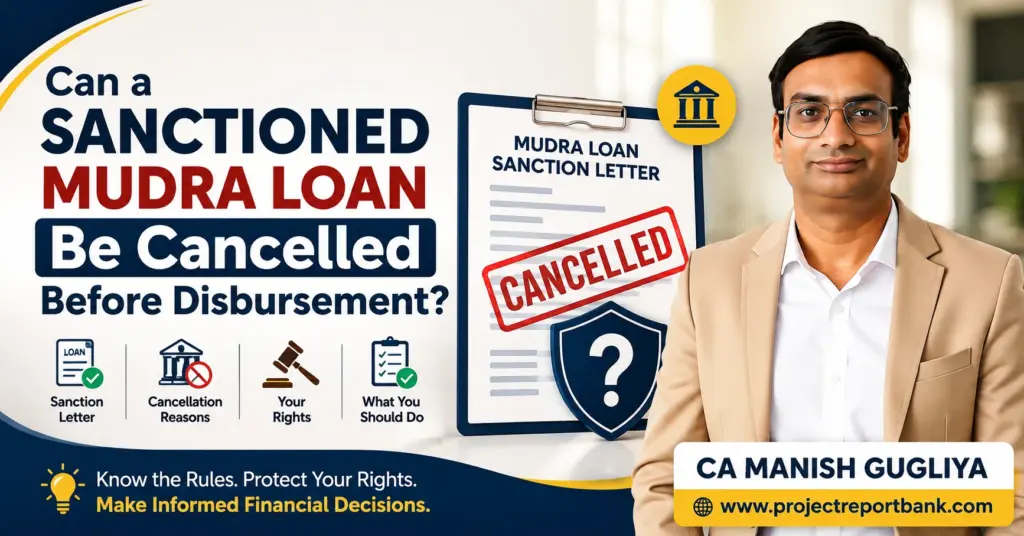
Can the bank cancel the balance? Yes, in specific situations: if you fail to arrange margin money, if your CIBIL report shows negative information, if you misuse the first installment, or if there is a serious mismatch between declared and actual use of funds. The bank cannot silently cancel the remaining amount without recording reasons and informing you.
As a borrower, you have the right to ask for written reasons. Keep all communication records. Read more about whether a sanctioned Mudra loan can be cancelled by the bank and whether the branch manager can reduce the Mudra loan amount.

Borrower’s Rights, Common Mistakes, and Expert Guidance by CA Manish Gugliya
Under Pradhan Mantri Mudra Yojana, every beneficiary micro unit is entitled to fair and transparent treatment, even during partial disbursement.
Your key rights include:
- Right to know pending requirements in writing
- Right to written explanation if disbursement is withheld
- Right to formal communication if the sanctioned amount is reduced
- Right to use the bank’s grievance redressal mechanism and, if needed, the RBI Ombudsman
Common mistakes I see borrowers make:
- Spending the first installment on personal needs instead of the approved business purpose
- Ignoring specific sanction conditions and assuming the balance will auto-credit
- Delaying submission of invoices, GST registration, or insurance documents
- Skipping scheduled inspections or not coordinating with suppliers
- Poor communication – not visiting the branch or following up for weeks
Expert guidance from a banker’s perspective: Credit officers think about risk. They prefer invoice-based disbursement for assets because it ensures money actually reaches the supplier, not someone’s personal account. Clean documentation and honest communication reduce their concerns dramatically.
My practical tips: prepare a simple business plan with cash flow projections even if the bank does not explicitly ask for one. Maintain a separate current account for business transactions so every rupee of the Mudra loan is traceable. Keep all Mudra-related bills, receipts, and correspondence in one file. Send documents by email and hard copy both – this speeds up verification. The financial support available under this scheme has generated remarkable success stories and growth for micro enterprises across India, but only when availed responsibly.
Stay polite and professional with the bank. Ask for timelines. Send gentle reminders. Never make false promises about company turnover or profits to push disbursement – this can backfire and create security concerns for the lending institution.
Practical Case Study: From 50% Disbursement to Full Mudra Loan Release
Rajesh, a young entrepreneur from Jaipur, applied for a ₹6,00,000 Kishore Mudra loan in early 2026 to start a printing and photocopy shop. He needed high-speed printers, a lamination machine, and initial stock.
The bank sanctioned ₹6,00,000. First partial disbursement: ₹3,00,000 paid directly to the machine supplier against a pro-forma invoice. Only a small portion – about ₹40,000 – was credited to Rajesh’s current account as working capital for initial stock and stationery.
Rajesh panicked. He thought the remaining ₹2,60,000 had been rejected.
The bank’s conditions were clear in the sanction letter: the balance would be released after machine delivery, installation, submission of the final GST invoice, site photographs, and a utilization certificate confirming proper use of the first installment.
Rajesh initially delayed submitting installation proof and did not follow up with his supplier for the delivery challan. Three weeks passed. After consulting a CA, he compiled all documents correctly, arranged a branch manager visit, and the file moved to the regional office. The remaining ₹2,60,000 was released within 10 working days.
Today, Rajesh’s shop is profitable. His EMIs are paid on time. His experience is a useful reference point: partial disbursement, handled correctly, still delivers the full benefits of the Mudra scheme. The property he operates from has seen extended growth, and he is now eligible for the next phase of lending under Tarun Plus.

Frequently Asked Questions on Partial Mudra Loan Disbursement
These FAQs address practical doubts not fully covered above, written for quick reference and voice search.
Why did I receive only part of my sanctioned Mudra loan amount?
Most borrowers receive partial amounts because the bank follows a pre-decided stage-wise disbursement plan. This is standard practice when the loan covers machinery, vehicle, shop construction, or any fixed asset purchase. The balance is typically released after you submit invoices, installation proof, and allow the bank to complete inspections. It does not mean your application has a problem – it means the bank wants to verify that the money is being used for the sanctioned purpose before releasing the next installment.
Will I automatically get the remaining Mudra loan, or do I need to apply again?
No fresh application is needed for the remaining part of an already sanctioned Mudra loan. However, the balance is not automatic. It is conditional on fulfilling the sanction terms: submitting required documents, allowing inspections, and sometimes depositing your margin money. You should proactively contact the branch, submit everything, and request release of the next installment in writing. The guarantee of receiving the full amount depends on meeting all stated conditions.
Does partial disbursement change my EMI or interest calculation?
Interest is charged only on the amount actually disbursed, from the date of each disbursement. Your EMI may start based on the full sanctioned amount (depending on the bank’s method) or be recalculated after each major disbursement. Ask the branch to explain your EMI schedule in writing so there are no surprises. This is an important aspect of finance that many borrowers overlook.
Can I use the first installment of my Mudra loan for some other urgent personal need?
Mudra loans under PMMY are strictly for business purposes in the manufacturing, trading, and services sector. Using the first installment for personal expenses – marriage, home renovation, or repaying old debt – can lead to refusal of further disbursement, classification of your account as high-risk, or even recall of the entire loan. The scheme is covered under strict end-use monitoring. Always use the money only for the purpose mentioned in your sanction letter.
What should I do if the bank refuses to release the remaining amount without valid reason?
First, ask for a written explanation listing all pending requirements. Send a polite written reminder. If there is still no clarity after a reasonable period, escalate to the branch manager, then the regional office, and finally use the bank’s formal grievance cell. If all internal channels fail, file a complaint with the RBI Integrated Ombudsman Scheme. Keep all supporting documents, emails, and SMS records as evidence. As a borrower of this government-backed scheme, you have every right to fair and timely treatment. Applications can be submitted online or at bank branches, and the same channels can be used for filing complaints about the mudra yojana process. A refinance agency like MUDRA Ltd. oversees the broader framework, and your legal entity status – whether proprietorship, partnership, or company – does not reduce your right to seek resolution.
- Can You Delay Accepting Mudra Loan Disbursement? Everything Borrowers Should Know


- What Happens on Mudra Loan Disbursement Day? (Practical Guide by CA Manish Gugliya)

- Partial Mudra Loan Disbursement: Reasons and Next Steps
- Can Banks Release Mudra Loan in Installments? (Practical Guide by CA Manish Gugliya)

- Does the Bank Verify Documents Again Before Disbursement?
- Can a Sanctioned Mudra Loan Be Cancelled Before Disbursement? (Practical Guide by CA Manish Gugliya)
- How to Check Mudra Loan Disbursement Status Online
- Mudra Loan Amount Not Credited After Disbursement Approval: Reasons, Timeline & What You Should Do
- Documents Required Before Mudra Loan Disbursement: Complete Post‑Sanction Checklist