Key Takeaways
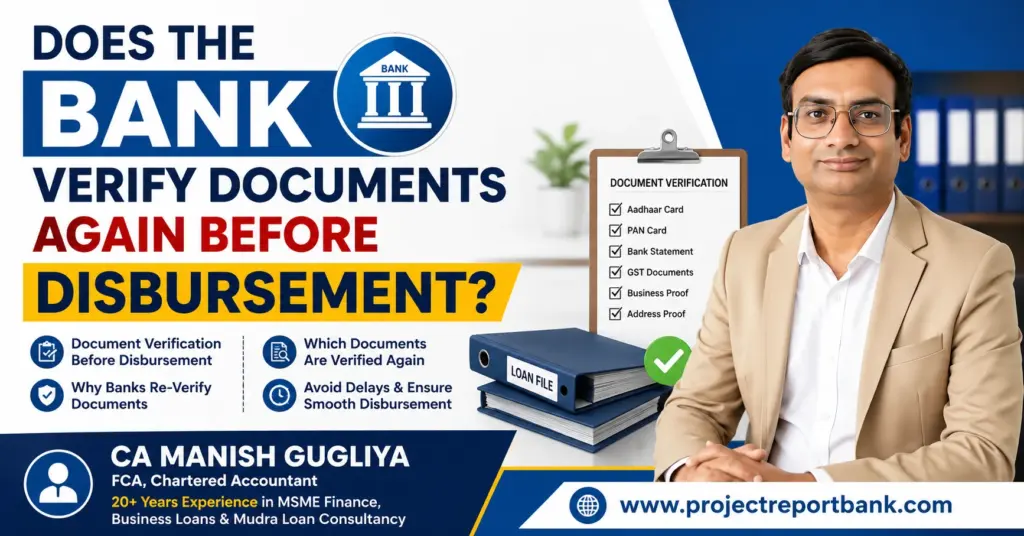
- Yes, banks normally verify key documents again just before loan disbursement – especially for Mudra loans, MSME loans, and personal loans in India.
- This second verification is mainly for KYC update, risk control, RBI/PMMY compliance, and to ensure nothing has changed after sanction.
- Banks may re-check your aadhaar card, pan card, address proof, income proof, bank statements, GST, Udyam, CIBIL, and even visit your business again in some cases.
- Re-verification can delay disbursement if documents are missing, expired, mismatched, or if you have taken another loan or defaulted in between.
- Borrowers should keep all documents updated, respond quickly to bank calls, and stay fully transparent to avoid delays and ensure smooth disbursement.
Introduction: Why Banks Verify Documents Again Before Disbursing a Loan
Your mudra loan of ₹5 lakh is sanctioned. You’re already planning how to use the money. Then the bank calls and asks for your Aadhaar, PAN, and latest bank statement – again. Is something wrong?
No. This is completely normal. Banks and financial institutions across India run a multi-layered verification process before loan approval and again before releasing funds. Whether it is a personal loan (which can be sanctioned up to ₹40 lakhs), a Mudra loan (up to ₹20 lakhs for micro enterprises with a repayment tenure of up to five years), or a business loan – re-verification before disbursement is standard banking discipline, not suspicion.
The loan process is a step-by-step financial journey: you fill the application form, submit required documents, the bank runs its verification, issues a sanction letter, and then – before actually transferring money – does a final round of checks. Procedures differ between public sector banks, private banks, RRBs, and cooperative banks, but the basic logic remains the same.
In this article, I’ll walk you through exactly which documents are re-verified, why, common scenarios that trigger extra checks, and how you can prepare to get your money faster.

Table of Contents
Loan Processing Stages: From Application to Final Disbursement
Most confusion happens because borrowers mix up “sanction” with “disbursement.” Understanding the difference between Mudra loan approval, sanction and disbursement clears up a lot.
Here is a simple breakdown:
| Stage | What Happens | Who Does It | Documents Checked? |
|---|---|---|---|
| Initial Verification | Basic KYC check – identity proof, address proof, business proof, income proof | Branch credit officer | Yes |
| Credit Appraisal | Deeper analysis of bank statements, business plan, cash flow, repayment capacity, credit history | Credit team / processing centre | Yes |
| Sanction | Successful verification results in the issuance of a sanction letter outlining loan terms and the approved loan amount | Branch manager / sanctioning authority | Reviewed, not freshly verified |
| Pre-disbursement Verification | The “second check” – re-verification of KYC, CIBIL, business activity, sanction conditions | Field officer / compliance team | Yes, often again |
| Final Disbursement | Cleared funds are disbursed only after signed loan agreements. Loan funds are typically transferred directly to the borrower’s verified bank account or seller. | Operations / treasury | Confirmed before transfer |
Approval for loans usually takes a few days to weeks, depending on loan type and completeness of documentation.
Why Banks Verify Documents Again Before Disbursement
Banks re-verify documents to protect public money and follow RBI KYC norms and PMMY guidelines. Here is why:
- Regulatory compliance: RBI and PMMY rules require updated KYC and due diligence before releasing any loan amount. The verification process minimizes the risk of default or fraud.
- Risk management: Your financial situation may change between sanction and disbursement – a new loan taken elsewhere, cheque bounces, or business closure. Banks must assess this.
- Fraud prevention: Banks check for fraud and compliance during the verification process. Rising cases of fake PAN, forged GST returns, and manipulated bank statements force lenders to re-verify against official databases.
- KYC validity: If your last KYC is older than what the bank’s policy allows, they will re-collect your aadhaar card, pan card, and address proof. All verification documents must confirm their authenticity to proceed.
- Internal audit: Audit teams randomly pick files and insist on fresh verification, especially for Mudra, MSME, and unsecured personal loans.
- Document validity: The verification process scrutinizes financial documents for authenticity – expired rent agreements, cancelled GST registration, or outdated income proof can all trigger re-collection.
The depth of re-verification depends on the loan type (small Shishu Mudra vs. large term loan), risk category, and the lender’s comfort level.
Which Documents Are Commonly Re-Verified Before Disbursement
Not every document is re-verified every time. Banks select based on risk, time gap, and whether it is a personal loan verification process or a business loan. The verification process categorizes documents into core groups:
Identity and address:
- Aadhaar: checked for name, DOB, and mobile link – sometimes OTP-based eKYC is repeated.
- PAN: re-confirmed through IT portal. Identity proof includes PAN cards and Aadhaar cards for verification.
- Address proof can include utility bills and rental agreements. If earlier proof is older than 3–6 months, the bank asks for a fresh copy from your current address.
Business and regulatory:
- GST registration and recent filings – verified for business continuity.
- Udyam Registration: confirmed for correct MSME category.
- Shop license, FSSAI, partnership deed, or company incorporation documents – validated for authenticity and current validity.
Financial and income proof:
- Latest 6–12 months bank statements showing cash flow, EMI debits, and fresh borrowing.
- Income proof for salaried applicants typically includes recent salary slips and Form 16. Self-employed applicants must provide audited financial statements, income tax returns, and profit & loss accounts.
- Required documents include identity proof and business proof.
- Collateral verification is required for secured loans and includes title deeds and encumbrance certificates.
Other items:
- Existing loan statements, CIBIL report refresh, and guarantor documents (if applicable) including passport sized photos where required.
Practical Situations When Banks Commonly Re-Verify Documents
From my day-to-day consulting experience with MSME clients, I see re-verification in these common situations:
- Time gap: If more than 30–90 days pass between sanction and disbursement, the branch typically asks for latest bank statements and fresh CIBIL.
- Expired KYC: Documents with changed details or KYC done over 2 years ago trigger re-collection.
- Address or business location change: Shifting your shop, office, or residence after sanction leads to fresh address proof and sometimes another field visit.
- Enhanced loan request: Asking to increase the loan amount at the last moment can trigger re-appraisal of your income proof and business plan.
- High-value cases: Large Mudra Tarun loans or unsecured working capital see stronger re-checks.
- Random audit: Files may be selected randomly by regional office or internal audit for extra verification before disbursement.
- Suspicious signals: Recent cheque bounces, sudden heavy cash deposits, or mismatch in GST turnover vs. declared turnover trigger deeper checks.
Physical Verification Before Disbursement: Will the Bank Visit Again?
A second physical visit is possible but not compulsory in every case. Field verification may be conducted to authenticate the applicant’s existence and financial stability. Here is when it typically happens:
- Shop or business visit: For Mudra and MSME loans, field officers may re-visit to confirm the business is still operational and stock exists.
- Office or manufacturing unit: For larger term loans, the bank may inspect machinery, equipment, and employee activity.
- Inventory and asset check: In working capital limits, banks re-check stock levels pledged as security.
- Residence visit: For unsecured personal loans, many private banks use third-party agencies for online verification combined with a physical residence check.
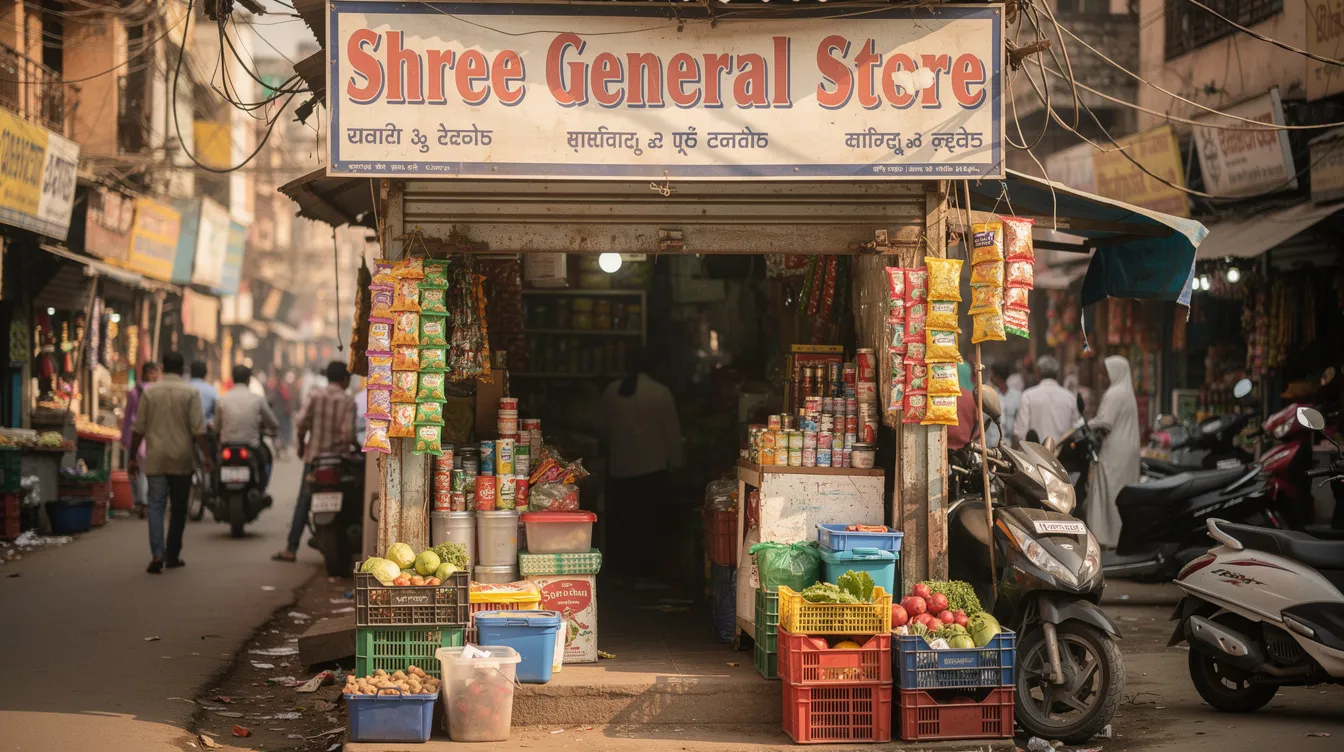
If you are a genuine borrower, just ensure your signboard, GST number, and licenses are visible and your shop or office is open when the officer visits.
Does the Bank Check CIBIL Again Before Disbursement?
Yes, many banks pull a fresh credit bureau report just before disbursing – especially for personal loans and larger Mudra or MSME limits. A credit bureau assessment evaluates the applicant’s credit score and repayment history.
- Soft inquiry: Used for monitoring. Does not impact your score.
- Hard inquiry: Taken when evaluating a new loan. Multiple hard pulls in a short time can slightly reduce your score.
Typical scenario: Loan sanctioned in March based on a CIBIL score of 735. Before disbursing in April, the bank pulls CIBIL again and finds a new personal loan taken after sanction. They may now reconsider the loan amount or ask for additional security.
If serious negatives appear – defaults, written-off accounts, or a drastic score drop (say from 735 to 640) – the bank can delay disbursement, reduce the limit, demand a guarantor, or in extreme cases, cancel the sanction altogether.
Can Re-Verification Delay or Stop Loan Disbursement?
“My Mudra loan is sanctioned but not disbursed – is re-verification the reason?” This is the most common concern I hear. Loan approval can take a few days to weeks based on documents and the process.
Typical timelines after sanction: Shishu (2–5 days), Kishor (5–10 days), Tarun or SME term loans (7–21 days), personal loan (1–7 days).
Common delay reasons:
- Missing or unreadable copies of Aadhaar, PAN, or address proof
- Old bank statement – branch needs latest 3 months
- KYC mismatch between Aadhaar and PAN (spelling, name order)
- Pending signatures on loan agreement or DP note
- Processing fees not yet paid (which can be up to 2% plus GST)
If your Mudra loan is sanctioned but not disbursed, check what documents are still pending. Understanding what happens after a Mudra loan is sanctioned can help you prepare.
Practical solutions: Keep your phone on, respond to document requests within 24 hours, and visit the branch promptly if in-person signatures are needed.
What If Any Document Does Not Match During Final Verification?
A mismatch does not always mean cancellation, but banks take accuracy seriously.
| Mismatch Type | Impact | What To Do |
|---|---|---|
| Minor name spelling variation | Low – usually resolved with written clarification | Submit alternate proof with correct name |
| Address mismatch (old vs. current address) | Medium – bank may ask for rental agreement or latest electricity bill | Provide updated address proof promptly |
| PAN or DOB mismatch | High – disbursement halted until corrected | Get PAN/Aadhaar corrected through official channels |
| Business proof mismatch (GST address ≠ actual shop) | High – can lead to re-appraisal | Update GST records or provide explanation with evidence |
| Bank account name mismatch | Medium – NEFT/RTGS returned | Submit corrected cancelled cheque or passbook copy |
| Fake or forged document | Critical – file rejected, may invite legal action | Never submit false documents |
Cooperate calmly and submit corrected documents quickly.
How Borrowers Should Prepare Before Final Verification (Practical Checklist)
Print this checklist right after receiving your sanction letter:
- ✅ Originals + 2 photocopies of Aadhaar, PAN, address proof, Udyam, GST, shop license
- ✅ Latest 6 months bank statements downloaded from internet banking
- ✅ Latest income tax returns, profit & loss, balance sheet (for business), or salary slips and Form 16 (for salaried applicants)
- ✅ Active mobile number linked to Aadhaar for OTP
- ✅ Accessible email ID for e-sanction letters and bank communications
- ✅ Photographs of shop/office, rent agreement or ownership papers
- ✅ Confirmed that your bank account is active, KYC-updated, and not frozen – cross-check IFSC and account number
- ✅ Upload required documents to the bank’s online application form or portal if available
- ✅ Passport or passport sized photos if the lender requires them
Following this checklist can help you avoid delays and achieve same-week disbursement.
Common Mistakes That Trigger Extra Verification or Delays
Most delays I see are due to avoidable mistakes, not because the bank wants to harass applicants:
- Ignoring bank calls: Not picking up calls from unknown numbers (often field officers or calling agents).
- Submitting outdated documents: Old ITR, expired electricity bill, or bank statement missing recent transactions.
- Hiding existing loans: Not disclosing NBFC loans, credit card dues, or informal borrowings that later appear in CIBIL or bank statement, creating trust issues.
- Changing business location without intimation: When the officer revisits and finds the place locked, it raises suspicion.
- Relying fully on agents: Not personally understanding the loan application form or provided information being signed can lead to wrong details.
- Incorrect bank account details: Typos in account number or IFSC cause returned transfers, forcing the bank to redo disbursement entries.
Double-check every form, confirm every detail, and maintain transparent communication with the branch.
Expert Tips from CA Manish Gugliya for Smooth Disbursement
These are field-tested tips from 20+ years of handling project reports, CMA data, and Mudra loan cases:
- Keep a single, clean KYC file: Maintain a physical file and scanned PDFs of updated Aadhaar, PAN, address proof, GST, Udyam, and bank statements.
- Align all documents: Business name, constitution, and address should match across GST, Udyam, bank account, and loan documents.
- Avoid fresh borrowing in between: If possible, do not take new high-value loans between sanction and disbursement. If unavoidable, inform the bank proactively instead of letting them discover it through CIBIL.
- Be present during field visits: Keep your shop open, have basic invoices ready, and allow the officer to verify stock and machinery without hesitation.
- Get professional help where needed: For complex MSME or Mudra Tarun proposals, consider working with an experienced CA to prepare a proper project report and business plan. Check the documents required before Mudra loan disbursement for a complete list.
Your eligibility criteria may be strong, but poor document management can still cause unnecessary delays. Interest rates and loan terms stay locked after sanction – do not let paperwork hold up your funding.

Frequently Asked Questions on Document Verification Before Loan Disbursement
These FAQs cover specific doubts that applicants commonly raise about the verification process and the personal loan verification process before disbursement.
Is it normal if the bank asks for my Aadhaar and PAN again just before disbursing my Mudra loan?
Yes, completely normal. If a few weeks have passed since initial KYC, or if the bank is switching from physical KYC to eKYC at the disbursement stage, they will re-verify your aadhaar card and pan card against UIDAI and IT databases. This is standard regulatory compliance, not a red flag.
Can my loan be cancelled after sanction if my CIBIL score falls before disbursement?
Banks are allowed to reconsider or even withdraw a sanction if fresh CIBIL shows serious new defaults, heavy new borrowing, or a major drop in score. Routine small score changes usually do not cause cancellation. But if your credit history shows significant deterioration, the lender may reduce the limit, ask for a guarantor, or in rare cases, cancel the sanction – especially for unsecured personal loans.
What should I do if my address has changed after sanction but before disbursement?
Inform the branch immediately in writing. Provide new address proof – a rental agreement, utility bills from your new residence, or a local municipality certificate. Cooperate if the bank wants a fresh visit. Hiding the change creates more delay and suspicion than honestly disclosing it.
Can the bank disburse my Mudra loan without any re-verification if I am an existing customer?
For long-standing customers with recent KYC and a clean track record, some banks keep re-verification minimal – relying on system-based or online verification only. However, even for existing customers, the bank retains the right to re-verify documents and CIBIL before disbursement based on internal policy, loan amount, and the status of your application’s progress.
How long does the final verification before disbursement usually take?
For a Shishu Mudra loan with complete documents, 2–5 working days is typical. For Kishor or Tarun, expect 5–21 days. Personal loans from private banks with digital services can disburse within 1–3 days if everything is in order. Delays happen mainly when documents are incomplete or when the bank needs additional validation on your financial stability or investment plans through a field visit.
Conclusion
Re-verification before disbursement is not a hurdle – it is a safeguard built into the banking industry to protect both the lender and the borrower. Every eligible borrower who keeps documents updated, responds promptly to bank requests, and maintains transparency through the process will see their loan credited without unnecessary friction.
Your job after sanction is simple: prepare, cooperate, and complete every requirement the bank asks for. The money is already approved. Do not let a missing document or an unanswered call stand between you and your business growth.
- Can You Delay Accepting Mudra Loan Disbursement? Everything Borrowers Should Know


- What Happens on Mudra Loan Disbursement Day? (Practical Guide by CA Manish Gugliya)
- Partial Mudra Loan Disbursement: Reasons and Next Steps
- Can Banks Release Mudra Loan in Installments? (Practical Guide by CA Manish Gugliya)
- Does the Bank Verify Documents Again Before Disbursement?
- Can a Sanctioned Mudra Loan Be Cancelled Before Disbursement? (Practical Guide by CA Manish Gugliya)
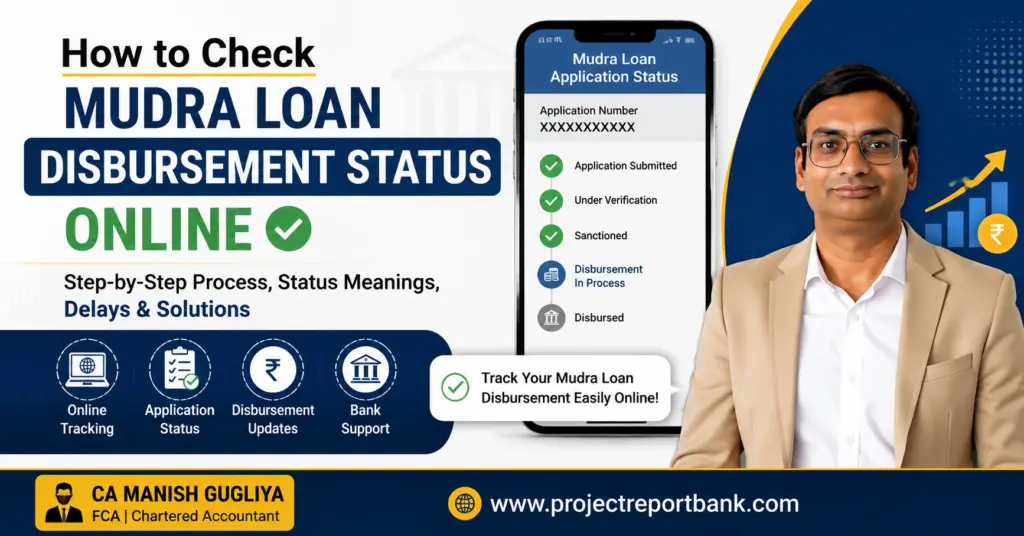
- How to Check Mudra Loan Disbursement Status Online
- Mudra Loan Amount Not Credited After Disbursement Approval: Reasons, Timeline & What You Should Do
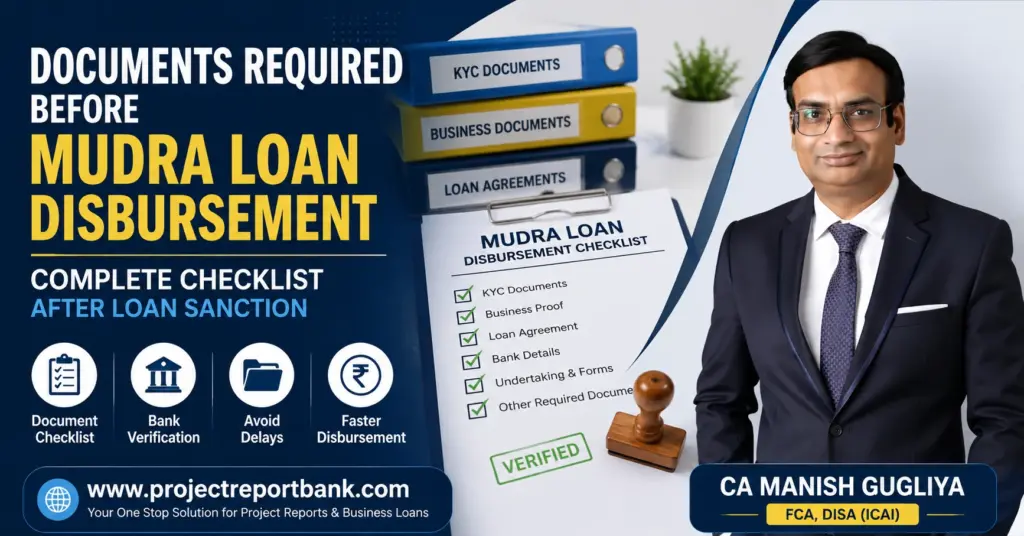
- Documents Required Before Mudra Loan Disbursement: Complete Post‑Sanction Checklist