Key Takeaways
Even after your Pradhan Mantri Mudra Yojana loan is sanctioned, the bank or financial institution will not release funds until every post‑sanction document is verified and signed. Approval of Mudra loans is not automatic and requires evaluation by the lender at each stage.
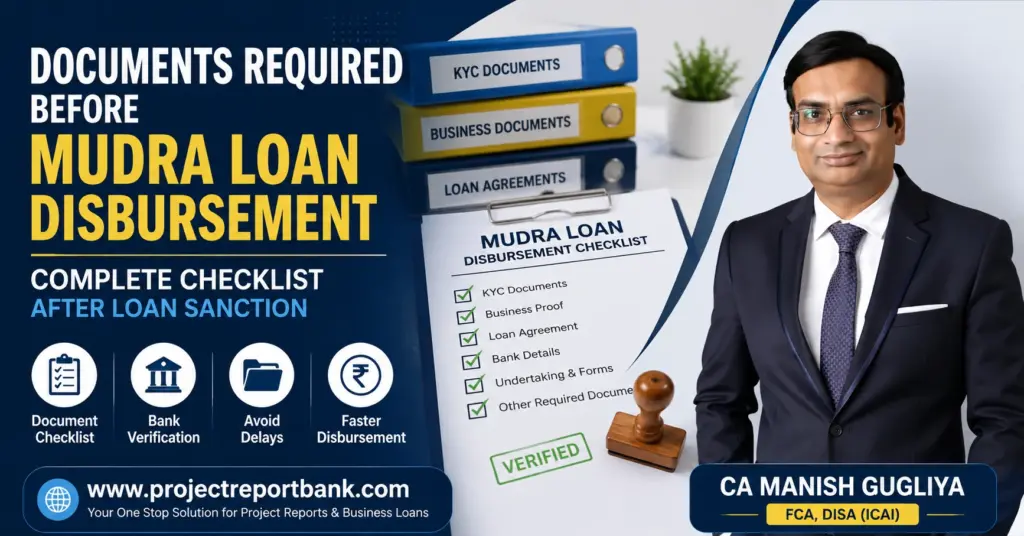
- The core documents required before mudra loan disbursement include sanction letter acceptance, loan agreement, KYC (PAN, Aadhaar card, address proof), business proof, cancelled cheque, ECS/NACH mandate, quotations or invoices, and guarantor papers where applicable.
- No collateral is required for loans up to ₹10 lakh under the mudra scheme.
- Missing or incorrect paperwork is the single biggest reason a mudra loan gets sanctioned but not disbursed.
- Requirements vary for proprietorship, partnership, company structures, and across Shishu, Kishore, and Tarun categories.
- Always carry photocopies and originals, and read the sanction letter carefully before visiting the bank.
This article is written by CA Manish Gugliya (FCA, DISA ICAI) based on 20+ years of banking, MSME finance, and project report experience.
Introduction: What Happens After Your Mudra Loan Is Sanctioned?
“Loan sanctioned” does not mean money lands in your account the same day. There is a separate disbursement stage where the bank must verify final documents, collect signatures on the loan agreement, and confirm every condition in the sanction letter is met. To obtain a mudra loan under PMMY, any Indian citizen with a business plan for a non‑farm enterprise is eligible, but the journey does not end at sanction.
Mudra loans are for micro enterprises engaged in manufacturing, trading, services, or allied agriculture sectors. Eligible businesses include shop owners, vendors, and service providers. Applicants must be aged between 18 to 65 years. Yet in my experience preparing project reports across India, the number one reason for delay is incomplete documents at the post‑sanction stage.
This article focuses strictly on documents required before mudra loan disbursement. For a detailed step‑by‑step explanation of the stages after mudra loan sanction, see our dedicated guide.
Table of Contents
Why Banks Ask for Documents Before Mudra Loan Disbursement
Every bank, non banking financial companies, small finance banks, and micro finance institutions must follow RBI, PMMY, and internal policy guidelines before releasing any loan amount.
- Risk management – Documents confirm the borrower, business, and end‑use of funds are genuine and that the loan can be repaid.
- Regulatory compliance – Banks maintain KYC, loan agreements, and security papers for RBI inspections and PMMY audits. Mudra stands for Micro Units Development and Refinance Agency, and this refinance agency monitors scheme usage closely.
- Identity confirmation – PAN, Aadhaar, and address proof prevent impersonation. Eligibility criteria include not being a defaulter with any financial institution.
- Business verification – Business registration, Udyam, GST, and bank statement records show the unit is a real micro or small business.
- Sanction condition compliance – Sanction letters may mention pre‑disbursement conditions like insurance, quotations, or hypothecation.
- Fraud prevention – Proper documentation stops fake invoices, bogus guarantors, or misuse of working capital.
Understanding the difference between approval, sanction, and disbursement helps you see why each stage has its own documentation.
Complete Documents Required Before Mudra Loan Disbursement (Master Checklist)
Below is the master mudra loan disbursement checklist applicable to most public sector banks, private banks, and NBFCs. Exact formats may vary.
| Document | Mandatory / Optional | Purpose | Who Submits |
|---|---|---|---|
| Sanction letter acceptance (signed) | Mandatory | Confirms borrower agrees to terms | Applicant |
| Loan agreement | Mandatory | Legal contract for the loan | Applicant + guarantor |
| Demand promissory note | Mandatory | Repayment commitment | Applicant |
| PAN card | Mandatory | Identity proof, tax linkage | All signatories |
| Aadhaar card | Mandatory | KYC, identity verification | Applicant |
| Passport‑size photographs (2–4) | Mandatory | Bank records | Applicant + guarantor |
| Address proof (utility bills, passport, voter ID, rent agreement) | Mandatory | Residence confirmation | Applicant |
| Business registration / shop licence | Mandatory | Business proof | Applicant |
| Udyam registration certificate | Recommended | MSME status confirmation | Applicant |
| GST registration (if applicable) | Conditional | Tax compliance | Applicant |
| Partnership deed / MOA‑AOA / LLP agreement | Conditional | Entity verification | Partners / directors |
| Cancelled cheque of operative account | Mandatory | Disbursement and EMI account | Applicant |
| Bank statements (last 6 months) | Mandatory | Cash flow and repayment capacity | Applicant |
| ECS / NACH mandate form | Mandatory | Auto‑debit for EMI | Applicant |
| Income proof (ITR, financials) | Conditional | Income verification for Kishore/Tarun | Applicant |
| Quotation / proforma invoice | Conditional | Equipment or stock purchase proof | Applicant + vendor |
| Vendor GSTIN and bank details | Conditional | Direct payment to vendor | Vendor |
| Guarantor KYC and income proof | Conditional | Guarantee documentation | Guarantor |
| Insurance policy (bank clause) | Conditional | Asset protection | Applicant |
| Other documents per sanction letter | Varies | Specific pre‑disbursement conditions | Applicant |
Identity proof is required, address proof must be submitted, business proof documents are necessary, bank statements for the last six months are required, and income proof is needed for mudra loan applications. Always cross‑check this list against your own sanction letter. Watch for hidden terms in a Mudra loan sanction letter.
Documents Required Based on Business Type
While KYC documents remain common, business‑specific papers change based on the other legal entity structure.
| Business Type | Key Additional Documents |
|---|---|
| Proprietorship | Proprietorship declaration, shop licence, Udyam, GST (if applicable), FSSAI licence for food processing units |
| Partnership Firm | Partnership deed, firm PAN, authorization letter for signing partner, KYC of all partners |
| LLP | LLP agreement, Certificate of Incorporation, LLP PAN, designated partner resolution |
| Private Limited Company | Certificate of Incorporation, Company PAN, MOA/AOA, board resolution, list of directors with DIN |
| Self‑employed Professionals | Professional registration, degree certificate, proof of professional receipts in bank statement |
In all cases, business address proof (rent agreement, property tax receipt, electricity bill) must match the application. Individual borrowers and any other legal entity must ensure consistency across all documents.
Documents Required for Different Mudra Categories: Shishu, Kishore, Tarun
Under the Pradhan Mantri Mudra Yojana, mudra loans support micro enterprises in various sectors, and the documentation intensity scales with loan amount. Mudra loans require credit need up to ₹20 lakh across all categories.
Shishu Category (Up to ₹50,000)
Shishu loans offer up to ₹50,000 for startups. Documentation is minimal: basic KYC, simple business proof or self‑declaration, passbook or bank statement, and a quotation for small equipment. Students above 18 can apply for mudra loans under this category. No educational qualification barrier exists.
Kishore Category (₹50,001 to ₹5 Lakh)
Kishore loans range from ₹50,001 to ₹5 lakh. Banks ask for stronger business proof, Udyam, GST registration, formal quotations, and stock statements for working capital. Business plans or project reports may be required, especially for larger loans. Applications are assessed based on business viability and the applicant’s satisfactory credit track record.
Tarun Category (₹5 Lakh to ₹10 Lakh)
Tarun loans provide ₹5 lakh to ₹10 lakh for established businesses. Documentation resembles standard MSME business loans: audited financials, income tax returns, guarantor documents, and complete hypothecation papers. Tarun Plus loans range from ₹10 lakh to ₹20 lakh for eligible borrowers needing additional financial assistance. Cross‑check with your sample Mudra loan sanction letter.
Documents Required for Equipment or Machinery Purchase Under Mudra Loan
Many Kishore and Tarun loans are sanctioned for machinery, vehicle, or equipment purchase. Banks need vendor documents before releasing the loan amount.
- Detailed quotation on vendor letterhead with GST number, address, and payment terms
- Machine description: brand, model, capacity, price breakdown with GST
- For vehicles: RC in borrower’s name, insurance with hypothecation marked in bank’s favour
- Banks often pay the vendor directly rather than crediting the borrower’s account, protecting capital assets and assets created from the funding
Any change in vendor or major price deviation must be reported before disbursement.
Documents Required for Working Capital Mudra Loans
Working capital loans have slightly different post‑sanction requirements. Key documents include:
- Stock and debtor statement
- List of major suppliers and customers
- Rent agreement or ownership proof of business premises
- Recent purchase and sales bills
- Past 6–12 months bank statement showing cash flow patterns
Banks use this data to understand seasonality and repayment capacity. As a CA, I suggest carrying a simple sheet with expected monthly sales, purchases, and expenses. Current account forms and cheque book requests may also need completion.
Common Reasons Banks Reject or Return Documents Before Disbursement
Even genuine borrowers face delays from avoidable issues:
- KYC problems: signature mismatch, PAN or Aadhaar spelling differences, expired ID proofs, unreadable photocopies
- Business document issues: business name on quotation not matching sanction letter, expired licences, Udyam or GST not updated
- Paperwork errors: unsigned loan agreements, missing pages, incomplete ECS/NACH mandate, unfilled guarantor sections
Real example: A shopkeeper’s disbursement was held up because the rent agreement name differed from Aadhaar. A small manufacturer’s payment was stopped because the machinery invoice deviated significantly from the quoted price. If your mudra loan is sanctioned but not disbursed, document issues are likely the reason.
Common Mistakes Applicants Make
- Visiting the bank without reading the sanction letter
- Assuming application‑stage documents are sufficient for disbursement
- Carrying only photocopies without originals
- Signing documents without checking the loan amount or interest rates
- Changing the proposed activity, vendor, or location after sanction without informing the bank
- Not taking acknowledgement of documents submitted
Practical Checklist Before Visiting the Bank
Personal KYC: Original PAN, Aadhaar, one additional address proof, 4–6 passport photos, photocopies of all.
Business Proof: Udyam, GST, shop licence, partnership deed or incorporation papers, rent agreement or ownership proof.
Banking & Repayment: Latest bank statements, cancelled cheque, filled ECS/NACH mandate.
Loan‑Specific: Quotations/invoices, vendor details, insurance quotations, guarantor’s KYC and income proof, any paper mentioned in the sanction letter’s special conditions.
Carry a transparent folder, stapler, pen, and soft copies on your phone.
What Happens After You Submit All Documents?
After submission, the bank performs document scrutiny, KYC verification in their system, and sometimes telephonic or physical verification of the business. The loan account is created under Pradhan Mantri Mudra Yojana with the correct category tag. Once everything is in order, a disbursement voucher is prepared and the beneficiary micro unit receives the funds – either in the borrower’s account or directly to the vendor. For details on timelines, see the Mudra loan processing stage timeline.
How Long Does Final Document Verification Take?
From experience, Shishu loans process within 1–3 working days. Kishore and Tarun loans take 5–10 working days depending on branch workload. Delays happen when documents are submitted in parts or sanction conditions remain pending. Note the exact date of complete submission and ask for a realistic timeline. If your loan is stuck, read about Mudra loan disbursement delay causes and remedies.
How to Speed Up Mudra Loan Disbursement: Practical CA Tips
- Read the sanction letter the same day and list all pre‑disbursement conditions
- Prepare all documents in one go – banks hate piecemeal submissions
- Visit during non‑rush hours and ask for the specific Mudra loan officer
- Carry two sets of photocopies plus originals
- Align PAN, Aadhaar, and business documents (same spelling, updated address) before applying
- Agree with vendors on final price and GST before sanction
- Maintain polite written communication summarising documents submitted
- Request written confirmation of completeness from the branch
- Ensure your bank account has the necessary skills for digital banking (net banking, UPI) as some banks require it
- If you have successfully repaid previous loans or have previous loans with the same bank, mention it – a satisfactory credit track record helps
Documents That Usually Cause Delays
Not all documents are equally sensitive. A few cause most hold‑ups:
- Aadhaar mismatches – old address or name changes without linkage documents
- Vendor documents – quotations without GST numbers, invoices not in borrower’s name, price deviations from sanctioned amount
- Business proof – waiting for Udyam or slow GST registration
- Guarantor issues – guarantor unavailable to sign or withdraws at last moment
- Security documents – mortgage papers for Tarun loans need legal opinion, valuation, and registration time
Small businesses should plan for these well in advance. The scheme has been availed by crores of entrepreneurs across India – over ₹40.07 lakh crore has been disbursed across 57+ crore accounts – so the process works smoothly when documentation is complete.
Whether you require funds to expand, buy trading stock, or invest in services equipment, keeping your documents ready is the fastest path from sanction to credit in your account. Read the sanction letter carefully, submit complete paperwork in one visit, and follow up politely if verification takes longer than expected. Explore our complete Mudra Loan Disbursement Problems library on ProjectReportBank for deeper guidance on every stage of your mudra yojana journey.

Frequently Asked Questions
Can the bank ask for additional documents even after issuing the sanction letter?
Yes. Banks can seek additional documents to complete KYC, verify the business, or comply with government and PMMY rules. However, they cannot keep changing conditions without reason. If this happens, ask for written clarification or escalate to the branch manager. The loan extended under the mudra scheme must follow a transparent process.
Is GST registration compulsory for Mudra loan disbursement?
GST is not mandatory for all applicants. It depends on your turnover threshold and bank policy. Many micro units in services or trading with turnover below the GST limit can qualify without it. Your bank will clarify based on the proposed activity and knowledge of your business.
Can the bank reject disbursement after sanction due to document issues?
Yes. If critical documents cannot be furnished or major discrepancies surface during final verification, the bank can withhold or even cancel disbursement. Ownership disputes, fraud indicators, or discovery that the applicant is a defaulter with any financial institution are common triggers. This is why the finance and documentation stage matters as much as the application itself.
Do I need a project report for Shishu loans?
Typically no. Shishu loans (up to ₹50,000) rarely need a formal business plan or project report. A simple description of the proposed activity is usually sufficient. For Kishore and Tarun categories, a project report strengthens your case and may be mandatory depending on the bank’s form requirements.
Can students apply for Mudra loans for a startup?
Students above 18 can apply for mudra loans if they have a viable business idea for eligible non‑farm activities. No specific educational qualification is required. The application is assessed based on the business plan’s feasibility, not academic credentials. The funding is available through any participating bank, NBFC, or financial institution across India.
- Can You Delay Accepting Mudra Loan Disbursement? Everything Borrowers Should Know

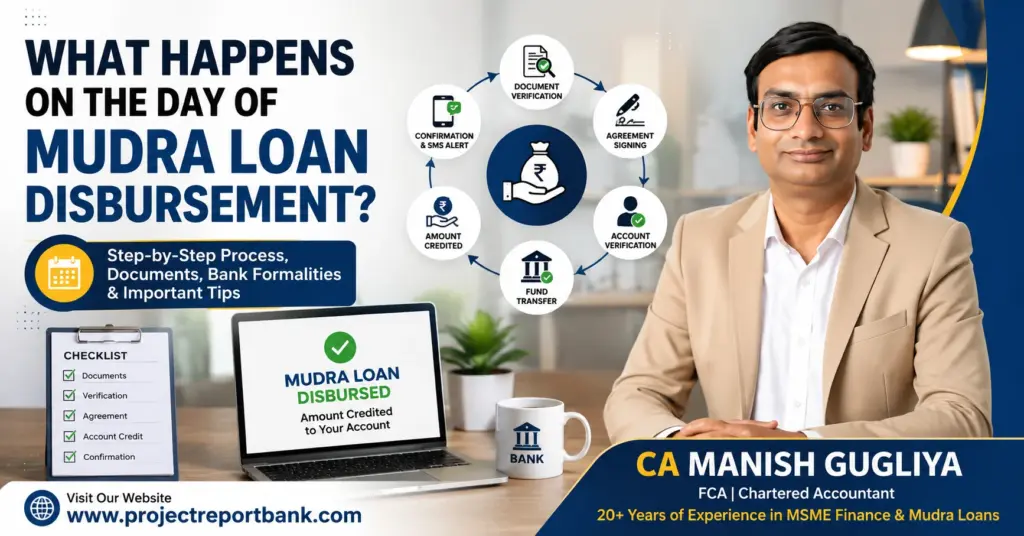
- What Happens on Mudra Loan Disbursement Day? (Practical Guide by CA Manish Gugliya)
- Partial Mudra Loan Disbursement: Reasons and Next Steps
- Can Banks Release Mudra Loan in Installments? (Practical Guide by CA Manish Gugliya)
- Does the Bank Verify Documents Again Before Disbursement?
- Can a Sanctioned Mudra Loan Be Cancelled Before Disbursement? (Practical Guide by CA Manish Gugliya)
- How to Check Mudra Loan Disbursement Status Online
- Mudra Loan Amount Not Credited After Disbursement Approval: Reasons, Timeline & What You Should Do
- Documents Required Before Mudra Loan Disbursement: Complete Post‑Sanction Checklist