Key Takeaways
- The typical processing time for a Mudra loan ranges from 7 to 21 working days when your documents are complete and there are no major issues with your credit profile or business verification.
- Stage-wise processing includes application submission, document check, CIBIL and financial assessment, business verification, credit appraisal, branch and regional approvals, sanction, and disbursement.
- Mudra loan applications are processed within a few days for simple Shishu loans, while Kishore and Tarun categories need more time due to deeper financial checks and site visits.
- Common delays happen because of missing financial documents, weak CIBIL scores, new business verification challenges, festival or public holidays, and heavy branch workload.
- With a proper project report, clear banking history, and full documentation, you can significantly reduce your mudra loan processing time and avoid unnecessary back-and-forth with the bank.
Introduction: Why Mudra Loan Processing Time Matters for Small Businesses
In my 20-plus years as a Chartered Accountant helping small business owners with finance, I have seen the same worry hundreds of times. A shopkeeper, a food processing unit owner, or a transport vehicles operator submits a Mudra loan application and then spends every next day wondering: “When will my loan come?”
Let me explain this clearly. A Mudra loan under the Pradhan Mantri Mudra Yojana (PMMY) is a collateral free loans scheme for non-farm, non corporate small businesses and micro units. MUDRA loans are classified into Shishu, Kishore, Tarun, and Tarun Plus. Shishu loans offer upto rs 50,000 for startups and small vendors. Kishore loans range from Rs 50,001 to Rs 5 lakh for growing businesses. Tarun loans provide Rs 5 lakh to Rs 10 lakh for established businesses. Tarun Plus loans offer Rs 10 lakh to Rs 20 lakh for expanded businesses – available to those who have successfully repaid previous loans in the Tarun category.
Loans under MUDRA are available for micro and small businesses, but no bank or financial institution can disburse them instantly. Every application must pass through multiple verification and approval stages. Processing time differs between banks, branches, and officers due to workload, holidays, and risk perception – but the basic stage-wise journey remains similar.
This article gives you the complete mudra loan processing time breakdown, realistic expectations, delay reasons, and practical tips to speed up your case.

Table of Contents
What You’ll Learn in This Mudra Loan Processing Time Guide
Here is a quick checklist of what this guide covers for busy entrepreneurs:
- ✔ Average mudra loan approval timeline from start to finish
- ✔ Stage-wise processing duration for each bank step
- ✔ Normal versus abnormal delays and what they mean
- ✔ What each bank stage actually does to your file
- ✔ How to track your mudra loan processing status online
- ✔ How to cut down waiting time with smart preparation
- ✔ Differences between existing and new business cases
- ✔ Tables, examples, and expert tips from real mantri mudra yojana pmmy loan consultancy
Whether you run a small enterprise, a micro unit, or are starting a proposed activity under the mudra scheme, this guide is your reference point.
Quick Overview Table: Stage-Wise Mudra Loan Processing Time
Here is a concise table summarizing each processing stage. Use this as your quick reference for realistic expectations.
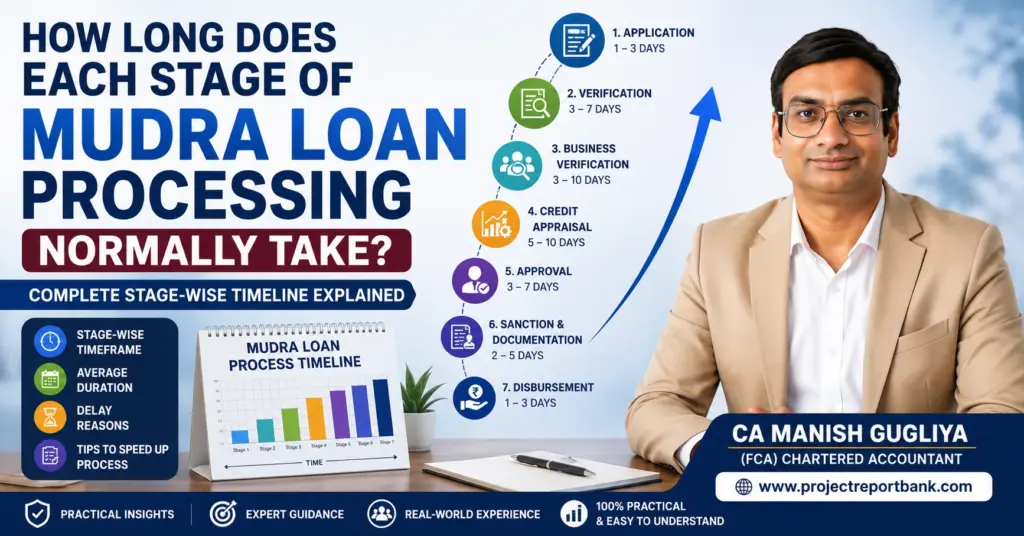
| Stage | Average Time (Working Days) | Normal Waiting Period | What Bank Does | What Applicant Should Do |
|---|---|---|---|---|
| Application Submission | Same day – 1 day | Immediate to 1 day | Registers application, checks basic eligibility criteria, assigns reference number | Fill form carefully, mention clear business purpose |
| Document Verification | 1–3 days (Shishu), 2–5 days (Kishore/Tarun) | Up to 5 days | Verifies KYC, business registration, bank statements, other documents | Submit complete documents together in proper order |
| CIBIL & Financial Assessment | 2–4 days (clean record), 5–7 days if issues | Up to 7 days | Pulls credit report, checks existing EMIs, reviews cash flow | Check your own CIBIL report beforehand, clear small overdues |
| Business Verification | 2–5 days (phone), up to 7 days (site visit) | Up to 10 days | Calls borrower, visits business premises, verifies rent agreement | Keep phone on, ensure business address is accurate |
| Credit Appraisal | 3–7 days | Up to 10 days | Reviews project report, financial viability, repayment capacity | Provide realistic business plan and financial projections |
| Branch Manager Approval | 2–5 days | Up to 7 days | Final branch-level risk review and recommendation | Be available to meet manager, carry original documents |
| Regional Office (if needed) | 3–10 days | Up to 14 days | Higher-level policy compliance, exposure checks | Follow up politely with branch, provide extra documents quickly |
| Sanction & Documentation | 1–3 days | Up to 5 days | Issues sanction letter, executes loan agreement | Read all terms carefully, sign promptly |
| Disbursement | 1–3 days | Up to 5 days | Credits loan amount to account or pays supplier | Ensure account is active, all conditions met |
Shishu loans typically take 7 to 10 days for processing. Kishore, Tarun, and Tarun Plus loans generally take 7 to 15 working days. Collateral is not required for loans up to Rs 10 lakh under the PMMY guidelines.
Timelines can stretch beyond 30 days if you have weak CIBIL, incomplete documents, or your file needs regional office clearance. Processing during festival seasons can also add extra days.
Understanding the Complete Mudra Loan Processing Journey
Every bank follows a similar step-by-step mudra loan processing journey, whether your loan is namely shishu, Kishore, or Tarun. Here is the flow:
Application Submitted → Document Verification → CIBIL & Financial Assessment → Business Verification → Credit Appraisal → Branch Manager Approval → Regional Office (if applicable) → Sanction → Documentation → Disbursement
Each step has a genuine purpose. The bank needs to confirm your identity proof, verify your business exists, check that you can repay, and ensure the loan amount matches your actual need. For individual borrowers and any other legal entity like a partnership or proprietorship, this loan process remains broadly the same across commercial banks, small finance banks, and micro finance institutions.
Detailed articles exist for specific stages like credit appraisal, branch manager approval, and disbursement delay – explore those if you want deeper guidance on any single stage.
Stage 1 – Application Submission
This is the day you submit your Mudra loan form and basic documents to the bank or apply online through a portal like JanSamarth. Digital application channels can speed up loan processing times significantly for existing customers.
Typical time: Same day to 1 working day.
The bank checks completeness of form, basic eligibility under Pradhan Mantri Mudra Yojana, and whether the requested maximum amount falls into the correct category – shishu kishore or Tarun.
Common mistakes that slow things down:
- Incomplete form or mismatched signatures
- Wrong contact details or unclear business purpose
- Requesting a Mudra loan for personal use instead of business purposes
- Not mentioning whether you need a term loan or working capital loans
Tip: Write a clear one-line description of your business activity. For Kishore and Tarun loans, attach a brief project summary showing the proposed activity, funding requirement, and expected income generating capacity.
Stage 2 – Initial Document Verification
Once the application is accepted, the bank verifies KYC, business proof, and basic financial documents. Shishu loans require minimal documentation and quicker processing – usually 1 to 3 working days. Kishore and Tarun cases take 2 to 5 working days.
Documents required typically include: Aadhaar, PAN, driver’s licence or other identity proof, address proof, business registration (GST, Udyam, shop licence), bank statements for 6-12 months, quotations or invoices, and for loans above rs 50,000, a simple project report.
Completeness of documentation influences loan approval duration directly. Common issues that cause delays: mismatched addresses between Aadhaar and rent agreement, expired licences, unclear income proofs, or missing bank statements.
MUDRA loans are processed quickly with minimal documentation required – but only if you submit everything correctly the first time. Prepare a neat “Mudra Loan File” with all documents in order. Using a professionally prepared project report can reduce back-and-forth at this stage.
Stage 3 – CIBIL & Financial Assessment
After documents are verified, the bank runs credit bureau checks as part of the loan processing, and these affect speed. This stage usually takes 2 to 4 working days with a clean record. If there are old overdues or disputes, it can stretch to 7 days or more.
Your credit score reflects your repayment history. The bank looks at existing EMIs, overdue accounts, written-off unsecured loans, and whether you have a satisfactory credit track record. Existing relationships with lenders can expedite verification processes because your banking behaviour is already visible.
The bank also reviews recent bank statements to assess regular turnover, cheque returns, and whether the proposed EMI seems affordable compared to your current cash flow.
How to avoid CIBIL delays:
- Check your CIBIL report before applying
- Clear small overdues and update records
- Maintain clean banking for at least 6 months
- Keep phone and email updated with credit bureaus
If your status shows “pending CIBIL verification,” refer to the detailed guide on CIBIL-related delays for step-by-step help.
Stage 4 – Business Verification (Telephonic & Physical)
This stage confirms whether your business actually exists – especially important for micro enterprises engaged in new ventures or home-based setups. MUDRA loans support various business activities including manufacturing and services, and each type gets verified differently.
Timeline: 2 to 5 working days for telephonic checks, up to 7 working days if physical site visit or landlord confirmation is needed.
The bank or an outsourced agency may call you, visit your shop or office, verify signage, ask neighbours, and check ownership or rental papers. For manufacturing units, they may check machinery. For food processing businesses, they may verify raw material storage.
Tips to avoid delays:
- Keep your phone switched on and answer unknown calls
- Ensure your business address matches documents, with a clear landmark
- Keep basic business setup ready – boards, invoices, raw material
- Inform staff or family about possible bank visits
- Have your rent agreement and electricity bills handy
For new business verification, the process can take longer since there is no track record to check.
Stage 5 – Credit Appraisal and Internal Assessment
Credit appraisal is where the bank decides whether your business plan is financially viable. The assessor reviews your project report, projected sales and profit, cash flow projections, and whether the loan amount matches realistic business needs. Your repayment capacity is assessed based on projected income minus expenses.
Typical duration: 3 to 7 working days for most small-ticket cases. Longer if clarifications are needed.
Well-prepared project reports and CMA data help reduce this stage significantly. The bank looks at whether assets created from the loan will generate enough revenue to service EMIs comfortably.
Practical tips:
- Avoid overestimating sales – banks spot inflated numbers quickly
- Keep expenses realistic and match bank statements with projected turnover
- Be ready to explain assumptions if the bank calls
- A professional project report from a CA or service like ProjectReportBank.com makes a real difference
For deeper insights, read the guide on Mudra loan under credit appraisal.
Stage 6 – Branch Manager Approval
After credit appraisal, the file moves to the Branch Manager for final branch-level decision. This is a critical stage in the mudra loan approval process.
Duration: 2 to 5 working days. Can be longer if the manager is on leave or the branch is overloaded with applications.
The BM reviews risk level, borrower reputation, document consistency, and whether the proposal fits PMMY norms including credit guarantee coverage under CGFMU. For a beneficiary micro unit, the BM also checks sector exposure limits.
Suggestions: Maintain good relations with the branch, be available if called, carry all original documents, and be transparent about past financial issues. If your file is stuck, the branch manager approval article explains what you can do.
Stage 7 – Regional Office Approval (When Required)
Not every Mudra loan goes to the Regional Office. This usually happens for Tarun category loans near the upper limit, special risk cases, or per specific bank policies. MUDRA stands for Micro Units Development and Refinance Agency, and the refinance agency framework requires banks to follow internal risk hierarchies.
Duration: 3 to 10 working days after branch recommendation.
If your mudra loan processing status shows “file sent to regional office,” it usually means the branch has recommended your case positively. During this time, follow up politely with the branch, provide any extra documents quickly, and avoid repeated pressure calls. More details are in the regional office guide.
Stage 8 – Sanction Letter and Documentation
Once approvals are done, the bank issues a sanction letter mentioning loan amount, interest rate, tenure, EMI, and conditions. MUDRA loans offer collateral-free financing up to Rs 20 lakh. Interest rates for MUDRA loans are generally lower than traditional business loans, and there is usually a small processing fee.
Timeline: 1 to 3 working days for the sanction letter, plus 1 to 2 days for document execution.
Documents at this stage: Loan agreement, demand promissory note, hypothecation agreement for stock or machinery (covering loans for capital assets), ECS mandate forms, and sometimes post-dated cheques.
Read every term carefully. Check whether the interest rate is floating or fixed, whether any educational qualification or necessary skills documentation is referenced, and ensure the loan extended matches what was promised. Keep copies of everything.
Stage 9 – Loan Disbursement and Account Credit
This is the final step where the approved loan amount is credited to your account or paid directly to suppliers. For working capital loans, disbursement goes to your current account. For term loan purposes like machinery or transport vehicles, payment may go directly to the supplier.
Normal time: 1 to 3 working days after documentation. In some small Shishu cases, disbursement can happen the same day.
Common disbursement delay reasons:
- Pending internal bank approval entry or system holidays
- KYC mismatch between application and bank records
- Insurance formalities not completed
- Margin deposit not yet made as per sanction conditions
If your loan is sanctioned but money has not come, check with the branch and refer to the disbursement delay guide for specific steps.
Overall Mudra Loan Processing Timeline: Typical Scenarios
For most eligible borrowers with complete files, total mudra loan processing time from application to disbursement ranges between 7 and 21 working days.
| Situation | Expected Timeline |
|---|---|
| Existing business, Shishu loan, perfect documents | 5–10 working days |
| New small business, Shishu, basic setup | 7–14 working days |
| Kishore/Tarun with project report, existing account | 10–20 working days |
| Minor CIBIL issues or incomplete documents | 15–25 working days |
| File sent to regional office | 20–30+ working days |
| Processing during festival season or year-end | Add 5–10 extra days |
MUDRA loans are typically approved quickly due to being collateral-free, but RBI and PMMY guidelines encourage – not guarantee – timely processing. Plan your business purchases assuming a realistic 3 to 4 week window for Kishore and Tarun loans.
Why Mudra Loan Processing Sometimes Takes Longer Than Expected
Some delay is normal. But very long silence usually points to specific issues:
- Incomplete or mismatched documents requiring multiple follow-ups
- Weak or disputed CIBIL report with previous loans showing overdue
- Multiple running unsecured loans reducing repayment capacity
- New business risk where no track record exists
- Site verification challenges in remote or shared premises
- Heavy branch workload or staff shortages
- Festival and public holiday periods, March year-end rush
- Incorrect application details or wrong loan category selection
Approval time may vary based on document completeness alone – I have seen cases where a simple rent agreement mismatch added 7 to 10 extra days. Each stage – credit appraisal, internal bank approval, regional office clearance – has its own delay pattern.
How to Reduce Mudra Loan Processing Time: Practical Tips
Here are actionable tips to speed up your mudra loan application processing time:
- Prepare all documents required in one complete set before visiting the bank
- Get your CIBIL report checked and clear small overdues at least 30 days before applying
- Maintain clean banking – no cheque bounces – for at least 6 months
- Choose a bank where you already have an active account; existing relationships help
- Get Udyam registration for your MSME status before applying
- Have a professional project report ready for Kishore and Tarun category loans
- Write a clear business plan showing realistic sales, expenses, and repayment capacity
- Keep your phone and email active; respond to bank calls within hours
- Ensure your rent agreement, electricity bill, and business registration have matching addresses
- Carry original documents along with photocopies in an organized file
- Be polite but consistent in follow-ups – visit the branch weekly if needed
- Send written email confirmations after every verbal discussion
- Keep a diary of every visit, document submitted, and person you spoke with
- If you need both term loan and working capital, clarify this upfront
- Avoid applying at multiple banks simultaneously – it creates confusion in credit reports
Applicant Checklist Before Applying for a Mudra Loan
Use this as your pre-application checklist:
Personal Documents:
- Aadhaar card, PAN card, driver’s licence or other identity proof
- Address proof matching business address
- Passport-size photographs
Business Documents:
- Business registration – GST, Udyam, shop licence, or any other legal entity proof
- Last 6 to 12 months bank statements
- Quotations from suppliers or invoices for machinery
- Rent agreement or ownership proof for business premises
Financial Readiness:
- CIBIL report checked and clean
- List of all existing EMIs and previous loans
- Realistic EMI capacity estimate
- Business plan or project report matching loan amount
Eligibility Checks:
- Applicants must be aged between 18 to 65 years
- Business must be non-farm (MUDRA loans are not available for agricultural crop loans)
- Proprietorship and partnership firms can apply for MUDRA loans, along with any legal entity
- Only non-farm small businesses are eligible for MUDRA loans
- Loan amount must match the correct category – Shishu, Kishore, Tarun, or Tarun Plus
- Funds must be used for business purposes only, supporting employment creation and income generating activities
Common Myths About Mudra Loan Processing Time (Myth vs Fact)
| Myth | Fact |
|---|---|
| All Mudra loans are sanctioned within 3 days | Only simple Shishu cases via STP may be very fast. Normal Kishore and Tarun processing takes 1-3 weeks. |
| No documents are needed for Mudra loans | Every Mudra loan requires KYC, business proof, and bank statements at minimum. |
| CIBIL is not checked for Mudra loans | Credit bureau checks are part of every Mudra loan process and directly affect speed. |
| Applying at 5 banks at once speeds up approval | Multiple applications show up in credit reports and can actually slow or hurt your chances. |
| Mudra loan is a government subsidy or grant | Pradhan Mantri Mudra Yojana provides financial assistance through loans, not grants. Every loan must be repaid with interest. |
| Rs 50,000 Shishu loans need no verification | Even small shishu loans go through basic KYC and credit checks. The process is simpler, not nonexistent. |
| Any business can get a Mudra loan | Only micro enterprises in non-farm sectors are eligible. Agricultural crop loans are excluded from the mudra scheme. |
Expert Insights from CA Manish Gugliya on Planning Your Mudra Loan Timeline
Here is my honest advice after helping hundreds of borrowers through the mudra loan processing journey:
Start early. Begin your preparation 30 to 45 days before you actually need funds. Arrange documents, check CIBIL, and get your project report ready during the next phase of planning – before you walk into the bank.
Choose the right category. Do not apply for Rs 5 lakh if you only need Rs 2 lakh. Over-borrowing attracts extra scrutiny and slows processing. Match your loan amount to your real business need, whether it is for working capital, capital assets, or both.
A good project report is not just for the bank. It helps you plan stock purchases, machinery timelines, and cash flow during the waiting period. At ProjectReportBank.com, we prepare reports specifically designed for Mudra and MSME loans with realistic projections that banks trust.
Example: A small manufacturer applying for Rs 3 lakh under Kishore category should arrange documents by Week 1, approach the bank by Week 2, expect verification by Week 3, and plan supplier payments for Week 4 or 5. This way, even if the loan takes 15 to 20 working days, business plans do not get disrupted.
Treat the mudra loan processing journey as a partnership with the bank – not a one-sided request. When you come prepared, the bank officer’s job becomes easier, and your file moves faster.

Frequently Asked Questions (FAQs) on Mudra Loan Processing Time
Can I speed up Mudra loan processing by applying through multiple banks at the same time?
No. Applying at multiple banks simultaneously creates multiple credit enquiries on your CIBIL report, which can lower your score and raise red flags. Apply at one bank or financial institution where you have an existing relationship. If rejected, wait for the formal rejection letter before approaching another lender.
Does applying through JanSamarth portal make processing faster than visiting a branch?
For Shishu category loans, digital platforms like JanSamarth can speed up initial processing through Straight Through Processing. However, for Kishore and Tarun loans, physical document verification and site visits are still needed. The portal helps with tracking your mudra loan processing status but does not eliminate all manual stages.
Is Mudra loan processing time different for Shishu compared to Kishore and Tarun loans?
Yes. Shishu loans typically take 7 to 10 days since they involve smaller amounts and simpler checks. Kishore, Tarun, and Tarun Plus loans generally take 7 to 15 working days or more because they require detailed project reports, business verification, and sometimes regional office approval.
What should I do if my Mudra loan is taking more than 30 days without any update?
Visit the branch and politely ask which specific stage your file is at. Get a written status update. If you get no satisfactory response, you can escalate to the bank’s nodal officer, write to the Lead District Manager, or file a complaint on the RBI’s banking ombudsman portal. Understanding the reasons for Mudra loan rejection can also help you check if there is an underlying issue.
Does having an existing bank account really make a difference in processing time?
Absolutely. When you are already a customer of the bank, your KYC is on file, your transaction history is visible, and the bank can assess your cash flow without requesting separate bank statements. This alone can save 3 to 5 working days in early processing stages.
Conclusion: Plan Your Business Keeping Realistic Mudra Loan Timelines in Mind
Every stage of the mudra loan processing time – from application and verification to CIBIL checks, business verification, credit appraisal, approvals, and disbursement – exists for a genuine reason and cannot be skipped by any bank.
Normal processing takes 7 to 21 working days for well-prepared files. Delays up to 30 days can occur due to document issues, verification challenges, or bank workload, especially for new businesses or during holiday seasons.
The best things you can do: submit complete documents, make honest declarations, respond quickly to bank queries, prepare a realistic project report, and follow up patiently but consistently.
If you are planning to apply for a Mudra loan, start your preparation today. Get your documents in order, check your credit report, and if you need a professional project report or CMA data, visit ProjectReportBank.com to give your application the strongest possible foundation.
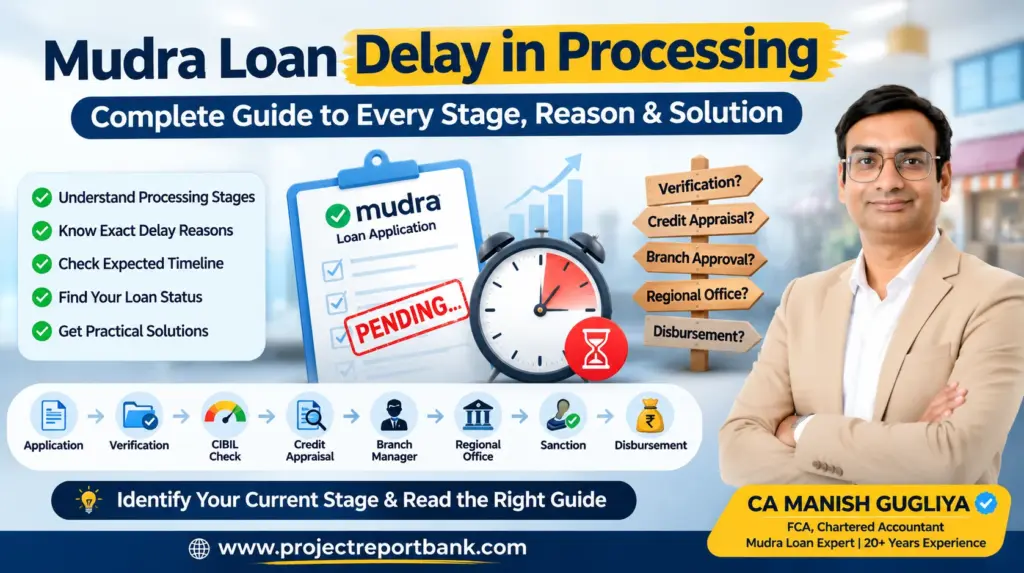
- Mudra Loan Delay in Processing: Complete Guide to Every Stage, Reason & Solution

- Mudra Loan Processing Time: Stage-Wise Timeline from Application to Disbursement

- Can Festivals, Holidays or Financial Year-End Delay Mudra Loan Processing?

- Mudra Loan Pending Due to Internal Bank Approval: What Should You Do?

- Mudra Loan Sanctioned but Disbursement Delayed: Reasons & Solutions (By CA Manish Gugliya)

- Why Is My Mudra Loan Still Under Credit Appraisal?

- Mudra Loan Pending After Site Inspection: What It Really Means (From a Banker’s Desk)

- Mudra Loan File Sent to Regional Office: What Happens Next?

- Why Is My Mudra Loan Stuck at Branch Manager Approval?