Key Takeaways
- “Mudra loan sanctioned” means the bank has approved your loan in principle, but money is credited only after you complete post-sanction formalities like document submission, agreement signing, and verification.
- The usual journey after sanction is: read sanction letter → accept offer → submit balance documents → sign Mudra loan agreement → final verification → disbursement into your account or directly to vendors.
- Typical disbursement timelines range from 1–3 working days for Shishu loans to 7–15 working days for Tarun loans, depending on documentation readiness and branch workload.
- Delays usually happen because of missing papers, bank holidays, internal approvals, or technical system issues – not because your loan has been cancelled.
- After receiving funds, use money only for business purposes, keep invoices and bank statements, track EMI dates, and avoid cash diversion for personal use.
Introduction: Sanction Is Not the End, It Is the Beginning
Let me share something I see almost every week in my practice. A small shopkeeper in Jaipur gets an SMS saying his Mudra loan under Pradhan Mantri Mudra Yojana (PMMY) is “sanctioned.” He tells his family, calls his supplier, and waits for the money. Three days pass. No credit in his account. He panics. He calls the branch. Nobody gives a clear answer. He starts thinking the bank is cheating him.
This confusion is extremely common among first-time borrowers.
Here is the simple truth: when a bank says your loan is “sanctioned,” it means they have agreed in writing to give you a certain loan amount – say ₹3,00,000 under the Kishore category – at a fixed interest rate and tenure, subject to certain conditions. But the actual transfer of money into your current or savings account, which is called “disbursement,” has not happened yet.
Sanction is the promise on paper. Disbursement is the actual money.
MUDRA Yojana offers collateral free loans up to ₹20 lakh to support micro and small enterprises engaged in non-farm small businesses. It encourages entrepreneurship among small business owners, including shop owners, service providers, traders, and manufacturers. Once a Pradhan Mantri MUDRA Yojana loan is sanctioned, operational steps follow – and that is exactly what this article covers.
In this guide, you will learn every stage after Mudra loan sanction, documents required after sanction, how long disbursement usually takes, what to do if there is delay, and how to use the Mudra loan correctly after the amount is credited.
Everything I share here is from practical banking and consultancy experience of handling hundreds of Mudra cases for small businesses across India over the last 20 years.

Table of Contents
What Does “Mudra Loan Sanctioned” Actually Mean?
When your Mudra loan is sanctioned, it means the bank’s credit officer and sanctioning authority have completed appraisal and approved your proposal. They have checked your eligibility criteria, basic documents, business viability (often through a project report or business plan), CIBIL score, and compliance with PMMY guidelines.
MUDRA loans are classified into three categories: Shishu (loans upto rs 50,000 for startups and small vendors), Kishore (₹50,000 to ₹5 lakh for growing businesses), and Tarun (₹5 lakh to ₹10 lakh for established businesses). Your sanction falls under one of these categories – namely shishu, Kishore, or Tarun – depending on your credit needs and loan amount.
Sanction can be of two types. A clean sanction means all conditions are already satisfied. A conditional sanction means some requirements are still pending – like submitting GST registration or a final quotation from the vendor.
Even after sanction, the bank can legally hold or cancel the sanction if conditions are not fulfilled or adverse information appears. I explain this in detail later in the article.
Here is a simple comparison to understand where sanction fits in the loan process:
| Stage | Meaning |
|---|---|
| Application Submitted | You have applied; bank is reviewing |
| Internal Approval | Bank officer has recommended; awaiting authority sign-off |
| Sanction | Bank has formally approved your loan with terms and conditions |
| Disbursement | Actual money is transferred to your account or vendor |
| Loan Account Activated | EMI schedule starts; repayment begins |
For a deeper explanation of each stage, read this guide on the difference between approval, sanction and disbursement.
Complete Journey After Mudra Loan Sanction
After sanction, there is a clear sequence of steps before money reaches your account. This journey is broadly similar across commercial banks, small finance banks, NBFCs, and micro finance institutions – whether you are banking with SBI, PNB, Bank of Baroda, or any other lender.
Here is the flow:
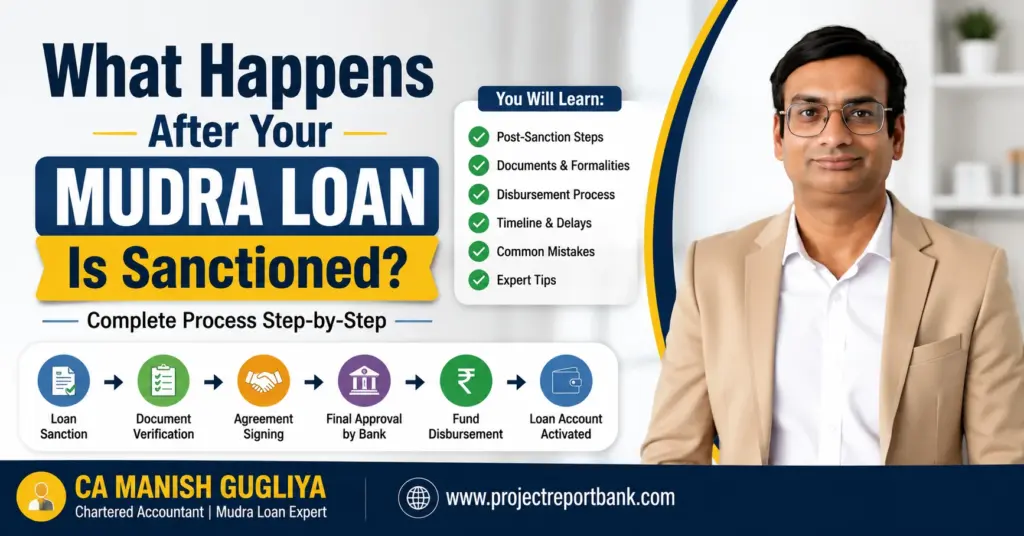
Sanction → Borrower Acceptance → Balance Documents → Loan Agreement Signing → Account Formalities → Insurance/Hypothecation (if any) → Final Verification → Disbursement Approval → Fund Transfer → Loan Account Activated
Let me explain each stage briefly:
- Acceptance by borrower: Sign the sanction letter or acceptance form within the validity period (usually 30–90 days).
- Document verification: Submit remaining KYC, business proof, quotations, and any pending papers.
- Loan agreement signing: Execute the legal contract covering EMI schedule, interest rate, security, and default clauses.
- Account creation: Bank opens a loan account; sometimes a new current account is opened for business routing.
- Insurance (optional): If you voluntarily opt for life or asset insurance. Be aware – it should never be forced on you.
- Hypothecation formalities: For machinery, transport vehicles, or equipment, hypothecation and registration may be required before disbursement.
- Disbursement approval and fund transfer: Branch manager or credit officer gives final clearance and money is released.
For small Shishu loans (say ₹30,000 working capital for a tea stall), steps are faster and simpler. MUDRA loans are processed quickly with minimal documentation at this level. For larger Tarun loans (₹8,00,000 for machinery), formalities and verifications are more detailed and may involve site visits.
For a day-wise expected timeline from application to disbursement, refer to this Mudra loan processing stage timeline guide.
Step 1 – Read the Mudra Loan Sanction Letter Carefully
Most borrowers either do not read the sanction letter fully or do not understand the technical terms. This later causes disputes about interest rate, EMI, and conditions.
A formal sanction letter details the approved loan amount, category, interest rate, and repayment schedule. Here is what you must check:
- Sanctioned amount: For example, ₹2,00,000 Shishu, ₹4,50,000 Kishore, or ₹8,00,000 Tarun. Tarun Plus loans provide ₹10 lakh to ₹20 lakh for expanded businesses – verify your category.
- Interest rate: Fixed or floating. For example, 9.05% p.a. linked to MCLR or RLLR plus a spread. Rate differs from bank to bank.
- Repayment period and EMI amount: Say 60 months with EMI around ₹5,000–₹6,000. EMI depends on loan amount, interest, and tenure.
- Moratorium: A grace period or moratorium may be provided before EMIs commence. For example, 3–6 months where only interest is paid. Important – moratorium is not “no interest.” Interest still accrues during this period.
- Type of facility: Term loan, working capital, overdraft, or composite loan.
- Processing fee and charges: Processing fees are either nil or minimally capped for higher tiers. Check if any insurance premium is included.
- Security/hypothecation: Assets created out of the Mudra loan usually become primary security. Collateral is not required for MUDRA loans under PMMY, but primary security on assets created is standard.
- Special conditions: Such as submitting business registration or GST certificate within 3 months.
- Sanction validity date: For example, valid for 60 days. If documents are not completed within that time, the sanction can lapse.
My advice:
- Ask the branch officer to explain any term you do not understand.
- Compare the letter with earlier discussions to ensure no major change in amount or interest rate.
- Keep both physical and scanned copies safe – this is your main proof of terms agreed.
For a visual understanding of the format, read the Mudra loan sanction letter format explained guide or see a sample sanction letter.
Step 2 – Accept the Loan Offer Within Validity
Once you are satisfied with the sanction conditions, you must formally accept the offer. This usually involves:
- Signing the sanction letter in the space marked “I accept the above terms.”
- Signing the bank’s standard acceptance or undertaking form.
- In some banks, confirming acceptance digitally or via email (rare for small Mudra cases but possible).
Every Mudra sanction letter carries a “valid up to” date – commonly 30–60 days. If you do not complete acceptance and post-sanction formalities within that period, the sanction may automatically lapse.
What happens if you miss the deadline?
- Bank may close the file.
- A fresh appraisal may be required for new disbursement.
- Interest rate and conditions may change because bank policies or repo rates may have shifted.
If you want a small modification – say, slightly longer tenure or a lower amount than sanctioned – discuss it with the manager before signing. Once you sign, it is considered full acceptance.
Simple best practices:
- Do not sign in a hurry. Read slowly.
- Sign using the same signature as in your bank records.
- Keep a photocopy or mobile photo of all pages you sign at the branch.
Step 3 – Complete Remaining Documentation After Sanction
Even after sanction, banks often ask for additional documents before disbursement, especially for Kishore and Tarun loans above ₹50,000. Here are the typical documents required post-sanction:
KYC and Identity:
- Aadhaar card, PAN card, voter ID, or driver’s licence of the proprietor, partners, or directors
- Passport-size photographs of borrower and co-borrowers or guarantors
Address and Business Proof:
- Electricity bill, rent agreement, or shop establishment licence
- Udyam registration, GST registration, licence under Shops & Establishment Act, or registration certificate for any other legal entity or small manufacturing unit
Financial Documents:
- Recent bank statements for the last six months (6–12 months preferred)
- ITR copies where available
- Basic projected financials or project report for loans above ₹2–3 lakh
Quotations and Invoices:
- Proforma invoices for machinery, vehicle, or equipment to be purchased (for example, a quotation for a ₹4,20,000 food processing machine)
Other Documents:
- Cancelled cheque for ECS or NACH auto-debit of EMI from your main business account
- Any security documents required for hypothecation
The bank uses these documents to double-check your identity proof, address, business existence, and purpose of the loan, as required under RBI KYC norms and PMMY guidelines.
The bank is allowed to ask for extra documents if something is missing. If your file is stuck, read this guide on Mudra loan pending after internal bank approval for troubleshooting.
Practical tips:
- Carry originals and photocopies together to the bank to save time.
- Arrange papers in a simple file – KYC, business proof, quotations, bank statements – so the officer can verify quickly.
- Ensure names and addresses match across Aadhaar, PAN, bank passbook, and your application form. Even a small mismatch can delay processing.

Step 4 – Execute the Mudra Loan Agreement and Related Forms
The Mudra loan agreement is a legal contract between borrower and the bank or financial institution. It records all terms from the sanction letter plus standard banking clauses regarding default, security, and rights of both sides.
Main components of the agreement:
- Details of borrower, co-borrower, and guarantor (if any), including legal entity type
- Sanctioned loan amount, interest rate, and type of facility (term loan, OD, CC)
- Repayment schedule, EMI start date, and moratorium terms
- Security clause: completion of final paperwork includes signing the hypothecation agreement for assets purchased with the loan. Assets purchased using the loan must be hypothecated in favor of the lending bank. Mudra loans are generally collateral free loans – collateral is not required – but primary security on assets created is standard.
- Events of default: non-payment of EMI, misuse of funds, giving false information
- Bank’s rights in case of default: charging penal interest, recalling the loan, reporting to credit bureaus
- Borrower obligations: maintain proper records, inform about change in address, keep assets insured if agreed
Along with the main agreement, you may also sign:
- Demand Promissory Note (DPN)
- Hypothecation deed or vehicle hypothecation forms
- ECS/NACH mandate for EMI auto-debit
- Consent forms for CIBIL reporting and SMS/email alerts
Important warning: Never sign blank forms or undated cheques. All details should be filled by the bank staff in front of you. Read or get the main clauses explained in your local language before signing.
This is the best point to clarify confusion about repayment dates, EMI amount, and prepayment rules. Once you sign, the bank will rely on these documents in case of any dispute.
Step 5 – Account Opening and Operational Formalities
Depending on the bank’s policy and the nature of your Mudra loan, you may need:
- Only a loan account: Amount credited into your existing savings or current account.
- A new current account: Especially for traders, manufacturers, and GST-registered small enterprises.
- A cash credit (CC) or overdraft (OD) style Mudra limit: Where working capital is used as and when required.
- A dedicated Mudra Loan Account may be opened specifically for the borrower.
Real examples:
- A Shishu loan of ₹40,000 for a vegetable vendor is often given as a simple term loan with EMI debited from his existing savings account.
- A Kishore loan of ₹3,50,000 for a small garment trader may be sanctioned as a working capital CC limit in a current account.
- A Tarun loan of ₹8,00,000 for a small manufacturing unit may be split – partly term loan for machinery and partly CC for working capital loans.
A RuPay-enabled Mudra Card may be issued for working capital requirements, allowing you to withdraw funds as needed for day-to-day business expenses.
During account opening, you will typically fill the account opening form, provide KYC and business proof (often already collected), receive a passbook or chequebook, and register for SMS alerts and net banking.
RBI guidelines do not force you to open an extra unwanted account. But many banks prefer that business turnover is routed through their branch for monitoring. Ask if there are minimum balance requirements or charges before agreeing.
Once the loan account is created, you get a loan account number used for all future EMI payments, prepayments, and statements.
Step 6 – Final Verification Before Disbursement
Before any Mudra loan disbursement, banks perform a final round of checks. This is standard internal control, not a sign of mistrust.
Common verification steps:
- Document verification: Cross-checking KYC, signatures, and sanction letter conditions.
- Field verification: Bank representatives may verify that the stated assets are active or being acquired. A branch staff or field officer visits the shop, workshop, or place of business to confirm existence and activity.
- Phone verification: Confirming mobile numbers, references, and sometimes landlord verification for rented premises.
- System checks: Verifying CIBIL once more, checking for any new overdue loans, or whether any RBI alert has been generated.
These checks usually take 1–3 working days and happen mostly in the background. But they can cause delay if:
- Address mismatch is found
- Business is found closed or shifted without intimation
- Phone numbers are switched off or unresponsive
For very small Shishu loans under ₹50,000, some banks rely on earlier field visits and may not repeat full verification. For loans closer to 10 lakh, verification tends to be more detailed and may need approval from a higher authority.
If your loan status shows “pending disbursement approval” or “under credit appraisal” even after sanction, it normally means this final step is going on. Read more in the guide on Mudra loans under credit appraisal.
Stay reachable by phone, keep your shop open, and ensure proper signage during this period.
Step 7 – Mudra Loan Disbursement: How and When Money Is Released
“Disbursement” means the actual release of Mudra loan funds. This happens only after all formalities are clear.
How disbursement can happen in practice:
- Full disbursement to your account: Common for small Shishu and Kishore working capital loans. The entire amount is credited in one shot.
- Direct payment to vendor: Funds may be transferred directly to the vendor’s account based on proof of purchase. For example, the bank transfers ₹3,80,000 directly to the machinery supplier’s account based on the invoice.
- Part disbursement: Funds released in stages as you produce bills for machinery, furniture, or business setup. Often seen in Tarun loans near ₹10 lakh for new units.
- Working capital limit: CC/OD type Mudra limit where funds are not credited in one go but become available as drawing power.
What to do on disbursement day:
- Confirm via SMS or passbook that the amount credited matches sanction terms (after deducting processing fee, if any)
- Check whether any insurance or other charge has been deducted unexpectedly – ask for an itemised breakup
- Collect copies of disbursement voucher, repayment schedule, and amortisation chart
Borrowers must utilize funds strictly for intended business purposes stated in the project proposal. Using the amount for house renovation, marriage, or gold purchase can be treated as “diversion of funds” by the bank and may create problems in future renewals. RBI’s Master Circulars require banks to monitor end-use of funds and prevent diversion.
For transparency and future tax or GST assessment, make most business payments through bank transfers or cheques rather than cash, and keep all invoices safely filed.

How Long Does Disbursement Take After Sanction?
In most smooth cases, once sanction is issued and all documents are complete, Mudra loan disbursement takes around 2–7 working days. Approval for MUDRA loans can take a few days if documents are complete. The exact time depends on the bank, branch workload, loan size, and borrower readiness.
| Situation | Typical Time |
|---|---|
| Shishu loan up to ₹50,000 with all documents ready | 1–3 working days |
| Kishore loan ₹50,000–₹5,00,000 with full papers | 3–7 working days |
| Tarun loan up to ₹10 lakh with machinery purchase and site visit | 7–15 working days |
| Cases with missing documents or complex ownership | Can go beyond 15 working days |
Weekends, bank holidays, and month-end workload can add extra days. Sometimes disbursement is held back till the next phase of the financial quarter if the branch has reached internal exposure limits.
Common reasons for delay after sanction:
- Pending documents (GST certificate, updated quotation, etc.)
- Slow field verification or valuation report
- Internal approvals from regional or zonal office not yet updated
- Account opening not completed or KYC mismatch
- Technical issues in CBS (core banking system) or payment gateway
How to follow up:
- Visit branch politely and ask for the exact stage status
- Request the officer to note in the system that all documents are submitted
- Keep communication polite and in writing (email or SMS summary)
For detailed troubleshooting if your case is delayed beyond normal, read the Mudra loan disbursement delay guide.
Why Is My Mudra Loan Still Not Disbursed After Sanction?
Many entrepreneurs get worried when 5–10 days pass after sanction and funds are still not credited, especially when they have already committed to machinery suppliers or shop landlords. I understand the anxiety.
Most common practical reasons:
- Missing or incomplete documents: Unsigned agreement, missing photograph, incomplete ECS mandate, or mismatch in PAN details.
- Conditional sanction not complied with: Not submitting Udyam certificate, GST registration, or margin money proof as required.
- Unsatisfactory field verification: Business found closed, location different from address declared, or neighbours giving negative feedback.
- Internal approval pending: File waiting in the queue at regional office or credit hub even after branch recommendation.
- Technical/system issues: Account not yet opened in the correct product code, CBS errors, or vendor payment setup issues.
- Bank holidays and peak-period backlog: Financial year-end, festival rush, or staff shortage.
How to identify the reason:
- Ask the branch directly which specific condition or document is pending
- Check whether all signatures and forms have been completed
- Request a clear timeline and the name of the officer handling the file
What not to do:
- Do not panic and place random complaints without understanding the issue
- Do not agree to pay any unofficial “speed money” – insist on official process only
- Do not cancel supplier orders without first confirming actual status with the bank
MUDRA loans are available from banks, NBFCs, and MFIs. Each financial institution has slightly different internal workflows. Patience and clear communication go a long way.
What Should You Do Immediately After Receiving Mudra Loan Money?
Once the Mudra loan amount is credited or paid to suppliers, a new responsibility phase begins. Managing funds properly is as important as getting the sanction.
Your post-disbursement checklist:
- Verify the credited amount: Compare with sanction letter after deducting processing charges and any approved insurance premium. If anything seems off, ask for a written breakup immediately.
- Save all documents: Borrowers should keep copies of the sanction letter, loan agreement, and repayment receipts. Store disbursement voucher, insurance policy (if taken), and SMS/email proofs – both physical and soft copies.
- Use funds only for sanctioned business purpose: Purchase machinery, raw materials, stock, furniture, or working capital as per your plan. Avoid personal expenses from the loan account.
- Make payments through bank: Pay vendors via NEFT/RTGS/IMPS or cheque so you can prove loan utilisation if bank or tax authorities ask later.
- Maintain invoices and bills: File all purchase invoices, quotations, and delivery challans date-wise. This helps during renewal or enhancement.
- Plan EMI management: Note EMI start date and amount. Maintain sufficient balance 2–3 days before the ECS date. Timely repayments improve credit scores and are essential to maintaining a good credit history.
- Track your loan account: Check your statement every month to confirm EMI debit, interest rate, and any charges. Correct errors early.
Regular reviews by the lending branch ensure credit flow achieves income-generating purposes. So expect occasional check-ins from the bank – this is routine monitoring, not harassment.
Example: A woman entrepreneur availed a ₹2,50,000 Mudra loan for a beauty parlour. She used funds to buy chairs, mirrors, AC, and cosmetics stock as per her plan, and kept all bills in a file. This helped her later when she applied for enhancement to ₹5,00,000. Her clean track record and documentation made the next phase of funding smooth.
Common Mistakes After Mudra Loan Sanction (And How to Avoid Them)
Many Mudra borrowers lose future benefits or face stress not because of the sanction process, but due to small mistakes after sanction and disbursement.
Frequent mistakes:
- Not reading sanction letter or agreement: Leads to surprise about EMI, interest rate, and conditions. Always read or get it explained before signing.
- Delaying documentation: Thinking “sanction ho gaya, ab toh ho hi jayega” and not submitting remaining papers. This can cause sanction to lapse.
- Using funds for personal expenses: Paying old personal loans, buying gold, or funding social functions from Mudra loan. This weakens your business and may be treated as fund diversion.
- Ignoring EMI dates: Missing the first one or two EMIs due to poor planning. This badly affects your credit profile and future eligibility for higher business loans.
- Misunderstanding moratorium: Treating it as “holiday from interest” and being shocked when EMI starts or loan tenure changes.
- Not checking disbursement details: Failing to notice unwanted insurance or extra charges deducted. Always demand an itemised statement.
- Signing blank or half-filled forms: Trusting others blindly. Insist that all amounts and terms be clearly filled before you sign.
How each mistake affects your future:
- Difficulty in getting top-up, Tarun, or Tarun Plus loan
- Higher interest on future financing due to weakened CIBIL
- Legal notices in extreme default cases
Stay disciplined: Maintain a small diary for the loan. Talk to your CA or advisor once a quarter. Treat EMI as a must-pay monthly expense – like shop rent.
Can the Bank Cancel a Mudra Loan After Sanction?
Yes, even after Mudra loan sanction, the bank can in some situations cancel or withdraw the offer. Sanction is always subject to fulfilment of conditions and non-deterioration of your credit profile.
Typical cancellation situations:
- Non-compliance with sanction conditions: You do not submit GST registration or Udyam certificate that was mandatory, within the validity period.
- Serious negative findings in verification: Business not existing, major mismatch between declared and actual turnover, or clear misrepresentation.
- Adverse CIBIL update: A large default appears in your credit report from another bank between sanction and disbursement.
- Suspected fraud or misuse: Forged documents, fake invoices, or misrepresented ownership.
- Expiry of sanction validity: You do not respond or complete formalities within the validity period (say 60 days), and bank chooses not to extend.
Usually the bank will inform the applicant of the reason and may record “proposal cancelled” in its internal system. This can affect future loan applications.
If you genuinely cannot take the loan after sanction:
- Communicate in writing (letter or email) to branch requesting cancellation, stating the reason
- Collect acknowledgement to avoid future confusion
- Keep sanction letter and cancellation letter copies in file
For detailed scenarios on whether a sanctioned Mudra loan can be cancelled by the bank and what rights you have, read the dedicated guide.
Expert Advice from CA Manish Gugliya for Post-Sanction Success
This section shares practical tips from over 20 years of handling Mudra and other MSME business loans, distilled specifically for micro units, small entrepreneurs, and first-time borrowers.
- Prepare a utilisation plan: Write down how every ₹10,000 of the Mudra loan will be used – stock, machinery, shop renovation, or marketing – before spending a single rupee. This is your reference point for the entire loan tenure.
- Maintain full documentation: Keep one dedicated file for “Mudra Loan – 2026” with sanction letter, agreement, disbursement papers, invoices, bank statements, and EMI chart.
- Keep all communication documented: When you submit papers or receive instructions, confirm by email or SMS. This helps if staff changes at the branch. Written records protect your investment of time and effort.
- Understand your repayment: Ask the bank or your CA to calculate total interest cost over the tenure. Decide whether you should prepay a portion if cash flow improves.
- Monitor your account monthly: Check for unnecessary charges, cheque return fees, or insurance debits. Clarify discrepancies early to build a clean history.
- Never pay unofficial charges: All fees must be mentioned in writing in the sanction letter or bank’s schedule of charges. If anyone asks for cash “service charge” off-the-record, politely refuse and escalate through official channels.
MUDRA loans, as a mudra scheme under the Pradhan Mantri Mudra Yojana, serve as a refinance agency mechanism for covering loans given by lenders to the beneficiary micro unit. The maximum amount available is ₹20 lakh, supporting employment creation and growth for eligible micro enterprises across services, trading, food processing, transport vehicles, and other non-farm sectors.
If you plan to grow from shishu kishore to Tarun and beyond, treat this first Mudra loan as your “credit report building project.” Discipline from day one opens doors to larger financial assistance later.

Frequently Asked Questions on Post-Sanction Mudra Loan Process
These FAQs cover common doubts that arise after sanction but before or just after disbursement, especially for first-time Mudra borrowers.
What is the difference between approval, sanction, and disbursement in a Mudra loan?
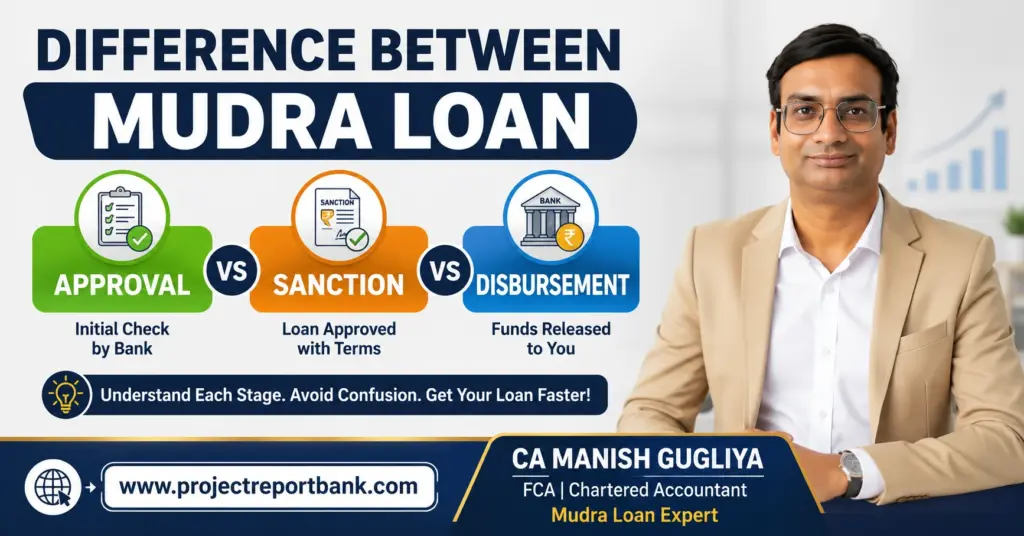
Approval is the bank’s internal recommendation, sanction is the formal written offer with terms and conditions, and disbursement is the actual transfer of funds. Read the detailed guide on difference between approval, sanction and disbursement for clarity.
How many days after sanction is a Mudra loan normally disbursed?
For Shishu loans with complete documents, 1–3 working days. For Kishore, 3–7 days. For Tarun loans involving equipment purchase, 7–15 working days.
Can the bank change the Mudra loan amount at the time of disbursement?
Generally no, unless new adverse information surfaces or you yourself request a lower amount. The sanctioned amount is what was agreed.
Is signing a loan agreement compulsory after sanction?
Yes. Without signing the agreement and related forms, the bank cannot legally disburse. It is a mandatory step in the loan process.
Can the bank ask for more documents even after issuing a sanction letter?
Yes. If something is missing or unclear during verification, the bank has the right to ask for additional papers before disbursement.
Can a sanctioned Mudra loan be cancelled by the bank or by me?
Yes, on both sides. The bank can cancel for non-compliance, fraud, or adverse findings. You can also request cancellation in writing if your plans change.
Will the disbursement come in parts or in one lump sum?
It depends on the facility type. Small working capital loans are usually disbursed fully. Larger loans for machinery may be disbursed partly to your account and partly directly to vendors.
Can I withdraw the full loan amount in cash?
Technically you can, but it is not advisable. Making payments through bank transfers helps prove end-use and avoids questions during audit or renewal.
What happens if I don’t sign the documents after getting the sanction SMS?
The sanction will lapse after the validity period expires. You may need to apply online again or restart the appraisal process.
Does Mudra loan sanction guarantee that money will definitely come?
No. Sanction is conditional upon completing formalities and verification. It is a strong commitment but not an absolute guarantee.
Can I use the Mudra loan to buy a vehicle for my business?
Yes, if the sanction is specifically for purchase of transport vehicles or commercial vehicles for business purposes. The vehicle will be hypothecated to the bank.
Are applicants above 60 years eligible?
Applicants must be aged between 18 to 65 years to be eligible for MUDRA loans.
Can I apply for a Mudra loan online?
Yes, MUDRA loans can be applied online through the JanSamarth portal. You can also apply directly at bank branches.
Are agricultural businesses eligible for MUDRA loans?
No. Agricultural businesses are not eligible for MUDRA loans. The mudra scheme is specifically for non-farm micro and small enterprises under the non corporate and non-farm segment.
How can I verify if my sanction letter is genuine?
Check for official bank letterhead, branch stamp, authorised signatures, and loan account details. For detailed verification steps, read the guide on how to check whether a Mudra loan sanction letter is genuine.
What is the role of CGTMSE in my Mudra loan?
CGTMSE provides credit guarantee to the bank for your loan, reducing the bank’s risk. This is one reason collateral is not required for Mudra loans. The CGTMSE scheme has provided cumulative guarantees worth approximately ₹9.34 lakh crore as of March 2025.
Can I download my sanction letter online?
Some banks allow digital access. Check with your branch or read the guide on downloading your Mudra loan sanction letter online.
What happens during moratorium – do I pay nothing?
During moratorium, you may not pay EMI, but interest continues to accrue on the outstanding loan amount. It is not a free period.
What if my Mudra loan is approved but not sanctioned?
This means internal recommendation has been made but formal sanction with terms is yet to be issued. Read more about Mudra loan approved but not sanctioned situations.
Can I prepay my Mudra loan early?
Most banks allow prepayment of Mudra loans. Check with your branch whether any prepayment charges apply, as policies differ by bank.
What documents should I keep after disbursement?
Keep your sanction letter, loan agreement, disbursement voucher, repayment schedule, insurance policy (if any), all purchase invoices, and monthly bank statements.
Is a co-borrower or guarantor always required?
Not always. For smaller Shishu loans, many banks do not require a guarantor. For larger Kishore and Tarun loans, some banks may ask for a co-borrower depending on risk assessment.
What is hypothecation in a Mudra loan?
Hypothecation means the assets created from the Mudra loan (like machinery, equipment, or stock) are pledged to the bank as security. You retain possession but cannot sell them without the bank’s permission.
Can I get a second Mudra loan while repaying the first one?
It depends on your repayment track record, business growth, and the bank’s assessment. A clean repayment history of the first loan significantly improves your chances.
What is the maximum amount I can get under Mudra Yojana?
The maximum amount under MUDRA Yojana is ₹20 lakh, available under the Tarun Plus category for established and expanding micro units development businesses.
Conclusion: Treat Sanction as a Starting Point, Not the Finish Line
In a Mudra loan under PMMY, “sanction” means the bank has agreed in principle to fund your small business. But the real journey – from documentation to agreement, verification, disbursement, and disciplined repayment – starts after that day.
Here is what matters most:
- Understand your sanction letter and post-sanction responsibilities completely
- Complete all documentation and formalities quickly and correctly
- Cooperate with the bank during verification and keep communication clear
- Use the loan amount strictly for business and maintain invoices and records
- Protect your CIBIL score by paying EMI on time, every time
If handled well, one successfully managed Mudra loan builds a strong foundation for future business loans, higher limits beyond ₹10 lakh, and long-term banking relationships that support growth at every stage – from Shishu to Tarun and beyond.
I encourage you to explore the related Mudra guides linked throughout this article – whether you need help understanding sanction letter formats, checking if your sanction letter is genuine, or dealing with disbursement delays. Stay informed, stay organised, and move confidently from sanction to successful business expansion.
- What Happens After Your Mudra Loan Is Sanctioned?

- Can a Sanctioned Mudra Loan Be Cancelled by the Bank? Complete Guide (2026)
- Difference Between Mudra Loan Approval, Sanction and Disbursement
- Mudra Loan Sanction Letter Format: Every Section Explained
- Mudra Loan Sanction Letter Download – Complete Step‑by‑Step Guide