Key Takeaways
- “Approved” means the bank has internally accepted your eligibility for a Mudra loan. “Sanctioned” means you hold an official sanction letter with the final loan amount, interest rate, and repayment terms.
- In most Pradhan Mantri Mudra Yojana cases, approval is a positive sign. Sanction usually follows unless the bank finds fake documents, wrong information, or fresh CIBIL problems.
- The top 3 reasons for delay between approval and sanction: pending internal approvals at regional or head office, document clarifications (address mismatch, PAN errors), and verification still in process (site visit, credit re-check, business existence).
- You can speed up sanction by keeping your phone active, responding to bank queries the same day, and carrying a neat file of all documents required.
- If more than 14 working days have passed since you submitted complete documents and you have no sanction letter or written rejection, you have the right to escalate.
Introduction: Why Your Mudra Loan Shows “Approved but Not Sanctioned”
I am CA Manish Gugliya (FCA), and over the past 20+ years of working with banks on business loans, I have met hundreds of small business owners who call me with the same worry: “Sir, my Mudra loan status shows Approved, but the branch says sanction letter is not ready yet. What is happening?”
Here is the simple truth. Under the Pradhan Mantri Mudra Yojana, which the government launched on 8th April 2015, “approval” and “sanction” are two separate steps. Think of it like this: approval is your teacher saying “good project idea,” while sanction is the teacher writing your final marks on the report card.
MUDRA stands for Micro Units Development and Refinance Agency. It works as a refinance agency, meaning it does not give loans directly to you. The actual loan comes from commercial banks, small finance banks, NBFCs, and micro finance institutions. Applicants must be aged between 18 to 65 years, and eligible businesses include shop owners and service providers running non-farm activities.
In this article, you will learn the exact difference between approval and sanction, the full loan process from application to disbursement, practical reasons for the gap, realistic timelines, what to do while waiting, and when to escalate. Everything here is based on real banking practice, not just theory.

Table of Contents
Understanding the Difference Between Mudra Loan Approval and Sanction
Loan approval means the application has passed basic checks. The bank’s credit department has reviewed your eligibility criteria, checked your KYC, looked at your credit profile, and decided that your business type and loan amount fit a Mudra category. This is a preliminary internal decision.
Loan sanction is the formal, binding commitment from the lender. The bank issues a written sanction letter that specifies the final loan amount, interest rate, repayment schedule, EMI, security conditions (if any), and any other terms. The lender issues a sanction letter after verifying documents and business viability. Until you hold this letter, nothing is final.
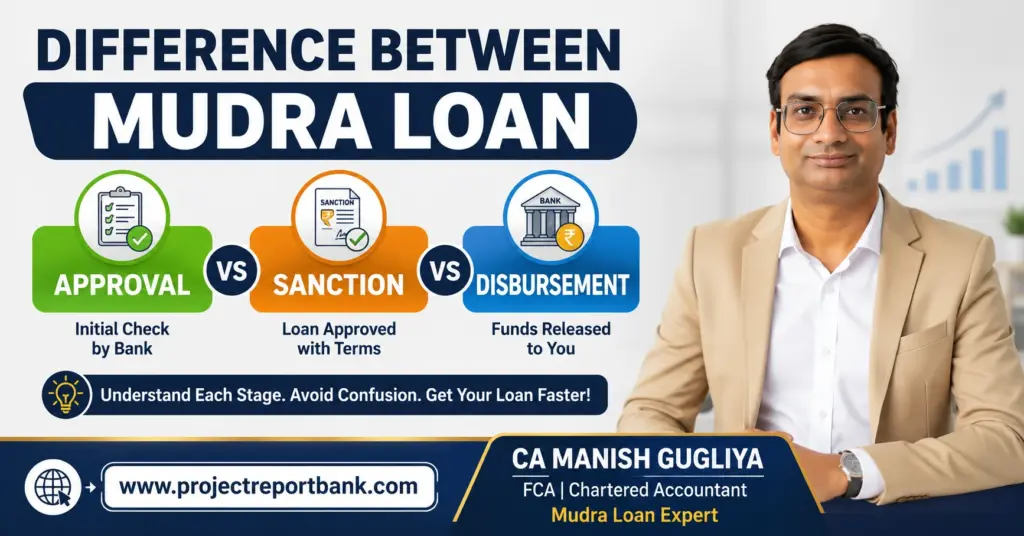
For a deeper breakdown of all three stages, see the detailed guide on approval, sanction, and disbursement.
| Parameter | Approval | Sanction |
|---|---|---|
| Meaning | Preliminary acceptance of eligibility | Final, formal loan offer |
| Legal Status | Not binding on the bank | Binding once borrower accepts |
| Document Issued | No official letter; SMS or portal status only | Written sanction letter on bank letterhead |
| Loan Amount Finalised? | Tentative; can still change | Yes, final amount confirmed |
| Interest Rate Finalised? | Not yet | Yes, specified in sanction letter |
| Can Bank Still Change Decision? | Yes, based on verification outcomes | Rare, unless fraud or misrepresentation found |
| Next Step for Customer | Submit pending documents, attend verification | Accept sanction, sign loan agreement, await disbursement |
Expert Tip by CA Manish Gugliya: Never treat an SMS or portal status of “approved” as money in hand. Until you receive a signed sanction letter from the bank on official letterhead, no funds will come to your account.
Typical Mudra Loan Processing Journey: From Application to Disbursement
Every Mudra loan under PMMY, whether a Shishu loan offering up to ₹50,000 for startups, Kishore loans ranging from ₹50,000 to ₹5 lakh, Tarun loans providing ₹5 lakh to ₹10 lakh for established businesses, or Tarun Plus loans ranging from ₹10 lakh to ₹20 lakh, passes through these stages:
Step 1: Application Submitted (online through Jan Samarth portal, or offline at branch) Step 2: Documents required collected (identity proof, bank statements, business registration, rent agreement, driver’s licence if transport vehicles are involved, and other documents per category) Step 3: Eligibility & KYC Check Step 4: Credit Appraisal (your cash flow, credit history, and proposed activity are assessed based on bank norms) Step 5: Internal “Approval” decision Step 6: Regional/Head Office clearance (for larger amounts) Step 7: “Sanction” decision Step 8: Sanction Letter issued Step 9: Loan Agreement signed; conditions must be fulfilled before the loan is disbursed to the borrower Step 10: Loan disbursement, the stage where funds are released after sanction
Your “mudra loan approved but not sanctioned” status sits between Step 5 and Step 7. Some bank tracking systems label this as “Mudra loan under credit appraisal” or “pending internal bank approval.” Both are normal intermediate stages.
MUDRA loans are available for non-farm businesses only. Agricultural businesses are not eligible for MUDRA loans. You can apply for a MUDRA loan online or offline through banks, NBFCs, and MFIs. MUDRA loans are collateral-free for micro and small businesses, and no collateral is required for MUDRA loans up to ₹10 lakh.
Quick borrower checklist for each stage:
- ✔ Complete documents with clear photocopies
- ✔ Correct mobile number registered with bank
- ✔ Available for site visit at short notice
- ✔ Clean bank statements for the last six months
Why Your Mudra Loan Is Approved but Not Yet Sanctioned: Common Practical Reasons
Most “approved but not sanctioned” files are stuck due to internal processing, not because the bank or financial institution wants to deny your loan. Banks participating in PMMY follow their own lending procedures. Here are the common reasons:
1. Regional Office clearance pending. For Tarun and Tarun Plus amounts, the branch forwards the file to a higher authority. This alone can add 5-10 working days.
2. Branch Manager recommendation not uploaded. The officer may have verbally approved but not completed the system entry.
3. Credit appraisal note incomplete. The credit officer still needs to verify your working capital needs, turnover, or projected income from the proposed activity.
4. Document mismatch. Your address on the electricity bill does not match Aadhaar, or there is a spelling error in PAN. A mobile repair shop owner in Lucknow once had his file delayed 8 days because his father’s name was misspelled on one form.
5. CIBIL re-check triggered. A new credit card default or overdue EMI surfaced after initial screening, requiring fresh assessment.
6. Site verification pending. For Kishore and Tarun categories, a field officer visits your business. A beauty parlour owner in Indore had approval for 12 days before the site visit was scheduled. Read more about what happens after site inspection.
7. Special sector review. If your business involves food processing or other legal entity structures, a technical officer’s note may be needed.
8. System issues or month-end backlog. Financial year end (March), audits, or high application volume can push files back by days.
Expert Tip by CA Manish Gugliya: Instead of asking “Kab tak hoga?”, politely ask the branch staff: “Can you tell me which exact stage my file is at: branch level, regional office, credit officer, site visit, or document clarification?” This gets you a specific answer.

Is “Approved” Status in Mudra Loan a Good Sign or Not?
Yes. In banking practice, an approved Mudra loan is a strong positive signal. It means your basic eligibility criteria, KYC, and initial credit appraisal are cleared. The probability of final sanction is high after this stage.
For example, an existing current account holder at the same bank applying for a Shishu loan with clean documents and a satisfactory credit track record can expect sanction within 2-5 working days of approval. MUDRA loans are processed quickly if documents are complete.
But approval is not a guarantee. The sanctioned amount can be lower than what you requested. A small enterprises owner wanting ₹9 lakh for capital assets may get sanctioned only ₹7 lakh based on the bank’s cash flow assessment. The bank may also add conditions, like requiring a co-applicant. This is called conditional sanction.
Expert Tip by CA Manish Gugliya: Do not commit to big purchases (machinery, shop advance, or transport vehicles) based only on “approved” status. Wait for the sanction letter, confirm the sanctioned loan amount, and get a clear disbursement date before making any investment.
Check the Mudra Loan Processing Stage Timeline for realistic expectations.
Can the Bank Still Reject or Change Your Mudra Loan After Approval?
Yes. Banks can legally refuse or modify a Mudra loan even after “approved” status if new issues appear. Here are the common triggers:
- Forged documents detected during verification
- False income, turnover, or business plan information
- Negative field verification (the business does not exist at the given address, or the applicant has no rent agreement or ownership proof)
- Fresh CIBIL default appearing after initial screening
- Loan purpose is actually personal, not for business purposes
- Activity falls outside Mudra scheme guidelines (e.g., an agricultural crop loan attempted under Mudra)
- Applicant’s educational qualification or necessary skills for the proposed activity are found misrepresented
For instance, if the site visit officer finds that the “shop” listed in the application is actually someone else’s property and the applicant is not the beneficiary micro unit operator, the file will be returned or rejected.
Sometimes the bank does not fully reject but offers a reduced loan amount, asks for a co-borrower, or moves the file to a different loan product. The bank should explain this in writing or through a clear communication.
Expert Tip by CA Manish Gugliya: Keep photocopies of every document you submit. If an approved Mudra loan is refused or changed, demand written reasons. You have the right to escalate to the branch manager, bank grievance cell, or Banking Ombudsman if you face discrimination or rule violations.
How Long After Approval Does Mudra Loan Sanction Usually Take?
Time from approval to sanction depends on the Mudra category, loan amount, and whether you are a new or existing customer of that financial institution. Here is a realistic table:
| Scenario | Typical Time (Working Days) |
|---|---|
| Shishu loan, existing customer, clean documents | 2-5 days |
| Shishu loan, new customer | 7-10 days |
| Kishore loan, no major verification pending | 10-15 days |
| Tarun loan, site and technical verification needed | 15-21 days |
| Tarun Plus (loans upto Rs 20 lakh), Regional/Head Office clearance | 21-30 days |
A legal precedent (Umakant Ashok Giri vs SBI, July 2023) confirms that once complete KYC and documents are submitted, the bank must sanction or reject within 14 working days and communicate the decision in writing.
Festivals, financial year end in March, and branch audits slow things down. If you need funding for seasonal stock or a specific business opportunity, apply at least 4-6 weeks before you need the money.
Expert Tip by CA Manish Gugliya: Ask the bank for an expected timeline via SMS or email. Maintain a simple diary noting your follow-up dates and what the bank told you each time.
What Should You Do While Your Mudra Loan Is Approved but Sanction Pending?
Instead of worrying, take these steps:
- ✔ Keep your phone switched on. Respond to missed calls from unknown numbers; they may be field officers.
- ✔ Reply to bank SMS or email queries the same day.
- ✔ Keep scanned copies of all documents required ready: Aadhaar, PAN, Udyam registration, bank statements for the last six months, quotations, rent agreement, business registration, and identity proof.
- ✔ Visit the branch once a week and politely ask which document or verification step is pending.
- ✔ Do not apply for the same Mudra loan at multiple banks simultaneously. This creates duplicate inquiries on your credit report and raises red flags for lenders.
- ✔ Avoid taking any new high-EMI loan or credit card during this period, as it disturbs your credit profile.
- ✔ If the bank asks for a project report or CMA data for Kishore/Tarun amounts, get it prepared by a professional.
- ✔ You must submit specific documents when applying for MUDRA loans; keep them organised in a single file.
Quick response to bank queries (same-day document submission) can cut 3-5 days from overall sanction time.
Expert Tip by CA Manish Gugliya: For Kishore and Tarun eligible borrowers, prepare a simple business plan before applying: what business you run, how much investment is needed, how the working capital or term loan will be used, and expected monthly sales and profit. This makes credit appraisal faster and strengthens your case.

Warning Signs and When to Escalate Your “Approved but Not Sanctioned” Mudra Loan
Some delay is normal. But these patterns mean the file is stuck and needs action:
- No update for more than 15 working days after approval with complete documents submitted
- Staff repeatedly says “come tomorrow” without checking the system
- Branch cannot tell you whether the file is at branch, regional office, or head office
- Repeated requests for the same document copies you already gave
- Conflicting information from different staff members
- Anyone asking for unofficial cash payments or conditions not written in PMMY guidelines; beware of fraudulent approval messages requesting fees before sanction. Authentic Mudra loans use official banking channels for processing. The government has issued fact checks warning about such scams.
Escalation steps:
- Write a letter to the Branch Manager with your application number and date of approval. Get a stamped acknowledgement.
- If no response in 5 working days, contact the Regional or Zonal Office.
- File a complaint with the bank’s nodal officer for PMMY or grievance redressal cell.
- As a last step, approach the RBI Banking Ombudsman.
Expert Tip by CA Manish Gugliya: Stay polite and professional. Never shout at or threaten bank staff. Calm, documented communication gets faster results than anger. Keep copies of every letter and email.
Common Mistakes Borrowers Make Between Approval and Sanction
Many delays after approval are created by the borrower’s own small mistakes:
- Assuming “approved” means money is guaranteed and making advance payments for machinery or shop rent.
- Not checking SMS or email regularly for bank queries about documents.
- Ignoring calls from unknown numbers, which are often the field verification officer.
- Giving inconsistent answers during verification (different turnover figures to different officers).
- Submitting blurred photocopies or unreadable documents required by the bank.
- Skipping the site visit appointment or not being present at the business address.
- Changing your mobile number or address without informing the bank.
- Applying for other big loans or credit cards during the same period, which disturbs your credit score for lenders.
The correct approach: stay reachable, maintain one complete file of all loan papers, attend every bank meeting on time, be honest and consistent, and avoid new credit obligations until the Mudra loan is sanctioned and disbursed.
Expert Tip by CA Manish Gugliya: Keep a simple checklist at your home or shop. Tick off each document and step as completed. This is helpful for individual borrowers and first-time entrepreneurs managing their first loan process with a bank.
Expert Guidance by CA Manish Gugliya to Speed Up Mudra Loan Sanction
From my 20+ years of working with banks on MSME finance, here are concrete strategies that work:
- Prepare a project report before applying. Even a 3-page document showing your business, investment plan, and expected cash flow makes the bank’s job easier.
- Choose the right category. Do not apply for Tarun if your actual need is ₹40,000 (Shishu). Mismatched applications face extra scrutiny.
- Maintain a healthy bank statement for 6 months before application. Regular deposits and withdrawals show the bank that your small business is active.
- Clean minor CIBIL issues in advance. Pay off overdue credit card balances or small EMI defaults before applying.
- Apply at a bank where you already have a current or savings account. Existing relationship with a financial institution reduces verification time because the bank already has your trading and services transaction history.
- Carry a neat, organised file to the branch. Loose papers and missing photocopies cause days of delay.
I recently helped a small trader whose Kishore loan (loan extended for working capital) was stuck at “approved but not sanctioned” for 11 days. After we submitted a structured follow-up letter and one missing GST document, the sanction came through in 4 days.
Once your loan is sanctioned, you can learn how to check if your sanction letter is genuine and understand the sanction letter format.
Most genuine micro enterprises under the Mudra scheme get their mudra loans sanctioned if borrowers stay patient, organised, and transparent. The scheme exists for employment creation and financial assistance to micro units; the government wants it to work.
Frequently Asked Questions on Mudra Loan Approved but Not Sanctioned
Is approval the same as sanction in a Mudra loan?
No. Approval is the bank’s internal decision that you are eligible. Sanction is the formal offer with a written letter detailing the final loan amount, interest rate, and repayment terms. Loan approval is preliminary while loan sanction is a formal offer.
Can the bank cancel an approved Mudra loan?
Yes. If the bank discovers forged documents, false information, or a new CIBIL default before issuing the sanction letter, it can withdraw the approval. The bank should communicate reasons in writing.
How many days after approval does sanction usually take?
For a Shishu loan with complete documents, 2-10 working days. Kishore takes 10-15 working days. Tarun and higher amounts can take 15-21 working days or more if site verification and regional office clearance are needed.
Can the sanctioned amount be lower than the approved amount?
Yes. After detailed credit appraisal, the bank may sanction a lower amount based on your assessed cash flow, assets created, or business turnover. For example, approval for ₹8 lakh may result in sanction of ₹6 lakh.
Can I apply at another bank if my approved loan is not sanctioned?
You can, but applying at multiple lenders simultaneously creates multiple credit inquiry entries on your report, which may hurt your credit profile. It is better to follow up with the first bank and apply elsewhere only if formally rejected.
Does Mudra approval guarantee that I will get money?
No. Only after sanction, loan agreement signing, and disbursement does money reach your account. Loan sanction includes a formal sanction letter detailing terms of the loan; without it, there is no guarantee.
Can the bank ask for more documents after approval?
Yes. During final verification, the bank may ask for additional bank statements, a business plan, quotations for capital assets, or proof of assets like machinery. Submit these immediately.
Can Mudra loan approval expire?
If you delay submitting required documents or do not respond to bank queries for weeks, the approval can lapse. The bank may ask you to reapply with updated documents.
What happens immediately after sanction?
The bank issues a sanction letter. You accept the terms, sign the loan agreement and other legal entity declarations, and then the bank processes disbursement. You can learn how to download your sanction letter online.
How do I check if my Mudra loan sanction letter is genuine?
A genuine sanction letter carries the bank’s letterhead, branch details, signatory name and signature, date, loan reference number, and full terms. Any letter from “Mudra Ltd” directly asking for fees is fake. Mudra is a refinance agency, not a direct lender.
Can a sanctioned Mudra loan be cancelled by the bank later?
In rare cases, yes, if the bank discovers fraud or policy violation after sanction. Read the detailed guide on whether a sanctioned Mudra loan can be cancelled.
Can students apply for Mudra loans?
Students above 18 years can apply for MUDRA loans if they plan to start a non-farm micro enterprise. The scheme covers micro enterprises engaged in manufacturing, trading, services, and food processing activities.
Conclusion: Don’t Panic If Your Mudra Loan Is Approved but Not Yet Sanctioned
“Approved” is a strong positive step. It means you have cleared the toughest filter: basic eligibility, KYC, and initial credit assessment. But “sanctioned” with a written sanction letter is the real confirmation, and disbursement is the last stage when money actually reaches your account. Since inception, millions of Mudra loans have been sanctioned across India; in Tamil Nadu alone, over 3.21 crore loans worth ₹2.05 lakh crore were sanctioned between April 2019 and 2024. Loans under MUDRA can go up to ₹20 lakh with the Tarun Plus category introduced in October 2024 for borrowers who have successfully repaid previous loans.
The key learnings: understand each stage of the Mudra loan journey, know realistic timelines for your category, recognise genuine reasons for delay versus warning signs, and follow up professionally with documented communication.
Most honest applications under the Mudra scheme, especially Shishu covering loans for micro units, do get sanctioned when documents are complete and verifications are clean. The availed scheme is designed for financial assistance to small business owners and individual borrowers who need working capital loans or term loan funding for business purposes. This knowledge should help every eligible applicant stay calm and prepared.
Explore other detailed guides on ProjectReportBank related to sample Mudra loan sanction letters, Mudra loan disbursement delays, and MSME finance planning. If you need personalised help with project reports or Mudra loan documentation, consider consulting a Chartered Accountant who understands how banks work from the inside.
Additional FAQs About Mudra Loan Approval and Sanction
Can I change my requested Mudra loan amount after approval but before sanction?
You can request it, but changing the loan amount mid-process often resets the credit appraisal. If you need a higher amount, the bank may need fresh documents and a revised business plan. A lower amount is usually easier to accommodate. Discuss this with the credit officer before formal sanction.
Will my Mudra loan EMI start immediately after sanction or only after disbursement?
EMI or repayment starts only after disbursement, not after sanction. The sanction letter states the terms, but the actual repayment schedule begins from the date the loan is disbursed into your account. Some banks offer a moratorium period of 1-6 months on the term loan component.
Can I shift my Mudra loan application from one bank branch to another if sanction is delayed?
Technically, you would need to withdraw the application from the first branch and reapply at the second. This restarts the form and process. It is usually faster to escalate with the same branch through the grievance mechanism than to start over.
Does taking a small Shishu loan now affect my chance for Kishore or Tarun in future?
Not negatively. In fact, it helps. If you take a Shishu loan and maintain a satisfactory credit track record with timely repayment, it builds your credit history with that bank. Many borrowers who availed and repaid previous loans move to Kishore and then Tarun category with the same lender. The Tarun Plus category specifically rewards borrowers who have successfully repaid previous loans.
Is there any benefit if I have Udyam Registration while applying for Mudra?
Yes. Udyam Registration proves your status as a registered micro enterprise. While it is not mandatory for all Mudra categories, it speeds up verification, strengthens your application, and may help you access other government services and schemes for micro enterprises in the future.
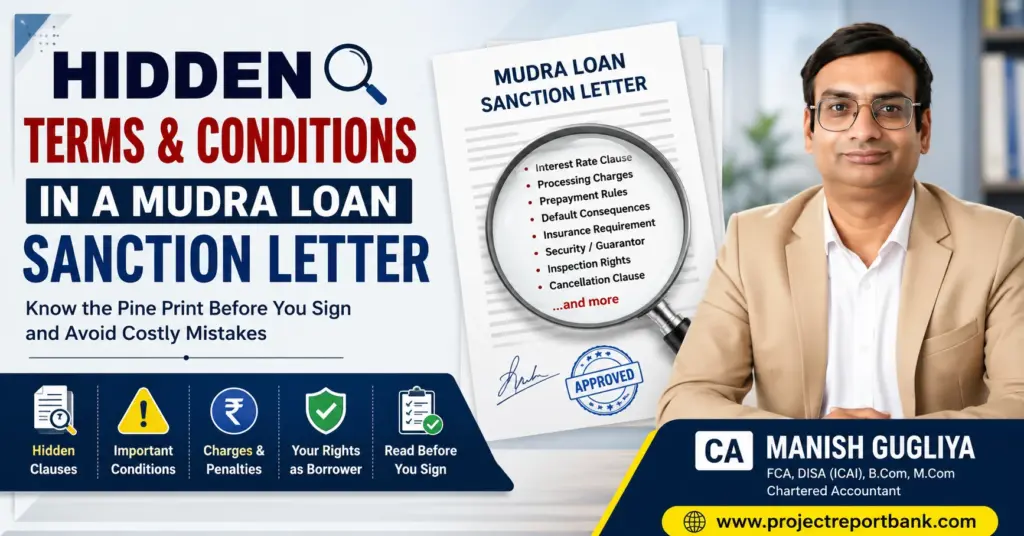
- Hidden Terms and Conditions in a Mudra Loan Sanction Letter

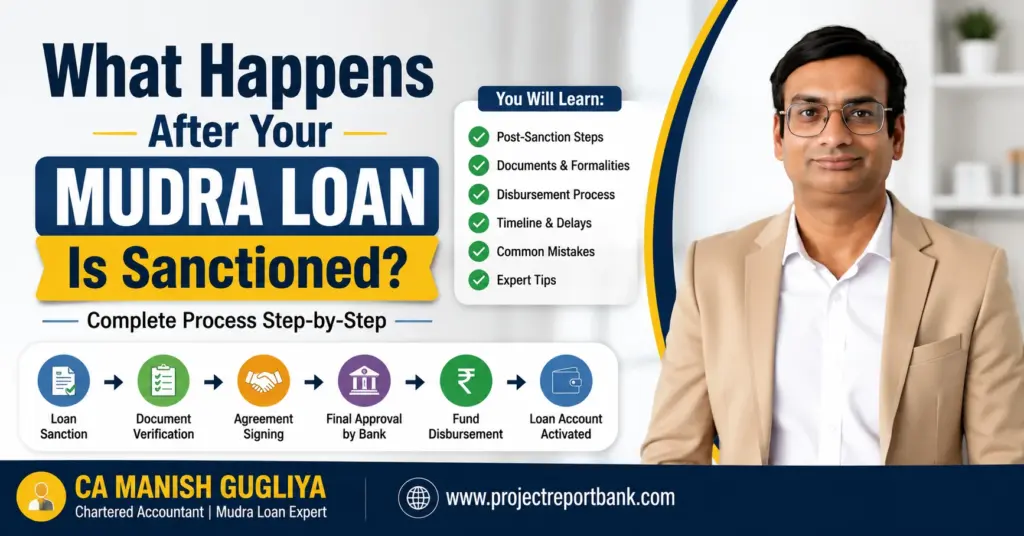
- What Happens After Your Mudra Loan Is Sanctioned?
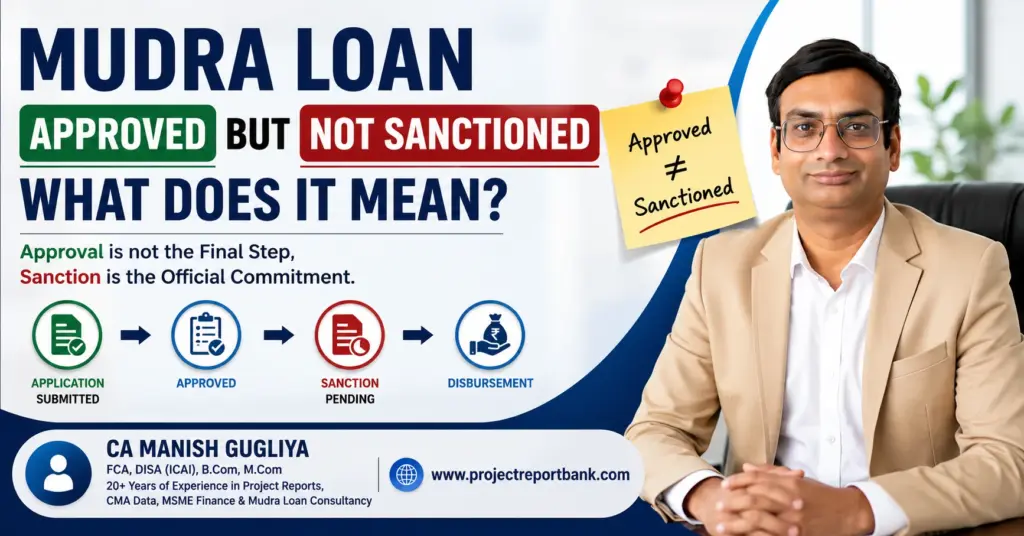
- Mudra Loan Approved but Not Sanctioned: What Does It Really Mean?
- What Is Conditional Sanction in a Mudra Loan? Meaning, Conditions, Documents & Next Steps
- Can a Sanctioned Mudra Loan Be Cancelled by the Bank? Complete Guide (2026)
- Difference Between Mudra Loan Approval, Sanction and Disbursement
- How to Check Whether Your Mudra Loan Sanction Letter Is Genuine

- Mudra Loan Sanction Letter Format: Every Section Explained
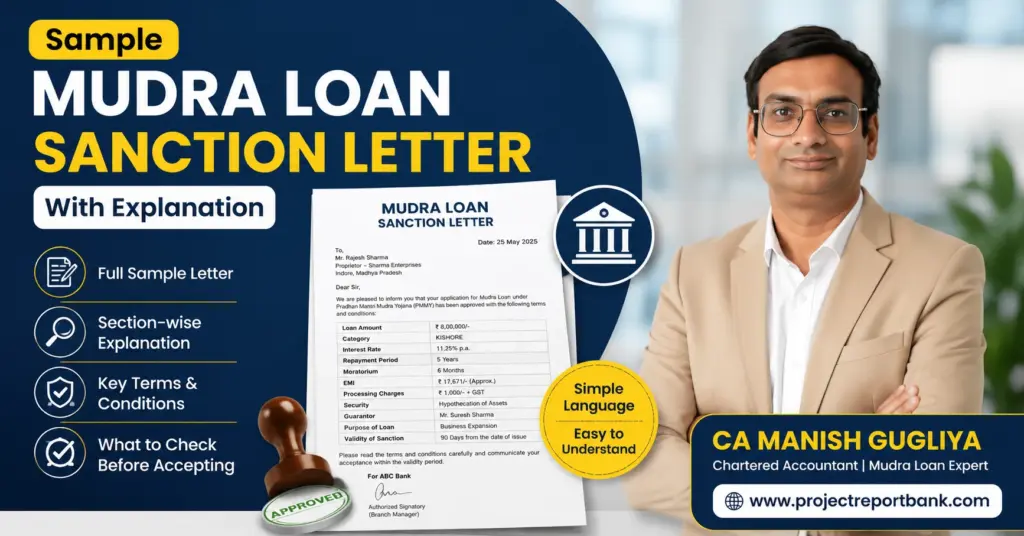
- Sample Mudra Loan Sanction Letter with Explanation