Key Takeaways
- Mudra loan sanction letter download is possible online for some banks through Internet Banking, Mobile App, or email, but many banks still issue it only at the branch as a printed copy.
- The process depends entirely on the lending bank or NBFC – not on the MUDRA or Pradhan Mantri Mudra Yojana (PMMY) portal itself, since MUDRA operates as a refinancing regulator and does not lend directly.
- If your letter is missing, you can request a duplicate sanction letter from your branch with a simple written application and ID proof such as Aadhaar or PAN card.
- Always use official bank websites and apps, never share your OTP with anyone, and keep both PDF and printed copies safely for the full loan tenure.
Introduction – Mudra Loan Sanction Letter Download in Simple Words
If you have applied for a mudra loan under the Pradhan Mantri Mudra Yojana (also called Mantri Mudra Yojana PMMY), one of the first documents you will want to keep is your sanction letter. Think of it as a written promise from the bank that your loan is approved and the money will be released soon, subject to certain conditions.
But here is the common doubt – can you actually do a mudra loan sanction letter download from some website or portal? The short answer: there is no single central “Mudra portal” that lets every borrower download their sanction letter. The download option fully depends on your specific bank or lender.
In this guide, you will learn:
- Where to find your Mudra loan sanction letter online
- How to download or obtain it step by step
- What details to check inside the letter
- How to get a duplicate if you lost the original
- Safety tips to protect yourself from fraud
Written by CA Manish Gugliya, FCA, founder of ProjectReportBank.com with 20+ years of experience in Mudra loan and MSME finance. If you are new to the scheme, start by understanding the Mudra Loan processing stages before diving in.

Table of Contents
What Is a Mudra Loan Sanction Letter and Why It Matters?
A Mudra loan sanction letter is a formal written approval issued by the lending bank or financial institution under the pm mudra loan scheme. The scheme was launched on April 8, 2015, to provide funding to non-corporate, non-farm small enterprises and micro units. Mudra loans are available up to Rs. 20 lakh for micro enterprises, and no collateral is required.
The sanction letter does more than just signify approval. It records the sanctioned amount, interest rate, tenure, EMI schedule, conditions, and guarantee details. It serves as a reference point for subsidy claims, business record-keeping, future refinancing, and tax purposes.
A Mudra loan sanction letter is issued by the lending institution that approved the loan – be it SBI, Bank of Baroda, PNB, Canara Bank, regional rural banks, cooperative banks, or NBFCs. It is typically generated after credit appraisal and branch manager approval but before disbursement.
Sanction vs Disbursement – Quick Comparison
| Aspect | Sanction | Disbursement |
|---|---|---|
| Timing | After credit appraisal, before money release | After all sanction conditions are fulfilled |
| Purpose | Confirms loan is approved with terms | Confirms actual money credited to your account |
| Main Contents | Amount, interest, tenure, conditions | Amount released, date, account credited |
| Processing Stage | Approval stage | Final release stage |
In many Mudra loan files, the sanction letter is signed physically at the branch. So borrowers must keep that original copy carefully. If your application is still under credit appraisal, the sanction letter has not been generated yet.
Can You Really Download a Mudra Loan Sanction Letter Online?
Yes, sometimes – and no, sometimes. Let me explain both scenarios clearly.
There is no direct “mudra loan sanction letter download” button on the main MUDRA or PMMY websites. MUDRA operates as a refinancing regulator and does not lend directly to borrowers. Digital or physical approval notices are issued by the lending institution after evaluation. So the facility to download depends entirely on your bank’s core banking and digital systems.
When online download is usually possible:
Modern banks with strong digital platforms – like Bank of Baroda, Indian Bank, or SBI – may provide sanction letters through Internet Banking, Mobile Banking App, or customer portals as a PDF. For instance, Bank of Baroda offers a Digital Mudra Loan with end-to-end digitisation for amounts upto Rs 50,000. Similarly, Indian Bank has an Online Shishu Mudra Loan with straight-through processing and no branch visit required for pre-selected customers.
When online download is usually not available:
Smaller cooperative banks, some RRBs, and branches with manual processing often issue only a printed sanction letter over the counter. If your loan was processed at a rural branch with limited digital infrastructure, you will likely need to collect the letter in person.
JanSamarth Portal: This government portal is mainly used to apply for pm mudra loan online and track application status. However, the final sanction letter is still generated by the lending bank’s own system – not by JanSamarth.
Some lenders send a PDF copy of the sanction letter to the registered email address. Always check your email inbox and spam folder. Note that procedures can change after system upgrades, so confirm the exact process from your branch or official bank website.
Banks and Portals – Where a Mudra Loan Sanction Letter PDF May Be Available
The table below is illustrative, not exhaustive. Availability may change with time. MUDRA loan applications can be submitted at commercial banks or regional rural banks, and each institution has its own digital capabilities.
| Bank / Institution | Internet Banking Download | Mobile App Download | Copy via Branch | Copy via Email |
|---|---|---|---|---|
| State Bank of India (SBI) | Case-to-case (e-Mudra may support) | Case-to-case | Yes | Sometimes |
| Bank of Baroda | Yes (Digital Mudra Loan) | Yes (bobWorld) | Yes | Yes |
| Punjab National Bank (PNB) | Case-to-case | Case-to-case | Yes | Sometimes |
| Canara Bank | Case-to-case | Case-to-case | Yes | Sometimes |
| Union Bank of India | Case-to-case | Case-to-case | Yes | Sometimes |
| Indian Bank | Yes (Online Shishu) | Yes | Yes | Yes |
| HDFC Bank | Case-to-case | Case-to-case | Yes | Sometimes |
| ICICI Bank | Case-to-case | Case-to-case | Yes | Sometimes |
| Axis Bank | Case-to-case | Case-to-case | Yes | Sometimes |
| Regional Rural Banks | Rarely | Rarely | Yes | Rarely |
| NBFCs | Varies | Varies | Yes | Sometimes |
Note: This information is based on general industry practice around 2024–2026 and may differ by state, branch, and staff. Even if online download is not enabled, every sanction must exist in the bank’s system and can be printed at the branch on request.
Step‑by‑Step Methods to Download or Obtain Your Mudra Loan Sanction Letter
Exact screens differ by bank, but the general flow is similar. To download the sanction letter online, users must log in to the lender’s portal. Loan application reference numbers are provided when the application is submitted – keep yours handy.
Method 1 – Internet Banking Portal
- Open your bank’s official Internet Banking website in a browser.
- Log in with your user ID and password.
- Navigate to the “Loans & Advances” or “My Loans” section.
- Select your Mudra loan account number from the list.
- Look for a tab like “Download Sanction Letter,” “Loan Documents,” or “Provisional Sanction.”
- Click to download the PDF.
- Save to your device and print a copy for your records.
Method 2 – Mobile Banking App
- Open your bank’s official mobile banking app (download only from Google Play Store or Apple App Store).
- Log in with your credentials.
- Go to the “Loans” or “Borrow” section.
- Select your Pradhan Mantri Mudra Yojana loan account.
- Check for “Documents” or “Statements” subsection.
- If available, tap to download the sanction letter PDF.
Method 3 – Email from Bank
- Open the email account registered with your bank.
- Search for keywords like your bank name, “sanction,” “Mudra,” or “approval.”
- Check the spam or junk folder – bank emails often land there.
- Download the attached PDF.
- Verify that the PDF shows bank logo, branch name, and your correct details.
Method 4 – Customer/Loan Portal or JanSamarth
Some banks allow viewing sanction details through their customer portals. The JanSamarth portal may show loan status and basic approval information. However, the document available here is often a provisional approval summary – not the final signed sanction letter. Always confirm with your branch whether the document from the portal is sufficient for your purposes.
Method 5 – Visit Branch for Printed or Duplicate Copy
- Carry your identity proof (Aadhaar card, PAN card), loan account number, or application number.
- Visit the branch where the Mudra loan was sanctioned.
- Submit a short written request for a printed copy of the sanction letter.
- Collect the letter with branch seal and manager’s signature.
Practical tip from experience: Take two photocopies, laminate one copy, and store the PDF in secure cloud storage for long-term safety.

How to Get a Duplicate Mudra Loan Sanction Letter If You Lost It
Common situations include: original sanction letter misplaced, damaged, never received, email deleted, or branch of account changed due to relocation. Do not panic – your loan remains valid even without the physical copy.
Branch process to get a duplicate:
- Visit the Mudra loan branch.
- Write a simple application requesting a duplicate sanction letter.
- Mention your loan account number, approximate date of sanction, and reason for the duplicate.
- Attach identity proof (Aadhaar, PAN), address proof, and a copy of your loan passbook or statement.
Banks usually print a duplicate from their core banking system on letterhead with a “Duplicate” remark. The branch manager may attach a seal and signature again.
Charges: Most banks do not charge for one duplicate. A small fee may apply as per their schedule of charges – confirm at the branch.
Processing time: In simple files, you can get it the same day. In older mudra loans or transferred accounts, it may take a few working days to trace the file. If you face repeated refusals or disbursement delay, ProjectReportBank.com can guide you through the escalation process.
What Details Are Mentioned in a Mudra Loan Sanction Letter?
A Mudra loan sanction letter includes loan amount sanctioned and interest rate information, along with several other critical details. Here is what you will typically find:
Personal and business details: Applicant’s full name, father or spouse name, business name, address, and nature of enterprise (trading, services, manufacturing, etc.).
Loan classification: Mudra loans are categorized into Shishu, Kishor, and Tarun. Shishu loans provide up to Rs. 50,000 for new businesses. Kishor loans range from Rs. 50,001 to Rs. 5 lakh. Tarun loans offer financing from Rs. 5 lakh to Rs. 10 lakh. The quantum of the sanctioned amount and the category will be clearly defined in the letter.
Financial terms: Rate of interest (interest rates start at 9.05% per annum, fixed or floating), repayment period, EMI amount, moratorium if any, processing charges, and whether a CGFMU guarantee is extended covering loans under the scheme. No collateral is required for Mudra loans, and the letter will confirm this – security is usually nil for collateral.
Facility type: Whether the loan is a term loan, working capital, cash credit (CC), or OD (overdraft).
Operational details: Branch name and code, loan account number, sanction date, validity period of the sanction, and any margin requirement.
Conditions: Every bank clause related to submission of bills, stock statements, insurance, or additional documents required for a Mudra Loan will appear under “Conditions Precedent” or “Special Conditions.” If you wonder whether a bank can keep asking for new documents, the sanction letter is your first place to check what was originally required.
Sample Sanction Letter Contents Table
| Field Name | Meaning in Simple Language |
|---|---|
| Sanctioned Amount | Total loan amount the bank has approved (e.g., Rs. 4,00,000) |
| Loan Category | Shishu / Kishor / Tarun |
| Purpose | What you will use the money for (e.g., buying a sewing machine for a tailoring shop) |
| Facility Type | Term loan, working capital, OD etc. |
| Interest Rate | The percentage charged on the loan, repayable over the tenure |
| Tenure | How many months or years to repay (e.g., 60 months) |
| EMI | Monthly payment amount |
| Moratorium | Grace period before EMIs start |
| Guarantee | CGFMU / CGTMSE coverage, if any |
| Conditions | Documents or steps you must complete before money is released |
| Validity | How many days the sanction is valid (typically 30-90 days) |
| Assets Created | What assets the loan funds should create (e.g., equipment, stock) |
Example: A tailoring shop owner in Jaipur who is the beneficiary micro unit might receive a Shishu category sanction for Rs. 4,00,000 with 60 months tenure, 10.25% interest, and a condition to submit proof of business address before disbursement.
Sanction Letter vs Loan Agreement vs Disbursement Letter vs Loan Statement
Borrowers often confuse these four documents. Here is a simple breakdown:
- A sanction letter records the bank’s approval and agreed terms. It comes after approval.
- A loan agreement is the detailed legal contract you sign before money is released. It is the main binding document.
- A disbursement letter confirms the actual payment of funds into your account after all conditions are met.
- A loan statement shows your outstanding principal, interest, and EMI history, issued periodically or on demand.
| Document | When Issued | Main Purpose | Usually Downloadable Online? |
|---|---|---|---|
| Sanction Letter | After loan approval | Confirm approved terms and conditions | Some banks – Yes |
| Loan Agreement | At signing, before disbursement | Main legal contract | Rarely online |
| Disbursement Letter | When money is credited | Confirms payout amount and date | Sometimes via email |
| Loan Statement | Periodically or on request | Shows outstanding balance and repayment history | Usually via Internet Banking |
Preserve all four types of documents for the full loan tenure. They may be needed when applying for higher loans, for subsidy claims, or if any dispute arises. If your file is pending internal bank approval, none of these documents will exist yet.
If You Cannot Download Your Mudra Loan Sanction Letter – Practical Solutions
Many borrowers face frustration with portals. If the online download is unavailable, physical copies can be requested from bank branches. Here are common problems and how to solve them:
No option visible in Internet Banking: Your bank may not have enabled document downloads for loan accounts. Call customer care and ask specifically about mudra loan sanction letter download. If unavailable, visit the branch directly.
Mobile app not showing loan: Some apps list only deposit accounts by default. Check settings or the “All Accounts” section. If still missing, re-register for Internet Banking or contact your branch.
Wrong or inactive email ID: If your registered email is old or incorrect, the bank’s email copy would have gone to the wrong address. Visit the branch, update your email and mobile number, and request a fresh copy.
Very old Mudra loan not in front-end systems: For loans availed several years ago, the front-end portal may not retain sanction documents. Only branch staff with back-end access can print these. There is nothing “wrong” with your loan – it is simply a system limitation.
JanSamarth portal not giving document: JanSamarth tracks applications but does not generate final sanction letters. You must approach your lending bank directly.
What to keep handy: Loan account number, application number, Aadhaar or PAN, branch name, and approximate sanction date.
If the branch is delaying or refusing without reason, you may escalate to the regional office or use the bank’s grievance portal. In extreme cases, you can approach the banking ombudsman. Even without a downloaded copy, your Mudra loan remains valid as long as it is properly sanctioned and disbursed.
Safety Tips Before Downloading and Using a Mudra Loan Sanction Letter PDF
- Always type the bank URL manually in your browser or use the official mobile app. Never click random SMS or WhatsApp links claiming to offer “Mudra sanction letter download.” Many entrepreneurs and shopkeepers fall for such scams.
- Never share your OTP, Internet Banking password, or MPIN with anyone – including callers pretending to be from the bank or from government Mudra offices.
- Check that the downloaded PDF clearly shows the bank logo, branch name, and your own correct details. If anything looks wrong or suspicious, verify with the branch before using the letter for any purpose.
- Save the PDF in a secure folder on your phone or computer. Back it up on a trusted cloud account or pen drive. Print at least one physical copy to keep in your loan file.
- Avoid downloading or printing from cyber cafés or public computers where files may be left behind. If unavoidable, delete all files and sign out completely before leaving.
- Altering any figure in the sanction letter is illegal and can lead to serious banking and legal consequences. Only the bank is authorised to amend and re-issue revised sanction letters.

Expert Guidance from CA Manish Gugliya – Making Best Use of Your Sanction Letter
I have seen hundreds of Mudra loan files over my 20+ years in MSME finance, and I can tell you that the sanction letter is one of the most overlooked yet most important documents in the entire loan process.
My first advice: read every single line before signing. Pay special attention to the interest rate, EMI amount, penal charges, and any bank clause about security or stock statements. Compare the sanction letter terms with what the bank officer verbally promised during discussions. If anything differs, clarify before disbursement – not after.
Maintaining a clean file with sanction letter, agreement, disbursement proof, and repayment track helps enormously later. If you have successfully repaid previous loans and want to upgrade from Shishu to Kishor or Tarun category, the bank will ask for your previous loans documentation. A well-maintained file makes the next phase smoother.
Checklist after receiving your sanction letter:
- Check name, address, and PAN – spelling must match exactly.
- Confirm sanctioned amount, tenure, and type of facility.
- Understand all conditions clearly.
- Sign only after full clarity.
- Store copies safely – both digital and physical.
At ProjectReportBank.com, we help MSME owners prepare strong project reports and understand why a loan may remain under credit appraisal or face delays. The sanction letter is your proof that the hard part – getting the approval – is done. Understanding it is a big step towards managing your business finance professionally. Whether you are eligible for a Shishu loan or have sought a larger Tarun facility, the guidelines remain the same: read carefully, store safely, and ask questions.
Common Mistakes Borrowers Make About Mudra Loan Sanction Letters
1. Treating SMS “approved” as the sanction letter. An SMS confirmation is just a notification. The actual sanction letter is a detailed document with all terms. Always collect the full letter.
2. Not collecting the physical copy from branch. Many borrowers assume the loan is done once money arrives. They skip collecting the sanction letter. This creates problems during audits, subsidy claims, or when applying for the next phase of credit.
3. Deleting bank emails without reading attachments. Some lenders send the mudra loan approval letter as an email attachment. Deleting that email means losing your only digital copy.
4. Signing without reading conditions. Conditions like prepayment charges, penalty interest, insurance requirements, or stock statement submission can catch you off guard. Take 10-15 minutes to read everything. If you are not a defaulter and meet all eligibility criteria, there should be no surprises – but always verify.
5. Downloading from unofficial websites. Agents promising “instant Mudra approval letter download” through third-party sites are almost always running a scam. Your data and money are at risk.
6. Not checking spelling of name or business name. Wrong spelling in the sanction letter creates problems in GST registration, subsidy claims, or when you apply for future loans. Verify details on day one.
7. Keeping only one paper copy. One fire, one flood, or one office shift – and the letter is gone. Always keep at least one scanned PDF backup.
Double-check your sanction letter thoroughly. If you do not understand any term, ask your bank officer or consult a CA.
FAQs on Mudra Loan Sanction Letter Download
Can I download my Mudra loan sanction letter directly from the official MUDRA or PMMY website?
No. MUDRA operates as a refinancing regulator and does not lend directly to borrowers. Sanction letters are generated only by the lending bank or NBFC that approved your loan. The PMMY website and JanSamarth portal help you apply and track status, but they do not provide the sanction letter. You need to check your bank’s Internet Banking portal, mobile app, or visit the branch to obtain it.
Is a printed photocopy of the sanction letter enough, or do I need the original?
For internal business records and general purposes, a photocopy or PDF is usually fine. However, the original letter with branch seal and manager’s signature may be required during dispute resolution, certain government verifications, or if you have sought subsidy benefits. Keep the original safely and use photocopies for day-to-day requirements.
How long should I keep my Mudra loan sanction letter?
Keep it for the entire loan tenure plus at least 3 years after final closure. Income tax assessments can go back several years, and future banks may ask for documentation of previous loans when you apply for higher funding. It also serves as proof that you are eligible and have availed the scheme properly.
Can I use the Mudra sanction letter as income proof for other loans?
While some lenders may look at it as a supporting document, the main income proof remains your bank statement, ITR, and business financials. The sanction letter shows how much credit was extended to you, not your cash flow or income. Do not rely on the sanction letter alone as income proof.
What should I do if details in the downloaded sanction letter are wrong?
Contact your branch immediately. Do not sign any documents until the error is corrected in the bank’s system. Common errors include wrong PAN number, misspelled business name, or incorrect loan amount. Request a revised, corrected sanction letter before proceeding to the next phase of disbursement. The bank is required to provide an accurate sanction letter – this is your right as a borrower.
Mudra loans support various sectors including manufacturing, services, and trading. Whether you run a small enterprise, a micro unit, or are among the many entrepreneurs and shopkeepers building something from scratch, understanding your sanction letter is the foundation of smart business finance. Explore more guides on ProjectReportBank.com to navigate every stage of your Mudra loan journey with confidence.
- What Happens After Your Mudra Loan Is Sanctioned?

- Can a Sanctioned Mudra Loan Be Cancelled by the Bank? Complete Guide (2026)
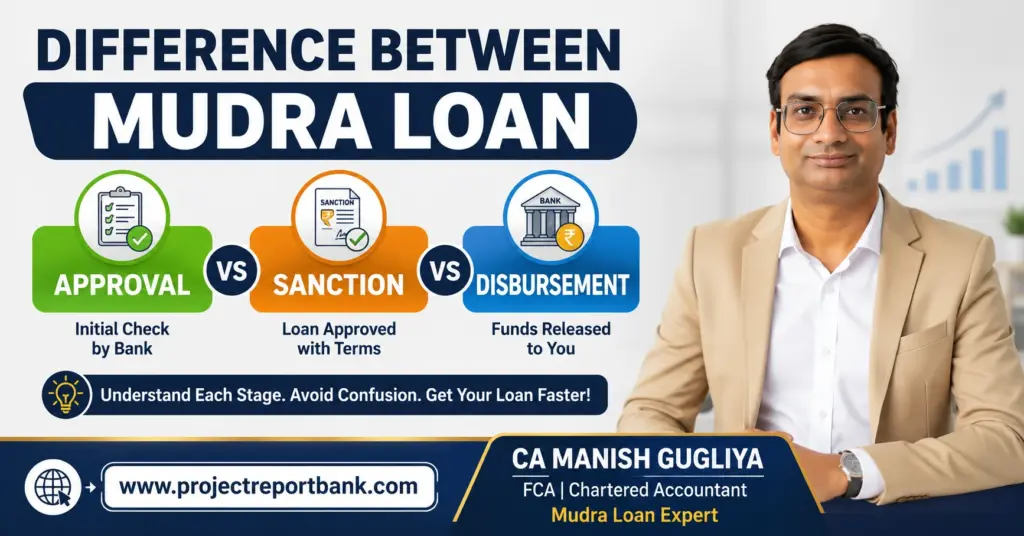
- Difference Between Mudra Loan Approval, Sanction and Disbursement
- Mudra Loan Sanction Letter Format: Every Section Explained
- Mudra Loan Sanction Letter Download – Complete Step‑by‑Step Guide