If your Mudra loan status shows “Approved” and you are wondering why the money has not arrived in your account, you are not alone. Every week, I receive calls from entrepreneurs who see “Approved” on their bank portal and assume the funds will be credited within hours. That is not how the loan process works.
Approval, sanction, and disbursement are three separate stages. Each has a different meaning, different legal weight, and different implications for you as a borrower. Confusing them leads to unnecessary panic, missed deadlines, and sometimes even lapsed loans.
I have been helping MSMEs, shop owners, and first-time entrepreneurs obtain Mudra loans for over 20 years as a practicing Chartered Accountant. The single most common mistake I see: applicants treat “approval” and “sanction” as the same thing. They are not.
Loan approval is a preliminary signal. It means the bank or financial institution has reviewed your application and found you eligible in principle. No money moves. No terms are locked. The bank can still change the interest rate, reduce the loan amount, or even reject your application at this stage.
Loan sanction is the formal authorization. The bank issues a sanction letter that fixes every term: the sanctioned loan amount, interest rate, tenure, EMI schedule, and conditions you must fulfill before the actual release of funds. Once you accept the sanction and meet all conditions, the bank is legally bound to release the money.
Disbursement is when the funds actually reach your account or get paid to your vendor. This is the stage where your repayment obligation begins.
Obtaining a Mudra loan follows stages including application, approval, sanction, and disbursement. Skipping the understanding of any stage can cost you time, money, or both. This guide walks you through each stage with real examples, timelines, comparison tables, and practical tips so you know exactly where you stand at every point in your Mudra loan journey.
The MUDRA scheme provides loans categorized into Shishu, Kishor, and Tarun based on amount. Shishu loans offer up to ₹50,000 for startups. Kishore loans range from ₹50,000 to ₹5 lakh for growth. Tarun loans provide ₹5 lakh to ₹10 lakh for established businesses. Tarun Plus loans range from ₹10 lakh to ₹20 lakh for expanded businesses.
MUDRA loans are intended for micro and small businesses only. Agricultural income-generating businesses are not eligible for MUDRA loans.
Let me explain each stage so you never have to wonder what your loan status actually means.
The Short Answer: Approval vs Sanction
Sanction is the milestone that matters. Loan approval represents a non-binding expression of interest. It tells you the bank has reviewed your papers and sees potential. But loan approval does not legally bind the lender to release money. The bank can still change terms, reduce the amount, or reject you.
Loan sanction is the approval of a specific loan amount. It results in a formal sanction letter stating loan terms such as amount and interest rate. Once you accept and fulfill the conditions listed in that letter, the bank must release the funds. Loan sanction indicates a conditional legal commitment from the lender.
Sanction occurs before disbursement in the loan process. Disbursement is the actual release of loan funds to the borrower. And disbursement triggers the borrower’s repayment obligation.
Here is a simple way to think about it:
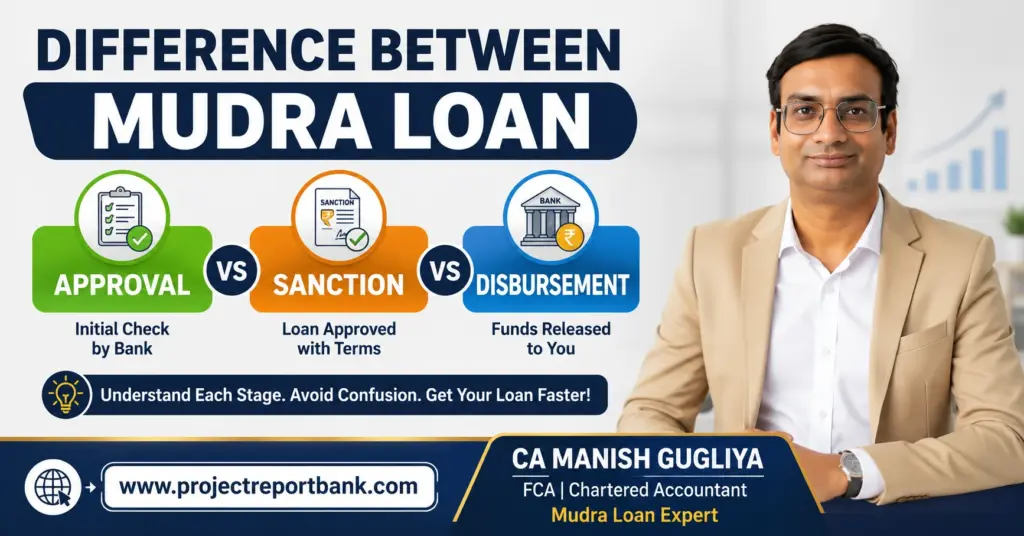
- Approval = “We are interested in lending to you.”
- Sanction = “Here is your loan with fixed terms. Sign the agreement.”
- Disbursement = “Money is in your account. EMI starts now.”
Most applicants should stop worrying about approval status and focus their energy on reaching the sanction stage. That is where the loan becomes real.
Table of Contents
Understanding the Complete Mudra Loan Journey
Before diving into each stage, here is the complete flow from application to fund release:
Application Submitted ↓ Document Verification ↓ Credit Assessment ↓ Loan Approval (In-Principle) ↓ Loan Sanction ↓ Sanction Letter Issued ↓ Acceptance of Terms & Completion of Legal Formalities ↓ Loan Disbursement
Loan approval is the preliminary stage where the lender reviews the application. After the bank completes its internal checks, it moves to sanction where formal agreements and loan terms are finalized before disbursement of funds.
Applications are processed quickly if documents are complete. Under official norms, all Mudra loan applications with required KYC documents must be sanctioned or rejected within 14 working days after receipt.
You can apply for MUDRA loans online through banks and NBFCs. The process runs through commercial banks, small finance banks, NBFCs, and other Member Lending Institutions. MUDRA itself is a refinance agency; it does not lend directly to borrowers. The actual sanction and disbursement happen through your bank or financial institution.
Let me now explain each critical stage in detail.
What Does Mudra Loan Approval Mean?
Loan approval is the stage where the bank says, “Your application looks good on paper. We are willing to consider lending to you.” Nothing more.
What the bank checks before approval
The lender evaluates the applicant’s background, business viability, and credit history during verification. The specific checks typically include:
- Identity proof (Aadhaar, PAN)
- Address proof (utility bill, rent agreement)
- Business registration documents (if applicable)
- Income proof or turnover statements
- Bank statements (usually last 6 to 12 months)
- Credit history via CIBIL or other bureaus
- Business plan or proposed activity description
For Shishu category loans (up to ₹50,000), approvals often happen digitally with Aadhaar/OTP-based e-KYC and minimal financial documentation. For Kishore and Tarun categories, the bank may require site inspections, quotations for capital assets, or detailed cash flow projections.
Applicants must be aged between 18 to 65 years. Eligible businesses include shop owners, vendors, and service providers. Businesses in food processing, manufacturing, trading, and services can all qualify as micro enterprises engaged in non-farm income generation.
Internal approval process
Once your documents are submitted, the bank’s credit team does a preliminary assessment. They check whether your proposed activity makes sense, whether your income supports repayment, and whether you have a satisfactory credit track record. If you have successfully repaid previous loans, that works in your favor.
This internal assessment produces a credit appraisal memo or internal approval note. This document stays within the bank. You as the applicant may only see a status update on your portal or receive an SMS saying “Approved.”
If you want to understand what happens during this internal review, I have explained it in detail in my guide on Mudra loan under credit appraisal.
Does approval guarantee money?
No. This is the single biggest misconception I encounter. Approval is not legally binding. The bank has not committed to any specific loan amount, interest rate, or tenure. Terms communicated at this stage are tentative estimates.
I have seen cases where an applicant was “approved” for ₹5 lakh, but the sanction letter came for ₹3 lakh because the bank’s deeper credit assessment revealed that the borrower’s cash flow could not support higher EMIs. I have also seen approvals reversed entirely when the bank discovered overlapping debts or mismatches in documentation during the next phase of verification.
When approval gets stuck
Sometimes your status shows “Approved” for weeks without progressing to sanction. This happens when minor documents are missing, when there is a mismatch in KYC details, or when the bank needs additional verification. If you are stuck at this stage, check my detailed guide on Mudra loan pending after internal bank approval.
What Does Mudra Loan Sanction Mean?
Loan sanction is the formal authorization granting a specific loan amount. This is where the bank moves from “interested” to “committed.”
What makes sanction different from approval
At the sanction stage, the bank issues a formal sanction letter. This document is not an internal note. It is a legal document shared with you, the borrower, and it locks in every term of your loan:
- Sanctioned loan amount (the exact amount the bank will lend)
- Interest rate (fixed or floating, clearly specified)
- Repayment tenure (number of months or years)
- EMI schedule (exact monthly payment amount)
- Moratorium period (if any, before EMIs begin)
- Conditions precedent (what you must do before money is released)
- Validity period of the sanction (typically 90 days in many banks)
You can learn the complete format and what each section means in my guide on Mudra loan sanction letter format.
Legal weight of the sanction letter
The sanction letter carries legal weight. In the case of Union Bank of India vs Shree Shyam Store, the court recognized the sanction letter, demand promissory note, and hypothecation agreement as legally binding documents that formalized the credit facility and its terms.
In another judgment, Umakant Ashok Giri vs SBI, it was upheld that disbursement for a term loan must follow the schedule in the sanction letter and only after all stipulations are satisfied.
Once you accept the sanction and comply with all conditions, the bank cannot unilaterally change the interest rate or loan amount without mutual consent. This is your strongest protection as a borrower.
Conditions you must fulfill after sanction
Sanction letters contain “conditions precedent,” which are actions you must complete before the bank releases money:
- Signing the loan agreement and other documents
- Submitting vendor quotations or invoices (for equipment purchases or capital assets)
- Providing insurance cover (if required)
- Completing any outstanding KYC requirements
- Sometimes, submitting a detailed business plan or project report
If you need help preparing a project report, I have a separate guide on Mudra loan project reports.
Validity period of sanction
Every sanction letter has an expiry date. In many banks, the validity is 90 days. If you fail to accept the sanction or fulfill the conditions within this period, the sanction lapses. You would then need to restart the process, and the new sanction may come with different (possibly less favorable) terms.
This is one of the most expensive mistakes I see applicants make. They receive the sanction letter, set it aside, and forget about it until the validity expires.
What Does Mudra Loan Disbursement Mean?
Disbursement is the actual release of loan funds to the borrower. This is the stage where money moves from the bank’s account to yours (or to your vendor’s account).
How disbursement works
After you accept the sanction, sign the loan agreement, and fulfill every condition listed in the sanction letter, the bank initiates disbursement. Depending on the loan terms, disbursement can happen in two ways:
- Full disbursement: The entire approved loan amount is transferred to your bank account at once. This is common for working capital loans and smaller Shishu loans.
- Partial or tranche-based disbursement: The bank releases money in instalments, often linked to specific milestones. For example, if you are purchasing machinery, the bank may release funds directly to the vendor against the invoice.
Disbursement triggers the borrower’s repayment obligation. Your EMI schedule typically starts from the date of disbursement (or after the moratorium period, if one was specified in the sanction letter).
Typical disbursement timelines
For Shishu category loans, where Straight-Through Processing (STP) with instant Aadhaar/OTP-based KYC is used, disbursement can happen within 1 to 3 days after sanction acceptance. For Kishore and Tarun categories, expect 5 to 10 days depending on the complexity of documentation and the bank’s internal processes.
If your disbursement is delayed beyond reasonable timelines, read my guide on Mudra loan disbursement delay: reasons and solutions.
Reasons for disbursement delay
Common causes include:
- Incomplete documentation after sanction
- Pending insurance or vendor invoice submission
- Bank’s internal processing backlog
- Mismatch in signed documents
- Delay in verification of assets created or to be created from loan funds
Approval vs Sanction vs Disbursement: How They Compare at a Glance
| Factor | Approval | Sanction | Disbursement |
|---|---|---|---|
| Meaning | Preliminary acceptance of application | Formal authorization of specific loan amount | Actual release of funds |
| Legal status | Not legally binding | Conditionally binding | Fully binding; creates repayment obligation |
| Bank decision | “We are interested” | “Here are the final terms” | “Funds released” |
| Money released? | No | No (pending conditions) | Yes |
| Documentation | Internal approval note | Formal sanction letter | Loan agreement executed, funds transferred |
| Loan terms | Tentative (amount, rate, tenure) | Fixed and confirmed | As per sanction letter |
| Applicant action | Wait; submit any missing documents | Accept terms; sign agreement; fulfill conditions | Begin repayment as per EMI schedule |
| Risk of cancellation | High (terms can change, application can be rejected) | Low (bank is committed unless borrower fails conditions) | None (loan is active) |
| Processing stage | Early stage | Mid-stage | Final stage |
| Typical timeline | 3 to 7 days from application | 3 to 5 days after approval | 1 to 10 days after sanction acceptance |
The key differences between these stages: approval signals interest, sanction creates commitment, and disbursement delivers the money. Focus your energy on moving from approval to sanction as fast as possible.
Legal Significance and Documentation
Sanction letter vs internal approval notes
The internal approval note is a bank-side document. You as the borrower typically never see it. It records the credit officer’s assessment and recommendation. It has no legal standing in disputes between you and the bank.
The sanction letter is your legal anchor. It defines:
- What the bank owes you (the sanctioned loan amount under specific terms)
- What you owe the bank (repayment schedule, conditions)
- The reference point for any future dispute
Courts have consistently treated sanction letters as enforceable documents. In Mudra loan cases specifically, courts have upheld that once a sanction letter is issued with terms and the borrower executes the demand promissory note and hypothecation agreement, the credit facility is legally established.
Borrower rights after sanction vs approval
After approval, your rights are limited. The bank can change terms, reduce the amount, or even reject you without any legal liability.
After sanction, the balance shifts. You have the right to:
- Receive the sanction letter in writing
- Know every term and condition before signing
- Expect the bank to disburse funds once you fulfill all conditions
- Challenge any unilateral change in sanctioned terms
MUDRA loans do not require collateral for amounts up to ₹10 lakh. If any bank or financial institution demands collateral for a loan within this limit, it violates the scheme guidelines. No collateral is required for MUDRA loans up to ₹10 lakh. If you see a security demand in your sanction letter for a loan under ₹10 lakh, raise it immediately.
To verify your sanction letter is genuine and contains correct terms, refer to my guide on how to check whether your Mudra loan sanction letter is genuine.
Timeline and Processing Differences
Here is a realistic timeline table based on my experience with hundreds of Mudra loan applications across commercial banks, small finance banks, and NBFCs:
| Stage | Shishu (up to ₹50,000) | Kishore (₹50,001 to ₹5 lakh) | Tarun / Tarun Plus (₹5 lakh to ₹20 lakh) |
|---|---|---|---|
| Application to Approval | 1 to 3 days | 3 to 7 days | 5 to 10 days |
| Approval to Sanction | 1 to 2 days | 3 to 5 days | 5 to 10 days |
| Sanction to Disbursement | 1 to 3 days | 3 to 7 days | 5 to 10 days |
| Total (Application to Money) | 3 to 8 days | 9 to 19 days | 15 to 30 days |
Factors that delay progression
- Missing documents: The most common cause. Incomplete income proof, unsigned forms, or missing business registration can stall you between approval and sanction for weeks.
- Credit history issues: Low CIBIL score, defaults on previous loans, or overlapping debts discovered during deeper checks.
- Business plan gaps: For Kishore and Tarun categories, a vague or unrealistic business plan triggers additional scrutiny.
- Site inspection delays: Bank officers may need to visit your business premises, and scheduling can take time. Read more on what happens after site inspection.
- Internal bank delays: Staff shortages, branch-level backlogs, or administrative bottlenecks.
For a complete breakdown of processing timelines across stages, see my Mudra loan processing time guide.
Money Release and Disbursement Process
Neither approval nor sanction puts money in your account. Only disbursement does.
Here is exactly what needs to happen after sanction for the bank to release funds:
Pre-disbursement checklist
- ✅ Sanction letter received and reviewed
- ✅ All terms (interest rate, EMI, tenure) verified and understood
- ✅ Loan agreement signed
- ✅ Demand promissory note executed
- ✅ Hypothecation agreement signed (if applicable)
- ✅ Vendor quotations or invoices submitted (if purchasing equipment or capital assets)
- ✅ Insurance obtained (if required in sanction letter)
- ✅ Any other documents specified in “conditions precedent” completed
Once every item above is fulfilled, the bank processes the disbursement. For Shishu loans with STP, this can happen within hours. For larger Kishore and Tarun loans, expect 3 to 10 days.
MUDRA loans are available for amounts up to ₹20 lakh. MUDRA loans are available up to ₹20 lakh, covering loans across all four categories. The actual disbursement matches the sanctioned loan amount, not the initially approved loan amount (which may have been tentative and different).
Real-Life Example: From Application to Money
Let me walk you through a case based on a real scenario (names changed for privacy):
Applicant: Priya, a food processing unit owner in Lucknow Category: Kishore (₹3 lakh for working capital and equipment)
January 10, 2026 – Priya submits her Mudra loan application at her bank branch. She provides identity proof (Aadhaar, PAN), business registration certificate, 6 months of bank statements, income proof, and a simple business plan describing her food processing operations and proposed activity.
January 13, 2026 – Bank completes preliminary verification. Priya receives an SMS: “Your Mudra Loan application has been Approved in Principle. Tentative amount: ₹3,00,000. Rate: ~9.5%. Tenure: 3 years.” She is excited but the money is not in her account.
January 14–16, 2026 – Bank’s credit team conducts detailed due diligence. They verify her cash flow from bank statements, check her CIBIL score (she had successfully repaid previous loans, so her credit score was healthy), validate her business plan, and confirm the quotation for equipment she plans to purchase.
January 17, 2026 – Bank issues a formal sanction letter dated January 17. The letter fixes the sanctioned loan amount at ₹3,00,000, interest rate at 9.5% per annum, tenure at 36 months, and monthly EMI at ₹9,596. Conditions precedent: sign loan agreement, submit invoice for equipment purchase, obtain insurance cover for assets created from the loan.
January 18–20, 2026 – Priya visits the branch, signs the loan agreement, submits the equipment vendor’s invoice, and provides insurance documentation. She also executes the demand promissory note.
January 22, 2026 – ₹3,00,000 is disbursed to Priya’s account. EMI starts from February 22, 2026.
Total time from application to money: 12 days.
At each stage, Priya received SMS and email notifications. After sanction, she received a physical copy of the sanction letter. After disbursement, she received her repayment schedule. She can also download her sanction letter online through her bank’s portal.
Common Applicant Confusions and Mistakes
“My loan is approved, but no money has come”
This is the most common complaint. Approval is not disbursement. Your application has cleared preliminary checks, but the bank still needs to complete sanction formalities, issue a sanction letter, and process disbursement. Check your loan status regularly to know which stage you are at.
“The bank changed my loan amount after approval”
This is perfectly normal and legal. Approval terms are tentative. If the bank’s detailed assessment shows your repayment capacity supports only ₹2 lakh instead of the ₹5 lakh you applied for, the sanction letter will reflect ₹2 lakh. The bank is within its rights to do this.
“I received sanction but no money for 3 weeks”
Check whether you have fulfilled all conditions in the sanction letter. Common culprits: unsigned agreements, missing vendor invoices, pending insurance. Contact your branch and ask specifically which condition is outstanding.
“Can the bank cancel my sanction?”
Yes, but only under specific circumstances. If you fail to fulfill the conditions precedent within the validity period, the sanction lapses. If the bank discovers fraud, document tampering, or material misrepresentation after sanction, it can withdraw the sanction. However, the bank cannot arbitrarily cancel a valid sanction where you have met all conditions.
“My status shows ‘Approved’ for weeks”
This happens when your file is stuck between approval and sanction, often due to missing documents, pending site inspection, or a backlog at the branch. Do not wait passively. Visit the branch, call the loan officer, and ask what is needed to move forward.
“Can I reject a sanctioned loan?”
Yes. If the terms in the sanction letter are not acceptable to you (for example, the interest rate is higher than expected, or the approved loan amount is too low), you can decline the sanction. There is no penalty for this. The loan simply does not proceed.
Not reading the sanction letter carefully
I have seen borrowers sign agreements without reading the sanction letter. Later, they are surprised by insurance requirements, margin money conditions, or processing fee deductions. Always read every clause. If something is unclear, ask the bank officer or consult a professional before signing.
Letting the sanction letter expire
Many banks set a 90-day validity on sanction letters. If you do not complete formalities within this period, the sanction lapses. You will need to reapply, and the new terms may be different. I have seen cases where interest rates increased between the lapsed sanction and the new one, costing the borrower thousands in additional interest over the loan tenure.
Assuming EMIs start after sanction
EMIs do not start when the loan is sanctioned. Disbursement triggers the borrower’s repayment obligation. Your EMI schedule begins from the disbursement date (or after any moratorium period specified in the sanction letter).
Timeline from Approval to Disbursement
| Step | What Happens | Typical Duration | Your Action |
|---|---|---|---|
| Application submitted | Bank receives your form and documents | Day 0 | Submit complete documents |
| Document verification | Bank verifies KYC, identity proof, business registration | 1 to 3 days | Respond to any queries promptly |
| Credit assessment | Bank checks CIBIL, cash flow, business viability | 2 to 5 days | Keep phone accessible for calls |
| Approval communicated | Bank informs you of in-principle acceptance | Same day as assessment completion | Do not assume money is coming |
| Sanction letter issued | Bank fixes terms and issues formal sanction letter | 2 to 7 days after approval | Review every term carefully |
| Conditions fulfilled | You sign agreements, submit invoices, complete formalities | 1 to 5 days (depends on you) | Act fast; do not delay |
| Disbursement | Money transferred to your account | 1 to 3 days after conditions met | Confirm receipt; note EMI start date |
Possible delays: Missing documents can add 1 to 3 weeks. Credit issues can add another week for resolution. Site inspection scheduling can add 3 to 7 days. For a detailed breakdown by processing stage, check my Mudra loan processing stage timeline.
Common Mistakes Applicants Make
Based on my two decades of practice helping eligible borrowers obtain Mudra loans, here are the mistakes that cost applicants the most time and money:
- Assuming approval equals guaranteed money. It does not. Approval is a preliminary green signal, not a commitment. Keep preparing documents until you have the sanction letter in hand.
- Submitting incomplete documents. This is the number one reason for delays between approval and sanction. Missing income proof, outdated bank statements, or unsigned forms can stall your file for weeks.
- Ignoring sanction letter conditions. The sanction letter lists specific actions you must complete. Treating them as optional or “later” items delays your disbursement and can cause the sanction to lapse.
- Not reading the sanction letter at all. Some borrowers sign without reading. They later discover unexpected conditions like mandatory insurance, margin requirements, or processing fee deductions.
- Delaying documentation after sanction. The validity period is ticking from the date of the sanction letter, not from when you read it. Every day of delay reduces your window.
- Missing bank communications. Banks send SMS alerts, emails, and sometimes physical letters. Keep your registered mobile number active and check your email regularly.
- Not following up with the branch. Passive waiting is a mistake. If your status has not changed in 7 to 10 days, visit the branch and ask for a specific update.
- Providing inconsistent information. If your application says monthly income is ₹40,000 but your bank statements show ₹25,000, the bank will flag the discrepancy. Be accurate from the start.
- Not keeping copies of submitted documents. Always retain photocopies or scans of everything you submit. If the bank asks for re-submission, you can respond instantly.
- Confusing Mudra categories. MUDRA loans are available for amounts up to ₹20 lakh. Applying under the wrong category (for example, applying for Tarun when your requirement is ₹2 lakh, which falls under Kishore) creates processing confusion.
Expert Tips from CA Manish Gugliya
Here are my practical recommendations based on direct experience with hundreds of Mudra loan applications:
- Prepare all required documents before applying. Do not submit the application and then scramble for documents. Have your identity proof, address proof, business registration, income proof, bank statements, and business plan ready before you walk into the branch or apply online.
- Check your CIBIL score before applying. If you have previous loans, ensure they show as repaid. A satisfactory credit track record (CIBIL score above 650) speeds up both approval and sanction. If your score is low, work on improving it before applying.
- Write a clear business plan. Even for Kishore category loans, a one-page business plan explaining your proposed activity, expected income, and how you will use the funds makes a difference. For Tarun and Tarun Plus categories, include detailed cash flow projections and vendor quotations.
- Understand your eligibility criteria clearly. Mudra loans are for micro enterprises and small enterprises in non-farm sectors. Individual borrowers, proprietorships, partnerships, and any other legal entity running a non-farm micro unit can apply. Educational qualification is not a barrier.
- Read every line of the sanction letter. Check the sanctioned loan amount, interest rate, EMI, tenure, validity period, and every condition precedent. If any term differs from what was discussed during approval, raise it immediately.
- Fulfill sanction conditions within 15 days. Do not wait until the last week of validity. Complete all legal formalities, sign agreements, and submit invoices quickly.
- Track your loan status actively. Use your bank’s online portal, mobile app, or visit the branch. Know whether your application is at approval, sanction, or disbursement stage. For a complete status tracking guide, see my Mudra loan status guide.
- Keep vendor quotations current. If your sanction letter requires a vendor invoice for equipment or capital assets, make sure the quotation is recent (within 30 days). Expired quotations cause delays.
- Do not panic if the amount is reduced. Banks assess based on your repayment capacity. If the sanctioned amount is lower than what you applied for, it reflects the bank’s assessment of what you can comfortably repay. You can always apply for a top-up or enhancement later.
- Check the interest rate type. Is it fixed or floating? A floating rate can change during your loan tenure. Know what you are signing up for.
- Verify the EMI start date. Confirm whether the moratorium applies and when your first EMI is due. Plan your cash flow accordingly.
- Save a copy of the sanction letter. This is your legal document. If there is any dispute later, the sanction letter is your reference point. You can also download it online through most bank portals.
- Ask about processing fees upfront. Some banks deduct processing fees from the disbursed amount. Know the exact fee so you can plan your net receivable.
- Do not apply at multiple banks simultaneously. Multiple applications show up in your credit report and can raise red flags during assessment.
- Consult a professional for Tarun and Tarun Plus categories. For loans above ₹5 lakh, a well-prepared project report and CMA data increase your sanction probability. Professional assistance pays for itself in faster processing and better terms.
Frequently Asked Questions
Is loan approval the same as loan sanction?
No. Approval is a preliminary, non-binding acceptance. Sanction is the formal authorization where the bank fixes all terms in a sanction letter. Only sanction creates a legal obligation.
Does approval guarantee that I will get the loan?
No. The bank can still reject your application or change terms after approval. Approval is an in-principle signal, not a guarantee.
Can approval be cancelled by the bank?
Yes. If the bank discovers credit issues, document mismatches, or eligibility problems during deeper checks, it can reverse the approval without any legal liability.
Is the sanction letter a legal document?
Yes. Courts have treated sanction letters as enforceable documents. Once you accept the sanction and fulfill all conditions, the bank is legally bound to disburse the funds.
Can the bank change the sanctioned loan amount?
Not after you have accepted the sanction and met all conditions. Before acceptance, the bank may revise terms. After acceptance and compliance, unilateral changes are not permitted.
Can sanction be cancelled?
Yes, if you fail to fulfill conditions within the validity period, if the bank discovers fraud or misrepresentation, or if you voluntarily withdraw. Otherwise, a valid sanction cannot be cancelled arbitrarily.
How many days after sanction is money released?
For Shishu loans, 1 to 3 days after you fulfill all conditions. For Kishore and Tarun, 3 to 10 days depending on documentation complexity and bank processing speed.
Why is my money not released after approval?
Because approval is not the money release stage. You still need to go through sanction, sign agreements, fulfill conditions, and then disbursement happens.
Can disbursement happen without sanction?
No. Sanction occurs before disbursement in the loan process. The bank must issue a sanction letter and you must fulfill its conditions before any money moves.
Is sanction legally binding on the bank?
Yes, once you accept the sanction terms and fulfill all conditions precedent. The bank must then disburse the sanctioned loan amount as per the terms.
What if my disbursement is delayed after sanction?
Contact your branch and ask which specific condition is pending. Common causes: unsigned documents, missing invoices, or internal processing delays. If the delay is unreasonable, escalate to the bank’s nodal officer.
Can I reject the sanctioned loan?
Yes. If the terms are unacceptable, you can decline the sanction without penalty. The loan simply does not proceed.
Is a sanction letter mandatory?
Yes. Loan sanction results in a document stating loan terms such as amount and interest rate. Every bank must issue a sanction letter for a sanctioned loan.
Can funds be released in parts?
Yes. Depending on the loan terms, the bank can disburse in tranches. This is common when the loan is for purchasing equipment or capital assets, where funds are released against specific invoices.
What happens if the sanction letter expires?
The sanction lapses. You may need to reapply, and the new sanction (if granted) may come with different terms, including a different interest rate.
Is collateral required for Mudra loans?
MUDRA loans are collateral-free for amounts up to ₹10 lakh. No bank can demand security for loans within this limit under the Pradhan Mantri Mudra Yojana guidelines.
How do I check my Mudra loan status?
Use your bank’s online portal, mobile app, or visit your branch. Your status will show one of the stages: Application Received, Under Review, Approved, Sanctioned, or Disbursed.
Can I apply for a Mudra loan online?
Yes. You can apply for MUDRA loans online through banks and NBFCs. Most commercial banks and small finance banks have online application portals. You can learn the complete process in my how to get a Mudra loan guide.
What documents are needed for sanction?
The required documents include identity proof, address proof, business registration, income proof, bank statements, business plan, and any other documents specified by the bank based on the loan category and amount.
When do EMIs start, after sanction or after disbursement?
After disbursement. Disbursement triggers the borrower’s repayment obligation. Your EMI schedule starts from the disbursement date or after the moratorium period.
Can the interest rate change between approval and sanction?
Yes. The interest rate communicated at approval is tentative. The rate in the sanction letter is the confirmed rate.
What is the maximum amount available under Mudra loans?
MUDRA loans are available up to ₹20 lakh, spread across four categories: Shishu (up to ₹50,000), Kishore (₹50,001 to ₹5 lakh), Tarun (₹5 lakh to ₹10 lakh), and Tarun Plus (₹10 lakh to ₹20 lakh).
How many Mudra loans have been disbursed so far?
As of April 2026, the Pradhan Mantri Mudra Yojana has facilitated over 57.79 crore loans with cumulative disbursements of ₹40.07 lakh crore.
Who issues the Mudra loan, MUDRA or the bank?
MUDRA (Micro Units Development and Refinance Agency) is a refinance agency. It does not lend directly to borrowers. Your loan is sanctioned and disbursed by the bank or financial institution where you apply. MUDRA provides refinance support to these lending institutions.
What should I do if I am stuck at the approval stage for weeks?
Visit your branch and ask the loan officer for a specific reason. Common blockers: missing documents, pending site inspection, or credit history concerns. Address the specific issue and follow up every 3 to 5 days until your application moves to sanction.
Conclusion
The difference between Mudra loan approval, sanction, and disbursement is not just technical. It determines whether you actually receive the financial assistance you applied for, and when.
Approval means the bank has assessed based on your initial documents and found you eligible in principle. It is a positive signal, but it is not a commitment. Terms are tentative. The bank can still change the loan amount, interest rate, or even reject you.
Sanction is the milestone that matters. The bank issues a formal sanction letter that fixes every term. Once you accept and fulfill the conditions, the bank is legally bound to release the funds. This is where the loan becomes real.
Disbursement is the finish line. Money reaches your account. Your repayment obligation begins. The loan extended to you is now active.
If you take away one thing from this guide: do not relax at approval. Push to reach sanction. Read your sanction letter carefully. Fulfill conditions quickly. Follow up actively.
I have seen thousands of entrepreneurs successfully navigate this process. The ones who succeed are not the ones with the best business plans or the highest incomes. They are the ones who understand each stage, prepare their documents early, and follow up consistently.
If you need professional help with your Mudra loan application, project report, or CMA data preparation, feel free to reach out. You can also explore my detailed guides on Mudra loan processing stages and sample sanction letters for more practical guidance.
- What Happens After Your Mudra Loan Is Sanctioned?

- Can a Sanctioned Mudra Loan Be Cancelled by the Bank? Complete Guide (2026)
- Difference Between Mudra Loan Approval, Sanction and Disbursement
- Mudra Loan Sanction Letter Format: Every Section Explained
- Mudra Loan Sanction Letter Download – Complete Step‑by‑Step Guide