Key Takeaways
Here is a quick summary for busy readers who want the most important points at a glance:
- A Mudra loan sanction letter is the written proof of approval for a Mudra loan under Pradhan Mantri Mudra Yojana (PMMY) – it is not just a verbal “yes” from the bank officer.
- This guide provides a full sample Mudra loan sanction letter with realistic dates, amounts, and terms, plus simple explanations of every clause inside it.
- You will also find checklists, common mistakes to avoid, and practical tips from CA Manish Gugliya based on 20+ years of MSME finance experience.
- A Mudra loan sanction letter should include the exact loan amount and repayment terms – always verify these before signing.
Introduction – Why Your Mudra Loan Sanction Letter Matters
Imagine you are Rajesh, a small shopkeeper in Jaipur. You applied for a Mudra loan two weeks ago. Today, the bank officer calls you and says, “Your loan is approved. Come and collect your sanction letter.” You feel excited. This is the turning point for your business – new sewing machines, fresh raw material, and maybe a small shop renovation.
But here is where most borrowers make a costly mistake. They rush to the bank, glance at the letter, sign it, and wait for the money. They never read the details. That one decision can lead to problems for years – wrong EMI, unexpected insurance deductions, or a floating interest rate that keeps climbing.
A verbal approval by the bank officer is not the same as a written sanction letter. The officer may say “your interest rate will be around 10%,” but the sanction letter might say 11.25% floating. The officer may say “no extra charges,” but the letter may list processing fees, documentation charges, and insurance premiums. Only the written sanction letter contains the final terms. Nothing else matters.
The MUDRA scheme was launched in 2015 to support small entrepreneurs. Under Pradhan Mantri Mudra Yojana, also known as PM Mudra Yojana or simply Mudra Yojana, Mudra loans help small traders, manufacturers, service providers, and women entrepreneurs access credit facility options for their businesses. These loans are aimed at first-generation entrepreneurs and existing small businesses. MUDRA loans are intended for income-generating micro enterprises in various sectors including trading, manufacturing, and services.
In this guide, I will walk you through a complete sample Mudra loan sanction letter, explain every clause in simple language, give you a checklist before signing, highlight common errors, cover the legal impact, and answer frequently asked questions. My name is CA Manish Gugliya (FCA), and I have spent over 20 years preparing project reports, CMA data, and helping small business owners across India navigate MSME finance and Mudra loan consultancy. Everything you read here comes from practical banking experience, not textbook theory.
Remember these 3 things before you read further: (1) Never sign a sanction letter without reading every line. (2) The sanction letter is your legal proof – keep it safely. (3) If any term differs from what the bank promised verbally, ask for written clarification before you accept.
Table of Contents
What is a Mudra Loan Sanction Letter?
A Mudra loan sanction letter is the official written approval document issued by a bank or NBFC for a Mudra loan under Pradhan Mantri Mudra Yojana (PMMY). It confirms that the bank has assessed your application, verified your eligibility and documents, and has agreed to grant you a specific loan amount under defined conditions.
This letter is issued by Member Lending Institutions – public sector banks like State Bank of India or Bank of Baroda, private banks, regional rural banks, small finance banks, and even NBFCs. MUDRA loans can be accessed through banks, NBFCs, and other notified financial intermediaries. Importantly, MUDRA is a refinancing institution and does not lend directly to micro entrepreneurs. The actual lending happens through these institutions.
The sanction letter is issued after your application and verification stage but before the signing of the loan agreement and before disbursement. It mentions the sanctioned loan amount, type of credit facility (term loan, working capital, or cash credit), category (Shishu, Kishore, or Tarun), interest rate, tenure, EMI, and key conditions.
A critical point many borrowers miss: sanction does not always guarantee disbursement. The bank releases funds only after you accept the terms, sign all documents, and complete every pre-disbursement condition listed in the letter.
Sanction Letter vs. Loan Agreement:
| Aspect | Sanction Letter | Loan Agreement |
|---|---|---|
| Purpose | Conditional approval offer | Binding legal contract |
| When issued | After verification, before agreement | After borrower accepts sanction |
| Detail level | Key terms and conditions | Full legal clauses, warranties, dispute resolution |
| Legal strength | Offer (binding once accepted) | Supersedes sanction letter where terms differ |
For example, if a garment shop applicant sought a ₹3,50,000 Kishore Mudra loan, the sanction letter would state the approved amount, rate, EMI, and all conditions. Only after signing the loan agreement does the legal contract come into full effect.

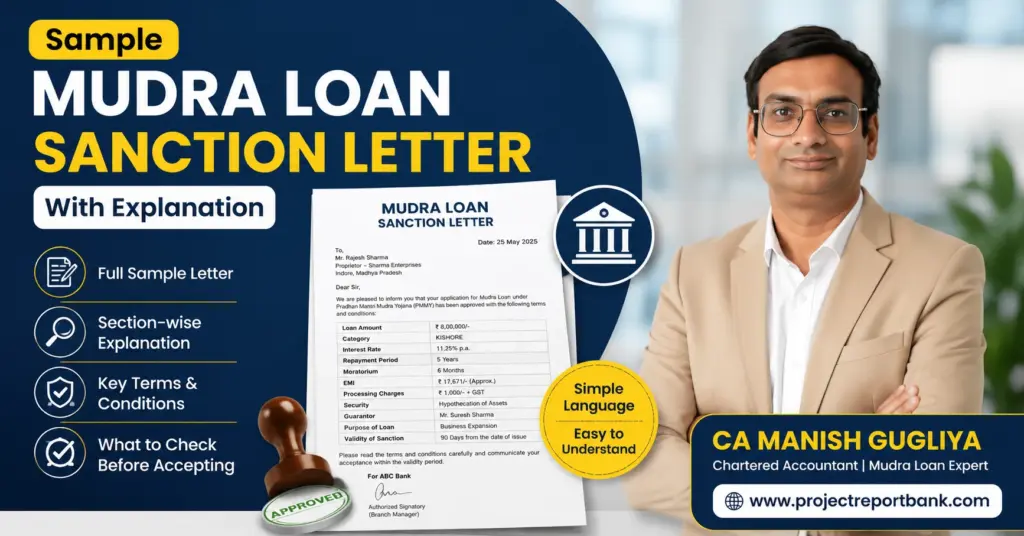
Sample Mudra Loan Sanction Letter (Full Example)
Note: This sample Mudra loan sanction letter is for educational purposes only. All names, dates, and figures are fictional but realistic. Actual formats vary between banks.
ABC BANK LTD. Raja Park Branch, Jaipur – 302004 Phone: 0141-XXXXXXX | Email: rajapark@abcbank.co.in
MUDRA LOAN SANCTION LETTER
Sanction Ref. No.: PMMY/2026/0415/00789 Sanction Date: 15 April 2026
Dear Mr. Rajesh Verma, S/o Shri Mohan Lal Verma Address: 14, Nehru Nagar, Jaipur – 302015
Business Name: Verma Tailoring & Garments (Proprietorship) Udyam Registration No.: UDYAM-RJ-01-0XXXXXX
We are pleased to inform you that your application for a Mudra loan under Pradhan Mantri Mudra Yojana (PMMY) has been approved. The details of the sanctioned credit facility are as follows:
| Field | Details |
|---|---|
| Mudra Category | Kishore |
| Type of Facility | Term Loan (for working capital and asset purchase) |
| Sanctioned Loan Amount | ₹3,75,000 (Rupees Three Lakh Seventy-Five Thousand Only) |
| Interest Rate | 11.25% per annum (Floating, linked to Bank MCLR + Spread) |
| Loan Tenure | 60 months (5 years) |
| Moratorium Period | 3 months from date of first disbursement |
| Approximate EMI | ₹8,230 per month (post moratorium) |
| Repayment Start Date | August 2026 (after moratorium) |
| Processing Fee | 0.50% of loan amount + GST (₹1,875 + ₹337.50 GST = ₹2,212.50) |
| Documentation Charges | ₹500 + GST |
| Insurance Premium | ₹2,800 (Life cover for borrower, deducted from disbursement) |
| Margin Money | Nil |
Security:
- Hypothecation of stock-in-trade, furniture, and sewing machines purchased from loan proceeds.
- No physical collateral required.
Guarantor:
- Name: Mr. Suresh Verma (Brother)
- Address: 22, Nehru Nagar, Jaipur
- PAN: XXXXX1234X
Purpose of Loan: Purchase of 4 industrial sewing machines, shop renovation, and working capital for raw materials.
Conditions Before Disbursement:
- Submission of original KYC documents (Aadhaar, PAN, address proof).
- Two recent passport-size photographs.
- Udyam registration certificate (original for verification).
- Supplier quotations/invoices for sewing machines.
- GST registration certificate (if applicable).
- Signed loan agreement, DP note, hypothecation deed, and guarantor form.
General Conditions:
- Loan proceeds shall be used only for the stated business purposes.
- Penal interest of 2% per annum above the applicable rate shall be charged on overdue EMIs.
- The bank reserves the right to recall the loan in case of default or misuse of funds.
- This sanction is valid for 30 days from the date of issue. If acceptance and documentation are not completed within this period, the sanction shall stand withdrawn.
Validity: This sanction letter is valid up to 15 May 2026.
For ABC Bank Ltd.
(Authorized Signatory) Mr. Anil Sharma Branch Manager, Raja Park Branch Employee Code: ABJ-4521
Borrower’s Acceptance: I have read and understood all terms and conditions mentioned above. I accept this sanction and agree to comply with all conditions.
Signature: _ Name: Mr. Rajesh Verma Date: _
Explanation of Every Section of the Sample Sanction Letter
Now let us break down each section of the sample Mudra loan sanction letter above. I will explain what each clause means, why the bank includes it, what you should check, and a practical tip.
Every explanation below uses short paragraphs and simple language. If you read carefully, even a 5th-class student can follow along.
Bank Name, Branch, and Sanction Reference
This section identifies the lending bank (ABC Bank Ltd.), the specific branch (Raja Park Branch, Jaipur), and a unique sanction reference number (PMMY/2026/0415/00789).
Always note down the sanction reference. You will need it every time you write a letter, email, or complaint to the bank. If you call the bank’s customer care, they will ask for this number first. Think of it like your loan’s identity card.
Borrower and Business Details
This part lists the borrower name, father’s name, address, business name, and constitution (proprietorship, partnership, trust, etc.). Even enterprises registered as trusts can apply under certain conditions.
Check every spelling carefully. Your name must match your PAN, Aadhaar, and Udyam registration exactly. A mismatch can create problems during disbursement, insurance claims, or if you apply for a government subsidy later. If your business trade name is different from your personal name, both should appear correctly.
Loan Amount (Sanctioned Limit)
The loan amount or sanctioned limit is the maximum Mudra loan approved under PMMY. In our sample, it is ₹3,75,000. But this is not necessarily the amount you will receive in your account.
The net disbursement will be lower because the bank deducts processing fee (₹2,212.50), documentation charges (₹590), and insurance premium (₹2,800) from the sanctioned amount. So the actual credit to your account may be around ₹3,69,397.50.
Always confirm that the sanctioned loan amount matches what you discussed with the bank officer and what is written in your project report or application form.
Category Under Pradhan Mantri Mudra Yojana (Shishu/Kishore/Tarun)
Under Mudra Yojana, there are three main categories. Shishu loans are up to ₹50,000. Kishore loans range from ₹50,001 to ₹5,00,000. Tarun loans range from ₹5,00,001 to ₹10,00,000. The maximum loan amount under PMMY is ₹10,00,000. A newer Tarun Plus category (up to ₹20 lakh) was introduced in October 2024 for borrowers who have successfully repaid a Tarun loan.
The correct category should appear in the sanction letter because it can influence processing charges (Shishu often has nil charges), documentation requirements, and sometimes guarantee coverage under the Credit Guarantee Fund for Micro Units. In our sample, Rajesh’s ₹3,75,000 loan correctly falls under the Kishore category.
Interest Rate
The interest rate tells you how much the bank charges for lending you money. In our sample, 11.25% per annum means the bank charges 11.25% of the outstanding loan balance per year as interest.
There are two types. A fixed interest rate stays the same throughout the loan. A floating interest rate changes when the bank’s benchmark rate (like MCLR or Repo Rate) changes. Mudra loans are often on floating rates, and each bank decides its own rate. As per published data, rates across banks range widely – Bank of Baroda may charge 8.40%–11.10%, while some private banks charge 15% or more.
Check if the rate in your approval letter matches what the officer verbally told you. Also confirm whether it says “fixed” or “floating” and which benchmark it is linked to.
Repayment Period (Tenure)
Repayment period or tenure is the total time you get to repay the Mudra loan, written in months. Our sample shows 60 months (5 years).
A longer tenure means smaller monthly EMI but more total interest paid over the life of the loan. A shorter tenure means higher EMI but less total interest. If your business is seasonal (like a tent house or ice cream shop), ask whether the tenure and EMI schedule suit your cash flow pattern.
EMI (Equated Monthly Instalment)
EMI is the fixed amount you pay every month. It includes a part of the principal (the borrowed amount) plus interest. In our sample, the approximate EMI is ₹8,230 per month after the moratorium period ends.
The EMI in the sanction letter is usually approximate. It may change slightly if the interest rate is floating or if the actual disbursement date shifts. Cross-check the EMI using a business loan calculator and make sure the payment fits your expected monthly profit from the mudra-funded business.
Moratorium (Holiday Period)
A moratorium period is the initial gap – say 3 or 6 months – during which you may not have to pay EMIs. But interest keeps adding up during this period.
For example, a new beauty parlour may get a 3-month moratorium to set up, buy equipment, hire staff, and start earning before EMIs begin. In our sample, Rajesh gets a 3-month moratorium, so his first EMI starts in August 2026 instead of May 2026.
Check whether the moratorium terms are clearly printed. Ask whether the interest during moratorium will be capitalized (added to the loan principal, increasing total cost) or paid separately.
Loan Purpose
The “purpose” section states why the Mudra loan is being availed. In the sample, it says: purchase of 4 industrial sewing machines, shop renovation, and working capital for raw materials.
Loan conditions include usage for stated business purposes and compliance with KYC requirements. Using Mudra loan funds for anything else – say a family wedding or personal car – can lead to serious issues during bank inspection or in case of default. Make sure the purpose matches your actual business need and project report.
Processing Charges and Other Fees
Processing fee is a one-time charge the bank takes for processing your loan application. Documentation charges cover stamp papers and legal paperwork. In our sample, processing fee is 0.50% of ₹3,75,000 = ₹1,875 plus 18% GST (₹337.50), totaling ₹2,212.50.
For Shishu category loans, processing charges are often nil. For Kishore and Tarun, 0.50% + GST is typical. Confirm that all charges match the bank’s published Mudra loan charges. If any fee looks unfamiliar or higher than expected, ask for a written breakup before you sign.
Insurance (Life/Asset Insurance)
Banks often link insurance with Mudra loans – life insurance for the borrower, asset insurance for machinery or stock, or credit-life cover. In our sample, a life cover premium of ₹2,800 is deducted from the disbursement amount.
This means even though the sanctioned amount is ₹3,75,000, the net credit to your account will be less. Check the policy name, premium amount, coverage period, and whether the insurance is optional or mandatory. Ask the bank clearly. Do not assume.

Security / Collateral / Hypothecation
The MUDRA scheme aims to provide collateral-free loans to underserved small enterprises. Mudra loans up to ₹10 lakh are generally collateral-free. But “collateral-free” does not mean “no security at all.”
Banks still use hypothecation – a legal charge over your business assets (stock, machinery, vehicle) without physically taking them. In our sample, the bank has hypothecation over stock-in-trade, furniture, and sewing machines. Read this section carefully. Understand what assets the bank has a claim on.
Guarantor Details
A guarantor is a person who promises to pay the loan if the borrower fails. Usually a relative, friend, or business associate. In our sample, Mr. Suresh Verma (brother) is the guarantor.
The sanction letter includes the guarantor’s name, relationship, address, PAN, and sometimes income details. Both the borrower and guarantor should understand that the guarantor is legally responsible. If the Mudra loan becomes overdue, the guarantor’s CIBIL score may also be impacted.
Conditions Before Disbursement
Common pre-disbursement conditions include submission of original KYC documents, latest photographs, Udyam registration, GST registration (if applicable), and invoices or quotations for machinery. The bank will release funds only after all such conditions are fulfilled.
Keep a small checklist based on this clause. Gather all documents before your next branch visit. Missing even one document can delay disbursement by days or weeks. Many borrowers get stuck at this stage simply because they did not read the conditions carefully after the assessment was complete.
Validity of Sanction
The validity period is the last date by which you must accept the sanction letter and complete documentation. In our sample, the sanction is valid until 15 May 2026 – exactly 30 days from the sanction date.
If you delay beyond this date, the bank may need to re-approve the loan, or it can withdraw the sanction entirely. Plan your document submission and any business purchase schedule accordingly. Do not waste this window.
Signature of Borrower and Authorized Signatory
The borrower’s signature with the statement “I accept the above terms and conditions” makes the sanction legally binding. The bank’s rubber stamp and signature of an authorized officer (with designation and employee code) must also be present.
Never sign blank documents. Never sign without reading every clause. If you do not understand something, ask the bank officer to explain it in your language before you sign.
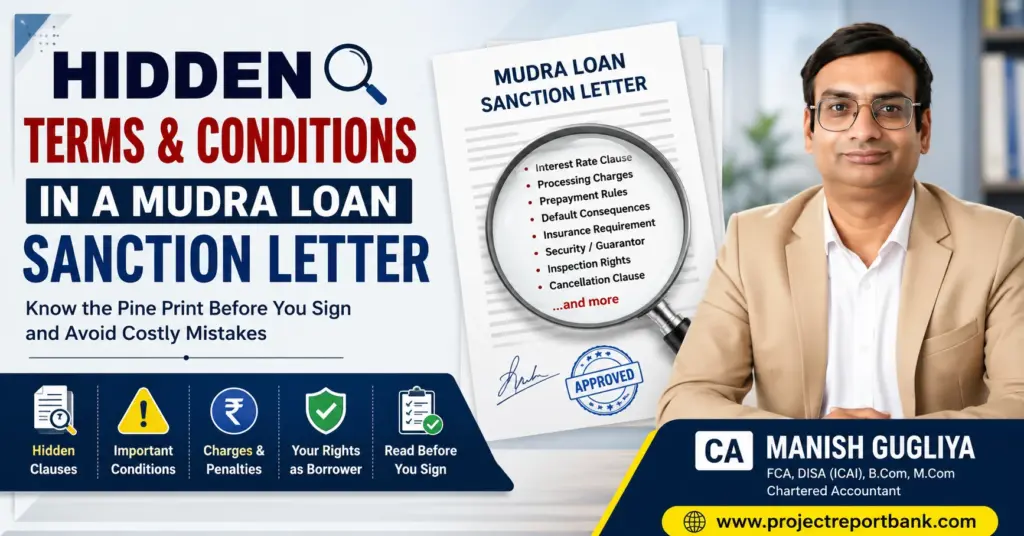
Terms Borrowers Often Ignore in a Mudra Loan Sanction Letter
Many small business owners focus only on two things: how much loan and how much EMI. They ignore the fine print. That fine print can cost you real money.
Floating vs. fixed interest rate: If your rate is floating, your EMI can increase when RBI raises the repo rate. A 0.50% increase on a ₹3,75,000 loan can add ₹100–₹150 to your monthly payment. Over 60 months, that adds up.
Penal interest: This is extra interest charged – typically 2% per year above your normal rate – when you miss or delay an EMI. It is always mentioned in the sanction letter. Read it.
Default clause: Missing three consecutive EMIs can trigger NPA classification. The bank can then start recovery action. This clause gives the bank that legal right.
Insurance deduction: Your sanctioned amount is ₹3,75,000, but after deducting insurance premium and fees, the credit to your account is lower. Many borrowers are surprised when they see less money than expected.
Hypothecation and margin money: Hypothecation means the bank has a legal charge over your business assets. Margin money is your own contribution to the project cost (often nil for Shishu, sometimes 5–15% for larger loans). Both terms should be clear.
Documentation charges, inspection charges, and foreclosure clause: Some banks charge a fee if you repay the loan early (foreclosure). Others do not charge for Mudra loans. Check this. Also look for inspection charges that some branches add.
If anything is unclear, get clarification in writing or by email. Verbal promises hold no weight in a dispute.
Checklist: What to Verify Before Accepting Your Mudra Loan Sanction Letter
Before you sign the sanction letter, run through this checklist:
| Item to Check | What to Confirm |
|---|---|
| Applicant name & address | Matches Aadhaar, PAN, Udyam exactly |
| Business name & constitution | Correct trade name, proprietorship/partnership |
| Sanctioned loan amount | Matches application and project report |
| Mudra category | Correct: Shishu / Kishore / Tarun |
| Interest rate | Fixed or floating? Rate matches verbal offer? |
| EMI amount | Realistic and affordable from monthly business income? |
| Total tenure | Suits your repayment capacity? |
| Moratorium details | Duration clear? Interest during moratorium explained? |
| Processing charges | Matches bank’s published rate? |
| Documentation charges | Reasonable and explained? |
| Insurance premium | Amount, type, mandatory or optional? |
| Hidden fees | Any unexpected charges? |
| Guarantor name | Correct details? Guarantor aware of liability? |
| Security / hypothecation | What assets are covered? |
| Repayment start date | Aligned with moratorium end? |
| Bank seal & signature | Officer name, designation, employee code present? |
| All pages complete | No missing or blank pages? |
| Validity date | Enough time to complete documentation? |
If you need a digital copy of your sanction letter, you can learn step-by-step how to download your Mudra loan sanction letter online.
Keep a signed copy plus a scanned PDF safely for future reference, subsidy claims, and in case of any dispute.
Common Mistakes Borrowers Make with Mudra Loan Sanction Letters
Even experienced shopkeepers and small manufacturers make avoidable mistakes at the sanction stage. Here are the most common ones I have seen in over two decades of practice:
1. Signing without reading. The number one mistake. Borrowers trust the bank officer and sign immediately. Read every word first.
2. Ignoring differences between verbal promises and written terms. The officer said 10% interest, but the letter says 11.25%. Only the written terms count.
3. Not checking interest rate type. They do not notice whether the rate is fixed or floating. Floating rates can increase your EMI without warning.
4. Accepting wrong EMI or tenure. The EMI in the letter may be higher than expected if the rate or tenure was entered differently than discussed.
5. Overlooking insurance deduction. Borrowers expect full loan amount in their account but receive less because insurance and fees are deducted upfront.
6. Not understanding penal interest. They miss the clause about 2% extra interest on delayed EMIs. This compounds over time.
7. Ignoring moratorium conditions. Some think moratorium means “no cost.” Interest still accrues during moratorium and may be added to the principal.
8. Using mudra funds for personal purposes. The sanction letter clearly states business purpose. Using funds for marriage, home repair, or personal expenses creates legal risk.
9. Not saving a copy. Many borrowers do not keep any copy. Years later, they cannot prove original terms in a dispute.
10. Ignoring validity period. They delay submitting documents, the sanction expires, and the bank withdraws the offer.
11. Accepting incorrect name or business spelling. A wrong name on the sanction letter can cause problems with insurance claims, government subsidies, or future top-up loans.
12. Not questioning unclear charges. If a charge looks unfamiliar, ask. Silence is not agreement – except legally, when you sign.
Consult a CA, financial advisor, or experienced person if you are unsure about any term before signing.
Can You Request Changes in a Mudra Loan Sanction Letter?
Yes, you can request corrections before you accept the sanction letter. Once accepted, your options reduce significantly.
Before acceptance: Spelling errors, address mistakes, business name, wrong category, or misprinted interest rate can usually be corrected. Visit the branch, write a short application highlighting the errors, and attach a copy of the sanction letter.
After acceptance but before disbursement: Minor changes like repayment start date or EMI debit date can sometimes be negotiated. However, major terms like interest rate or loan amount changes typically require a revised sanction or fresh assessment.
After disbursement: Any major change – like reduction in interest rate or tenure extension – normally requires formal restructuring or a fresh sanction. This is governed by bank rules and RBI guidelines.
Always keep the revised sanction letter safely. Mark the old incorrect copy as “cancelled” to avoid confusion.
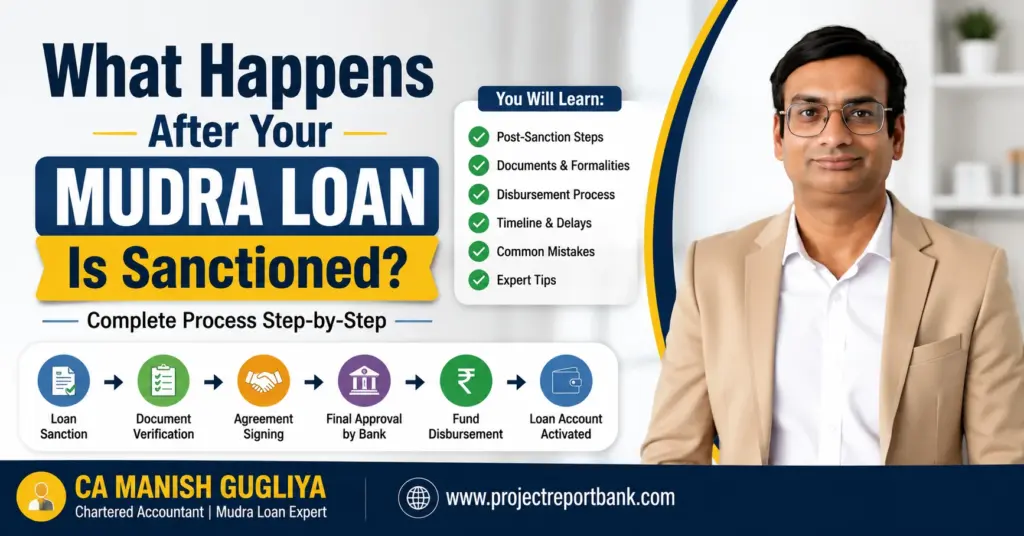
What Happens After Receiving the Mudra Loan Sanction Letter?
Here is the complete process flow in simple steps:
Application → Verification → Sanction → Acceptance → Documentation → Disbursement → Repayment
Acceptance: You read the sanction letter, clarify doubts, sign the acceptance, and return one copy to the bank. You keep one signed copy.
Documentation: You sign the loan agreement, demand promissory (DP) note, hypothecation deed, guarantor forms, and other PMMY documents as required.
Disbursement: The sanctioned loan amount (minus deductions) is credited to your current or savings account, or paid directly to suppliers based on invoices. The bank decides the mode based on the loan form and purpose.
Repayment: EMIs begin after the moratorium period. Payment is usually through ECS auto-debit or standing instructions from your account. Record the first EMI date and always maintain sufficient balance.
For a detailed breakdown of every step, refer to this Mudra loan processing stages guide.
Example: Rajesh receives sanction on 15 April 2026. He submits all documents by 25 April. Bank disburses funds on 1 May. Moratorium of 3 months means first EMI is due in August 2026.
When Should You Contact the Bank About Your Sanction Letter?
Contact your bank immediately if you notice any error. Quick action prevents bigger problems later.
Common situations requiring immediate contact:
- Wrong loan amount or interest rate
- Incorrect EMI, tenure, or Mudra category
- Spelling errors in your name or business name
- Missing pages, missing bank stamp, or missing officer signature
- Unclear or blank clauses
- Two different interest rates mentioned in different places
If deductions (processing fee, insurance, documentation charges) appear higher than what the banker verbally quoted, ask for a written breakup and clarification before signing.
For serious issues, prefer written communication – email or written application – so you have proof. Minor queries can be clarified in person at the branch during a visit.
If the branch does not respond, escalate to the branch manager or bank’s customer care. Quote your sanction reference number and attach a copy of the letter.

Expert Guidance from CA Manish Gugliya on Reading Mudra Loan Sanction Letters
In my 20+ years of working with MSME clients across India, I have handled hundreds of Mudra loan cases – from tiny Shishu loans for street vendors to Tarun loans for small manufacturing units. Let me share some ground-level wisdom.
Compare before you sign. Always compare the sanction letter with your project report and the bank’s earlier written offer. I once had a client whose project report showed 10.50% interest, but the sanction letter said 12.15%. Because he noticed and raised it before signing, the bank corrected it. Another client did not check and paid the higher rate for three years before realizing it.
Verify every number. Do not just glance at the loan amount. Check processing fee, insurance, documentation charges, and calculate the net disbursement yourself. Many borrowers are confused when ₹3,75,000 sanctioned becomes ₹3,69,000 credited. The deductions are legitimate – but you should know exactly what they are.
Understand floating interest. Ask the bank: “How often can the rate change? Will you inform me before changing it? How will my EMI be affected?” Get this in writing if possible. Many borrowers are shocked when their EMI increases after six months because the repo rate went up.
Prepare a simple cash flow. Before accepting any Mudra loan under PM Mudra Yojana, sit down with a notebook. Write your expected monthly sales. Subtract your expenses (rent, salary, raw material, electricity). The remaining amount should comfortably cover your EMI. If it does not, reconsider the loan amount or tenure.
Keep documents like gold. Store your sanction letter, EMI schedule, insurance policy, and loan agreement in a dedicated “Loan Documents” folder – both physical and digital. You will need these for top-up loans, restructuring, CGTMSE or other guarantee schemes, and during income tax or bank audits. The Credit Guarantee Fund for Micro Units provides coverage for certain Mudra loans, and having proper documentation is essential if a claim ever needs to be processed under that scheme.
Do not feel shy about asking questions. I especially want to say this to first-time borrowers and women entrepreneurs. It is your money and your business. You have every right to ask the bank officer to explain any clause in simple language. No question is too basic. If the officer cannot explain, ask the branch manager.
Your sanction letter is extended as an offer – treat it like a contract. With proper understanding of every section, you can use Pradhan Mantri Mudra Yojana effectively for stable, stress-free business growth.
Frequently Asked Questions on Mudra Loan Sanction Letters
These FAQs cover practical doubts that many borrowers have but are not fully addressed in the main body above. Each answer is kept short and simple.
Is a Mudra loan sanction letter the same as getting the money in my account?
No. The sanction letter means the bank has agreed in principle to give you the Mudra loan. Money is credited to your account only after you sign all documents and fulfil every pre-disbursement condition listed in the letter. If documents are not completed within the validity period, the bank may cancel the sanction and no disbursement will happen. Think of the sanction letter as an approval letter, not a payment confirmation.
Can the bank change the terms after issuing the Mudra loan sanction letter?
Banks normally should not change key terms like interest rate or tenure after you have accepted and signed the sanction letter. The exception is floating rate loans – if RBI changes the policy rate, the bank may revise your rate accordingly. For any other change, the bank should issue a revised sanction letter or addendum. Read any revised document carefully before signing.
What should I do if I lose my original Mudra loan sanction letter?
Visit your bank branch immediately with your ID proof and request a duplicate or certified copy. Many banks can also provide a digital copy by email or through net banking. You can also refer to our guide on how to download your Mudra loan sanction letter online for step-by-step help.
Is it compulsory to take insurance mentioned in the Mudra sanction letter?
Many banks recommend or require insurance (life cover or asset insurance) to protect both the borrower’s family and the bank. However, not all types of insurance are always mandatory. Ask the bank which insurance is required by their loan policy and which is optional. Read the basic terms – coverage amount, period, and claim process – before agreeing.
Can I use my Mudra loan for personal expenses if the sanction letter says “business purpose”?
No. Mudra loans under PMMY are meant only for business and income-generating activities, not for personal uses like marriage, home renovation, or family expenses. Using funds for non-business purposes can create serious issues if the bank inspects usage, and it may cause trouble during loan renewal, restructuring, or in case of default.
Conclusion
Your Mudra loan sanction letter is the foundation document for the entire Mudra loan journey. It captures every key term – loan amount, interest rate, EMI, tenure, insurance, charges, and penalties – under the Pradhan Mantri Mudra Yojana PMMY framework.
Never sign or accept the sanction letter without fully reading and understanding every clause. Verify all financial details. Ask questions. Request corrections where needed. Keep both physical and digital copies safely for the entire loan period – you may need them for audits, subsidy claims, top-up loans, or dispute resolution.
If you are a small business owner, shopkeeper, manufacturer, or woman entrepreneur applying for a Mudra loan for the first time, take your time with this document. It is your right to understand every word before you commit.
For deeper practical help, explore the Mudra loan processing stages guide and other resources on ProjectReportBank to make your business finance journey smoother and stress-free.
- Hidden Terms and Conditions in a Mudra Loan Sanction Letter

- What Happens After Your Mudra Loan Is Sanctioned?
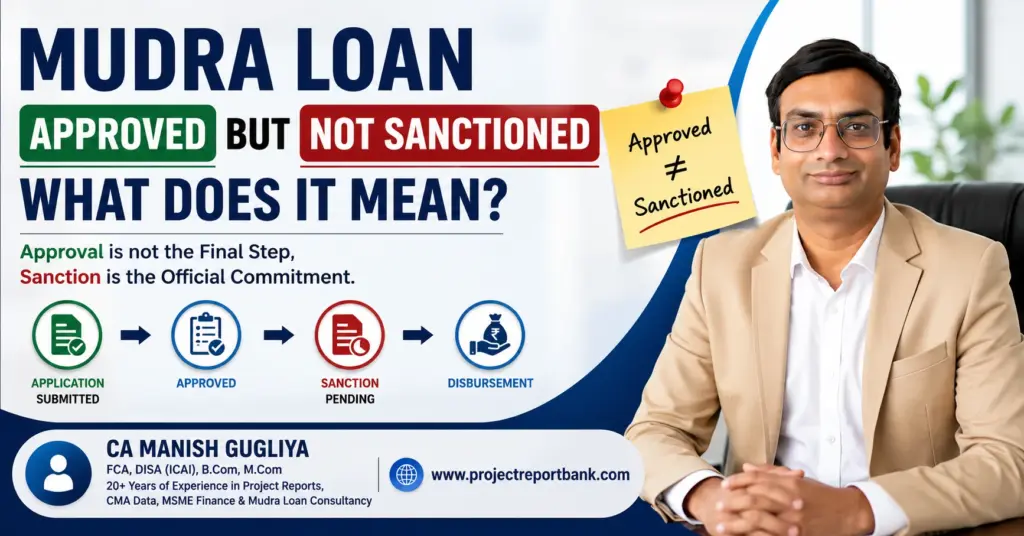
- Mudra Loan Approved but Not Sanctioned: What Does It Really Mean?
- What Is Conditional Sanction in a Mudra Loan? Meaning, Conditions, Documents & Next Steps
- Can a Sanctioned Mudra Loan Be Cancelled by the Bank? Complete Guide (2026)
- Difference Between Mudra Loan Approval, Sanction and Disbursement
- How to Check Whether Your Mudra Loan Sanction Letter Is Genuine

- Mudra Loan Sanction Letter Format: Every Section Explained
- Sample Mudra Loan Sanction Letter with Explanation